Implications
Free-range systems vary in outdoor space per hen, but few studies have assessed effects of outdoor density on hen welfare. By 36 weeks of age, most hens were in visibly good condition across three stocking densities, although eggs from the highest density hens had the highest albumen corticosterone concentrations. Proportions of hens dust bathing, foraging and resting varied between densities with more hens resting in the lowest density. Across all measures, pen replicates within densities also varied. These results imply that consideration of both individual and flock-level welfare may be necessary in free-range system management and for housing guideline development.
Introduction
Consumer perceptions of laying hen (Gallus gallus domesticus) welfare within Australia are driving the increasing number of free-range production systems which are deemed more natural and ethical compared with caged housing. Free-range systems provide hens with the choice between indoor and outdoor areas, the opportunity to access fresh air, and exhibit behaviours such as sun bathing and foraging (Knierim, Reference Knierim2006). However, within Australia, there is a wide variation in housing conditions for free-range systems, notably outdoor stocking density, and the latter has ignited consumer dissatisfaction regarding the definition of ‘free-range’ (Consumer Affairs Australia and New Zealand, 2015). The Australian Model Code of Practice for the Welfare of Animals – Domestic Poultry (Primary Industries Standing Committee, 2002) recommends a density of 1500 hens/ha outdoors (at maximum occupancy), but no maximum density is set. Subsequently, on 31 March 2016, the Australian Consumer Affairs Ministers released a free-range egg labelling information standard requiring hens to have ‘meaningful and regular access to the outdoors, with outdoor stocking of no more than 1 hen/m2 (maximum 10 000 hens/ha)’. However, scientific data on the effects of outdoor range stocking density on hen welfare are not documented, but are necessary for an objective determination of optimal outdoor space requirements for free-range laying hens.
Manipulations of stocking densities in ‘cage-free’ closed indoor systems such as aviaries or percheries have shown some negative impacts of high stocking densities on breast blisters, plumage condition, feather pecking and aggression (Nicol et al., Reference Nicol, Gregory, Knowles, Parkman and Wilkins1999; Zimmerman et al., Reference Zimmerman, Lindberg, Pope, Glen, Bolhuis and Nicol2006; Steenfeldt and Nielsen, Reference Steenfeldt and Nielsen2015). However, these effects would appear to be indirect results of resource reduction rather than higher densities per se (Steenfeldt and Nielsen, Reference Steenfeldt and Nielsen2015), and were also correlated with flock size (Nicol et al., Reference Nicol, Gregory, Knowles, Parkman and Wilkins1999; Zimmerman et al., Reference Zimmerman, Lindberg, Pope, Glen, Bolhuis and Nicol2006). Assessing the effects of free-range outdoor stocking densities on hen welfare should be distinguished from the effects of indoor stocking densities as not all birds use the range simultaneously, if at all (Richards et al., Reference Richards, Wilkins, Knowles, Booth, Toscano, Nicol and Brown2011; Gebhardt-Henrich et al., Reference Gebhardt-Henrich, Toscano and Fröhlich2014; Campbell et al., Reference Campbell, Hinch, Dyall, Warin, Little and Lee2016a). Therefore, individual hens can be exposed to contrasting conditions within the free-range system.
Range access is perceived to improve hen welfare (Knierim, Reference Knierim2006), but few studies have assessed the relationship between time spent on the range and measures of hen health and welfare, particularly for individual hens. Physiological assessment of individual hens varying in range use showed outdoor-preferring hens had higher BW than indoor-preferring hens (Singh et al., Reference Singh, Cook, Cheng and Silversides2016). Outdoor-preferring hens also had improved digestive function, but differences in specific gut function characteristics were dependent on the type of range usage; whether it was fewer and longer duration visits, compared with more frequent shorter duration visits (Singh et al., Reference Singh, Cook, Cheng and Silversides2016). Greater use of the outdoor range has been correlated with lower incidences of footpad dermatitis (Rodriguez-Aurrekoetxea and Estevez, Reference Rodriguez-Aurrekoetxea and Estevez2016) and less plumage damage (Mahboub et al., Reference Mahboub, Müller and van Borell2004; Chielo et al., Reference Chielo, Pike and Cooper2016; Rodriguez-Aurrekoetxea and Estevez, Reference Rodriguez-Aurrekoetxea and Estevez2016) but Hartcher et al. (Reference Hartcher, Hickey, Hemsworth, Cronin, Wilkinson and Singh2016) found no association between range use and plumage damage. Finally, birds with keel damage will use the pop holes to the range less frequently, but the causal relationship between outdoor access and keel damage is unknown (Richards et al., Reference Richards, Wilkins, Knowles, Booth, Toscano, Nicol and Brown2012).
The outdoor range is also perceived to improve hen welfare by providing a suitable environment for hens to express behaviours deemed ethologically important such as dust bathing and foraging (Cooper and Albentosa, Reference Cooper and Albentosa2003), but there are few data on what hens do while ranging. Foraging, preening, locomotion, resting and vigilance were the most frequent behaviours reported in the study of Larsen et al. (Reference Larsen, Cronin, Hemsworth, Smith and Rault2014) and standing, pecking, walking and foraging were the most frequent behaviours reported by Chielo et al. (Reference Chielo, Pike and Cooper2016). Higher stocking densities in indoor perchery systems have been associated with decreased foraging, dust bathing and mobility (Carmichael et al., Reference Carmichael, Walker and Hughes1999, but see Zimmerman et al., Reference Zimmerman, Lindberg, Pope, Glen, Bolhuis and Nicol2006).
In the first portion of the larger experiment on impacts of outdoor stocking density, radio-frequency identification (RFID) technology was used to track the range usage of birds housed in small flock sizes at one of three different outdoor stocking densities (2000, 10 000 and 20 000 hens/ha). These results showed that birds used the range more when housed in the lowest stocking density, and used the range less when housed at the highest stocking density, including some changes with age (Campbell et al., Reference Campbell, Hinch, Dyall, Warin, Little and Lee2016a). Sampling counts from video recordings of all hens on the range simultaneously showed hens used all areas of all ranges at all times of the day with on average, less than half of the birds outside simultaneously (least squares means 37% to 49% of flock, Campbell et al., Reference Campbell, Hinch, Dyall, Warin, Little and Lee2016a). The highest percentage of birds were observed on the range simultaneously in the 2000 hens/ha density and the lowest percentage in the 20 000 hens/ha density, although neither differed from the 10 000 hens/ha treatment (Campbell et al., Reference Campbell, Hinch, Dyall, Warin, Little and Lee2016a). The objective of this current study was to assess the impacts of outdoor stocking density on multiple parameters of hen health using external heath scoring, including correlating some measures with range usage at the individual level. In addition, this study assessed the impacts on welfare indicators including egg albumen corticosterone concentrations and frequencies of ethologically important behaviours (dust bathing, foraging and resting) performed on the range and indoors.
Material and methods
Animals and housing
All research was approved (AEC14-100) by the University of New England Animal Ethics Committee. In total, 900 commercially floor-raised ISA Brown pullet laying hens, having been beak-trimmed at 1-day old (IR) and re-trimmed, at 11 weeks (hot blade), were evenly distributed at 16 weeks of age between six indoor floor pens (150 birds/pen) at the University of New England’s Laureldale experimental free-range facility located in Armidale, NSW, Australia.
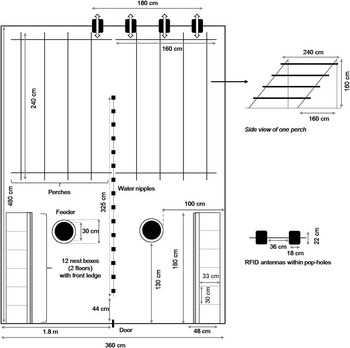
Indoor stocking densities were 9 birds/m2 with perches, nest boxes, feed and water resources (Figure 1) provided to meet or exceed the Australian Model Code of Practice for the Welfare of Animals – Domestic Poultry (Primary Industries Standing Committee, 2002). The indoor shed was fan-ventilated, but otherwise not environmentally controlled and further details of the indoor conditions have been reported by Campbell et al. (Reference Campbell, Hinch, Dyall, Warin, Little and Lee2016a).
A top-down schematic of the hens’ indoor pen set-up showing location of the range pop holes (including radio-frequency identification (RFID) antennas), perches (side view included), nest boxes, feed and water. Each indoor pen had identical resources and configuration.

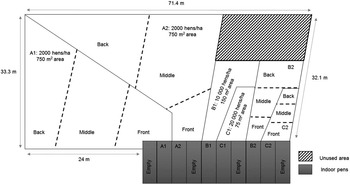
Each indoor pen was associated with a designated fenced outdoor area which, before bird access, was 100% covered with grass and weeds, but no on-range shelter was present (and the vegetation was not tall enough for birds to hide in). There were no visual barriers between ranges, but hens were observed using all areas of all ranges and no obvious gathering at fence lines. Based on all birds being located on the range simultaneously, three outdoor stocking densities were simulated via different range sizes with two pen replicates per treatment density (2000, 10 000 and 20 000 hens/ha, Figure 2). The single range-access pop hole per pen that was fitted with four RFID passageways (36 cm height×18 cm weight) was first opened at 21 weeks of age (2 to 3 weeks after laying began) with daily access from 0900 to 1630 h and all birds were contained inside the shed at other times. Voluntary range use by hens was assessed across 15 weeks during winter when days were typically dry (86% of days) and average outdoor temperature during range access hours was 14.3°C±5.34°C; but ranged between −3.5°C and 27.9°C. Weekly photos taken of the range areas showed ground coverage (green v. brown area) decreased from 100% to 0% within 5 weeks in the pens of 20 000 hens/ha, within 6 weeks in the pens of 10 000 hens/ha and by 8 weeks the coverage had dropped to ~20% in the pens of 2000 hens/ha and remained at this level for the trial duration.
The six indoor pens and their designated outdoor range areas for the two replicates of each outdoor stocking density treatment (2000, 10 000, 20 000 hens/ha), including the front, middle and back range delimitations used during behavioural observations (range delimitations were equal between both ‘B’ and both ‘C’ pens, respectively).

Radio-frequency identification tracking
In total, 50% of birds (n=150 per stocking density treatment, n=75 birds per pen replicate) were microchip leg-banded and RFID-tracked daily from 22 to 36 weeks of age. However, as only three RFID systems were available, one pen replicate from each stocking density was recorded for ~2 weeks, and the units swapped to record the second pen replicate for ~2 weeks. Tracking data were obtained on 91 days for the treatment with 2000 hens/ha, on 92 days for the treatment with 10 000 hens/ha, and 88 days for the treatment with 20 000 hens/ha. Further details on the RFID set-up are given in Campbell et al. (Reference Campbell, Hinch, Dyall, Warin, Little and Lee2016a).
Welfare scoring
Birds were weighed 1 week following placement (BAT1, VEIT Electronics, Moravany, Czech Republic). Using a modified version of the Welfare Quality® scoring protocol (Welfare Quality®, 2009), basic health and welfare measures were made on all birds before release onto the range (20 weeks of age), then at 5 (26 weeks of age), 10 (31 weeks of age) and 15 (36 weeks of age) weeks following range access. Over 2 days at each sampling time, all birds were weighed, the length of the middle toenail of the right foot was measured with a seamstress tape measure (fitted to the curve of the toenail and measured to the nearest mm), and then feet were checked for broken, missing or injured toes. Any footpad dermatitis was determined using a scale where 1=footpad dermatitis on one or both feet with no swelling, 2=dermatitis on one or both feet with moderate swelling, 3=footpad dermatitis on one or both feet with dorsally visible swelling. At the same time, birds were manually palpated for keel damage with the scoring being N for no damage and Y for any damage (deviations or indication of fracture) and at 36 weeks an additional category (Y*) was added because of the comparatively more severe keel damage. Visual checks were made for comb abnormalities, comb wounds, skin pecking wounds, presence of external parasites, feather damage and feather loss, but no evidence of these conditions were observed (except for one bird having a nude head at 36 weeks of age). The same experimenter (who was aware of the treatment groups) did all visual health scoring and keel palpations.
Albumen corticosterone
In total, 90 eggs from each pen were sampled across 2 days (45 eggs/day) at 23 (hens were at 50% to 60% lay), 29 and 35 weeks of age for assessment of albumen corticosterone concentrations. On the day of collection, all eggs were weighed, broken open, the albumen was separated from the yolk then weighed and stored at −20°C until processing via radioimmunoassay following procedures reported by Downing and Bryden (Reference Downing and Bryden2008). All albumen corticosterone analyses were conducted blind to outdoor stocking density treatment.
Video recordings and decoding
When weather permitted, a series of video cameras (Panasonic HC-V110, Panasonic HDC-SD40 (Panasonic Australia Pty Ltd, Macquarie Park, NSW, Australia), Sony HDR-XR260E, Sony HDR-XR550 (Sony Electronics Inc., San Diego, CA, USA)) recorded each range area during 25, 26 and 27 weeks of age (peak production period and following 3 weeks of acclimation to the range area). Six sampling days of recording were made per range area (only 3 range areas, one pen replicate from each stocking density could be recorded on any 1 day). On each sampling day, the entire range area was video recorded during range access hours (0900 to 1630 h). Six Hikvision (DS-2CD2T42WD-14 Outdoor EXIR Bullet; iCam Security, Forest Lake, QLD, Australia) cameras were used to simultaneously record the indoor shed pens. Videos recordings were used to count the proportion of birds performing three behaviours outside in the ‘front’ and ‘middle’ (Figure 2) of the range area and throughout the indoor shed pen. The observed behaviours included dust bathing, foraging (scratching followed by ground-pecking) or resting (including both sitting down or perching (indoors only)) while awake, but performing no other behaviour or asleep with head tucked under the wing). Observations were made for 1 min starting at 10 min after pop hole opening, and then every 20 min thereafter with one observer working with the range videos and another observer working with the indoor shed videos (inter-observer reliability as measured by Cohen’s κ coefficient (McHugh, Reference McHugh2012) was κ=0.87 to 0.90). Upon watching the video recordings, the behaviour of hens at the ‘back’ of the larger range areas could not be reliably observed, and thus this area was excluded from observations across all of the experimental ranges. Previous counts of hens within the same age bracket showed birds in all pens used all areas of each range (see Campbell et al., Reference Campbell, Hinch, Dyall, Warin, Little and Lee2016a).
Data and statistical analyses
For individual hens within each outdoor stocking density treatment, at each sampling time point (17 (BW only), 20, 26, 31 and 36 weeks of age), values were compiled for keel damage, BW and toenail length, with the latter two measures also separated by pen replicate. The effect of pen replicate was not assessed for keel damage due to low sample numbers in some categories at different bird ages (i.e. little damage present at 20 and 26 weeks of age), thus data from each replicate were combined into outdoor stocking density treatment only. Individual egg albumen corticosterone concentrations (ng/g) were compiled for each pen replicate within each outdoor stocking density treatment for the three sampling ages. Pearson’s χ 2 tests compared frequencies of keel damage between outdoor stocking densities, separately at each sampling age. GLM’s were applied to compare separately for each sampling age, the effects of pen replicate nested within outdoor stocking density, and outdoor stocking density on hens’ toenail length (n=890), hens’ BW (n=890) and albumen corticosterone (n=540). Data were analysed in JMP® 12.1.0 (SAS Institute Inc., Cary, NC, USA) with α set at 0.05. Where significant differences were present, Student’s t-tests were used to compare the least squares means with α level adjusted using the Bonferroni correction for multiple post hoc comparisons.
The daily RFID data per hen were summarised from within three time blocks across the experimental period (weeks 22 to 26, weeks 27 to 31, weeks 32 to 36) to provide the average daily hours spent outdoors (see Campbell et al., Reference Campbell, Hinch, Dyall, Warin, Little and Lee2016a for a full analysis of the RFID data). Pearson product-moment correlations were applied to assess the relationship between daily hours outside and toenail length and between daily hours outside and BW of the RFID-tagged birds within each pen replicate of each outdoor stocking density treatment (50% of birds), separately for each sampling age (e.g. toenail length or BW at 26 weeks was correlated with range use from 22 to 26 weeks of age, toenail length or BW at 31 weeks was correlated with range use from 27 to 31 weeks and so forth).
The video data were averaged across each day to compile the average daily proportion of birds dust bathing, foraging or resting on the range and indoors for 6 days per outdoor stocking density replicate. Proportions were arcsine square-root transformed and GLM’s with repeated measures applied to compare the effect of sampling week of age and outdoor stocking density on behavioural measures separately for outdoors and indoors. The proportion of birds dust bathing, foraging or resting, were also compared between indoor and outdoor areas for each outdoor stocking density across all sampled weeks. Where significant differences were present, Student’s t-tests were used to compare the least squares means with α level adjusted using the Bonferroni correction for multiple post hoc comparisons.
Results
Welfare scoring
Total flock mortality was low at 0.8% across the trial period (2000 hens/ha: n=5; 10 000 hens/ha: n=2; 20 000 hens/ha: n=3). By 36 weeks of age, cumulatively, 5.5% of birds across all pens had signs of toe damage (broken toes) (2000 hens/ha: 3.1%; 10 000 hens/ha: 1.7%; 20 000 hens/ha: 0.7%), and only 0.3% of birds showed any footpad dermatitis with all being category 3 lesions (2000 hens/ha: n=1; 20 000 hens/ha: n=2). There were differences in keel damage between outdoor stocking densities at 36 weeks of age where hens from the 10 000 hens/ha outdoor stocking density showed the least overall keel damage (P<0.007; 2000 hens/ha: 19.7% damaged, 2.7% severely damaged; 10 000 hens/ha: 9.4% damaged, 1.7% severely damaged; 20 000 hens/ha: 16.5% damaged, 2.4% severely damaged). In contrast, there were no differences in keel damage between outdoor stocking densities at other sampling ages although the percentage damaged increased with age (20 weeks of age: 2000 hens/ha: 0.7% damaged, 10 000 hens/ha: 1.7% damaged, 20 000 hens/ha: 0% damaged; 26 weeks: 2000 hens/ha: 1.7% damaged, 10 000 hens/ha: 2.7% damaged, 20 000 hens/ha: 1.01% damaged; 31 weeks: 2000 hens/ha: 4.08% damaged, 10 000 hens/ha: 6.04% damaged; 20 000 hens/ha: 5.05% damaged, all P>0.20 for differences between outdoor densities within each sampling age).
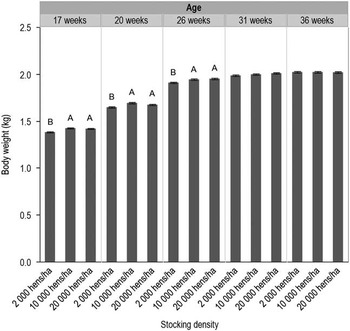
Bird weight for pullets (17 weeks of age) assigned to different outdoor stocking density pens at bird placement were unexpectedly found to be different after placement occurred (P<0.001, Figure 3) and between replicates for pullets assigned to the 10 000 hens/ha treatment (P=0.03). This was indicative of poor flock uniformity during rearing. Approximately 13 crates of pullets were placed into each pen (12 birds/crate). Eight personnel removed crates from the delivery truck and placed them into each pen in no intentional order. It is possible the majority of the first crates off the truck were placed into the first pens which were assigned to the 2000 hens/ha outdoor stocking density treatment and that these birds were the smallest. Birds were not remixed to avoid social stress. There were still differences in average BW between the pens assigned to outdoor stocking density treatments at pre-release (20 weeks of age) with birds assigned to the 2000 hens/ha outdoor stocking density treatment having lower BW (P<0.001, Figure 3), but only a trend for differences between pen replicates (P=0.07). At 26 weeks of age, after 5 weeks of range access, hens from the 2000 hens/ha outdoor stocking densities were still of a lower BW (P<0.001, Figure 3), and there was an effect of pen replicate within outdoor stocking density (P=0.02) with pen replicates differing within both the 2000 and 10 000 hens/ha outdoor stocking densities (P<0.017). At 31 weeks of age there were no differences in BW between outdoor stocking density treatments (P=0.10, Figure 3), but there continued to be an effect of pen replicate (P=0.001) within the 2000 and 10 000 hens/ha densities (P=0.017). At the final 36 weeks of age sampling, there was no effect of outdoor stocking density on BW (P=0.96, Figure 3), but there was a pen replicate effect within the 10 000 hens/ha outdoor stocking density treatment (P=0.003).
The average BW (kg)±SEM measured at 17 weeks (1 week after pullet placement), then 20 weeks (1 week before range access) 26, 31 and 36 weeks of age for all hens of each outdoor stocking density treatment (2000, 10 000 and 20 000 hens/ha). A,BStocking densities without common letters were significantly different (adjusted P<0.017).

There was a negative correlation between BW and average daily hours spent outside for pen replicate one of the 10 000 hens/ha outdoor stocking density at 26 weeks of age (r=−0.24, P=0.04). There tended to be positive associations between BW and average daily hours spent on the range within both pen replicates of the 2000 hens/ha outdoor stocking density at 36 weeks (P⩽0.07). There was no relationship between BW and average daily hours spent outside within the 20 000 hens/ha outdoor stocking density or at the other sampling ages for the 2000 and 10 000 hens/ha treatments (P⩾0.11).
There was an effect of outdoor stocking density (P=0.001) and pen replicate (P=0.003) on toenail length at 31 weeks of age, with the longest toenails found on the hens from the 2000 hens/ha outdoor stocking density (least squares means (LSM) ±SEM cm: 2000 hens/ha: 1.51±0.007, 10 000 hens/ha: 1.48±0.007, 20 000 hens/ha: 1.48±0.007). But there were no differences between the outdoor stocking density treatments in toenail length at 20 weeks of age (pre-release sampling LSM±SEM cm 2000 hens/ha: 1.46±0.007, 10 000 hens/ha: 1.47±0.007, 20 000 hens/ha: 1.48±0.007, P=0.23), 26 weeks of age (LSM±SEM cm 2000 hens/ha: 1.48±0.007, 10 000 hens/ha: 1.48±0.006, 20 000 hens/ha: 1.48±0.007, P=0.74) or 36 weeks of age (LSM±SEM cm 2000 hens/ha: 1.54±0.007, 10 000 hens/ha: 1.52±0.006, 20 000 hens/ha: 1.53±0.007, P=0.27). There were differences between some of the outdoor stocking density pen replicates at 20 and 26 weeks of age (P<0.001), but not at 36 weeks of age (P=0.18).
Within all pen replicates for all outdoor stocking densities at 36 weeks of age, toenail length was shorter for birds that spent a longer time on the range (all r⩾−0.23, P⩽0.04). Toenail length was not correlated with daily time (hours) on the range at 26 weeks of age for all pen replicates within all outdoor stocking densities (all P⩾0.25), or at 31 weeks of age for the 2000 and 20 000 hens/ha densities (all P⩾0.10), but there was a significant negative relationship for pen replicate one of the 10 000 hens/ha density (r=−0.27, P=0.02).
Albumen corticosterone
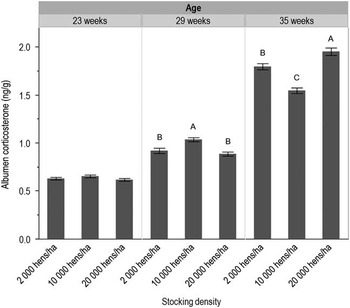
Concentrations of albumen corticosterone increased with age when combined across all stocking density treatments (P<0.001, the LSM±SEM for 23 weeks: 0.63±0.017 ng/g; 29 weeks: 0.94±0.015 ng/g and 35 weeks: 1.76±0.15 ng/g, Figure 4). At 23 weeks of age, there were no differences in corticosterone concentrations between outdoor stocking densities (P=0.44), but there were differences between the pen replicates within the 10 000 and 20 000 hens/ha outdoor stocking densities (P=0.006, Figure 4). At 29 weeks of age there was an effect of outdoor stocking density (P<0.001) with the highest albumen corticosterone concentrations seen in the 10 000 hens/ha density (P<0.017, Figure 4). There were also significant differences between each pen replicate within outdoor stocking density (P<0.001, Figure 4). At 35 weeks the significant effect of outdoor stocking density (P<0.001) showed hens from the 20 000 hens/ha treatment had the highest albumen corticosterone concentrations and hens from the 10 000 hens/ha treatment had the lowest (P<0.017, Figure 4). There were also significant differences between each replicate within density (P<0.001, Figure 4). Overall, eggs from the 10 000 hens/ha outdoor stocking density showed the smallest change in corticosterone concentrations between 23 and 35 weeks (the mean±SEM for differences between 23 and 35 weeks were: 2000 hens/ha: 1.16±0.09 ng/g; 10 000 hens/ha: 0.89±0.16 ng/g and 20 000 hens/ha: 1.33±0.16 ng/g).
The mean±SEM albumen corticosterone concentrations (ng/g) for eggs from hens within the three outdoor stocking density treatments (2000, 10 000 and 20 000 hens/ha) at each sampling age point (23 weeks, 29 weeks, 35 weeks). A,B,CStocking densities without common letters were significantly different (adjusted P<0.017).

Behavioural observations
Across all sampling weeks and for all outdoor stocking densities, more hens were observed dust bathing and foraging outdoors, and more resting indoors (all P<0.001, LSM±SEM of recorded values: indoor dust bathing 1.69%±0.31, outdoor dust bathing 3.53%±0.31; indoor foraging 1.51%±0.78, outdoor foraging 35.59%±0.78; indoor resting 6.94%±0.32, outdoor resting 1.37%±0.32).
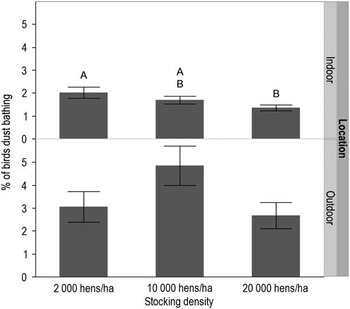
There was an effect of outdoor stocking density (P<0.01) on proportions of hens dust bathing indoors, with more dust bathing observed in the 2000 hens/ha densities than in the 20 000 hens/ha densities (P<0.017, Figure 5). There was also an effect of pen replicate within outdoor stocking density (P<0.001) for the 2000 hens/ha densities (P<0.017, Figure 5). There was an effect of week of age (P=0.002) with the most dust bathing seen indoors at 25 weeks of age (P<0.017), but no interaction between outdoor stocking density and week of age (P=0.87). There was only a trend for differences between outdoor stocking densities in the proportion of hens dust bathing outdoors (P=0.08, Figure 5) and no differences between pen replicates within outdoor stocking densities (P=0.21). There was an effect of week of age (P=0.004) with the least dust bathing seen outdoors at 27 weeks of age (P<0.017), but no interaction between outdoor stocking density and week of age (P=0.99).
The mean percentages±SEM of hens observed dust bathing indoors or outdoors on the range (raw values) for each outdoor stocking density treatment (2000, 10 000 and 20 000 hens/ha). A,BStocking densities without common letters were significantly different (adjusted P<0.017).

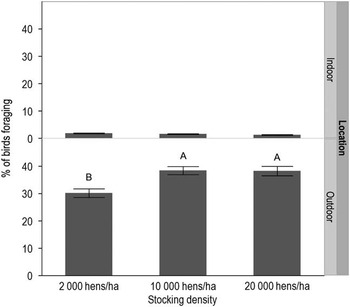
There was a trend for differences between stocking densities in the proportions of hens observed foraging indoors (P=0.07, Figure 6), but no differences between pen replicates or week of age (all P⩾0.26) and no interaction between outdoor stocking density and week of age (P=0.52). There were differences between outdoor stocking densities in the proportions of hens observed foraging outdoors (P<0.001) with the least hens observed foraging outdoors in the 2000 hens/ha density (P<0.017, Figure 6). There was trend for differences between pen replicates (P=0.06), specifically within the 20 000 hens/ha density. There was also an effect of week of age (P=0.007) with the least birds foraging at 25 weeks of age (P<0.017), but no interaction between outdoor stocking density and week of age (P=0.96).
The mean percentages±SEM of hens observed foraging indoors or outdoors on the range (raw values) for each outdoor stocking density treatment (2000, 10 000 and 20 000 hens/ha). A,BStocking densities without common letters were significantly different (adjusted P<0.017).

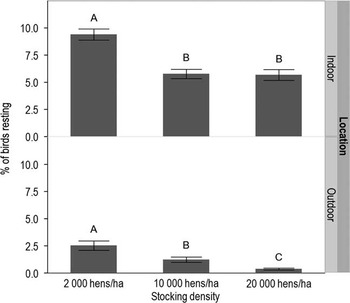
The proportion of hens resting indoors differed between outdoor stocking densities (P<0.001) with the greatest proportion of birds resting indoors for the 2000 hens/ha treatment (P<0.017, Figure 7). The proportion of hens resting indoors also differed between pen replicates (P=0.02) for the 2000 and 20 000 hens/ha densities (P<0.008), but there were no differences between weeks of age (P=0.11) and no interaction between outdoor stocking density and week of age (P=0.61).
The mean percentages±SEM of hens observed resting indoors or outdoors on the range (raw values) for each outdoor stocking density treatment (2000, 10 000 and 20 000 hens/ha). A,B,CStocking densities without common letters were significantly different (adjusted P<0.017).

The proportion of hens resting outdoors also differed between outdoor stocking densities (P<0.001) with the 2000 hens/ha having the highest proportions of hens resting and the 20 000 hens/ha the least (P<0.017, Figure 7). But pen replicate within outdoor stocking density did not vary (P=0.12) with no effect of week of age, or interaction between outdoor stocking density and week of age (all P⩾0.42).
Discussion
Overall, at the conclusion of the study, the majority of birds in all outdoor stocking densities visibly appeared to be in good condition including full feather cover and the absence of pecking wounds with some inconsistent effects of density on measures of physical welfare, including keel damage and toenail length. The albumen corticosterone concentrations at 35 weeks of age indicate stocking density did affect the birds, further supported by the higher frequencies of resting observed in the 2000 hens/ha density.
The visibly good condition of birds across all densities may have resulted from the management provided in the experimental setting and/or the small group sizes. Indoor stocking density was comparable with industry practice and resources were provided to either meet or exceed the model code of practice recommendations. Assessment occurred over the period of peak production when resource demand was likely to be at its highest, but greater differences in health status between the stocking densities may have become apparent towards the end of the lay cycle when hens are often in poorer condition (Nicol et al., Reference Nicol, Brown, Glen, Pope, Short, Warriss, Zimmerman and Wilkins2006). Furthermore, greater differences may have also been seen if these densities were scaled up to commercial level. Birds would be part of a larger flock size that could limit range access (Pettersson et al., Reference Pettersson, Freire and Nicol2016), and hens would have a much larger area to traverse (e.g. 10 000 birds housed on 1 ha compared with 150 birds stocked at 10 000 hens/ha on 150 m2 of land in this study) that could further differentiate between individuals (Chielo et al., Reference Chielo, Pike and Cooper2016). Additional measures such as comb colour (Whay et al., Reference Zeltner, Klein and Huber-Eicher2007), if included, may have shown more differences between treatment groups. However, there were some relationships between welfare variables and ranging behaviour. In particular toenail length, where at the end of the trial, hens that ranged longer had shorter toenails, likely resulting from scratching and walking in the dirt. On average, all birds had shorter toenails than those reported for hens housed in indoor aviary, enriched and conventional cages systems (Blatchford et al., Reference Blatchford, Fulton and Mench2015) indicating the benefits of ranging in keeping toenails from becoming overgrown.
At 35 weeks, albumen corticosterone concentrations showed a non-linear relationship with outdoor stocking density as eggs from the 20 000 hens/ha density had the highest concentrations but eggs from the 10 000 hens/ha treatment showed the smallest mean change between 23 and 35 weeks. The hens in the lowest stocking density did not have the lowest albumen corticosterone values. Daily, hens in the 2000 hens/ha treatment spent the longest time outside (Campbell et al., Reference Campbell, Hinch, Dyall, Warin, Little and Lee2016a) and in previous studies, hens that ranged for longer were reported to have higher heterophil/lymphocyte ratios and basophil leucocytes which may be indicators of increased stress (Mahboub et al., Reference Mahboub, Müller and van Borell2004, but see Cotter, Reference Cotter2015). The increase in albumen corticosterone concentrations with age was consistent with some previous flock-cycle patterns within multiple Australian commercial systems, although specific patterns did vary between individual farms (Downing, Reference Downing2012). Studies of several hen strains within cages and floor-based systems also showed higher corticosterone concentrations at 22 weeks v. 42 weeks indicating increased stress with the onset of production, but adaptation to environments over time (Singh et al., Reference Singh, Hernandez, Lee, Hinch and Cowieson2009). At 35 weeks, all corticosterone values in this study, except within pen replicate two of the 10 000 hens/ha density were above 1.5 ng/g which is higher than the average values shown in caged ISA Brown laying hens exposed to prolonged heat stress (Downing and Bryden, Reference Downing and Bryden2008). In addition, albumen corticosterone is sensitive to short-term changes (Downing and Bryden, Reference Downing and Bryden2008; Singh et al., Reference Singh, Hernandez, Lee, Hinch and Cowieson2009), thus, there may have been unknown stressors present at the time of sampling that affected specific flocks, causing high corticosterone concentrations. These results highlight the need for further sampling across more pen replicates over time to determine the welfare implications of specific corticosterone values and the adaptability of different hen groups to their environmental conditions.
Behavioural observations of hens indoors and outdoors showed that hens preferred to dust bathe and forage outdoors but rest indoors, with the frequencies of all behaviours affected by stocking density to varying degrees. The positive relationship between outdoor resting and available outdoor space was in contrast to observations of hens housed indoors in perchery systems where the stocking density had no impact on resting time (Carmichael et al., Reference Carmichael, Walker and Hughes1999), although both the latter and the current study found low proportions of birds resting. More space may have permitted more resting as disturbances from other birds could be minimised, but more resting may have been observed outdoors in all groups if shelter had been provided on the range (Larsen et al., Reference Larsen, Cronin, Hemsworth, Smith and Rault2014). The similar proportions of hens observed dust bathing outdoors across all densities was comparable with observations made in aviary systems where there was no effect of stocking density on frequency of dust bathing (Zimmerman et al., Reference Zimmerman, Lindberg, Pope, Glen, Bolhuis and Nicol2006). However, the proportions of hens dust bathing indoors (litter was friable), and in total, were considerably less than the levels observed when hens were on friable litter in commercial aviaries (~15% to 20%, Odén et al., Reference Odén, Keeling and Algers2002, some observations over 90%, Campbell et al., Reference Campbell, Makagon, Swanson and Siegford2016b) suggesting free-range birds may spend more of their daily time budget in other activities such as foraging. Outdoor dust bathing was greater than recently reported for commercial free-range systems (0.2%, Chielo et al., Reference Chielo, Pike and Cooper2016) which could be related to strain or age of birds or differences in ground composition between studies. In the current study, the overall proportions of hens foraging were much higher than previously reported for indoor percheries, but the proportions of indoor foraging were lower (5.8% to 9.1%: Carmichael et al., Reference Carmichael, Walker and Hughes1999; 5.9%: Channing et al., Reference Channing, Hughes and Walker2001), thus indicating more foraging opportunities were present outdoors. The birds from the lowest stocking density performed less foraging, similar to observations in percheries where foraging increased with increasing density (Carmichael et al., Reference Carmichael, Walker and Hughes1999). Observations in commercial systems also showed that foraging was performed more in the range areas furthest from the shed (Chielo et al., Reference Chielo, Pike and Cooper2016) and thus, hens at the back of the larger-sized ranges may have been foraging more, but in the current study these birds were not observed.
This study indicated some association between BW and ranging, although this was inconsistent between stocking densities and across hen ages. Previous studies have found positive correlations between BW and ranging (Singh et al., Reference Singh, Cook, Cheng and Silversides2016), although high pasture intake can limit the consumption of formulated diet, and is thus proposed to negatively impact hen health (Singh and Cowieson, Reference Singh and Cowieson2013) and potentially reduce BW. Accordingly, further research at the individual level, across the flock-cycle, comparing varying levels of ground coverage is needed to determine relationships between hours spent ranging and BW.
For health, stress and behavioural measures, there were differences between pen replicates for individual stocking density treatments. This could be a result of the differences in shape between some of the pen replicates, or their location within the experimental range (e.g. with other hens on both sides in pen C1 v. hens on only one side in pen C2). Alternatively, these differences could highlight the influence of flock-level dynamics with separate flocks of birds responding differently to the same housing environments. Some evidence suggests there is social transmission of feather pecking (e.g. Zeltner et al., Reference Zimmerman, Lindberg, Pope, Glen, Bolhuis and Nicol2000; McAdie and Keeling, Reference McAdie and Keeling2002), and also transmission of fear by a few individuals that increase stress levels in the remainder of the group (de Haas et al., Reference De Haas, Kops, Bolhuis, Groothuis, Ellen and Rodenburg2012). To the best of the author’s knowledge, there are currently no data available on the social dynamics of free-range environments, such as whether dominance hierarchies influence ranging, or if subgroups form within outdoor- and indoor-preferring birds. Further studies could assess the relationship between social dynamics of different groups in the same housing environments and their impacts on the welfare of the individuals.
In conclusion, in these small experimental flock sizes, outdoor stocking density did have some inconsistent impact on external measures of physical welfare such as keel damage and toenail length. Albumen corticosterone concentrations were also impacted by stocking density, but not in a linear manner indicating the need for further data on reactions to environmental conditions and overall adaptability of birds. Higher proportions of hens resting in the lowest density suggests more space allowed greater behavioural freedom, but all birds exhibited higher levels of foraging than previously observed in indoor systems. Differences between pen replicates highlight the need to consider both individual and flock-level behaviours when determining optimal outdoor stocking densities for free-range hens, as the social interactions may determine how groups of birds respond to specific environmental conditions.
Acknowledgements
This research was conducted within the Poultry CRC (grant 1.5.6), established and supported under the Australian Government’s Cooperative Research Centres Program. Thank you to Grahame Chaffey, Mandy Choice, Mark Porter, Shalanee Weerasinghe (University of New England, Armidale, NSW), Sue Belson, Andrew Cohen-Barnhouse, Tim Dyall, Troy Kalinowski, Jim Lea, Belinda Niemeyer, Dominic Niemeyer, Samantha Robinson (CSIRO, Armidale, NSW), Marie Berodier, Hélène Pecourt, Tristan Rose and Laura Warin (AgroParisTech, Paris and CSIRO, Armidale, NSW) for technical assistance.