Introduction
In its 2015 official report on growth and employment, the European Commission indicated that the EU economy would be characterized by slow growth and high, but stable, unemployment. The Commission therefore suggested reforms that supporting and well-functioning labour markets must take, and continue to manage, in order to effectively reduce unemployment. Labour market reforms, following austerity and fiscal discipline, seemingly became another recipe for the recovery of the Eurozone economy in the EU’s post-euro-crisis management. With both monetary and fiscal policies reaching their limits and unemployment still at a high level in some EU member states, labour market reforms were expected to be the major, if not the last, resort that policy makers could turn to. As the European Central Bank (ECB) indicated in its report, a comprehensive strategy of labour market reforms was key to a solid economic recovery. 1 Against this backdrop, Germany has stood out with its record high employment and low unemployment since the mid-2000s, and especially with its conspicuous employment stability during the global financial crisis and the European sovereign debt crises. Indeed, Germany was the only advanced OECD economy that did not experience a rise in unemployment during the financial crisis. 2 As with its fiscal governance, Germany, again, became a model for some unemployment-stricken EU members to look up to. It has been a strongly debated issue among academics and policy makers as to why and how the German economy could be transformed from ‘the sick man of Europe’ in the early 2000s to an ‘economic superstar’ since the mid-2000s. 3 , Reference Dustmann, Fitzenberger, Schonberg and Spitz-Oener 4 Conventional wisdom suggested the main explanation to be the so-called Hartz reforms (also known as Agenda 2010), a series of structural reforms introduced by the German Schröder government on the labour market a decade ago. Following these reforms, the German unemployment rate has been in steady decline, from a peak of 11% in 2005, to 5% at the end of 2014, and this ‘labour market miracle’ has been recognized by the European Commission and the OECD. 5 , Reference Hufner and Klein 6
Scientific evidence of the effectiveness of the Hartz reforms, however, has remained a subject of debate. Reflections on the policy effects have emerged a decade after its implementation, and debates have been further developed on whether this German model is applicable to other EU member states. Given that there has not yet been consensus on the effects of these reforms, this paper attempts to clarify the issue from competing arguments and to identify the welfare implications for German society and the German economy, so as to explore whether labour market reforms could be another German answer to the EU’s post-euro-crisis management.
The remainder of this article is arranged as follows: the next section briefly introduces the policy contents of the Hartz reforms. The third section discusses its overall policy effects. The fourth section analyses whether the German model could be the recipe for the recovery of the weak Eurozone economy.
The Hartz Reforms
At the turn of the twenty-first century, Germany demonstrated the typical symptoms of Eurosclerosis – a stagnant economy with increasing unemployment since the 1970s. The high unemployment issue was further aggravated by the reunification of Germany in 1990. By 2003, the German unemployment rate exceeded that in most advanced OECD countries. The labour market scenario, expressed by the deteriorating Beveridge curve, which combines data on the number of unemployed and companies looking for workers, indicated that regular employment was in decline and long-term unemployment was on the rise.Reference Rinne and Zimmermann 7 , Reference Bonin 8 On the other hand, with the heavy burden of generous unemployment benefits, Germany had breached the Stability and Growth Pact (SGP), the EU’s regulation on public finance, for four consecutive years and was running excessive budget deficits above the 3% ceiling. A majority of economists believed that the crux was the rigidity of the German labour market, which thus was in desperate need of reform.Reference Sinn 9
A few reforms, such as the Employment Promotion Act and the new Social Code, were experimented with in the 1990s, but they failed to lower unemployment satisfactorily. A scandal involving the German Federal Labour Office, which had fabricated employment statistics, finally ushered in what the then German Chancellor Gerhard Schröder called the ‘biggest package of changes in post-war German history’ – the Hartz reforms. 3
Based on the principle of supporting and demanding (fördern und fordern), the Hartz reforms were composed of four laws that were implemented gradually from January 2003 to January 2005. The first three measures, Hartz I–III, aimed at improving job search efficiency and employment flexibility, including restructuring the Federal Labour Agency, deregulating temporary work sectors, and exempting social security taxes for low-paid jobs, the so-called mini-jobs and midi-jobs. ‘Mini-jobs’ refers to work that is exempt from social security contributions. Before the Hartz reforms, the income threshold of mini-jobs amounted to €325 per month. The Hartz II reform raised this threshold to €400. The Hartz reforms further introduced midi-jobs, a type of employment with reduced social security contributions for the income range of €400.01 to €800 per month. Germany’s long-term unemployment benefits were extremely generous owing to their unlimited duration, resulting in the long-term unemployment rate becoming higher than any other OECD country. Hence, the final and crucial component of the reforms, Hartz IV, became an overhaul of Germany’s long-term unemployment benefit systems by reducing the amount and duration of unemployment benefits and by tightening the rules and conditions of job searching and acceptance for unemployment benefit recipients.Reference Engbom, Detragiache and Raei 10 , Reference Jacobi and Kluve 11 The key features of the Hartz reforms are summarized in Table 1. 12 , Reference Klinger and Rothe 13
Main features of the Hartz reforms.

Different from the previous reforms, the Hartz reforms addressed all stakeholders of the labour market – service providers (job agencies), the demand side of the workforce (employers), and the supply side of the potential workforce (the unemployed). They emphasized improving the efficiency of services providers by reorganizing them, increasing flexibility for employers by introducing various work arrangements, and by putting pressure and obligations on the unemployed to return to work by cutting the scale and duration of their benefits. In short, policy makers believed that, with better service provisions, lower barriers to creating new jobs, and fewer incentives to remaining unemployed, Germany’s high and persistent unemployment, especially the long-term cases, could be reduced effectively. It is noteworthy that although the Hartz reforms were extensive in their scope and depth, they left the core labour market untouched and only picked out marginal employment, the so-called ‘atypical’ jobs and the unemployed to be the reform targets.
Debating Policy Effects
It has been more than a decade since the Hartz reforms were implemented. It is now appropriate to evaluate their overall effects on the German economy and society.
Were the Hartz Reforms Effective in Reducing Unemployment?
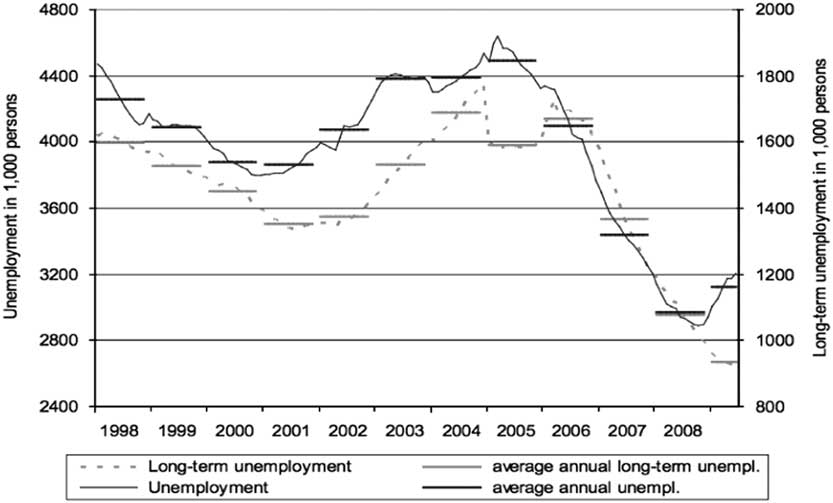
As the German unemployment rate dropped significantly after the reforms (Figure 1), most economists agreed that the Hartz reforms had successfully contributed to reducing unemployment, although they disagreed on the causes of, and estimates for, the policy effects because of their different approaches and simulations.
The stocks of unemployment and long-term unemployment in Germany, 1998m1 to 2009m6. Remarks: Monthly data, seasonally adjusted. Source: Federal Employment Agency.

In its own official evaluation, the German Federal Employment Agency indicated that following the implementation of the reforms, within three years between 2006 and 2008, unemployment had been reduced by one third. Long-term unemployment had dropped more significantly by 40%. These positive results were explained as being due to improvements in matching efficiency, of the order of 10–20% more efficient than before. The report believed the long-term unemployed were the group that benefited most from the reforms, as up to 6% more benefited than the short-term unemployed (Ref. Reference Klinger and Rothe13, pp. 5, 29–30). Others contended that the reforms accelerated the matching process between the unemployed and job vacancies and thus the labour market witnessed significant increases in the employment of female workers, low-skilled workers, older workers and young workers.Reference Rinne and Zimmermann 14
OECD economists concurred with the German official view that the Hartz reforms reduced structural unemployment by increasing work incentives for low-income and older workers by improving matching efficiency. Employment rates for older workers in the 55–64 year age group increased by 19% and were almost five times that of the OECD average. These changes combined, resulting in a decrease of NAIRU (non-accelerating inflation rate of unemployment) by 0.5% (Ref. Reference Hufner and Klein6, pp. 7–9).
Other economists held similar views, albeit with their individual explanations and estimates. Krebs and Scheffel estimated that Hartz I–III reduced the structural unemployment rate by 1.5% and Hartz IV reduced it further by 1.4%. Together, the four reforms contributed to half of total unemployment reduction in the period of 2005–2012.Reference Krebs and Scheffel 15 Giannelli et al. suggested that the reforms reduced unemployment by one third in three years, and this was accompanied by a rise in employment by the same amount.Reference Giannelli, Jaenichen and Rothe 16 Kirkegaard asserted that the reforms created more than three million jobs since 2005 and reduced the recorded number of unemployed by more than two million in the same period.Reference Kirkegaard 17 Busl and Seymen estimated that the Hartz reforms reduced unemployment by 3.3% due to improved matching efficiency and lowering of unemployment benefits and that these positive policy effects contributed to a quarter of Germany’s GDP growth between 2003 and 2010.Reference Busl and Seymen 18 Krause and Uhlig obtained similar estimates, namely that the reforms reduced the unemployment rate by about 3.45%.Reference Krause and Uhlig 19
Whilst agreeing on the effects of Hartz reforms on reducing unemployment, economists also argued about which parts of the reforms were most effective. Some claimed that reforms for the long-term unemployed were more effective than those for the short-term unemployed (Ref. Reference Krebs and Scheffel15, p. 20). Conversely, others argued that the reforms were more effective in reducing the number of short-term unemployed from becoming long-term unemployed and had little or no effect on the long-term unemployed (Ref. Reference Bonin8, p. 792; Ref. Reference Jacobi and Kluve11, pp. 59–61).
Explanations for the causes of policy effectiveness varied, too. Some argued that it was due to improvements in matching efficiencies that effectively reduced unemployment.Reference Hertweck and Sigrist 20 , Reference Caliendo and Hogenacker 21 It was suggested that a 23% increase in the matching efficiency would result in a 20% decrease in the unemployment rate, and that the effects of Hartz reforms in matching efficiencies (Hartz I–III) amounted to between 12% and 31%.Reference Caliendo and Hogenacker 21 Meanwhile, some contended that both improved matching efficiency and strengthened incentives to return to work accounted for the reduction in unemployment (Ref. Reference Engbom, Detragiache and Raei10, pp. 21–22). Conversely, others emphasized the role played by the reform of the unemployment benefit system (Hartz IV) for reducing unemployment.Reference Dlugosz, Stephan and Wilke 22
Only a handful of economists differed from the mainstream viewpoint by casting doubt on the reforms’ effectiveness. It was argued that the reforms had only a negligible effect, 0.07%, in reducing unemployment. For the group of low-skilled labour, unemployment actually went up. In their simulations, productivity growth accounted for about 80% more recovery than the reforms in the reduction of unemployment.Reference Launov and Walde 23 Some contended that the evidence was ‘still preliminary’ and ‘inconclusive.’ Beissinger et al. believed that without these reforms, unemployment would have dropped anyway,Reference Beissinger, Chusseau and Hellier 24 while Bornhorst and Mody highlighted that similar reforms had been undertaken in other European countries since the mid-1990s but had not produced the same magnitude of policy results as in the German case.Reference Bornhorst and Mody 25
However, such doubts cannot conceal the fact that the sharp fall in German unemployment only started in 2005 and coincided with the implementation of the Hartz reforms. Nor can they explain the fact that if productivity growth was the driving force for this unemployment reduction, then the fall should have appeared a decade earlier as productivity growth started as early as the mid-1990s rather than the mid-2000s (Ref. Reference Dustmann, Fitzenberger, Schonberg and Spitz-Oener4, pp. 169–176). It is hard to deny the effectiveness of the Hartz reforms on unemployment reduction. What should be noted, however, are the waning and stagnating effects over time. The reforms considerably reduced long-term unemployment from 1.8 million to 1 million between 2005 and 2011. But that number has remained largely unchanged since then, and no more incentives or pressures from the reforms have reduced it any further. So far, Germany’s long-term unemployment rate has remained 10% higher than the OECD average.Reference Spermann 26 That is to say, the Hartz reforms were effective in reducing unemployment to a certain extent, but they did not fundamentally solve the problem.
Explanations for Germany’s Jobs Miracle in the Financial Crisis
The Nobel-prize winner Paul Krugman claimed, in his column in the New York Times, that very modest increases in the German unemployment during the global financial crisis amounted to ‘Germany’s jobs miracle’. Indeed, it was Germany’s high and stable employment during the recession that brought the Hartz reforms into the international spotlight. During the financial crisis, Germany’s GDP declined by over 5%, compared with the OECD average of 3.8%, and its exports fell more sharply by 14%. Its unemployment, however, increased only slightly, by 0.2%, compared with the OECD average of 2.2% (Ref. Reference Hufner and Klein6, p. 5). It is on this point that economists are divided on the effects of the Hartz reforms.
Some government-related economists attributed Germany’s exceptional performance during the world recession to the Hartz reforms. According to this view, the reforms were implemented before the crisis so as to allow the improved German labour market to benefit from a stronger position to weather the financial crisis more effectively and efficiently. Internal flexibility within the German industry, such as working time accounts and short-time work exercised in the most severely hit export manufacturing sector, saved many jobs from redundancy. However, such internal flexibility of labour hoarding could not be sustained without an effective and efficient labour market that was delivered by the reforms (Ref. Reference Rinne and Zimmermann7, pp. 2, 9–16; Ref. Reference Rinne and Zimmermann14, p. 7). Some scholars also held similar views, namely that the good performance of the German labour market during the financial crisis was attributable at least partially to the Hartz reforms (Ref. Reference Hufner and Klein6, p. 9; Ref. Reference Klinger and Rothe13, p. 30; Ref. Reference Krebs and Scheffel15, p. 668).
On the other hand, an official report of the French government suggested that such adjustment mechanisms as short-time work, time-saving accounts, and job-preservation agreements, etc., accounted for the resilience of the German jobs market during the crisis.Reference Bouvard, Rambert, Romanello and Studer 27 Other economists also excluded the Hartz reforms as a plausible explanation. Moller indicated that labour hoarding used by the German industry was the explanation (Ref. Reference Hertweck and Sigrist20, p. 335). Krause and Uhlig emphasized the government’s role, arguing that government subsidies for short-time work prevented unemployment from rising during the recession. Without such supporting policies, Germany would have experienced the same magnitude increase in unemployment as in other G7 countries, by about 2–2.5% (Ref. Reference Krause and Uhlig19, pp. 77–78). Eichhorst suggested that both government-subsidized short-time work arrangements and employer’s need to retain skilled workers in the form of negotiated working-time accounts contributed to the remarkable employment stability during the crisis.Reference Eichhorst 28 Bonin explained that, first, the German financial system featured a large number of small and semi-public local banks that were mostly disconnected from international capital markets and as such Germany did not have the same problem with housing market bubbles. Second, the sector that was hit most by the crisis was the German export-oriented manufacturing sector. But most firms were willing to retain workers through working-time flexibility because they learned from previous experiences of the shortage of skilled workers. Helped by government-sponsored short-time subsidies, most firms were able to avoid large-scale redundancies (Ref. Reference Bonin8, pp. 801–805).
The following facts can help clarify the debates of the Hartz reforms. The first evidence comes from Germany itself. It was the temporary work sector that suffered most from job losses during the financial crisis, declining by 20% compared with a 4% decline in the manufacturing sector during the same period. Another vulnerable group that faced greater-than-average risks in loss of earnings was low-skilled and non-standard workers (Ref. Reference Rinne and Zimmermann7, p. 15). That is to say, the marginal jobs that the Hartz reforms had targeted were the ones that were lost most during the financial crisis. The core and skilled workforces of the manufacturing sector, which were retained during the crisis, contributed to employment stability during this period. They were the ones that the Hartz reforms had not targeted. In short, Germany’s jobs miracle during the financial crisis derived from labour retention in the core workforce in the manufacturing sector, not from the Hartz reform effects on continuing unemployment reduction. Ironically, the above-average losses in temporary, low-paid and non-standard jobs during the recession indicate that the Hartz reforms increased Germany’s unemployment during this period in an unexpected way.
The second evidence comes from other European countries. The Netherlands and Austria did not undertake similar labour market reforms prior to the financial crisis. The two countries resorted to the same strategy of short-time work to retain a qualified workforce during the crisis and this also resulted in an insignificant rise in unemployment (Ref. Reference Rinne and Zimmermann7, p. 16). It was short-time work rather than labour market reforms that can explain the jobs market performance during this period more convincingly.
The Quality and Cost of Job Creation
Having clarified the Hartz reforms’ effects on employment, other questions were raised: what kinds of jobs were created then and what types of jobs were taken up? And, more importantly, at what cost were such effects achieved?
In terms of job quality, the reforms failed to create standard (full-time), high-quality jobs while creating non-standard, low-quality ones. From 2004 to the first half of 2012, the Hartz reforms had created 2.5 million jobs, but most of them were non-standard jobs. Temporary (agency) work increased 2.7 times, from 331,000 people in 2003 to 882,000 in 2011. Standard and full-time jobs increased only very slightly by 2.4% between 2004 and 2011, while part-time jobs increased by 33%. After the reforms, Germany’s part-time employment rate became the second highest in the Eurozone. The report accordingly criticized that most macroeconomic evaluations on the Hartz reforms failed to measure the quality and duration of jobs created by the reforms (Ref. Reference Eichhorst28, p. 3).
Other groups of atypical jobs that were seen to rapidly increase were mini-jobs and midi-jobs. The Hartz reforms increased midi-jobs by about 125,000 and expanded mini-jobs much further by 1.8 million in just two years (Ref. Reference Jacobi and Kluve11, pp. 58–59). Looking at a longer timeframe, the number of mini-jobs increased from 4 million in 2003 to 7.5 million in 2014 (Ref. Reference Kirkegaard17, pp. 4–5), with 4.9 million of these held as main jobs, and 75% of them earning less than €10 per hour. The huge increase in mini-jobs also replaced regular jobs, especially in smaller firms (Ref. Reference Bornhorst and Mody25, pp. 316–317).
Mini-jobs and midi-jobs existed in Germany long before the Hartz reforms, but why did they grow so rapidly after the reforms? A ‘carrot’ perspective held that the reforms liberalized non-standard jobs, and when combined with minimum income support by Hartz IV, they provided strong incentives for benefits recipients to take up these jobs to maximize their benefits (Ref. Reference Carlin and Soskice29, pp. 17–19). This can explain an unexpected rise in taking-up low paid and non-standard work in low- and medium-skilled service sectors. After the reforms, around 1.3 million workers were identified as ‘working unemployed’, half of them in marginal part-time work.
On the other hand, a ‘stick’ perspective argued that the unemployed felt the ‘demanding’ part of the reforms and had to prove their efforts in job searching or even had to take up the so-called ‘1-euro jobs’, a form of public employment rewarded with a symbolic wage, but that the ‘supporting’ part of the reforms, such as good quality counselling and training, did not reach many of the long-term unemployed. Therefore, the rapid decline in the German unemployment rate was because the reforms put pressure on people who were at risk of becoming long-term unemployed to accept low-wage work (Ref. Reference Bonin8, pp. 792, 805).
Moreover, it was estimated that the reforms lowered post-re-entry earnings by 10% in relation to similar workers who remained employed (Ref. Reference Engbom, Detragiache and Raei10, p. 21). Some further argued that those temporary jobs that the reforms liberalized were paid 20–40% less than the normal level (Ref. Reference Bornhorst and Mody25, pp. 316–317). The reforms were successful in reducing unemployment but came at a cost to unemployed workers in terms of benefit cuts and lower earnings post-unemployment (Ref. Reference Engbom, Detragiache and Raei10, p. 22).
The direct consequences of the growing low-paid sectors were wage restraints and increasing income inequality. The reforms liberalized the low-wage workforce and increased part-time jobs in Germany, but did little to reform regular employmentReference Carlin and Soskice 29 (Ref. Reference Kirkegaard17, p. 6). They aggravated the ‘insider–outsider’ labour market (those with secure jobs and those outside job protection). More women, young and older people participated in the labour market after the reforms, but most of their jobs lacked the same employment protection that insider workers enjoyed. The reforms led to the growing dualization of the German employment system – into ‘good’ and ‘insider’ jobs, and ‘bad’ and ‘outsider’ jobs. Although the employment stability and pay level of ‘insider’ jobs’ have remained unaffected, the marginal workforce puts pressure on the core workforce as the latter can be replaced by the former in the long term (Ref. Reference Carlin and Soskice29, pp. 17–19).
Indeed, the time of the Hartz reforms coincided with a prolonged period of decline in average wages (Ref. Reference Engbom, Detragiache and Raei10, p. 6). It was even argued that the reforms reduced real wages because they forced unemployed people to take up lower-paid jobs rather than lose benefits, and therefore this increased labour supply. This development in the ‘outsider’ job market further put wage pressure on ‘insider’ workers’ in collective negotiations and thus lowered unit labour costs in Germany (Ref. Reference Krebs and Scheffel15, p. 685; Ref. Reference Dlugosz, Stephan and Wilke22, p. 12). Unit labour costs dropped significantly in the post-reform period, 2005–2007, by more than 4%. ‘Additional wage restraint is a rational answer to the “reforms”’ (Ref. Reference Bonin8, pp. 798–799). However, some did not accept the phenomenon of wage restraint as the outcome of the reforms, but attributed it to the behaviour of social partners in order to make firms more internationally competitive (Ref. Reference Rinne and Zimmermann7, p. 10).
It is true that wage restraint alone could not be explained by only one single factor. The declining power of trade unions, for one, contributed to this outcome to some extent. The changing behaviour of social partners, however, cannot explain why real wages actually fell rather than stagnating after the reforms appeared. According to the OECD report, wage moderation in Germany during the 2000s was especially remarkable by both international and historical standards (Ref. Reference Hufner and Klein6, p. 10). Internationally, compared with an increase of 22% in the average OECD country, Germany’s unit labour cost fell by 2% from 2000 to 2007. Historically, this figure increased by 15% in the 1990s, by 20% in the 1980s and by 69% in the 1970s. The report argued that the negative growth of wages was associated with the Hartz reforms, as they led the unemployed to accept lower-paid jobs.
A natural development of the growing low-paid sector was rising income inequality. Income inequality in Germany increased after the reforms, and the share of Germans earning two-thirds or less of the national median gross hourly earnings (22%) was higher than that in other Western euro member states (Ref. Reference Kirkegaard17, pp. 4–5). During the time when the Hartz reforms were deployed, the Gini coefficient rose by three points from 26.2 in 2000 to 29.2 in 2008. This made Germany one of the few OECD countries where median income stagnated between the mid-1990s and the mid-2000s. Real income for the lowest quintile of households actually fell at an average annual rate of 0.3% during this period (Ref. Reference Eichhorst28, p. 6).
While some argued that it was changes in employment patterns such as the growth of part-time and marginal part-time work, not the Hartz reforms, that contributed to the increase in income inequality and poverty,Reference Biewen and Juhasz 30 such arguments cannot stand up to empirical examination. Giannelli et al. investigated the quality of new jobs created by the Hartz reforms, measuring job duration and wages. They found that the disadvantaged groups – temporary, unskilled and unemployed workers – actually faced wage losses more than others as their re-entry wage was reduced significantly after the reforms. Although the reforms were not found to affect labour turnover rates, this was not because of high satisfaction with new jobs, but because of higher costs of being unemployed and lower entry wages after the reforms. As a result, the reforms reinforced an already existing tendency towards lower wages and greater income inequality (Ref. Reference Giannelli, Jaenichen and Rothe16, pp. 4–6, 22–24).
In summary, the reforms were effective at reducing unemployment by creating non-standard, low-quality, low-paid jobs, which were taken up by the unemployed with lower re-entry wages and no job protection, at the cost of the decline of wages for the general German workers for the first time since the 1970s, accompanied by rising income inequality for society.
Were the Hartz Reforms a Worthy Trade-off and Welfare-enhancing?
If these adverse effects were the inevitable price paid for the reforms’ effectiveness on reducing unemployment, further questions need to be addressed, namely whether they represented a worthy trade-off and were welfare-enhancing overall for the entire German economy.
For some, a large increase in job creation in return for a modest increase in income inequality was a positive trade-off and worth embracing (Ref. Reference Kirkegaard17, p. 4). It was suggested that the reforms produced winners and losers. Winners were employed households, as the reforms reduced their tax burden, which was equivalent to an increase of 0.4% of lifetime consumption. Losers were the unemployed and low-skilled workers, as the reforms raised the cost of being unemployed for the long-term unemployed and pressed the short-term unemployed to accept low-paid and usually precarious jobs. The welfare loss of the long-term unemployed was estimated at around 1% of lifetime consumption. Overall, the reforms increased the long-term growth for the German economy by 0.1% (Ref. Reference Krebs and Scheffel15, pp. 667, 686).
Conversely, some did not accept that labour market reforms necessarily enhanced welfare; this depended on the type of reforms being implemented.Reference Poilly and Wesselbaum 31 It was suggested that the Hartz-style reforms reduced welfare for around 76% of the workforce, because the value of being employed fell and resulted in public demonstrations against the reforms, which were seen as only beneficial to firms and as ‘the direct road to poverty’. Productivity growth rather than the reforms was taken to explain Germany’s economic growth (Ref. Reference Dustmann, Fitzenberger, Schonberg and Spitz-Oener4, p. 184; Ref. Reference Beissinger, Chusseau and Hellier24, pp. 1159, 1184–1187).
Some further suggested that the rise of low-paid and temporary jobs after the Hartz reforms constrained the consumption growth of the German economy in the medium-term, as the consumption of low-skilled workers was restrained by low wages and precautionary savings in the core workforce were unexpectedly raised. In the long-term, the weak demand for consumption would be detrimental to Germany’s much-needed transformation from a heavy dependence on manufacturing and exporting to a domestically driven growth economy (Ref. Reference Busl and Seymen18, p. 40; Ref. Reference Spermann26, p. 24; Ref. Reference Biewen and Juhasz30, p. 89).
One report suggested that the Hartz reforms were not a desirable trade-off because of rising poverty in both the employed and unemployed. By increasing the supply of low-paid jobs, the Hartz reforms increased the poverty rate of employed workers from 4.8% in 2004 to 7.5% in 2006. The largest increase in poverty rate was found among the unemployed, rising from 41% in 2004 to 68% in 2010. Two thirds of unemployment benefit recipients found a job after the reforms, but the hours and wages of temporary and part-time jobs were too low to raise them above the poverty line (Ref. Reference Eichhorst28, p. 6). Another study also contended that while the reforms showed that low pay was the price for low unemployment, such inequality–unemployment trade-offs may be damaging. A policy that fostered inequality by impoverishing low-skilled workers could be counterproductive in the long term. The evidence showed that the reforms reduced unemployment by creating cheap jobs in the non-tradable sector and this came with a decrease in the exports-to-production ratio (Ref. Reference Bornhorst and Mody25, pp. 327–328).
For the general public, whether the Hartz reforms were a worthy trade-off could only be measured by the effects on their real income and the living standards that they felt personally. The decline of wages and living standards indicated the simple fact that many members of the general public were invisible losers of these reforms, along with the visible losers of the unemployed. Thus, all of society was in a state of deteriorating welfare. Unemployment was indeed reduced in Germany, but this came with a rise of low-paid employment, which was not only economically counterproductive for the growth of domestic consumption, but was also socially destabilising because of rising income inequality. The political and social cost of public riots and terrorist attacks associated with these reforms clearly illustrated public perception of the welfare effects of these reforms. The Merkel government’s decision to reinstate some benefits was a response to strong public opposition and indicated the unsustainability of these reforms in real politics regardless of how effective they actually were. As one commentator described, the methods that the Hartz reforms resorted to were ‘perspiration’ but not ‘inspiration’, and therefore were by no means a politically and economically desirable trade-off.Reference Whyte 32
Another German Answer to the Post-Euro-Crisis?
Following fiscal governance, could the Hartz reforms be another German model for other unemployment-stricken EU member states? This question must be answered by considering two issues. The first concerns the question of why the Hartz reforms worked, as well as the main factors for their effectiveness. The second relates to the nature of Germany’s unemployment problem prior to the reforms and the extent to which it could be compared with other unemployment-suffering EU member states stricken by the euro-crisis.
Could the German Model Fit All Situations?
To the extent that the Hartz reforms could shed light on reducing unemployment, it is important to examine the conditions underpinning their success, and to examine whether these conditions are present in current national and international contexts.
The favourable international context is one of the important factors to explain the Hartz reforms’ success. From this point of view, the reforms would not have been successful if the German exports did not grow, and the export market was indeed able to grow thanks to the increased demand from emerging markets such as China at that time. This factor drove the German economy to expand by 2%. ‘None of this [Hartz reforms] will help […] if growth doesn’t return’. 3
Other commentators emphasized the German national contexts, focusing on the competitiveness of the German industry and macro-economic policies. Some suggested that Germany’s unique competitiveness in exporting capital goods, of which 450 small and medium enterprises (SMEs) were world leaders in their respective niche markets, was the main factor behind the success of the Hartz reforms (Ref. Reference Sinn9, p. 1163; Ref. Reference Spermann26, pp. 12, 20). Moreover, Germany’s international competitiveness was restored before the Hartz reforms through a long period during which wage growth lagged behind productivity growth, which was achieved by a cooperation between trade unions and employer organizations on the basis of their mutual agreement on maintaining employment stability (Ref. Reference Bonin8, pp. 797–798). In other words, if it wasn’t for international competitiveness, it would be very doubtful that the reforms could reduce unemployment in a favourable international context.
On the other hand, it was also suggested that the reforms were successful because of the absence of fiscal austerity. Germany’s public debt increased by 40% between 2000 and 2010 and public resources were used to foster growth when the Hartz reforms were implemented (Ref. Reference Rinne and Zimmermann14, pp. 17–18).
In short, the Hartz reforms were effective in a context in which the economy was growing – although some stressed an expanding international market and some emphasized the expanding national economy – which was achieved either by a competitive exporting sector, or public spending, or both. Without favourable national and international contexts, the fortunes of the Hartz reforms would have been reversed.
Do such conditions exist in the current Eurozone? Internationally, the policy of low or negative interest rates adopted by certain central banks since 2015 has highlighted the weakness of the aggregate demand on the global market. Nationally, with the Fiscal Compact in operation, austerity became the norm of fiscal governance for euro members. As concerns export competitiveness, euro members performed differently from one another. Given that the number of unskilled workers was higher in other euro countries, the Hartz-style reforms, which produced an inequality–unemployment trade-off in Germany, would be more painful in such countries (Ref. Reference Bornhorst and Mody25, p. 328).
Furthermore, the nature of unemployment in Germany was not identical to that in other European countries. For countries such as France and Spain, where long-term unemployment benefits are already very low, the Hartz-style reforms would have only very modest effects. Similarly, for other unemployment-stricken EU countries, such as Ireland, Portugal and Italy, where unemployment increased as a result of the euro-crisis but not due to generous unemployment benefits for low- and unskilled workers, the Hartz-style reforms certainly could not address their problems (Ref. Reference Krebs and Scheffel15, pp. 693–694). The very different causes of unemployment explained the fact that, while Hartz-style reforms had been undertaken throughout much of Europe in the mid-1990s and similar strategies of government-subsidized short-time work were also adopted in other European countries during the global financial crisis, they failed to produce similar effects as in Germany (Ref. Reference Spermann26, pp. 12, 20).
The above discussion indicates that the German model of labour market reforms cannot fit other European countries at this time. The Hartz reforms were effective in a Germany-specific context for a very Germany-specific problem. Without favourable national and international conditions, the increase in labour supply that resulted from the Hartz reforms would not have translated into an increase in employment. Equally, without reforms addressing the German-specific crux, an increase in labour demand would not have translated into a decrease in unemployment, either.
The Real Danger of European Integration: The German Complacency of One-Size-Fits-All Thinking and its Double Standard
The performance of the Hartz reforms in reducing unemployment has led some to suggest that all euro countries without exchange rate flexibility should learn from Germany (Ref. Reference Kirkegaard17, p. 9). The true believers came from the ranks of the German policy-makers themselves. The German Chancellor, Angela Merkel, urged EU countries suffering from the euro-crisis to carry out the same labour market reforms as Germany did, so that they might better compete in the global market. 33 Klaus Zimmermann, the policy advisor of the Hartz reforms, praised the reforms as the ‘“North Star of labour” policy’ and stressed how the reforms could serve as a role model for other countries (Ref. Reference Rinne and Zimmermann7, p. 16).
Such remarks, however, ignored the fact that it was the Merkel government that revised the reforms in 2006 by extending the duration of unemployment benefits up to 24 months because the reforms were too unpopular (Ref. Reference Launov and Walde23, p. 333). They also ignored the fact that the adverse political repercussions of the Hartz reforms were so strong and persisted over such an extended period that no major political party was willing to openly identify itself with these reforms (Ref. Reference Rinne and Zimmermann14, p. 4). The praise for the reforms therefore reflected not only the oversimplified one-size-fits-all thinking of German policy makers towards EU governance, but also their ignorance of both the causes of unemployment and the different economic contexts in which states found themselves. The incoherence between the Merkel government’s revisions to the reforms on the one hand, and the German Chancellor’s demanding other EU governments to push through labour market reforms regardless of strong domestic opposition on the other hand, further showed Germany’s double standards as well as how politically unjustifiable and unsustainable such demands were.
Economically, the Hartz-style labour market reforms were not a welfare-enhancing project, and their effects will wane over time, too. German policy makers may have believed that a Eurozone that turned into a larger version of Germany in terms of fiscal discipline and labour market reforms would be the best scenario for the Eurozone’s economic governance. However, a Eurozone that becomes ‘too German’ could be as crisis-ridden as one that remains too ‘Greek’. If the domestic consumption of core euro countries such as Germany continued to contract, one of the adverse consequences of the Hartz reforms would be the lack of sufficient demand in the Eurozone to prop the growth and a further worsening of the situation of indebted countries (Ref. 33, pp. 9–10).
On the other hand, other EU countries that did not implement similar labour market reforms, such as Denmark, Austria, Sweden and the Netherlands, proved to be more resilient to the financial crisis than others. 34 Denmark was a good example of balancing between labour market flexibility and job security and investment in improved working conditions. 35 This suggests that there are ways other than the German model to tackle the unemployment problem. A greater cause for concern for European integration was not the unemployment challenge that these indebted euro countries faced. Unemployment was serious but not intractable. Rather, it was Germany’s complacency with one-size-fits-all thinking and its double standards that posed a real danger to European integration.
Conclusion
Since 2005, there has been a steady decline in the German unemployment rate, from the record peak of 11% in 2005 to the historic low of 5.3% in 2013. There is no doubt that the Hartz reforms implemented in 2003–2005 played a key role in this impressive unemployment reduction. In terms of their primary policy goal, i.e. reducing unemployment, the reforms were successful. However, their effectiveness waned over time. Furthermore, such effects came at the cost of the rise of low-paid sectors, declining wages, and increased income inequality. For individuals, the successful Hartz reforms were by no means welfare-enhancing because poverty levels for both the employed and unemployed increased. For the German economy and society as a whole, the reforms implied a counterproductive risk because of the contraction of domestic consumption, and potential social instability because of rising inequality and deteriorating living standards. These led the successive Merkel governments to reform the reforms to a considerable extent. Therefore, the Hartz-style reforms were not a desirable model for other EU countries. Neither could they be the answer to the post-euro-crisis management in an age of fiscal austerity and negative interest rates. As one commentator said, labour market reforms should focus on both quantity and quality of jobs, i.e. jobs that can offer career and investment possibilities, and jobs that are stepping stones rather than dead ends.Reference Pall 36
It is here that this article contends that the real danger to European integration arises not from the unemployment challenge faced by some indebted euro countries, but from Germany’s complacency of its one-size-fits-all thinking and, given its leading role in the Eurozone, its double standards and ignorance of the differential nature and causes of the unemployment issue in Germany and elsewhere. A mishandling of labour market reforms could result in the collapse of the already fragile public confidence in European integration. An effective way of securing the future of European integration is not to focus solely on reducing unemployment, but depends on a clear-cut solution to improving wage growth and living standards. The German-style labour market reforms, as the Hartz reforms demonstrated, addressed none of these challenges for the EU economy and society.
Luo Chih-Mei is a Professor in the Department of Public Administration and Policy, National Taipei University, Taiwan, Republic of China. She holds a PhD in Politics from the University of East Anglia, UK, and is an Elected Member of the Royal Institute of International Affairs (Chatham House), UK. She earned several honours from the Government of Taiwan for distinguished research and teaching. Her areas of specialization comprise European integration, the European single currency, economic governance and UK politics.