An archaeological site on the northern Gulf Coast of Florida with the unassuming name of Shell Mound (8LV42) illustrates the intersection of cosmology, society, and ecology in the intensification of a maritime ritual economy (Figure 1). Cosmologically, the site straddles the end of a parabolic dune arm that is oriented to the solstices and was long used to bury the dead. Socially, communities from across the region gathered at Shell Mound for summer solstice feasts and related activities. Ecologically, solstice feasts over a 250-year span (ca. AD 400–650) went beyond the productivity of nearshore estuarine resources to include offshore resource patches and the infrastructure of mass fish capture. Here we examine the connections between religious practice and economic intensification at Shell Mound in the context of a history of sea-level change that altered not only the relationship between inhabitable land and nearshore resources but also the relationship between the living and the dead.
Locator map of the study area on the northern Gulf Coast of Florida (left) and regional map (right) showing locations of civic-ceremonial centers of the Woodland period.

The long arc of climatic history on the northern Gulf Coast of Florida spans more than 80 m of sea-level rise and more than 200 km of shoreline retreat since people of the late Pleistocene colonized the peninsula. Shell Mound and its ritual economy are but one small segment of that arc, linked to all that came before and after by the common experience of transgressive sea. In its particular geomorphology, the landscape surrounding Shell Mound connected climate events spanning centuries, arguably millennia. Across the greater locality of Shell Mound were parabolic dunes up to 2 km long and 17 m tall that rose out of the southwesterly winds of the Pleistocene (Wright et al. Reference Wright, Hine, Goodbred and Locker2005). As they eroded with rising sea, dunes provided the sand necessary for offshore seagrass beds and aggrading nearshore marshes. In addition, the tops of dunes offered elevated refuge from rising water. Beyond their practical value, dunes were an integral part of a sacred landscape, one that indexed solar cycles by virtue of solstitial alignments and thus predisposed places like Shell Mound to gather people for solstice events (Supplemental Text 1).
Here we present the archaeological residues of these solstice gatherings and situate them in the cosmological context of a maritime ritual economy. The deep historical context of cosmology involving solstice-oriented dunes extends back to the Late Archaic period (ca. 3000–1200 BC), when coastal communities appear to have relocated cemeteries landward to the ends of dune arms in advance of shoreline retreat (Randall and Sassaman Reference Randall and Sassaman2017; Sassaman Reference Sassaman, Roddick and Stahl2016). Later, the practice of Hopewell religion in the Midwest (ca. AD 1–400) and its counterparts in the Southeast (ca. AD 200–650) figured prominently as nonlocal things, persons, and ideas influenced the traditions of indigenous coastal communities. We refer repeatedly to these precedents and impingements in the discussion that follows, but our focus in this article is the 250-year period of ritual intensification at Shell Mound.
We introduce Shell Mound as a locus of summer solstice gatherings with special attention to the vertebrate faunal assemblages recovered from massive pits. Reported here for the first time, these pit assemblages provide unusually specific seasonal indicators for feasting events. Among the bones of these assemblages are elements of avian species that were taken in mid- to late June (Goodwin Reference Goodwin2017; Goodwin et al. Reference Goodwin, Sassaman, Blessing and Steadman2019). The remains of many other taxa support the summer timing of the events. These same faunal assemblages point to the mass collection of intertidal and subtidal resources from locations as much as 12 km distant. We also review details on the infrastructure of feasting events, including processing pits, cooking and serving vessels, and fish traps, as well as evidence for oyster mariculture. All such data support the inference that feasts were relatively large-scale events requiring more than the amplification of daily subsistence. Finally, in a discussion of the broader contexts for Shell Mound feasts, we consider the environmental conditions under which this 10-generation span of gathering started and stopped. We conclude that the ritual economy that structured human gatherings at Shell Mound was an effective means of risk aversion—notably in affording options to relocate landward during severe climate events—but only to the extent that movements of the sun, gathered communities, objects of cosmic value, and the dead remained in sync or could be brought into balance. Before presenting the evidence to support these inferences we review briefly the theory of ritual economy that guides our interpretation, followed by background on civic-ceremonial centers in the Southeast.
Ritual Economy
Inspired by the ethnographic work of Roy Rappaport (Reference Rappaport1968), the concept of “ritual economy” or “ritual mode of production” privileges the connections between religious belief and economic practice in reproducing and changing society. Archaeological investigations of ritual economies turn on the material residues of ritual activities, such as ceremonial feasting; the production, distribution, and deposition of socially valued things; and the construction and use of ritual infrastructure (Spielmann Reference Spielmann2002, Reference Spielmann, Christian Wells and McAnany2008). A robust literature on cases worldwide illustrates how these sorts of practices inflect the economic tempo of everyday life, a process referred to generally as intensification (Bender Reference Bender1985; Lourandos Reference Lourandos, Ingold, Riches and Woodburn1988; McNiven Reference McNiven2016; Morgan Reference Morgan2015; Roberts et al. Reference Roberts, Mollenmans, Agius, Graham, Newchurch, Rigney, Sansbury, Sansbury, Turner, Wanganeen and Wanganeen2016; Spielmann Reference Spielmann2002). In systems-serving terms like those Rappaport envisioned for the Tsmebaga Maring, ritual intensification reproduces society beyond the household, a sort of political economy embedded in religious practice. In this sense, feasting brings together people who are otherwise dispersed, exchanging socially valued things nurtures extralocal alliances, and building infrastructure spatially anchors gatherings and exchanges. The benefit in systems-serving terms is a network of shared risk for buffering against failure from environmental stresses such as drought (e.g., McNiven Reference McNiven2016).
Later in his career Rappaport (Reference Rappaport1999) acknowledged that the systems-serving aspects of a ritual economy fell short of explaining the religious motivations for intensification. Although emergent properties of systems—homeostasis, resiliency, entropy—give analytical perspective on material or energetic processes playing out over many generations, they provide little insight on the intentions and interventions of all the agents they subsume. This is not so much a commentary on the precedence of agency over structure as it is a recognition of the subjectivity of experience. Influenced by the idealist versus materialist debate of the late 1960s and 1970s (e.g., Friedman Reference Friedman1974; Sahlins Reference Sahlins1976), Rappaport's distinction between the “cognized environment” and the “operational environment” led him and his students to deeper consideration of the mutuality of mind-body, object-subject, and nature-culture. The “new ecologies” that arose from reconciliation of these dichotomies insists that any explanation for the objective material needs of people (i.e., operational environment) recognize that such needs are the subjective product of sociohistorical circumstances (i.e., cognized environment). In this regard, nature and culture exist in dialectical, not dichotomous, relationships (Biersak Reference Biersak1999).
A perspective on ritual economy that foregrounds cosmology brings into focus the symbolic and historical substance of a cognized environment. McAnany and Wells point us in this direction in defining ritual economy as “the process of provisioning and consuming that materializes and substantiates worldview for managing meaning and shaping interpretation” (Reference McAnany, Wells, Wells and McAnany2008:3; emphasis ours). In rituality, they suggest, beliefs about the order and process of the cosmos are laid bare. This opportunity invites questions about the timing and siting of ritual acts that help to situate ritual in operational terms. For example, to the extent that ritual feasts were eventful, when did these events take place? Likewise, to the extent that feasts involved gatherings of dispersed people, where did people gather? It seems reasonable to suggest that answers to these questions are to be found in the time-space variation of the material demands of ritual practice, notably the availability of abundant food (e.g., Weissner Reference Weissner, Dietler and Hayden2001). However, that may be the last place to look if what mattered was not the ecological qualities of a particular place but rather its relationship to other realms, other places, and other times.
A cosmological perspective on ritual economy shifts the analytical focus from the reproduction of particular societies to world renewal writ large (Supplemental Text 2). At this level of abstraction, cosmic relations (i.e., religion) extend beyond humans to all manner of nonhuman agents, a nexus of relations that Hardenberg (Reference Hardenberg and Hardenberg2016) calls the sociocosmic field. The material demands attending sociocosmic obligations can be substantial and impact activities over months or years. For instance, it is not unusual for ritual events involving ancestors or otherworldly forces to require provisions of extraordinary scale and substance (e.g., Claassen Reference Claassen2010; DeBoer Reference DeBoer, Dietler and Hayden2001; Gamble Reference Gamble2017; Kassabaum Reference Kassabaum2014; Luby and Gruber Reference Luby and Gruber1999; Wallis and Blessing Reference Wallis and Blessing2015). Likewise, feasts in which “guests from the spirit world also had a seat at the feasting table” involved the production of material surpluses to meet cosmic debt (Cobb and Stephenson Reference Cobb, Stephenson and Cipolla2017:147). Whereas relations with supernatural forces are subject to politicization and competition among would-be ritual leaders, in their fundamental power to affect futures, rituals of world renewal tend to be communal and integrative. The mound-top feasts of civic-ceremonial centers in the American Southeast exemplify these sorts of cosmic relations.
Civic-Ceremonial Centers and World Renewal
First-millennium AD mound centers in the American Southeast that housed a resident population as well as regional gatherings are known as civic-ceremonial centers (Anderson and Sassaman Reference Anderson and Sassaman2012:127–128). They have affinity to ceremonial centers of the Ohio Hopewell in their mortuary purpose and associated ritual objects, many from nonlocal sources and thus indicative of the geographic scope of periodic gatherings (Wright Reference Wright2017). However, Hopewell centers of Ohio were not occupied throughout the year, at least not in ways that left an indelible mark (e.g., architecture and middens of domestic living). In contrast, counterparts in the Southeast provide evidence of residential communities ranging from a few dozen to a few hundred people (e.g., Milanich et al. Reference Milanich, Cordell, Knight, Kohler and Sigler-Lavelle1984; Pluckhahn Reference Pluckhahn2003). Communities were arranged mostly in U-shaped compounds of variable orientation. Erected astride open plazas were mounds with at least one—usually conical—dedicated to human interment.
Prominent at civic-ceremonial centers in the Southeast are quadrilateral flat-topped mounds, essentially truncated pyramids made of earth. This type of mound has a deep history in the region and was succeeded in the last millennium by the truncated pyramids of the Mississippian era. Despite similarities in form, flat-topped mounds were built and used for different purposes over time (Kassabaum Reference Kassabaum2019; Lindauer and Blitz Reference Lindauer and Blitz1997). Those of the Mississippian era and its institutions of social rank were platforms for elite housing and ceremony, not accessible to common persons. Those of the Middle Woodland era were platforms of communal ritual, including world renewal.
Knight (Reference Knight, Dietler and Hayden2001) makes the case that Middle Woodland platform mounds were elevated surfaces for world-renewal events involving feasting. Mounds were themselves staged constructions. Emplaced on successive platforms were multiple pits, large posts, and occasionally buildings that have been interpreted as charnel houses (e.g., Milanich et al. Reference Milanich, Cordell, Knight, Kohler and Sigler-Lavelle1984), much like those of Hopewell. Connections between mound-top feasts and interaction with the dead are ambiguous but likely strong. However, flat-topped mounds were not burial mounds. As Knight emphasizes, “Burial-mound ceremonialism was segregated from a second kind of ceremonialism” (Reference Knight, Dietler and Hayden2001:328), namely, world renewal (see also Hall Reference Hall1997). Akin to the Green Corn ceremonialism of Mississippian people and their descendants (Witthoft Reference Witthoft1949), world-renewal rituals of the Middle Woodland period emphasized inclusion and integration, ultimately in the interest of establishing and maintaining intervillage alliances (Knight Reference Knight, Dietler and Hayden2001:327; see also Kassabaum and Nelson [Reference Kassabaum and Nelson2016] for a similar view of the rituality of Late Woodland platform mounds in the lower Mississippi Valley).
Green Corn ceremonies were and still are conducted in ceremonial areas that are consecrated as world symbols or cosmograms (Hudson Reference Hudson1976:368–375; Lankford Reference Lankford, Townsend and Sharp2004; Witthoft Reference Witthoft1949). Like those of the Mississippian era, ceremonial grounds of Hopewell and its Southeast counterparts involve geometry and orientations of apparent cosmological relevance. Although we may never know completely the cosmic significance of the built environment, a variety of solar alignments are evident at Middle Woodland mound complexes (e.g., Milanich et al. Reference Milanich, Cordell, Knight, Kohler and Sigler-Lavelle1984; Williamson Reference Williamson1987:258–262). Likewise, connections among mound centers and other features of the “natural” terrain suggest relational qualities manifest in movements of bodies, celestial and earthly (e.g., Romain Reference Romain, Buchanan and Skousen2015; Wallis Reference Wallis, Birch and Thompson2018). In what Urton (Reference Urton1981) has called the “crossroads” of sky and earth, features on the landscape, both natural and built, are made meaningful through ritual acts that are oriented to places and times on earth where the sun, moon, or other celestial bodies traverse the ground. The Hopewell road connecting Newark with Mound City as an earthly equivalent of the Milky Way is a case in point (Romain Reference Romain, Buchanan and Skousen2015). With earthly connections this vast, the implications for the movement and emplacement of bodies and things are legion. As Robert Hall once wrote, “Astronomical alignments served . . . to magically gather and direct powers from nature for the benefit of the people” and enable “communication between cosmic levels, including those of the sky and the Underworld” (Reference Hall1985:191).
Shell Mound is not a typical civic-ceremonial center, because it lacks a flat-topped mound. Nevertheless, the mound-like dune that it occupied was penetrated by numerous large pits that contain the remains of what arguably were summer solstice feasts. Other attributes of Shell Mound compare favorably with other civic-ceremonial centers in the region, including an associated cemetery, Palmetto Mound, that preceded solstice gatherings by centuries; and after 100 years of such gatherings, Shell Mound was reconfigured into an arcuate shell ridge with a central plaza (Randall and Sassaman Reference Randall and Sassaman2017:23–24; Sassaman et al. Reference Sassaman, Barbour, Blessing, Boucher, Donop, Duke, Goodwin, Jenkins, Mahar and Monés2019).
Beyond these comparisons, long-term experiences with rising sea and shoreline retreat help to explain why coastal civic-ceremonial centers were sited where they were. As noted earlier, emplacement of the dead on the ends of parabolic dune arms goes back at least 4,000 years, when sea level was down more than 1 m and the shoreline was westward 5 km from its present location (Sassaman Reference Sassaman, Roddick and Stahl2016). As rising sea threatened cemeteries, they were relocated to the distal ends of landward dune arms. Likewise, an overstep event involving 2–3 km of shoreline retreat occurred around the beginning of the first millennium AD (Goodbred et al. Reference Goodbred, Hine and Wright1998; McFadden Reference McFadden2015; Wright et al. Reference Wright, Hine, Goodbred and Locker2005) and may have influenced the establishment of civic-ceremonial centers at Crystal River (Pluckhahn and Thompson Reference Pluckhahn and Thompson2018) to the south of Shell Mound and Garden Patch (Wallis et al. Reference Wallis, McFadden and Singleton2015) to the north (Supplemental Text 3). Both were preceded by mortuaries, and both were sited back from the coast, 7 km for Crystal River and 2 km for Garden Patch. This same overstep event is likely to have separated Palmetto Mound from the landward portion of a dune arm, where Shell Mound arose two centuries later as a locus of summer solstice gatherings. The convergence of a history of rising sea with a landscape of solstice-oriented dunes led to what Herva and Ylimaunu (Reference Herva and Ylimaunu2014) call “horizontal temporality,” where a changing shoreline was indexed to cycles of renewal. In this regard, the siting of Palmetto Mound, and in turn Shell Mound, was influenced by a worldview that ascribed ritual value to landforms that materialized the cycles of the sun. Given that solar standstills were marked by the orientation of dunes (summer solstice rise [~60 degrees E/N]:winter solstice set [~240 degrees E/N]), solstices were probable times of world renewal at Shell Mound.
Shell Mound and Its Pit Assemblages
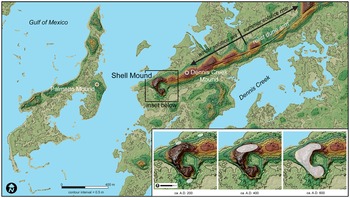
In its current configuration, which was achieved about 1,400 years ago, Shell Mound is an arcuate (C-shaped) ridge-and-mound complex of mostly oyster shell roughly 180 × 170 m in plan and 7 m tall at an apex opposite an opening to the southeast (Figure 2). Its enclosed, plaza-like central space is roughly 60 m in diameter. In its geometry and relief, Shell Mound resembles some of the shell rings of the lower Southeast, although these generally date to the Late Archaic period (ca. 3000–1200 BC; Russo and Heide Reference Russo and Heide2001; Saunders Reference Saunders2017). Ring-shaped middens resulting from circular or semicircular villages of the first millennium AD have been documented along the Gulf Coast of Florida (Russo et al. Reference Russo, Dengel, Shanks, Wallis and Randall2014), but none express the topographic relief of Shell Mound.
Topographic map of the area surrounding Shell Mound (8LV42) and Palmetto Mound (8LV2). Note the relief and orientation of the relict dune arm on which Shell Mound sits. Inset to the bottom right illustrates the history of occupation starting with ephemeral use of the landform at low elevation at AD 200, followed by occupation of the dune arm and pit digging after AD 400 and terraforming of the south ridge by AD 600.

Until recently, Shell Mound was the subject of only limited controlled excavation, a 10 × 10 ft. unit dug into the apex of the shell ridge (Bullen and Dolan Reference Bullen and Dolan1960). Sustained archaeological investigations at Shell Mound began in 2012 (Sassaman et al. Reference Sassaman, Palmiotto, Mahar, Monés and McFadden2013) and benefited from the assistance of students of the Lower Suwannee Archaeological Field Schools in 2014 (Sassaman et al. Reference Sassaman, Mahar, Donop, Jenkins, Boucher, Oliveira and Goodwin2015) and 2015 (Sassaman et al. Reference Sassaman, Barbour, Blessing, Boucher, Donop, Duke, Goodwin, Jenkins, Mahar and Monés2019). The enduring goal of testing has been to sample the site widely to establish the range of variation of subsurface deposits, with emphasis on both the deep stratigraphic profiles of the shell ridge and feature assemblages in the central plaza and dune arm.
The structure and sequence of mounded shell and associated matrix at Shell Mound are complex but relatively well known to us. Before the arcuate ridge was erected, occupation of the top of the dune arm resulted in the accumulation of thick organic midden. At the same time, many large pits were dug and backfilled along the side slope of the arm. At about AD 550, midden and pit fill from the base of the side slope was mined and redeposited to the south of the arm to form the arcuate ridge. Pits continued to be excavated and backfilled in the dune arm during this phase of “terraforming” (Randall and Sassaman Reference Randall and Sassaman2017). In addition, two mortuary mounds in the vicinity of Shell Mound must be counted as components of this terraformed landscape. Dennis Creek Mound—250 m to the northeast, along the dune arm—was small and short-lived (Boucher Reference Boucher2017). Palmetto Mound—500 m to the west, across intertidal water—was the locus of intensive mortuary practice since at least 400 BC (Donop Reference Donop2017). Growing over the centuries to become the densest bundle of persons, pots, and other objects in the region, Palmetto Mound was the likely impetus for siting ritual gatherings on the nearby dune arm where Shell Mound would later arise.
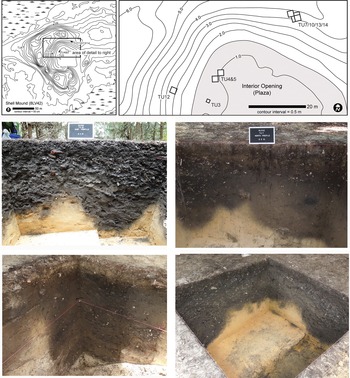
The north ridge of Shell Mound owes much of its topographic relief to aeolian process. Beneath a veneer of emplaced shell midden is a 3–4 m thick mantle of dune sand. As noted above, large pits were dug into the dune sands and backfilled. Twenty-two such pits have been uncovered in two locations on the southeast side slope tested to date (Figure 3). At least 1 m wide and up to 2 m deep, cylindrical and hemispherical pits were backfilled with organic matrix that stands in sharp contrast to the inorganic yellow-brown dune sand into which they were dug. Contained in the pit fill are shell and abundant vertebrate faunal remains dominated by the bones of mullet and other fish, sea turtle, wading birds, and white-tailed deer, among other taxa. Accompanying the bones and shell are sherds from large cooking vessels and small serving vessels. Occasional exotic items such as mica and quartz crystal have been unearthed. Extrapolating the density of pits exposed in test excavations to the expanse of the southeast side slope, at least 675 pits were excavated and backfilled (Sassaman et al. Reference Sassaman, Barbour, Blessing, Boucher, Donop, Duke, Goodwin, Jenkins, Mahar and Monés2019). The analyses we report below focus on the fill of six pits divided between two locations on the side slope.
Sample of large infilled pits that were exposed in test excavations on the southern slope of the dune arm at Shell Mound. All excavation units of profiles shown here are 2 × 2 m in plan.

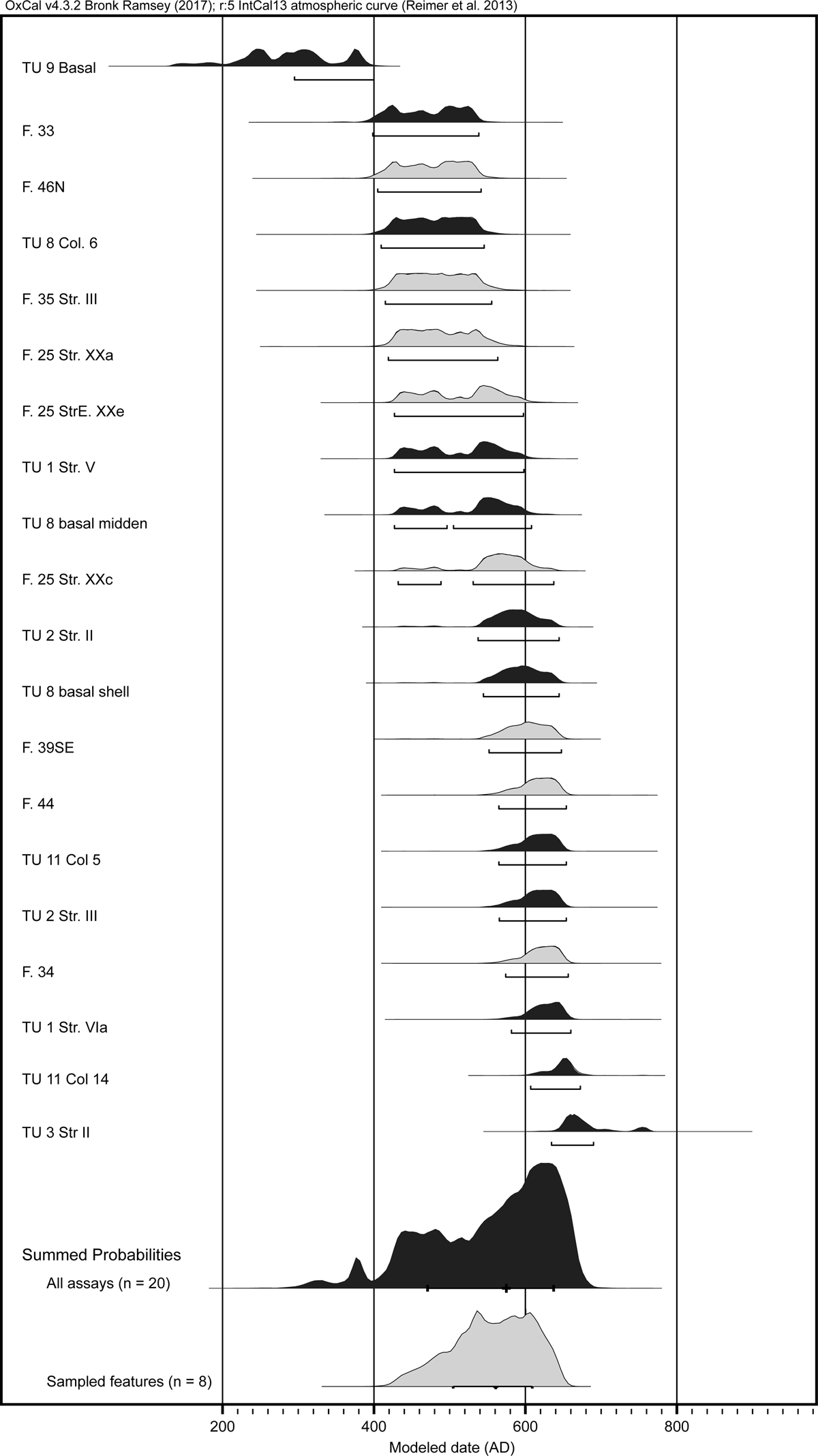
The use of pits before they were backfilled is unknown, but earth oven cooking is a possibility. Irrespective of their initial use, large pits must have been backfilled soon after being dug because deep vertical cuts into dune sands are inherently unstable. Large pits were thus short-lived and not likely reused. However, those documented to date were intercepted by other pits, so the activities during which they were dug, used, and backfilled were protracted over many events. The six relatively discrete pits for which we have accelerator mass spectrometry (AMS) assays span a 250-year period of about AD 400–650 (Sassaman et al. Reference Sassaman, Barbour, Blessing, Boucher, Donop, Duke, Goodwin, Jenkins, Mahar and Monés2019:Appendix B), roughly mirroring the history of Shell Mound before and during the period of terraforming (Figure 4). Although pits generally are not stratified, those with distinct layers also appear to have been infilled quickly. Three AMS age estimates on charcoal from successive strata of Feature 25, for example, overlap at one sigma and are thus statistically coeval (Supplemental Text 4).
Individual and summed probability distributions of 20 accelerator mass spectrometry assays on charcoal from sampled features (in gray) and accretional midden at Shell Mound (8LV42). OxCal v4.3.2 Bronk Ramsey (Reference Bronk Ramsey2017); r:5 IntCal13 atmospheric curve (Reimer et al. Reference Reimer, Bard, Bayliss, Beck, Blackwell, Bronk Ramsey, Buck, Cheng, Edwards, Friedrich, Grootes, Guilderson, Haflidason, Hajdas, Hatté, Heaton, Hoffmann, Hogg, Hughen, Kaiser, Kromer, Manning, Niu, Reimer, Richards, Scott, Southon, Staff, Turney and van der Plicht2013).

We hypothesize that the pit fill was deposited in conjunction with ritual feasting and that these events took place during solstices. As we review in detail below, the preponderance of vertebrate faunal evidence points to summer events. Accretional midden from coeval deposits at Shell Mound provides limited but insightful evidence of depositional events at other times of the year. After summarizing the vertebrate assemblages of pits, we review the remains of infrastructure and practices that enabled intensified production.
Vertebrate Assemblages in Pits
Excavation of pit features was not standardized, owing to the complexities of intersecting pits in confined space, but all were sampled in bulk for flotation, and the remaining fill was passed through ¼-inch or ⅛-inch screens. For our purposes here only the ¼-inch fraction of pit fill is reported. We also note that the volume of pit fill passed through screens was not measured and thus comparisons must be restricted to relative frequencies of taxa. Despite the lack of data to calculate the density of vertebrate faunal remains in screened fill, both the volume of fill and frequency of bony elements were sizable, in keeping with the large size of the pits.
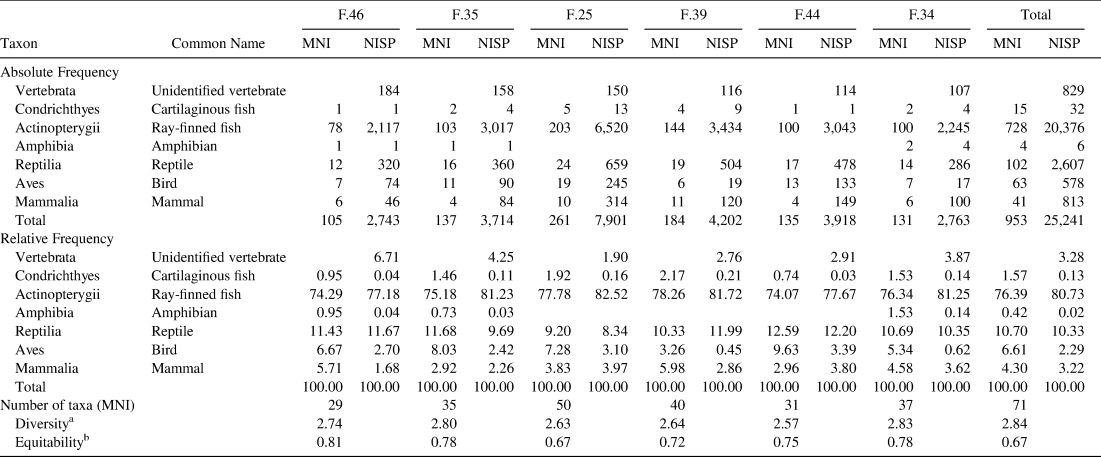
A total of 25,241 bony elements ¼ inch or greater in size were identified from the screened fill of six pit features at Shell Mound (Table 1). These account for a minimum number of individuals (MNI) of 953 distributed across 86 taxa. Fish account for the vast majority of individuals, a total of 723, or 76.4% by MNI. Mullet constitute nearly half of all the fish (45.6% by MNI), followed by lesser fractions of jack (9.8%), sheepshead (7.1%), red drum (7.1%), sea trout (6.9%), and hardhead catfish (5.4%). Black drum, flounder, pinfish, and gar contribute between 1.5% and 3.0% each. Bowfin, Gulf sturgeon, ladyfish, toadfish, pigfish, freshwater catfish, and largemouth bass each occur as more than a trace. The bones of sharks and rays are few but occur in nearly all pits.
Absolute Frequency of the Minimum Number of Individuals (MNI) and Number of Individual Specimens (NISP) for Vertebrate Taxa in Six Pit Features at Shell Mound (8LV42).

Turtles and tortoises make up just over 10% of the total MNI, most of which are sea turtles (n = 37), mud turtles (n = 25), and box turtles (n = 11). Snapping turtles, pond turtles, and gopher tortoises are represented by six individuals each, and diamondback terrapin and softshell turtle each by two. Snakes are represented in all pits in trace frequencies.
Birds account for about 6.6% of all MNI. Well over half of the 63 birds identified are white ibis (n = 39), at least two-thirds of which are juveniles, providing our most precise measure of season of capture (see below). The only other avian taxa to occur as more than a trace are ducks (n = 5), pied-billed grebes (n = 4), and blue herons (n = 5), the latter of which are all juveniles. Loon, horned grebe, double-crested cormorant, yellow-crowned night heron, spoonbill, herring gull, turkey, and crow are each represented by a single individual, most by only a single element.
All pits contain the bones of white-tailed deer. We count at least 17 individuals among the 669 elements and note that some, maybe most, were young. Rabbit (n = 7), opossum (n = 6), and raccoon (n = 4) occur across most pits in low but appreciable frequencies. Single elements of panther, skunk, wood rat, and cotton rat round out the modest inventory of terrestrial mammals, and we count two dolphins by single elements in each of two pits.
In sum, vertebrate bone from Shell Mound is dominated by mullet but also includes appreciable numbers of other saltwater fish taxa, as well as sea turtles, mud turtles, juvenile white ibises, and white-tailed deer. The condition of bone recovered from the pits is uniformly excellent. Traces of gnawing or weathering are scarce, as is the incidence of burning. Bone from accretional midden at Shell Mound is not always so well preserved, owing presumably to prolonged surface exposure or redeposition. In contrast, the infilling of pits with bone and other materials must have been relatively quick.
Comparing Pit Assemblages
The contents of large pits at Shell Mound are not identical, but they are very similar. With minor exceptions, the proportions of taxa across general categories vary by only a few percentage points from aggregate values (Table 2). Across pit assemblages, ray-finned fish consistently constitute ~76% of MNI; reptiles (turtles/tortoises), ~11%; birds, ~7%; mammals, ~4%; and cartilaginous fish, ~2%. Again, all assemblages contain abundant mullet bone, accounting for 25.6% (Feature 35) to 42.5% (Feature 25) of all vertebrate taxa by MNI. The average percentage of mullet across pits, 34.8%, has the least amount of variance of any taxon. As might be expected, taxa of low frequency show the greatest variation across features, but those with at least 10 individuals collectively express limited variance across features. Shown in Figure 5 are the relative frequencies of taxa by MNI that meet this criterion, less mullet, which strongly diminish the relative values of all other taxa. This subset of 467 individuals across 14 taxa makes up 49.0% of all MNI. Individuals of each of these taxa, like mullet, are represented by bone in each of the pits and generally in like proportions. Individuals of seven of the taxa (crevalle jack, sheepshead, red drum, sea trout, hardhead catfish, white ibis, sea turtle) account for ~8%–15% each of the MNI of this subset. Notable exceptions include the higher fraction of jack in Feature 35, the spikes in sea trout in Features 46 and 34, and the diminished fraction of white ibis in Feature 39. Another four taxa (mud turtles, black drum, flounder, white-tailed deer) each contribute ~4%–5% of the MNI per pit, with a few exceptions (e.g., spikes in back drum and white-tailed deer in Feature 39). The final three taxa of this subset (gar, pinfish, box turtle) each account for another ~2%–3% of MNI. Minor variations notwithstanding, vertebrate taxa from Shell Mound pits are consistent in type and relative frequency.
Relative frequency of minimum number of individuals (MNI) of major taxa (>10 MNI), excluding mullet, in six pit features, Shell Mound (8LV42), ¼-inch fraction. Combined MNI (n = 467) by taxa: jack (n = 71), sheepshead (n = 52), red drum (n = 52), sea trout (n = 50), hardhead catfish (n = 50), white ibis (n = 39), sea turtle (n = 37), mud turtle (n = 25), black drum (n = 22), flounder (n = 18), white-tailed deer (n = 17), gar (n = 12), pinfish (n = 11), and box turtle (n = 11).

Absolute and Relative Frequencies of Minimum Number of Individuals (MNI) and Number of Individual Specimens (NISP) of Vertebrate Faunal Remains >¼ Inch by Feature and General Taxon, Shell Mound (8LV42).

Note: Diversity and equitability values calculated with absolute frequencies of MNI.
a Calculated using the Shannon-Weaver function (Reitz and Wing Reference Reitz and Wing1999:105).
b Calculated as the Shannon-Weaver function/log of total number of taxa (Reitz and Wing Reference Reitz and Wing1999:105).
Values for the diversity and equitability of taxa are also comparable across pit assemblages (Table 2). Diversity values for all MNI are relatively high, ranging from 2.57 to 2.83 across taxa totaling from 29 to 50 per pit. Owing to the high frequencies of mullet, equitability values are moderate, ranging from 0.67 to 0.81. Limited variation in these values across pits is consistent with the frequency data we just reviewed and stands in contrast with values for nonfeature midden assemblages we review below after considering the seasonality of pits.
Inferring Season of Capture/Deposition
Among the avian remains in each of the six pits in our sample are the bones of a species with an unusually specific indicator of season of capture. The bones of at least two and as many as 12 white ibises (Eudocimus albus) per pit are dominated by elements whose immature level of development indicates capture in early summer. Details of this evidence are presented by Goodwin (Reference Goodwin2017; Goodwin et al. Reference Goodwin, Sassaman, Blessing and Steadman2019), who also delves into the symbolic import of birds and bird imagery in the cultural milieu of Middle Woodland rituality. Without repeating these details, it bears mentioning that the strength of this inference is predicated on a longitudinal study of the breeding ecology of white ibises in an offshore rookery 12 km from Shell Mound (Rudegeair Reference Rudegeair1975). Although we cannot be certain that this or another offshore rookery was the locus of juvenile white ibis capture at the time of Shell Mound feasts, we are certain that they were taken in the summer, more specifically, mid- to late June.
Other taxa in Shell Mound pits lend support to the timing of ibis capture. Regarding the fish we note the usual frustration of ascribing season of capture to any Gulf Coastal fish because members of each species can be taken any time of the year, if not also in the same location. However, there are notable exceptions to this tendency, and when we consider data on seasonal variation in capture rates as well as allometry, support for the inference of summer capture abounds.
With respect to variation in capture rates, data from the long-standing Florida Fish and Wildlife (FWC) fish collection program provide some basis for comparisons across seasons (FWC 2016). Data used by Palmiotto (Reference Palmiotto2016) to construct “effective seasons” include seine net captures from 1996 to 2012 across thousands of randomly selected sample sites in the greater vicinity of Shell Mound. Collection trips over this span averaged about six per month, with eight sampling locations per trip. More than 430,000 fish were captured on these trips, each identified to taxon and size.
In her analysis of monthly capture data from FWC, Palmiotto (Reference Palmiotto2015, Reference Palmiotto2016) concludes that effective seasons must take into account annual variations in both temperature and precipitation. She infers from these data four seasons: (1) the warm-dry season of April through May, (2) the warm-wet season of June through September, (3) the cool-dry season of October through January, and (4) the cool-wet season of February through March.
With reference to these effective seasons, six of the eight high-frequency fish taxa found in Shell Mound pits were taken at the greatest frequencies during the warm-wet season. The exceptions are mullet and red drum. Given the high frequency of mullet in Shell Mound pits, the FWC data would seem to undermine the inference of capture around June. To the contrary, allometric data on mullet from Shell Mound pits support summer timing (Mahar Reference Mahar2019). An estimate of standard length for a combined 243 mullet from all six pits (31–51 per pit) averages 290.73 mm, with a standard deviation of 38.10 mm (Figure 6). The low variance (cv = 0.13) of this population points to same-age capture. As Palmiotto (Reference Palmiotto2015:78) notes from FWC data, mullet express the least variation in size during the warm-wet season. Striped mullet that are 300 mm in length are roughly three years of age, just reaching sexually maturity and on the verge of their first offshore spawning run in the fall (Florida Museum of Natural History 2019). It stands to reason that same-age capture of this size fish targeted nearshore schools as they were fattening up during the summer.
Absolute frequency distribution of mullet by estimated standard length (mm) from six pit features at Shell Mound (8LV42; n = 243).

In contrast to mullet, which vary most in size during cool months, jack vary most in size during warm months. Allometric data on jack from the pits tend to support this expectation: jack in pits express more size variation than mullet (Mahar Reference Mahar2019:232, 298). Sea turtles can also be taken year-round, but they are concentrated in the nesting season of summer, which begins in May. The beaches of offshore islands are nesting sites today.
On balance, multiple lines of evidence point to a warm-wet season of deposition for the fill of large pits at Shell Mound. Given the timing afforded by the immature bones of juvenile white ibises, these activities likely took place in mid- to late June, the time of summer solstice. Before turning to the infrastructure and practices that supported summer solstice feasts, a comparison of pit assemblages with those of accretional midden at Shell Mound corroborates the seasonal specificity of pit fill.
Vertebrate Faunal Remains in Accretional Midden
Most of the anthropogenic deposits at Shell Mound consist of accretional midden that accumulated along the top of the relict dune arm and its margins. Much of the south ridge and some of the north ridge consist of redeposited fill, including former pit fill. Beneath redeposited fill on top of the dune arm and along the south ridge are autochthonous midden deposits. Testing in several locations of accretional midden resulted in the recovery of vertebrate faunal remains that can be compared with those of the pit assemblages. Such comparisons serve more than simply to corroborate that pits contain the fill of summer solstice feasts. If Shell Mound was a civic-ceremonial center that supported a resident population, as well as ritual gatherings, then we ought to be able to locate deposits that were emplaced during times other than mid- to late June.
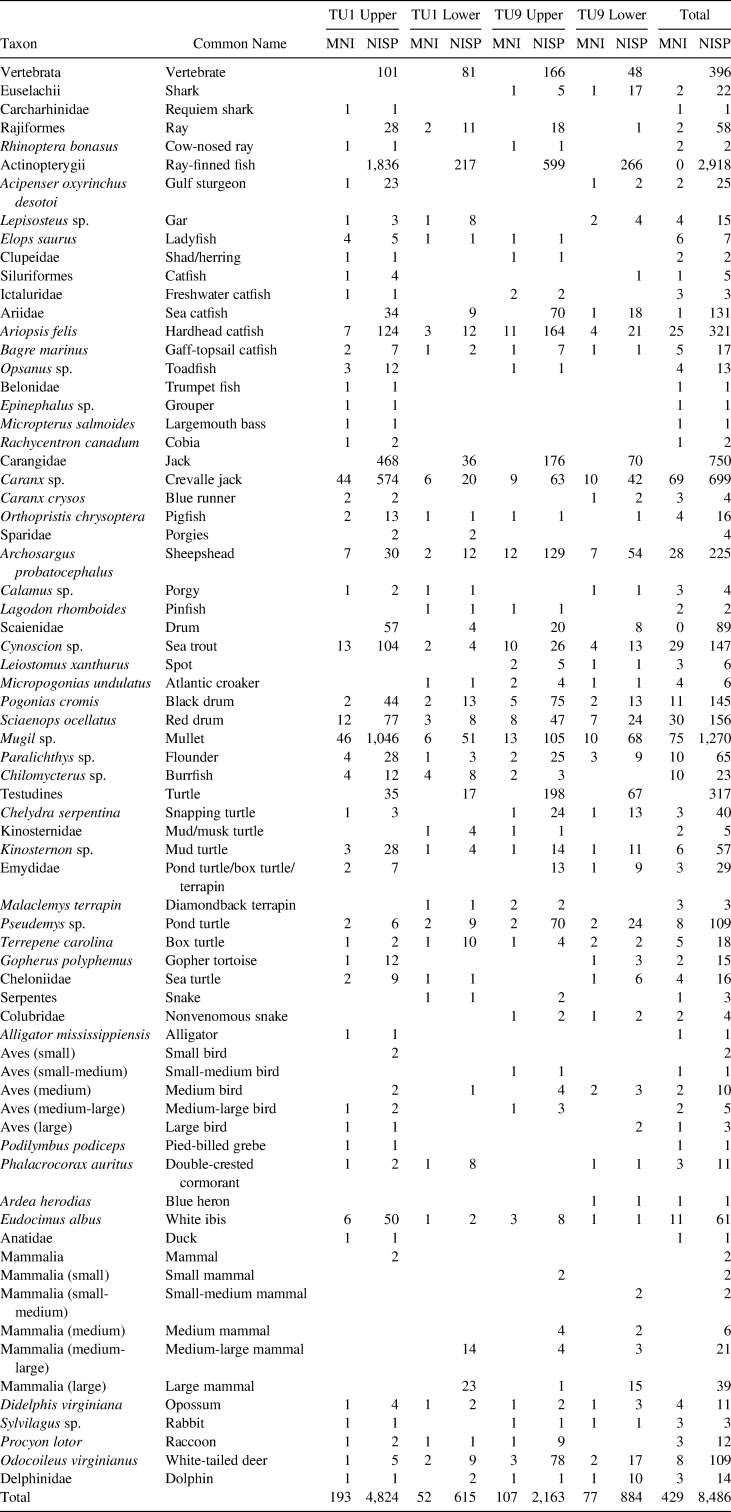
Two test units—one each on the north and south outer ridges of Shell Mound—provide provisional evidence for cool-season procurement and deposition (Table 3). Test Units 1 and 9 exposed well-stratified oyster midden with abundant vertebrate fauna. The lower macro-unit of Test Unit 1 and both macro-units of Test Unit 9 are coeval with pit activity at Shell Mound. The upper macro-unit of Test Unit 1 consists of redeposited fill, a pattern repeated at other locations on the south ridge. For the observations that follow, this redeposited fill is exempted and we refer to the nonpit, accretional deposition simply as “midden.”
Absolute Frequency of the Minimum Number of Individuals (MNI) and Number of Individual Specimens (NISP) of Vertebrate Taxa in Accretional Midden at Shell Mound (8LV42).

The most marked difference between pit and midden vertebrate fauna is the diminished frequency of mullet in the latter. Mullet constitutes only about 11% of MNI in midden contexts. Jack make up another 9%–12% of MNI, comparable to pits, and are typically larger in midden fill. Other fish taxa in midden deviate between the two units in ways not seen in the pit fill. Sea trout, hardhead catfish, and sheepshead are twice as common in Test Unit 9 as in Test Unit 1. Collectively these taxa occur at about twice the frequency observed in pits. Black drum, red drum, and white-tailed deer are all proportionately more common in midden than in pits. White ibis occur in all midden contexts but at considerably lower frequency than in pits; some of the individuals in midden are juvenile. Remarkably, sea turtle is completely absent from midden in Test Unit 9, and mud turtles appear as only a trace. Two fish species that are rare or absent in pits, Atlantic croaker and burrfish, are represented by several individuals in midden.
Overall, midden vertebrate assemblages are more diverse (3.07–3.21) and considerably more equitable (0.86–0.94) than those from pits. Subtle but meaningful trends in fish taxa suggest that midden includes cool-weather deposits (e.g., bones of spot; Palmiotto Reference Palmiotto2015:274). More cautiously, we suggest that the midden assemblages analyzed to date are not as season-specific as the pit assemblages and thus reflect activities aside from summer solstice events.
Technology of Feasts
Beyond the bony remains of pits are a variety of material residues of technologies and practices geared toward the ritual intensification of summer solstice feasts and other interventions to enhance production. In the sections that follow we briefly review evidence for (1) the pottery technology of feasts, (2) a tidal fish trap for harvesting mullet and other fish, and (3) the management of oysters.
Pottery
All contexts at Shell Mound contain sherds of pottery, and the vast majority of these are from limestone-tempered vessels of the Pasco tradition (Goggin Reference Goggin1948). Widespread along the northern Gulf Coast, Pasco pottery dates as early as 200 BC and continued to be used until at least AD 700. Vessels of this tradition vary from open bowls to tall jars, and they are predominately plain. The distinguishing feature of Pasco ware is its limestone temper, an abundant substance in the region.
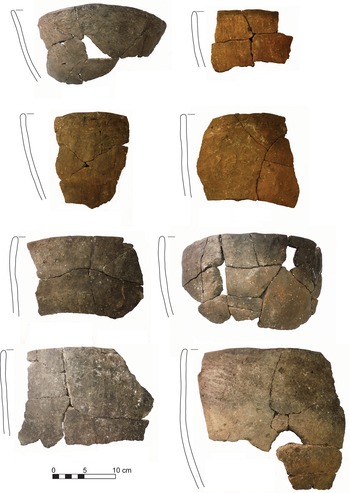
Sherds of Pasco pottery from pits are distinguished from sherds in other contexts by their larger-than-average size and by surfaces indicative of expedient manufacture (Figure 7). Pits tend to contain larger sherds than accretional midden for taphonomic reasons alone, but many sherds from pits are from unusually large vessels. Shown in Figure 8 is the frequency distribution of all Pasco vessels for which rim portions are large enough to estimate orifice diameter. This sample of 22 vessels has an average orifice diameter of 35.7 cm and a modal tendency of 46–50 cm. Although we do not have comparable data on the height of these vessels, the largest shown in Figure 7 is estimated to be at least 40 cm tall.
Rim portions and profile drawings of large cooking vessels from pit features at Shell Mound (8LV42).

Comparison of the frequency distributions of the orifice diameters of limestone-tempered Pasco vessels from pits at Shell Mound (8LV42) and from other sites in the region.

There are few large rim portions from accretional midden to compare against those from pits. However, a sample of 29 large Pasco rim sherds from surface collections of sites in the vicinity of Shell Mound is characterized by a mean orifice diameter of only 25.2 cm and a modal range of 16–30 cm (O'Donoughue Reference O'Donoughue2009). Despite the small samples, Pasco vessels represented by sherds in pits have orifices that are more than 10 cm on average larger than the general population of Pasco vessels (Figure 8). Several of those from Shell Mound pits bear traces of soot on exterior surfaces, direct evidence for use over open fire. These were thus large cooking vessels, the largest capable of holding more than 50 L. Although cooking large quantities of food may not have conferred social advantage in the context of communal feasting (cf. Blitz Reference Blitz1993), big pots evidently served the needs of big events (see Kassabaum Reference Kassabaum2014 for another example of large vessels produced for communal feasts).
Further details on the condition of Pasco sherds from pits suggest that the production of large cooking vessels was expedient, evidently for the express purpose of feasting events. Pasco pottery in general is not refined, but some of the large vessels from feasting pits are especially unrefined. Exterior surfaces tend to be only roughly smoothed, with some so weakly smoothed that joints between coils are exposed. Despite the vulnerability of uneven surfaces to thermal shock, these unrefined vessels clearly were drafted into thermal uses. We infer from this that large vessels in pits were not intended to last long. One, in fact, has a radial impact fracture in its sidewall and possibly was deliberately “killed” before being deposited in a pit (Figure 7, Vessel 1). Cooking vessels appear to have been made, used, and discarded in the span of single feasting events.
Serving vessels tell a different story (Figure 9). Although they are infrequent, the sherds of small bowls from pits tend to be either spicule- or sand-tempered. They are also well crafted and occasionally eccentric in design. At least one of the spicule-tempered bowls was painted or slipped with a red substance, a characteristic of the Dunns Creek Red type common to northeast Florida. Whereas this example might imply that feasts at Shell Mound were attended by visitors from afar, a recent provenance study of spicule-tempered pottery in Florida points to predominately local manufacture, even on the Gulf Coast (Bloch et al. Reference Bloch, Wallis, Kamenov and Jaeger2019). Nonetheless, serving vessels in Shell Mound pits deviate from cooking vessels not only in form and function but also in paste, manufacture, and surface treatment. Even if not from far away, serving vessels in feasting pits likely include examples that were carried to Shell Mound by guests.
Rim portions, profile drawings, and orifice plan drawings (gray) of four serving vessels from pits at Shell Mound (8LV42).

Tidal Fish Trap
Whether or not they were cooked in pots, mullet were captured, brought to Shell Mound, and deposited in pits in large quantities. With a projected population of 675 pits and an average of 53.3 mullet per pit, an estimated 37,328 mullet were harvested and deposited over a 250-year period. If events were annual, this comes to a modest 149 mullet per event, but it is much more likely that the actual rate of capture fluctuated from year to year. A fish trap south of Shell Mound gives us reason to assume that harvests were at least occasionally quite large.
Before modern prohibitions on the use of certain mass capture technologies (i.e., gill nets; Anderson Reference Anderson2002), commercial mullet fisherfolk targeted schools heading out to the Gulf of Mexico to spawn. This was a fall activity, when schools in the thousands were harvested with nets stretched across the outlet of the Suwannee River. Today recreational and subsistence fishing for mullet involves the use of cast nets or small beach seine nets, which are deployed year-round with a bag limit of 50 per person (FWC 2019). Nearshore locations are often productive, although schools are much more dispersed during the summer, when they are feeding on zooplankton, algae, plant detritus, and other small marine resources before the fall spawning runs.
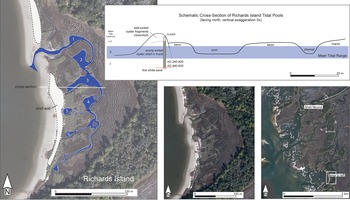
Like those of the fall, summer harvests of mullet in large quantities would have benefited from, perhaps required, some means of mass capture (Mahar Reference Mahar2019). Large seine nets are one possibility, but we suspect that a series of tidal pools 2 km south of Shell Mound were used as a tidal fish trap (Figure 10). Enclosing these pools are two seawalls consisting mostly of oyster shell. The upper stratum of these walls consists of reworked shell “hash,” the result of repeated tidal surge. To the extent the walls consisted entirely of shell hash, they are not likely to have involved human engineering, although the outcome would have been beneficial for trapping fish that entered the pools at high tide. However, below about 60 cm of shell hash is a 2+ m thick mantle of poorly sorted oyster shell in muck. Our preliminary assessment is that this mantle was emplaced deliberately to create the seawall and hence the fish trap (Sassaman et al. Reference Sassaman, Barbour, Blessing, Boucher, Donop, Duke, Goodwin, Jenkins, Mahar and Monés2019). We have no information on the source of the shell and muck, but two radiometric dates on oyster shell from the base of the mantle correspond to the time of feasting activities at Shell Mound, and they are in reverse order, which is a common pattern of terraforming with extant midden (Randall and Sassaman Reference Randall and Sassaman2017). Moreover, an ephemeral midden on a hammock to the immediate north of the tidal pools returned a calibrated two-sigma AMS age estimate of AD 550–650 (Sassaman et al. Reference Sassaman, Barbour, Blessing, Boucher, Donop, Duke, Goodwin, Jenkins, Mahar and Monés2019:Appendix B).
Tidal pools and shell seawall of Richards Island (left), with inset of schematic cross section (upper right) of these features, and Google Earth image of the greater vicinity (bottom right), showing the location of Shell Mound.

In the near future we plan to conduct more testing at the Richards Island tidal pool complex, as well as acquire high-resolution lidar data to more accurately characterize the morphology of the seawalls, the pools, and the berms that separate them. For now we can only hypothesize how this probable trap was used. Although it resembles the technology of tidal traps in coastal South Africa (Avery Reference Avery1975), the current tidal range in the Lower Suwannee area (<1 m) is insufficient to breach the seawall. It is more likely that water and fish entered the pools via the opening seen today and then were trapped by a net or gate that prevented fish from escaping as the tide receded. Recalling the size and age of mullet in Shell Mound pits, schools of three-year-old mullet would have frequented the nearshore waters of the area to fatten up before moving toward the Suwannee Delta and the Gulf in the fall. Of course, smaller and larger fish would have entered the pools too, but the size of fish harvested would have been constrained by the gauge of netting or fencing that was used at the tidal outlet.
Oyster Mariculture
Oyster shell is by far the most numerous animal remains at Shell Mound, even if it does not constitute much of the fill of large pits. As described earlier, shell accumulated on the top and side slopes of the dune ridge and in primary and secondary deposits of the arcuate ridge. Extrapolating the density of shell in bulk samples of accretional midden, Shell Mound contains an estimated 1.2 billion oyster shells (Sassaman et al. Reference Sassaman, Barbour, Blessing, Boucher, Donop, Duke, Goodwin, Jenkins, Mahar and Monés2019). We have no basis for arguing that oysters were harvested in large quantities for summer solstice feasts, but clearly they factored significantly in the subsistence of year-round residents, and they were the chief substance of terraforming. Historically, the Lower Suwannee region was an exceptional oyster habitat, notable for subtidal reefs that were both the product of and precedent for estuarine conditions (Berquist et al. Reference Berquist, Hale, Baker and Baker2006; Seavey et al. Reference Seavey, Pine, Frederick, Sturmer and Berrigan2011). Since 4,500 years ago, when reefs now in need of restoration took shape, the productivity of oyster (and the fisheries they support) could have been enhanced, or at least sustained, with nominal human intervention.
Evidence for oyster mariculture during the occupation of Shell Mound is described elsewhere (Jenkins Reference Jenkins2017) and need not be repeated here in detail. In short, shells from subtidal reefs in certain contexts bear evidence for culling, and the deposits in which these shells are concentrated are dominated by left valves. Right valves presumably were left at or returned to reefs to encourage growth. This amounts to indirect evidence for culling and shelling, two common maricultural practices of the modern era (Jenkins Reference Jenkins2016; US National Research Council 1992:29). Shells bearing this evidence were recovered from a 50 cm thick stratum near the apex of Shell Mound dating from ~AD 550–650. Arguably, this stratum accumulated quickly, as it consists of little other than shell. Similar “clean shell” strata at Late Archaic shell rings of the Atlantic coast have been interpreted as evidence for feasting (e.g., Russo Reference Russo, Gibson and Carr2004; Saunders Reference Saunders2017; Thompson and Andrus Reference Thompson and Andrus2011). Against the ambient collection of intertidal oysters at Shell Mound—proximate to the site and ubiquitous in most depositional contexts—the collection of cultured oysters was likely more eventful. We have yet to collect data on the seasonality of the mass deposition of oyster shell at Shell Mound, but judging from isotopic results from shells of a later civic-ceremonial center to the south (Roberts Island), winter is likely (Lulewicz et al. Reference Lulewicz, Thompson, Pluckhahn, Andrus and Das2018).
If collected and deposited in winter, cultured oyster shells are not expected to have accumulated in the pits of summer feasts, but we must bear in mind that shell was often mounded and thus dissociated from coeval counterparts of bone and other matter. Timing of events aside, oyster mariculture likely sustained or even enhanced the health and productivity of subtidal reefs. In comparing the sizes of shells from early and later contexts Jenkins (Reference Jenkins2016, Reference Jenkins2017) finds no evidence for resource depression but rather an increase in height and height-to-length ratio of shell over time.
Discussion
To summarize, large pits dug into the relict dune arm of Shell Mound contain vertebrate fauna remains indicative of large-scale feasts that took place around the time of summer solstices. Harvested in mass, mullet were the mainstay of solstice feasts, accompanied by other fish, sea turtles, juvenile ibises, and deer, among other resources. Accretional midden at Shell Mound contains most of the same taxa as pits, but with much less emphasis on mullet and indicators for subsistence activities throughout the year. We imagine that the events materialized in the fill of large pits punctuated the otherwise everyday activities of Shell Mound residents. The scale of food harvesting and processing suggests that nonresidents regularly gathered at Shell Mound for these annual events (Supplemental Text 5).
Attention to the cosmological rationale for the ritual economy of Shell Mound turns our focus away from the ecological capacity of the place to sustain gatherings and toward the larger time-space context of feasting events. In this regard, we come to understand why feasts were held at Shell Mound and why they were timed to the summer solstice. It is not because this place and this time were more abundant with food than any other place and time (cf. Weissner Reference Weissner, Dietler and Hayden2001:117). Indeed, if mullet were needed in quantity, the fall spawning runs would have been targeted, and if gatherings were sited proximate to places where juvenile birds, marine turtles, and large fish were most abundant, they would have taken place on the offshore islands.
The deeper history and regional context of Shell Mound point to a cosmological significance that overshadowed ecological constraints. As outlined earlier, a history of shoreline retreat going back millennia contributed to a horizontal temporality (sensu Herva and Ylimaunu Reference Herva and Ylimaunu2014) that was experienced in repeated abandonment and resettlement but also indexed to solar cycles. Because the most prominent landforms of the region were parabolic dunes with solstitial orientations, it may have been inevitable that dune arms would garner attention as materialized solar standstills. At the intersection of sky and earth, these features were likely regarded as portals between realms of the cosmos, basically a tripartite scheme of Upper, Middle, and Lower Worlds (Hudson Reference Hudson1976:122–128). Ensuring that these worlds remain in balance through a cycle of rejuvenation is the work of world-renewal ceremonialism. As discussed earlier, Knight (Reference Knight, Dietler and Hayden2001) argues convincingly that communal feasting at civic-ceremonial centers of the Woodland Southeast was a matter of rejuvenation. Although the timing of such feasts eludes detection in most cases, Knight draws a comparison with the Green Corn ceremonies of ethnohistory, communal summer events even for societies with histories of social inequality.
Beyond the parallel between Green Corn ceremonialism and communal feasts of the Woodland period, there may be another reason that summer solstice was the time of world renewal. Because summer solstice is the longest day of the year, the ensuing six months of increasingly shorter days would not appear to be a trend toward renewal. However, the Lower World of the cosmos was, among many things, the realm of future time (Hudson Reference Hudson1976:127–128). Increasingly longer nights and shorter days meant that the sun spent more time each day in the Lower World. As water was associated with the Lower World in ethnohistoric accounts of the native Southeast (Hudson Reference Hudson1976:122–128), the long-term encroachment of water over land lent a horizontal quality to the cyclical process of world renewal.
Shell Mound is unlike any other civic-ceremonial center in the region in form, and now it stands alone as the only place providing evidence for summer events (Supplemental Text 6). Roughly coeval civic-ceremonial centers to the north and south of Shell Mound provide evidence for winter events of extradomestic scope, such as mounding (Lulewicz et al. Reference Lulewicz, Thompson, Pluckhahn, Andrus and Das2018; Neill J. Wallis, personal communication Reference Bloch, Wallis, Kamenov and Jaeger2019). Rather than seeing these as incomparable data points, we think it is worth considering that all such centers were parts of a constellation of ritual involving the synchronized movement of persons and things (e.g., Bernardini Reference Bernardini2004; Howey and O'Shea Reference Howey and O'Shea2006; Pauketat Reference Pauketat2013; Pauketat et al. Reference Pauketat, Alt and Kruchten2017). A circuit of movement separating rituals of the winter and summer solstices in place comports with a distinction between mortuary (winter) and world-renewal (summer) ceremonialism (e.g., Hall Reference Hall1997; Knight Reference Knight, Dietler and Hayden2001). It may also explain the geographic displacement of mortuary pottery that is well documented by geochemical sourcing (e.g., Wallis et al. Reference Wallis, Pluckhahn and Glascock2016).
This brings us to one final observation. The six pits of our current sample span a 250-year period and thus signal in their relative consistency an enduring practice of summer solstice feasting. To the extent that pit fill contains small fish and other resources that were taken in nearshore, intertidal waters, variations in these taxa over time may in fact register environmental changes that contributed to the abandonment of Shell Mound after AD 650. It is certainly reasonable to suggest that environmental change posed challenges to a tradition that required so much provisioning, but we suspect that the range of tolerance for change was wide. Thus, changes in the nearshore habitats of Shell Mound may have had little impact on the ritual economy of solstice feasts; people were willing and able to travel farther to provision feasts, to build infrastructure to increase production, and to manage oysters to sustain residency. Arguably a more impactful measure was changing spatial relationships between the dead and the living as shorelines retreated. The one overstep event that is well documented in the region resulted in the landward siting of civic-ceremonial centers to places already established as cemeteries (Pluckhahn and Thompson Reference Pluckhahn and Thompson2018; Wallis et al. Reference Wallis, McFadden and Singleton2015). Shell Mound is the exception in that it went upward, not inward, to the top of a dune arm with a cemetery to the west that was evidently cut off from the mainland by rising sea. It is worth considering that this event alone precipitated intense world-renewal ceremonialism on the landward dune arm (future Shell Mound) and the establishment of a new mortuary mound (Dennis Creek Mound, to the northeast) as active interments and caching ceased in the now water-encased cemetery. Likewise, an apparent drop in sea level between about circa AD 600 and 850 (Sassaman et al. Reference Sassaman, Wallis, McFadden, Mahar, Jenkins, Donop, Monés, Palmiotto, Boucher, Goodwin and Oliveira2017) may have reconnected Palmetto Mound to the dune arm and been the impetus for the abandonment of Shell Mound at circa AD 650. Notably, mortuary activity at Palmetto Mound intensified in the centuries following abandonment (Donop Reference Donop2017).
Conclusion
Shell Mound illustrates how a ritual economy synced to solar cycles preconfigured the time and place of intensification. Place in this sense was not simply a matter of “persistence” but rather anticipated by its relational qualities in the cosmos, in this case its relationship to standstills of the sun. Places such as Poverty Point, Mound City, and the Great Houses of Chaco Canyon were sited where they were not because of intrinsic ecological potential but because of their connections to other times and places. Shell Mound never had the elaborate ritual architecture of these other places, or even the platform mounds of its counterparts in the Southeast, but it shared with places worldwide the materialization on earth of movements and events of the sky. Which astronomical events gather meaning through ritual practice in any particular place is a matter of history and culture. However, by virtue of the eventfulness of solstices, equinoxes, lunar standstills, and the like, the timing of ritual practices synced to astronomical cycles is preordained. At Shell Mound the ritual practices we can infer from archaeological remains were timed to summer solstices. It is not likely coincidental that summer solstice feasts took place on a parabolic dune oriented to the solstices or that the distal ends of dune arms in the area had been used to bury the dead for millennia. Both history and sacred geography predisposed Shell Mound for these events.
Summer solstice feasts at Shell Mound were relatively large events judging from the scale of the infrastructure and consumption involved. Insofar as the timing and siting of these events were a matter of cosmological precedent—as opposed to ecological or economic potential—proximate, nearshore food resources may not have been sufficient to provision these feasts. We do not know whether the procurement of offshore resources was a matter of necessity or preference, although we doubt that juvenile ibises were merely an abundant, albeit distant, food for feasting (Goodwin et al. Reference Goodwin, Sassaman, Blessing and Steadman2019). No matter, the construction of a fish trap to harvest mullet at the time of year when they were the least abundant in nearshore locations underscores the economic demands of ritual whose timing and siting were not determined by abundance or the ease of resource collecting. In the systems-serving terms of Rappaport, summer solstice feasts served to reproduce a network of communities that were dispersed across the region. They traveled to Shell Mound routinely in the summer, as they likely did to other places of ritual events at other times of the year, some on the coast, some far to the interior. If the comparison with Green Corn ceremonialism bears relevance, summer solstice feasts were communal events of world renewal. For communities whose experience on the coast included shoreline retreat and other disruptive consequences of changing sea level, world-renewal rituality served to reproduce alliances with communities of lesser vulnerability, such as those of interior Florida. Irrespective of its practical value, the cosmic work of world renewal that synchronized movements of the sky and earth was not to be constrained by the ecological limitations of ritually charged times and places. As Rappaport came to understand, religion in non-Western societies is not the epiphenomenon of ecosystems but instead the rationale for negotiating relationships between people and environment through ritual practice.
Acknowledgments
Excavations at Shell Mound were conducted under Archaeological Resources Protection Act permits with the U.S. Fish and Wildlife Service. We thank Fish and Wildlife Service archaeologist Richard Kanaski and refuge managers Andrew Gude and Larry Woodward for their support of our efforts. Funding for this research was provided by the Hyatt and Cici Brown Endowment for Florida Archaeology, Department of Anthropology, University of Florida. Mahar's research was supported by National Science Foundation Doctoral Dissertation Improvement Grant 1764138. We thank Neill Wallis, Tim Pauketat, and three anonymous reviewers for comments on a draft of this article that helped to clarify important points and American Antiquity editor Lynn Gamble for guidance with our revision. We are grateful for the expert help of Miriam E. Domínguez in translating our abstract into Spanish.
Data Availability Statement
All archaeological materials from Shell Mound (8LV42) reported herein are curated at the Laboratory of Southeastern Archaeology, Department of Anthropology, University of Florida, at the behest of the U.S. Fish and Wildlife Service.
Supplemental Materials
For supplementary material accompanying this article, visit https://doi.org/10.1017/aaq.2019.68.
Supplemental Text 1. Astronomical alignments of parabolic dunes.
Supplemental Text 2. World-Renewal.
Supplemental Text 3. Overstepping events.
Supplemental Text 4. Depositonal history of pits.
Supplemental Text 5. Sampling for everyday subsistence.
Supplemental Text 6. Shell Mound as anomalous.