Introduction
Terrorist groups are political organizations that try to achieve their goals by using violence against civilians.Footnote 1 Often, such groups assert that it is unfeasible to attain their goals using conventional and peaceful means. In fact, many group leaders justify the use of terror by arguing that the political system they target is too restrictive for their groups to voice grievances peacefully. For example, Kurdistan Workers Party (PKK) leaders often criticize the Turkish political system for failing to adequately represent Kurdish concerns and issues. Indeed, the system's restrictiveness is often cited as an important reason for the PKK's use of violence.Footnote 2
In democracies, elections are a fundamental political institution that enables discontented groups to address their concerns.Footnote 3 Accordingly, a rich body of research in the comparative politics literature studies the influence of electoral institutions on political instability and violence.Footnote 4 Seminal studies such as Powell and Lijphart show that democratic electoral systems differ in their ability to satisfy the grievances of societal groups. Less permissive electoral institutions with high electoral thresholds or majoritarian electoral formulas are considered to have a limited capacity to appease discontented societal groups.Footnote 5 Thus, variations among democracies in terms of electoral institutions should also be particularly relevant to the emergence of terrorism.
Recent political debates in Turkey also suggest a connection between electoral institutions and terrorism. In July 2010, the largest opposition party in Turkey, the Republican People's Party, submitted a bill to the Turkish parliament that proposes decreasing the country's high (10 per cent) electoral threshold to help resolve the problems with Kurdish terrorist groups. In an interview with Hürriyet, a major Turkish newspaper, the leader of the party emphasized how a lower election threshold would help smaller parties, such as the pro-Kurdish Peace and Democracy Party, increase their representation in parliament and help solve the country's problem of domestic terrorism.Footnote 6 This observation suggests an important relationship between the permissiveness of democratic electoral institutions and terrorism. Democracies with more permissive electoral institutions should provide more meaningful opportunities for marginal political groups to peacefully participate in electoral politics. Accordingly, marginal groups such as the Kurdish minority in Turkey should be less likely to resort to terrorism. However, despite the prominent and germane comparative politics literature on electoral institutions and political violence, few terrorism studies directly explore the relationship between electoral institutions and terrorism. Moreover, previous research does not find robust evidence that electoral rules significantly influence terrorism (such as Li).Footnote 7
We argue that a key reason behind the lack of evidence for the importance of electoral institutions is that the existing research overlooks important distinctions among terrorist groups’ goals. Terrorist groups differ from each other in terms of how extreme their goals are relative to the prevailing political system. For instance, groups such as Farem Tot Petar and Red Brigade of Occitania demand greater autonomy for Occitania and the Occitan language within France's existing political system. However, groups such as Turkish Hezbollah aim to overthrow the existing political system and establish a Muslim theocracy. This article defines within-system groups as those with goals that are consistent with securing representation in the existing political system. Anti-system groups have as their goal the complete overhaul of a country's existing political system. We argue that the distinction between groups with anti-system and within-system goals plays a significant and unexplored mediating role in determining whether a country's domestic political institutions can deter the emergence of terrorist groups. Since within-system groups are affected by the ease of attaining influence in electoral politics, the permissiveness of electoral institutions should influence the behaviour of within-system groups. In contrast, electoral institutions should not influence the calculus of anti-system groups, since their goals cannot be achieved by representation within the existing political system.
We believe that acknowledging the distinctions between anti-system and within-system groups also clarifies a key puzzle in the literature about regime type and terrorism. The vast majority of studies in the literature find that democracies experience more terrorism than non-democracies.Footnote 8 This finding is somewhat counterintuitive, since democracies provide citizens with peaceful means to raise their concerns and attain their political goals. In this article, we show that if we disregard groups’ goals, terrorist groups are significantly more likely to emerge in democracies, which is in line with the findings in the literature. However, if we take group goals into account, we find that democracies are not more likely to experience within-system group emergence than non-democracies and are only more likely to experience anti-system group emergence. We argue that the key reason for this difference is that democratic institutions are relatively effective at satisfying the grievances of within-system groups, but not those of anti-system groups. Thus, while the standard findings in the literature suggest that democratic institutions do not significantly reduce the propensity of discontented groups to use terrorism, we show that this is not necessarily true. The extent to which democratic institutions can deter terrorism depends on the goals of the discontented groups that resort to terrorist tactics.
In addition to emphasizing the importance of group goals, this article differs from previous work on electoral institutions and terrorism in two ways. First, unlike the vast majority of studies, we do not evaluate data on transnational terrorist incidents. Transnational groups do not typically have goals that can be gained via representation within the political system of the target state. We argue and show that electoral institutions have a significant influence on the behaviour of within-system groups with domestically orientated goals. Secondly, we do not focus on the number of terrorist incidents. We argue that it is more appropriate to focus on the initial emergence of terrorist groups than the number of terrorist incidents over time to understand the connection between electoral institutions and terrorism. Electoral institutions play a more direct role in shaping the incentives of aggrieved groups to begin employing violence than in determining the level of violence they inflict after turning to violent tactics, which is significantly linked to governments’ ability to swiftly respond to terrorism.Footnote 9 Thus, this article focuses on group emergence rather than on the number of attacks over time or the time-series properties of attacks.Footnote 10
In the rest of the article, we review the relevant literature and lay out our main arguments and hypotheses. We then assess the empirical veracity of our theoretical expectations using two distinct data sets on terrorist group emergence. First, we use a global dataset on terrorist groups collected by Jones and Libicki.Footnote 11 Secondly, we use the Terrorism in Western Europe Event Data (TWEED), which contains information on terrorist groups operating in Western European countries.Footnote 12 Importantly for our purposes, both datasets include information on groups’ primary political goals. We analyse these two sets of data with numerous empirical models and find consistent and strong support for our hypotheses. We conclude the paper with a summary and a discussion of our findings.
Electoral Institutions, Terrorism and Group Goals
The majority of terrorist attacks since the early 1970s have targeted democratic countries that provide citizens with peaceful means to raise their concerns.Footnote 13 Many scholars offer alternative explanations for this somewhat counterintuitive finding.Footnote 14 Some argue that high levels of political and civil freedoms in democracies create a permissive environment for terrorist groups to operate.Footnote 15 Others suggest that constraints on the executive power of democratic governments limit their ability to effectively deal with terrorist groups.Footnote 16 Recently, Chenoweth shows that high levels of inter-group political competition in democracies explain why they experience more terrorism, while Young and Dugan argue that a larger number of veto players in democratic politics is associated with increased levels of terrorism.Footnote 17 In a recent study on India, Piazza emphasizes the importance of political party systems and argues that states with fragmented party systems are more likely to experience terrorism.Footnote 18 Overall, even though the growing literature on regime type and terrorism contains considerable insight, there are significant unanswered questions about the connection between terrorism and democracy. Existing explanations focus almost exclusively on the characteristics of the states in which terrorism occurs, and underemphasize the key characteristics of the groups themselves. We argue that evaluating the interaction between group goals and democratic institutions is essential to understanding the institutions’ role in mediating terrorism and the commonly reported connection between democracy and terrorism.
Identifying relevant factors that increase the incentives of discontented individuals to use violence is an important step towards understanding why terrorist groups emerge in democracies. The extensive comparative politics literature on democratic institutions suggests that electoral institutions should be particularly relevant to understanding terrorism in democracies.Footnote 19 The majority of this research suggests that electoral institutions shape individuals’ incentives to pursue conventional (peaceful) or unconventional (violent) ways of attaining their political goals. For example, in his highly influential study, Powell finds evidence that democracies with permissive proportional electoral rules experience less political violence and instability than those with majoritarian rules. He suggests that ‘[t]here remains a tendency for the representational constitutions, with their parliamentary executives and multimember districts, to perform better in maintaining political order’.Footnote 20 A large body of work has subsequently corroborated many of Powell's key findings in studies of domestic political violence, ethnic violence and rebellions.Footnote 21 This impressive body of work also builds on the seminal work of Lijphart, who suggests that proportional representation electoral systems are beneficial for the peaceful resolution of social tensions in plural societies.Footnote 22
The literature on electoral institutions and political violence suggests that the permissiveness of electoral institutions should also be relevant to the emergence of terrorism in democracies. In general, democracies with relatively permissive proportional representation electoral rules should be less likely to experience terrorism.Footnote 23 The formation and active participation of small and marginal political parties is central to the theoretical mechanism by which electoral permissiveness influences terrorist group emergence. When electoral permissiveness is high, there are institutional means for even the most marginal discontented groups to seek their political goals by forming new parties, competing in elections and gaining representation in the legislature. Thus, an individual with marginal political views is much more likely to perceive electoral participation as a viable means of attaining political goals if there are active parties that share his or her views and have a real chance of gaining legislative representation. Consequently, individuals with marginal political views are less likely to consider violent tactics such as terrorism as a necessary means to get their message across.Footnote 24
The key results in the literature on the rise of extremist parties support this idea.Footnote 25 One of the main findings of this literature is that permissive electoral systems facilitate the emergence of new political parties that represent citizens with marginal or ‘extreme’ views. As the plausibility of gaining representation in the legislature increases, discontented group leaders’ incentives to form political parties and the group supporters’ incentives to champion and vote for such parties also increases. Thus, where electoral institutions are permissive, at least some of the discontented groups should join the electoral competition and thus have diminished incentives to use violent means. However, when electoral permissiveness is low, there are significant barriers for discontented groups to form political parties and compete in elections. This is especially true for discontented groups with political views that place them in a relatively small minority of the population. It is difficult for such groups to gain access to the political system by forming political parties and competing in elections. Therefore they are more likely to use extra-parliamentary means, such as political violence or terrorism. For instance, the French National Assembly is elected using a two-stage single-member district system in which only the candidate with the majority of votes wins the seat. This system has made it difficult for Corsican nationalist parties to win Assembly seats, which has been used as a justification for nationalist groups with the goal of autonomy or changes in immigration policy, for example Clandestini Corsi. Thus, the key mechanism by which low electoral permissiveness can lead to the emergence of terrorist groups is related to the way it hinders the formation of political parties that can help represent the interests of marginalized discontented groups.Footnote 26 Accordingly, democracies with low electoral permissiveness should experience a higher rate of terrorist group emergence. This idea is consistent with Bueno de Mesquita, who developed a formal theoretical model which demonstrates that terrorist mobilization decreases as institutions for the nonviolent expression of grievances become stronger.Footnote 27
The contrast between the electoral relevance of extreme right parties and the prevalence of extreme right terrorist groups in the Netherlands and France is instructive. The Netherlands has a highly permissive electoral system: one district proportionally elects all 150 members of its parliament. In contrast, France has a relatively restrictive majoritarian electoral system.Footnote 28 While there have been active right-wing social movements in both countries post-World War II, France has experienced over 250 attacks by right-wing groups since 1946, while the Netherlands has had only one right-wing terrorist incident during the same period. Interestingly, the two countries’ experience with right-wing political parties being elected to parliament is the opposite of their experience with terrorism. In spite of the widespread recognition that right-wing parties have been resurgent throughout Europe in the past decade, in the 2002 and 2007 legislative elections in France, the right-wing National Front (FN) did not elect any representatives to the Assembly,Footnote 29 despite the widely publicized support for its presidential candidate, Jean-Marie Le Pen. In contrast, the right-wing Party for Freedom (PVV) in the Netherlands won a number of seats in the House of Representatives in both 2006 and 2010. We argue that the ability of individuals with right-wing political views to vote in elections for parties that reflect their views and to see those parties participate in the legislature significantly diminishes incentives to resort to violent means such as terrorism. Thus, the ability of parties like the PVV in the Netherlands to gain representation helps channel participation to peaceful means and has helped the country avoid incidents such as the deadly August 1986 attack in France by the right-wing Commandos of France.
In sum, there is ample reason to expect that democracies with permissive electoral systems will experience the emergence of fewer terrorist groups. However, while this theoretical logic is intuitive, we argue that it overlooks fundamental differences in discontented groups’ goals. We argue that the permissiveness of electoral institutions should influence the calculus of only a subset of discontented groups: those with goals that are consistent with securing representation within the existing political system. In contrast, groups whose primary goals are not consistent with representation within the existing political system should not be significantly affected by electoral rules.Footnote 30
Many discontented groups seek policy change on a particular issue and do not threaten the continuation of the broader political regime. We call such groups within-system groups. Even though within-system groups can pursue their goals though peaceful means, they also use violent tactics like terrorism. For example, the supporters of Comando Jaramilista Morelense 23 de Mayo of Mexico (CJM-23) are opposed to the neo-liberal economic policies of the Mexican government. The terrorist group emerged on the political scene in 2004 with several attacks coupled with statements opposing the economic policies of Vicente Fox's government. The goals of CJM-23 are consistent with the continued existence of the Mexican regime and do not necessitate the complete overthrow of the political system. We argue that permissive electoral institutions will decrease the likelihood that within-system groups will use violent methods like terrorism. Thus, democracies with highly permissive electoral institutions should have a lower likelihood of experiencing within-system terrorist group emergence.
However, if a groups’ goals are incompatible with the existing political system, electoral permissiveness and ease of access to the political system should be largely irrelevant. For example, supporters of a terrorist organization like Turkish Hezbollah, which promote the establishment of a Sunni Muslim theocracy in Turkey and aim to overthrow the country's secular regime, are unlikely to join an electoral competition regardless of electoral permissiveness. We call discontented groups that aim to overhaul a country's existing political system anti-system groups. Anti-system groups have goals that preclude seeking access to the existing political system. Thus, the existence of permissive electoral institutions is unlikely to decrease the incentives of the members of such groups to resort to terror. For instance, the Revolutionary People's Struggle (ELA) emerged in Greece in 1975, right after democracy was established following the military junta. Despite a relatively permissive proportional representation electoral system with a median district magnitude of 6, the ELA denounced democracy as a facade and called for social revolution. The group carried out numerous attacks for almost three decades, even though leftist parties like the Communist Party of Greece and the Panhellenic Socialist Movement were frequently in the governing coalition. The ELA's anti-system goal of overthrowing democracy via a social revolution simply precluded the desire for representation within the Greek political system.
In sum, we argue that the distinction between within-system and anti-system groups is central to understanding the influence of electoral permissiveness on terrorism. Hypotheses 1a and 1b summarize our expectation that electoral permissiveness will strongly influence within-system group emergence, but will not influence anti-system group emergence.Footnote 31
Hypothesis 1a. Democracies with more permissive electoral rules are less likely to experience the emergence of within-system terrorist groups than democracies with less permissive electoral rules.
Hypothesis 1b. The permissiveness of electoral institutions has no effect on the likelihood that anti-system groups emerge to target a democracy.
The two components of the hypothesis are closely connected to each other, as consistent support for our theory requires support for both. In what follows, we first introduce the data we use to assess our hypothesis. We also explain how we determine whether a group is anti-system or within-system. Next, we describe the statistical methods used in our analysis and present our results. Finally, we provide a discussion of the substantive significance of our results.
Data
We use two quite different sets of data on group emergence to increase confidence that our key results are fairly robust. The first contains information on 648 terrorist groups that existed globally from 1968 to 2006. The data contains important information about groups, such as their names, primary goals and dates of emergence.Footnote 32 The second set of data on group emergence comes from the TWEED project and contains information about all domestic groups that emerged in Western Europe from 1950–2004.Footnote 33 Both sets of data code the primary goal of each group, which allows us to categorize groups as within-system or anti-system.
Our unit of observation is country-year, as our theory is about how a country's electoral institutions affect the propensity for groups targeting that country to emerge.Footnote 34 A group's emergence is measured in relation to the state that is the group's primary target (that is, if a group explicitly identifies that country as its primary target or carries out the bulk of its combat activities within that country).
Our initial analysis using the data from Jones and Libicki includes 167 democratic and non-democratic countries. In ninety of these 167 countries, a terrorist group emerged to target it during the study period. Our subsequent analysis of just the democracies includes eighty-one countries that are democratic or were democratic for a period of time based on Cheibub, Gandhi and Vreeland.Footnote 35 Finally, our analysis of the TWEED data includes sixteen West European democracies.
Dependent Variables
We construct three main dependent variables to test our hypothesis. The dependent variables are binary measures of whether a country experiences the emergence of any group, an anti-system group or a within-system group in a given year.
The first dependent variable measures whether a group emerges that targets a country in a given year. Thus, each country (i) either has a group emerge that targets it in year (t) or not. Accordingly, the dependent variable yi,t takes the following form:
 $${{y}_{i,t}}\, = \,\left\{ {\matrix{ 0 \hfill \& {\:if\;no\;group\;emerges\;in\;country\;i\;in\;year\;t\:} \hfill \cr 1 \hfill \& {\:if\;at\;least\;one\;group\;emerges\;in\;country\;i\;in\;year\;t.\:} \hfill } \right$$
While this variable provides a nice ‘first cut’ for assessing the effect of electoral institutions on group emergence, it has clear shortcomings. In particular, it does not distinguish among groups in terms of their goals. As explained above, we expect that electoral institutions will not influence all groups in the same manner.
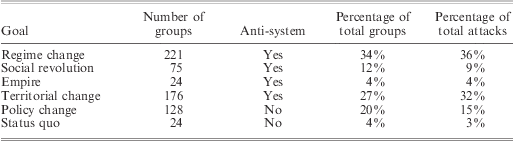
Accordingly, we distinguish between groups that have anti-system versus within-system goals, utilizing information available in Jones and Libicki and Engene about each group's primary goal.Footnote 36Table 1 lists six possible primary goals recorded in Jones and Libicki. If a group has the goal of regime change, it primarily seeks to overthrow the government of the target state. Groups with the primary goal of territorial change seek a territorial concession or change from the target state. The goal of policy change applies to groups that seek a change in an official policy of the target state. Groups with a primary goal of social revolution seek to overthrow the existing regime and social order in the target state. The goal of empire is ascribed to groups that seek territorial change on a transnational basis. An example of a group with empire as its goal is al-Qaeda, which aims to reinstate the caliphate at the expense of multiple states. Finally, some groups primarily try to maintain the current status quo within the target state.
Group Goals
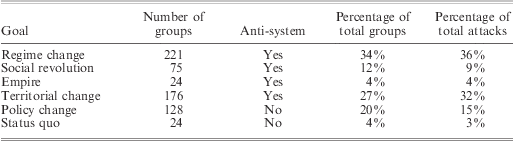
We classify groups that have goals of regime change, social revolution or empire as anti-system groups, since their goals imply that they want to overthrow the current system of government. Territorial change is generally a less extreme goal than regime change, but such a goal also implies that the group does not want to work within the current political system of the target state. For instance, the numerous groups that target India over Kashmir either seek accession to Pakistan or independence. Thus, they do not have much interest in securing representation within India. Thus, a group that has one of the first four goals listed in Table 1 is classified as anti-system.Footnote 37
Groups that seek to maintain the status quo or enact a policy change are classified as within-system groups. Using violence in pursuit of policy change or to protect the status quo indicates that these groups do not find seeking peaceful representation within the existing system fruitful. However, neither of these two goals necessitates an overthrow of the existing system of government.
In Table 1 we also present information on the percentage of attacks anti-system or within-system groups were responsible for from 1970–2006. The data on attacks is obtained from the Global Terrorism Database (GTD).Footnote 38 The fifth column of Table 1 shows the percentage of all attacks that was carried out by groups with each goal type. Groups that seek regime change account for 36 per cent of all attacks among groups included in Jones and Libicki, while policy change groups account for 15 per cent of all attacks. Additionally, in the fourth column we present the percentage of all groups that shares a given goal type. In general, the volume of attacks conducted by groups with a specific goal type roughly reflects the volume of groups with that goal type (columns four and five have similar percentages). Thus, within-system groups are not insignificant or considerably less violent than their anti-system counterparts.
Finally, note that all the goals listed in Table 1 except empire are directed towards a specific regime or government. While groups seeking empire (such as al-Qaeda or the Islamic Movement of Uzbekistan) have transnational goals, groups that seek any of the other primary goals target a specific government. Thus, we are largely able to sidestep problems that arise from focusing on transnational groups. In our data, only twenty-four out of 648 groups have explicitly transnational goals.Footnote 39
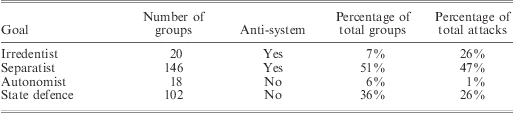
Table 2 contains information on the four possible group goals coded in the TWEED data: irredentist, separatist, autonomist or state defence. If the group is irredentist, it seeks to have a region of the state it is currently in break off and join another state. A separatist group seeks to break off a region from a state to form a new independent state. Groups that seek either of these two goals are coded as anti-system, as their goals are inconsistent with continuing as political actors within the current state. If an irredentist or separatist group obtains its goal, it will no longer be part of the target state. An autonomist group seeks more rights and self-government for a region within the existing target state. Groups that seek state defence actively work to preserve the existing system within the target state. We code autonomist and state defence groups as within-system, as both goals imply working within the target state's existing political system.
Group Goals in TWEED
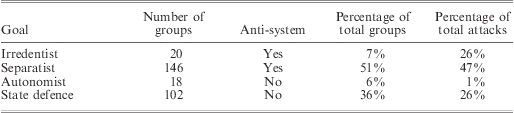
We think that the differences in the coding of primary goals in the TWEED and Jones and Libicki data sets are an advantage, since they ensure that our findings are not dependent upon a particular coding scheme. Additionally, the TWEED data only includes groups that have domestically oriented goals, which dovetails nicely with our theory. Table 2 also contains information on the percentage of all attacks in the data that is attributed to groups with each goal type. The patterns of the volume of attacks attributed to each group type are similar to those in Table 1. The key exceptions are for irredentist groups, which are responsible for `too many’ attacks per group, and autonomist groups, which are responsible for `too few’ attacks per group.
Once we classify groups as anti-system or within-system, we create two dependent variables to test Hypotheses 1a and 1b. The first variable indicates whether at least one anti-system group emerges targeting a country (i) in a given year (t). The second variable indicates whether at least one within-system group emerges targeting a country in a given year. Both of these variables take the binary form shown in Equation 1; the only difference is that yi,t is specific to anti-system or within-system groups. It is worth noting that a country can experience the emergence of both types of groups in a given year. However, the bivariate correlation between these two dependent variables in the set of countries included in analysis of the Jones and Libicki data is only 0.16, while the correlation between the two dependent variables in the TWEED data is −0.06. The low correlation between the anti-system and within-system group emergence variables indicates that they are quite distinct measures.
Given our emphasis on the importance of group goals, we believe that focusing on group emergence has an important advantage. The goals of the groups are coded based on the groups’ initial objectives. However, groups’ goals can change over time as they struggle to survive or as they realize their constraints. Thus, groups’ behaviour in later periods of their existence (that is, the number of attacks they conduct) might be motivated by goals that differ from their initial goals. Focusing on group emergence significantly mitigates this problem, as a group's initial objective is a key motivator for its initial turn to violence. For instance, almost no one disputes that the goal of the Revolutionary Armed Forces of Colombia (FARC) was to overthrow the Colombian government when it first emerged in 1964. However, after over four decades of conflict, there is much skepticism that the FARC retains its ideological fervour and goal of regime change. The group now seems mostly interested in generating revenue via the drug trade.
One potential concern about our dependent variables is that they are all binary variables. Given that multiple groups can emerge in a country in a given year, we also coded three dependent variables that measure the total number of each type of group that emerges in a given year. Thus, we have a second set of dependent variables that measures: the total number of groups that emerged in a country in a given year, the total number of anti-system groups that emerged in a country in a given year and the total number of within-system groups that emerged in a country in a given year. We constructed these variables for both the Jones and Libicki and TWEED data. The results using the count variables are substantively very similar to those using the binary variables, so we report the binary dependent variable models here and relegate the count models to the online appendix.
Independent Variables
Since we argue that distinguishing among groups according to their goals clarifies the relationship between regime type and terrorism, we initially assess whether democracies are more likely to experience the emergence of both within-system and anti-system groups. Accordingly, we use an independent variable to indicate whether a country is a democracy. We use the coding in Cheibub, Gandhi and Vreeland, in which a country is coded as a democracy if the legislature and the executive are elected, multiple parties compete in elections and executive power turns over via elections. All other regimes are considered non-democracies.Footnote 40
Given our interest in the influence of democratic electoral institutions, we need comprehensive data on institutions in democracies. We use data from the Institutions and Elections Project (IAEP)Footnote 41 and the Democratic Electoral Systems Around the World Project.Footnote 42 The former data contains information on a number of key institutional features in a wide range of countries between 1972 and 2005, while the latter has more detailed information on electoral institutions in democracies between 1946 and 2000. Our main analysis of electoral institutions focuses exclusively on democracies, where we again classify countries as democratic using the Cheibub, Gandhi and Vreeland measure.Footnote 43
To assess our hypothesis about the effects of electoral institutions, we first use the IAEP data to create three binary variables that indicate whether a country's electoral system for legislative elections is a proportional representation, majoritarian/plurality or a mixed system. Mixed electoral systems represent a compromise between majoritarian and proportional rules, as they typically have voters choose both a single district representative and a party list of candidates. The type of electoral system is an important indicator of how permissive that system is. Proportional representation systems tend to achieve greater proportionality and are thus more permissive than plurality and majoritarian systems.Footnote 44 However, electoral system type is a relatively rough measure of permissiveness, and other important factors determine an electoral system's permissiveness in representing diverse interests.Footnote 45
A more fine-grained and nuanced measure of permissiveness is district magnitude, which refers to the number of representatives elected from each electoral district. Proportional representation systems have multimember districts of varying magnitudes, while majoritarian and plurality systems have a district magnitude of one (each district elects only one representative). It is widely acknowledged that larger district magnitudes make an electoral system more proportional (that is, permissive), while lower district magnitudes tend to disadvantage smaller political parties and the social groups they represent.Footnote 46 For example, in a single member simple plurality system, the candidate or party that has the plurality of the votes wins the seat in a district. Thus, a small party candidate cannot win a seat even though he or she might have received a considerable share of the votes cast. In contrast, systems with large district magnitude allow for the election of multiple candidates from each district, which leads to a more proportional distribution of seats among diverse interests.
District magnitude is often used in the comparative politics literature to study the effects of electoral rules and electoral permissiveness.Footnote 47 Thus, our second and preferred indicator of electoral permissiveness is a variable from the Democratic Electoral Systems Around the World data, which indicates the median district magnitude in the lowest electoral tier in each country.Footnote 48 We take the logarithm of the median legislator's district magnitude, since the measure is highly skewed and the marginal effect of district magnitude on permissiveness of an electoral system should be smaller as district magnitude increases.Footnote 49
In our analysis we control for several key factors that plausibly affect the propensity of terrorist groups to emerge in democracies. To capture the degree of ethnic heterogeneity among countries, we include a common measure of ethnic fractionalization.Footnote 50 It is likely that the more ethnically heterogeneous countries are more likely to experience group emergence. Additionally, some countries that are coded as democracies by Cheibub, Gandhi and Vreeland have explicit bans on certain political parties. For instance, the Turkish government has frequently banned Kurdish parties, while several European countries have banned far right parties with neo-Nazi platforms (such as Austria). Explicit party bans should further increase the incentives for marginal political groups to turn to violence, as `peaceful’ participation in politics is further constrained. Accordingly, we use the party ban measure from the IAEP as a control.Footnote 51
To ensure that our findings are comparable with the key studies in the literature, we include several other variables that previous studies have found to be important. Fearon and Laitin find that gross domestic product (GDP) per capita is a key determinant of whether an insurgency will emerge in that country.Footnote 52 GDP per capita is a reasonable measure of a state's level of economic development and capacity. Thus, we also include the logged GDP per capita of the target country. We obtained the GDP per capita data from the World Bank.Footnote 53 Finally, some authors suggest that the existence of a federal system can make terrorist group emergence less likely (such as Shugart).Footnote 54 The idea is that a greater degree of local or regional autonomy provides a better opportunity for the representation of diverse interests. To assess this idea, we include a binary variable that indicates whether a country has a federal structure or not. Li finds that the institutional constraints on the executive and political participation in the prior election are significant predictors of transnational attacks. Thus, we include the executive constraints measure from the Polity IV database in our models. This index assesses the extent to which a democratic country's executive faces institutional constraints on its decision-making powers, usually relative to a legislature. It has a 7-point scale (1 indicates that the executive has unlimited authority and 7 indicates executive subordination). We also include a variable that measures the percentage of the voting age population that participated in the prior democratic election, using the IAEP data. Chenoweth finds that heightened inter-group political competition is associated with terrorist group emergence.Footnote 55 To account for this possibility, we use an indicator of political competition from the Polity IV database that ranges from 1 to 10. A score of 1 indicates that no oppositional activity is permitted, while a score of 10 indicates that no political groups, issues or types of conventional political action are routinely banned from political participation, and that political groups regularly compete for political influence.
Finally, in all models we control for temporal dependence using a cubic polynomial in time. The temporal variable, t, measures the time since a country has experienced terrorist group emergence.Footnote 56 Inclusion of the t, t 2 and t 3 variables ensures that we explicitly model any temporal dependence in group emergence. For instance, it is plausible that the emergence of a group in year t increases the likelihood that another group will emerging the following year, for example due to competition or outbidding among groups. Alternatively, the emergence of a violent group in year t could decrease the probability the following year because there are fewer marginal non-violent groups remaining. A cubic polynomial is flexible enough to deal with either of these possibilities.
Results
In this section, we first compare democracies and non-democracies. We demonstrate that democracies experience a higher risk of terrorist group emergence than non-democracies only if we pool all groups or focus exclusively on anti-system groups. Secondly, we conduct our main analysis of democracies and demonstrate that permissiveness of democratic electoral institutions is a key to understanding why democracies are less likely to experience within-system group emergence.
Democracy, Group Goals and Group Emergence
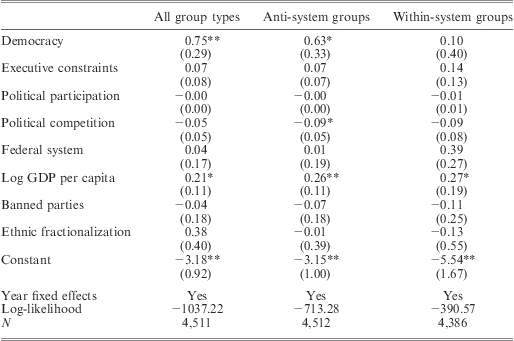
Table 3 presents the results of three logit models of terrorist group emergence in democracies and non-democracies. The model in the second column is a pooled model that estimates the likelihood that either type of group will emerge. The models in the third and fourth columns estimate the likelihood of anti-system and within-system group emergence, respectively. The main purpose of these three models is to compare democracies with non-democracies. Thus, in discussing the findings we focus exclusively on the democracy variable, and leave the interpretation of the other variables to our discussion of the models that focus solely on democracies. The democracy variable is coded one for countries that are considered democratic in Cheibub, Gandhi and Vreeland.Footnote 57 The excluded category is non-democracy.
The Emergence of Terror: Regime Type and Group Goals

Note: Standard errors clustered by target in parentheses.
**p < 0.05; *p < 0.10
The results in Table 3 suggest that the relationship between democracy and terrorist group emergence is highly conditional on the nature of group goals. In both the pooled and anti-system group models, the coefficients of democracy are positive and significant. However, the coefficient is insignificant in the within-system group emergence model. This finding suggests that democracies are only more likely to experience group emergence if we ignore the distinction among groups’ goals or focus exclusively on anti-system groups. However, the likelihood of within-system group emergence is not higher in democracies than in non-democracies. In the following analysis we focus exclusively on democracies and show that the permissiveness of democratic electoral institutions is key to understanding why democracies are not more likely to experience within-system group emergence.
Electoral Rules and Terrorism in Democracies
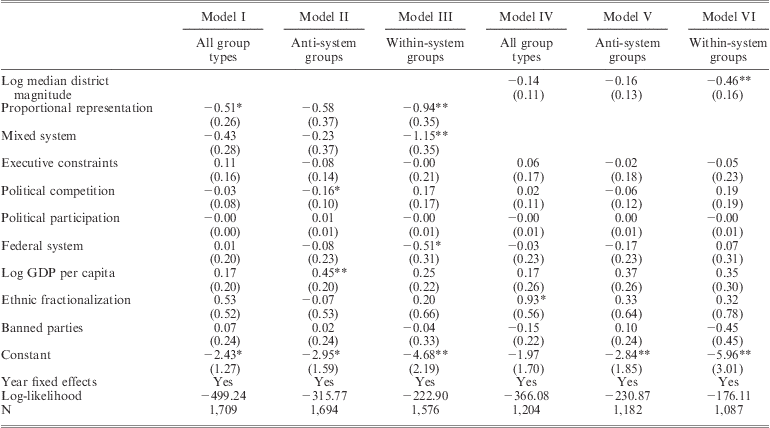
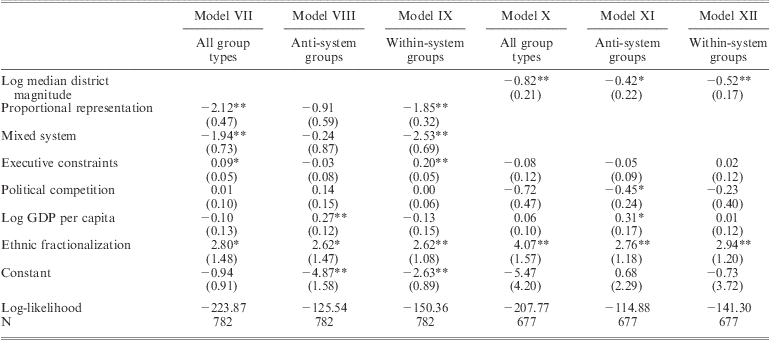
In Table 4 we present logit models of pooled and disaggregated group emergence using the Jones and Libicki data.Footnote 58 The models in Table 4 also include year-fixed effects to account for possible temporal variation in the types of groups.Footnote 59Table 5 displays models using the TWEED data. In both tables, the first three models include an indicator of electoral system type (such as proportional representation) as a measure of electoral permissiveness, while the last three models include median district magnitude, our preferred measure of electoral permissiveness.
The Emergence of Terror: Global Data
Note: Standard errors clustered by target in parentheses.
**p < 0.05; *p < 0.10.
The Emergence of Terror: TWEED Data
Note: Standard errors clustered by target in parentheses.
**p < 0.05; *p < 0.10.
We first discuss the two models in Table 4 that pool all group types together. Models I and IV do not provide support for the idea that the likelihood of terrorist group emergence is lower in democracies that have more permissive electoral institutions. In Model I, the coefficients for proportional representation and mixed systems are both negative but of mixed significance. A democracy with a plurality or majoritarian system is the excluded category. Thus, democracies with more permissive proportional representation systems are (weakly) less likely to experience group emergence than democracies with a plurality or majoritarian electoral system. Similarly, in Model IV the coefficient for district magnitude is negative but insignificant. Thus, if we pool all groups together we do not find much support for the notion that permissive electoral rules reduce the likelihood of group emergence.
Models II and V focus exclusively on anti-system group emergence. In these two models, the coefficients for electoral system type, proportional representation and mixed system, and district magnitude variables are negative but statistically insignificant. Thus, electoral permissiveness has no significant effect on the probability of anti-system group emergence. Consistent with Hypothesis 1b, these findings suggest that when group goals are so transformational as to be unachievable within the current political system, electoral permissiveness does not matter.
Models III and VI in Table 4 provide solid evidence that electoral permissiveness has a significant effect on within-system group emergence. The coefficients for proportional representation and mixed system in Model III and district magnitude in Model VI are negative and statistically significant. Thus, countries with proportional representation and mixed electoral systems are significantly less likely to experience within-system group emergence than countries with plurality or majoritarian systems. Similarly, countries with higher median district magnitudes are significantly less likely to experience within-system group emergence. Thus, the permissiveness of electoral institutions always has a significant and negative effect on the likelihood of within-system group emergence. This finding provides strong support for Hypothesis 1a.
Table 5, which is based on TWEED data, provides further evidence in support of our hypothesis. Examination of the models in Table 5 shows that the effect of electoral permissiveness on group emergence is driven by within-system groups. The coefficients for both proportional representation and mixed systems in Model VII and district magnitude in Model X are all negative and statistically insignificant.Footnote 60 The coefficients for both proportional representation and mixed systems in Model VIII suggest that electoral permissiveness does not have a significant influence on anti-system group emergence, while the results of Model XI suggest a relatively weak relationship.Footnote 61 This is again consistent with Hypothesis 1b.
In the within-system group models (that is, Models IX and XII), the coefficients for the proportional representation, mixed system and district magnitude variables are negative and statistically significant. Thus, Model IX provides further evidence that countries with proportional representation or mixed electoral systems are significantly less likely to experience within-system group emergence than countries with plurality or majoritarian systems. Model XII demonstrates that countries with higher district magnitudes are significantly less likely to experience within-system group emergence. This set of findings is in line with Hypothesis 1a. Furthermore, comparison of the results across models makes clear that the negative effect of electoral permissiveness on the emergence of groups in the pooled models (Models VII and X) is driven by within-system groups.
In sum, our findings are remarkably consistent across two measures of electoral permissiveness and two distinct data sources on terrorist group emergence.Footnote 62 Permissive electoral systems are associated with a reduced risk of within-system group emergence but have no effect on anti-system groups. Our findings about electoral permissiveness based on the TWEED dataset are consistent with those based on the global data.Footnote 63 Therefore our results do not depend on a particular dataset or on the coding of group goals employed in a particular dataset.Footnote 64
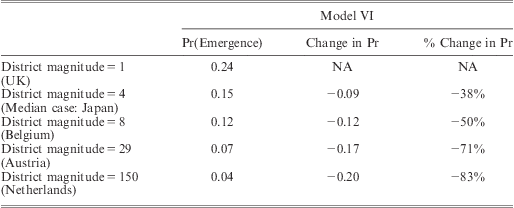
To further illustrate the importance of electoral institutions for explaining within-system group emergence, we present illustrations of the substantive effects of the district magnitude variable in Table 6. The substantive effects are calculated based on Model VI from Table 4 since the results of models using the electoral type variables and the TWEED data are very similar. We do not show the substantive effects of electoral permissiveness on anti-system group emergence, as electoral permissiveness is insignificant for anti-system groups.
Within-system Group Emergence: Substantive Effects for UK 1990
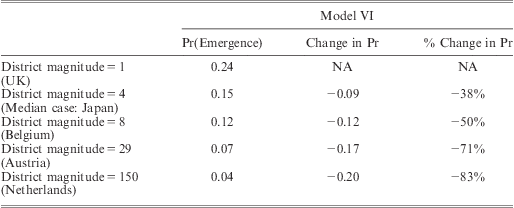
Table 6 shows the substantive effects of district magnitude based on Model VI. The values of all the control variables are set to the values they had for the UK in 1990. We chose the UK as a baseline because it is has a maximally restrictive electoral system and is known to have experienced a lot of domestic terrorism. The second column in the table shows the predicted probabilities of within-system group emergence across different hypothetical values of median district magnitude. The first row shows that the probability that the UK will experience a within-system group emergence in 1990 is 0.24. The second row shows that the predicted probability that a within-system group will emerge falls to 0.15 if district magnitude is at 4, which is the district magnitude of Japan in 1990. The remaining rows show the predicted probabilities for the UK in 1990 if it had a median district magnitude equal to that of Belguim (8), Austria (29) or the most extreme case of the Netherlands (150). The predicted probability of within-system group emergence decreases considerably as the median district magnitude increases. Overall, the results in Table 6 bolster the support for Hypothesis 1a, which suggests that increasing electoral permissiveness significantly decreases the likelihood of within-system group emergence.
The models in Tables 4 and 5 also include several variables that control for additional sources of heterogeneity across democracies that are likely to affect group emergence.Footnote 65 The estimated coefficients from Model IX in Table 5 provide evidence that higher executive constraints are associated with lower risks of within-system group emergence. However, using the global data we find that democracies with high levels of executive constraints are less likely to experience the emergence of within-system groups. These findings are somewhat in line with Li.Footnote 66 However, it is important to note that Li studies the number of attacks and argues that executive constraints diminish the ability of the executive to effectively combat terrorist organizations. This suggests that executive constraints matter because of their effect on governments’ ability to deal with existing groups, and might explain why we do not find consistent support for the importance of executive constraints. We find that the level of political competition in a given country is not a significant factor in determining group emergence. The coefficient of the political competition variable is only statistically significant in one of the twelve models. Similarly, we find no evidence that the level of participation in the previous democratic election affects group emergence, which is in contrast with previous studies such as Li.Footnote 67 We find little support for the notion that democracies with a federal system of government experience less group emergence. All models in our study include a standard measure of ethnic fractionalization. The coefficient of this variable is in the expected direction and is statistically significant only in the models based on TWEED data in Table 5. The models in Table 5 suggest that countries with higher ethnic fractionalization are more likely to experience group emergence. However, we do not find the same result using the global data. The results for GDP per capita are similarly inconsistent across the different models. While some of the models suggest that wealthier countries are more likely to experience group emergence, the coefficient of the GDP variable is sporadically significant in the models using the global data in Table 4 and never significant in Table 5. Finally, we find no evidence that democracies that ban certain parties have a higher risk of group emergence.
Robustness Check: Country-Specific Effects
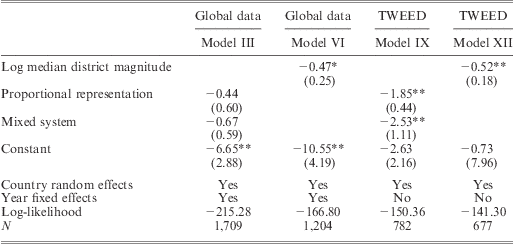
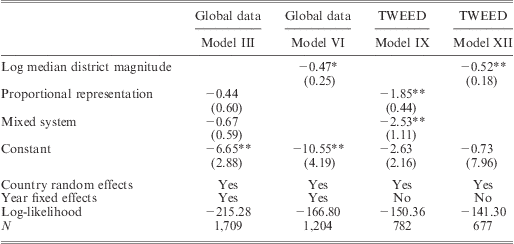
To ensure that our main finding – that electoral permissiveness significantly reduces the likelihood of within-system group emergence – is not driven solely by cross-sectional variation, we estimate our within-system group emergence models using country-specific random effects. Table 7 presents the within-system group emergence models with random effects using both data sets.Footnote 68 We use all of the same regressors included in Tables 4 and 5, but only report the electoral permissiveness results to keep the table simple. None of the results for the other variables change in a substantively significant way.
The Emergence of Within-System Groups -- Robustness Check
Note: Standard errors clustered by target in parentheses.
**p < 0.05; *p < 0.10.
We find that the coefficients of proportional representation, mixed system and median district magnitude variables are still consistently negative and statistically significant. Importantly, median district magnitude, our more precise measure of permissiveness, is significant in both Models VI and XII. Furthermore, the coefficients for proportional representation and mixed systems are significant and negative in Model IX, which uses the TWEED data. The only exception is that the coefficients for proportional representation and mixed system lose significance in Model III using the global data. The relative robustness of the findings for the district magnitude measure can be explained by the fact that there is considerably more within-country variation in the district magnitude measure of permissiveness than the electoral system type measure. For instance, it is not at all uncommon for countries to keep a proportional representation or mixed system but alter the median district magnitude (for example, Austria in 1994 or Ireland in 1981).
Conclusion
This article provides a refined analysis of the relationship between electoral institutions and terrorism in democracies.Footnote 69 The literature has long held that democracies experience more terrorism than non-democracies. However, the effects of various institutional features of democracies are just beginning to be understood. Existing explanations focus almost exclusively on the characteristics of the states in which terrorism occurs and underemphasize the key characteristics of the groups themselves. We show that the interaction between group goals and democratic institutions is essential to understanding the role that electoral institutions play in mediating terrorism and the commonly reported connection between democracy and terrorism.
We argue that not all democracies are equally likely to experience terrorist group emergence. We show that electoral institutions are a particularly important factor that explains why some democracies are more likely to experience group emergence than others. However, in a significant departure from the literature on electoral institutions and violence, we argue and demonstrate that group goals matter greatly. Specifically, electoral institutions significantly influence the emergence of within-system groups (which seek policy changes), but do not influence the emergence of anti-system groups (which seek a complete overthrow of the existing regime and government). Achieving the goals of within-system groups is possible through representation in the current political system, while achieving the goals of anti-system groups implies overthrowing or destroying the current political system. We show that the existence of permissive electoral institutions does not diminish the likelihood that anti-system groups will emerge, but it significantly diminishes the likelihood that within-system groups will emerge. Our findings are quite robust, as they hold after using two different data sources with distinct measures of group goals and two different measures of electoral permissiveness, and survive the inclusion of country-specific effects. Accordingly, we suggest that subsequent research on electoral institutions and political violence should take into account the heterogeneity of violent groups’ goals.
Our findings suggest that the common understanding that democracies experience more terrorism is not necessarily true if we take terrorist groups’ goals into account. Rather, we find that democracies are not significantly more susceptible to the emergence of within-system groups. Moreover, we consistently show that the set of democracies with relatively permissive electoral institutions experiences significantly less within-system group emergence. This finding provides an answer to a key puzzle in the literature on democracy and terrorism. The notion that democracies experience more terrorism is puzzling, given that democratic institutions are designed to provide peaceful means of participation. Our findings suggest that a key feature of democracies – electoral institutions – can effectively channel even relatively extreme groups towards peaceful participation.
This study also opens several fruitful avenues for future research. We demonstrate that the key characteristics of groups are important to understanding the relationship between regime type and terrorism. We specifically focus on group emergence, as we argue that electoral institutions have the greatest influence over the decision to initially turn to violence. However, there is much left to be explored relative to how group goals affect other key aspects of terrorism and political violence. For instance, whether groups have anti-system or within-system goals should also affect both their willingness to strike bargains to join peaceful politics and their target government's willingness to bargain with them. Thus, group goals should help predict how conflicts with terrorist groups end, in addition to how groups emerge to carry out attacks within a target state. Furthermore, this article suggests that future data collection efforts should place greater focus on the characteristics of groups; most existing data sources lack detailed information on the groups themselves beyond attacks they have carried out. A more comprehensive data set on terrorist groups would undoubtedly help researchers address these and other theoretically important issues.