

IntroductionFootnote 1
Canadian politicians are often expected to develop a “thick skin” to withstand the high demands of public office, even when those demands include intimidation, threats and harassment. But what happens when an MP decides not to “endure”? In 2024, MP Pam Damoff (Liberal) announced that she would not seek re-election in 2025, citing toxicity and misogyny as reasons for her decision. One year earlier, British Columbia’s First Nations woman Member of the Legislative Assembly, Melanie Mark, announced her departure from politics and described the provincial legislature as a colonial “torture chamber” in her resignation statement (Zussman, Reference Zussman2023). Unfortunately, these experiences are not unique. In testimony to a parliamentary committee in 2024, the House of Commons’ Sergeant-at-Arms revealed that over the last five years threats against MPs had risen by 700–800 per cent.Footnote 2 Yet, despite growing attention to political harassment and violence, the factors that drive politicians from public life remain insufficiently understood.
The purpose of this research is to spotlight the frequently overlooked and largely hidden aspects of toxicity and harassment that influence Canadian MPs who decide not to reoffer. We do so by considering the gendered dynamics of non-retention in the House of Commons, where an MP has decided not to run in a subsequent election. We ask two research questions: (1) whether, and in what ways, toxicity and harassment contribute to politicians’ decisions to exit elected office, and (2) whether these dynamics are gendered and, to the extent the data will allow, raced. To answer these questions, we use a mixed-methods approach that combines original legislative turnover data from the last 20 years, novel MP exit interview data and resignation statements made by MPs who dropped out before the 2025 general election.
Together, our findings reveal that toxicity and harassment are part of the everyday lives of many Canadian MPs. Specific concerns relate to the perception of growing levels of toxicity in two political arenas: interactions between MPs in parliamentary debates and on social media and between MPs and members of the public in real life and online. It is important to note that, as observed in our interview data, these two arenas are not always distinct; harassment in the House of Commons can also evolve into extended attacks online by opposing politicians and their supporters. As well, harassment on social media can be amplified in House of Commons debates if brought to the attention of parliamentarians willing to exploit online toxicity for political points.
Although our data do not allow us to reliably measure whether political toxicity is increasing, interviewees across party affiliation, gender and race consistently convey that they believe it is significantly on the rise in Canadian politics. We also find gendered and racialized patterns associated with MPs’ decisions to leave politics. Although some men expressed concerns about harassment, women MPs who did not reoffer were more likely to describe their personal experiences of sexism and harassment, while racialized MPs (of both sexes) expressed concerns about racism and incivility in politics more broadly.Footnote 3 In addition to worrying about their personal security, former MPs also articulated fears about the safety of their families and staff members.
Based on our findings, we argue that toxicity and harassment form part of the decision-making calculus for many elected officials as they consider their political futures. As such, those who choose to retire from public life for these reasons are not making an unconstrained choice; rather, they are being pushed out. While any MP’s departure from politics due to harassment poses a challenge for democracy, the exit of politicians from underrepresented groups in response to hostility and harassment has broader consequences by reducing the diversity of decision-making bodies and diminishing democratic representation. In what follows, we review the relevant literature on gendered political violence and gendered political ambition and contextualize the Canadian case study. We then describe our methodological approach to examine the decision calculi of retiring MPs, followed by a presentation of our research findings. We conclude with a discussion of the article’s implications and offer some recommendations on how to address this problem.
The Gendered Impacts of Toxicity and Harassment on Political Ambition
Politicians around the world are being subjected to increasing levels of hostility, harassment and violence (Collignon and Rüdig, Reference Collignon and Rüdig2021; Inter-parliamentary Union, 2022; Krook, Reference Krook2018; Raney and Collier, Reference Raney and Collier2024; Sawer and Maley, Reference Sawer and Maley2024). According to Krook (Reference Krook2020: 65), when violence targets women specifically because of their gender, it has a uniquely harmful effect on democratic representation, as it seeks to exclude them from public office. The aim of gendered political violence is to silence women or drive them out of politics not because of policy disagreements, but rather due to gender bias and misogynistic backlash (Eady and Rasmussen, Reference Eady and Rasmussen2024; Krook, Reference Krook2020; Krook and Restrepo Sanín, Reference Krook and Restrepo Sanín2020). Gendered violence can take a variety of forms—physical, psychological, sexual, economic and semiotic violence (Krook and Restrepo Sanín, Reference Krook and Restrepo Sanín2020). To determine whether political violence is gendered, Bardall et al. (Reference Bardall, Bjarnegård and Piscopo2020) suggest that researchers examine its motives (a perpetrator is prompted by sexism), its forms (the violence is sexist in nature) and its impacts (how targets understand or respond to the violence). Building on this work, Raney and Collier (Reference Raney and Collier2024: 7) define gender-based violence in politics (GBV-P) as: “ harmful actions that are directed at an individual because of their gender, gender expression, gender identity, or perceived gender and which are designed to discourage or restrict them from being active in informal (for example, movement, advocacy, online) or formal (for example, elections, political parties, legislatures) political spaces.”
GBV-P can be understood as a continuum of harmful behaviours, rather than a set of isolated incidents (Bjarnegård and Zetterberg, Reference Bjarnegård and Zetterberg2023). At one end of the spectrum are more normalized forms of hostility, such as incivility and sexist remarks, which may appear less severe but nonetheless reinforce gender hierarchies and send signals that women do not fully belong in political spaces. These interactions can escalate into more overt expressions of discrimination, threats and sometimes violence, including targeted harassment, and the sexualization of women in public life. At the most severe end of the continuum are acts of sexual assault and harassment, which constitute direct violations of personal safety and bodily autonomy. What these forms have in common is that they are rooted in gendered power relations that serve to police women’s political participation and to punish them for occupying spaces that have been traditionally held by men.
Comparative research has unpacked some of the gendered dimensions of political violence. In Sweden and the United Kingdom, women politicians were more likely to be targeted by sexual, psychological and physical violence compared to their male counterparts (Collignon et al., Reference Collignon, Campbell and Rüdig2022; Håkansson, Reference Håkansson2021). In Denmark, Kjøller and Pederson (Reference Kjøller and Pedersen2025) found that women politicians were more likely to experience sexism and harassment and to assess their risk of victimization as higher than men. Håkansson (Reference Håkansson2023) similarly found that compared to men, Swedish women politicians face more personal, sexual and gender-related attacks. Indigenous, Black, religious minorities, 2SLGBTQ+ and younger women are disproportionately more likely to be targeted by harassment and violence in politics (Håkansson and Lajevardi, Reference Håkansson and Lajevardi2025; Kosiara-Pedersen, Reference Kosiara-Pedersen2024; Kuperberg, Reference Kuperberg2018; Major and Niioo-Binee-Seh-Kwe Stirbys, Reference Major, Niioo-Binee-Seh-Kwe Stirbys, Raney and Collier2024).
Much of the toxicity directed at politicians occurs online (Collignon et al., Reference Collignon, Campbell and Rüdig2022). A study of Swedish MPs found that although women do not experience a higher frequency of online abuse compared to men, the character of the abuse they are subjected to is gendered, with women more likely to experience sexualized abuse and gendered harassment (Erikson et al., Reference Erikson, Håkansson and Josefsson2023). Women MPs in New Zealand similarly reported higher incidents of certain types of social media harassment, including sexualised comments, threats of sexual violence and threats toward their family and staff (Every-Palmer et al., Reference Every-Palmer, Hansby and Barry-Walsh2024). Concerningly, online abuse has a “gateway impact” leading to violence spreading from the virtual to the physical world (U.N. Women, 2018).
Gender-based violence is also a feature of the Canadian political landscape (Raney and Collier, Reference Raney and Collier2024). In Canada, women, racialized and Indigenous political actors experience disproportionate harassment, with insufficient institutional/party accountability mechanisms in place to address it (Collier and Raney, Reference Collier and Raney2018a; Gerrits, Reference Gerrits, Raney and Collier2024; Major and Niioo-Binee-Seh-Kwe Stirbys, Reference Major, Niioo-Binee-Seh-Kwe Stirbys, Raney and Collier2024). Online, Canadian women politicians are more likely to receive demeaning messages and gendered harassment compared to men, with highly visible women—like Cabinet ministers—the most likely to experience online harassment (De Angelis, Reference De Angelis2024; Rheault et al., Reference Rheault, Rayment and Musulan2019; Wagner, Reference Wagner2022).
While academic research has established that gendered political violence and harassment are problems, what we know less about is how they are contributing to politicians’ departures from public office. Recent anecdotal evidence from Canada supports a link between toxicity and harassment and political dropouts. During the 2025 federal election, several media outlets reported that toxicity and harassment were “driving women out of politics.” Ontario MP Pam Damoff’s decision not to reoffer was referred to as a “canary in the coalmine” (Canadian Press, 2025; Harris, Reference Harris2024). International research supports these observations. In the U.S., Herrick et al. (Reference Herrick, Thomas, Franklin, Godwin, Gnabasik and Schroedel2021) found that politicians who suffered physical abuse were more likely to consider leaving public office compared to those who faced psychological abuse. In Italy, women mayors who were subjected to attacks were less likely to reoffer compared to men mayors who were subjected to similar attacks, while Belgian women politicians who experienced violence expressed doubts about whether they would stay in politics, with some contemplating quitting altogether (Daniele et al., Reference Daniele, Dipoppa and Pulejo2023; Van Bavel, Reference Van Bavel2022). Erikson et al. (Reference Erikson, Håkansson and Josefsson2023) found the opposite in Sweden, where exposure to harassment reduced men’s desire to stay in politics more so than for women.
In this article, we bring the above research on gendered political violence into conversation with that of political ambition, the latter of which highlights the gendered dynamics of “leaky” political leadership pipelines (Runderkamp and Kenny, Reference Runderkamp, Kenny, Kenny and Bjarnegård2025). This scholarship demonstrates that compared to men, women are less likely to leave politics because they want to retire and are more likely to do so due to gendered biases embedded in political party organizations and political institutions (Chappell and Waylen, Reference Chappell and Waylen2013; Collier and Raney, Reference Collier and Raney2018b; Muriaas and Stavenes, Reference Muriaas and Stavenes2024; Verge and Claveria, Reference Verge and Claveria2018). At the Dutch local level, Runderkamp and Kenny (Reference Runderkamp, Kenny, Kenny and Bjarnegård2025) find that compared to men, women are more likely to “drop out” of politics (defined as politicians standing down for reasons other than non-election) due to gender inequalities in political party and institutional organizations.
We suspect that the gendered nature of Canada’s “winner-take-all” first-past-the-post electoral system, the strong role of political parties in candidate recruitment processes and its Westminster-style institutional design, which prioritizes hyper-masculine behaviours, make it difficult for women and other non-traditional political actors to not only thrive in but also inhabit safely (Collier and Raney, Reference Collier and Raney2018b; Lovenduski, Reference Lovenduski2014; Sawer and Maley, Reference Sawer and Maley2024). The most public manifestations of dominant masculinity in the House of Commons occur during Question Period, when opposition politicians are given the opportunity to hold the government accountable for its decisions, but which can at times devolve into loud heckling, name-calling and interruptions, including gendered heckling targeting women’s weight, age and physical appearance (Samara Centre for Democracy, 2016). Research on other male-dominated workplaces (for example, policing and law) similarly reveals that sexism and toxic workplace cultures are determinants of women’s attrition (Kay et al., Reference Kay, Alarie and Adjei2016). While the drivers of turnover may be similar, the consequences of women being pushed out of politics have significant democratic implications. When women drop-out of politics due to gendered violence, political representation and policymaking become less inclusive, weakening democratic processes.
Internalized norms about leadership might additionally shape how some politicians respond to toxicity and harassment and, consequently, how they navigate their departures from public life. Leadership norms may discourage politicians from publicly identifying hostility or harassment as reasons for leaving office, leading them instead to emphasize more socially acceptable explanations. In Sweden, Håkansson and Grahn (Reference Håkansson and Grahn2026) find that politicians who publicly draw attention to political harassment in the media can incur significant reputational costs, as doing so clashes with traditional ideals of political leadership that equate authority with masculine-coded characteristics like resiliency and “toughness.” Politicians who speak openly about hostility and violence in politics may therefore risk being perceived as weak, overly emotional or ill-suited for public office.
These dynamics have important, gendered implications. Women who speak about violence and harassment could reinforce longstanding stereotypes about women’s supposed unsuitability for elected office (Krook and Restrepo Sanín, Reference Krook and Restrepo Sanín2020). In private interviews, some women politicians in Krook and Restrepo Sanín’s study described publicly disclosing experiences of political violence as tantamount to “political suicide” (Reference Krook and Restrepo Sanín2020: 6). At the same time, men who speak publicly about political violence may face stigma associated with perceived femininity, leading them to remain silent for fear of being viewed as “weak.” Consequently, both women and men may be reluctant to cite toxicity and harassment as reasons for leaving politics, rendering the personal and structural costs of political violence less visible and obscuring their role in political dropouts.
One of the goals of this research agenda is to make these hidden gendered dynamics more visible by examining the role that hostility and harassment play in Canadian politicians’ decisions to drop out of politics. While we are primarily interested in women’s experiences, we also include men in our analysis to explore whether they may be willing to discuss these issues after leaving politics and are therefore less constrained by prevailing gendered norms about leadership. Although our data do not permit causal claims about differences between women’s and men’s departures, a gendered comparison will shed light on how hostility and harassment shape politicians’ decisions to leave public office and bring these often-hidden influences on political dropouts into sharper focus.
Based on the above research, we anticipate that MPs’ decisions not to reoffer will be gendered and raced, with hostility, violence and harassment playing roles in women, racialized and Indigenous politicians’ decisions to exit politics. Given the relatively low percentage of women in the House of Commons historically (currently at 31%), identifying the correlational factors that prevent women from staying in public office is crucial to the goal of improving women’s political representation overall. This article addresses the research and empirical gaps identified above by examining, for the first time, whether and how toxicity and harassment shape Canadian MPs’ decisions to leave politics.
Methodology and Data Descriptions
To answer our research questions, we undertake a mixed-methods approach. We begin by establishing a “baseline” of legislative turnover from the House of Commons over two decades, broken down by gender. Using Library of Parliament data, we collected data on all MPs who did not run again between the 38th (2004–2006) and 44th (2021–2025) Parliaments. This time frame allows us to assess the potential impact of online harassment in particular on MPs’ political ambitions as it straddles the 2011 election, dubbed as Canada’s first “social media election” (Curry, Reference Curry2011). Since we are primarily interested in those who dropped out, only MPs who did not run again are included; those who indicated their desire to reoffer but were not selected by their party, lost their nomination race or ran again and lost are excluded from the analysis.Footnote 4 In total, 259 MPs (191 men and 68 women) made the decision to vacate their seat over the last 20 years. These data are intended to provide a broad picture of whether women are more likely to resign from politics than men for any reason, which may include harassment.
Second, we use novel interview data collected by the Samara Centre for Democracy and qualitatively examine the reasons MPs expressed for deciding not to run again, including those that relate to the threats and abuse they received. The Samara Centre’s MP Exit Interview project, which now encompasses 165 interviews across the 38th–43rd Parliaments, features in-depth, semi-structured interviews with MPs covering their earliest forays into politics and through to the end of their time in the House of Commons. It is the first and only systematic collection of exit interviews with former Canadian MPs.
To our knowledge, this study is the first to qualitatively examine MP exit interview data to investigate the relationship between harassment and political dropouts. This research agenda thus offers an important intervention in studies of gender and legislative turnover, which to date have been primarily driven by quantitative data. Our article seeks to fill this empirical gap by using a rich, descriptive approach to better understand how and in what ways violence and harassment incentivized MPs to drop out of politics. Given the hesitations politicians may have in disclosing their fears or concerns about harassment in politics discussed above, our expectation is that former MPs will feel more able to be open about these topics when they are free from partisan and electoral pressures. Relying on exit interview data (rather than a quantitative survey or interviews of current politicians) thus offers a unique opportunity to uncover these previously “hidden” dynamics of political dropouts.
Since 2008, the Samara Centre has interviewed MPs from every party: 59 Liberal, 50 Conservative, 39 New Democratic Party (NDP), 11 Bloc Quebecois, 2 Green and 3 Independent former Parliamentarians. Of the former MPs, 120 are men and 45 are women. The interviews were conducted with the purpose of providing greater understanding about the practice of politics in Canada, through the lived experiences of MPs who had recently exited the House of Commons.Footnote 5 The semi-structured interviews centred on questions related to former MPs’ motivations for running for office, their understanding of their job, their perceived achievements, barriers to effectiveness and relationships with the media and constituents. They were asked about their suggestions for improving public life and invited to talk about additional issues they thought were important for the public to understand.
For our analysis, we examine the transcripts from MPs who did not run in a subsequent general election, a total of 65 interviews. Forty-eight of these interviews are with men, and 17 with women. We then use thematic analysis of audio recordings and close reading of the written transcripts to identify the ways in which experiences of toxicity or harassment emerged as influential decision factors in MPs’ decisions to leave office. Since interviewees were not directly asked about toxicity or harassment, our approach could underestimate their effect on MPs’ departure decisions. At the same time, any unprompted references to these subjects would indicate that these issues were particularly salient to the MPs who mention them. We then coded the interview data using a hybrid approach of inductive and deductive coding; the interviews were originally coded inductively, while for this study, they were re-approached with deductive coding to capture the nuances of MPs’ discussions of their choice to exit. At this stage, we engaged in a fine-grained analysis of the transcript of every woman who did not reoffer between the 38th–43rd Parliaments, coding these interviews for mentions of hostility, racism, sexism, homophobia and harassment, either in-person or online, as problems in politics. We also conducted close readings of the transcripts of men MPs who had been tagged in our initial inductive coding for referencing these topics.
As the interview data do not include politicians who decided to retire after the 44th Parliament, in a final step we additionally collected and analyzed the public resignation statements made by MPs who retired in 2025 and applied the same coding scheme that we used for the MP Exit Interview data. We believe this multi-step approach is particularly well-suited to examine the underlying gendered/racialized dynamics of MPs’ exits. It also builds on previous quantitative studies that have found that despite Canada’s relatively high rate of legislative turnover, women MPs are not exiting parliament at greater rates than men MPs (Kerby and Blidook, Reference Kerby and Blidook2011; Weber et al., Reference Weber, Bodet, Gélineau and Blais2024). These studies rely on large-scale, historical trend data, which we suspect might obscure the real (and largely hidden gendered/raced) factors that animate MPs’ political ambitions.
Before turning to our findings, it is important to note that our data are not intended to make a causal argument that toxicity and harassment in politics are the only, or perhaps even the most important, factors in MPs’ retirement decisions. There are a variety of reasons why an MP might retire from public office, which include overall job satisfaction, ideological disagreements within their party, their chances of re-election or constituency redistricting (Huber and Martinez-Gallardo, Reference Huber and Martinez-Gallardo2008; Kerby and Blidook, Reference Kerby and Blidook2011; Wolak, Reference Wolak2007). Economic incentives, including pension access and future job opportunities, as well as personal reasons (e.g., family considerations, travel/commute time or the length of time they’ve already served in office) can also play roles in MPs’ choices to leave (Weber et al., Reference Weber, Bodet, Gélineau and Blais2024). Instead, we are seeking to explore whether violence and harassment are also meaningful factors contributing to MPs’ departures, which we consider through a gendered lens for the first time.
Findings
Legislative dropouts: a twenty-year picture
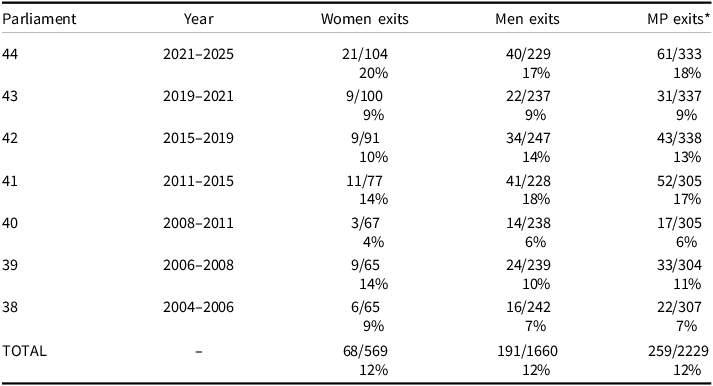
We begin by first establishing the overall gendered pattern in MP dropouts over the last 20 years. Are women choosing to leave the House of Commons at higher rates than men? The answer to this question appears to depend on the election in question. As a proportion of the total number of MPs serving in each parliament by gender, Table 1 shows relatively few gendered differences in the dropout rates of MPs over the last 20 years, with an overall rate of 12 per cent women and men retiring from politics over the last two decades.
Political Drop-outs from the House of Commons by Gender (%): 2004–2025

Table 1. Long description
A table titled Political Drop-outs from the House of Commons by Gender (percent): 2004-2025. The table has 10 rows and 5 columns. The columns are labeled Parliament, Year, Women exits, Men exits, and MP exits. The rows list data for different parliaments from 2004 to 2025. Each row includes the parliament number, the corresponding years, the number and percentage of women exits, the number and percentage of men exits, and the number and percentage of MP exits. For example, Parliament 44 from 2021-2025 shows 21 out of 104 women exits (20 percent), 40 out of 229 men exits (17 percent), and 61 out of 333 MP exits (18 percent). The table shows the overall dropout rates for women, men, and MPs across different parliaments and years.
*Total number of MPs sitting at the time of dissolution.
While a somewhat higher percentage of women MPs left the 39th Parliament compared to men (14% to 10%), men were more likely than women to voluntarily leave after the 41st and 42nd Parliaments. In the most recent Parliament (the 44th), there is a small, three percentage point gendered difference with 20 per cent of women MPs dropping out of politics, compared to 17 per cent of men MPs, who did the same.
Overall, women do not appear to be heading for the parliamentary exit door at significantly higher rates than men. From the vantage point of women’s numerical representation, however, the dropout rate of one in every five women MPs from the most recent parliament (2021–2025) is concerning. Over the last 20 years, the average age of women who did not reoffer is 57, compared to 61 for men.Footnote 6 We also find that women MPs leave office with shorter parliamentary careers than men, with retiring women averaging 9 years of parliamentary experience compared to 12 years for men. This finding raises concerns about the gendered nature of parliamentary expertise and highlights a persistent pattern of gendered hierarchy in the seniority of positions within Canada’s House of Commons.
MPs’ political dropouts: the 38th to 43rd Parliament (2004–2021)
The longitudinal data above might suggest that gender is irrelevant in political dropouts from the House of Commons. Our interview data offer a more nuanced—and problematic—picture. A close listening to the interview data reveals how harassment has informed the decision-making process of women who have dropped out of federal politics.Footnote 7 When examining the totality of MPs the Samara Centre interviewed, two central themes emerge. The first theme is a shift in the way former women MPs describe their experience in office over time, with more recently retired women MPs more likely than previously retired women MPs to talk about toxicity and harassment in politics as problems. Only one woman from the 38th and 39th Parliaments described an experience of harassment as a meaningful part of her time in office. When she did mention such an experience, it was not described as particularly notable or more largely representative of her time in the House of Commons. Specifically, she (a white woman who served from 2006–2008) off-handedly mentioned: “I have had a lot of death threats, two or three that were serious ones, always around abortion. Always. Death threats usually come from people who just need a lot of help.” She immediately clarified that these threats were “not anybody who is actually going to do something” (The Samara Centre for Democracy, 2009). This framing is in clear contradistinction to the way women in the 41st–43rd Parliaments talk about their experiences of death threats. A Black woman MP (2015–2019), for example, noted that she bought a secluded home because she had received death threats against her and her children. She explicitly described these incidents as “some of” the reasons she decided not to run again (The Samara Centre for Democracy, 2022).
Overall, women MPs from the 41st–43rd Parliament (the Samara Centre did not interview any women in the 40th Parliament who dropped out) were much more likely to reference either in-person or online violence as factors in choosing not to run again. This finding holds across the major parties, as there was no evident distinction in how women from different parties discussed the issue. Some interviewees referred to harassment and toxicity inside Parliament, which they referred to as a “House of Commons problem,” rather than a problem confined to an MP’s party caucus. One white woman from the Liberal Party specifically used the word “harassment” to describe her experiences in Question Period. She reflected on parliament as a workplace: “I’m really tough. I went to law school, I lived in a war zone. I’m a competitive swimmer … And I just could not believe this … little cage match [where] everyone’s screaming” (The Samara Centre for Democracy, 2022). It is unclear whether our interview data reflect a worsening ecosystem of toxicity and harassment within the House of Commons and online, or rather that only recently have the institutional norms (spoken and unspoken) in parliament shifted enough so that women and racialized MPs have become more willing to identify and articulate their experiences of harassment as outside the bounds of reasonable workplace behaviour.
In one interview, a Black woman with the Liberal Party (2015–2021) pointed out how a lack of diversity within the House of Commons prevented her from speaking up about her experiences earlier: “I wouldn’t have said anything to my colleagues. No way. Who would I have said it to? My imaginary Black girlfriend across the aisle? No.” Voicing and calling attention to forms of workplace racism meant risking public vitriol and/or dismissive comments from her colleagues. This interviewee also noted that when she did take the chance of speaking to a colleague, she was told she needed to “get a thicker skin” (The Samara Centre for Democracy, 2022). The expectation that MPs should simply grow a “thicker skin” in response to violence and harassment reveals how deeply internalized these behaviours are inside Canada’s parliament, so much so that even a trusted colleague expected one of the only Black women elected to the House of Commons to conform to them, rather than challenge or call them out in a private conversation.
A Métis woman with the Conservative Party (2008–2015) explicitly stated the centrality of gendered harassment to her experience in federal politics: “Parliament is a nasty, nasty place to be a woman … The men don’t get criticized about their hair and what they wear, almost every single day. They aren’t criticized about who you might be going out to an event with. But, the women are, constantly … As you can tell, I’m never running for politics again” (The Samara Centre for Democracy, 2017). After this statement, the former MP reflected that this was a “true” exit interview, noting that life was too short to spend it in this way.
Other women interviewees referenced toxicity or harassment as problems but were less explicit about them being “push” factors in their decision to leave politics. One white woman who served as an MP with the NDP (2007–2015), who is also an out-lesbian woman, pointed out:
No other professional workplace would have managers or whatever screaming and yelling at each other and hurling insults…I used to hate it when my colleagues heckled. Hated it when other parties did it. I thought it was juvenile, ridiculous, self-indulgent behavior. I felt by and large, most of the women MPs felt like that … Enormous amount of sexism. I could go on and on and on about that. And it’s so dysfunctional. It … it can be very non-professional” (The Samara Centre for Democracy, 2017).
While she never clearly provides a reason for choosing not to run again (and indeed, often speaks as though her time in the House of Commons just came to a natural end), the strength of her language on parliament’s workplace culture indicates that the toxicity of the House of Commons may have had an impact on her decision.
In addition to toxicity inside parliament, women in the 41st–43rd Parliaments also discussed the online harassment they’ve faced. One former Liberal MP observed how MPs from marginalized communities were especially targeted by online abuse:
you could probably talk to almost any parliamentarian right now, and they’ve had in incidents with respect to their security, but certainly if … you happen to be a woman, you happen to be LGBT2+, you happen to be Indigenous, you happen to be a visible minority, I can almost guarantee that you’ve had many more problems on social media, but often in real life, too”
(The Samara Centre for Democracy, 2022).The “often in real life, too” reflection is significant; there are clear instances in the interview data where MPs articulate how online and in-person harassment were not two distinct arenas but overlapping. The same MP quoted above noted that after receiving gendered comments in the House of Commons, which she felt “diminish[ed] her message,” a male colleague from another party shifted to attack her on social media. Another interviewee, a white woman who served with the Conservative Party (1997–2015), referenced the “nastiness and evil” she encountered on social media, which she experienced as worsening during her time in office. She then stated: “I know people that’d be very good, elected representatives at every level, but they don’t want to run. Because people are unreasonable. You get vilified and attacked and so, they just say, ‘I don’t need this. My family doesn’t need this’” (The Samara Centre for Democracy, 2017).
Concerns for the safety of staff and family members as drivers of MPs’ drop-outs
This finding leads into the second key thematic continuity across our interview data, as we observe that harassment and violence are routinely referenced in relation to people in the orbit of MPs, and not necessarily to the MPs themselves. A Black woman Liberal Party former MP (2015–2021) noted that staffers with intersectional identities had to deal with consistent harassment. She relayed that Black women staffers in her constituency office felt that they needed white people in the office because angry (white) constituents would be more likely to treat them with respect. She further stated that her staffers felt they needed to be better protected, and that seeing the experiences of these staffers negatively affected her, personally, during her time as an MP (The Samara Centre for Democracy, 2022). When her constituency office was defaced with a misogynistic slur in 2019, a white woman serving with the Liberal Party (2015–2021) similarly recounted that a primary stress for her was the impact this experience had on the young women volunteers in her office. She noted that while she was “pissed off,” they “were really upset. And I felt like I needed to say things for them” (The Samara Centre for Democracy, 2022).
The same former MP also described the negative impact of sexism and toxicity in the House of Commons on her children. After her kids came to Question Period and asked her why she was willing to put herself through it, she only then came to consider it as an experience of harassment. She later reflected “[it] really was bad for my kids.” In reference to the constituency office incident, she recalled that when someone wrote: “the C word on my campaign office … I didn’t tell my son what had happened [because] he was young. [I] came home and I talked to my older kids and they’re like, oh, [he] knows.” Later, she reflected: “I think all parliamentarians would admit that politics is extremely challenging, but when you bring in other folks that are not, they’re not the parliamentarian, they’re just your family members … I think that is really hard” (The Samara Centre for Democracy, 2022).
For the Métis woman serving with the Conservative Party referenced earlier, her reasons for retiring were tied to the impact of online harassment on her family and children; she was “constantly telling the kids not to read Facebook, Twitter and the constant calls,” but her kids would still see comments and cry. While in politics, she remembered realizing “Oh, my God, my kids are at risk now. I was a cop for heaven’s sake and my kids were never at risk like this … This is crazy. My family would have divorced me if I had run again. They would have divorced me” (The Samara Centre for Democracy, 2017). These candid statements suggest that it is worth further consideration and exploration of MPs who have publicly provided “family reasons” as a key motivator not to run again. As we see from our interview data, toxicity and harassment directed towards the families of MPs are powerfully intertwined with MPs’ understanding of their family obligations and can motivate their decision to step away from the public eye.
Importantly, many MPs who dropped out of politics often spoke of multiple, intersecting, “push” factors for their departures. Rarely is a single, dominating factor presented as “the” reason for their choice not to run again. Frustrations with their party, with their ability to make effective change for their constituents and a lack of support are all repeatedly cited reasons for exiting the House of Commons. Interviewees often offered a number of these reasons in conjunction with each other. Some of these factors are mentioned alongside harassment, which to date has been an under-appreciated part of the calculus that spurs women to leave office.
Turning to men MPs, similar to women, there is a significant difference between discussions of toxicity and harassment in the 38th and 39th Parliaments, and subsequent Parliaments (although overall, fewer men than women spoke about it). These topics were more frequent subjects of conversation for racialized men MPs. A former Black male MP with the Liberal Party (2015–2019) clearly articulated that he did not want to be “part of the circus” of unprofessional behaviour in the House of Commons, including the screaming, yelling, interrupting and name-calling. He noted that if you behaved this way in the business world, you would be fired. He also articulated a belief that this type of behaviour is a deterrent for a lot of people in terms of getting into politics (The Samara Centre for Democracy, 2022).
This theme—discussing their own experience of workplace toxicity as a jumping-off point to discuss a broader problem of recruitment for public office—was common amongst men and women (see the white Conservative woman referenced above). It is worth noting that many MPs from the 41st–43rd Parliaments across demographic categories articulated a belief that harassment and bullying during Question Period had increased in recent years, and that online harassment has increased significantly. In his interview, a racialized man who served with the Liberal Party (2004–2021) does not specifically state his own personal reasons for choosing not to run again, but he observes that toxicity and online political polarization have had a negative impact on the recruitment of future political candidates:
one thing I noticed today, compared to six, seven years ago, is how difficult it is to recruit people into the political process…the polarization and the nasty rhetoric online have dissuaded a lot of good people from getting involved…[W]hen you have good people with good intentions that are willing to say no, because of the toxic dynamic that exists in the political sphere today, that is deeply problematic
(The Samara Centre for Democracy, 2022).This finding raises an important question about why harassment and violence, which are clearly part of the everyday experiences of MPs, continue to remain largely invisible in studies of legislative turnover. In our exit interview data, we observe how MPs are sometimes uncomfortable or shy away from discussing the emotional and psychological toll that parliamentary culture has had on them as individuals. Instead, they appear much more comfortable talking about harassment as a problem because of its effect on others and on the democratic process more broadly, including how it limits the ability to recruit quality prospective candidates.
Internalized norms about what a “strong” political leader should look and act like are also evident in our interview data. As the previously mentioned Métis woman serving with the Conservative Party put it, in politics: “everybody expects you to have a thick skin” (The Samara Centre for Democracy, 2017). A “thick skin/stiff upper-lip” political culture means all public data, whether media statements, interviews or personal publications about dropouts, should be approached with an understanding that there are strong institutional/cultural reasons why MPs would not mention their personal experiences of workplace harassment as a reason not to reoffer.
While concern about an increasing culture of harassment emerges from the interview data of both men and women, former MPs were not strongly inclined to offer concrete recommendations for solutions to address the problem. Women who spoke about harassment were focused on establishing that harassment was, in fact, a meaningful problem that had not been fully acknowledged inside the House of Commons or by the public. One solution that was proffered by a white Liberal MP woman (2015–2021) was to disrupt the current understanding of parliamentary privilege, and to adopt a more rigorous Code of Conduct: “there should be a much higher standard in the code of conduct … parliamentary privilege seems to be this thing that people throw around like you can do anything. Um, I’m sorry. That’s not what it’s about … it doesn’t mean, you know, you [can] attack your colleagues.” (The Samara Centre for Democracy, 2022) While the Canadian House of Commons’ MP-to-MP Code of Conduct on Sexual Harassment is theoretically a tool to limit harassment, this MP was the only interviewee to even obliquely acknowledge its existence, presumably because the code does little to address the institutional norms diverse parliamentary privileges referenced above (Collier and Raney, Reference Collier and Raney2018a).
Spotlight: MPs’ resignation statements from the 44th Parliament (2021–2025)
Given the relatively high turnover rate (18%) of MPs from the 44th parliament, we supplement the above interview data by analyzing the public resignation statements of the 61 MPs who dropped out prior to the 2025 general election, looking at whether they mention toxicity, racism, sexism, gender-based harassment or homophobia as factors in their decisions not to reoffer. Resignation statements include formal letters or videos announcing their intention to retire. Historically, politicians rarely mention harassment or violence in their resignation statements, which are typically highly partisan and focused on thanking their party leader, colleagues and constituents. In some instances, political parties coordinate with a retiring MP and issue a formal statement announcing their retirement on their behalf.
An analysis of the resignation statements from these 61 MPs reveals themes that closely align with those in our interview data. In total, we find that five parliamentarians (three white women, one racialized woman and one racialized man) who retired after the 44th Parliament explicitly mentioned toxicity, misogyny or harassment in their resignation statements. These were: Liberal MP Pam Damoff, Parliamentary Secretaries Jeneca Atwin and Jennifer O’Connell, the Honourable Mary Ng and the Honourable Harjit Sajjan. Nineteen percent (4 of 21) of women who did not reoffer in 2025 explicitly referenced some form of hostility, sexism or harassment in politics in their resignation announcement.
In her statement, Pam Damoff cited misogyny, death threats, misinformation and incivility as reasons for not running again. Jeneca Atwin shared similar reasons for her decision to leave politics, referencing the hostility she received online, saying: “[j]ust the constant barrage, the vitriol, the threats, and I think women, in particular my female colleagues, we’ve got it on a different level than a lot of our male colleagues” (Alam Reference Alam2025; Harris Reference Harris2024). In her decision to resign, Jennifer O’Connell reflected on the costs to herself, her family and her staff, and stated that: “[s]igning up for public office comes with good and bad, but when the physical safety of myself and those I care most about comes into question, I did have to seriously reflect on the risks and what was best for not just my own wellbeing but those who support this work as well.” (O’Connell, Reference O’Connell2025).
Two racialized former Cabinet ministers (Honourable Sajjan and Ng) discussed the cost of political hostility to their families and to democracy. Honourable Sajjan—Canada’s first South Asian and Sikh minister of national defence—referenced Canada’s increasingly “toxic and polarized” political landscape, which takes a “significant toll on politicians, but also on our ability to raise our children in a healthy and safe way” (Sajjan, Reference Sajjan2025). In her statement, Honourable Ng noted how the “unchecked spread of disinformation and unwarranted attacks on the character of our leaders in today’s digital age has created an environment that increasingly deters qualified individuals from entering public life. This weakens our democracy and deprives Canadians of the leadership talent they deserve” (Ng, Reference Ng2025).
In a CBC Newsworld interview, another former minister, Carla Qualtrough, was asked whether hostility and harassment played a role in her decision to leave politics. She stated:
It was a big factor … You know, I’ve gone through 2015 to 2019 to 2021 - it’s torqued up. The boundaries aren’t what they were. I can tell you that in 2015, 2016, I’d be in my community and someone might come up to me very frustrated and say ‘I’m so mad at what you guys did, can I make an appointment to talk to you about it’ …. Now there’s no boundaries. I get accosted in the Walmart or my kids and I are buying slurpies at 7-11 and I get screamed at and we have to call the police or … like, there’s just no boundaries for my family, and as my kids have gotten older, and even yesterday when I announced, I had to tell my kids to stay off social media because of what was being directed to me. Just the hatred and the threats and everything that was being said about me. I just didn’t want them to see it.
(CBC News, 2024)Although other retiring MPs in 2025 did not mention these issues explicitly in their resignation statements, some have spoken out about them prior to announcing their retirements from politics. In 2024, two retiring male MPs (NDP MP Charlie Angus and Liberal MP John Mackay) wrote op-eds in major news publications laying out their serious concerns about growing levels of hostility and toxicity in Canadian politics (Angus, Reference Angus2024; Mackay, Reference Mackay2024). These public statements demonstrate how some retiring MPs from the 44th Parliament were aware of, and willing to widely share their concerns about, growing hostility, harassment and violence in politics. Their willingness to discuss these issues publicly despite the risks in doing so is suggestive that these issues are of concern to retiring MPs today.
Discussion
This article set out to answer two research questions: (1) whether, and in what ways, toxicity and harassment contribute to politicians’ decisions to exit elected office, and (2) whether these dynamics are gendered and, to the extent our data allow, raced. Using a mixed methods approach, we find that toxicity and harassment play roles in MPs’ experiences of elected office and contribute to their decisions to leave public office. Compared to men, women were more likely to identify gendered harassment and violence as factors in their decisions to exit the political arena. These findings contribute to gender and politics scholarship by offering evidence of the relationship between harassment and women’s political dropouts in Canada for the first time. At the same time, our exit interview data do not allow us to determine why women were more likely than men to speak about violence and harassment in their exit interviews. This gendered difference may indicate that women experience more harassment, that they are more affected by it, or simply that they are more willing to disclose these experiences than men even in exit interview settings. Future research should probe these possibilities.
Nevertheless, the fact that women MPs cite these issues at all as part of the reason why they dropped out of politics is an important empirical contribution to research on gendered political violence. It is also an alarming one. Our study demonstrates that concerns about civility, harassment and violence are suppressing some women politicians’ desire to stay in politics, which they characterize as a toxic profession. This finding reinforces existing research on the gendered dynamics of political ambition and highlights how violence and harassment contribute to women dropping out of elected office. Moreover, we identify several specific mechanisms through which harassment and violence are driving women out of politics, particularly the need to keep themselves, their families and their staff members safe from further harm.
This article opens the door to future research on gendered political violence and political ambition. Given that Westminster parliaments are particularly prone to hyper-masculine behaviour, scholars should consider the relationship between violence/harassment and political dropouts in other legislative settings. Future research should examine violence as a driver of women’s political drop-outs relative to other factors known to suppress women’s political ambition, such as a lack of mentorship, family obligations and financial limitations. Our qualitative analysis also invites future complementary quantitative research, including but not limited to studies that categorize and rank the prevalence of different types of harassment, cross-referenced with relevant variables, such as party membership, age, race and gender. A final consideration is whether electoral incentives, such as national party polling or margin of victory, influence a politician’s willingness to endure harassment and maintain a “thick skin” (see Wasserman, Reference Wasserman2023).
Our findings additionally highlight the need to better understand men’s experiences of harassment and violence in politics. Although more women than men raised concerns about these issues in our interviews, it is noteworthy that male interviewees, including racialized men, from the most recent parliaments were more likely to discuss hostility in politics as a problem than men from earlier parliaments. This pattern could be an indication that violence and harassment are becoming increasingly salient concerns for men; it also raises questions about whether changing gendered leadership norms have made it more acceptable for men to acknowledge these experiences publicly. Future research should investigate these possibilities, with a particular focus on men politicians who are racialized or identify as 2SLGBTQ+. In terms of interventions, men should further be encouraged to speak out about these issues, thereby challenging the normalization of toxicity and violence in the political sphere and the expectation that politicians should respond to abuse with stoicism and a “stiff upper lip.”
Another area of future research is to examine whether public disclosures of violence in politics deter prospective candidates from considering running for office or, conversely, contribute to destigmatizing such experiences and fostering cultural change within parliamentary institutions that have historically enabled this behaviour. Interviews of MPs who choose not to run in the 2025 election are also needed. Legislative turnover studies should be broadened to consider violence and harassment as reasons why MPs may decide to retire from politics.
One final, but important, consideration that we have not yet addressed here is why, in the face of harassment, some politicians choose to “tough it out” and remain in politics. In their study of Danish MPs, Kjøller and Pedersen (Reference Kjøller and Pedersen2025) find that while women suffer more from sexism in politics, being targeted by this behaviour can have a mobilizing effect, incentivizing some women to seek political influence even more. Future scholarship is needed to unpack why some MPs who are subjected to hostile and harassing behaviour decide to stay in politics, and how they remain resilient in the face of these additional workplace burdens. This line of research would be helpful in providing support for MPs who might struggle with the harassment they suffer and serve to generate new policy ideas to address this problem.
Conclusion
The findings in this article demonstrate that hostility, toxicity and harassment are part of the calculi for some MPs as they decide to stay or leave politics. For women, the cumulative personal costs of gendered violence, including chronic stress, increased workload, security costs and concerns for the safety of loved ones and staff, can shift the calculus, leading some to conclude that the costs of staying in public office outweigh the benefits. While women were more likely than men to cite gendered abuse in parliaments and social media as reasons for their departure, an increasing number of men are willing to discuss this issue more openly. Racism and incivility are also motivating some racialized MPs to leave public office. These issues are clearly part of the equation when an MP from a marginalized community weighs their career options prior to the electoral writ being drawn up.
As for her own post-retirement plans, Minister Carla Qualtrough stated that it was her intention to continue raising the alarm about violence and harassment in politics. She went on to say that this is an important conversation because we want women, parents and diversity in our elected officials and “if [violence and harassment] are the kinds of considerations you have to put into play it will deter and it would be such a shame if we didn’t nip this right now” (CBC News online, 2024). Our findings corroborate what a growing chorus of Canadian politicians are now saying: violence and harassment come with a cost to individual politicians, to the public and to Canadian democracy. Bringing this once “hidden” problem out of the shadows will hopefully facilitate a public dialogue on how to retain talented, diverse leaders after they are elected. More academic research is needed so that this cost of politics remains invisible no longer.

 Open access

