1. Introduction
Wall-bounded turbulence (WBT) with spanwise rotation is of great significance in turbomachinery, astrophysical and geophysical applications. To this end, the spanwise-rotating plane Couette flow (RPCF), representing the curvature-free limit of Taylor–Couette flow, has served as a canonical problem for investigation of the influence of rotation on WBT (Bech & Andersson Reference Bech and Andersson1996, Reference Bech and Andersson1997; Tsukahara, Tillmark & Alfredsson Reference Tsukahara, Tillmark and Alfredsson2010; Gai et al. Reference Gai, Xia, Cai and Chen2016; Xia et al. Reference Xia, Shi, Wan, Sun, Cai and Chen2019). Evidently, turbulent flow structures and momentum transport in plane Couette flow (PCF) can be greatly affected by spanwise rotation. Specifically, the near-wall turbulence is significantly altered by Coriolis forces induced by the anticyclonic and cyclonic spanwise rotations, which are opposite to and aligned with the mean flow vorticity direction, respectively. While, in Newtonian PCF, the near-wall turbulence dynamics is dominated by small-scale quasi-streamwise vortices (QSVs), cyclonic rotation and the resulting Coriolis forces redirect the high-speed fluid near the walls towards the viscous sublayer, leading to significant viscous dissipation. Consequently, the RPCF goes through a multi-step transition path from a turbulent flow to a laminar one (Salewski & Eckhardt Reference Salewski and Eckhardt2015). On the other hand, with anticyclonic rotation, i.e. positive rotation number  $Ro$, large-scale vortical structures, namely, roll cells, are formed and enhanced as
 $Ro$ is progressively increased. These structures are known to substantially increase transverse momentum transport, which in turn leads to drag enhancement (DE) as compared to the non-rotating PCF (Salewski & Eckhardt Reference Salewski and Eckhardt2015; Brauckmann, Salewski & Eckhardt Reference Brauckmann, Salewski and Eckhardt2016; Kawata & Alfredsson Reference Kawata and Alfredsson2016). These roll cells are weakened as
 $Ro$ is further increased and eventually are eliminated at
 $Ro\geqslant 0.5$. Accordingly, this leads to weakened transverse momentum transport and a commensurate drag decrease. As a result, small-scale vortices generated via Coriolis forces become the dominant flow structures at
 $Ro\geqslant 0.5$.
Introducing a trace amount of high-molecular-weight polymers to WBT is known to have profound effects on turbulent structures and flow transition. In fact, studies focused on polymer-induced drag reduction (DR) of up to  $80\,\%$, commonly referred to as the maximum drag reduction asymptote (MDR), date back to Toms (Reference Toms1948) and Virk (Reference Virk1975). Since these pioneering studies, significant advancement in the understanding of polymer-induced DR, at low elasticity number, defined as the ratio of the Weissenberg to Reynolds number
 $E=Wi/Re$, has been realized. Specifically, it has been shown that polymer chains stretched via the mean shear flow suppress QSVs and Reynolds stress production, leading to significant DR (De Angelis, Casciola & Piva Reference De Angelis, Casciola and Piva2002; Dubief et al. Reference Dubief, Terrapon, White, Shaqfeh, Moin and Lele2005; Li, Sureshkumar & Khomami Reference Li, Sureshkumar and Khomami2006; Kim et al. Reference Kim, Li, Sureshkumar, Balachandar and Adrian2007; Li, Sureshkumar & Khomami Reference Li, Sureshkumar and Khomami2015). Despite these significant advances, the physical origin of MDR remained an open question until nearly a decade ago (White & Mungal Reference White and Mungal2008; Xi Reference Xi2019). However, numerous recent studies have demonstrated that polymer-induced DR can even exceed the MDR limit via a reverse transition as
 $Wi$ is progressively increased. Specifically, as elastic effects become more dominant, the inertia-driven Newtonian turbulence is eliminated and gives way to a laminar flow state. Subsequently, this laminar flow state undergoes a secondary instability, namely, elasto-inertial instability, that results in the so-called ‘elasto-inertial turbulent’ flow state (EIT) (Choueiri, Lopez & Hof Reference Choueiri, Lopez and Hof2018; Lopez, Choueiri & Hof Reference Lopez, Choueiri and Hof2019; Shekar et al. Reference Shekar, McMullen, Wang, McKeon and Graham2019), which exhibits similar DR to MDR. In parallel shear flows, EIT is mainly composed of weak trains of two-dimensional spanwise-oriented flow structures with inclined sheets of polymer stretch. The kinetic energy spectrum in the EIT regime has a
 $-14/3$ scaling, which is distinctly different from the Kolmogorov scaling of
 $-5/3$ for inertial turbulence but is close to the
 $-3.5$ scaling of elastic turbulence (Dubief, Terrapon & Soria Reference Dubief, Terrapon and Soria2013; Samanta et al. Reference Samanta, Dubief, Holzner, Schäfer, Morozov, Wagner and Hof2013).
Polymer-induced flow relaminarization in viscoelastic RPCF at a relatively low spanwise rotation, i.e.  $Ro=0.2$, was recently discovered by Zhu et al. (Reference Zhu, Song, Liu, Lu and Khomami2020). Specifically, it was shown that the relaminarization occurs via a reverse transition pathway from a Newtonian turbulent RPCF, characterized by large-scale roll cells overlaid by small-scale turbulent vortices, to a fully relaminarized viscoelastic flow consisting of only two-dimensional roll cells. In contrast to polymer-induced DR in planar WBT flows (Choueiri et al. Reference Choueiri, Lopez and Hof2018; Lopez et al. Reference Lopez, Choueiri and Hof2019; Shekar et al. Reference Shekar, McMullen, Wang, McKeon and Graham2019), this reverse transition pathway is accompanied by significant DE. The DE occurs due to the significant polymer stretch and accompanying large polymeric stress that result from the extensionally dominated flows between adjacent roll cells. Despite the opposite drag modification (DM), this flow relaminarization exhibits vortical changes much like DR viscoelastic WBT flows, such as the viscoelastic PCF at
 $Ro=0$ (Pereira et al. Reference Pereira, Mompean, Thais and Soares2017a,Reference Pereira, Mompean, Thais, Soares and Thompsonb; Teng et al. Reference Teng, Liu, Lu and Khomami2018), where small-scale turbulent vortices are gradually suppressed and eventually eliminated by the growing polymer body force. This observation further substantiates the universal interplay between turbulent vortices with polymer chains in viscoelastic WBT.
The aforementioned intriguing flow transitions and the accompanying DM driven by either spanwise rotation or polymeric body forces in PCF bring up two interesting questions. (1) What vortical changes and DM will be observed as  $Ro$ is progressively increased in the viscoelastic RPCF? That is, at large
 $Ro$, will the addition of a trace amount of polymer additives lead to suppression and eventual elimination of the small-scale vortices generated by Coriolis forces in the Newtonian RPCF (Bech & Andersson Reference Bech and Andersson1997; Gai et al. Reference Gai, Xia, Cai and Chen2016)? (2) What will be the effect of polymer additives on drag modification, i.e. DR as seen in PCF, or DE arising from a completely distinct mechanism? To answer these two fundamental questions, an extensive examination of spanwise-rotation-driven flow transitions and accompanying DM in the viscoelastic RPCF at
 $Re=1300$,
 $Wi=5$ and
 $Ro=0 - 1$ has been performed via high-fidelity direct numerical simulations (DNS). Hereafter, the DM of the viscoelastic RPCF, including DR and DE, corresponds to a direct comparison with its Newtonian counterpart, if not otherwise specified.
In the following, we report for the first time a rotation-driven flow transition from a DR inertia-dominated turbulence (IDT) to a DE EIT, and finally to a fully relaminarized flow state at  $Ro=1$. In addition, the transition from a DR to DE flow state is shown to arise from the competition between the polymer-induced DR that arises from suppression of vortical structures at all
 $Ro$ and the DE that results from significant polymer stress generated in the extensionally dominated flow between adjacent large-scale roll cells at
 $Ro\leqslant 0.2$, as well as incoherent transport and homogenization of polymer stress facilitated by Coriolis-force-generated turbulent vortices at
 $Ro=0.5 - 0.9$.
2. Problem formulation and computational details
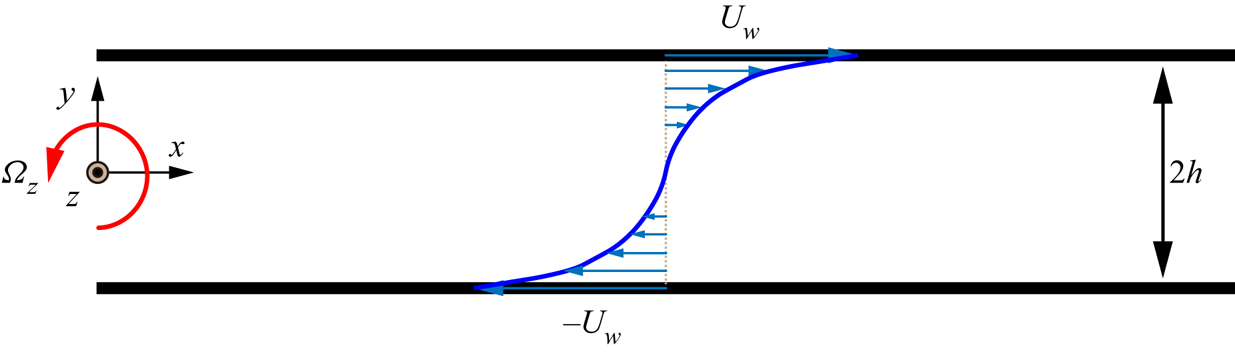
Similar to our prior studies (Liu & Khomami Reference Liu and Khomami2013a,Reference Liu and Khomamib; Teng et al. Reference Teng, Liu, Lu and Khomami2018; Song et al. Reference Song, Teng, Liu, Ding, Lu and Khomami2019; Zhu et al. Reference Zhu, Song, Liu, Lu and Khomami2020), spanwise-rotation-driven transition of viscoelastic RPCF is explored by high-fidelity DNS via a three-dimensional spectral parallel algorithm. As indicated in figure 1, we have chosen  $h,\ h/U_w,\ U_w$ and
 $\rho {U_w}^2$ as scales for length, time, velocity
 $\boldsymbol {u}$ and pressure
 $P$, respectively. Here,
 $h$ denotes the half gap width,
 $U_w$ is the wall translation velocity and
 $\rho$ represents the polymeric solution density. The polymer stress
 $\boldsymbol {\tau }^p$ is related to the polymer conformation tensor
 $\boldsymbol{\mathsf{C}}$ through the FENE-P (finitely extensible nonlinear elastic–Peterlin) constitutive model. The governing equations for an incompressible flow of FENE-P fluids are non-dimensionalized as
 \begin{gather} \frac{\partial \boldsymbol{u}}{\partial t}+\boldsymbol{u}\boldsymbol{\cdot}\boldsymbol{\nabla}\boldsymbol{u} ={-}\boldsymbol{\nabla} P+\frac{\beta}{Re}\nabla^2\boldsymbol{u} +\frac{1-\beta}{Re}\boldsymbol{\nabla}\boldsymbol{\cdot}\boldsymbol{\tau}^p -{Ro} \,{\boldsymbol{e}_{\boldsymbol{z}}}\times\boldsymbol{u}, \end{gather}
 \begin{gather}\frac{\partial \boldsymbol{\mathsf{C}}}{\partial t} ={-}\boldsymbol{u}\boldsymbol{\cdot}\boldsymbol{\nabla}\boldsymbol{\mathsf{C}}+\boldsymbol{\mathsf{C}}\boldsymbol{\cdot} \boldsymbol{\nabla}\boldsymbol{u} +(\boldsymbol{\nabla}\boldsymbol{u})^\textrm{T}\boldsymbol{\cdot}\boldsymbol{\mathsf{C}}-\boldsymbol{\tau}^p. \end{gather}
The polymer stress tensor  $\boldsymbol {\tau }^p$ is obtained via the Peterlin function
 $f(\boldsymbol{\mathsf{C}})$ by
 \begin{equation} \boldsymbol{\tau}^p=\frac{1}{Wi}(f(\boldsymbol{\mathsf{C}})\boldsymbol{\mathsf{C}}-\boldsymbol{\mathsf{I}}),\quad f(\boldsymbol{\mathsf{C}})=\frac{L^2-3}{L^2-\textrm{trace}(\boldsymbol{\mathsf{C}})}. \end{equation}
Here  $\beta =\eta _s / \eta _t$, with
 $\eta _s$ and
 $\eta _p$ being, respectively, the solvent and polymeric contributions to the total viscosity
 $\eta _t$;
 $L$ denotes the maximum polymer chain extension; and the Weissenberg number is defined as
 $Wi=\lambda U_w/h$, with
 $\lambda$ being the polymer relaxation time. The Reynolds and rotation numbers are defined as
 $Re=\rho U_w h/\eta _t$ and
 $Ro=2{\varOmega _z}h/U_w$, respectively, where
 $\varOmega _z$ signifies the spanwise system rotation. A small diffusive term
 $\kappa \nabla ^2\boldsymbol{\mathsf{C}}$ is added to (2.2) in the bulk flow region for numerical stabilization. Specifically, the
 $\kappa$ value used corresponds to a Schmidt number
 $Sc=1/(\kappa Re)=0.15$. Our prior studies have clearly demonstrated that the
 $Sc$ used in this study does not modify the essential features of viscoelastic RPCF at the relatively small
 $Wi$ used in our simulations (Zhu et al. Reference Zhu, Song, Liu, Lu and Khomami2020); although, slight quantitative differences in the predicted polymeric stresses and turbulent statistics could exist with those of very high-
 $Sc$ simulations.
Sketch of spanwise-rotating plane Couette flow.

All the simulations are started from a statistically steady viscoelastic turbulent PCF at  $Re = 1300$ with
 $Wi=5$ corresponding to a small
 $E\approx 4\times 10^{-3}$. A large value of
 $\beta =0.9$ and
 $L=120$ is used so that the dilute polymeric solution has a nearly shear-independent viscosity and a significant elongational viscosity which scales with
 $L^2$. A comprehensive examination of the rotation effect on viscoelastic PCF is performed by considering a broad range of
 $0\leqslant Ro\leqslant 1$ (Salewski & Eckhardt Reference Salewski and Eckhardt2015; Gai et al. Reference Gai, Xia, Cai and Chen2016). The computational domain of
 $L_x\times L_y\times L_z=10{\rm \pi} \times 2\times 4{\rm \pi}$ and a corresponding grid size of
 $N_x\times N_y\times N_z=256\times 129\times 256$ (Bech & Andersson Reference Bech and Andersson1996, Reference Bech and Andersson1997; Gai et al. Reference Gai, Xia, Cai and Chen2016; Xia et al. Reference Xia, Shi, Wan, Sun, Cai and Chen2019; Zhu et al. Reference Zhu, Song, Liu, Lu and Khomami2020) are used for the streamwise (
 $x$), wall-normal (
 $y$) and spanwise (
 $z$) directions, respectively. Guided by our prior studies (Teng et al. Reference Teng, Liu, Lu and Khomami2018; Zhu et al. Reference Zhu, Song, Liu, Lu and Khomami2020), calculations of
 ${\sim }1000h/U_w$ are performed to ensure that statistically steady flows have been realized, using a small time step, i.e.
 $\Delta t=0.01$.
3. Results and discussion
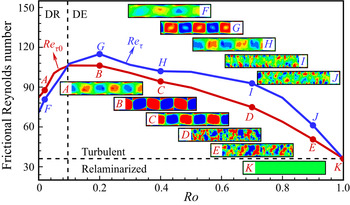
Rotation-driven flow transition from a DR to a DE flow regime is realized by varying  $Ro$ from
 $0$ to
 $0.9$ in the viscoelastic RPCF (see figure 2). A comparison of the viscoelastic RPCF friction Reynolds number (
 $Re_\tau$) with its Newtonian counterpart (
 $Re_{\tau 0}$) is used to quantify the flow drag modification due to polymer additives. Specifically, at
 $Ro<0.1$ polymer-induced DR is observed and this is attributed to suppression of QSVs and Reynolds stress production. At
 $Ro>0.1$ (see curves in figure 2), DE is observed. In this regime, the drag and vortical structures have similar rotation dependence in the Newtonian and viscoelastic RPCF. Specifically, increasing
 $Ro$ from 0.1 to 0.2 results in a gradual increase of
 $Re_{\tau }$ and
 $Re_{\tau 0}$, and development and enhancement of very well-defined large-scale roll cells (see insets
 $A$,
 $B$ and
 $F$,
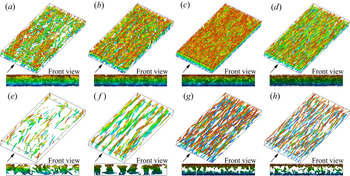
 $G$ of figure 2 and figure 3a,b,e,f). Prior studies have demonstrated that the formation of highly organized roll cells results in amplified transverse momentum transport and a commensurate DE as compared to the non-rotating case (Salewski & Eckhardt Reference Salewski and Eckhardt2015; Gai et al. Reference Gai, Xia, Cai and Chen2016). Upon further increase of
 $Ro$ from 0.2 to 0.9 the large-scale roll cells progressively deteriorate and give way to small-scale vortices generated by the Coriolis forces (see insets
 $C$–
 $E$ and
 $H$–
 $J$ of figure 2 and figure 3d,d,g,h). This vortical change is accompanied by a continuous decrease of
 $Re_{\tau 0}$ and
 $Re_{\tau }$. Finally, both Newtonian and viscoelastic RPCF (see inset
 $K$ of figure 2) fully relaminarize at
 $Ro=1$ with two slightly different drag values because of their different viscosity, i.e.
 $Re_{\tau 0}=36.1$ and
 $Re_{\tau }=36.0$. Therefore, this rotation-driven transition of viscoelastic RPCF is accomplished by obvious suppression of Newtonian vortical structures caused by polymer additives. Since vortical circulations play an important role in momentum exchange between the near-wall and core regions, such polymer-induced suppression of vortical structures is expected to result in a commensurate decrease of the Reynolds stress, as discussed below. This phenomenon is commonly referred to as the polymer-induced DR effect (Pereira et al. Reference Pereira, Mompean, Thais and Soares2017a,Reference Pereira, Mompean, Thais, Soares and Thompsonb; Teng et al. Reference Teng, Liu, Lu and Khomami2018).
Frictional Reynolds numbers of the viscoelastic ( $Re_{\tau }$) and Newtonian (
 $Re_{\tau 0}$) RPCF are determined based on the frictional velocity
 $u_\tau$ and the total wall shear stress
 $\tau _{w}$, for example,
 $Re_\tau =\rho u_\tau h/\eta _t$ with
 $u_\tau =\sqrt {\tau _{w}/\rho }$. Here, DR and DE denote
 $Re_{\tau }-Re_{\tau 0}<0$ and
 $>0$, respectively. Insets
 $A$–
 $E$ depict the averaged streamwise vorticity
 ${\langle \omega _x\rangle }_{x,t}$ of Newtonian RPCF in the (
 $y, z$) plane at
 $Ro=0.02, 0.2, 0.4, 0.7, 0.9$ and insets
 $F$–
 $J$ depict their viscoelastic counterparts. For
 $0.02\leqslant Ro\leqslant 0.4$, 10 contours are plotted within the range (
 $-0.3, 0.3$) and for the other
 $Ro$ the range is (
 $-0.05$, 0.05).

Instantaneous vortical structures identified by  $Q$-criterion with
 $Q=0.2$ and coloured by distance to the lower wall for typical cases. The upper and lower plots are the full and front (
 $x$-direction) views, respectively; (a–d) represent Newtonian and (e–h) viscoelastic RPCF, respectively; (a,e)
 $Ro=0.02$, (b,f)
 $Ro=0.2$, (c,g)
 $Ro=0.7$ and (d,h)
 $Ro=0.9$.

The DM of viscoelastic RPCF at various  $Ro$, in comparison with its Newtonian counterpart, is inherently linked to the aforementioned vortical changes, which result from two distinct effects, namely, polymer stretch and anticyclonic rotation. These changes and their underlying mechanism can be examined via the conserved momentum flux (Salewski & Eckhardt Reference Salewski and Eckhardt2015; Brauckmann et al. Reference Brauckmann, Salewski and Eckhardt2016; Zhu et al. Reference Zhu, Song, Liu, Lu and Khomami2020):
 \begin{equation} J^u={-}\langle u'v'\rangle+\frac{\beta}{Re} \frac{\textrm{d}\langle u\rangle}{\textrm{d} y}+\frac{1-\beta}{Re}\langle\tau_{xy}^p\rangle, \end{equation}
where  $\langle \ \rangle ={\langle {\langle {\langle \ \rangle }_{x}\rangle }_{z}\rangle }_{t}$ denotes averaging in the
 $x$-direction (
 ${\langle \ \rangle }_{x}$),
 $z$-direction (
 ${\langle \ \rangle }_{z}$) and time (
 ${\langle \ \rangle }_{t}$), and
 $\boldsymbol {u}'=\boldsymbol {u}-\langle \boldsymbol {u}\rangle$. Evidently,
 $J^u$ is evaluated by summing the three terms on the right-hand side of (3.1), namely, the Reynolds stress (
 $J^u_R$; convective flux), the viscous stress (
 $J^u_v$; diffusive flux) and the polymer stress (
 $J^u_p$; polymeric source/sink term). When
 $J^u$ is recast in wall units, i.e.
 $J^u={Re^2_\tau }/{Re^2}$, polymer-induced DM can be directly related to the changes of
 $J^u$ through variation of its components in the core flow region, i.e.
 $J^u_R$ and
 $J^u_p$. Note that,
 $J^u_R$ is calculated from the fluctuating velocity
 $\boldsymbol {u}'$ that results from both the large-scale roll cells and the small-scale turbulent vortices; thus it can be used to ascertain changes in transverse momentum flux by vortical motions.
The underlying physics associated with the DM discussed above is scrutinized by examining the variation of Reynolds stress ( $J^u_R$) and polymer stress (
 $J^u_p$) at the gap centre. As expected for all
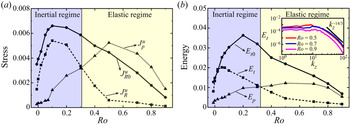
 $Ro$ (see figure 4a),
 $J^u_R$ exhibits a tremendous decrease as compared to its Newtonian counterpart
 $J^u_{R0}$. This is in concert with the expected polymer-induced suppression of turbulent vortices leading to weakened transverse momentum transport (see insets in figures 2 and 3). For the viscoelastic RPCF,
 $J^u_p$ is increased as
 $Ro$ varies from 0 to 0.5 and in turn diminishes as
 $Ro$ is increased further to 1. Therefore, the DM realized in viscoelastic RPCF results from the competition between the polymer-induced decrease of
 $J^u_R$ and the rotation-rendered increase of
 $J^u_p$. As indicated in figure 4(a), for
 $Ro<0.1$, the polymer-induced decrease of
 $J^u_R$ accounts for the DR of viscoelastic RPCF. This is due to the suppression of vortical structures by polymer additives. While, for
 $Ro>0.1$, the DE observed in the viscoelastic RPCF is related to the variation of
 $J^u_p$, which, as shown below, has two different generation mechanisms: one is associated with the large-scale roll cells and the other arises due to Coriolis-force-generated small-scale vortices.
(a) The Reynolds stress term  $J^u_R$ and polymer stress term
 $J^u_p$ obtained at the gap centre versus
 $Ro$. (b) The turbulent kinetic energy (
 $E_t$) and elastic potential energy (
 $E_p$) calculated by
 $E_t=({1}/(2h)){{\int }_{-h}^h}{\langle u'^2_i\rangle }\,{\textrm {d} y}$ and
 $E_p=({1}/(2h)){{\int }_{-h}^h}{\langle (L^2-3)(1-\beta )\ln (f(\boldsymbol{\mathsf{C}}))\rangle }/(2ReWi)\,{\textrm {d} y}$, respectively; their Newtonian counterparts are denoted by
 $J^u_{R0}$ and
 $E_{t0}$. The inset in panel (b) depicts the one-dimensional spectra of
 $E_t$ in the EIT regime (
 $Ro=0.5, 0.7, 0.9$) at
 $y=0.95h$, i.e. near the wall.

Interestingly,  $J^u_p$ becomes larger than
 $J^u_R$ at
 $Ro\gtrsim 0.3$. Commensurate with this change, the elastic potential energy (
 $E_p$) exceeds the turbulent kinetic energy (
 $E_t$) (see figure 3b). As
 $J^u_R$ and
 $E_t$ are both calculated based on
 $\boldsymbol {u}'$, they capture the influence of both large- and small-scale fluid motions. This observation further underscores the intrinsic competition between elastic and inertial forces in determining flow transitions and the commensurate DM in viscoelastic RPCF. Specifically, at
 $Ro\approx 0.3$ a transition from an inertia-dominated to an elasto-inertial flow regime is observed. In fact, the flow at
 $Ro=0.5 - 0.9$ is a novel elasto-inertial turbulent flow state, comprising streamwise-elongated small-scale vortices attached to the walls (see insets
 $I$ and
 $J$ of figure 2 and figure 3g,h). Evidently, in this flow state, the kinetic energy spectrum decays with a
 $-14/3$ slope (see inset of figure 4b) as for other EIT flow states such as planar DR viscoelastic WBT flows (Dubief et al. Reference Dubief, Terrapon and Soria2013; Samanta et al. Reference Samanta, Dubief, Holzner, Schäfer, Morozov, Wagner and Hof2013).
The polymer-induced suppression of  $J^u_R$ and
 $E_t$ compared to their Newtonian counterparts (see figure 4a,b) further highlights the universality of polymer–turbulence interaction. This interaction is quantified by the energy exchange between turbulent motions and polymer chains, denoted here by
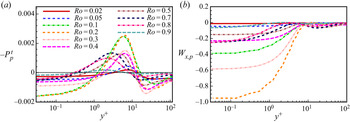
 $-P^t_{p}$ (Teng et al. Reference Teng, Liu, Lu and Khomami2018; Zhu et al. Reference Zhu, Song, Liu, Lu and Khomami2020). Specifically,
 $-P^t_{p}$ has similar profiles for all DR and DE viscoelastic RPCF, namely, two elastic-energy-storing (
 $-P^t_{p}<0$) regions located close to the wall and in the core, and a transition region between the two, i.e. the buffer layer where elastic energy is released back to the flow(
 $-P^t_{p}>0$) (see figure 5a). Hence, irrespective of polymer-induced DM, polymer chains stretch near the wall, namely, they extract kinetic energy from turbulent motions and in turn this stored elastic energy is released back to the flow as the chains relax in the buffer layer (Zhu et al. Reference Zhu, Song, Liu, Lu and Khomami2020).
(a) Energy exchange between turbulent motions and polymer chains denoted by  $-P^t_{p}=-\langle {\tau ^{p}_{ik}}'(\partial {u'_i} / \partial {x_k})\rangle$. (b) The work done by the polymer-induced torque
 $W_{x,p}$. Here,
 ${\boldsymbol {\tau }^p}' = \boldsymbol {\tau }^p - \langle \boldsymbol {\tau }^p\rangle$. The results for the laminar flow state at
 $Ro=1$ are not included hereafter.

Kim et al. (Reference Kim, Li, Sureshkumar, Balachandar and Adrian2007) have demonstrated that polymer–turbulence interactions can also be examined by evaluating the work done by the polymer-induced torque, denoted by  $W_{x,p}$ in the following budget equation for the streamwise enstrophy
 $\langle \omega ^2_x\rangle$:
 \begin{align} \frac{1}{2}\frac{{D\langle\omega^2_x\rangle}}{\partial t} & = \underbrace{\left\langle{\omega_x}\left(\frac{\partial f_z}{\partial y}-\frac{\partial f_y}{\partial z}\right)\right\rangle}_{W_{x,p}}+ \underbrace{\left\langle{\omega^2_x}\frac{\partial u}{\partial x}\right\rangle- \left\langle{\omega_x}\frac{\partial w}{\partial x}\frac{\partial u}{\partial y}\right\rangle+ \left\langle{\omega_x}\frac{\partial v}{\partial x}\frac{\partial u}{\partial z}\right\rangle}_{W_{x,c}} \nonumber\\ & \quad +\underbrace{\left\langle{\omega_x}Ro\frac{\partial u}{\partial z}\right\rangle}_{W_{x,C}} +\left\langle{\omega_x}\frac{\beta}{Re}\nabla^2{\omega_x}\right\rangle. \end{align}
Here  $f_i=(1-\beta )(\tau _{ik}/ \partial {x_k})/Re$ denotes the polymer body force; and
 $W_{x,p}$ represents the correlation between streamwise vorticity
 $(\boldsymbol {\nabla }\times \boldsymbol {u})_x$ and the torque generated by the polymer body force
 $(\boldsymbol {\nabla }\times \boldsymbol {f})_x$;
 $W_{x,p}$ is negative for all
 $Ro$ (see figure 5b), which indicates that the polymer-induced torque acts in the opposite direction to vorticity and thus suppresses turbulent vortices and Reynolds stress production. Commensurate with above-mentioned vortical changes (see figures 2 and 3),
 $W_{x,p}$, is enhanced when
 $Ro\leqslant 0.2$ and it diminishes for
 $Ro>0.2$.
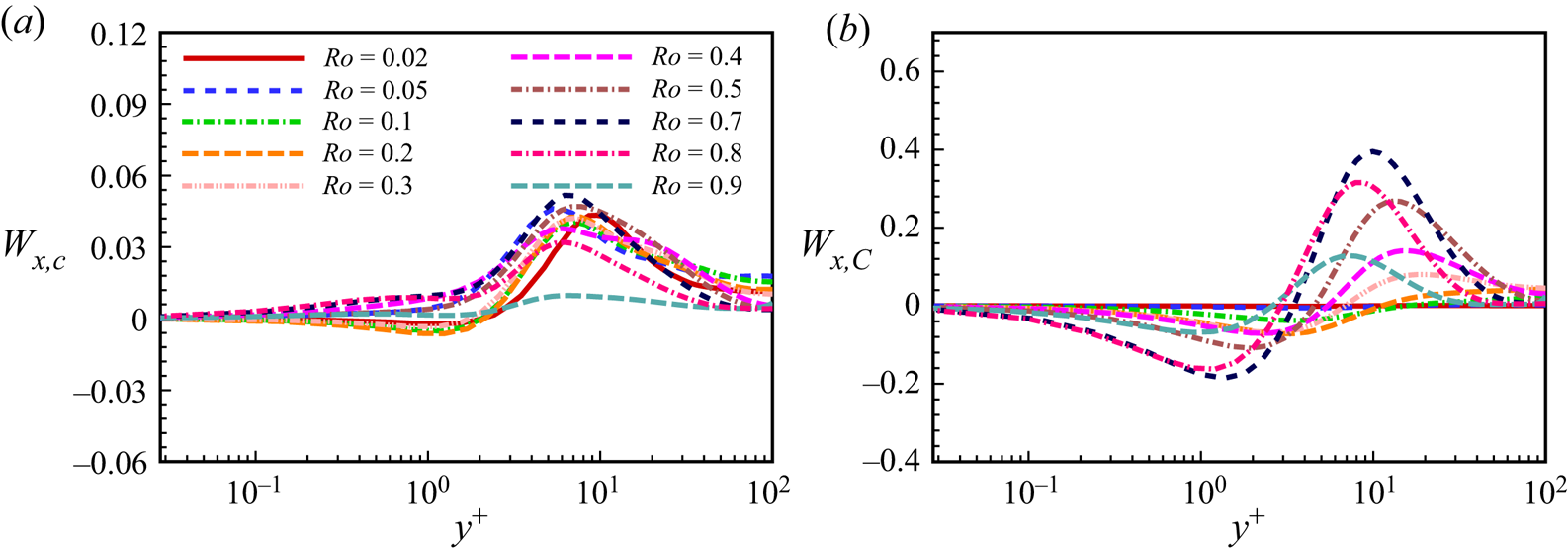
The origin of small-scale vortices in the EIT flow regime at  $Ro=0.5 - 0.9$ depicted in figures 2 and 3 is also examined via the combined production term
 $W_{x,c}$ (see figure 6a) and the Coriolis production term
 $W_{x,C}$ (see figure 6b) defined in (3.2). In this representation,
 $W_{x,c}$ combines the contributions from stretching, tilting and twisting of vortical structures (Kim et al. Reference Kim, Li, Sureshkumar, Balachandar and Adrian2007), and
 $W_{x,C}$ represents vorticity generation by Coriolis forces that arise due to spanwise rotation. In the buffer layer (
 $y^+\approx 10$),
 $W_{x,c}$ has a positive value. This indicates a slight rotation dependence and serves as the main production of
 $\langle \omega ^2_x\rangle$, as it is much larger than
 $W_{x,C}$. For
 $Ro=0.3 - 0.7$,
 $W_{x,C}$ monotonically increases as
 $Ro$ is enhanced; hence, it becomes the dominant production term for
 $\langle \omega ^2_x\rangle$ in the buffer layer. In fact, this term is approximately six times larger than
 $W_{x,c}$, even at
 $Ro=0.9$, where it has been greatly diminished. Therefore, at
 $Ro\geqslant 0.3$, Coriolis forces deteriorate large-scale roll cells and give rise to the formation of small-scale turbulent vortices attached to the walls (see figures 2 and 3). This vortical feature highlights the mechanistic difference between the present rotation-driven EIT flow state and other EIT or elasticity-dominated turbulent flow states (EDT). Specifically, prior findings underscore that EDT in Taylor–Couette flows is signatured by small-scale elastic Görtler vortices (Song et al. Reference Song, Teng, Liu, Ding, Lu and Khomami2019) while EIT in channel and pipe flows is composed of two-dimensional sheets of highly stretched polymers (Dubief et al. Reference Dubief, Terrapon and Soria2013) and streamwise-elongated streaks (Choueiri et al. Reference Choueiri, Lopez and Hof2018; Lopez et al. Reference Lopez, Choueiri and Hof2019), respectively.
(a) The combined production term  $W_{x,c}$ and (b) the Coriolis production term
 $W_{x,C}$.

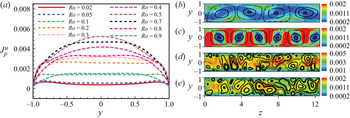
A close examination of the polymer stress term  $J^u_p$ and its spatial relation to vortical structures, shown in figure 7, clearly points to two different DE mechanisms. Specifically, at
 $Ro=0 - 0.2$, a significant increase in the polymer stress is observed near the walls (see figure 7a). This is attributed to the formation of roll cells as
 $Ro$ is increased. The extensional flow generated between those adjacent roll cells produces significant polymer stress, which gives rise to large polymer body forces (see figure 7b,c). Specifically, the transition from polymer-induced DR to DE results from the gradual enhancement of roll cells at
 $Ro=0 - 0.2$ and has an onset at
 $Ro\approx 0.1$ where the enhanced roll cells become energetic enough to produce equivalent polymer stress that complements the decrease of Reynolds stress. For
 $Ro=0.2 - 0.5$, the deterioration of the large roll cells leads to significant reduction of polymer stress that arises from polymer chain interactions with the roll cells. Meanwhile, the appearance of Coriolis-force-generated small-scale vortices much like the small-scale elastic Görtler vortices in Taylor–Couette flows (Song et al. Reference Song, Teng, Liu, Ding, Lu and Khomami2019) gives rise to incoherent transport and homogenization of polymer stress via vortical circulations. That is, highly stretched polymer chains at the walls are transported to the bulk where intense turbulent mixing occurs, resulting in larger polymer stress. This new DE mechanism is more clearly seen at
 $Ro=0.5 - 0.9$ where large-scale roll cells are entirely absent (see figure 7d,e). Although the gradual suppression and final elimination of small-scale vortices in this regime leads to a decrease in
 $J^u_p$, the polymer body forces remain sufficiently large to cause DE. Hence, this intricate flow–microstructure coupling gives rise to a distinct DE mechanism at high rotation.
(a) Ensemble-averaged polymer stress term  $J^u_p$ and (b–e) contour plots of
 $J^u_p$ superimposed with the streamlines of the ensemble-averaged velocity vector (
 $\boldsymbol {v}, \boldsymbol {w}$), for (b)
 $Ro=0.02$, (c)
 $Ro=0.2$, (d)
 $Ro=0.7$ and (e)
 $Ro=0.9$.

4. Concluding remarks
In summary, novel spanwise-rotation-driven flow transitions in the viscoelastic PCF leading to a DE elasto-inertial turbulent flow state have been reported via DNS. These intriguing flow transitions begin from a polymer-rendered drag-reduced inertial turbulent flow regime at  $0\leqslant Ro \leqslant 0.1$, which transitions to a rotation/polymer-additive-driven DE inertial turbulent flow regime at
 $0.1\leqslant Ro \leqslant 0.3$, followed by a rotation- and polymer-additive-rendered EIT flow regime in
 $0.3\leqslant Ro \leqslant 0.9$, and finally to a fully relaminarized flow at
 $Ro=1$. These transitions occur due to the competition between polymer-induced decrease of convective momentum flux
 $J^u_R$, i.e. Reynolds stress, and rotation-rendered increase of polymer stress
 $J^u_p$.
The universal mechanism for the polymer–turbulence interactions is further substantiated by our simulations. Specifically, it is confirmed that polymer additives extract kinetic energy from turbulent motions via chain stretching near the wall and subsequently release the stored elastic energy back to the flow as the chains relax in the buffer layer. In addition, two intriguing rotation-dependent DE mechanisms have been proposed and substantiated via variation in the transverse momentum exchange. Specifically, at  $Ro \leqslant 0.2$ rotation-induced formation of large-scale roll cells results in enhanced convective momentum transport along with significant production of polymer stress localized between neighbouring roll cells, while for
 $Ro=0.5 - 0.9$ Coriolis-force-generated turbulent vortices cause strong incoherent transport and homogenization of sufficiently large polymer stress in the bulk via their vortical circulations.
Funding
The present calculations are performed at the Supercomputing Center of the University of Science and Technology of China. This work was supported by the National Natural Science Foundation of China (grant numbers 12172353, 92052301, 91752110, 11621202 and 11572312), Science Challenge Project (grant number TZ2016001) and National Science Foundation (grant number CBET0755269).
Declaration of interests
The authors report no conflict of interest.