Implications
Correct coat color identification is important from the breeder’s point of view because it can support the selection of undesired colors and allow to plan the future matings. Herein we show that the coat colors of Hucul horses are frequently misclassified if compared to these predicted from Agouti Signaling Protein (ASIP) and T-box 3 (TBX3) genotypes. This indicates the necessity of genetic testing in order to avoid potential mistakes in the official breeding documentation. Moreover, the high level of noted discrepancies suggests the existence of unknown genetic modifier(s), making distinguishing of some coat colors challenging.
Introduction
The Hucul horse (Carpathian pony) is a primitive horse breed originating in the eastern Carpathian Mountains (currently near the border of the Ukraine and Romania). The earliest written records of this breed date to the beginning of the 17th century. Before World War I, the primary breeding center for the Hucul horse was located in the Bukovina region, and the famous national stud at Lucina was founded in 1856. Currently, Huculs are bred in Poland (over 50% of the population) as well as the Czech Republic, Hungary, Slovakia, Germany, Austria and Romania (Stachurska and Jansen, Reference Stachurska and Jansen2015). Due to their primitive body conformation, good health, strength and longevity, the Hucul horses are considered genetically valuable rare breed. Therefore, in the early 2000s the breed entered the livestock conservation program in Poland (Mackowski et al., Reference Mackowski, Mucha, Cholewinski and Cieslak2015) managed by the National Research Institute of Animal Production (Balice, Poland) (http://www.izoo.krakow.pl/en/).
The permitted coat colors for the Hucul horse differ between individual national breeding programs. For example, in the latest (8th) volume of the Polish studbook the number of tobiano spotted horses exceeded 30%, whereas in Slovakia and Hungary horses carrying this pigmentation pattern are banned from the registry. The Czech Republic established a separate section within the official studbook for tobiano spotted Huculs. The Polish breeding program of the Hucul horse allows various pigmentation types except gray, roan, albino, leopard spotting and in the majority of cases – chestnut (chestnut mares are registered only in exceptional circumstances, whereas chestnut stallions are eliminated by definition). Moreover, horses carrying white markings and those without clearly pronounced primitive features (e.g. a dark dorsal stripe) are usually removed from the breeding program. Analysis of official breeding documentation conducted by Stachurska et al. (Reference Stachurska, Brodacki and Grabowska2012) revealed that Huculs registered in the Polish studbook are mainly bay, black, bay dun or blue dun – often in combination with the tobiano spotting pattern. Notably, Huculs possess a ‘crypto-tobiano’ phenotype characterized by individuals that do not clearly manifest the presence of the dominant To spotting allele. This may be due to the segregation of an additional, unknown genetic modifier, suppressing the tobiano spotting gene effect (Stachurska and Jansen, Reference Stachurska and Jansen2015).
To date, most studies of Hucul coat color were based upon breeding documentation only, and relatively little is known about the molecular background of the observed phenotypic variability. Analysis of crypto-tobiano cases demonstrated that correctly distinguishing of pigmentation types is sometimes impossible without molecular testing. It should be stressed that from the modern horse breeding point of view the identification of genotype in coat color loci is often essential because it allows accurate selection of pairs for mating, for example, to avoid undesired coat colors in the next generation or to increase the probability of the more valuable phenotypes. Based on information obtained from the Polish Horse Breeders Association, correctly identifying and recording coat color in the Hucul horse is challenging for registry staff. Multiple shades of the bay base coat color segregate within the Hucul horse population, which in combination with color dilution resulting from the dominant dun (D) gene (blue dun and bay dun), creates many phenocopies within this population (the most common coat colors within the Hucul breed and their expected genotypes are shown in Supplementary Table S1). Thus, taking into consideration the recent discovery of genetic variants related to the dun/non-dun phenotypes, we initiated this pilot study in order to compare the frequency of the dun-diluted coat colors with the color description recorded in the breeding documentation. The Dun coat color in the horse is typically characterized by a diluted base coat and presence of Dun characteristics including a dorsal stripe, shoulder crosses, leg barring, eye shadows, etc. (Imsland et al., Reference Imsland, McGowan, Rubin, Henegar, Sundström, Berglund, Schwochow, Gustafson, Imsland, Lindblad-Toh, Lindgren, Mikko, Millon, Wade, Schubert, Orlando, Penedo, Barsh and Andersson2016). According to the work by Imsland et al. (Reference Imsland, McGowan, Rubin, Henegar, Sundström, Berglund, Schwochow, Gustafson, Imsland, Lindblad-Toh, Lindgren, Mikko, Millon, Wade, Schubert, Orlando, Penedo, Barsh and Andersson2016), the dun dilution effect is due to the presence of a 1.6 kb insert within the downstream region of the TBX3 gene (the dominant D allele), whereas absence of this fragment on both chromosomes results in non-dilute (recessive nd2–non-dun 2 allele) coats and absence of Dun-related characteristics. There is also another variant located within the 1.6 kb insert (a G>T Single Nucleotide Polymorphism (SNP)), that disrupts the dun dilution effect (nd1–non-dun 1 allele), but leaves evidence of the other Dun phenotype characteristics like the dorsal stripe. Thus, horses carrying nd1nd1 and nd1nd2 genotypes often possess a dark dorsal stripe and other ‘primitive’ Dun-related markings.
In addition, given the presence of various shades of the bay base coat color within the Hucul breed, we genotyped all horses for the causative 11 bp indel polymorphism in the ASIP gene. In the homozygous state (aa genotype), this frameshift mutation causes uniform production of dark pigmentation across the body of the horse (black coat color). Presence of at least one copy of wild-type allele (AA and Aa genotypes) results in the restricted distribution of eumelanin to several ‘points’: the mane, tail, lower legs or ear rims (bay horse) (Rieder et al., Reference Rieder, Taourit, Mariat, Langlois and Guérin2001). As chestnut pigmentation caused by a recessive SNP in the MC1R gene (encoding the melanocortin 1 receptor) occurs in the Polish population of Huculs only rarely (chestnut horses are usually eliminated from breeding), we decided to focus on the two above mentioned dominant loci (TBX3 and ASIP) since these are responsible for almost all coat colors recognized in this breed.
Material and methods
Altogether 462 genomic DNA samples were used in this study. The majority of samples (n = 414) were provided by the Horse Genetic Markers Laboratory (Poznan University of Life Sciences) collection where they previously used for parentage control analyses. In addition, 48 DNA samples were extracted from newly collected hair samples of horses kept within the national Hucul stud in Gladyszow (Poland). About 20 hairs from each horse mane were collected during routine grooming (no special permission of the local ethics committee was needed). Deoxyribonucleic acid isolation from hair follicles was carried out according to the methodology described previously (Cieslak et al., Reference Cieslak, Cholewinski and Mackowski2013).
Initially, to calculate the frequency of the TBX3 and ASIP variants within our sampling of the Hucul breed we used the set of 74 randomly selected samples. Afterwards the larger panel of 386 horses (both genders) representing different coat colors and shades (according to the Polish Horse Breeders Association database) was selected for comparisons of the recorded and genetic coat colors. To better reflect the coat color loci (TBX3 and ASIP) allelic distributions within the whole Hucul breed, we decided to not restrict our study to those horses fully qualified for breeding (recorded in studbooks). It should be also noted that in this study we used coat color data derived from mature horses only.
Polymerase chain reaction primers for TBX3 gene fragment amplification were designed using Primer3 software v. 4.1.0 (http://bioinfo.ut.ee/primer3/) (Koressar and Remm, Reference Koressaar and Remm2007), whereas sequences of primers used for ASIP polymorphism genotyping were adopted from the work of Rieder et al. (Reference Rieder, Taourit, Mariat, Langlois and Guérin2001). Analysis of the TBX3 gene 1.6 kb in/del (D v. nd2 allele) was performed using allele-specific PCR (a combination of three primers) and electrophoresis in 1.5% agarose gel stained with ethidium bromide (120 V, 30 min). Genotype for the G>T SNP (D v. nd1 allele) was established by direct sequencing of PCR products (ABI Prism 3130 Genetic Analyzer; Applied Biosystems, Foster City, CA, USA). Genotypes for the ASIP in/del were determined by electrophoresis in 2.5% agarose gel stained with ethidium bromide (120 V, 45 min). Polymerase chain reaction amplification of all studied fragments was carried out in a T-100 thermocycler (Bio-Rad, Hercules, CA, USA) using 1 U of DreamTaq DNA Polymerase under conditions provided by the manufacturer (Thermo Fisher Scientific, Waltham, MA, USA). All PCR primer sequences and other amplification details are shown in Supplementary Table S2.
After genotyping, the randomly selected group of 74 horses was tested for Hardy–Weinberg equilibrium according to the formula considering segregation of 2 (A, a) or 3 (D, nd1 and nd2) alleles at the ASIP and TBX3 loci, respectively. Afterwards, the coat color characteristics of each horse (provided in the Polish Horse Breeders Association database) was compared to those predicted on the basis of genotypes for the TBX3 and ASIP loci and discrepancies carefully noted (all recorded genotypes and coat colors are shown in Supplementary Table S3). For all phenotypic groups (light bay, bay, dark bay, bay dun, blue dun, dark blue dun and black) the percentage error rate was calculated as ratio of animals with misclassified coat colors to the total number of horses comprised in the given group.
Results
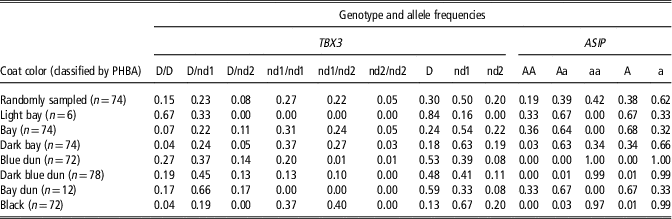
Genotyping of the TBX3 gene variants (1.6 kb in/del polymorphism and the nd1-related SNP) in 74 randomly selected Hucul horses revealed the presence of all six possible genotypes with the nd1nd1 at the highest frequency (0.27) and nd2/nd2 the lowest (0.05) (Table 1). The nd1 (non-dun 1) allele frequency reached 0.50, whereas D (dun) and nd2 (non-dun 2) equaled 0.30 and 0.20, respectively. The ASIP genotype frequencies were as follows: AA – 0.19; Aa – 0.39 and aa – 0.42. No statistically significant deviations from Hardy–Weinberg equilibrium were noticed for either locus (P > 0.05). Comparison of the obtained genotypes with the recorded coat color descriptions from the Polish Horse Breeders Association database indicated the presence of significant discrepancies regarding the dun dilution effect, since about 35% of horses recorded as bay (all shades) were genetically bay dun (at least one copy of the dominant D allele). Interestingly, within this small sample set the vast majority of blue dun horses (86%) were recognized correctly. Moreover, in seven cases the genetically black horses (aa genotype in the ASIP gene, without dominant dun dilution D allele) were classified improperly as dark bay.
TBX3 and ASIP genotype and allele frequencies in the Polish population of Hucul horses

PHBA = Polish Horse Breeders Association; TBX3 = the T-box 3 gene; ASIP = the agouti signaling protein gene; D = dominant Dun allele (TBX3); nd1 = recessive non-dun 1 allele (TBX3); nd2 = recessive non-dun 2 allele (TBX3); A = dominant allele (ASIP); a = recessive allele (ASIP).
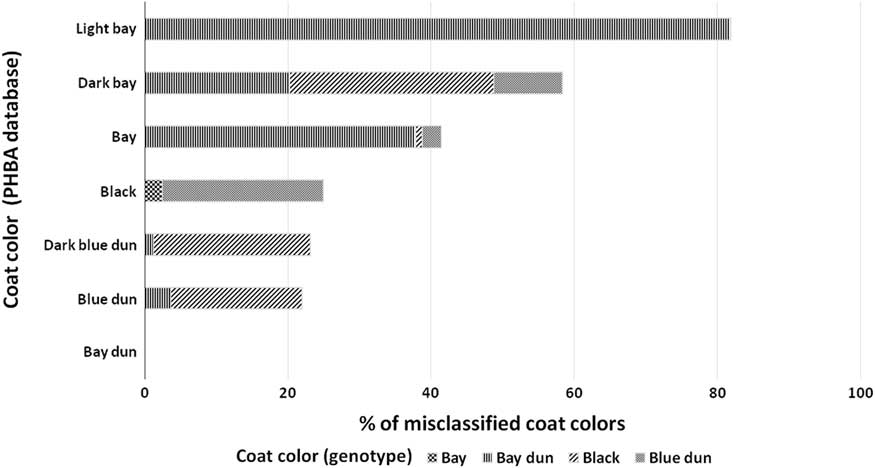
Examination of the color categories recorded in Hucul breeding documentation for the genotyped horses confirmed a significant number of misclassified individuals. The only phenotypic group in which all individuals were described correctly was the small set (n = 12) of bay dun horses. For the remaining groups the overall error rate ranged from 22% (blue dun) to 82% (light bay). In the case of the blue dun horse group (containing horses of different shades), phenotype classification was likely confounded by the segregation of nd1/nd1 and nd1/nd2 genotypes. Whereas in the bay horses the situation seems to be much more complex. In all ‘shade’ categories within the bay pigmentation a high number of bay dun individuals were not correctly recognized (24%, n = 18; 39%, n = 29 and 100%, n = 6 for dark bay, bay and light bay, respectively). Furthermore, the ASIP genotype distribution illustrated that a significant portion (34%, n = 25) of animals described as dark bay are genetically black (TBX3 genotypes: nd1/nd1 or nd1/nd2) or blue dun. Finally, in the cohort of animals recorded as black, about one-fourth were truly blue dun (Figure 1).
Incorrectly recognized coat colors within particular phenotypic groups of Hucul horses. PHBA = Polish Horse Breeders Association.

Discussion
Pigmentation type impacts the economic value of the domesticated horse by influencing the esthetic appeal of individual animals. More importantly, certain colors are also associated with genetic disorders, and could therefore also negatively impact the health of the animal (Bellone, Reference Bellone2010). Moreover, the existence of pleiotropic effects on horse behavior phenotypes were recently documented for two of the basic coat colors loci (MC1R and ASIP) (Finn et al., Reference Finn, Haase, Willet, van Rooy, Chew, Wade, Hamilton and Velie2016; Jacobs et al., Reference Jacobs, Staiger, Albright and Brooks2016). Although, the dun pigmentation is suggested to be the wild-type allele for the domestic horse coat (Ludwig et al., Reference Ludwig, Pruvost, Reissmann, Benecke, Brockmann, Castaños, Cieslak, Lippold, Llorente, Malaspinas, Slatkin and Hofreiter2009) this hypothesis was only recently verified with discovery of the molecular basis of dun/non-dun phenotypes. Analyses performed on large numbers of horse breeds indicated that the dun dilution effect results from a radially asymmetric pigment distribution within the growing hair directed by asymmetric expression of TBX3 transcription factor in the hair bulb keratinocytes. Comparison of nucleotide sequences derived from dun and non-dun horses has resulted in the precise localization a 1.6 kb dun-specific insert found 5 kb downstream from the TBX3 gene. Interestingly, the presence of two causative regulatory mutations for non-dun phenotypes was indicated: the 1.6 kb deletion (called nd2, non-dun 2) and the G>T SNP (nd1, non-dun 1) located within the 1.6 kb fragment (Imsland et al., Reference Imsland, McGowan, Rubin, Henegar, Sundström, Berglund, Schwochow, Gustafson, Imsland, Lindblad-Toh, Lindgren, Mikko, Millon, Wade, Schubert, Orlando, Penedo, Barsh and Andersson2016).
Comparisons of the dun/non-dun allele frequencies between this and previously published studies highlights noticeable differences. The Polish population of Hucul horses possesses a very high frequency of the nd1 allele (which in our group of randomly selected 74 horses reached the value of 0.50) with a relatively low frequency of nd2 allele (0.20). For example, the overall nd1 frequency calculated for 1841 horses (various breeds) studied in the work by Imsland et al. (Reference Imsland, McGowan, Rubin, Henegar, Sundström, Berglund, Schwochow, Gustafson, Imsland, Lindblad-Toh, Lindgren, Mikko, Millon, Wade, Schubert, Orlando, Penedo, Barsh and Andersson2016) was nearly three times lower (0.18), whereas the frequency of nd2 allele was over three times higher (0.63) than recorded in the present study. Finally, in the Polish Primitive Horse (Konik) breed the nd1 allele was totally absent (Stefaniuk-Szmukier et al., Reference Stefaniuk-Szmukier, Ropka-Molik, Piórkowska, Szmatoła, Długosz, Pisarczyk and Bugno-Poniewierska2017). It is likely that high frequency of the nd1 allele within the population of Hucul horses kept in Poland is a result of specific phenotypic requirements included in the official breeding program. Various coat colors are permitted by the registry, but for all individuals the presence of a dark dorsal stripe and other primitive markings is required (fully described in the introduction section). As clearly indicated by Imsland et al. (Reference Imsland, McGowan, Rubin, Henegar, Sundström, Berglund, Schwochow, Gustafson, Imsland, Lindblad-Toh, Lindgren, Mikko, Millon, Wade, Schubert, Orlando, Penedo, Barsh and Andersson2016) the ancient nd1 allele, which predates horse domestication, is associated with the presence of a dark dorsal stripe. Conversely, horses carrying the two copies of the relatively recent nd2 allele do not manifest such primitive features. Thus, we can assume that within the Hucul breed the nd2 allele is under strong negative selection, while the nd1 allele allows to presence of both a diversity of coat colors and the highly desirable primitive markings. Interestingly, the observed high frequency of the nd1 allele may resemble the genetic situation present within the ancestral population of wild horses that contributed to the domestication process (Imsland et al., Reference Imsland, McGowan, Rubin, Henegar, Sundström, Berglund, Schwochow, Gustafson, Imsland, Lindblad-Toh, Lindgren, Mikko, Millon, Wade, Schubert, Orlando, Penedo, Barsh and Andersson2016). Despite the fact that nd2/nd2 horses do not manifest the presence of highly desirable primitive markings (including dorsal stripe) we have found several carriers of these genotype within tested samples set. However as mentioned above (the Material and methods section) our study has spanned also horses which do not fully meet the breeding registry requirements. Moreover, the relatively large phenotypic groups of Hucul horses are these of black or dark bay coat colors in which the presence or absence of dorsal stripe is difficult to examine. Our study has shown that some individuals classified to these groups are nd2/nd2 homozygotes.
Previously published studies have documented that the number of Hucul horses with coats diluted by the dun gene may be higher than officially recorded. This was partly predicted by simple pedigree analysis conducted in the work by Stachurska et al. (Reference Stachurska, Brodacki and Grabowska2012) which indicated that the frequency of D allele in progeny is significantly lower than anticipated based on Mendelian ratios given the phenotypes of the sires and dams. However, our analysis indicates that the magnitude of the D allele underestimation is higher than predicted, especially in the group of genetically bay dun horses (1.7% v. 19% in the present study). Analysis of consecutive studbook volumes suggested that although the dun pigmentation is considered ancestral (and should be of preference in the primitive Hucul breed) the overall frequency of D allele is decreasing over time because the majority of breeders prefer the undiluted coat colors. Yet, our study clearly indicates that the frequency of the D allele is still relatively high (around 30%) and may be partly ‘hidden’ in the large group of horses with misclassified coat colors. Conversely, we have shown that the real frequency of the dominant A allele in the ASIP gene is lower than predicted by Stachurska et al. (Reference Stachurska, Brodacki and Grabowska2012) based upon the information recorded in studbooks (0.39 v. 0.48, respectively).
Occasional misclassifications based on visual observations are understandable given the large number of horses in the Hucul registry and the diversity of pigmentation types present. Yet, the number of inconsistencies between molecular and phenotypic data significantly exceeded our expectations, and was multiple times higher than previously recorded for coldblood breeds kept in Poland (Cieslak et al., Reference Cieslak, Cholewinski and Mackowski2013). The phenotypes of Hucul and above-mentioned coldblood breeds are often described and officially recorded by the same Polish Horse Breeders Association inspectors. Therefore, we suggest that the large number of misclassified coat colors specific to the Hucul is not likely an effect of simple human error. There are putatively several genetic reasons for these discrepancies. First, is the high prevalence of nd1/nd1 and nd1/nd2 genotypes within Hucul horse breed. As suggested by Imsland et al. (Reference Imsland, McGowan, Rubin, Henegar, Sundström, Berglund, Schwochow, Gustafson, Imsland, Lindblad-Toh, Lindgren, Mikko, Millon, Wade, Schubert, Orlando, Penedo, Barsh and Andersson2016), the effect of the nd1 SNP is not as strong as that of the nd2 deletion, what is noticeable for both – microscopic and gross pigmentary phenotypes. Therefore we assume that in the case of nd1/nd1 and nd1/nd2 genotypes carriers some ‘intermediate’ phenotypes (between fully diluted and non-diluted coats) can occur. This can lead to the frequent nomenclatural problems during coat color classification as such horses may be designated ‘non-duns’ by visual examination, although their coats possess some subtle signs of dilution (see Supplementary Figure S1). In our study, we have found that many carriers of the nd1/nd1 or nd1/nd2 genotypes were assigned improperly to the group of blue duns. We also suggest that the dun dilution effect itself is not as strongly dominant in the Hucul horse, as compared to previous reports in other breeds. For example, in the Polish Primitive Horse (Konik) many individuals are described as light blue dun, whereas in the case of Hucul horse this is extremely rare. Moreover, we found that the large number of horses classified as bay, dark bay or even black are carriers of at least one dominant D allele (Table 1). Alternatively, these findings may suggest the segregation of an additional, unknown, genetic modifier that masks the dun dilution effect within the Hucul horse population. The activity of a ‘dilute repressor’ locus is observed in laboratory mice (MREG – melanoregulin gene) (Moore et al., Reference Moore, Seperack, Strobel, Swing, Copeland and Jenkins1998). Interestingly, to our knowledge, there are no scientific data regarding the possible influence of equine MREG gene variants on coat color variability of Hucul and other horse breeds.
It is also likely, that in some cases the extensive tobiano spotting (not tested in this work) can alter the efficacy of determining the basic coat color by eye (e.g. by masking the presence of highly desirable dorsal stripe). Currently, over 30% of Hucul horses recorded in studbook possess the tobiano pigmentation pattern (Stachurska and Jansen, Reference Stachurska and Jansen2015).
Our study has indicated the presence of numerous discrepancies between officially distinguished coat colors of the Hucul horse and the phenotype predicted on the basis of genotypes. We also documented the allele frequencies of two important coat color loci (TBX3 and ASIP), and found significant differences from values deduced previously from data recorded in studbooks. Generally, we can confirm that due to the complex molecular background found within the coat color genes in the Hucul breed (e.g. high frequency of nd1 allele) the correct assignation of particular pigmentation types can be challenging. Thus, in the most problematic cases application of available molecular tests is strongly recommended. This would help to avoid mistakes in the coat color descriptions provided in the official breeding documentation, and inform selective breeding programs seeking to produce desired coat colors.
Acknowledgements
This work was supported by the Polish Ministry of Science and Higher Education, grant number: IP2014 006873 (Iuventus Plus program).
Declaration of interest
The authors declare no potential conflicts of interest associated with this research.
Ethics statement
No special permission of the local ethics committee was needed to conduct this work.
Software and data repository resources
None of the data were deposited in an official repository.
Supplementary material
To view supplementary material for this article, please visit https://doi.org/10.1017/S1751731118003506