Introduction
Recent studies have described and tested innovative methods of haemostasis for thyroid surgery, with promising results. In addition to conventional ligatures, haemostasis can be achieved using clips, staples, and several types of energy-based tissue sealing and cautery devices (e.g. those that use monopolar and bipolar electrical currents, laser, ultrasonic waves and the harmonic scalpel).Reference Duh1–Reference Franko, Kish, Pezzi and Pak19 The conventional knot tying technique requires a large number of surgical ties and is therefore time-consuming.
Radiofrequency surgery could be a safe and effective alternative method of haemostasis.Reference Petrakis, Kogerakis, Lasithiotakis, Vrachassotakis and Chalkiadakis14, Reference Lachanas, Prokopakis, Mpenakis, Karatzanis and Velegrakis17–Reference Franko, Kish, Pezzi and Pak19 It offers the highest degree of precision and causes minimal thermal damage compared with conventional electrosurgery. The precision of the energy input makes it an ideal technique for microsurgery. This method also avoids the need for extreme temperatures, which can injure important surrounding structures. Radiofrequency surgery is associated with less thermal damage and reduced operative times. The recent increase in the use of radiofrequency surgery as a haemostatic technique has led researchers to focus on the design of a reliable radiofrequency-activated dissector for use in head and neck surgery.Reference Frias20–Reference Bellantone, Lombardi, Bossola, Boscherini, De Crea and Alesina23
The usefulness of this technique in minimally invasive thyroid surgery is not well defined. Radiofrequency surgery is likely to have significant advantages over the knot tying technique, especially in terms of reducing operative time, complication rates and incision sizes, with comparable morbidity rates. However, there is concern about its routine use in conventional ‘open’ total thyroidectomy. In this prospective randomised study, we evaluated the efficiency, safety and surgical outcomes related to the use of radiofrequency dissection during total thyroidectomy.
Materials and methods
Of the patients scheduled for conventional ‘open’ total thyroidectomy between March and December 2012 at the Haseki Research and Training Hospital, 39 consented to be included in the study. These patients were randomly assigned to two groups: total thyroidectomy was performed using a radiofrequency dissector (radiofrequency dissection group) in one group, and the knot tying technique was used in the other (knot tying group). The study protocol was approved by our institution's ethics committee.
All patients scheduled to undergo total thyroidectomy were considered eligible for inclusion in the study. Exclusion criteria were aged less than 18 years, previous neck surgery or irradiation, need for central and/or lateral lymph node dissection, and concomitant parathyroid disorders. Patients were informed about the study by a resident or a staff surgeon at the time of hospitalisation. All patients provided informed written consent.
Patient demographic data and pre-operative clinical characteristics were assessed by a specific questionnaire prior to surgery. Patients were randomly assigned to either the radiofrequency dissection group or the knot tying group at the time of surgery. Patients were blinded to the technique used for haemostasis. Group assignment was communicated to the surgeon and operating team (by the first author) immediately after the skin incision.
The scrub nurse was responsible for the prospective collection of intra-operative and post-operative data on the following parameters: operative time (from skin incision to wound closure), number of disposable surgical materials used and number of surgical instruments requested by the surgeon during the operation. Medical staff of the ENT division were responsible for the collection of clinical data, including information relating to the pre-operative diagnosis, operative procedure, drain fluid volume, post-operative complications and histology.
Laryngoscopy was performed pre- and post-operatively in all patients to check vocal fold mobility. A Kocher incision, measuring 5–6 cm in length, was made at the start of the total thyroidectomy procedure.
All surgical procedures were performed by an experienced head and neck surgeon or resident surgeon. Total thyroidectomy was defined as total bilateral extracapsular lobectomy, and the surgical technique is described elsewhere.Reference Bellantone, Lombardi, Bossola, Boscherini, De Crea and Alesina23 For patients in the knot tying group, the upper, middle and inferior vessels were divided after being tied with conventional ligatures (Vicryl™ polyglactin 910 sutures, sizes 2-0 and 3-0 as required). For patients in the radiofrequency dissection group, coagulation and cutting of the middle and inferior vessels was carried out using a radiofrequency dissector (non-stick bipolar dissection forceps, Sutter Medizintechnik, Freiburg, Germany; Figure 1). The upper pole was tied with size 2-0 silk sutures. No other coagulation method was used in this group. Monopolar and bipolar electrocautery were used as accessory coagulation methods in the knot tying group only. During the radiofrequency dissection procedure, the middle and inferior vessels were grasped with adequate pressure. The coagulation foot pedal was used first, and when the activation voice stopped, we shifted to cut mode using the cut foot pedal until vessels were divided. The knot tying technique was not used to achieve haemostasis in the radiofrequency dissection group when dissecting close to (within 5 mm) the laryngeal nerves and parathyroid glands.
(a–d) Four views of the non-stick bipolar dissection forceps (a), showing dissecting (b), coagulating (c), and cutting and grasping (d) during thyroid surgery

Post-operatively, patients were given a visual analogue scale form to subjectively rank and record the degree of pain from 1 (least severe pain) to 10 (most severe pain). Calcium and phosphorus levels were monitored in all patients. Hypocalcaemia was defined as a serum calcium level of less than 2 mmol/l, even if this was based on a single measurement. Hypocalcaemic patients received supplementation therapy, including oral calcium and vitamin D, even if they were asymptomatic.
Patients who did not recover within six months of the operation were defined as having definitive recurrent laryngeal nerve palsy or hypoparathyroidism. Follow-up evaluations were carried out during out-patient consultation or by telephone at one, three and six months after surgery.
Statistical analysis
Comparative analysis of quantitative and descriptive data (means, standard deviations, medians, frequencies, ratios) was performed with The Number Cruncher Statistical System 2007 and PASS 2008 statistical software programs (NCSS, Kaysville, Utah, USA). Independent sample t-tests were used to compare parameters with normal distributions. The Mann–Whitney U test was used to compare parameters without normal distributions. Yates' continuity correction test and Fisher's exact test were used to compare qualitative data. Results were evaluated as 95 per cent confidence intervals and statistical significance was set at p < 0.05.
Results
The study was performed at a tertiary referral centre between March and September 2012, and comprised 39 patients. Patient demographics, clinical features and pre-operative diagnoses are shown in Table I. A significant difference in pre-operative diagnosis was found between the two groups (p < 0.05; Table I).
Demographic characteristics, pre-operative diagnosis and pathological findings for the KT and RF groups
*n = 20. †n = 19. †Independent samples t-test. ‡Yates correction for continuity. **Fisher's exact test. §p < 0.05. KT = knot tying; RF = radiofrequency dissection; SD = standard deviation
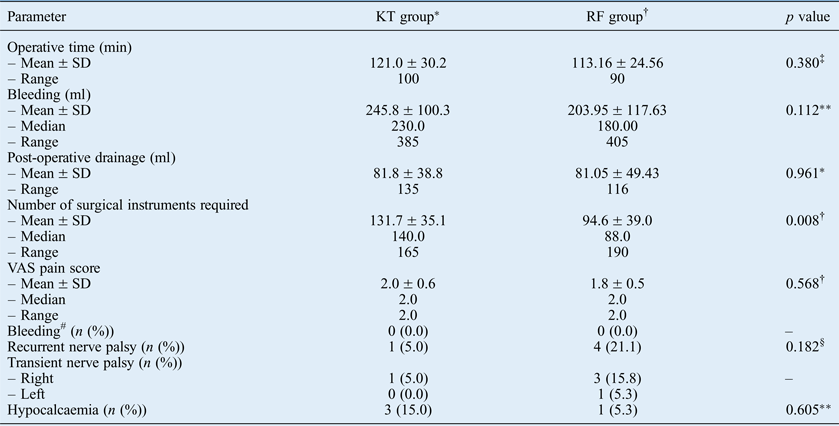
No significant differences in operative time, blood loss, post-operative drainage volume and pain were found between the knot tying and radiofrequency dissection groups (p > 0.05). The number of surgical instruments used was significantly higher in the knot tying group (131.65 ± 35.08) than the radiofrequency dissection group (94.63 ± 39.00; p < 0.01). No post-operative bleeding (e.g. haematoma, urgent draining or re-operation) occurred in either group.
There was no significant difference in the occurrence of transient recurrent palsy between the two groups: there was one case (5.0 per cent) of transient recurrent palsy in the knot tying group and four cases (21.1 per cent) in the radiofrequency dissection group (p > 0.05; Table II). Statistical analysis of the side affected with palsy could not be performed because of insufficient patient numbers. One patient in the knot tying group was affected by right-sided transient recurrent palsy, and three patients with right-sided palsy and one with left-sided palsy in the radiofrequency dissection group. There was no significant difference between the knot tying and radiofrequency dissection groups in the occurrence of hypocalcaemia: three patients (15.0 per cent) had hypocalcaemia in the knot tying group and one (5.3 per cent) in the radiofrequency dissection group (p > 0.05).
Operative and post-operative characteristics of patient groups
*n = 20. †n = 19. ‡Independent samples t-test. **Mann–Whitney U test. §Fisher's exact test. #Including haematoma, urgent draining or re-operation. – = values could not be calculated because of insufficient patients; KT = knot tying; RF = radiofrequency dissection; SD = standard deviation; VAS = visual analogue scale
Discussion
The potential use of radiofrequency in minimally invasive thyroid surgery has yet to be fully realised. However, it provides excellent haemostasis in neck dissection and, with the aid of a handy dissector, can reduce operative time, with morbidity rates comparable with those of other haemostatic techniques.Reference Rosato, Avenia, Bernante, De Palma, Gulino and Nasi24 A smaller, specialised handpiece can be used with the radiofrequency dissector for dissecting delicate tissues and in narrow spaces such as the neck. Its lateral thermal spread is minimal.
Reservations about the use of radiofrequency dissection in minimally invasive total thyroidectomy remain because of the concerns of thyroid surgeons about recurrent laryngeal nerve damage.Reference Duh1, Reference Siperstein, Berber and Morkoyun6, Reference Shemen7, Reference Cordón, Fajardo, Ramírez and Herrera10 Indeed, before its use is considered, it should first be unequivocally demonstrated to provide at least the same complication rates and surgical outcomes as the knot tying technique, without increasing the overall risk of the procedure.
To date, no comparative observational studies demonstrating improvements in operative time, complication rates and post-operative pain have been published. Our results, although based on a small patient series, showed that achieving haemostasis during conventional total thyroidectomy with radiofrequency dissection is at least as safe as using the knot tying technique (with similar morbidity rates for both groups). To avoid bias, patients were randomly assigned to each group and surgeons were only informed about which technique they should use for haemostasis immediately before the operation. When designing this study protocol, attempts were made to eliminate bias in both patient selection and assessment of the main outcome measures. It is possible that the radiofrequency dissection technique could also enable total thyroidectomy to be performed using a smaller skin incision. However, this endpoint was not measured in the present study to avoid introducing bias into the overall evaluation of the operative outcome.
Some studies have compared the knot tying method with ultrasonically activated shears and the harmonic scalpel. Voutilainen and Haglund reported the mean operating time to be 99.1 minutes in the ultrasonically activated shears group and 134.9 minutes in the conventional surgery group.Reference Voutilainen and Haglund5 The average operative time saved using the ultrasonically activated shears was 35.8 minutes, with no difference in complication rates between the two groups. Siperstein et al. reported a shorter mean operative time in the harmonic scalpel group than in the conventional technique group for total thyroidectomy procedures (132 ± 39 minutes vs 161 ± 42 minutes; p < 0.01).Reference Siperstein, Berber and Morkoyun6 There was no difference in the volume of blood loss between the two techniques. In the present study, the difference in the duration of surgery (7.84 minutes) using the radiofrequency dissector technique and the conventional technique was not significant (113.16 ± 24.56 minutes vs 121.00 ± 30.15 minutes). The mean operative time using the radiofrequency dissector technique was similar to that of both the ultrasonically activated shears and harmonic scalpel. In our study, however, the mean duration of conventional surgery was shorter than in both previous studies. This may be a caused by differences among operating surgeons and clinical centres. In addition, the use of bipolar coagulation in our knot tying group reduced the operative time, which may explain why there was no significant difference in operative duration between the knot tying and radiofrequency dissection groups. Therefore, we conclude that the radiofrequency dissector technique is cost-effective and takes a similar amount of time as the ultrasonically activated shears and harmonic scalpel techniques. This study demonstrates that total thyroidectomy is equally safe when carried out using the radiofrequency dissector and the knot tying technique.
• Energy-based devices such as electrocauterisation, laser, ultrasonic waves and harmonic scalpel are used for tissue sealing in total thyroidectomy
• This is the first report of total thyroidectomy by radiofrequency dissection
• Radiofrequency dissection is a safe, effective alternative to the knot tying technique for total thyroidectomy
• It enables a 30 per cent reduction in the number of surgical instruments required, without increasing complication rates or procedure times
In a resection procedure such as thyroidectomy, the conventional knot tying technique requires a large number of surgical ties and surgical instruments used to promote coagulation (such as clamps, scissors and bipolar forceps). This technique is therefore time-consuming and demanding for the scrub nurse who provides the requested instruments.Reference Shen, Baumbusch, Kebebew and Duh16, Reference Lachanas, Prokopakis, Mpenakis, Karatzanis and Velegrakis17, Reference Franko, Kish, Pezzi and Pak19 A reduction in the time spent on conventional ligature can significantly reduce the operative time in this procedure. The present study confirms that the use of radiofrequency dissection during total thyroidectomy enables a significant reduction in the number of surgical instruments required: about 30 per cent fewer surgical instruments were requested for the radiofrequency dissection group (94.63 ± 39.00) compared with the knot tying group (131.65 ± 35.08). As time spent in the operating theatre is expensive, this reduction is likely to counterbalance the cost of the radiofrequency dissector handpiece, and result in an overall cost saving.Reference Petrakis, Kogerakis, Lasithiotakis, Vrachassotakis and Chalkiadakis14
Conclusion
This study demonstrated that radiofrequency dissection is associated with a reduction in the number of surgical instruments required by surgeons. The use of this technique during total thyroidectomy may substantially improve health resource utilisation. In addition, the need for fewer surgical instruments to perform a particular procedure is likely to reduce the operative time and help improve safety (for example, in preventing recurrent laryngeal nerve injury).Reference Siperstein, Berber and Morkoyun6, Reference Franko, Kish, Pezzi and Pak19 Another potential advantage of radiofrequency dissection and the consequent avoidance of manual tying (except for the upper pole) is the possible reduction of human resources in the operating theatre. In theory, surgeons could accomplish total thyroidectomy without an assistant. This could be particularly relevant in private practice. However, we did not specifically investigate this endpoint because in our training hospital residents undergoing surgical training are available to provide assistance.