Introduction
A growing body of genetic research has associated anorexia nervosa (AN) with a cluster of behavioral traits that appear to predate onset of the disorder and persist following recovery (Fairburn et al. Reference Fairburn, Cooper, Doll and Welch1999; Price Foundation Collaborative Group, 2001; Devlin et al. Reference Devlin, Bacanu, Klump, Bulik, Fichter, Halmi, Kaplan, Strober, Treasure, Woodside, Berrettini and Kaye2002; Kaye et al. Reference Kaye, Barbarich, Putnam, Gendall, Fernstrom, Fernstrom, McConaha and Kishore2003; Agras et al. Reference Agras, Brandt, Bulik, Dolan-Sewell, Fairburn, Halmi, Herzog, Jimerson, Kaplan, Kaye, Le Grange, Lock, Mitchell, Rudorfer, Street, Striegel-Moore, Vitousek, Walsh and Wilfley2004). These traits, which include perfectionism, anxiety and harm avoidance, may be susceptibility traits for developing AN and may also contribute to chronicity of illness and high relapse rates. In addition, these traits are heritable and occur in family members of individuals with AN (Jonnal et al. Reference Jonnal, Gardner, Prescott and Kendler2000; Kaye et al. Reference Kaye, Devlin, Barbarich, Bulik, Thornton, Bacanu, Fichter, Halmi, Kaplan, Strober, Woodside, Bergen, Crow, Mitchell, Rotondo, Mauri, Cassano, Keel, Plotnicov, Pollice, Klump, Lilenfeld, Ganjei, Quadflieg and Berrettini2004b; Tozzi et al. Reference Tozzi, Aggen, Neale, Anderson, Mazzeo, Neale and Bulik2004). This is the first study to examine the patterns of behavioral traits in a large, carefully screened sample of AN probands and both of their biological parents.
The panel of traits chosen for this study comprises perfectionism, anxiety, and temperamental features, including novelty seeking and harm avoidance. Perfectionism has been identified as a potential risk factor for the development of AN (Fairburn et al. Reference Fairburn, Cooper, Doll and Welch1999; Halmi et al. Reference Halmi, Sunday, Strober, Kaplan, Woodside, Fichter, Treasure, Berrettini and Kaye2000). Mothers of individuals with AN have shown evidence of elevated levels of perfectionism and drive for thinness relative to gender- and age-matched controls (Woodside et al. Reference Woodside, Bulik, Halmi, Fichter, Kaplan, Berrettini, Strober, Treasure, Lilenfeld, Klump and Kaye2002). Anxiety has also been identified as a risk factor for AN. Anxiety disorders are more prevalent among individuals with AN than normal controls (Deep et al. Reference Deep, Nagy, Weltzin, Rao and Kaye1995; Bulik et al. Reference Bulik, Sullivan, Fear and Joyce1997; Kaye et al. Reference Kaye, Bulik, Thornton, Barbarich, Masters and Group2004a). Evidence suggests that anxious personality traits predate onset of AN and persist following recovery (Kaye et al. Reference Kaye, Barbarich, Putnam, Gendall, Fernstrom, Fernstrom, McConaha and Kishore2003). Individuals with AN often demonstrate low levels of novelty seeking and high levels of harm avoidance relative to controls (Fassino et al. Reference Fassino, Svrakic, Abbate-Daga, Leombruni, Amianto, Stanic and Rovera2002; Karwautz et al. Reference Karwautz, Troop, Rabe-Hesketh, Collier and Treasure2003).
The personality characteristics described above may be present to a significant degree in AN families and create a temperamental susceptibility for AN (Sohlberg & Strober, Reference Sohlberg and Strober1994). Efforts to define eating disorder (ED) phenotypes empirically have motivated analyses based on behavioral traits rather than strictly diagnostic criteria (Goldner et al. Reference Goldner, Srikameswaran, Schroeder, Livesley and Birmingham1999; Bulik et al. Reference Bulik, Sullivan and Kendler2000, Reference Bulik, Hebebrand, Keski-Rahkonen, Klump, Mazzeo, Reichborn-Kjennerud and Wade2007; Westen & Harnden-Fischer, Reference Westen and Harnden-Fischer2001; Keel et al. Reference Keel, Fichter, Quadflieg, Bulik, Baxter, Thornton, Halmi, Kaplan, Strober, Woodside, Crow, Mitchell, Rotondo, Mauri, Cassano, Treasure, Goldman, Berrettini and Kaye2004). Although the literature suggests that differences in underlying behavioral traits may influence AN subtypes (i.e. restricting versus binge eating/purging), the precise nature of that relationship remains unclear (Herzog et al. Reference Herzog, Field, Keller, West, Robbins, Staley and Colditz1996; Eddy et al. Reference Eddy, Keel, Dorer, Delinsky, Franko and Herzog2002; Ward et al. Reference Ward, Campbell, Brown and Treasure2003; Vervaet et al. Reference Vervaet, van Heeringen and Audenaert2004). More recent longitudinal studies suggest that some of the previously identified differences between subtypes may reflect methodological issues (e.g. length of follow-up, sample size) rather than clear phenotypic differences (Herzog et al. Reference Herzog, Field, Keller, West, Robbins, Staley and Colditz1996; Eddy et al. Reference Eddy, Keel, Dorer, Delinsky, Franko and Herzog2002). These methodological issues have clouded efforts to provide more definitive conclusions regarding the significance and/or appropriateness of the current taxonomy of AN (Herzog et al. Reference Herzog, Field, Keller, West, Robbins, Staley and Colditz1996; Agras et al. Reference Agras, Brandt, Bulik, Dolan-Sewell, Fairburn, Halmi, Herzog, Jimerson, Kaplan, Kaye, Le Grange, Lock, Mitchell, Rudorfer, Street, Striegel-Moore, Vitousek, Walsh and Wilfley2004).
The primary aim of the present study was to identify cross-generational clusters of behavioral traits occurring among a large, rigorously screened sample of AN probands and their parents. We sought to characterize behavioral profiles of AN trios that could facilitate the identification of homogeneous and familial subtypes of AN that could be useful in genetic research. This is the first Price Foundation study to undertake such examination of parent–child trios. Our secondary aim included a validation of latent classes by comparing probands across latent classes on personality, clinical status, and ED subtype.
Method
Participants and study design
The sample for this analysis comprised individuals and parents enrolled in the multi-site International Price Foundation Study of the Genetics of Anorexia Nervosa (Kaye et al. Reference Kaye, Lilenfeld, Berrettini, Strober, Devlin, Klump, Goldman, Bulik, Halmi, Fichter, Kaplan, Woodside, Treasure, Plotnicov, Pollice, Rao and McConaha2000). This study is part of an effort to identify susceptibility loci for EDs. The sample of the present study includes 433 complete AN trios (proband plus two biological parents). An additional 88 probands had one participating parent; only probands with both participating parents were included in the trio analyses. In addition, because of the small number of males recruited into the study (n=12), only trios with female probands were included in the analyses. Participants with a history of AN were recruited from nine sites in Europe and the USA, including: Pisa, Italy; Munich, Germany; Toronto, Canada; Fargo, ND; Pittsburgh, PA; New York, NY; Los Angeles, CA; Baltimore, MD; and Tulsa, OK, USA. Each participating site obtained approval from its local Institutional Review Board; all participants gave written informed consent to participate in the study.
Acceptance into the study did not require active illness at the time of assessment and was not restricted by sex of the proband. Current use of medication did not affect the eligibility of probands (Kaye et al. Reference Kaye, Devlin, Barbarich, Bulik, Thornton, Bacanu, Fichter, Halmi, Kaplan, Strober, Woodside, Bergen, Crow, Mitchell, Rotondo, Mauri, Cassano, Keel, Plotnicov, Pollice, Klump, Lilenfeld, Ganjei, Quadflieg and Berrettini2004b). Probands entered into the study met the following criteria: (1) had an unequivocal lifetime diagnosis of AN [meeting modified DSM-IV criteria for AN (APA, 1994), excluding amenorrhea] at least 3 years prior to entry into the study; (2) low weight must have been less than the fifth percentile of body mass index (BMI) for age and gender on the Hebebrand (Reference Hebebrand, Himmelmann, Heseker, Schafer and Remschmidt1996) chart of the National Health and Nutrition Examination Survey (NHANES) epidemiological sample (Hebebrand et al. Reference Hebebrand, Himmelmann, Heseker, Schafer and Remschmidt1996); (3) had an age of onset prior to age 25; (4) were Caucasian; and (5) were between the ages of 13 and 65 years. Subtypes were defined in the following manner: (1) restricting only (RAN), (2) purging with no binge eating (PAN), and (3) bingeing-purging subtype (BAN), which included individuals with binge eating with or without purging. The AN diagnosis is a lifetime diagnosis of AN and does not take into consideration other ED diagnoses. Probands could be currently ill or in remission at the time of study entry. Exclusionary criteria included onset of AN after age 25 or a lifetime history of any of the following: dementia; schizophrenia; mental retardation; organic brain syndrome; bipolar I or bipolar II, if symptoms of AN occurred only in the context of a manic or hypomanic episode; intelligence quotient (IQ) <70; maximum BMI since puberty >27 for females and >27.8 for males; medical condition affecting body weight, appetite, or eating behavior (i.e. individuals with diabetes and thyroid conditions were excluded if the onset of the disease preceded the onset of the ED). Parents of probands were invited to participate, regardless of age, medication status or psychiatric diagnosis. Parental participation was optional.
Measures
The assessment battery for this study was selected to facilitate ED diagnoses and to assess psychological and personality features that are known to be heritable and relevant to ED vulnerability. ED diagnoses and symptom profiles of probands were obtained using the Structured Inventory of Anorexia Nervosa and Bulimic Syndromes (SIAB; Fichter et al. Reference Fichter, Herpetz, Quadflieg and Herpetz-Dahlmann1998) and the expanded version of Module H of the Structured Clinical Interview of DSM-IV Axis I Disorders (SCID-I; First et al. Reference First, Spitzer, Gibbon and Williams1996). The SIAB is a semi-structured clinical interview designed to obtain a detailed eating and weight history and to establish a DSM-IV ED diagnosis. ED recovery status and the presence or absence of ED behaviors (i.e. bingeing, purging) were obtained using the expanded version of Module H of SCID-I.
ED symptomatology of probands and parents was assessed using the Eating Disorder Inventory-2 (EDI-2; Garner, Reference Garner1990), which is a 91-item questionnaire consisting of 11 subscales that assess specific cognitive and behavioral ED dimensions. The subscales included in the present study include the bulimia, drive for thinness, and body dissatisfaction subscales. The original version of the EDI (Garner et al. Reference Garner, Olmsted and Polivy1983) demonstrated good internal consistency, convergent and discriminant validity. The EDI has been widely used in ED research and is reported to successfully discriminate between subjects with and without EDs (Garner et al. Reference Garner, Olmsted and Polivy1983). The three subscales in the present study were chosen for their utility in assessing domains of primary interest.
Obsessions and compulsions of probands were assessed using the Yale–Brown Obsessive Compulsive Scale (YBOCS; Goodman et al. Reference Goodman, Price, Rasmussen, Mazure, Fleischmann, Hill, Heninger and Chamey1989) and the Yale–Brown–Cornell Eating Disorder Scale (YBC-EDS; Sunday et al. Reference Sunday, Halmi and Einhorn1995). The YBOCS is a semi-structured interview designed to assess the presence and severity of obsessive thoughts and compulsive behaviors. It has excellent inter-rater reliability and is considered to be the ‘gold standard’ for measuring OC symptom severity (Pato et al. Reference Pato, Eisen, Pato, Hollander, Zohar, Marassati and Olivier1994). The YBC-EDS is similar to the YBOCS, but assesses core obsessions and compulsions specific to EDs. The YBC-EDS has demonstrated excellent inter-rater reliability, internal consistency and convergent validity (Mazure et al. Reference Mazure, Halmi, Sunday, Romano and Einhorn1994).
Perfectionism in probands and parents was assessed using the Multidimensional Perfectionism Scale (MPS; Frost et al. Reference Frost, Marten, Lahart and Rosenblate1990). The MPS is a 35-item factor-analytically developed questionnaire designed to evaluate overall perfectionism as well as six specific dimensions of perfectionism (including high personal standards, concern over mistakes, high perceived parental criticism, high perceived parental expectations, doubt about quality of performance, and need for organization, order, and precision). Internal consistency coefficients for the factor scales range from 0.77 to 0.93. The reliability of the overall perfectionism scale is 0.9 (Frost et al. Reference Frost, Marten, Lahart and Rosenblate1990). The MPS has been shown to successfully discriminate between individuals with and without EDs (Srinivasagam et al. Reference Srinivasagam, Plotnicov, Greeno, Weltzin, Rao and Kaye1995). Supported by findings from Tozzi et al. (Reference Tozzi, Aggen, Neale, Anderson, Mazzeo, Neale and Bulik2004), the current study proceeded from the notion that perfectionism is a multi-dimensional construct. We used the MPS total score to best capture this multi-dimensionality. The Temperament and Character Inventory (TCI; Cloninger et al. Reference Cloninger, Svrakic and Przybeck1993) was used to assess temperament in probands and parents. The TCI is a 240-item factor-analytically developed questionnaire measuring seven personality dimensions: four dimensions relate to temperament and three relate to character. The temperament dimensions include novelty-seeking, harm avoidance, reward dependence, and persistence. The character dimensions include self-directedness, cooperativeness, and self-transcendence. The TCI demonstrates acceptable internal consistency, ranging from 0.76 to 0.89 (Cloninger et al. Reference Cloninger, Przybeck, Svrakic and Wetzel1994).
Neuroticism in probands and parents was measured using the Revised Neuroticism–Extroversion–Openness Personality Inventory (NEO PI-R; Costa & McCrae, Reference Costa and McCrae1992), which is a 240-item questionnaire that evaluates five major personality domains (neuroticism, extraversion, openness to experience, agreeableness, and conscientiousness), based on the Five-Factor Model of personality. The subscale of interest in the present study was neuroticism, which is deemed to be a marker of psychopathology and psychological distress (Ormel et al. Reference Ormel, Rosmalen and Farmer2004). The neuroticism scale of the NEO PI-R measures the following six facets of the construct: anxiety, depression, angry hostility, impulsivity, self-consciousness, and vulnerability.
Impulsivity in probands and parents was assessed with the Barratt Impulsivity Scale-11 (BIS-11; Barratt, Reference Barratt1983), which is a 30-item self-report measure of impulsiveness. The BIS measures three aspects of impulsiveness: cognitive, motor, and non-planning. This measure has been shown to successfully discriminate the degree of impulse control in subgroups of women with eating disorders (Bulik et al. Reference Bulik, Sullivan, Fear and Joyce1997).
Anxiety among probands and parents was assessing using the Spielberger State-Trait Anxiety Inventory (STAI; Spielberger et al. Reference Spielberger, Gorsuch and Lushene1970), which is a widely used 40-item questionnaire that assesses current anxiety (state) and general levels of anxiety (trait). The questionnaire asks participants to report ‘how they feel at this moment’ and how they ‘generally feel’. State and trait assessments with this measure demonstrate high internal consistency, ranging from 0.86 to 0.96.
Statistical analysis
Latent profile analysis (LPA)
LPA was conducted to identify latent classes of trios with similar temperament and personality patterns. The rationale for using LPA in the present study was to use an empirically driven approach in defining clusters of trios based on behavioral traits. LPA was performed using MPlus version 3.0 (Muthen & Muthen, Reference Muthen and Muthen2004). The primary goals of LPA are to (a) identify the number of classes or groups that best represent the data (i.e. overall model fit) and (b) to substantively identify the classes. Model fit in the current study was determined using both the Vuong–Lo–Mendell–Rubin (VLMR) Likelihood Ratio test and the size-adjusted Bayesian information criteria (ABIC). The VLMR is a statistical test that compares a target class solution (e.g. 3) to a class solution that is fit with one fewer class (e.g. 2). A statistically significant result (i.e. p<0.05) indicates that the higher class solution better represents the data. Once overall model fit is determined, substantive identification of classes is undertaken. To describe each class, the conditional response means for each indicator variable are evaluated. Each family member is treated as an independent entity in the analysis. All indicator variables were treated as conditionally independent.
The necessity of including data from three groups of participants, the large number of potential variables, and the limits on the number of variables that could meaningfully be examined in the LPA necessitated a parsimonious approach in choosing variables for inclusion. The variables included were those that have consistently demonstrated a relationship to the onset and maintenance of AN. To maximize the use of available data, key variables from several measures were chosen. As noted above, there is substantial support for the role of perfectionism, trait anxiety, harm avoidance, and neuroticism in AN, as well as drive for thinness and body dissatisfaction. Thus, these variables were chosen for inclusion in the trio analysis. The nature of LPA, which separates the three groups that have little within-group variability, obviated the need to include age as a covariate. Indicator variables included in the LPAs were the following: EDI drive for thinness and body dissatisfaction subscales; MPS total perfectionism score; NEO neuroticism subscale; STAI trait anxiety subscale; and TCI harm avoidance subscale.
Validation
To characterize the clusters, univariate ANOVA was conducted for the best-fitting class solution; ANOVA was used to identify significant differences between groups. Within-class differences were investigated using paired-sample t tests. External validation of the results of the LPAs was conducted to investigate whether classes derived from the LPAs demonstrated other clinically meaningful differences. Univariate ANOVA (with post-hoc comparisons) and χ2 tests were used. Variables included in the external validation procedure included the following: EDI bulimia subscale; BIS motor, non-planning, and cognitive subscales; STAI state anxiety subscale; TCI novelty seeking and self-directedness subscales; YBC-EDS current total score (probands only); and YBOCS total score (probands only). The rationale for inclusion of these variables was based on a review of the literature establishing the relevance of these variables to domains being measured by the LPAs, including ED symptoms and characteristics related to temperament, anxiety and OC symptoms.
Because of the large number of comparisons, sample size and exploratory nature of many analyses included in this study, a conservative per comparison α-level of 0.001 was used to control for Type I error. Measures of effect size were also included.
Results
Demographics
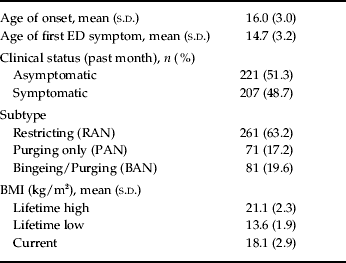
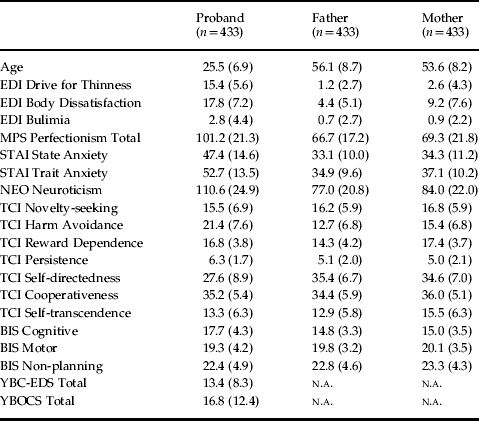
Behavioral traits and demographic characteristics of participants in the present study are presented in Tables 1 and 2.
Proband demographic information for AN probands (n=433)

AN, Anorexia nervosa; s.d., standard deviation; ED, eating disorder; BMI, body mass index.
Descriptive information [mean (s.d.)] for study sample

EDI, Eating Disorder Inventory-2; MPS, Multidimensional Perfectionism Scale; STAI, Spielberger State-Trait Anxiety Inventory; NEO, Revised NEO Personality Inventory; TCI, Temperament and Character Inventory; BIS, Barratt Impulsivity Scale-11; YBC-EDS, Yale–Brown–Cornell Eating Disorder Scale; YBOCS, Yale–Brown Obsessive Compulsive Scale; s.d., standard deviation; n.a., not assessed.
LPA
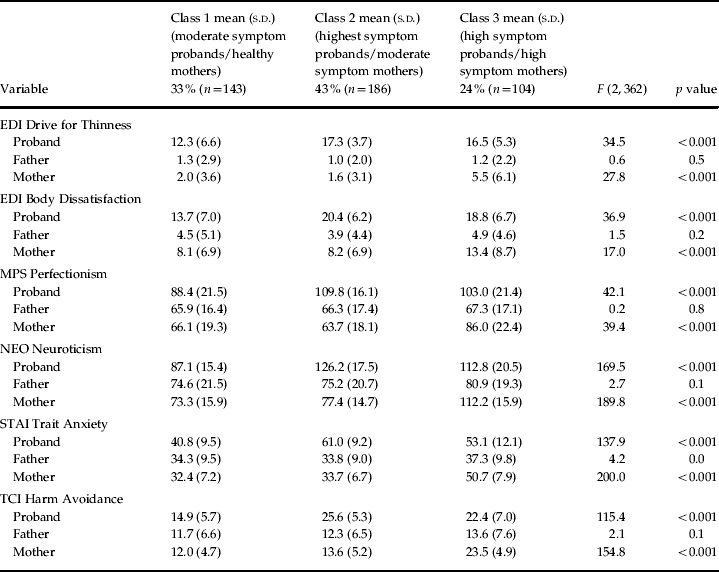
LPA indicated three distinct classes of families. The three-class solution had a VLMR significance level of p=0.01, indicating that the three-class solution was superior to a two-class solution; the three-class solution was also superior to a more complex, four-class solution. The ABIC for the three-class solution was 47365.9. In combination, the VLMR and the ABIC suggest that the three-class solution best fit the data. One class, constituting approximately 33% of the sample, reported less extreme scores than classes 2 (~43% of the sample) and 3 (~24% of the sample) on the vast majority of variables that significantly differed between classes (see Tables 3 and 4). The three classes will be referred to using the following labels: moderate symptomatology probands/healthy mothers (class 1), highest symptomatology probands/moderate symptomatology mothers (class 2), and high symptomatology probands/high symptomatology mothers (class 3). Fathers in the three classes did not differ significantly on any of the variables tested.
Trio latent classes

EDI, Eating Disorder Inventory-2; MPS, Multidimensional Perfectionism Scale; NEO, Revised NEO Personality Inventory; STAI, Spielberger State-Trait Anxiety Inventory; TCI, Temperament and Character Inventory; s.d., standard deviation.
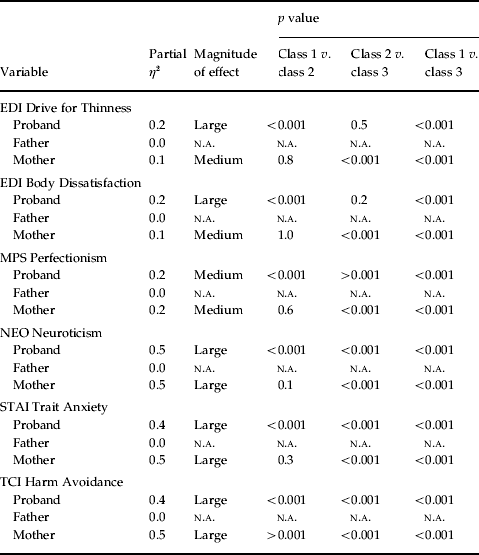
Effect sizes and post-hoc tests for AN trio latent classes

AN, Anorexia nervosa; EDI, Eating Disorder Inventory-2; MPS, Multidimensional Perfectionism Scale; NEO, Revised NEO Personality Inventory; STAI, Spielberger State-Trait Anxiety Inventory; TCI, Temperament and Character Inventory; n.a., not assessed.
One-way ANOVA was conducted for each variable that differed significantly between classes of families, followed by pairwise comparisons to further explore significant differences between groups. Detailed findings for each subgroup and variable investigated are available in the accompanying tables (Tables 3 and 4). Class 1 was characterized by probands with moderate levels of symptoms compared to the other probands and low symptom mothers. With the exception of maternal perfectionism, this group reported the lowest levels of both proband and mother drive for thinness, body dissatisfaction, neuroticism, trait anxiety, harm avoidance, and proband perfectionism.
For the most part, class 2 was characterized by the highest levels of symptoms among probands and mothers with moderate symptoms relative to mothers in the other two classes. Finally, class 3 was characterized by having both probands and mothers with high levels of symptoms relative to the other classes on many of the variables investigated. More specifically, the mothers in this class had the highest levels of drive for thinness, body dissatisfaction, perfectionism, neuroticism, and harm avoidance relative to mothers in the other classes. Probands in this class reported greater symptomatology than class 1 probands but less than class 2 probands.
Comparisons between mothers and daughters within latent classes indicated that mothers and daughters in two of the classes (classes 1 and 2) differed significantly from each other within clusters (p<0.001). More specifically, within classes 1 and 2, mothers and daughters differed significantly from each other on neuroticism, trait anxiety, and harm avoidance, as well as drive for thinness, body dissatisfaction, and perfectionism. Within class 3, however, mothers and daughters differed significantly from each other only on drive for thinness, body dissatisfaction, and perfectionism (p<0.001). The class 3 mothers and daughters did not differ significantly from each other on neuroticism, trait anxiety, or harm avoidance.
Validation of classes
χ2 tests conducted to investigate whether AN subtype or clinical status was related to family class membership indicated that class membership was not significantly related to probands' illness subtype [χ2(4)=6.18, p=0.186, Cramer's V=0.09] or clinical status [χ2(2)=2.75, p=0.253, Cramer's V=0.09]. The moderate symptomatology probands/healthy mothers class (class 1) was composed of 55.8% RAN probands, 17.5% PAN and 26.7% BAN. The highest symptomatology probands/moderate symptomatology mothers class (class 2) was composed of 67.7% RAN probands, 14.6% PAN, and 17.7% BAN. The high symptomatology probands/high symptomatology mothers class (class 3) was composed of 58.6% RAN probands, 21.8% PAN and 19.6% BAN.
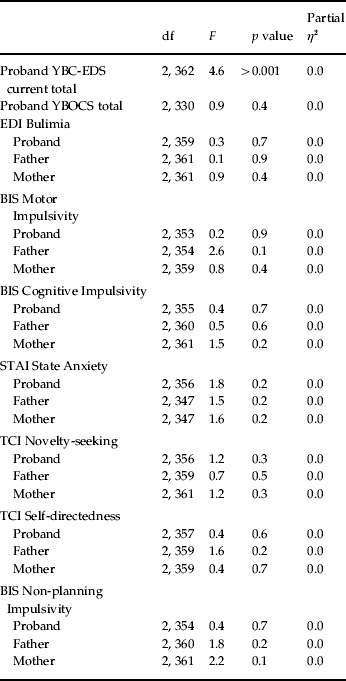
In the external validation, one-way ANOVAS with post-hoc comparisons were conducted. There were no significant differences between groups at the α=0.001 level (see Table 5). The proband current YBC-EDS total score indicated a trend toward significance [F(2, 362)=4.55, p=0.011, η2=0.03], with class 3 probands reporting the highest scores on this variable (mean=15.99, s.d.=8.30).
External validation ANOVA results for AN trio latent classes

AN, Anorexia nervosa; YBC-EDS, Yale–Brown–Cornell Eating Disorder Scale; YBOCS, Yale–Brown Obsessive Compulsive Scale; BIS, Barratt Impulsivity Scale-11; STAI, Spielberger State-Trait Anxiety Inventory; TCI, Temperament and Character Inventory; df degrees of freedom.
Discussion
This study of temperament and personality characteristics of AN probands and their parents identified distinct patterns of traits within AN families. The three distinct classes of trios were distinguished by levels of symptoms on selected variables rather than qualitative pattern differences.
The first class of trios contained probands and mothers with the least symptomatology. The patterns of scores within the other two classes of trios were characterized by counterbalancing scores for mothers and probands. In the second class of trios (highest symptomatology probands/moderate symptomatology mothers), mothers with mid-range scores had daughters with the highest proband scores. The mothers in this class reported lower levels of perfectionism and drive for thinness than AN mothers in the other trio classes, although elevated compared to the healthy comparison women (Woodside et al. Reference Woodside, Bulik, Halmi, Fichter, Kaplan, Berrettini, Strober, Treasure, Lilenfeld, Klump and Kaye2002). Significant differences between mothers and daughters on all variables within this class confirm the more severe symptomatology of the probands.
Mothers with the highest scores on the trio LPA variables had daughters with mid-range scores relative to other probands. It should be noted that the probands' raw scores on a majority of variables were higher than their mothers' scores. Probands in this class demonstrated higher levels of symptomatology than the least symptomatic probands (moderate symptomatology probands/healthy mothers, class 1) and their own mothers. Unlike the other trio classes, however, mothers and daughters in the high symptomatology probands/high symptomatology mothers class did not significantly differ on all variables in the LPA. More specifically, they did not differ significantly with respect to neuroticism, harm avoidance, and trait anxiety. Thus, these mothers demonstrated levels of personality, temperamental, and affective disturbance in the same range as their daughters. The significantly higher perfectionism of the probands compared to their mothers provides support for the notion that perfectionism may moderate the relationship between personality, temperamental, and affective disturbances and the development and maintenance of AN.
Taken together, the results of the trios LPA indicate differences in severity in both probands and mothers across the classes, rather than qualitative pattern differences. The more severe symptomatology of two of the classes [the highest symptomatology probands/moderate symptomatology mothers (class 2) and the high symptomatology probands/high symptomatology mothers (class 3)] is consistent with the pervasive temperamental and behavioral disturbances that have been identified previously in AN (Agras et al. Reference Agras, Brandt, Bulik, Dolan-Sewell, Fairburn, Halmi, Herzog, Jimerson, Kaplan, Kaye, Le Grange, Lock, Mitchell, Rudorfer, Street, Striegel-Moore, Vitousek, Walsh and Wilfley2004). Consistent with our findings, a small study examining temperament and character in AN daughters and parents found selected positive correlations between daughters and mothers, but not between daughters and fathers (Fassino et al. Reference Fassino, Svrakic, Abbate-Daga, Leombruni, Amianto, Stanic and Rovera2002). No larger, more comparable studies could be identified. The finding that more temperamentally healthy mothers tended to have daughters with less severe temperamental symptomatology relative to other probands suggests that these daughters may benefit from a different genetic loading for these characteristics than more highly symptomatic probands. When reflecting on the mechanism whereby genetics might influence risk for a complex trait such as AN, we envision the action of many genes across risk domains including appetite, weight regulation, and temperament. These results indicate that ‘healthier’ mothers were not associated with offspring with high severity of ED symptomatology. It is conceivable that more extreme temperamental traits (in both probands and their mothers) may influence severity of symptoms expressed. We hypothesize that the transmission of milder temperamental profiles may protect offspring from developing more severe AN symptomatology. This could reflect the direct genetic transmission of milder temperamental traits, or could index the family environment influenced by mothers with milder temperaments, environments that may serve to contain the expression of AN symptoms rather than exacerbate them.
The risk factors for the development of EDs are poorly understood. Findings in this study using LPA to identify temperamental, personality, and affective disturbances among family members are consistent with previous reports from other Price Foundation studies (Lilenfeld et al. Reference Lilenfeld, Kaye, Greeno, Merikangas, Plotnicov, Pollice, Rao, Strober, Bulik and Nagy1998; Woodside et al. Reference Woodside, Bulik, Halmi, Fichter, Kaplan, Berrettini, Strober, Treasure, Lilenfeld, Klump and Kaye2002; Keel et al. Reference Keel, Fichter, Quadflieg, Bulik, Baxter, Thornton, Halmi, Kaplan, Strober, Woodside, Crow, Mitchell, Rotondo, Mauri, Cassano, Treasure, Goldman, Berrettini and Kaye2004) as well as other studies (Fairburn et al. Reference Fairburn, Cooper, Doll and Welch1999; Espina, Reference Espina2003) noting familial personality profiles in AN. In this study, class membership was more strongly influenced by maternal and proband characteristics. It is possible that other factors not captured in this study, such as inflexibility and rigidity, may be related to fathers (Lilenfeld et al. Reference Lilenfeld, Kaye, Greeno, Merikangas, Plotnicov, Pollice, Rao, Strober, Bulik and Nagy1998). Perhaps the assessment battery (which did not assess OC symptoms in parents) failed to capture dimensions that are characteristic of fathers of individuals with AN.
Although neuroticism, trait anxiety, and harm avoidance contributed the most to the determination of class groups, mothers and daughters within classes 1 and 2 differed significantly on these variables. Given the considerable genetic contribution thought to be associated with these traits (Cloninger et al. Reference Cloninger, Svrakic and Przybeck1993; Jang et al. Reference Jang, Livesley and Vernon1996; Price Foundation Collaborative Group, 2001; Fassino et al. Reference Fassino, Svrakic, Abbate-Daga, Leombruni, Amianto, Stanic and Rovera2002), it may initially seem counterintuitive that mothers and daughters within two classes differed significantly on these traits. It may be that the higher levels of severity among daughters (relative to mothers) reflects the impact of lifetime eating disordered behavior or may have driven that behavior initially. In addition, there may be traits that were not assessed that help to explain the mismatch. We are just starting to understand the biology of AN and it is not possible to understand or include all potentially relevant factors.
Contrary to the initial hypotheses, the differences in personality and temperament patterns among the trio classes were not related to subtype or clinical status. Potential implications are that differences in subtype may not be related to family temperament and personality profiles and that profiles are stable to clinical status. It is possible, however, that subtype results were influenced by an under-representation of AN probands with binge eating. The resulting latent classes, distinguished by symptom levels rather than by qualitatively distinct patterns, could reflect the relative diagnostic homogeneity of the probands. We would like to emphasize, however, that if a subtype were truly homogeneous, this would be reflected in the LPA results. Under-representation would only seriously threaten the validity of the LPA at about 5% representation. The selection of indicator variables could also have influenced the resultant latent classes. For example, including the EDI-2 bulimia subscale as an indicator variable in the LPA (instead of in the external validation) could have potentially produced different class groupings. Nevertheless, it is not likely that this would threaten the null finding with respect to subtype, given that there were no significant differences between classes on the bulimia subscale in the external validation.
Although no significant differences in trio class membership were identified based on OC symptoms of the probands, it should be noted that all three classes of trios reported elevated OC symptoms relative to controls (Kaye et al. Reference Kaye, Weltzin, Hsu, Bulik, McConaha and Sobkiewicz1992; Rosenfeld et al. Reference Rosenfeld, Reuven, Anderson, Kobak and Greist1992; Sunday & Halmi, Reference Sunday and Halmi2000). This may indicate a ceiling effect and is consistent with literature highlighting the important role of OC symptoms in the etiology (Lilenfeld et al. Reference Lilenfeld, Kaye, Greeno, Merikangas, Plotnicov, Pollice, Rao, Strober, Bulik and Nagy1998) and course of AN (Keel et al. Reference Keel, Fichter, Quadflieg, Bulik, Baxter, Thornton, Halmi, Kaplan, Strober, Woodside, Crow, Mitchell, Rotondo, Mauri, Cassano, Treasure, Goldman, Berrettini and Kaye2004).
The strengths of the present study include the large sample size, comprehensive assessment protocol, diagnostic homogeneity of the probands, and inclusion of both biological parents of individuals with AN. Nevertheless, families included may differ systematically from families in which both parents were not available and/or willing to participate. Other potential sources of variance, particularly related to the inclusion of relatives who may have had other Axis I psychiatric diagnoses (Kaye et al. Reference Kaye, Devlin, Barbarich, Bulik, Thornton, Bacanu, Fichter, Halmi, Kaplan, Strober, Woodside, Bergen, Crow, Mitchell, Rotondo, Mauri, Cassano, Keel, Plotnicov, Pollice, Klump, Lilenfeld, Ganjei, Quadflieg and Berrettini2004b) or the possible presence of parents with a lifetime ED diagnosis, must be acknowledged. History of an ED may help to explain the role of mothers compared to fathers in determining class profiles. Risk factors for EDs are not well understood and variables not captured by the assessment battery in this study, including past parental ED, may contribute to an enhanced understanding of its findings (Jacobi et al. Reference Jacobi, Hayward, de Zwaan, Kraemer and Agras2004). Finally, this study does not contain an unaffected comparison group of trios. Similar profiles of trios may exist within the unaffected population. Nevertheless, exploring differences within the affected sample may help us to better understand diversity within the ED population and to explore genetic variants and commonalities.
A key finding of this study is the importance of mothers' and daughters' traits relative to fathers' in the identification of temperament and personality patterns in families affected by AN. The high symptomatology probands/high symptomatology mothers class (class 3) may represent a more homogeneous and familial variant of AN and index an underlying anxiety/harm avoidant dimension and/or propensity to extreme fear conditioning hypothesized to be related to AN (Strober, Reference Strober2004). Identification of phenotypes that evidence strong familiality can assist with choosing optimal quantitative traits for inclusion in linkage and association studies.
Acknowledgments
We thank the Price Foundation for support in the clinical collection of participants and in data analysis. We thank the staff of the Price Foundation Collaborative Group for their efforts in participant screening and clinical assessments. We are indebted to the participating families for their contribution of time and effort in support of this study.
Declaration of Interest
None.