1 Introduction
Korea is currently experiencing the most rapid population aging in the world. The makeup of the elderly as a percentage of total population is projected to double from 7% in 2000 to 14% by 2018 (Statistics Korea, 2008a). Furthermore, the increase in life expectancy will increase the length of post retirement years, which will very likely lead to the rise in the need for the insurance protection against the prolonged period of survival.
Although the needs for a guaranteed regular income after the retirement have increased, the voluntary annuity market in Korea remains to be thin as in other countries such as USA and UK. This shows contrasts with the fact that only few retirees are expected to have the full benefit from other pillars of pension (e.g., the public and corporate pension schemes). According to the Korea Financial Investment Association (2010), over the 70% of the household assets is allocated to the real estate and approximately 10% to the bank deposit, whereas the proportion of insurance and annuity takes only 5%. These figures show that annuities are not popular financial vehicles that are used to prepare the retirement income in Korea.
In recent years, however, Korea has observed the change of the atmosphere as baby boomers have begun to retire. As the baby boomers of Korea, born in 1950s–1960s, enter the retirement phase, the methods that can secure the retirement income have drawn the public interest. More than 7 million baby boomers are expected to retire between 2010 and 2018, and life insurers in Korea since late 2000s have offered the immediate annuity products with a single premium to meet the demand for the income security from the retiring baby boomers.
This paper provides the detailed information and the recent trend of Korean longevity market. The main goal is to verify whether the annuity product in Korea is delivering an adequate value for the money by applying the money's worth methodology in Mitchell et al. (Reference Mitchell, Poterba, Warshawsky and Brown1999) . Several papers have analyzed the annuity markets in the USA, UK, Canada, Switzerland, Australia, Chile, and Singapore (Finkelstein and Poterba, Reference Finkelstein and Poterba2002, Reference Finkelstein and Poterba2004; Rocha et al., Reference Rocha, Morales and Thorburn2008), and a recent work of Michell et al. (Reference Mitchell, Piggott and Takayama2011) has shown that the annuity products in ten countries have different features for the longevity risk management. This paper extends the previous studies by examining the annuity market in Korea and provides another layer to better understand an emerging annuity market.
The paper is structured as follows: Section 2 provides an overview of the retirement incomes structure in Korea that includes public pension, corporate pension, and voluntary participation in individual annuity markets. Section 3 discusses the methodology to estimate the money's worth ratio (MWR), and explains formulas, payouts, mortality tables, and discount rates used for the analysis. Section 4 presents our analytical results such as the MWRs and cost factors of the individual annuity products in Korea. Section 5 summarizes the main findings and concludes with several suggestions for future researches.
2 The overview of Korean retirement income structure
2.1 Overview
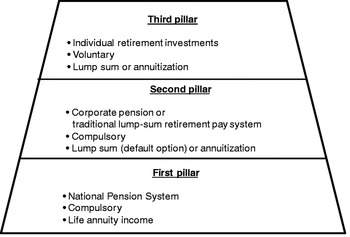
As shown in Figure 1, the pension system of Korea is built around three pillars; public pension, corporate pension, and individual retirement investments. Despite of the comprehensiveness of system in providing the security for the retirement income, the policies are rather immature, do not provide a complete coverage, and are poorly designed.
The three pillars of Korean retirement income structure.

The main platform of Korean retirement income provision is the National Pension Scheme (NPS). Implemented in 1988, the NPS is the mandatory social insurance and provides the coverage through old-age, disability and survivor pensions. As it is still in a relatively young phase, contributions are growing fast while its benefit payments remain to be small. As of May 2010, the number of pensioners with its full old-age benefit just surpassed 43,000. Benefits are paid in the form of a life annuity and indexed to inflation. However, the NPS is not yet a universal scheme that covers every retiree, and many self-employed and low income as well as temporary and daily workers do not participate in it.
The corporate pension was implemented in December 2005 as the second pillar to fill the gap left by the NPS. Employers are the sole contributors of the corporate pension, and its benefits are paid in the form of either annuity (life annuity or annuity certain) or lump-sum if an employee retires at age 55 and has had at least 10 years of service.
Individual retirement investments, as the third pillar, consist of qualified contracts and non-qualified contracts. Qualified contracts were introduced in June 1994. Non-qualified contracts, on the other hand, have been sold since the 1980s. During the accumulation phase, tax preferences are given to the individual retirement investment, and have been responsible for much of its sale. Overall, due to a unique tax policy for pension system, the annuity market in Korea has been more used as a retirement saving vehicle than as an insurance function against the longevity risk.
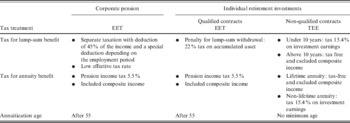
Table 1 shows the tax system for corporate pension and individual retirement investment including qualified and non-qualified contracts in Korea. Compared to advanced pension schemes such as UK and USA, there is an excessive tax preference for the lump-sum benefit, especially in corporate pension and non-qualified individual annuities. Under a non-qualified annuity, lump-sum benefits become tax-free if its persistence period is more than 10 years. Furthermore, lump-sum benefits from corporate pension have an effective tax rate less than 3%, lower than that of annuitization. We will explain the tax structure further in Sections 2.3 and 2.4.
Tax system of corporate pension and voluntary individual annuities in Korea

Note: EET means exempt when contributing, exempt when investing, taxed when receiving benefits, and TEE means taxed when contributing, exempt when investing, exempt when receiving benefits.
Since all pension schemes are relatively new, as of 2011, only a limited number of elderly Koreans are receiving public or private pensions. Moreover, as future reforms of the public pension are likely to reduce its replacement rate for the retirement income, corporate pension, and individual retirement investments will have to take up the gap, and their role in enhancing the security for the retirement income is expected to grow.
2.2 The National Pension System
The NPS is currently at an immature stage, and it is only after 2030 that the most of the elderly in Korea will be entitled pension benefits. Despite of its immature stage, it has been diagnosed that a rapid population ageing trend and overly generous pension benefits already threatens the long-run financial sustainability of the NPS. Korea's birth rate fell sharply from 6.0 in 1960 to 1.19 in 2008 and life expectancy increased from 61 years in 1970 to 80.8 years in 2010. Accordingly several reforms have been attempted since the early 1990s to cope with rapid population ageing. For example, the most recent reform in July 2007 included various parametric changes, such as increasing pensionable age, contribution rates, and reducing pension benefits. The recent reform can be explained as follows.
First, with 60 being the current pensionable age, the pensionable age will first increase to 61 in 2013, and continue its marginal change of an increase of 1 year every 5 year-period until it becomes 65 in 2033. Second, the contribution rate is planned to rise gradually from current 9% to 23.9% in 2065. This contribution schedule reflects that the NPS is a partially funded defined benefit (DB) plan, which is forecasted to turn into deficit in 2045 and then to be exhausted by 2060. Finally, lowering the benefit is recognized as an essential of achieving the long-run financial stability, and benefit reductions are scheduled to continue until 2028.
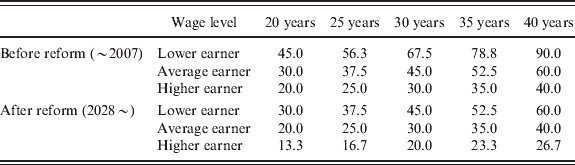
We note the change in the replacement rate in Table 2 for lower, average and higher earners by hypothetical participation years. Assuming the 30-year participation, the replacement rate of average earner will be lowered to 30% in 2028 from 45% in 2007. This replacement rate is based on average wage during the participated period, but not on final wage. Considering the unemployment period and converting it on the basis of final wage, the replacement rate can be as low as 20% level. Thus, it can be easily seen that the debate on the NPS will continue as future contributory burdens will be higher and the retirement income protection will be weaker.
Korean national pension replacement rates by hypothetical participation years (unit: %)
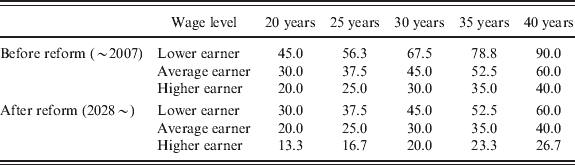
Note: (1) Based on average wage during participation.
(2) The benefit reduction is planned to continue by constant portion per year between 2008 and 2028.
Source: Moon (Reference Moon2007) .
2.3 The corporate pension plans
The legal and regulatory foundation for employer-sponsored pension plans was implemented at the end of 2005 in Korea. The Employee Retirement Benefit Security Act (ERBSA, hereafter) came into force to address the shortcomings of the traditional lump-sum retirement pay system and to provide more securely structured and better funded pension alternatives. The main shortcomings of traditional lump-sum retirement system are that its benefit is rather used to cover periods of unemployment or to start a new business, than to cover the income after the retirement and that its liability is not funded externally (i.e., book reserves). Through the introduction of ERBSA, the government of Korea encouraged the conversion of traditional lump-sum retirement system of the unfunded retirement allowances into the funded corporate pension.
Since December 2005, an employer is required to set up a traditional lump-sum retirement pay system or a new corporate pension fund in order to pay the retirement benefit to employees. Under the traditional lump-sum retirement pay system, employees who have completed 1 year of continuous employment are entitled to the lump-sum benefit that is equal to one month's pay (i.e., 8.3%) for every full year of employment, based on the wage of final 3-month of employment.
Despite the introduction of new corporate pension system, the benefit design and payout structure of the corporate pension plan in Korea differ from what are traditionally found in Europe. For example, the corporate pension system in Korea, unlike those in UK and USA, only manages its accumulation phase in both DB and defined contribution (DC). The main difference between DB and DC in Korea is the risk bearer of investment during its accumulation phase. Under the DB, an employee gets the benefit that equals ‘8.3%×wage×years of service’ regardless actual investment return, which indicate that the employer are the risk bearer of the investment. However, under the DC, an employer's liability is limited to the contribution of ‘8.3%×wage each year’ and an employee gets a lump-sum payout equal to the accumulated annual contributions plus investment return. This also implies that the corporate pension plan in Korea provides a lump-sum payment as its default option in both DB and DC.
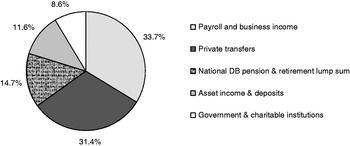
Because of no restriction on the lump-sum withdrawal and low effective tax rate explained in Table 1, retirees tend to prefer the lump-sum withdrawal over the annuitization. As a result, a life annuity has not been popular among Korean as an option within the corporate pension plan to protect the retirement income. However, as shown in Figure 2, guaranteed lifetime income is essential in securing the retirement income in Korea. For those 60 and older, the combined income from the NPS and corporate pension plan including traditional lump-sum retirement accounts for only 14.7% of total income as of 2009 (Statistics Korea, 2009), whereas private transfers within the family account for 31.4%. This differs from the developed countries where the pension is reported to be the most important income source for the elderly. This may be one of the reasons why Korea has the highest elderly household poverty rate of 45.0% among OECD member countries, while the OECD average is 13.3% based on the old-age income poverty rates (OECD, 2009).
Composition of income over 60-year old (2009). Note: (1) Private transfers indicate family and/or children allowances. (2) Government and charitable institutions denote the means-tested benefits (including benefit in kinds). Source: Statistics Korea (2009) .

2.4 The individual retirement investments
In Korea, individual retirement investments can be purchased voluntarily from various financial institutions including life insurance companies. For individuals who want voluntary personal pension in the form of individual retirement accounts, financial institutes provide Exempt-Exempt-Tax (EET)-type products, such as mutual funds, savings, and participating annuities. Under the form of individual retirement accounts, individuals are required to withdraw their accumulated balances for more than 5 year periods (i.e., period-certain annuity) after 55 years of age, or have to pay a tax-penalty for a lump-sum withdrawal as shown in Table 1.
In contrast, only life insurance companies are allowed to sell individual annuities of tax-exempt-exempt (TTE) type. In order to induce the long-term asset accumulation through the life insurance industry, the government of Korea has provided generous tax benefits. For instance, unlike its EET counterpart, the policyholders of TEE annuities are permitted to withdraw the benefit in the form of lump sum without any tax penalty as long as there has been more than 10 years of accumulation period. Under such a circumstance, the majority of the deferred policyholders tend to terminate the contract right after satisfying the tax-free condition of the 10-year accumulation, indicating that the deferred TEE product is rather used as a tax-efficient saving vehicle. Immediate annuities, the focused product in this paper, belong to TEE-type, and they are also given a tax-free status if policyholders choose the payout of lifetime. Tax policies for immediate annuities differ from deferred annuities because immediate annuities do not have at least 10-year accumulation period.
Considering the tax-exemption feature of individual annuity products where an extraordinary tax preference is given to the lump-sum payout, only a small portion of deferred policyholders in both EET and TEE is expected to choose to annuitize at the maturity date. In this regard, the structure of Korean individual annuity market has become similar to that of the USA, Australia, and Japan where a thin longevity insurance market also exists. In the USA, for example, Brown and Poterba (Reference Brown and Poterba2006) report that only about 1% of policyholders of deferred annuity chooses to annuitize.
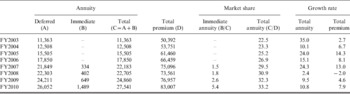
With the given tax preference and rapid population ageing, individual annuity market in Korea has grown rapidly since the mid-2000s. Table 3 shows total annuity premiums decomposedFootnote 1 by deferred annuity and immediate annuityFootnote 2 where it increased from KRW 11.4 trillion in 2003 to KRW 27.5 trillion in 2010. The annuity business has been growing even during the global financial crisis of 2008, and its growth has consistently exceeded that of total life insurance. As a result, the share of annuity against the total premium of life insurers has increased from 22.5% in 2003 to 33.2% in 2010.
Individual annuity premiums in the Korean life insurance industry (unit: KRW billion, %)

Note: (1) Fiscal year begins in April and ends in March.
(2) Immediate annuity premium is estimated by the author based on individual company data.
(3) Total premium are composed of annuity, health insurance, and life (death and term) insurance.
Source: Korea Insurance Development Institute, Monthly Insurance Report, various issues.
In Korea, immediate annuities only began to receive the public attention from 2007. The main purchasers of the immediate annuities are high net-worth individuals who want to take advantage of tax benefit given to the products. Total immediate annuity sales increased from KRW 334 billion in 2007 to KRW 1,489 billion in 2010, and the share in total individual annuity premium rose by 5.4% during the same period.
Since 2000, the individual annuity in Korea has been designed as an interest sensitive product. Prior to 1990s, life insurance companies sold the fixed interest rate products of guaranteeing the entire period, for example, 30 or more years of fixed return to policyholders. As the interest rate began to decline from the early 2000s, however, the fixed interest rate products have become no longer supportable where these high crediting rate products have led to insurers facing severe challenge of negative spread. As a consequence, life insurance companies have started to issue interest sensitive products in order to reduce negative spread.
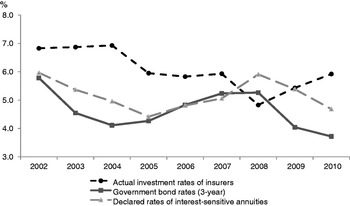
New products with fixed interest type have disappeared and almost all products are issued as an interest-sensitive type. With the interest-sensitive policies, the interest rate is declared from time to time (e.g., every 3 months) by the company, and it is based on market interest rates such as corporate bond yields and bank deposit interest rates, an insurance company's own investment performance, regulations, and etc. As shown in Figure 3, the declared yields of interest sensitive products were usually between the actual investment rates of insurers and the interest rates on 3-year government bond. This shows that interest sensitive annuities have exceeded the risk-free rates, so they could be attractive to potential policyholders.
Average interest rates on declaration of interest sensitive annuities, 3-year government bond, and actual investment rates of insurers. Note: Actual investment rates of insurers represent the investment yields of life insurance companies on the basis of ex post, and declared rates of interest sensitive annuities imply the promised return to policyholders at the ex ante. Therefore, the gap between actual investment rates of insurers and declared rates is attributed to the interest margin of the providers of interest sensitive annuities. Source: Bank of Korea, Annual Report, various issues. Korea Insurance Development Institute, Monthly Insurance Report, various issues.

Korean annuity providers invest in a portfolio of various assets to declare higher interest rate and to match liability. Table 4 summarizes asset portfolio during fiscal year 2006–2010. It shows that the Korean life insurance industry has shifted toward bonds, from 45.8% to 50.9%, in matching the liability. The government bonds have been used as the most appropriate investment vehicles to match annuity liabilities, although the supply of long-term bonds in Korea has not been enough to meet the demand by annuity providers. For example, the share of long-term (longer than 7 years) issues in total treasury issues in 2009 recorded only 10.6% and the average maturity of government bonds was 5.8 years. Owing to the limited supply of long-term bonds, Korean annuity providers are instead utilizing 3-year and 5-year bonds as a key investment vehicle.
Asset portfolio of Korean life insurance companies (unit: %)

Note: Fiscal year begins in April and ends in March.
Source: Financial Supervisory Service, Annual Report, various issues.
The second largest asset share is loans, which account for more than 20% of asset portfolio. They are mainly policy loan, which uses the cash value of policy as the collateral. In contrast, the share of commercial mortgage is small due to the undeveloped mortgage market in Korea. Korean annuity providers also hold some risky assets such as stocks and mutual funds in order to seek a higher return of investment.
3 Evaluating the MWRs of immediate annuities
3.1 The basic framework
The main goal of this paper is to calculate the value of immediate annuities and make this value comparable across different annuitant ages, gender, and annuity providers. The MWRs is a conventional measure of the value of an annuity, which is the ratio of the expected present discounted value of the flow of payments made by an annuity to the single premium paid for it.
In Korea, it is worth noting that an annuitant cannot ‘pure life annuity’ without a guarantee period by government regulation. Annuity providers are required to supply guarantee periods at least 5 years independent of whether the insured person is alive. According to the regulation, most of life insurers offer a period certain guarantee for the first 10 years. The guarantee form incurs costs to the annuitants, making their longevity insurances more expensive.
Considering the regulation of Korean immediate annuity market, we analyze a 10-year guarantee period product. The MWR for the product can be written as in Equation (1)
 $${\rm MWR} \equiv {\rm }\left[ {\sum\limits_{t = 1}^{10} {\displaystyle{{A_x } \over {(1 + j_t )^t }} + \sum\limits_{t = 11}^{\omega - x} {\displaystyle{{_t p_x \cdot A_x } \over {(1 + j_t )^t }}} } } \right]/K,$$
where MWR is the money's worth ratio; Ax is the nominal benefit payment made per year in arrears for the individual purchasing annuity at age x; t represents the number of years beyond annuity starting date; ω is the maximum lifespan in a given mortality table; tpx is the survival probability to period t given the annuitant is alive at t=0; it is the nominal interest rate at t to discount future payouts, based on the term structure of interest rate; and K is the single premium paid or the immediate annuity contract.
Note that the first 10 years of payment for a 10-year guaranteed annuity is not affected by the survival probability, since the annuity payments are paid out irrespective of whether the annuitant dies in this period. In Equation (1), the money's worth is based on the information available when the annuity was sold and is not affected by the benefit payment of hindsight.
Assuming no costs or loads, the discounted value of the annuity income will equal the premium paid. It means that the MWR is unity under actuarially fair basis. In practice, however, many factors make annuities actuarially unfair for the average individual. Generally, ‘1-MWR’ is often referred as the load factors. These factors may include various costs such as administrative costs, additions to contingency reserves, overhead costs, costs of capital, and costs of adverse selection. An MWR of less than unity is common in voluntary annuity market; however, an immediate annuity may not be a good product for retirees if it is considerably less than unity.
There are three important variable inputs to the expected present discounted value calculation: annuity payments, mortality tables, and the discount rates. The following sections will discuss these.
3.2 Annuity payments
The most straightforward component of money's worth calculation is the annuity prices. For this, we consider an individual who is contemplating the purchase of a single immediate annuity with KRW 100 million from one of the life insurance companies. We gather data from insurance agencies for sale as of November 8, 2010. At the end of 2010, there were ten life insurance companies, providing immediate annuities in Korea. We get information of the eight companies, so our data cover 80% of Korean immediate annuity providers.
Most of previous studies focus on individuals of ages 65 and older except SingaporeFootnote 3 (Fong, Reference Fong2002). Unlike western countries, Korean employees have a relatively short working period since a normal retirement age is uniformly set at around 55. Considering this situation, our study gathers data from retirees of 55, 60, and 65 age old.
As described in Section 2.4, all Korean immediate annuities are interest sensitive type. Therefore, payout amounts could be higher or lower than initial payout since declared rates could be changed at regular intervals. In this paper, the amount paid during the first year is used, since the annual payouts in each subsequent year are not certain. The variability of annuity payments and the lack of matching assets means that the money's worth being calculated for Korea is different from that being calculated for the UK or USA, as there is risk in both the denominator and the numerator, whereas in the UK and USA both are certain.
Another important factor of immediate annuity price is administrative and marketing costs. Korean life insurance companies load acquisition costs and maintenance costs. The acquisition costs amount to about 5–7% of the single premium and tend to be front-end loaded. After that, maintenance costs are imposed about 0.5–1.0% of periodic annuity benefit.
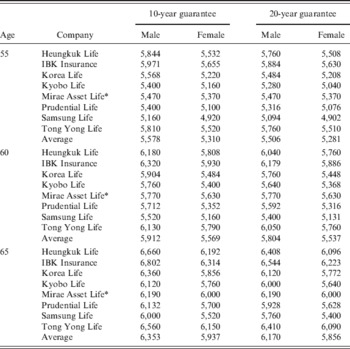
Table 5 provides of the payout amounts of the eight insurance companies reflecting declared interest rate and various cost factors.Footnote 4 On average, a 55-year-old male who paid KRW 100 million could expect to receive an annual payment of KRW 5,578,000 and KRW 5,506,000 for the 10-year guarantee type and the 20-year guarantee type, respectively. A female of the same age could expect to receive KRW 5,310,000 and KRW 5,281,000 for life, which is 4.8% and 4.1% less, respectively, on account of higher longevity. Not surprisingly, annuity payouts generally increase with age. A 65-year old male would receive KRW 6,353,000 and KRW 6,170,000 a year, almost 12.2% and 10.8% more than a 55-year-old male. For female, age also raises the annual payouts, but by less than for a male, i.e., 10.6% and 9.8%, respectively.
Immediate annuity payouts by Korean insurers (unit: KRW thousand)

Notes: (1) Assume a single premium is KRW 100 million.
(2) * Mirae Asset Life offers the same rate for both 10-year guarantee and 20-year guarantee at all three ages. As of November 2010, Mirae Asset Life did not provide life annuity type: so we use payouts for 90-year-old guarantee type.
Source: Author's gathering through general agencies quotes as of November 2010.
At the age of 65, annuity rates for the 10-year guarantee can range from 6.0% to 6.8% for a male and from 5.5% to 6.3% for a female. Overall, a female receives lower annuity rates due to the longer life expectancies. The gap between the highest and lowest annuity rates is about 80 basis points, which is similar to the spread found by Cannon and Tonks (Reference Cannon and Tonks2008) for the UK market. This may make a big difference to the income of the annuitant.
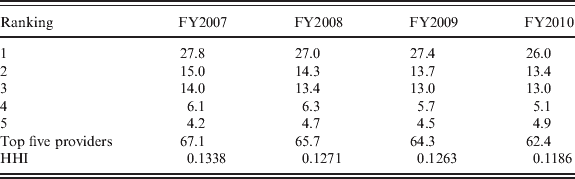
A possible explanation for this dispersion in annuity rates across insurers may be the overall market structure and the financial capacity, product strategy and business policy of the company selling the annuities (Mitchell et al., Reference Mitchell, Poterba, Warshawsky and Brown1999). Considering market structure, Korean life insurance market including annuity sector shows very similar features to the UK annuity market. Table 6 illustrates market shares and concentration ratios for the Korean life insurance industry between FY2007 and FY2010. The 4-year average market share of top five providers accounts for about 65% both Korea and the UK.Footnote 5 The Herfindahl–Herschman index (HHI) of Korean market in 2010 is 0.1186, indicating moderate concentration similar to the UK pension annuities market (ABI, 2008).
Market share and HHI in the Korean life insurance industry (unit: %)
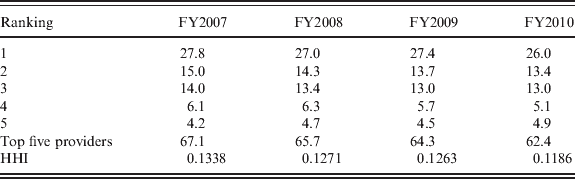
Note: Market share represents the premium of total life insurance industry including annuity, life (death), and health.
Source: Korea Insurance Development Institute, Monthly Insurance Report, various issues.
3.3 Mortality tables
To calculate the MWRs of immediate annuities, the estimates of death probabilities are needed for the general population and for annuitants. The Statistics Korea publishes general population mortality tables every 5 year. The most recent life table is derived from 2008 data, representing a period table (Statistics Korea, 2008b). To estimate annuity money's worth, a period mortality table has to be transformed into a cohort table to adjust expected mortality improvements. A cohort mortality table is constructed for each birth year representing the anticipated mortality of that specific birth cohort. To project the expected longevity of a 55-year-old individual in the year 2010, therefore, the 1955 birth cohort table would be appropriate. Generally, cohort mortality tables could be produced from the forecast period death rates by computing age-specific probabilities of dying.
In this paper, the population tables are cohortized by the same methodology as the previous study (Fong et al., Reference Fong, Mitchell and Koh2010). Two stages are necessary. First, period table 2008 must be changed on the basis of 2010. Mortality improvements are estimated by extrapolating past improvements between 1999 and 2008 population tables. The mortality improvement over the 9 years is given by:
 $$\alpha _x (2008 - 1999) = \left( {\displaystyle{{q_x (2008)} \over {q_x (1999)}}} \right)^{1/9} ,$$
where αx(2008–1999) is the mortality improvement rate over the 9 years for age x. These rates are applied to the 2008 mortality rate to estimate the 2010 rates:
 $$q_x (2010) = [\alpha _x (2008 - 1999)]^2 \times q_x (2008),$$
where qx(2010) is the annual mortality rate for age x in year 2010.
Second, period life table 2010 must be cohortized as following:
 $$\hat q_x (2010 + t) = [\alpha _x (2008 - 1999)]^t \times q_x (2010),$$
where  $\hat{q}_{x} \lpar 2010 \plus t\rpar $ is the estimated annual mortality rate for age x in year (2010+t), and αx is the estimated annual mortality improvements above mentioned. We compute the cumulative survival probabilities from the tables as follows:
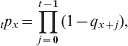 $$_t p_x = \prod\limits_{j = 0}^{t - 1} {(1 - q_{x + j} )} ,$$
where tpx is the cumulative probability of an individual aged x surviving for t years, and qx +j is the probability of an individual age (x+j) dying within the year.
Unlike to general population, data on the mortality experience of annuitants are limited in Korea due to the early stage of an annuity market. In response, the Korea Insurance Development Institute publishes estimated annuitant mortality tables for a reference rate. The table is based on the experience data of life insurance policyholders such as whole-life and health insurance, reflecting the improvement rate of general population. Generally, the table is used for the pricing and projecting reserves of annuity products.
The most recent 6th individual annuitant table is estimated based on the data between 2003 and 2005 (KIDI, Reference Mitchell, Poterba, Warshawsky and Brown2009). To change on the basis of 2010, the same way of population table is applied to the 6th individual annuitant table. However, the actuarial tables are not converted to a cohort table because they already reflect the projected mortality improvements based on improvement rate of general population.
3.4 Discount rates
To calculate the MWR, it is necessary to consider discount rates. In this study, similar to previous study (Mitchell et al., Reference Mitchell, Poterba, Warshawsky and Brown1999), we use two alternative assumptions about the rate of time preference.
The first is the term structure of yields on Korean government bonds. These are obtained from bond rating agencies and are based on their estimate of the zero coupon yield curves.Footnote 6 This approach takes the point of view of an individual whose alternative investment is risk-free government bonds. The data are for maturities between 1 and 20 years. After the first 20 years, we assume a flat interest rate structure at the same level in year 20 as with other studies (Mitchell et al., Reference Mitchell, Poterba, Warshawsky and Brown1999; Rocha and Thorburn, Reference Rocha and Thorburn2007; Cannon and Tonks, Reference Cannon and Tonks2008).
Additionally, we also consider the term structure of yields on corporate bonds on the same date, which allows for the fact that annuity payouts are not entirely risk-free. Reflecting insurers’ insolvency, individuals may discount future annuity payouts more heavily than the risk-free return on government bonds.
4 Results
4.1 Money's worth ratios
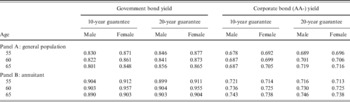
Table 7 presents estimates of MWRs by gender and age for a single annuitant using two sets of mortality tables and discount rates. Panel A shows the results of using the general population table and panel B shows the results of using the annuitant table. The MWRs of panels A and B are less than unity implying that an average individual is likely to face a cost in converting an accumulated savings into an annuity.
MWR of immediate annuity (General population vs. Annuitants)

Note: MWRs are based on payouts in the first year.
The second and third columns of panel A suggest the value of money for a male and a female respectively with 10-year guarantee type using general population table, discounting government bond yields. According to the results, on average, 1 unit premium by a 55-year-old male would generate 0.830 in expected annuity income and a female could receive 0.871. For a 65-year old, the MWRs are lower, at 0.801 and 0.848, respectively. Though annuity rates are lower for a female than a male, the MWR values are higher for a female than a male. This could be explained by the fact that the survival probability of a female is higher than that of a male.
Since the survival probability of annuitants is higher than the general population, panel B generates uniformly higher MWRs than panel A. For example, in the case of a 10-year guarantee a 65-year-old male would assess the value 0.801 if he perceives himself to be facing general population mortality rates, however, 0.890 if facing the mortality rate of the annuitant population. This is due to the fact that the life expectancy of the general population is lower than that of voluntary annuitants.
In the general population, although, the annuity rates for 20-year guarantee period are lower than that of the 10-year guarantee period, the MWRs are higher for a 20-year guarantee than that of a 10-year guarantee. This is due to the fact that the effect of the guarantee years outweighs the difference of annuity rates. Therefore, longer guarantee annuities may be useful for those with below average life expectancy.
Generally, total loading is estimated as the difference between the purchase price and expected present discounted value, which equals to 1-MWR. On average, the total loading on a 10-year guarantee annuity purchased by a 65-yeal-old male is estimated at 19.9%. If a guarantee period is increased to 20 year, then total loading is lowered 14.4%. This means that a 20-year guarantee period offers better deals compared to a 10-year guarantee period, as the guarantee eliminates the uncertainty involved in payments up to the end of guarantee period as Ganegoda and Bateman (Reference Ganegoda and Bateman2008) noted.
Average loadings computed from general population and government bond yields are between 12.3% and 19.9%. Using corporate bond yields would generate lower MWRs, so the average loadings are higher level, 28.1% and 32.2%, respectively.
4.2 International comparisons
This section compares the MWRs estimated in this study with other countries estimated by previous studies. Focusing on the voluntary annuity market, we try to compare the money's worth for the case of a 65-year-old male, using the government bond yields. Nevertheless, due to the different product regulation among nations, we cannot select exactly the same type of product.
This analysis of Korean voluntary annuity market proves that MWR is in line with the international experience, lying about 0.8 for the general population table and 0.9 for the annuitant table. The MWRs of Korea are similar to the USA, calculated at 0.816 and 0.916, respectively (Mitchell et al., Reference Mitchell, Poterba, Warshawsky and Brown1999). Also, they show similar levels with those of Singapore, estimated at 0.854 and 0.896, respectively (Fong et al., Reference Fong, Mitchell and Koh2010). On the other hand, both Germany and Australia show lower MWRs than those of Korea. Two countries’ MWRs are less than 0.8 and 0.9, respectively.
Overall, the MWRs in voluntary annuity market are considerably lower than those of the compulsory annuity market such as Chile (Thorburn et al., 2007) and the UK (James and Vittas, 1999) cases. The MWRs are estimated approximately unity in the compulsory market.
5 Conclusions
The demand for longevity insurance in Korea has been very small so far. But rapid ageing factors are drawing the attention of retirees to the role of longevity protection. This paper provides some insights into voluntary annuity market in Korea. Most individuals do not voluntarily annuitize their accumulated assets because Korean individual annuity market has been growing as saving vehicle rather than longevity insurance. However, since baby boomers were transforming retirement an immediate annuity has formed emerging market.
This paper investigates the voluntary annuity market in Korea focusing on single immediate annuity products. Although Korean immediate annuity market is at an early developmental stage, the market is considered to be reasonably efficient. The average annuity rate of 10-year guarantee period for a 65-year-old male is estimated 6.4%. The gap between the highest and lowest annuity rates is about 80 basis points, which is similar to the spread found by Cannon and Tonks (Reference Cannon and Tonks2008) for the UK. The annuitant belong to the general population could expect to obtain the MWRs value of about 0.8 and it is improved to 0.9 using the annuitant table. The results of international comparisons indicate that the average MWRs of Korea is similar to that of other countries with thin voluntary annuity markets such as the USA and Singapore. Furthermore, Korea shows much higher levels of MWRs than both Germany and Australia.
Financial products offering protection against longevity risk will become increasingly important in Korea due to the low income replacement rate of public pension system and corporate pension system. To enhance the overall retirement income security, an efficient individual annuity market and the related research are essential in Korea. Although this research is the first attempt to analyze the value of annuity in Korea, the scope is limited to the given products in a particular dataset due to the restricted nature of the data. We hope that further analysis of Korean MWRs will provide insight that will inform the development of emerging markets.