Introduction
Panax L., a genus of family Araliaceae, is an important medicinal resource mainly distributed in Himalayas area and central and southwestern China. The pharmaceutical activities of Panax species attribute mainly to ginsenosides, which are salutary for cardiovascular health. Comparative genome analysis revealed the evolutionary trajectory of ginsenoside biosynthesis (Yang et al., Reference Yang, Li, Yang, Peng, Song, Lin, Xiang, Li, Ye, Ma, Miao, Zhang, Chen, Yang and Dong2023). Four Panax taxa, P. zingiberensis, P. vietnamensis, P. wangianus and P. bipinnatifidus were treated as P. bipinnatifidus complex due to the difficulties in species delimitation and unresolved evolutionary relationships among them (Zuo et al., Reference Zuo, Chen, Kondo, Funamoto, Wen and Zhou2011, Reference Zuo, Wen, Ma and Zhou2015; Zhou et al., Reference Zhou, Yang, Sun, Guo, Gong and Pan2020). This species complex, characterized by a spectrum of intermediates or transitional characters in root, leaf, flower and fruit morphology (Wen and Zimmer, Reference Wen and Zimmer1996; Lee and Wen, Reference Lee and Wen2004; Zhou et al., Reference Zhou, Yang, Sun, Guo, Gong and Pan2020), underwent rapid demographic expansion during the Oligocene (Zuo et al., Reference Zuo, Wen and Zhou2017), and the taxonomic relationships among the species remain contentious (Lee and Wen, Reference Lee and Wen2004; Zuo et al., Reference Zuo, Chen, Kondo, Funamoto, Wen and Zhou2011, Reference Zuo, Wen, Ma and Zhou2015; Wen et al., Reference Wen, Zhang, Nie, Zhong and Sun2014; Shi et al., Reference Shi, Li, Li, Jiang, Zhang, Pan, Liu, Xiao and Li2015; Ji et al., Reference Ji, Liu, Yang, Yang, He, Wang, Yang and Yi2019; Zhou et al., Reference Zhou, Yang, Sun, Guo, Gong and Pan2020). This taxonomic uncertainty complicates the precise identification of species and may pose an obstacle to the conservation of these valuable wild resources.
Simple sequence repeats (SSRs), a form of Mendelian inheritance and codominant microsatellite markers, are renowned for their high levels of polymorphism and reproducibility (Varshney et al., Reference Varshney, Graner and Sorrells2005; Kalia et al., Reference Kalia, Rai, Kalia, Singh and Dhawan2011). They have been extensively applied in studies of genetic diversity and species delimitation (Hauser et al., Reference Hauser, Athrey and Leberg2021). Several researchers have focused on the development of SSR markers in the three most famous ginseng species, Panax notoginseng, P. ginseng and P. quinquefolius (Choi et al., Reference Choi, Kim, Kim, Choi, Ahn, Lee and Yang2011; Jiang et al., Reference Jiang, Shi, Li, Liu and Li2016; Jang et al., Reference Jang, Jang, Kim, Waminal, Kim, Lee and Yang2020; Su et al., Reference Su, Zhang, Yang, Qu, Cui, Ge and Liu2023). Within the P. bipinnatifidus complex, only nine SSR markers were developed from the transcriptome data of P. vietnamensis (Vu et al., Reference Vu, Shah, Pham, Bui, Nguyen and Nguyen2020), and their transferability was not tested in the related species. The objective of this study was to develop highly polymorphic SSR markers from restriction-site associated DNA sequence (RAD-seq) data of P. bipinnatifidus complex, with the goal of ascertaining their efficacy in identifying the wild resources of this complex.
Experimental procedure
We selected RAD-seq datasets of 29 diploid individuals of the P. bipinnatifidus complex, from our previous study (Zhou et al., Reference Zhou, Yang, Sun, Guo, Gong and Pan2020), to develop SSR markers utilizing Stacks v1.48 (Catchen et al., Reference Catchen, Hohenlohe, Bassham, Amores and Cresko2013) and QDD v3.1.2 (Meglécz et al., Reference Meglécz, Pech, Gilles, Dubut, Hingamp, Trilles, Grenier and Martin2014). The threshold for the minimum number of repeats was set at six for dinucleotides and trinucleotides, and five for tetra-, penta- and hexanucleotides. Subsequently, primer pairs were designed employing default parameters of Primer 3 (Untergasser et al., Reference Untergasser, Cutcutache, Koressaar, Ye, Faircloth, Remm and Rozen2012). Eighty-four primer pairs were successfully designed and their universality was ascertained through polymerase chain reactions (PCRs) with 10 individuals randomly chosen from P. bipinnatifidus complex. Details of the PCR mixture composition and protocol are provided in the online Supplementary file (Tables S1 and S2). Totally, 48 pairs of primers were successfully amplified, followed by linking with fluorescent adapters. Subsequent PCRs were performed to assess the polymorphisms within the P. bipinnatifidus complex (online Supplementary Table S3) using polyacrylamide gel electrophoresis. Allele scoring was conducted manually, by recording co-dominant values to generate a data matrix with GenALEx 6.5 (Peakall and Smouse, Reference Peakall and Smouse2012) for subsequent analysis. Ultimately, 11 primer pairs with high polymorphisms were identified (Table 1), and the allele data from these loci were utilized to construct the phylogenetic trees encompassing 63 individuals from P. bipinnatifidus complex and 13 individuals from three outgroup taxa (P. notoginseng, P. stipuleanatus and P. japonicus) (online Supplementary Table S3). Total DNA extraction from leaf tissues was performed using a modified cetyltrimethylammonium bromide (CTAB) procedure (Doyle, Reference Doyle, Hewitt and Johnston1991). The trees were constructed using the unweighted pair-group method with arithmetic average (UPGMA) in PowerMarker 3.25 (Liu and Muse, Reference Liu and Muse2005), and a consensus tree (Fig. 1) was obtained using the program ‘consensus’ in the Phylip package (Felsenstein, Reference Felsenstein2005) after summarizing 2000 trees.
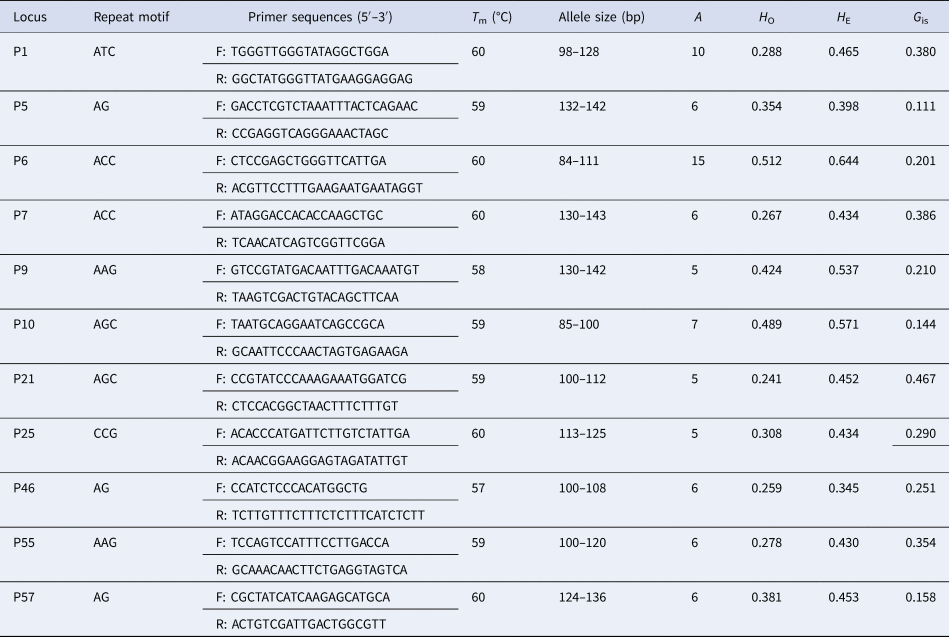
Genetic properties of the 11 polymorphic SSR markers developed in P. bipinnatifidus complex

T m, annealing temperature; A, allele number; H O, observed heterozygosity; H E, expected heterozygosity; G is, inbreeding coefficient.
UPGMA tree of 76 individuals based on the data of 11 SSR markers. Branches with different colours represent different taxon clades.

Discussion
Initially, our analysis detected 7458 loci containing perfect microsatellites in the 9,014,726 RAD reads, including the most abundant dinucleotide repeats (50.60%) and trinucleotide repeats (36.78%) as observed in P. ginseng (Choi et al., Reference Choi, Kim, Kim, Choi, Ahn, Lee and Yang2011). After screening treatment following the criteria (online Supplementary Table S4), 11 SSR primer sets were retained and were successfully amplified across all the 63 individuals of the P. bipinnatifidus complex, demonstrating extremely high transferability in this taxonomic group. The features of these 11 SSR primer sets and the corresponding indices of genetic diversity within P. bipinnatifidus complex are detailed in Table 1. The analysis discovered 76 alleles in total across the 11 SSR loci, averaging 6.9 alleles per locus and ranging from 5 to 15. The observed heterozygosity (H O) ranged from 0.241 to 0.512, with an overall mean of 0.346. The expected heterozygosity (H E) ranged from 0.345 to 0.644, averaging 0.469 across loci. The maximum value of inbreeding coefficient (G is) was 0.467 at locus P21, whereas the minimum value was 0.111 at locus P5. Cross-species amplification analysis within the three outgroups indicated high transferability in P. japonicus (97.7%), P. stipuleanatus (75%) and in P. notoginseng (73.6%). Notably, locus P25 failed to be amplified in any individual of P. stipuleanatus and P. notoginseng, but succeeded in all P. japonicus individuals.
UPGMA tree (Fig. 1) revealed that 63 individuals of the P. bipinnatifidus complex were grouped into one big clade. The samples of P. zingiberensis and P. vietnamensis formed the monophyletic group, respectively, with their sister relationship corroborated by prior research utilizing the RAD-seq data (Zhou et al., Reference Zhou, Yang, Sun, Guo, Gong and Pan2020). The remaining accessions of P. bipinnatifidus and P. wangianus formed several smaller clades and nested into each other. Additionally, the samples recently collected from Hunan and Hubei provinces, clustered together, exhibited a close genetic affinity with the samples identified as P. wangianus (KM) and P. bipinnatifidus (LJ and LD). This genetic concordance substantiated our initial taxonomic assignment of these samples as P. wangianus, primarily based on morphological characteristics such as the fleshy roots and lanceolate leaflets. These newly developed SSR markers will be important molecular resources for future investigation on conservation genetics of the wild ginseng plants.
Supplementary material
The supplementary material for this article can be found at https://doi.org/10.1017/S1479262124000480.
Acknowledgement
This work was supported by a grant from the National Natural Science Foundation of China (31570339).
Competing interests
None.