Introduction
Knowledge-intensive business service (KIBS) firm is a typical service supplier. Development of the manufacturing industry can be effectively promoted by KIBS (Doloreux & Shearmur, Reference Doloreux and Shearmur2012), because interaction with KIBS can produce knowledge-based resources for manufacturing firms (Landry, Amara, & Doloreux, Reference Landry, Amara and Doloreux2012) and stimulate their development (Fernandes & Ferreira, Reference Fernandes and Ferreira2013). Extant research has largely concerned large-scale manufacturing firms. Yet small and medium manufacturing enterprises (SMMEs)Footnote 1 also play an important role in economy, but are typically excluded from mainstream discussion (Brunswicker & Vanhaverbeke, Reference Brunswicker and Vanhaverbeke2015). Compared with large-scale firms, SMMEs have a comparatively limited range of resources and possess insufficient knowledge and time to improve their capability (Rajala, Westerlund, & Rajala, Reference Rajala, Westerlund and Rajala2008; Franco & Haase, Reference Franco and Haase2015). On one hand, they need external supplementary resources, which are similar with their existing resources and can easily come to synergy. On the other hand, they need complementary resource, which are different from what they possess, but can help them to achieve exploratory innovation. KIBS, as a kind of such asset, may therefore be particularly helpful to SMMEs (Das & Teng, Reference Das and Teng2000).
External KIBS are infrequently acquired by manufacturing firms in developing countries (Park & Chan, Reference Park and Chan1989; Pilat & Wolfl, Reference Pilat and Wolfl2005; Preissl, Reference Preissl2007; Zhou & Wei, Reference Zhou and Wei2009). The main reason for this is that traditional labor-intensive manufacturing industries are often dominant in developing countries, while technology-intensive manufacturing industries are the main users of knowledge-intensive services (Guerrieri & Meliciani, Reference Guerrieri and Meliciani2005). China, as a developing country, is usually labeled as a big manufacturing country; most of its manufacturing firms are product-centric and not knowledge-intensive. Accordingly, traditional Chinese manufacturing firms, especially the traditional SMMEs, have not expressed much demand for KIBS. In addition, the emerging economy of China is characterized by volatile environments and a lack of institutions (Luo, Reference Luo2003), which have inhibited the expansion of Chinese SMMEs. With intense global competition and a shortened product life cycle, there is a considerable need for Chinese SMMEs to acquire critical knowledge-based resources to grow rapidly. Interactions with KIBS may therefore have profound significance for Chinese SMMEs. In this study, we have chosen Chinese SMMEs as samples to analyze.
Despite the benefit of interactions with KIBS to firm performance, the practices by which firms interact with high- versus low-performance KIBS remain unclear. Moreover, the mechanisms through which the interactions with KIBS influence performance remain unknown. We addressed this research gap by conducting in-depth case studies to understand how interactions with KIBS influence SMMEs’ performance. This paper extends existing literature of service coproduction in area of KIBS and the literature of interaction in industrial marketing. It also takes the perspective of knowledge-based view and in so doing provides insight to the performance of manufacturing firms that interact with KIBS. Notably, this study provides further empirical evidence that the influence of interactions with KIBS on firm performance should be treated differently according to the role of KIBS.
This paper is structured as follows. Second section is a Literature Review. It is followed by an illustration of the Research Method in third section. Fourth section analyzes the relationship between SMMEs’ performance and their interaction with KIBS. This is followed by an exploration of how interaction with KIBS influences SMMEs’ performance. The penultimate section is the Discussion. The last section brings forward Conclusions, Implications, Limitations, and Future research directions.
Literature Review
Previous research provided insights about knowledge integration and the interaction between SMMEs and KIBS, which constitutes our theoretical context.
A starting point is the research on KIBS coproduction, which discusses the characteristics and processes of interaction between KIBS and their clients. KIBS are private organizations that rely heavily on professional knowledge and operate in the business-to-business sector (Miles, Reference Miles2005; den Hertog, Gallouj, & Segers, Reference den Hertog, Gallouj and Segers2011). KIBS aim to develop, adapt, and transfer knowledge for various organizations (Castaldi, Faber, & Kishna, Reference Castaldi, Faber and Kishna2013; Fernandes & Ferreira, Reference Fernandes and Ferreira2013). For example, a service firm with high knowledge-intensity and a professional workforce (Toivonen, Brax, & Tuominen, Reference Toivonen, Brax and Tuominen2008; von Nordenflycht, Reference von Nordenflycht2010) can help their clients overcome knowledge localization by accessing their own knowledge repository (Corrocher & Cusmano, Reference Corrocher and Cusmano2014). KIBS play positive roles in promoting client firms’ knowledge search and improving their performance (Wagner, Hoisl, & Thoma, Reference Wagner, Hoisl and Thoma2014). They also contribute to and interpret tacit knowledge, which is an important component of innovation that influences firms’ performance (Drejer & Vinding, Reference Drejer and Vinding2005). The classification of KIBS varies in perspective, depending on the aims of studies. The seminal work by Miles, Kastrinos, Flanagan, Bilderbeek, Hertog, Huntink, and Bouman (Reference Miles, Kastrinos, Flanagan, Bilderbeek, Hertog, Huntink and Bouman1995) categorized KIBS into traditional professional KIBS (P-KIBS) and technology-based KIBS (T-KIBS). P-KIBS, such as management and marketing services, are intensive users of new technologies. T-KIBS, such as information technology-related services and research and development services, are often related to the development of technologies. Though this category of KIBS has been available for >20 years, and challenged by some researchers (e.g., see Horgos and Koch, Reference Horgos and Koch2008), it still has been frequently adopted. The difference between T-KIBS and P-KIBS does not reside in which industries utilize them, but in the ad hoc nature in which they (most, but not all) deliver service. P-KIBS typically strives to tailor its client’ solution, while T-KIBS almost neutrally provide comparative prearranged service packages (Consoli & Hortelano, Reference Consoli and Hortelano2010). Our study considered these two factors and selected the following sub-sectors as representative of KIBS in the analysis: information, communication and technology service, research and development service, management consultancy service, and marketing service.
In general, services are produced in a process wherein firms interact with the service providers (Tsiotsou & Wirtz, Reference Tsiotsou and Wirtz2015). Transactions with KIBS are usually collaborative (Valminen & Toivonen, Reference Valminen and Toivonen2012). KIBS usually entails intensive and cognitive producer-user interaction (Scarso & Bolisani, Reference Scarso and Bolisani2012). In such an interaction, KIBS provide technical or applicative knowledge-based resources for their clients, whereas clients provide KIBS with knowledge necessary for solutions that would satisfy the clients’ needs (Scarso & Bolisani, Reference Scarso and Bolisani2012). Some studies have analyzed various stages of interaction with service providers. For example, in the three-stage perspective, the pre-purchase, encounter, and post-encounter stages make up the process of service delivery (Lovelock & Jochen, Reference Lovelock and Jochen2011; Tsiotsou & Jochen, Reference Tsiotsou and Jochen2012). Another well-known opinion concerning KIBS coproduction stages is that it includes a service specification stage and service delivery stage. During the stage of service specification, the client firms define their needs and identify appropriate providers. And service production and consumption are conterminous in time and space during the delivery stage (Miles et al., Reference Miles, Kastrinos, Flanagan, Bilderbeek, Hertog, Huntink and Bouman1995).
Research from the Industrial Marketing Purchase Group has provided insight on the components of interaction. An initial study was Hakansson’s (Reference Hakansson1982) research that brought forward an interaction model. He argued that an interaction is created by a considerable number of successive episodes that occur in a buyer–seller relationship that involves exchanges of products or service, information, finance, and social relationships. The exchange of a product or service is influenced by the characteristics of the product or service itself, and the exchange of information that concerns technical, economic, or organizational matters. Financial exchange refers to the quantity of money, for example. Social exchange establishes the buyer–seller relationship and helps to avoid short-term difficulties during the transactions of the two parties. Several studies on industrial marketing support the ideas of Hakansson (Reference Hakansson1982) interaction model. It has been suggested that the interaction model has structural and process dimensions. The structural dimension refers to the buyer–seller interface and the process dimension concerns how the process is organized (Valk, Reference Valk2008, Reference Valk2009; Valk, Wynstra, & Axelsson, Reference Valk, Wynstra and Axelsson2009).
The knowledge-based view adds a theoretical perspective on the mechanism of SMMEs–KIBS interaction and its influence has on SMMEs’ performance. Using this perspective, researchers in service innovation suggested that the interaction with KIBS can trigger some knowledge-based activities (e.g. knowledge transformation, den Hertog, Reference den Hertog2000; knowledge recombination, Müller & Zenker, Reference Müller and Zenker2001; and knowledge accumulation, Caloghirou, Kastelli, & Tsakanikas, Reference Caloghirou, Kastelli and Tsakanikas2004), and finally influence SMMEs’ performance. Opinions of researchers, however, are not consistent. Recent research has conceptualized knowledge integration as a mechanism to explore this black box, which is also of concern to our study.
Knowledge integration encapsulates insights from earlier works on organizational learning, the knowledge-based view, and architectural innovation (Henderson & Clark, Reference Henderson and Clark1990; Grant, Reference Grant1996b; Levitt & March, Reference Levitt and March1988). According to the knowledge-based view, knowledge integration, but not knowledge itself, can enhance firm capabilities (Grant, Reference Grant1996a). Knowledge integration plays an important role in the creation of competitive advantage; continuous knowledge integration can combine various knowledge-based resources to create new ones (Grant, Reference Grant1996a; Subramaniam, Reference Subramaniam2006; Hung, Kao, & Chu, Reference Hung, Kao and Chu2008). Many SMMEs that lack internal resources must integrate external knowledge-based resources; knowledge integration is therefore a critical process, especially for SMMEs (Kraaijenbrink, Wijnhoven, & Groen, Reference Kraaijenbrink, Wijnhoven and Groen2007). Henderson and Clark (Reference Henderson and Clark1990) suggested that knowledge integration usually is triggered by changing characteristics of some component knowledge, e.g. size, amount, or other subsidiary design parameters. Thus, the creation of new linkages in component knowledge triggers knowledge integration. KIBS, as providers of knowledge-intensive services, are constantly concerned with spreading knowledge (Fernandes & Ferreira, Reference Fernandes and Ferreira2013). By interacting with KIBS, firms can access a new knowledge base or acquire new and specialized knowledge that can enhance the combination of knowledge (Carnabuci & Operti, Reference Carnabuci and Operti2013) and eventually influence their performance.
In many firms, external knowledge integration is a critical process (Kraaijenbrink, Wijnhoven, & Groen, Reference Kraaijenbrink, Wijnhoven and Groen2007). From the process perspective, some researchers have categorized knowledge integration into knowledge capture, analysis, and interpretation, and then combined these phases as a process (Luca & Atuahene-Gima, Reference Luca and Atuahene-Gima2007). Specifically, Kraaijenbrink, Wijnhoven, and Groen (Reference Kraaijenbrink, Wijnhoven and Groen2007) conceived that external knowledge integration includes the identification, acquisition, and utilization of knowledge. Differentiating the connotation between knowledge acquisition and knowledge utilization as in this definition, however, is difficult; knowledge acquisition is defined as a process of obtaining knowledge to alter the scope of a firm’s specialized knowledge (Buckley, Glaister, Klijn, & Tan, Reference Buckley, Glaister, Klijn and Tan2009), while knowledge utilization involves storing, diffusing, exploiting, and combining knowledge (Grant, Reference Grant1996b; Kraaijenbrink, Wijnhoven, & Groen, Reference Kraaijenbrink, Wijnhoven and Groen2007). Perhaps knowledge accession may more properly replace knowledge acquisition here, according to some studies of strategic alliances. Grant and Baden-Fuller (Reference Grant and Baden-Fuller2004) suggested that the advantage of cooperation with other parties resides in accessing knowledge rather than acquiring it. Knowledge accession can increase knowledge specialization, but it cannot trigger learning (Grant & Baden-Fuller, Reference Grant and Baden-Fuller2004). By contrast, the activities of knowledge accession function similarly to those of knowledge acquisition, but are significantly different from knowledge utilization.
As a whole, knowledge identification, accession, and utilization are more properly deemed as three key components of the process of knowledge integration. Knowledge identification refers to identifying what knowledge is to be used (Fu, Chui, & Helander, Reference Fu, Chui and Helander2006), to facilitate the identification of specific knowledge by firms. It includes locating relevant external knowledge and accidental discovery (Kraaijenbrink, Wijnhoven, & Groen, Reference Kraaijenbrink, Wijnhoven and Groen2007). Knowledge accession can increase firms’ knowledge specialization without broadening their knowledge base. After accessing external knowledge, firms’ internal knowledge and the aforementioned external knowledge will therefore not necessarily converge (Grant & Baden-Fuller, Reference Grant and Baden-Fuller2004). Thus, knowledge accession does not require firms to have strong absorptive capacities. In general, firms are increasingly able to access diversified knowledge (Cantwell & Zhang, Reference Cantwell and Zhang2012; Zhang & Cantwell, Reference Zhang and Cantwell2013). Knowledge utilization requires the assimilation of external knowledge and its transformation into new knowledge (Orsi, Ganzaroli, Noni, & Marelli, Reference Orsi, Ganzaroli, Noni and Marelli2015). For example, citing partners’ patents indicates that the focus firms have utilized that knowledge (Vasudeva & Anand, Reference Vasudeva and Anand2011). If firms want to utilize external knowledge, they should therefore have strong absorptive capacity.
Overall, most studies have implied that the process of service coproduction has two stages: service specification and service delivery. During the interaction, the two parties exchange service, financial issues, information, and social relationships. It can also be inferred that interaction with KIBS can influence firms’ knowledge integration and result in different performance. Some critical issues, however, remain. First, previous studies have seldom used an interaction project as a unit of analysis and the processes of interaction between SMMEs and KIBS have scarcely been deconstructed. The interaction process has a critical influence on the clients’ performance. Second, knowledge integration has usually been conceptualized as an aggregate construct. Though some studies have attempted to disentangle it, it is still a black box; relevant statistical research remains weak. Despite the critical relevance of the interaction in terms collaboration, cooperation, tie, or the buyer–seller relationship in related situations, questions remain concerning how interactions between SMMEs and KIBS influence the various dimensions of knowledge integration and finally lead to different performance. We address such questions here.
Research Methods
Research design
Theories on the processes of interaction between firms and KIBS, and how these interactions affect firms’ knowledge integration are limited. We relied on inductive theory building using multiple cases (Eisenhardt, Reference Eisenhardt1989), which facilitates more accurate and generalizable theory than single cases (Eisenhardt, Reference Eisenhardt1991; Yin, Reference Yin1994).
China’s electrical appliance industry cluster was the empirical setting of our study. This industrial cluster was suitable for the following reasons. First, firms in this traditional industry cluster rarely generate technological innovations. These firms enter easily into cutthroat competition, such as a price war. They cannot effectively cooperate because of their lack of mutual trust (Fang & Guo, Reference Fang and Guo2013; Liu, Weng, Mao, & Huang, Reference Liu, Weng, Mao and Huang2013). Interaction with KIBS is strategically important and widespread. KIBS firms, as third parties, are considered more trustworthy than peer manufacturing firms. Second, this cluster is dominated by SMMEs that could serve as potential samples. Third, SMMEs in the same industrial cluster are embedded in a similar economic environment. Their management styles are influenced by similar culture. Therefore, we can control the influence of the industry, environment, and culture in this study.
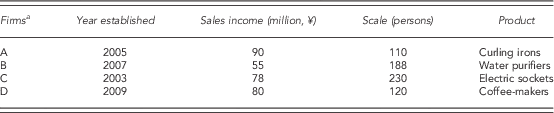
Four SMMEs in the electrical appliance cluster in Zhejiang Province in China were selected as cases for this research. Each SMME had a record of interacting with P-KIBS and T-KIBS. For confidentiality reasons and to discuss our findings freely, we labeled these SMMEs as A, B, C, and D (Table 1).
Overview of focal firms

a To protect the firms’ anonymity, they are labeled A, B, C, and D.
Data collection
Several data sources were used in this study, including interviews and archival data such as internal company documents and websites. We interviewed general managers, department managers, and engineers in November 2013 and August 2014, respectively. We began the interviews by asking the informants background questions about their firms’ interaction with KIBS. Then, we tentatively asked for details about the process of the KIBS interaction, including their aims of acquiring external knowledge-intensive services, the process of the interaction, and their firms’ financial performance before and after the KIBS interaction. We also asked the informants open questions about changes in their firms’ personnel, technology, and management processes before and after the KIBS interaction.
Data analysis
We built individual write-ups using triangulation data (Eisenhardt, Reference Eisenhardt1989; Yin, Reference Yin1994).
Three of us independently coded the data, which were composed of interviews, company documents, news from websites, and so on. We then conducted a cross-case analysis using replication logic. Upon the emergence of deliberate learning constructs, we conducted the general cross-case analysis to explore alternative theoretical relationships (Eisenhardt, Reference Eisenhardt1989). The theoretical logic of the emerging relationships was promoted by prior research, case evidence, and stand-alone logic (Eisenhardt & Graebner, Reference Eisenhardt and Graebner2007). We tested emerging relationships on other cases to validate and refine the emerging theory. The analyses were completed when a strong match between the cases and the emerging theory was achieved.
Below we present our findings about the interaction processes of SMMEs and KIBS as well as the mechanism of their influence on SMMEs’ performance.
The Relationship Between The KIBS Interaction And Performance
Interaction performance
Our research determined how SMMEs created high versus low performance by interacting with KIBS. First, we described how we measured interaction performance.
We used one criterion to measure interaction performance. The direct outputs were lowered costs or increased income. We used qualitative assessments from informants. High-interaction performances were indicated by positive comments such as
‘It was successful because we generated a huge sum of money from the innovative function of the new product with their help.’
‘For us, new materials are very important. We lacked proper materials to produce our products until they helped us. We cooperated with them to successfully design our product.’
Low interaction performances were indicated by negative comments such as
‘We did not reach our previous objectives. Their help was not so obvious.’
‘We carried out the project according to their advice. However, we could not assess the effect.’
According to the qualitative assessment of a corporate manager and project director, three of us independently rated the performance of each interaction (using a 7-point Likert scale). Then we averaged the ratings, and these two measures complementarily showed the performance (Martin & Eisenhardt, Reference Martin and Eisenhardt2010).
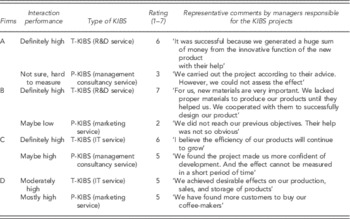
Table 2 summarizes our assessments of interaction performance and provides representative informant comments.
Interaction performance

KIBS, knowledge-intensive business services; T-KIBS, technology-based KIBS; P-KIBS, professional KIBS; R&D, research and development; IT, information technology.
We can see that interactions with T-KIBS show evidence of definite results for interaction performance and that the evaluation of interaction performance was mostly positive. Interactions with P-KIBS, however, usually resulted a somewhat blurry evaluation of interaction performance and a negative evaluation of performance mostly dominated in our cases. It was therefore crucial for us to explore the inherent causes. In the next section, we provide case materials on interaction processes and some theoretical logic to explain these striking differences.
Process of interaction with KIBS
This section presents the four cluster firms and the main processes of their interactions with KIBS firms.
Firm A produces curling irons, whose target market is mainly females. At a certain time, however, their customers indicated that hair curling was a cumbersome process and that it caused scalp burning because of the endless rotations of the hand shank and the quick-heating metal sheets. Firm A wanted to solve this problem and asked for assistance from an institute attached to a university in Zhejiang province. They had a clear objective during the interaction, which revolved around this identified problem. Eventually, they found a solution. They developed a hand shank that could automatically rotate with the press of a button. In addition, the sheets are now made of plastic that does not transmit heat. Firm A also sought advice from a management consultancy company in Taiwan to help them cultivate their organizational culture. Such kinds of projects do not have definite aims. The interaction revealed a substantial amount of information on problems with the organizational culture and on their competitors’ strategies. The outcome of this interaction was difficult to measure.
Firm B produces and sells water purifiers. It is a young company that wants to develop quickly. They cooperated with a research institute in Japan to develop new materials for water purification, which is the core of their business. Their interaction focused on developing effective and efficient materials; it successfully resulted in the design of high-quality purification products. In addition, they wanted to enhance the market share of their products and asked a marketing service company in China to help them to design some marketing promotion programs. For this, however, they just had a general idea and were unable to set the targets they wanted to achieve. In the end, they did not achieve any notable effects.
Firm C is older than the other firms. Its business is electric sockets, which always incurs a profit from the scale effect. This firm wanted to build an enterprise resource planning (ERP) system to improve production, sales, and storage. In its interaction with an information and communications technology service company, the firm exchanged information concerning the ERP system with the information, communication and technology service company, and established a relationship for further cooperation and improvement of after-sale services. They increased production efficiency through this interaction. Firm C also wanted to initiate a development plan for managerial reform. They asked a management consultancy company in China to make this plan for them. During the interaction, they gathered ideas concerning their managerial modes and sought information on national policies, typical competitor behaviors, and the demands of their major suppliers and customers. Ultimately, they got a promising planning textbook. It is difficult, however, to evaluate its impact on competitive advantages immediately.
Firm D produces coffee machines. Their business is still in its infancy and their basic production and storage strategies are weak. They commissioned an external information, communication and technology company to help them to build a basic ERP system. The interaction between these two parties was relatively simple. The basic ERP effectively improved their production. In addition, Firm D improved their performance in supplying coffee machines by analyzing customer behavior with the assistance of a marketing service company. They found that they had a chance to attract more customers for their coffee machines.
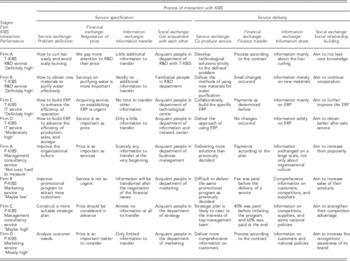
For more detail, Table 3 presents information about the four SMMEs’ interaction processes. It was found that the four elementary activities of KIBS interaction function differently during the stages of service specification and delivery. At the stage of service specification, service exchange activities aim to define the problems, financial exchange activities focus on negotiating the price, information exchange activities aim to transfer relevant information, and social exchange activities are needed to acquaint the partners with each other. At the stage of service delivery, those four activities function differently. Service exchange activities’ aim to coproduces specific services, financial exchange activities mainly transfer finance according to the contract, information exchange activities aim to share information with each other, and social exchange activities aim to build the partners’ social relationship.
Interaction processes of Firms A, B, C, and D during the different phases of service coproduction

KIBS, knowledge-intensive business services; T-KIBS, technology-based KIBS; R&D, research and development; IT, information technology; ERP, enterprise resource planning; P-KIBS, professional KIBS.
Data also indicated that the two parties mainly discussed the concept of services (e.g. problem defining) and financial issues (e.g. price negotiating) at the stage of service specification as the following comments show:
‘How to curl hair easily and avoid scalp burning,’ ‘We pay more attention to R&D than price’ (Firm A’s interaction with T-KIBS).
‘How to obtain new materials to purify water effectively,’ ‘Services on purifying water are more important’ (Firm B’s interaction with T-KIBS).
They shifted their focus to obtain further information and build social relationships at the service delivery stage as the following comments show:
‘We share information mainly about the hair curling,’ ‘We aim to not leak our core knowledge by the way of building some cooperative relationships.’ (Firm A’s interaction with T-KIBS).
‘We share information merely on new materials,’ ‘We aim to continue cooperation’ (Firm B’s interaction with T-KIBS).
In addition, coproducing services was also critical at this stage as the following comments show:
‘We developed technological solutions strictly to the defined problem after we defined the problems.’ (Firm A’s interaction with T-KIBS).
‘We delivered the methods on how to use new materials for water purification’ (Firm B’s interaction with T-KIBS).
Accordingly, defining the problem, and negotiating the price are more important at the stage of service specification, while coproducing the service, sharing information, and building social relationships require more attention at the stage of service delivery.
Some differences, however, exist between SMMEs’ interaction with T-KIBS and P-KIBS. At the stage of service specification, the SMMEs want to obtain complementary technological services from T-KIBS, which they lack and therefore need to acquire. The SMMEs therefore have a definite goal in the interaction, but have relatively weak bargaining power, as Firm C described:
‘Why we chose it to cooperate was that we wanted to how to enhance the efficiency of our operations by the way of building an ERP.’ ‘For us, establishing an ERP is very urgent, and we may pay less attention to price.’
From P-KIBS, SMMEs want to obtain supplementary professional services related to improving the productivity of the knowledge they already possess. Compared with the more specific services they seek from the T-KIBS, they have rather undefined goals for their interactions with P-KIBS, with whom they have strong bargaining power and can therefore dominate price negotiations. This can be observed from Firm D’s interaction with a management consultancy service in the comments below:
‘Though our firm develops well, we want to be more excellent. We need more advice from different voices.’ ‘Thus, we asked an external professional company to help us construct a more suitable strategic plan to obtain such objectives.’
‘Because it was not a very urgent task to finish, we had more time to consider the potential partners, and the relevant price the counterpart charges will become an important factor.’
At the stage of T-KIBS service delivery, SMMEs can gather information related to the technologies they need and get better after-sale services through building a social relationship with the T-KIBS, as seen in comments from Firm D:
‘Our interaction task focuses on establishing the ERP; therefore, we share information solely on ERP.’
‘We even build some friendly relationship with each other to obtain better after-sales service for ERP.’
This relates to the cultural concept of guanxi, which is a specific resource in China (Leung, Reference Leung2014). Chinese firms may obtain services of the highest quality if they have better guanxi with their service providers.
By interacting with P-KIBS, SMMEs obtain such information as the experiences of worldwide leaders in their industry and the status of their competitors, suppliers, and potential customers. P-KIBS interact with many firms (Zhang & Li, Reference Zhang and Li2010) that can help the SMMEs enhance their reputation and brand through establishing stable and harmonious social relationships. This was seen in comments from Firm D:
‘We share information on a relatively broad scope, such as customers’ behaviors and some economic policies in our nations where we do business.’
‘We do not only solve some specific problems, but also increase the recognition/awareness of our brand by such ways.’
Overall, it was found that there were significant differences between the SMME interactions with T-KIBS and P-KIBS. Accordingly, they each had a distinct interaction performance. In the following section, we will further explore how different interaction performance happen.
Mechanism Of Interaction With KIBS Influencing Firm Performance
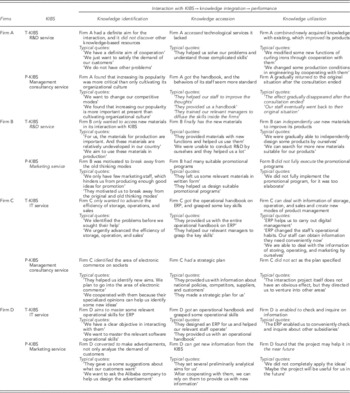
From previous research on knowledge integration theory, and our comparison of the four SMMEs, we found that interacting with KIBS could affect the identification, accession, and utilization of knowledge. All of these factors ultimately influence the interaction performance. Table 4 summarizes these relationships and provides typical informant comments.
Mechanism of interaction with KIBS influences performance

KIBS, knowledge-intensive business services; T-KIBS, technology-based KIBS; P-KIBS, professional KIBS; ERP, enterprise resource planning; R&D, research and development.
First, interactions with KIBS can enhance SMMEs’ capability to identify knowledge, and help them identify useful external knowledge-based resources. SMMEs that interact with T-KIBS usually have definite aims, whereas SMMEs that interact with P-KIBS have goals that are more vague. Interactions with P-KIBS are therefore more inclined to influence knowledge identification. For example, Firm B realized that investing on promotion to strengthen their marketing efforts is critical for their development after they cooperated with an external marketing service company. As Firm B indicated
‘We only have a few marketing staff, which hinders us from producing enough good ideas for promotion.’
‘They motivated us to break away from the original old thinking modes.’
The reason why Firm C interacts with the managerial consultancy company is that they wanted to obtain specific new ideas from the company’s specialized opinions. Firm C identified the huge economic potential of entering the area of electronic commerce and acquired relevant knowledge-based resources. As Firm C echoed
‘They helped us to identify new aims. We plan to go into the area of electronic commerce.’
‘We cooperated with them because their specialized opinions can help us to identify some new ideas.’
Second, interactions with KIBS can help SMMEs access external knowledge-based resources. Interactions with T-KIBS and P-KIBS have similar effects on knowledge accession. For example, when Firm C adopted the ERP system by cooperating with the external software company, the information technology service suppliers provided training and helped their staff access relevant skills in software operations. Firm C described the interaction as follows:
‘They provided us with the entire operational handbook on ERP.’
‘They helped our relevant managers grasp the key skills.’
Similarly, Firm D got an operational handbook after they invited an external information technology service supplier to establish their ERP system. The service suppliers also maintained and upgraded the system for them. Firm D had this to say:
‘They designed an ERP for us, helping the operations of our relevant staff.’
‘They provided us with an operational handbook.’
When interacting with P-KIBS, SMMEs can also access various knowledge-based resources. In addition, they can search for more extensive knowledge with the help of P-KIBS. P-KIBS often acts not only as a bridge to knowledge, but also as an indirect knowledge-based resource. Firm A asked a management consultancy company to build and cultivate an organizational culture for them. During the process of interaction, however, they found that increasing their popularity among their clients was currently more important than cultivating an organizational culture. In the end, they searched for strategies to expand their popularity and brand. Here is how Firm A described the interaction:
‘They helped our staff improve our ideas.’
‘They provided us with a handbook.’
‘They trained our relevant managers to diffuse the skills inside the firm.’
Third, interactions with KIBS can improve the utilization of knowledge-based resources. SMMEs often fail to evaluate the effect of implementing and applying new projects when they interact with P-KIBS. The influence of interactions with T-KIBS therefore usually has a large significance on SMMEs’ knowledge utilization. Firm A described their interaction with T-KIBS, as follows:
‘We modified some new functions of curling irons through cooperation with them.’
‘We changed some production conditions in engineering by cooperating with them.’
Firm A then diffused new ideas about its innovative functions of the curling iron. Firm C found a way to deal with the information concerning storage, operation, and sales of its products after interacting with the information technology service supplier. Firm C described it this way:
‘ERP helped us carry out digital management.’
‘ERP changed the staff’s operational habits. Our staff can now conveniently obtain information they need.’
‘We are able to deal with the information concerning storing, operating, and marketing by ourselves.’
These benefits were also found in Firm B. When interacting with external research and development service companies, they gradually and independently imitated and designed some products. Firm B described the interaction like this:
‘We were gradually able to independently design some products by ourselves.’
‘We can now search for more new materials suitable for our products.’
There are some differences in SMMEs’ interactions with P-KIBS compared with those with T-KIBS. After an interaction with a managerial consultancy company to cultivate their organizational culture, Firm A found that most of the staff would behave according to the cultural norms right away, but they could not insist on complying with the rules shortly after. This made the evaluation of the consultation difficult, as Firm A indicated:
‘The effect gradually disappeared after the consultation ended.’
‘Our staff eventually went back to their original behaviors.’
Overall, the case analysis showed that the knowledge accession and utilization of SMMEs that interacted with T-KIBS changed significantly and eventually influenced the interaction performance. Knowledge identification and accession of SMMEs that interacted with P-KIBS, however, change significantly and ultimately influenced the interaction performance.
Discussion
We have added to the theory of SMMEs–KIBS interactions. Previous research indicated the importance of the interaction for SMMEs, but empirical research on the mechanisms of the interaction was weak. Addressing this gap, we explored how SMMEs interact with KIBS, disentangling the internal mechanisms.
First, our study provides insights for the interaction model of industrial marketing research. Prior research suggested that the interaction had four components: service/product, financial issues, information, and social relationships (Hakansson, Reference Hakansson1982; Wynstra, Axelsson, & Valk, Reference Wynstra, Axelsson and Valk2006; Valk, Reference Valk2007). Our research suggests that service coproduction (Miles et al., Reference Miles, Kastrinos, Flanagan, Bilderbeek, Hertog, Huntink and Bouman1995) and the interaction model (Hakansson, Reference Hakansson1982) can be combined to explore the interaction between SMMEs and KIBS. Four scenarios have different sequences in the SMMEs–KIBS interaction. Service consumption generally has two stages: service specification and delivery. On the former stage, SMMEs mainly define the questions and negotiate the price. On the latter stage, they aim to coproduce the service, share information, and build social relationships for further cooperation.
Second, our study provides insight concerning the categorization of KIBS. Dividing KIBS into T-KIBS and P-KIBS is well known (Miles et al., Reference Miles, Kastrinos, Flanagan, Bilderbeek, Hertog, Huntink and Bouman1995), but the difference between T-KIBS and P-KIBS is still in need of further clarification, especially from the perspective of how they interact with SMMEs. Our data indicated that SMMEs have definite goals for the service/product exchange with T-KIBS during service specification, while their goals become more vague when they interact with P-KIBS. Accordingly, SMMEs have relatively strong bargaining power when they negotiate prices with P-KIBS. For their part, T-KIBS can deliver prearranged services to SMMEs, but P-KIBS usually delivers services that are not specified before the interaction. We argue that T-KIBS provide something more concrete, whereas P-KIBS offer services that require prior input from clients, often concerning the firm’s ‘deep’ characteristics and values. This makes the P-KIBS’s advice more difficult to implement than the more technical aspects of the T-KIBS materials and services. In other words, P-KIBS deal with more complex and nuanced, and less value-free, issues that are hard to define, measure, and evaluate. This opinion is also supported by Consoli and Hortelano (Reference Consoli and Hortelano2010).
What is more, information exchange and social exchange have different characteristics when SMMEs interact with different types of KIBS. Specifically, when SMMEs interact with T-KIBS, information exchange is mainly about service- or product-related technologies, while building a social relationship with the T-KIBS aims to improve after-sale services or build trust by avoiding knowledge leaks from the KIBS. When SMMEs interact with P-KIBS, exchangeable information is comprehensive and may even concern worldwide competitors, suppliers, customers, and national policies. The principal objective of building a social relationship with the P-KIBS is to broaden brands and increase the popularity of firms. We argue that these differences can be ascribed to different interaction modes. Interactions between SMMEs and T-KIBS are complementary, characterized by SMMEs obtaining missing technology or knowledge from T-KIBS, while the supplementary interactions between SMMEs and P-KIBS are characterized by SMMEs deriving greater value from resources that they already have (Buckley et al., Reference Buckley, Glaister, Klijn and Tan2009). In the context of China, which has a lack of institutions (Luo, Reference Luo2003), client firms are more wary of KIBS’s trustworthiness. Accordingly, SMMEs typically pay less attention to P-KIBS services because they are more intangible and their effects are harder to measure. The nontechnological problems they address are in general more challenging because they are harder to define and therefore harder to solve. The uncertainty created by P-KIBS interactions can be confusing for the SMMEs compared with the more straightforward technical services. We think this may be because the examined firms seemed not to have specific aims in their interactions with P-KIBS.
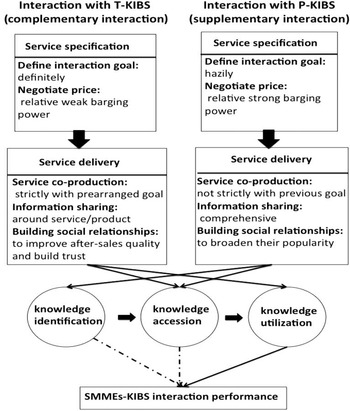
Third, our study provides insights concerning the knowledge integration role of KIBS. In our case studies, we found that SMMEs interactions with T-KIBS and P-KIBS had different effects on the firms’ integration of external knowledge integration. Interactions between SMMEs and T-KIBS mainly influence the firms’ knowledge accession and utilization, whereas interactions between SMMEs and P-KIBS mainly influence the firms’ knowledge identification and accession. Compared with manufacturers, service providers pay more attention to cocreating value with their clients (Rajala, Westerlund, & Rajala, Reference Rajala, Westerlund and Rajala2008). KIBS act as the source, carrier, and facilitator of innovation and as the coordinator and bridge of information for manufacturing firms (Hauknes, Reference Hauknes1998; Muller & Zenker, Reference Muller and Zenker2001). Interactions with KIBS therefore affect the knowledge activities of SMMEs. When interacting with SMMEs, however, T-KIBS serves as a knowledge source by supplying complementary knowledge to SMMEs. Interactions with T-KIBS is a knowledge-transferring activity (Rajala, Westerlund, & Rajala, Reference Rajala, Westerlund and Rajala2008) that inevitably helps firms acquire knowledge-based resources. When interacting with SMMEs, P-KIBS acts as a bridge. SMMEs seek to obtain supplementary knowledge or information from P-KIBS and find other specific knowledge-based resources to acquire. Knowledge identification and accession cannot ensure that SMMEs will apply this knowledge to develop their performance. Interactions with P-KIBS therefore usually cannot obviously or immediately influence SMMEs’ performance, which makes it difficult to measure the effect of such interactions. By contrast, interaction with T-KIBS can influence the knowledge utilization of SMMEs, which has a more direct impact on performance. As a whole, this type of interaction can influence SMMEs’ performance in a timely way. Figure 1 graphically shows our theoretical model, which was obtained from this case analysis.
Mechanism of the knowledge-intensive business services (KIBS) interaction’s influence on firm performance. T-KIBS, technology-based KIBS; P-KIBS, professional KIBS; SMMEs–KIBS, small and medium manufacturing enterprises-KIBS

Conclusions
In this study, we analyzed the process of SMMEs–KIBS interactions and their effect on knowledge identification, accession, and utilization to explain why interactions with different types of KIBS can result in different performance outcomes. With data on four SMMEs from an electrical appliance industry cluster in China, we proposed that during the SMMEs–KIBS interaction, the SMMEs normally define the demand and negotiate the price during service specification, and they coproduce the service, share information, and build social relationships during service delivery. We summarize that SMMEs interact with T-KIBS to obtain complementary knowledge and with P-KIBS to derive supplementary knowledge, or greater value from knowledge already obtained. Interactions between SMMEs and T-KIBS are therefore usually complementary, and interactions between SMMEs and P-KIBS are therefore supplementary. In this study, we also found that both types of KIBS promote knowledge accession, but T-KIBS additionally acts as knowledge sources (promoting knowledge utilization), and P-KIBS serve as knowledge bridges (promoting knowledge identification). In other words, interaction with T-KIBS is inclined to influence knowledge accession and knowledge utilization, ultimately influencing SMMEs’ performance. Interaction with P-KIBS is likely to influence knowledge identification and knowledge accession, ultimately influencing SMMEs’ performance, but not immediately.
Theoretical contribution
Our study extends the research on Hakansson (Reference Hakansson1982) interaction model of industrial marketing. We propose that the three main episodes in the original interaction model appear in different sequences during service supply. One episode of the interaction, financial exchange, appears mainly during service specification. Two other episodes of the interaction, information exchange and social exchange, occur mainly during service delivery. Service/product exchange generally occurs during both stages. We particularly classified interactions with KIBS as either complementary or supplementary, which also deepens the research on the differences between T-KIBS and P-KIBS. In addition, we identified the roles of different KIBS for manufacturing firms. Previous research generally asserted that KIBS was the source, carrier, and facilitator of innovation and the coordinator and bridge for manufacturing firms (Hauknes, Reference Hauknes1998; Muller & Zenker, Reference Muller and Zenker2001). That research did not, however, further specify the role of the different KIBS. Our study argued that T-KIBS act mainly as a knowledge source, while P-KIBS mostly as a bridge for the manufacturing firms; this finding broadens KIBS research. Furthermore, we split knowledge integration into three parts: knowledge identification, accession, and utilization. From the perspective of knowledge integration, we identified the pathways by which KIBS interactions influence performance. We aim to give further insights for future research on knowledge integration.
Managerial implications
Our study provides important managerial implications. First, managers of SMMEs are advised to realize the significance of interactions with KIBS. These interactions are useful pathways to improve external knowledge integration capability and firm performance. SMMEs also need to choose the right type of KIBS based on their specific characteristics. To interact with T-KIBS, SMMEs are advised to have strong capabilities for absorbing specific knowledge-based resources. While interacting with P-KIBS, it is better for SMMEs to take advantage of the KIBS disseminating role in their search for other knowledge-based resources. What is more, SMMEs are suggested to convert some noncore resources into external professional service firms to help service suppliers attain economies of scale and consequently promote the development of SMMEs.
Second, KIBS should recognize their role as knowledge sources and knowledge bridges, fully consider their clients, and help SMMEs to identify, access, and utilize external knowledge-based resources to improve their competitive advantage during the interaction.
Limitations and future research directions
Our study has several limitations. On the basis of organizational structure and the demand by manufacturing firms for the services of external KIBS, we selected four SMMEs as case studies. Although our sample selection complied with a strict criterion, the samples mostly came from Zhejiang province, China. The generalizability of this research should therefore be examined in the future. Similar research should be conducted in other industrial clusters in other countries to formulate general propositions. In addition, the measurement of ‘interaction performance’ needs to be further improved. We only adopted one criterion to measure performance, namely the commercial or business performance. The specific service characteristics, however, could cause multiple-criteria evaluations of performance to become mandatory (Djellal & Gallouj, Reference Djellal and Gallouj2008, Reference Djellal and Gallouj2013). Further research should add more dimensions, such as technical performance, civic performance, and relational performance to measure interaction performance.
Acknowledgements
The authors express their gratitude for the financial support of the National Natural Science Foundation of China (No. 71402042; No. 71372170), the Natural Science Foundation of Zhejiang Province of China (No. LQ14G020013; No. LQ14G020008), and the Social Science Planning Project of Zhejiang Province of China (No. 14NDJC022YB). The authors also thank anonymous reviewers and editors who gave constructive suggestions.