INTRODUCTION
Following two decades of implementation, community-based natural resources management (CBNRM) faces the challenge of establishing institutions that practise good governance over the management of common property resources (Corbett & Jones Reference Corbett and Jones2000; Campbell & Shackleton Reference Campbell and Shackleton2001; Turner Reference Turner2004). Decentralization characterized by lack of downward accountability has been cited as a hindrance to CBNRM in sub-Saharan Africa (Child & Dalal-Clayton Reference Child, Dalal-Clayton, McShane and Wells2004; Jones & Murphree Reference Jones, Murphree and Child2004; Murphree Reference Murphree2004). Simultaneously, despite generating income from high value wildlife resources and tourism, CBNRM has fallen short of delivering household benefits to local communities (Bandyopadhyay et al. Reference Bandyopadhyay, Shyamsundar, Wang and Humavindu2004; Balint & Mashinya Reference Balint and Mashinya2006; Musumali et al. Reference Musumali, Larsen and Kaltenborn2007). We contend that local communities with better CBNRM governance will see greater social and economic returns. However, to date, CBNRM assessments have been hampered by the inadequacy of measures to assess good governance and by a lack of studies relating them to socioeconomic improvements.
CBNRM was implemented as early as the 1960s in Zimbabwe and Namibia, where private landowners received rights to manage and derive benefits from wildlife on their land (Jones & Murphree Reference Jones, Murphree, Hulme and Murphree2001). Subsequently, a similar devolution of wildlife rights was granted to communities on communally-held lands. In Namibia, the Nature Conservation Amendment Act of 1996 (Government of Namibia 1996) established conservancies as communal land areas with set boundaries and within which local people are granted partial and conditional benefits from wildlife (NACSO [Namibian Association of Community Based Natural Resource Management Support Organizations] 2006). They are considered a prime mechanism to foster environmentally friendly local economic development and to strengthen community management capacity in communal areas (Long Reference Long2001). Established through democratic processes, conservancies strive to achieve good governance with accountable leadership structures that ensure that their constituents receive benefits.
Good governance is based on participatory and democratic traditions, promoting equity, equality, gender balance, the synthesis of diverse perspectives, the mobilization of resources for social purposes and, finally, the rule of law (Rhodes Reference Rhodes and Pierre2000). The lack of accountability by community leaders to their constituents is considered as a major hindrance to good governance in CBNRM programmes across southern Africa (Campbell & Shackleton Reference Campbell and Shackleton2001; IUCN [International Union for Conservation of Nature] 2006). Upward accountability from local leaders to the Government department has been more successful in terms of meeting various Government requirements such as membership formation, constitution development and some financial obligations (NACSO 2004). At the micro level, however, the mechanisms that reinforce accountability within the community institutions are weak. In addition, ways of measuring the performance of these micro level CBNRM institutions are not available.
Accountability has ‘vertical’ and ‘horizontal’ forms (O'Donnell Reference O'Donell1994). Vertical accountability is the relationship between unequals; it refers to a powerful ‘superior’ actor holding a less powerful inferior actor accountable. In CBNRM, this relationship is exhibited between government (for example wildlife departments) and the local communities. Horizontal accountability, however, describes a relationship between equals; it refers to somebody holding someone else of roughly equal power accountable, and is a key element of good governance. Schedler (Reference Schedler, Schedler, Diamond and Plattner1999) conceptualized accountability as the means of constraining power. Accountability has basic connotations of ‘answerability’ and enforcement. Answerability is the obligation of public officials to inform about and explain their actions. Enforcement is the capacity of accounting agencies to impose sanctions on power holders who have violated their public duties. For the purpose of measuring horizontal accountability in CBNRM, this study focuses on answerability. In CBNRM, answerability is manifested as the ability of local leaders to transfer information to their constituents. Schedler (Reference Schedler, Schedler, Diamond and Plattner1999) argued that answerability is achieved through members of a group having the right to information and the corresponding obligation of local leaders to release the necessary information. In CBNRM communities, elected leaders should provide information on financial, operational, and administrative matters and natural resources on a frequent and transparent basis to their constituents, but such information transfer is often lacking or asymmetrical.
Within CBNRM, horizontal accountability should foster an environment for ensuring that social and economic benefits reach all members of a community. These benefits differ from location to location. For the purpose of this study, we restricted our assessment to a subset of benefits that we knew had been provided to varying degrees by one or more conservancies in the Caprivi province. These included cash dividends, game meat distribution, employment opportunities, community project funding, educational support and other in-kind benefits (such as transport or cell phone charging).
We present results from a study measuring governance and socioeconomic indicators in five CBNRM communities in Namibia. The research was largely exploratory and stakeholder driven to determine which variables should be considered, with a strong emphasis on how this could realistically be incorporated into community based monitoring systems (so that it lives beyond the presence of university-trained researchers). Specifically, we sought to explore if and how good governance could be measured within CBNRM programmes through a focus on horizontal accountability. We focus on financial data (annual budgets, source and amount of income; how money was spent; income from campsites and lodges) and natural resource data (hunting quotas; number of animals shot on license; prices of animals; trends in rare and endangered species). We argue that availability of information in CBNRM communities should lead to accountable leaders and explore whether this element of good governance was linked to the provision of socioeconomic benefits for community members in the present case.
METHODS
Study site
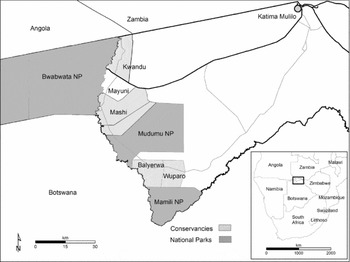
The study was conducted in five conservancies west of Katima Mulilo, close to the Kwandu river in the Caprivi province of Namibia (Fig. 1). This area is part of the Kavango Zambezi Transfrontier Conservation Area, which spans into neighbouring Angola, Botswana and Zambia. Specifically, we worked in Mashi, Kwandu, Mayuni, Wuparo and Balyerwa conservancies, the first three of which were gazetted in 1999 and the last two in 2003 and 2006, respectively. Mayuni, Kwandu and parts of Mashi conservancies are located along the tar road that connects the provincial capital of Katima Mulilo (110 km away), and closest significant market, to the rest of the country. Starting in Mayuni, a dirt road loops back south-east to Katima Mulilo.
Map indicating the location of the study sites.

Precipitation in the area ranges from 600 to 700 mm per year, but is subject to extreme seasonal as well as annual variation that can lead to extensive floods followed by long droughts. The banks of the Kwandu river are characterized by extensive flood plains, interspersed by Terminalia and Mopane woodlands and grasslands. Inland, the soils range from sandy and infertile to clay and more fertile ground. Much of the interior is bush and grassland and serves as a wildlife corridor (National Planning Commission 2006). Wildlife populations and diversity in the area have been improving since the 1970s, including elephants, various antelope species, felines, hippos and warthogs (Weaver & Skyer Reference Weaver and Skyer2003).
Data collection
In each conservancy, local research assistants were selected from a pool of bilingual (English/local language) residents who had at least an 11th grade education. Each of them received additional training to conduct individual interviews using structured questionnaires (Appendix 1, see supplementary material at Journals.cambridge.org/ENC). The research assistants translated the questionnaire orally during the interviews into a local language (mainly Sifwe, Yeyi or Mbukushu), unless respondents were fluent in English. The questionnaire included indicators of community governance performance, such as participation, decision making, attitudes towards leaders and accountability, as well as indicators of socioeconomic benefits provided by the conservancy, such as whether respondents had received benefits or whether community projects had been implemented by the conservancy. A total of 236 individuals were randomly selected in Mashi (n M = 32), Mayuni (n My = 46), Kwandu (n K = 37), Balyerwa (n B = 52) and Wuparo (n W = 69). In the absence of formal sampling frames, such as established village census lists, we selected the sample participants using geographical stratification along village paths and maximizing the between-group variance by age and gender (Bernard Reference Bernard2002).
Indices for governance and socioeconomic data
To get an overall measure of good governance and of socioeconomic performance, we developed two aggregate indices. Complex latent concepts cannot be measured through direct observations and are best estimated by combining multiple indicators (Bernard Reference Bernard2002; DeVellis Reference DeVellis2003). In our case, we selected the indicators following discussions with local stakeholders and experts. We confirmed that these indicators measured a similar concept by calculating Cronbach alphas as a measure of the indices' internal consistency (Bernard Reference Bernard2002). We grouped indicators into their respective index, following a simple averaging procedure, such as that used for the Index of Economic Freedom or CIFOR [Centre for International Forestry Research]'s well-being index (Cahyat et al. Reference Cahyat, Gonner and Haug2007; Miller et al. Reference Miller, Holmes, Kim, Markheim, Roberts and Walsh2010). This approach assumes equal weighting for all indicators, which we adopted because of the ease of implementation and potential replication within community-based monitoring schemes and the absence of additional data to determine appropriate weights.
For governance, the index consisted of seven items, including four on information about financial resources and three on information about natural resources. Each item assessed whether the respondents had received information about the subject in question from conservancy leaders (for example ‘Have you been given information on the conservancy budget in the past 12 months?’). Items were coded as 1 for having received some information, and 0 for having received no information. We averaged the scores of these seven items and normalized it on a 0–100 scale to generate an information transfer index (ITI), as a proxy of horizontal accountability. This index had a Cronbach alpha of 0.79, suggesting strong internal validity. We also calculated sub-indices for ‘information on natural resources’ and ‘information on financial resources’ by averaging their respective items, and normalizing the result to a 0–100 scale.
We followed a similar procedure to generate a socioeconomic achievements index (SAI) on a scale from 0 to 100, averaging binary responses from a set of six items (1 for having received the benefit in question, 0 for not having received it). The SAI had a Cronbach alpha of 0.83, suggesting strong internal validity. These six items captured multiple dimensions of socioeconomic benefits that could be provided by the conservancy, such as provision of cash, meat or educational services. These items reflect the respondents' perceptions of whether they received these benefits within the previous 12 months rather than actual distribution of benefits as may be recorded by conservancy officers.
The data gathered for both the horizontal accountability and the socioeconomic measures, were analysed using SPSS 13 and STATA software. Analysis included crosstabs, ANOVA and t-tests to compare means and Pearson correlations.
RESULTS
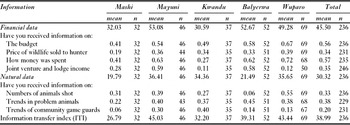
The highest performance scores in terms of information transfer, used as a proxy for horizontal accountability, were for Mayuni and Wuparo conservancies (Table 1), followed by Balyerwa and Kwandu conservancies, and finally Mashi conservancy (ANOVA F = 2.68; p < 0.05). Considering the sub-index on the transfer of financial information, the conservancies are ranked in decreasing order from a top group consisting of Mayuni, Balyerwa and Wuparo conservancies, followed by Kwandu and Mashi conservancies (ANOVA F = 4.36; p < 0.05). A different ordering is observed for the sub-index on the transfer of natural resources information: Mayuni, Wuparo and Kwandu formed the top group and Balyerwa and Mashi the bottom group (ANOVA F = 2.70; p < 0.05).
Measurement of horizontal accountability for each conservancy, using information transfer as a proxy. Means for financial data, natural data and ITI are reported on a 0–100 scale. Other means range between 0–1. Data from individual interviews.

Except for Kwandu conservancy, the transfer of financial information index was higher than the transfer of natural resources information index (t = 7.43, 4.78, 2.44, 4.17 for Balyerwa, Mayuni, Mashi and Wuparo respectively; p < 0.05). Within the financial information category, budget information transfer and information on how money was spent by the conservancy scored the highest when compared to the transfer of other kinds of information. Within the natural resources information, the trends of community escort guides were the least well known of the three kinds of information.
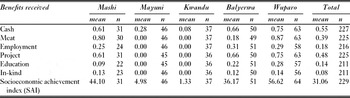
In terms of the socioeconomic performance scores of the five conservancies (Table 2), Wuparo, Mashi and Balyerwa conservancies formed the highest ranking group, and Mayuni and Kwandu the lower ranking group (ANOVA F = 42.02, p < 0.05). The most commonly provided benefits were cash, game meat (from trophy hunters) and communal projects.
Measurement of socioeconomic performance for each conservancy, using the perception of benefit receipt as a proxy. Means for SAI are reported on a 0–100 scale. Other means are in the range 0–1. Data from individual interviews.

Pearson correlations indicated a positive relationship between the provision of benefits (SAI) and horizontal accountability (ITI) (r = 0.30; p < 0.05). This positive correlation held true for Balyerwa, Mashi and Wuparo conservancies (r = 0.51, r = 0.35 and r = 0.59, respectively; p < 0.05).
DISCUSSION
Standardized systems for measuring the effectiveness, legitimacy and performance of community governance have not yet been developed for CBNRM (Armitage Reference Armitage2005). Furthermore, systems for assessing how well CBNRM programs are serving the needs and aspirations of their constituency are also lacking (Turner Reference Turner2004). The development of the indices presented here is one mechanism to start addressing these gaps. Our work suggests that horizontal accountability can be implemented for systematic and comparable measurements, which lays the foundation for future refinements and broader measures of good governance.
We note that all conservancies are rated poorly for horizontal accountability which means conservancy leaders are not doing an effective job at transferring information to their constituents. The horizontal accountability index we developed suggests that Mayuni and Wuparo conservancies had a higher level of information transfer and thus may have been more accountable than the other conservancies. Furthermore, information transfer of financial data was better than for natural resources, indicating that conservancies were less accountable on the latter than the former.
The differences in horizontal accountability between conservancies are attributable to a number of causes. The size and spatial distribution of a conservancy population has a potential influence over the effectiveness of information transfer efforts. Mayuni and Wuparo are relatively small, with populations of 2000–2400 people over approximately 150 km2, as opposed to Mashi's 3900 people over 297 km2 (NACSO 2006). It is likely easier to organize meetings with higher attendance, or to generally distribute information even informally, with a smaller number of people and within a smaller area. Another factor at play may be the age of the conservancy. Again, Mayuni and Wuparo are older and therefore may have implemented the process of information transfer slightly better than younger conservancies.
Information is power, and deciding who to inform, when and about what can be subject to local politics (Schedler Reference Schedler, Schedler, Diamond and Plattner1999; Stewart Reference Stewart and Hodges2005). In Namibia, traditional leaders are vested with official authority and strongly influence decisions, especially at local scales (Rice Reference Rice1997). In the Caprivi province, the situation is complex because the population is split in its allegiance to multiple traditional authorities. The residents of some conservancies, such as Wuparo, almost exclusively recognize a single Chief, but in other conservancies, significant portions of the population may recognize two different Chiefs (Rice Reference Rice1997). For instance, Mashi conservancy includes villages linked predominantly to one Chief, as well as villages predominantly linked to another Chief. In many respects, Mashi conservancy officers have successfully incorporated both traditional authorities in their management structures. However, just as in any other local political landscapes, differences and tensions are likely to arise among individual supporters in the general population. Such issues can influence information transfer.
The population, spatial and leadership characteristics of conservancies however do not explain why the financial information transfer sub-indices are higher than the natural information transfer sub-indices. To explain such differences, we consider the challenge of distinguishing perception from reality. Our data were collected from conservancy residents rather than its leaders, thus revealing residents perceptions about the types of information received, rather than whether conservancy leaders actually took steps to distribute information. It is possible that the conservancy distributed information either in written reports or at general meetings, but that people failed to receive, or failed to remember receiving, that information.
Conservancies are supposed to organize annual general meetings (AGMs) at which they discuss a wide range of issues, usually reporting on past achievements, and plan ahead for the future (NACSO 2007). These meetings are open to the community at large, but in practice, attendance may be limited. The venue may be located too far away from some villages, especially in large conservancies, and transport is usually insufficient. Attending a meeting has an opportunity cost that some people may deem too high. Meetings tend to be long, and people may not stay the whole time, or may not pay attention the whole time. Furthermore, meeting agendas tend to be over packed and some items may not be covered. All these factors may have hindered the transfer of information in this case. The higher transfer of financial information may indicate that information on natural resources was not as high a priority for both conservancy members and leaders and that the focus was more on informing people about finances.
The distinction between perception and reality is also important when interpreting the socioeconomic achievements. Meat was being distributed as part of joint venture agreements between conservancies and safari hunting operators, and was the most common benefit perceived by residents of Mashi and Wuparo conservancies. In Balyerwa, the most common benefits were the distribution of cash and the organization of community projects. These were also common in Mashi and Wuparo conservancies. Employment benefits were listed as fourth except in Kwandu and Mayuni conservancies, where the perception of employment benefits seemed more limited. We expected Mayuni residents to perceive stronger employment benefits because it has two tourism lodges and a campsite, while Kwandu has only one campsite. However, at the time of the survey, local residents were disgruntled about the benefits provision by the conservancy, partly owing to a lack of communication from the Mayuni leadership, which had not held an annual general meeting for almost three years. The provision of educational support or other in-kind benefits was minor.
Our data shows that similarly to governance performance, all conservancies appeared still to have scope for improving the distribution of benefits. Out of a maximum score of 100, all conservancies achieved less than 50, with Kwandu and Mayuni being particularly low. In socioeconomic terms Kwandu residents seemed to benefit the least of all conservancies. Interestingly Kwandu's horizontal accountability, relative to the other conservancies was in the mid range. We also observed that Wuparo had the highest socioeconomic performance score, and a fairly high horizontal accountability index score. Mayuni conversely had the highest horizontal accountability level, but one of the poorest records of socioeconomic achievements. Overall, the ordered ranking of conservancies according to their horizontal accountability did not seem to match their socioeconomic performance ranking.
Our hypothesis was that increased horizontal accountability within CBNRM projects should lead to the provision of socioeconomic benefits. However, the present findings do not support this claim. In the context of this study, we approximated horizontal accountability using the concept of answerability as the single proxy. Our study shows no strong evidence of a connection between answerability and the provision of socioeconomic benefits. However, our results were encouraging in that they showed that answerability could be documented, and can thus be included, along with additional indicators, in a subsequent measure of horizontal accountability.
Another important factor to consider in terms of the extent of socioeconomic benefits is how resource rich (in terms of wildlife and tourism operations) a conservancy is. This would affect the amount of revenue different conservancies would be able to earn and use to provide benefits for their constituents. A future study would thus consider the issue of resources available to each conservancy. Good governance alone may not be sufficient to provide substantial benefits and set conservancies on a self-reliant development path. That goal is also partially constrained by the local availability of natural, human, financial and infrastructural capital. Any future work may also need to consider the level of enforcement mechanisms.
CONCLUSIONS
Using accountability as a measure of good governance, this study is a first step to explore if good governance in CBNRM fosters socioeconomic development. Good governance however, can be measured using other indicators such as participation, membership, tenure rights and competition. Similarly, we reduced socioeconomic development to the perception of benefit provisions. It is probable that more complete, but also more complex, indices would provide a stronger assessment of CBNRM governance and its relationship to socioeconomic impacts in a way that matters to communities.
In southern Africa, CBNRM is at a crossroads and, after two decades of implementation, the CBNRM community is questioning how this programme could evolve innovatively. Understanding what good governance is and what impacts it has, is very important. The first stage of CBNRM implementation in southern Africa had a strong focus on management and the provision of economic benefits, with little or no emphasis on building strong local institutions that would ensure these goals are sustainably undertaken. Top-down management, mostly from government officials was common, and local governance was a secondary aspect of CBNRM. As this programme evolves into a new phase, it has become increasingly important to focus on understanding what CBNRM governance is, and how it functions.
ACKNOWLEDGEMENTS
This study was part of a broader collaborative research initiative involving the Universities of Florida, North Carolina, Namibia, Botswana and Zimbabwe, the Botswana Department of Wildlife and National Parks, and the NGO Integrated Rural Development and Nature Conservation. Research was conducted in Namibia under a Ministry of Environment and Tourism research permit (#1168/2007), and financed by the University of Florida's Center for African Studies, IUCN and the National Science Foundation. We extend our gratitude to the traditional authorities, conservancy leaders and residents of Kwandu, Mayuni, Mashi, Balyerwa and Wuparo conservancies, to our research assistants and collaborators from the UF Southern Africa Research Team, and to three anonymous reviewers.