Introduction
Elder mistreatment (EM), regardless of being prevalent, costly, and sometimes fatal, is an understudied area of research (Acierno et al., Reference Acierno2010; Dong, Reference Dong2015). Accumulated research has indicated that EM should be considered a stressful life event (Anetzberger, Reference Anetzberger2012; Cooper et al., Reference Cooper, Selwood and Livingston2008). Aside from bodily injuries resulting from physical abuse (Anetzberger, Reference Anetzberger2012), EM has been linked to adverse mental health consequences, including fear, depression, and suicidal ideation (Yan and Tang, Reference Yan and Tang2001). Moreover, Lachs et al. (Reference Lachs, Williams, O’Brien, Pillemer and Charlson1998) demonstrated that older adults subjected to EM have a greater mortality risk than those who are not victimized.
Numerous studies have demonstrated that physical frailty is a significant predictor of EM (Acierno et al., Reference Acierno2010; Yan et al., Reference Yan, So-Kum and Yeung2002). However, little is known about the mechanism underlying the effects of physical frailty on EM, which has further hampered the development of potential preventive strategies. The National Research Council (NRC, 2003) put forth a strong recommendation for future research to explore cultural diversity surrounding EM. Having undergone rapid modernization amid the persistence of filial piety, China offers a unique context to advance the global understanding of EM.
Guided by EM-related theories, this study investigated potential mediators in the linkage between physical frailty and EM. Specifically, we focused on three key factors suggested by Western literature: psychological vulnerability, housework involvement, and financial independence.
Prevalence of EM: a pervasive global issue
It was not until 1975, with the first scientific literature reporting the case of “granny bashing,” that a small but growing evidence base emerged and indicated the widespread nature of EM across different countries (see Cooper et al., Reference Cooper, Selwood and Livingston2008 for a systematic review). Western studies revealed that EM is alarmingly common, with prevalence ranging from 1% to 20% (Acierno et al., Reference Acierno2010; Cooper et al., Reference Cooper, Katona, Finne-Soveri, Topinková, Carpenter and Livingston2006, Reference Cooper, Selwood and Livingston2008), depending on the sample and method. A landmark survey conducted by Acierno et al. (Reference Acierno2010) of a nationally representative sample of 5777 older adults in the USA found that 1 in 10 respondents had experienced EM, with prevalence rates of 4.6% for psychological abuse, 1.6% for physical abuse, .6% for sexual abuse, 5.1% for neglect, and 5.2% for financial exploitation.
There is a great paucity of understanding of this pervasive issue in China. Particularly, on account of the Confucian ethics of caring for older adults, Chinese older adults have long been assumed to be immune from EM (Yan et al., Reference Yan, So-Kum and Yeung2002). Yet evidence has shown that EM does exist in China. In a longitudinal study based on a convenience sample of 412 urban older adults in a clinical setting, the prevalence estimate of EM was 35%, with caregiver neglect being the most common subtype (16.9%), followed by financial exploitation (13.6%), psychological abuse (11.4%), physical abuse (5.8%), sexual abuse (1.2%), and abandonment (.7%; Dong et al., Reference Dong, Simon, Odwazny and Gorbien2008, Reference Dong, Beck and Simon2010). Another often-cited study was conducted in a community setting with 2039 rural older adults and reported similar findings, with a 36.2% EM rate and psychological abuse (27.3%) as the most common type (Wu et al., Reference Wu, Chen, Hu, Xiang, Yu, Zhang, Cao and Wang2012). However, the prevalence of EM in China remains mostly unknown, and we are not aware of any studies that were national in scope. Additionally, it has often been argued that existing investigations failed to capture the cultural sensitivity of EM in Asian countries, which is far different than Western and individualistic cultures (Yan et al., Reference Yan, Chan and Tiwari2015). Therefore, one focus of this study was to expand our knowledge about the subtypes and prevalence of EM in China, particularly three culturally specific subtypes (intentional isolation, housing deprivation, and food deprivation).
Physical frailty as a predictor of EM
Our research adopted the conceptual approach suggested by the NRC, which identifies three major components: an older person, a trust relationship, and vulnerability. Vulnerability is defined as “financial, physical or emotional dependence on others or impaired capacity for self-care or self-protection” (NRC, 2003, p. 39). Consequently, it was logical for our study to assume that physical frailty would make older adults more vulnerable to abuse or neglect by their caregivers. Several studies have reported an especially high association between EM and physical frailty of older adults (Acierno et al., Reference Acierno2010; Lai, Reference Lai2011). Yet studies seldom investigated possible intervening factors in this linkage. Guided by EM-related theories, the current study examined the mediating role of three factors suggested by Western literature.
Psychological vulnerability as a potential mediator
Caregiver stress theory postulates that excessive and continuous loads of caregiving would lead to a high level of stress for the caregiver that may trigger abusive behaviors (e.g. Burnight and Mosqueda, Reference Burnight and Mosqueda2011). Thus, it is reasonable to view the pathway from physical frailty to EM as a stress process of cumulative stressors. Along with it comes the possibility that physical frailty – namely, the primary stressor – might initiate a cascade of secondary stressors that mediate the occurrence of EM. Theoretically, there are considerable reasons to examine psychological vulnerability as a potential mediator.
First, as Mysyuk et al. (Reference Mysyuk, Westendorp and Lindenberg2013) suggested, increasing physical decline might escalate psychological disorders among frail older adults, because to admit that they are no longer independent might cause shame and humiliation. How the decline of physical function negatively influences the mental health of older adults over time has been observed in longitudinal epidemiological studies (e.g. Chen et al., Reference Chen, Lee, Su, Mullan and Chiu2017). Second, in the context of eldercare, caregiving cannot be maintained in a business-like way, but has to rely on trust, intimacy, and emotional connectedness (Ayalon, 2018). Hence, on the one hand, emotional conflicts may be particularly near the surface in families due to the heavy load of caregiving; on the other hand, the psychological vulnerability of older adults also implies their inability to cope with situations with potentially abusive consequences. Previous studies have demonstrated that the psychological vulnerability of older adults, such as loneliness (Dong et al., Reference Dong, Beck and Simon2009) and depressive symptoms (Cooper et al., Reference Cooper, Katona, Finne-Soveri, Topinková, Carpenter and Livingston2006), is associated with an increased likelihood of EM. Accordingly, we formulated the first hypothesis:
Hypothesis 1: Older adults with higher levels of physical frailty are more likely to have higher levels of psychological vulnerability and in turn, are more likely to be abused or neglected by their family members.
Housework involvement as a potential mediator
Social exchange theory explains the interactions between individuals as a process of negotiated exchanges, and people who receive much from others are expected under pressure to give as much in return (Homans, Reference Homans1958). The housework involvement of older adults, which is especially profuse in Chinese extended families (Sun, Reference Sun2002), could be considered as one type of social behavior. Studies have reported that whether older Chinese parents can receive support from their adult children depends on whether they can contribute other kinds of resources to the younger generation in return (Liu et al., Reference Liu, Lu and Feng2017). Dowd (Reference Dowd1975) viewed aging as a social exchange and pointed out that “power is as synonymous with the dependence of one person upon another” (p. 587). Therefore, on one hand, older adults are often dependent on their family members for care, which implies the loss of power; on the other hand, the support provided by older adults to their families, such as housework involvement, could entitle them to negotiation power. For instance, Wu et al. (Reference Wu, Chen, Hu, Xiang, Yu, Zhang, Cao and Wang2012) speculated that the reason female gender is a protective factor is that Chinese older women’s higher involvement in domestic chores might win the respect of their adult children and in turn, reduce EM. Along with increases in physical frailty, it is justified to assume that the housework involvement of older adults will decrease. In sum, social exchange theory can shed light on our second hypothesis:
Hypothesis 2: Older adults with higher levels of physical frailty are more likely to have lower levels of housework involvement and in turn, are more likely to be abused or neglected by their family members.
Financial independence as a potential mediator
Power and control theory regards domestic violence as the result of unequal and even oppressive power relations between individuals (Walker, Reference Walker1990). Accordingly, understanding how EM takes place should not only focus on the caregivers’ stress, but also consider the power dynamics. Pillemer and Finkelhor (Reference Pillemer and Finkelhor1989) highlighted that the “deviance of abusers” that stems from ageism in Western countries probably stimulates their belief that they have exclusive rights entitling them to abuse or neglect older adults. Simultaneously, previous studies have reported that the dependence of victims, especially those related to financial status, might significantly influence family dynamics (Lee and Hadeed, Reference Lee and Hadeed2009).
Chinese populations, unlike most Western individuals, uphold a strong belief that eldercare is family centered and adult children are expected to take care of their parents, including providing financial support (Cong and Silverstein, Reference Cong and Silverstein2011; Tsai et al., Reference Tsai, Chen and Tsai2008). Thus, when Chinese older adults become physically frail in old age, it is customary for adult children to fulfill filial responsibilities and contribute financially to their parents’ households, including giving money, paying for healthcare costs, or even covering daily expenses (Xie and Zhu, Reference Xie and Zhu2009). In other words, the process of becoming frail among Chinese older adults would create new financial needs, making them less financially independent. This new financial dependence might affect the power and control dynamics in the family, and thus increase EM. The literature has also well documented that older adults who are financially dependent on their families are more likely to experience EM (Sebastian and Sekher, Reference Sebastian and Sekher2011). Taken together, we hypothesized the following:
Hypothesis 3: Older adults with higher levels of physical frailty are more likely to have lower levels of financial independence and in turn, are more likely to be abused or neglected by their family members.
Sociocultural context of EM in China
EM cannot be separated from the sociocultural contexts in which it occurs (NRC, 2003). Our knowledge of the mechanisms of EM is further limited by a lack of attention to the Chinese context. Studies show that Chinese older adults usually hold high filial expectations, especially approving of children’s responsibility to obey, respect, and care (e.g. Cong and Silverstein, Reference Cong and Silverstein2011). The Chinese government has also advocated for adult children’s obligation to care for their parents with the 1979 Criminal Law and the 1980 revised Marriage Law. However, Chinese families are now at the crossroads of modernism and traditionalism (Tam and Neysmith, Reference Tam and Neysmith2006). Research has showed that younger Chinese generations tend to interpret filial duty differently than their parents (Tsai et al., Reference Tsai, Chen and Tsai2008). Yan et al. (Reference Yan, Chan and Tiwari2015) reported that in Hong Kong, filial piety is increasingly interpreted as paying for the institutional care of older adults, rather than providing the care themselves.
Present study
The current study aimed to address the shortcomings of the prior literature and explore two research questions: (a) What are the prevalence rates of EM among Chinese older adults? (b) How do psychological vulnerability, housework involvement, and financial independence mediate the effects of physical frailty on EM?
Method
Data source and study sample
The data used in the current study were part of the Survey on the Social Status of Women in China (Older Adult Volume) conducted jointly by the China Women’s Federation and the National Bureau of Statistics in 2010. In this study, we conducted an analysis based solely on adults aged 60 or older. Ethics approval for the study was obtained from the China Women’s Federation.
The survey, adopting a stratified multistage method, was a nationally representative longitudinal study. First, 460 counties and districts were randomly selected from a sampling frame containing all county-level cities, using the probability proportionate to size sampling method. In the second stage, villages and neighborhood committees were drawn at random in each county or district, based on the ratio of urbanization level. In the third stage, 15 households were randomly selected from each village or neighborhood committee, and 1 older adult per household was randomly chosen. Given the sensitive nature of EM, potential respondents were explicitly informed of ethical instructions, especially regarding privacy and confidentiality. The surveys were only identified by a code number; respondents’ names or any other identifying information were not collected. Following this procedure, 3527 older adults with a letter of informed consent were recruited and completed an anonymous questionnaire through a face-to-face interview with the support of trained research assistants. We excluded respondents who had missing values for the main study variables. The final sample featured 3516 older adults.
We compared the distribution of demographic data between the study sample and the results from the Sixth National Population Census of China (National Bureau of Statistics of China, 2011) and found the data quality was satisfactory. For example, the study population featured 1711 women and 1805 men, giving a male-to-female ratio of 1.054:1. Given the ratio of 1:1.052 in the Sixth National Population Census of China, no statistically significant difference was noted.
Measurements
Elder mistreatment
EM was assessed as a latent construct composed of seven subtypes of abuse or neglect: physical abuse, psychological abuse, caregiver neglect, financial exploitation, intentional isolation, housing deprivation, and food deprivation. Older adults were asked whether they were subjected to a certain form of mistreatment by family members(s), with seven items using a dichotomous scale; for example, “Have your family member(s) ever hit pushed, slapped, yelled at, or scolded you in the last 12 months?” Each answer was measured as 0 = no and 1 = yes. Cronbach’s alpha for EM was .70.
Physical frailty
Physical frailty was assessed by four indicators: (a) self-reported frailty, referring to the degree to which older adults evaluated their physical frailty, ranging from 1 (lowest level) to 5 (highest level); (b) subjective needs for care, measured with a dichotomous item: “Do you need daily care currently?”; (c) objective status of care, measured with a dichotomous item: “Are you being cared for by others currently?”; and (d) the number of chronic diseases among participants. Cronbach’s alpha for physical frailty was .60.
Psychological vulnerability
Psychological vulnerability was assessed as a latent construct composed of three indicators: anxiety, loneliness, and uselessness. Older adults were asked how often they felt negative emotions, with three items using a 4-point Likert-type scale; for example, “How often do you feel anxious?” Each answer was measured on a range from 1 (rarely) to 4 (most of the time), with a higher score indicating a higher level of psychological vulnerability. Cronbach’s alpha for psychological vulnerability was .73.
Housework involvement
Housework involvement was assessed as a latent construct composed of four indicators: cooking, dishwashing, laundry, and grocery shopping. Older adults were asked how often they provided informal help to their family with household tasks, with four items using a 5-point Likert-type scale; for example, “How often do you cook for your family?” Each answer was measured on a scale from 1 (never) to 5 (most of the time), with a higher score indicating a higher level of housework involvement. Cronbach’s alpha for housework involvement was .93.
Financial independence
Financial independence was assessed as a latent construct composed of three indicators: personal pension levels, medical insurance level, and self-reported financial independence. First, older adults were asked about the level of their personal pension, ranging from 1 (other social endowment insurance) to 6 (basic old-age pension system for civil servants). Then, older adults were asked about the level of their medical insurance, ranging from 1 (other social medical insurance) to 6 (free medical service program for civil servants). These two items corresponded to the schemes of China’s pension coverage and medical insurance identified by previous research (e.g. Dong, Reference Dong, Beck and Simon2009), with a higher score indicating a higher level of financial self-sufficiency. After that, self-reported financial independence referred to the degree to which older adults had enough income to pay their living and medical expenses. It was measured by two items using a dichotomous scale: “Is self-income your primary living resource?” and “Did you pay medical care yourself?” Cronbach’s alpha for financial independence was .70.
Control variables
Control variables included in the hypothesized model analysis were gender (dummy variable: 0 = male, 1 = female), age (continuous variable), marital status (dummy variable: 0 = divorced, separated, or never married, 1 = married), number of children (continuous variable), region (dummy variable: 0 = urban, 1 = rural), ethnicity (dummy variable: 0 = Han majority, 1 = ethnic minority), and education. The education of respondents was assessed in six categories ranging from “illiterate” to “college or higher.”
Analysis plan
Structural equation modeling (SEM) was conducted using AMOS 25. Before examining the hypothesized model, the descriptive and bivariate analyses were examined using SPSS 25. After that, the two-step approach to SEM (Kline, 2015) was followed: (a) the measurement model was tested using confirmative factor analysis to establish a statistically reliable measure for corresponding latent variables and (b) after the validation of the measurement model, the structural model was tested to examine the multivariate relationships among latent variables. The bootstrapping procedure with 5000 iterations and bias-corrected 95% confidence intervals was employed to evaluate the significance of total, direct, and indirect effects. Multiple indexes were used to assess the model fit while testing both the measurement and structural models, including the likelihood ratio test statistics (χ 2), where an associated probability value showing a nonsignificant χ 2 indicates a better fit of the hypothesized model; the comparative fit index (CFI), for which values above .90 denote a good model fit; and the root mean square error of approximation (RMSEA), wherein values less than .05 indicate a “close fit” (Kline, Reference Kline2015).
Results
Descriptive statistics
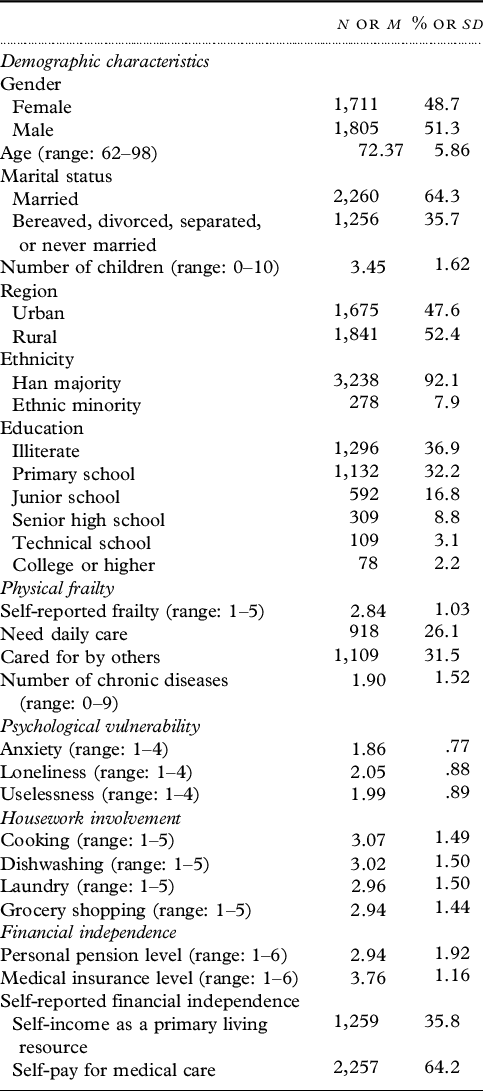
The average age of respondents was 72.37 years (SD = 5.86), with a range of 62–98. Slightly more than half (51.3%) were male, 64.3% were married, 47.6% came from urban areas of China, 7.9% had an ethnic minority background, and 36.9% reported illiteracy. The demographic characteristics of the current sample are summarized in Table 1.
Descriptive statistics of analytic variables (N = 3516)

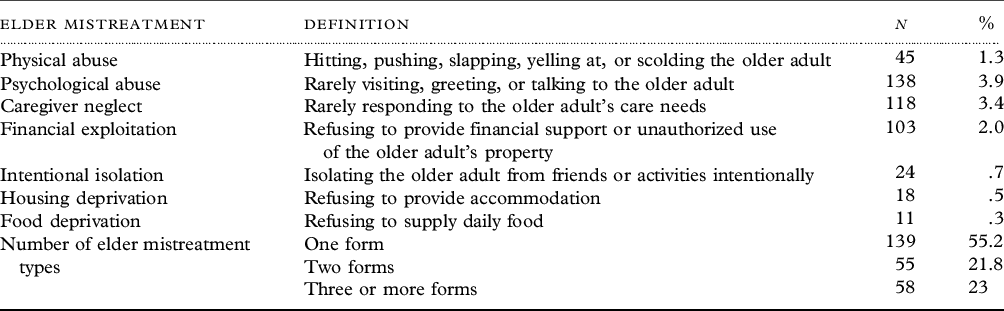
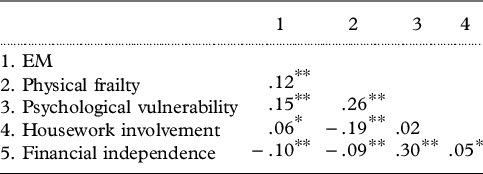
As presented in Table 2, 4% of respondents in the current sample reported having experienced abuse or neglect in the previous 12 months, with subtypes ranging from .3% to 3.9%. Psychological abuse was the most common form, accounting for 3.9%, followed by caregiver neglect (3.4%), financial exploitation (2.0%), and physical abuse (1.3%). The prevalence rates of intentional isolation, housing deprivation, and food deprivation were .7%, .5%, and .3%, respectively. The coexistence of multiple forms of EM was very common. Of the victims, 21.8% suffered two forms at the same time, whereas 23% suffered three or more forms. Table 3 provides a correlation matrix summarizing bivariate correlations between the main variables.
Past-year prevalence and forms of EM (N = 3516)

Bivariate correlations of key variables

*p < .01. **p < .001.
Test of measurement model
The measurement model of the latent constructs was evaluated first. Although the χ2 value was large and significant (χ 2 = 1,535.94, df = 194, p < .001) due to its sensitivity to the large sample size, other goodness of fit indexes demonstrated satisfactory results (CFI = .958, RMSEA = .044), which suggests that measurement model had a good fit (Hu and Bentler, Reference Hu and Bentler1999). The standardized factor loadings of all indicators for each latent construct are presented (see Table S1 published as supplementary material online).
Test of structural model
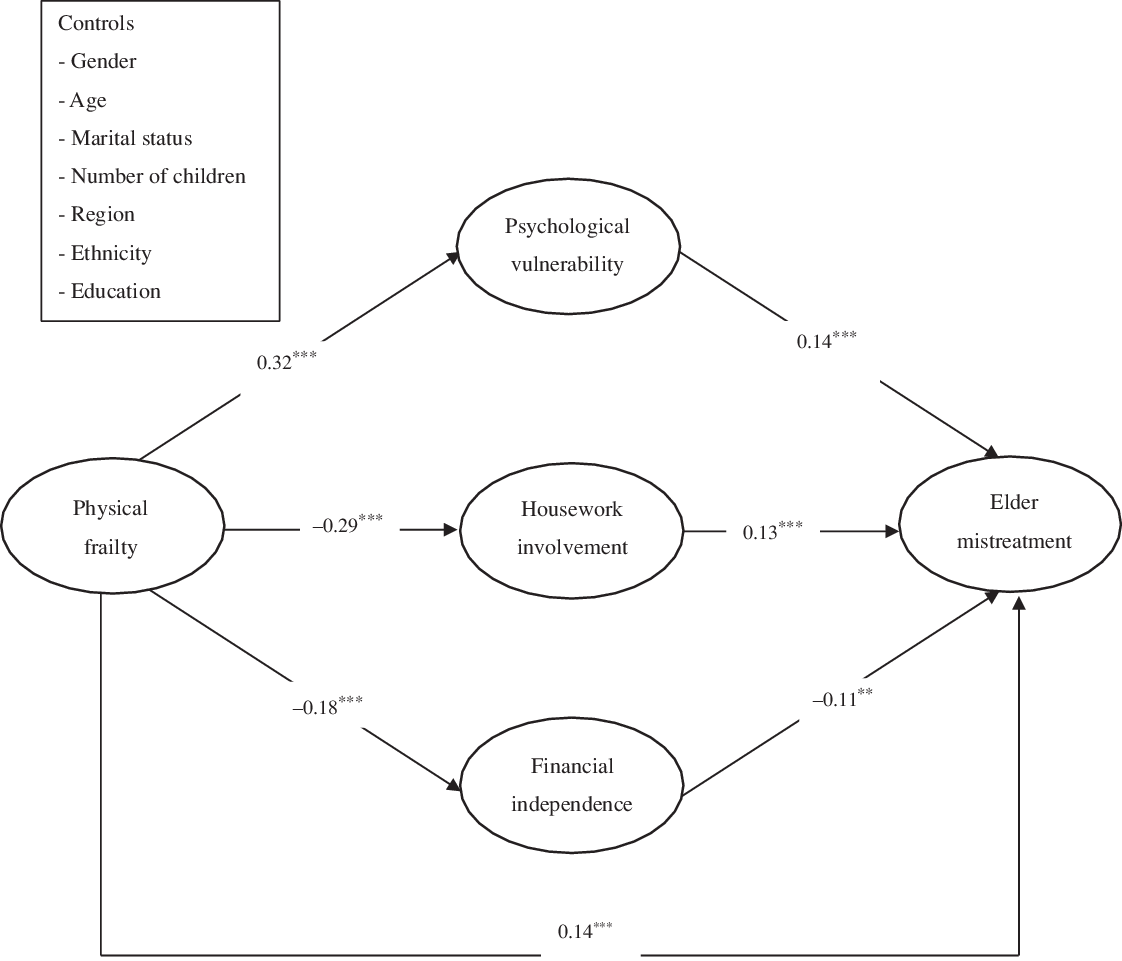
Figure 1 presents the standardized solutions of the structural model. The final test of the hypothesized structural model based on the total sample showed that it provided a good fit to the observed data (χ 2 = 3,030.734, df = 330, p < .001, CFI = .932, RMSEA = .048). The model explained 6.3% of the variance in EM.
Standardized solutions for the structural model of physical frailty effects on the EM of Chinese older adults. The control variables (gender, age, marital status, number of children, region, ethnicity, and education) were included in the analysis, but are not presented in Figure 1 for clarity. Model fit indexes: χ 2 = 3,030.734, df = 330, p < .001, CFI = .932, RMSEA = .048. *p < .05. **p < .01. ***p < .001.

Physical frailty had a significant direct effect on EM, with higher levels of physical frailty predicting a higher risk of being abused (β = .14, p < .001). Higher levels of physical frailty were significantly associated with lower levels of housework involvement (β = −.29, p < .001), which further correlated with increased risk of EM. Higher levels of physical frailty were also positively correlated with psychological vulnerability, which generated an increased risk of elder abuse (β = .14, p < .001). Older adults with higher levels of physical frailty were significantly more likely to have lower levels of financial independence, which in turn, surprisingly predicted a lower probability of EM (β = −.11, p < .01). The results demonstrate that the effects of physical frailty on EM were mediated by the impacts of psychological vulnerability, housework involvement, and financial independence, despite the unexpected direction of financial independence. The mediating effects of the three mediators were further clarified by the results of the bootstrapping estimation (Table 4). Significant indirect effects were found between EM and psychological vulnerability (β = .013, 95% CI = .007, .019, p < .001), housework involvement (β = −.011, 95% CI = −.016, −.006, p < .001), and financial independence (β = .006, 95% CI = .001, .012, p < .001).
Standardized direct, indirect, and total effects of major predictor variables of EM

*p < .05. **p < .001.
Discussion
Despite its public health significance, EM is largely a hidden problem, and in China, our knowledge of EM is still in its infancy. This study provided unique contributions to the literature by examining the prevalence of EM and its subtypes with a national survey in China. We are not aware of any literature exploring the mechanism underlying the effects of physical frailty on EM. We demonstrated that physical frailty is positively associated with the risk of EM and offered insight into the mediating effects of psychological vulnerability, housework involvement, and financial independence.
Regarding the prevalence of EM, our study extended prior research in two ways. First, previous studies conducted in China have been based on small samples from one city or province of China: Dong et al. (Reference Dong, Simon, Odwazny and Gorbien2008, Reference Dong, Beck and Simon2010) studied a major urban medical center in Nanjing, whereas Wu et al. (Reference Wu, Chen, Hu, Xiang, Yu, Zhang, Cao and Wang2012) focused on three rural communities in Macheng. Regrettably, the results from such clinical or community settings could not be representative of all populations of China with cultural and ethnic diversity. Our research, thus, represents an important contribution to cumulative knowledge by adopting a nationally representative sample. It should also be noted that the present report indicated that the prevalence of EM was 4%, which is much lower than rates found in early studies: 35% reported by Dong et al. (Reference Dong, Simon, Odwazny and Gorbien2008, Reference Dong, Beck and Simon2010) and 36.2% reported by Wu et al. (Reference Wu, Chen, Hu, Xiang, Yu, Zhang, Cao and Wang2012). This discrepancy echoes the findings of a systematic review of EM in Asian countries, which suggested that studies relying on unrepresentative samples generally report much higher rates compared with those with representative samples, resulting from their small sizes and biased characteristics (Yan et al., Reference Yan, Chan and Tiwari2015). Second, building on prior Western studies, this study is the first to demonstrate that EM and four of its five major subtypes exist in the Chinese population. The current study found that psychological abuse (3.9%) and caregiver neglect (3.4%) were more common, which is consistent with existing evidence in China (Wu et al., Reference Wu, Chen, Hu, Xiang, Yu, Zhang, Cao and Wang2012), yet contrasts with the observation of financial exploitation being the most common EM subtype among Chinese older adults in Chicago (Dong, Reference Dong2014). This may result from the fact that Chinese older adults who live in China or the USA may be subjected to different cultural dynamics, which may affect the rates of EM. Additionally, we further identified three culturally specific EM subtypes in the Chinese population: intentional isolation (.7%), housing deprivation (.5%), and food deprivation (.3%), which are unrecognized in Western research and strongly violate Confucian traditions of filial piety.
Consistent with the literature (e.g. Lai, Reference Lai2011; Yan and Tang, Reference Yan and Tang2004), our findings indicate that the rate of EM is higher among older persons with physical frailty. With an SEM analysis, the present study confirmed that a higher level of physical frailty had a direct influence on EM. As Joshi and Flaherty (Reference Joshi and Flaherty2005) pointed out, older adults who need daily care are often physically impaired, which makes them heavily dependent on caregivers. One cross-sectional study of 183 caregivers in Taiwan also indicated that when dealing with highly dependent older adults, caregivers may demonstrate abusive behavior (Wang et al., Reference Wang, Lin, Tseng and Chang2009).
Furthermore, this study advanced prior studies by demonstrating that three psychosocial variables partially mediated the pathway from physical frailty to EM.
First, our study confirmed that physical frailty was significantly associated with increased psychological vulnerability of older adults, which was related to an increased likelihood of EM (supporting Hypothesis 1). Previous studies have mostly examined lower levels of psychosocial well-being as risk factors associated with EM directly (Dong et al., Reference Dong, Simon, Odwazny and Gorbien2008; Yan and Chan, Reference Yan and Chan2012); less is known regarding its effect as a mediator. Participants in our sample reported mean scores of 1.86, 2.05, and 1.99 on anxiety, loneliness, and uselessness, respectively, which equates to a response of “sometimes” in the questionnaire, suggesting psychological vulnerability is common among Chinese older adults but varies by physical status. In other words, frail older adults were more psychologically vulnerable than their counterparts. Meanwhile, based on SEM analysis, the findings demonstrate a significant mediating effect of psychological vulnerability on the association between physical frailty and EM.
Second, this research added to previous research by introducing housework involvement as a mediator in the mechanism of how physical frailty is related to EM (supporting Hypothesis 2). The significant mediating role of housework involvement provided empirical support for the argument of Dowd (Reference Dowd1975), who viewed aging as an exchange: As increased age implies declining resources, older adults become increasingly unable to enter balanced exchange relations with other people. It also aligns with the literature on intergenerational exchange in China that focuses on how support from adult children is affected by parent-to-child transfers (Cong and Silverstein, Reference Cong and Silverstein2011; Sun, Reference Sun2002). In the EM-related context, this study advanced the literature by highlighting the decline of housework involvement that Chinese older adults experience as their level of frailty increases and related pathways that make them vulnerable to potential perpetrators.
Third, the analysis demonstrated that frail Chinese older adults are less likely to have financial independence, yet unexpectedly, this contributed to a lower risk of EM (violating Hypothesis 3). Previous findings indicated that financial strain is positively associated with EM (Sebastian and Sekher, Reference Sebastian and Sekher2011). This counterintuitive finding might offer insight into the impacts of Chinese culture on our global understanding of EM’s occurrence. One plausible explanation is that unlike Western countries, where comprehensive social protection systems for older adults are well established, it is an ironclad cultural norm for Chinese families, especially adult children, to take responsibility for providing care to their older parents. Consequently, when frail older adults become increasingly financially strained, it is widely accepted that Chinese adult children will provide financial support to their parents. Although the decline of Confucian traditions has raised concerns about the family function in eldercare in contemporary China (Tam and Neysmith, Reference Tam and Neysmith2006), our finding implies that the value of filial piety might still provide protective functions against the effects of physical frailty on EM.
Although we have addressed part of the knowledge gap in this domain, several limitations are worthy of discussion. First, it is documented that the Chinese older adults are less likely to disclose incidents of EM (Yan and Tang, Reference Yan and Tang2001). Therefore, despite adopting a national representative sample, our study might still have underestimated the occurrence of EM. Second, although the mediational role of the three variables was supported by the data, the effect sizes were small and thus, a large amount of the variance in EM remained unexplained. This may be because EM is a complex problem with multiple causes, and the limitations of secondary data prohibited us from querying about other mediators, including caregiver burden. Thus, future research is needed to corroborate our findings regarding the mediation hypothesis of how EM occurs. Third, because we needed to use the limited available items to construct variables for analysis, studies with validated measurements are warranted to further test the theoretical model. Fourth, the complex design features of stratified multistage sampling may have a limitation as we conducted an SEM analysis through AMOS, which is unable to compute weighted estimates and incorporate the stratum codes into the variance estimation. Thus, in order to make a more accurate estimation, it is necessary to conduct further studies that take the analytic error into account. Last, given that our investigation used cross-sectional data, longitudinal data are necessary to establish the validity of temporal relationships and rule out potential bias.
Our study offers several practice and policy implications. First, this study reported that EM does exist among Chinese older adults nationwide; thus, even though Confucian principles of filial piety and respect for the older adults are highly regarded in the Chinese tradition, it is important for practitioners not to assume that their service users are exempt from EM. Second, the direct effects of physical frailty on EM indicate a need to encourage interventions that prevent or reduce the level of physical frailty among older adults, including enhancing healthcare resources in the community. Third, despite the small effect sizes, psychological vulnerability and housework involvement still significantly mediated the effects of physical frailty on EM and are amenable to change. Thus, we suggest frontline practitioners consider providing mental health promotion activities and psychological counseling for frail older adults. Besides, community organizations should exert effort to enhance resources of the formal support system, such as homemaker services and home health aides. Fourth, it is worth noting that the dominance of stigma could be a key reason why many incidents of EM go unreported; thus, assessment of EM in community settings might help identify frail older adults at higher risk. Special efforts by community organizations must be made to introduce available screening instruments to frontline practitioners such as the Conflict Tactic Scales and the Hwalek-Sengstock Elder Abuse Screening Test (see Dong, Reference Dong2015 for a systematic review).
In conclusion, this study provided the first evidence of the prevalence of EM and its subtypes among Chinese older adults and expanded the global understanding of EM by examining the mediating role of three psychosocial variables – psychological vulnerability, housework involvement, and financial independence – in the pathway from physical frailty to increased risk of EM. We encourage future studies to corroborate our findings and identify factors contributing to the complex mechanism of EM.
Conflict of interest
None.
Funding
The study was partially funded by the Major Program of the National Natural Science Foundation of China [Grant No. 71490733] and the Shanghai Municipal Education Commission Research and Innovation Project [Grant No. E00026]. The first funding supported the team to access the data and both funding partially supported the data analysis procedures of the paper.
Description of author’s roles
Dr. Yunjun Li conducted major data analysis and Dr. Honglin Chen composed the research question and conceptual framework. Dr. Peng made comprehensive revisions to the paper. Both Dr. Li and Dr. Chen made the draft of the manuscript and contributed to the revision.
Supplementary material
To view supplementary material for this article, please visit https://doi.org/10.1017/S1041610221000739.