Introduction
Borderline personality disorder (BPD) is a serious, debilitating and potentially lethal disorder that is associated with significant emotional suffering (APA, 1994). BPD is partly characterized by impairments in interpersonal appraisals that are posited to form the bases of severe interpersonal instability (e.g. expectations of abandonment and extreme positive and negative views of significant others). These appraisals can interfere with treatment engagement and prompt suicidal and self-injurious behaviors (Brodsky et al. Reference Brodsky, Groves, Oquendo, Mann and Stanley2006). Consequently, interpersonal attributions (Fonagy et al. Reference Fonagy, Leigh, Steele, Steele, Kennedy, Mattoon, Target and Gerber1996; Clarkin & Levy, Reference Clarkin and Levy2006), cognitions and schemas (Young, Reference Young1999), and judgments (Linehan, Reference Linehan1993) are key targets of intervention in several efficacious psychotherapeutic treatments for BPD. Despite these interpersonal impairments, clinicians have also observed the capacity in many individuals with BPD to very perceptively recognize emotional expressions in others (Krohn, Reference Krohn1974; Carter & Rinsley, Reference Carter and Rinsley1977), and there is some empirical support for these clinical observations (Lynch et al. Reference Lynch, Rosenthal, Kosson, Cheavens, Lejuez and Blair2006; Domes et al. Reference Domes, Czieschnek, Weidler, Berger, Fast and Herpertz2008; Flury et al. Reference Flury, Ickes and Schweinle2008). Indeed, Krohn (Reference Krohn1974) labeled the apparent contradiction between impaired interpersonal relations and enhanced emotional sensitivity as a ‘paradox’ specific to borderline psychopathology.
The most common assessment used thus far is facial emotion recognition (FER), which assesses the accuracy of the perception of emotion expressed in human faces. Human faces are a rich source of information regarding subjective emotional states and social communication (Ekman et al. Reference Ekman, Sorenson and Friesen1969). There have been several studies of FER in BPD and they have yielded contradictory findings. These studies can be divided into three types, documenting impaired, comparable, and enhanced FER accuracy in BPD, as summarized below.
Two studies of FER in BPD found that individuals with BPD are less accurate than healthy controls (HCs) in negative FER. Both studies used the Pictures of Facial Affect (PFA) measure developed by Ekman et al. (Reference Ekman, Sorenson and Friesen1969). Bland et al. (Reference Bland, Williams, Scharer, Manning, Bland and Bland2004) found that individuals with BPD were specifically less accurate than HCs in identifying three negative facial emotions: anger, disgust, and sadness. There were no differences in FER of positive emotions. Similarly, Levine et al. (Reference Levine, Marziali and Hood1997) reported that BPD participants were less accurate in identifying anger, fear, and disgust on the PFA, but that there were no differences in FER of other emotions compared with their HC group.
Other studies indicate that FER in BPD is not significantly different than in HCs, but that individuals with BPD may exhibit a negativity bias in the appraisal of neutral or ambiguous faces (Meyer et al. Reference Meyer, Pilkonis and Beevers2004; Murphy, Reference Murphy2006; Domes et al. Reference Domes, Czieschnek, Weidler, Berger, Fast and Herpertz2008). In addition, Minzenberg et al. (Reference Minzenberg, Poole and Vinogradov2006a) found that individuals with BPD have poorer performance than HCs when appraising emotional stimuli across multiple modalities (e.g. facial and vocal emotional expressions). This finding suggests that, as social appraisals become more multifaceted, individuals with BPD begin to evidence impairments. Finally, a perceived threat in the ambiguity of neutral expressions in BPD is in accord with a recent functional magnetic resonance imaging (fMRI) investigation that found greater amygdala activation in BPD relative to HCs when viewing faces, particularly those of a neutral valence (Donegan et al. Reference Donegan, Sanislow, Blumberg, Fulbright, Lacadie, Skudlarski, Gore, Olson, McGlashan and Wexler2003).
However, other studies of FER in BPD indicate enhanced accuracy in FER relative to HCs (Wagner & Linehan, Reference Wagner and Linehan1999; Lynch et al. Reference Lynch, Rosenthal, Kosson, Cheavens, Lejuez and Blair2006). In the study by Lynch et al. (Reference Lynch, Rosenthal, Kosson, Cheavens, Lejuez and Blair2006), BPD and HC participants were shown faces that morphed from neutral to maximum intensity emotional expressions. The BPD group accurately appraised FER at an earlier stage across all emotional expressions compared to HCs. Wagner & Linehan (Reference Wagner and Linehan1999) found that individuals with BPD were primarily accurate appraisers of others' emotions and evidenced an enhanced sensitivity in the FER of fear faces compared to HCs. Of note, the BPD group was less accurate than the HC group in identifying neutral facial expressions, perhaps consistent with the negativity bias. One study (Domes et al. Reference Domes, Czieschnek, Weidler, Berger, Fast and Herpertz2008) assessed the capacity to learn, by improvements in accuracy over time, the emotional expression of morphed faces that were shown to participants on three consecutive trials. Individuals with BPD improved their accuracy in FER over the consecutive trials to a greater degree than HCs.
There are several possible methodological explanations for these inconsistencies. These include the timing of the face presentation, type of facial stimuli used (e.g. Ekman versus another set of stimuli), reaction time, the subtlety of emotional expression of faces, and the integration of emotional stimuli across modalities varied across studies. There has also been inconsistent attention given to potentially confounding factors such as education level, source of patient recruitment (treatment seeking versus community based; in-patient versus out-patient), intelligence levels, co-occurring psychiatric disorders, medication status, and state levels of anxiety and other emotions and mood states, all of which may influence emotion and mental state appraisals.
In an attempt to identify factors that may clarify the bases for these contradictory findings, we sought to extend prior studies of FER in BPD by using a measure of the capacity to make subtle discriminations of the mental states of others. There are few social cognitive tests that are designed to measure subtle deficits in mental state discrimination in otherwise normally intelligent adults. The ‘Reading the Mind in the Eyes Test’ (RMET; Baron-Cohen et al. Reference Baron-Cohen, Wheelwright, Hill, Raste and Plumb2001) was developed for this purpose. The RMET differs from other FER paradigms in that it assesses the capacity to discriminate the mental states of others using only stimuli from the eye region of the face by choosing the most accurate mental state from one of four mental state words. In addition, the mental state discriminations were developed based on a consensus of independent judges rather than the analysis of the expressions in the eyes by emotion coding systems (for a description of the development of the RMET, see Baron-Cohen et al. Reference Baron-Cohen, Wheelwright, Hill, Raste and Plumb2001).
Mental state discrimination is one of at least two dimensions of mentalization (cf. Sabbagh, Reference Sabbagh2004). These two dimensions are: (1) detecting and discriminating social stimuli in the immediate environment (e.g. using facial expression to detect that someone is in a happy state of mind) and (2) making inferences, or reasoning, about those stimuli (e.g. detecting that someone is happy because they needed money and won the lottery). The RMET is a measure of the first ‘discrimination’ aspect of mentalization, but not the second. Consequently, the RMET does share some conceptual overlap with other measures of FER, such as the Ekman coding systems, as they both assess the detection of social stimuli in the immediate environment.
Investigating mental state discrimination performance based on the eye region of the face is in line with several previous studies that indicate that the eyes alone are a crucial feature of social and emotional processing (Baron-Cohen et al. Reference Baron-Cohen, Wheelwright and Jolliffe1997; Morris et al. Reference Morris, deBonis and Dolan2002; Adolphs et al. Reference Adolphs, Baron-Cohen and Tranel2002; Dadds et al. Reference Dadds, Perry, Hawes, Merz, Riddell, Haines, Solak and Abeygunawardane2006). For example, Adolphs et al. (Reference Adolphs, Baron-Cohen and Tranel2002) and Dadds et al. (Reference Dadds, Perry, Hawes, Merz, Riddell, Haines, Solak and Abeygunawardane2006) found that poor recognition of fearful facial expressions in people with amygdala damage and in those with psychopathic traits could be attributed to lack of attention to the eyes. Baron-Cohen et al. (Reference Baron-Cohen, Wheelwright and Jolliffe1997) found that the eye region conveyed informative cues of complex mental states (i.e. scheme, admire, interest, thoughtfulness, etc.) comparable to the whole face. Morris et al. (Reference Morris, deBonis and Dolan2002) found that appraising fearful eyes alone produced better performance than seeing the mouth alone, and that the eye region was as sufficient as the whole face to evoke increased human amygdala activity.
Using the RMET to assess subtle FER discriminations, we evaluate two competing hypotheses that emerge in both the research and clinical literature. First is the BPD ‘paradox’ (Krohn, Reference Krohn1974) hypothesis, wherein individuals with BPD exhibit enhanced mental state discrimination in the context of their relatively impaired interpersonal relationships. Support for this hypothesis would be that individuals with BPD perform better than controls when making subtle mental state discriminations based on the eye region of the face. Second, some research and clinical theories (Kernberg, Reference Kernberg1967; Fonagy, Reference Fonagy, Leigh, Steele, Steele, Kennedy, Mattoon, Target and Gerber1996; Young, Reference Young1999) suggest a fundamental impairment in mental state discrimination in BPD, which may account for the basis of interpersonal difficulties. We evaluate whether the RMET can uncover a deficit in mental state discriminations by using a more subtle measure of this social cognitive capacity than has been used in prior studies. In evaluating these hypotheses, we also address several potentially confounding variables that have not been adequately addressed in most prior studies, including demographic factors (age, education, and ethnicity/race), severity of depression, state levels of emotional arousal, medication status, abuse history status, and co-occurring post-traumatic stress disorder (PTSD) and major depression. Finally, we explore the specificity of mental state discrimination performance by comparing BPD status to other personality disorder (PD) features.
Method
Participants
Participants between the ages of 18 and 55 years who met DSM-IV criteria for BPD and were recruited through a large, metropolitan hospital as part of ongoing clinical studies in mood disorders, suicidal behavior, and BPD. HC participants between the ages of 18 and 55 years were recruited through both the Psychiatric Institute (through advertisements) and a large, public, metropolitan University's Psychology Department participant pool. The Institutional Review Boards of both institutions approved the study. All participants were informed about the risks and benefits of participation, and all provided written consent. Exclusion criteria for the BPD group were bipolar I disorder, schizophrenia and other psychotic disorders, mental retardation, history of severe head trauma, or other cognitive impairment that might interfere with the accuracy assessments or competency to give informed consent. All BPD participants were free of neurological disease as determined by clinical history and examination.
HCs were excluded if they exhibited evidence of current or past Axis I or II psychiatric or substance use disorder. HC adults were matched with the BPD group on race/ethnicity, age, and education level. HCs were also screened for BPD features with the SCID-II screener (see below). Of the 14 screener items for BPD, the modal number of criteria endorsed by the HC group was zero (n=12), and the mean was 1.6 and standard deviation (s.d.) 2.0. There were no HCs with a BPD screener score of 7 or more of the 14 total BPD screener items, which would suggest a positive BPD diagnosis.
Demographic information
A questionnaire was administered to obtain age, gender, race, education level, and marital status.
Clinical assessment
For individuals with BPD, diagnoses were determined by the Structured Clinical Interview for DSM-IV, Patient Edition (SCID-I; Spitzer et al. Reference Spitzer, Williams, Gibbon and First1990) and the Structured Clinical Interview for DSM-IV Axis II Personality Disorders (SCID-II; First et al. Reference First, Spitzer, Gibbon, Williams and Benjamin1995). Recent reliability studies within our research division yielded the following intra-class correlation coefficients (ICCs) (criterion levels are shown in parentheses): Axis I diagnosis/SCID-I, ICC=0.80 (0.70); Axis II diagnosis/SCID-II, ICC=0.70 (0.70); BPD diagnosis, ICC=0.89 (0.70).
Measures
Mental state discrimination
The RMET (Baron-Cohen et al. Reference Baron-Cohen, Wheelwright, Hill, Raste and Plumb2001) measure presents participants with 36 black-and-white photographs of the area of the face including and immediately surrounding the eyes. All photographs are of equal size (15 cm×6 cm). Participants are asked to choose one of four words (three distracter words and one correct word) that describe the mental state of the person in the photograph. Participants are provided with a glossary, which contains the meaning of words describing mental states. If necessary, the glossary can be used during the assessment. The eyes and the surrounding areas can provide a substantial amount of emotional cues (Kleinke, Reference Kleinke1986), but are difficult to interpret when separated from the entire facial expression (Ekman & Friesen, Reference Ekman and Friesen1978; Harkness et al. Reference Harkness, Sabbagh, Jacobson, Chowdrey and Chen2005). Scores are calculated as the total number of correct discriminations for all 36 items. Mental state valence subscores were also computed using the same algorithms used by Harkness et al. (Reference Harkness, Sabbagh, Jacobson, Chowdrey and Chen2005) to identify RMET for faces with positive (eight items), negative (12 items), and neutral mental state valences (16 items). Every participant evaluated the same set of RMET stimuli in the same sequence, according to the instructions of Baron-Cohen et al. (Reference Baron-Cohen, Wheelwright, Hill, Raste and Plumb2001).
PD features
The severity of Axis II PD features in both groups was assessed with the screener section of SCID-II (First et al. Reference First, Spitzer, Gibbon, Williams and Benjamin1995).
State affect
The Profile of Mood States (POMS; Lorr & McNair, Reference Lorr and McNair1982) is a 65-item questionnaire that measures general negative affect, including confusion, depression, tension, vigor and fatigue (α=0.95).
Depression
Depression severity was rated with the Beck Depression Inventory (BDI; Beck & Steer, Reference Beck and Steer1993; see Table 1). For the general population, a score of ⩾21 is typical for individuals with major depression. Abuse history was assessed as part of the demographic interview, which asks participants to answer yes or no as to whether they have or have not experienced physical and/or sexual abuse before age 18.
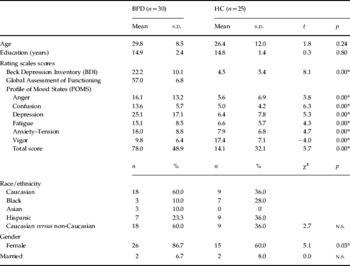
Demographic and clinical characteristics of BPD versus HC

BPD, Borderline personality disorder; HC, healthy controls; s.d., standard deviation; n.s., not significant.
n=53 for the BDI and POMS because of missing data from two participants (one BPD and one HC).
* p<0.05, all two-tailed tests.
Results
Demographic and clinical comparisons
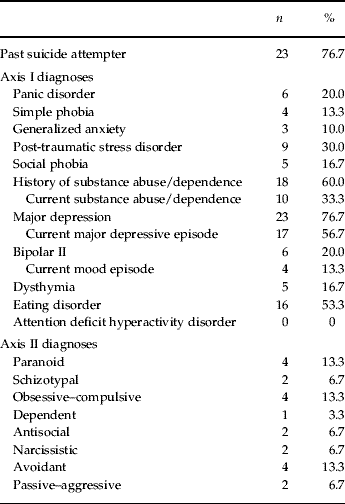
There were no significant differences between the BPD and HC groups on any demographic variables with the exception of sex (see Table 1). The BPD group was 86.7% female and the HC group 60% female (χ2=5.1, p<0.05). As is typical of clinically ascertained BPD samples, the individuals with BPD frequently exhibited co-occurring diagnoses such as major depression (76.7%), and the group was predominantly composed of those who had made a prior suicide attempt (76.7%; see Table 2).
Co-occurring diagnoses in the BPD group

Comparisons between BPD and HCs on RMET
We inspected the RMET for evidence of outliers. We excluded from our analyses two (one BPD and on HC) of the original 55 participants who had RMET scores of 11 and 12 Total Correct. Both scores were >3 s.d. below the mean for the combined sample (mean=26.91, s.d.=3.8).
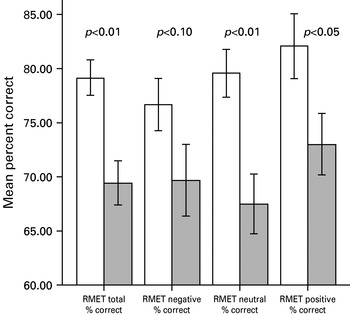
ANOVAs (two-tailed) indicated that the BPD group performed significantly better than the HC group on Total RMET Correct [BPD: n=30, mean=28.50, s.d.=3.3; HC: n=25 mean=25.00, s.d.=3.63; F(1, 54)=14.43, p<0.001] and on the Neutral [BPD: mean=12.73, s.d.=1.95; HC: mean=10.8, s.d.=2.24; F(1, 54)=11.75, p<0.001] and Positive RMET subscales [BPD: mean=6.57, s.d.=1.31; HC: mean=5.84, s.d.=1.14; F(1, 54)=4.73, p<0.05]. There was also a trend towards better performance in Negative RMET in the BPD group [BPD: mean=9.20, s.d.=1.58; HC: mean=8.36, s.d.=2.00; F(1, 54)=3.03, p=0.09]. We used Cohen's d (Cohen, Reference Cohen1988) as an index of effect size, or the magnitude of the significant group differences. Total RMET (d=1.02) and Neutral RMET (d=0.92) were both in the ‘large’ range by conventional standards. Positive RMET (d=0.59) is in the ‘medium’ range by the same standards. Fig. 1 illustrates these findings transformed into the percentage of correct RMET responses for the mental state total and subscales in the BPD and HC groups.
Accuracy of the Reading the Mind in the Eyes Test (RMET) in borderline personality disorder (BPD, □) (n=30) compared to healthy controls (HC,  ) (n=25). Error bars indicate standard error of the mean.

Specificity of BPD status as a predictor of RMET performance
Initially, a stepwise regression using RMET Total scores on the nine other PD feature scores, excluding BPD features, was used to identify whether any other PD features contribute to RMET performance. Obsessive–compulsive (β=0.48, t=1.9, p<0.06) and avoidant PD features (β=0.42, t=1.7, p<0.09) each predicted RMET performance at the trend level in this regression. Next, a backward stepwise regression was conducted using all 10 of the PD features variables and a removal criterion of p=0.15. As the BPD features variable had a bimodal distribution clustered around group (BPD and HC), we instead used group status as the BPD predictor. In this second regression, the previously significant PD features variables dropped out (obsessive–compulsive and avoidant), and only group status remained as a significant predictor of RMET performance (β=0.35, F=12.23, p<0.001).
Correlations between POMS (emotional state), depression severity, and RMET
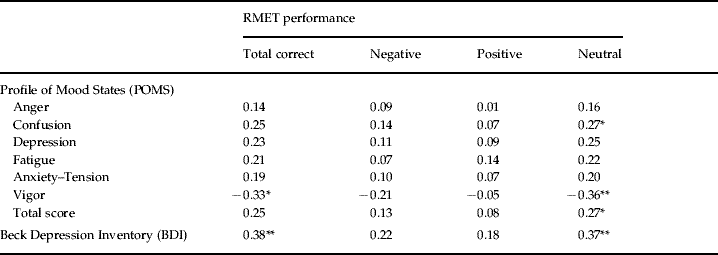
We evaluated the impact of emotional state on RMET performance with Pearson r correlations between POMS scores and RMET performance. Table 3 indicates that ‘Vigor’ was negatively correlated with Total RMET performance, but none of the other subscales were associated with RMET Total. Performance on the Neutral RMET was associated with ‘Confusion’ and ‘Vigor’. Finally, the BDI was significantly associated with better RMET performance, indicating that greater depressive symptoms are also associated with enhanced mental state discrimination.
Correlations in the combined sample (n=53) between Reading the Mind in the Eyes (RMET) performance, depression severity, and emotional state (POMS)
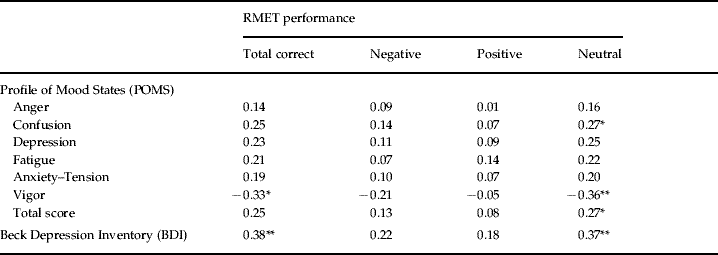
n=53 for the BDI, POMS and SCID-II screener because of missing data from two participants (one with borderline personality disorder and one healthy control).
* p<0.05, ** p<0.01, two-tailed tests.
Analysis of potentially confounding variables
As expected, depression levels as measured by the BDI were higher in the BPD group (see Table 1), and greater BDI scores were associated with better RMET performance. There were also differences in gender distribution and POMS Vigor scores between the groups. To address the possibility that depression severity, POMS Vigor, and sex ratio differences accounted for the differences between BPD and HC in RMET performance, we conducted an ANCOVA controlling for these variables when comparing BPD and HC on RMET performance. In the first ANCOVA, Sex and POMS Vigor score were not significant predictors of RMET performance on any subscale, so were not included in the final ANCOVA. The BDI, however, was significant and was entered as a covariate. Although the significance of the group difference in RMET diminished, the group effect for the RMET Total score remained significant (F=4.8, p<0.05). However, Neutral RMET dropped to trend-level significance (F=3.7, p=0.06), and Positive RMET became non-significant when BDI was added as a covariate.
BPD features (assessed with the SCID-II screener) and the BDI were highly correlated (r=0.72, p<0.001) in this combined sample, and there is a high rate of co-occurrence between depression and BPD in clinically ascertained samples (Zimmerman & Mattia, Reference Zimmerman and Mattia1999). Consequently, the covariation of BDI scores is a particularly conservative statistical test of our group differences because this analysis also covaries out some BPD features that may be inextricably associated with some depressive symptoms. Even with this more conservative approach, depression severity moderates, but does not eliminate, the difference between BPD and HCs in Total RMET performance.
Medication status
In the BPD group, there was no difference in the medicated (n=4) versus non-medicated (n=26) patients in Total RMET (t=−0.66, n.s.), Neutral RMET (t=−0.56, n.s.) or Positive RMET (t=−1.1, n.s.) performance.
PTSD co-occurrence
In the BPD group, the co-occurrence of a PTSD (n=11) versus no PTSD (n=21) diagnosis did not predict Total RMET (t=0.80, n.s.), Neutral RMET (t=−0.69, n.s.), or Positive RMET (t=1.96, n.s.).
Current versus past major depressive episode (MDE)
Current (n=17) versus past MDE (n=13) did not predict Total RMET (t=−0.06, n.s.), Neutral RMET (t=1.0, n.s.) or Positive RMET (t=−1.0, n.s.) performance in the BPD sample.
Abuse history
Self-reported physical or sexual abuse history before age 18 in the BPD group (n=19) versus not abused individuals with BPD (n=11) was not predictive of RMET Total (t=−0.66, n.s.), Neutral RMET (t=−0.56, n.s.) or Positive RMET (t=−1.1, n.s.) performance in the BPD sample.
Discussion
To our knowledge, this is the first study to document enhanced mental state discrimination in BPD focusing only on the eye region. This enhancement could not be accounted for by current emotional state, depression severity, medication status, educational level, co-occurring psychiatric disorders, abuse history, or demographic factors. With regard to the valence of mental state discrimination, individuals with BPD performed better than HCs for both ‘neutral’ and ‘positive’ expressions, but outperformed HCs on ‘negative’ expressions only at the trend level. After controlling for depression severity, Total RMET remained significant, Positive RMET was non-significant, and Neutral RMET nearly significant (p=0.06), indicating that depression partially mediates the relationship between RMET and BPD status.
Our results are concordant with those of Lynch et al. (Reference Lynch, Rosenthal, Kosson, Cheavens, Lejuez and Blair2006), who reported heightened sensitivity to facial emotion using a facial morphing procedure. Our findings are partially consistent with Wagner & Linehan (Reference Wagner and Linehan1999), who found that individuals with BPD evidenced enhanced sensitivity in the FER of fear only. In addition, Domes et al. (Reference Domes, Czieschnek, Weidler, Berger, Fast and Herpertz2008) reported that, as faces became more familiar over time in an FER task, accuracy improved to a greater degree in BPD compared to HC. By contrast, our findings are inconsistent with the studies that found that individuals with BPD are impaired (Levine et al. Reference Levine, Marziali and Hood1997; Bland et al. Reference Bland, Williams, Scharer, Manning, Bland and Bland2004; Minzenberg et al. Reference Minzenberg, Poole and Vinogradov2006b) or are comparable to HCs in FER (Murphy, Reference Murphy2006).
Because of the possibility that poor performance in our HC group influenced group differences, we compared our results with others in the literature. As there are no published psychometric norms for the RMET, we reviewed previous published studies that used the same version of the RMET and identified the mean percentage correct responses for HC groups in six separate studies (Baron-Cohen et al. Reference Baron-Cohen, Wheelwright, Hill, Raste and Plumb2001; Richell et al. Reference Richell, Mitchell, Newman, Leonard, Baron-Cohen and Blair2003; Kelemen et al. Reference Kelemen, Keri, Must, Benedek and Janka2004; Harkness et al. Reference Harkness, Sabbagh, Jacobson, Chowdrey and Chen2005; Lee et al. Reference Lee, Harkness, Sabbagh and Jacobson2005; Domes et al. Reference Domes, Heinrichs, Michel, Berger and Herpertz2007). Across these six studies the mean percentage correct for an HC group was 73.1%. This overall mean and all of the individual study means are comparable to our mean of 69.4% Total RMET correct in our HC group (one-sample t test at 95% confidence interval: t=−1.8, p=0.08, n.s., two-tailed). Although our HC group seems to fall at the lower end of the range when compared to these other studies, our overall mean is not significantly different from them. This suggests that our findings are probably not attributable to a poorly performing HC group.
RMET performance in other disorders
Depression and dysphoria
Previous studies suggest that dysphoria in non-clinical samples and clinical major depressive disorder exhibit divergent RMET profiles. Lee et al. (Reference Lee, Harkness, Sabbagh and Jacobson2005) compared women with severe and moderate forms of major depressive disorder to HCs on the RMET and found that both depressed groups performed equally, and were significantly poorer in RMET performance than HCs. By contrast, Harkness et al. (Reference Harkness, Sabbagh, Jacobson, Chowdrey and Chen2005) investigated RMET in dysphoric college undergraduates, and used the BDI as an index of dysphoria. Contrary to Lee et al.'s (Reference Lee, Harkness, Sabbagh and Jacobson2005) findings, college students with dysphoria were more accurate on the emotional sensitivity task than non-dysphoric students.
Depressed mood is common in BPD, but may differ in quality (Wixom et al. Reference Wixom, Ludolph and Westen1993) and intensity (Stanley & Wilson, Reference Stanley and Wilson2006) from major depression without BPD. For instance, rumination (cf. Nolen-Hoeksema, Reference Nolen-Hoeksema2000) over how one is perceived by others may characterize BPD to a greater degree than major depression alone. As RMET performance in BPD and also in dysphoric undergraduates was elevated relative to HCs, our results suggest that depressed and dysphoric mood in BPD may be more concordant with non-clinical dysphoria than depressed mood in major depressive disorder. We speculate that dysphoria outside the context of an MDE may share with BPD an attempt to gain control and understanding of social surroundings. As total RMET remains significant higher in BPD after controlling for BDI severity, however, BPD status may be associated with an even more enhanced attunement to moment-to-moment mental states of others.
Autism and schizophrenia
RMET is impaired in other psychopathological populations such as schizophrenia (Kelemen et al. Reference Kelemen, Keri, Must, Benedek and Janka2004) and autism spectrum disorders (Baron-Cohen et al. Reference Baron-Cohen, Wheelwright, Hill, Raste and Plumb2001), suggesting differing underlying mechanisms than BPD. In particular, many interpersonal difficulties in BPD seem to revolve around a desire for social contact and support, which is often felt as unmet or unavailable. Autistic spectrum disorders and schizophrenia are more often characterized by social withdrawal and anxiety around interpersonal contact. Furthermore, impairments in FER are specifically evident when individuals with autism are presented with only the eye region (Adolphs et al. Reference Adolphs, Baron-Cohen and Tranel2002).
Mental state discrimination and social neuroscience of BPD
Given the reactivity of the human amygdala to social stimuli in a range of clinical populations, enhanced sensitivity for mental states in BPD may be in accordance with the hyperactivity of the amygdala in BPD patients to neutral (Donegan et al. Reference Donegan, Sanislow, Blumberg, Fulbright, Lacadie, Skudlarski, Gore, Olson, McGlashan and Wexler2003) and fearful facial stimuli (Donegan et al. Reference Donegan, Sanislow, Blumberg, Fulbright, Lacadie, Skudlarski, Gore, Olson, McGlashan and Wexler2003; Minzenberg et al. Reference Minzenberg, Fan, New, Tang and Siever2007). Enhanced FER performance in BPD may be related to the greater threat potential accorded mental state stimuli, particularly neutral stimuli, in BPD. We speculate that, for individuals with BPD, there may be particular vigilance and sensitivity to neutral faces as they may represent the most ambiguous potential threat.
Stages of social cognition and person perception in BPD
How can we reconcile enhanced mental state discrimination with the interpersonal problems characteristic of BPD (e.g. frantic efforts to avoid abandonment, polarized views of others)? The correspondence bias model of social cognition (Gilbert & Malone, Reference Gilbert and Malone1995) proposes that individuals engage in four stages of inference when trying to understand the behavior of others. Initially, (a) they bring their prior expectations about people and relationships, which influence their automatic perceptions of interpersonal situations. Next, individuals (b) observe and categorize the other person's momentary behavior in the situation (e.g. they look angry). After the categorization is made, (c) individuals make an attribution about the long-term disposition of that person (e.g. they are a threatening person). Finally, (d) the disposition is modified and corrected based on the ongoing evaluation of the situational forces that may be impacting the person's behavior.
At the initial stage (a) individuals with BPD bring strong expectations that they will be abandoned, rejected and otherwise emotionally hurt by others (Ayduk et al. Reference Ayduk, Zayas, Downey, Cole, Shoda and Mischel2008). Based on our findings, in the second stage (b) we speculate that enhanced accuracy in categorizing the mental states is in the service of constant vigilance to potential rejection and resulting emotional pain that are anticipated by individuals with BPD. For the third stage (c) we theorize that individuals with BPD make rigid and biased dispositional attributions (e.g. that person will hurt me emotionally). In the final stage (d) executive cognitive control (Fertuck et al. Reference Fertuck, Lenzenweger, Clarkin, Hoermann and Stanley2006; Ayduk et al. Reference Ayduk, Zayas, Downey, Cole, Shoda and Mischel2008) and mental state reasoning capacities (Fonagy et al. Reference Fonagy, Leigh, Steele, Steele, Kennedy, Mattoon, Target and Gerber1996; Sabbagh, Reference Sabbagh2004) may be compromised in BPD, so that rigid attributions are not flexibly altered based on further appraisal of the situation. These theoretical speculations argue for further research into these four stages of person perception in BPD.
Limitations
Given the association between RMET and depression severity, a depressed (non-BPD) psychiatric control group would have aided in further clarifying any difference between major depression and BPD in RMET performance. Furthermore, given our speculations regarding attentional resources being predominated by interpersonal cues, the assessment of reaction time in mental state discrimination is a crucial variable. Moreover, our results may be specific to a subgroup of motivated, predominantly treatment-seeking ambulatory BPD patients. A wider spectrum of individuals with BPD at different levels of care, severity, and with varying demographic characteristics would aid in clarifying the generalizability of these findings. Our stimuli were visual, static and non-personally relevant and were evaluated under low stress conditions. It is important to extend this research by using dynamic and personally relevant social stimuli in multiple modalities and differing social contexts and stress levels to identify whether the effect we document here is seen under more ecologically valid conditions. Furthermore, we did not measure ‘empathy’, so it is not clear whether enhanced mental state discrimination translates into increased capacity for perspective taking and emotional understanding of the mental state of others in BPD. Finally, as we did not use a free response format with neutral expression, we could not assess any potential ‘negativity’ bias. Thus, more studies assessing the potential interaction between mental state discrimination enhancement and negativity bias in neutral stimuli are needed.
Conclusions
Our results highlight the eye region of the face as crucial to uncovering enhanced mental state discrimination in BPD. This specific social cognitive enhancement may help us to clarify past conflicting findings of FER in BPD, all of which used the entire face. Under typical (non-stressful) conditions, individuals with BPD seem able to discriminate mental states based on only the eye region of the face, particularly for ‘neutral’ states, consistent with the ‘paradoxical’ theory of social cognition in BPD (Krohn, Reference Krohn1974; Carter & Rinsley, Reference Carter and Rinsley1977), comprising both unstable interpersonal relationships and enhanced sensitivity to the mental states of others.
Acknowledgements
This study was supported in part by grants from the Fund for Psychoanalytic Research through the American Psychoanalytic Association, the American Foundation for Suicide Prevention (AFSP), to E.F. and B.S., the NIMH (K23 MH077044) to E.F. and NIMH (R01 MH061017 and MH62665) to B.S. and NIAAA (P20 AA015630) to B.S. We are indebted to Professor Simon Baron-Cohen for providing the Reading the Mind in the Eyes Test.
Declaration of Interest
None.