Introduction
Associations between growth patterns in early life and the development of non-communicable diseases (NCDs) such as hypertension, stroke, type 2 diabetes, obesity and cardiovascular disease have been reported by numerous studies, mainly from high-income countries.Reference Eriksson, Forsen, Tuomilehto, Osmond and Barker 1 – Reference Osmond, Barker, Winter, Fall and Simmonds 5 The first series of epidemiological studies by Barker et al. suggested a strong link between fetal growth, birth weight and cardiovascular disease in adulthood.Reference Fall, Osmond and Barker 6 , Reference Barker, Martyn, Osmond and Wield 7 One of such studies showed a strong inverse relationship between low birth weight and altered lipid metabolism, a risk marker for cardiovascular disease, in adulthood.Reference Barker, Martyn, Osmond, Hales and Fall 8 Adults who had a small body size (low birth weight and abdominal circumference) at birth presented raised serum concentrations of total and low-density lipoprotein (LDL) cholesterol in adulthood.Reference Barker, Martyn, Osmond, Hales and Fall 8 Serum cholesterol concentrations and LDL cholesterol increased by 0.25 mmol/l (95% confidence interval 0.09–0.42) and 0.26 mmol/l (0.11–0.42), respectively, with each 1-inch decrease in abdominal circumference at birth.Reference Barker, Martyn, Osmond, Hales and Fall 8 Similar results have been reported in other high-income settings,Reference Miura, Nakagawa, Tabata, Morikawa, Nishijo and Kagamimori 9 – Reference Fagerberg, Bondjers and Nilsson 12 however; only a few studies have examined these associations in African populations.Reference Amigo, Bustos and Alvarado 13 – Reference Nair, Nair, Chacko, Zulfikar, George and Sarma 15
Body composition (fat and fat-free mass) has been shown be an independent predictor of cardio-metabolic health in later adult life.Reference Fox, Massaro and Hoffmann 16 , Reference Wiklund, Toss and Weinehall 17 Evidence suggests adults who were low birth weight tend to have a disproportionately high ratio of fat to fat-free mass if they were overweight.Reference Kahn 18 Comparable data from both low and high-income countries that examined the relationships between birth weight and adult body composition showed a positive association between birth weight and later fat-free mass but a weak or non-significant association with later fat mass.Reference Hediger, Overpeck, Kuczmarski, McGlynn, Maurer and Davis 19 – Reference Wells, Chomtho and Fewtrell 22
A number of studies showed positive associations between early postnatal growth patterns and later cardio-metabolic disease risk in pre-pubertal children. A study in a Dutch population showed that a rapid weight gain in the first year of life was negatively associated with risk factors such as insulin sensitivity, serum high-density lipoprotein (HDL) cholesterol and was positively associated with level of triglycerides in early adulthood. Furthermore, rapid weight gain during the first 3 months of life resulted in a higher percentage of body fat, more central adiposity and reduced insulin sensitivity in early adulthood (21 years) than when slower weight gain occurred during the entire first year.Reference Leunissen, Kerkhof, Stijnen and Hokken-Koelega 23 Similarly, other studies have shown a positive association of infant weight gain with enlarged waist circumference and increased fat massReference Ekelund, Ong and Linne 24 and other risk factors like fasting insulin concentration, basal lipid levels and systolic blood pressure in individuals born small for gestational age.Reference Fabricius-Bjerre, Jensen and Faerch 25
In South Africa, the rapid and complex health transition over the past 2 decades has been accompanied by the triple burden of disease (HIV and AIDS, malnutrition-related infectious and non-communicable diseases).Reference Vorster, Kruger and Margetts 26 Owing to the adverse early life environment and subsequent nutritional excess in late childhood and adulthood, cardio-metabolic disease risk is high in both urban and rural parts of the country.Reference Alberts, Urdal and Steyn 27 – Reference Kimani-Murage, Kahn and Pettifor 29 Age-standardized prevalence of NCDs such as hypertension and hypercholesterolemia (total cholesterol >5 mmol/l) have been reported to be 27.1 and 35.5%, respectively.Reference Alberts, Urdal and Steyn 27 , Reference Thorogood, Connor, Tollman, Lewando Hundt, Fowkes and Marsh 28 Furthermore, adult mortality rates from hypertensive heart disease (20%) and ill-defined heart diseases (23%) between 1999 and 2006 are high in South Africa.Reference Mayosi, Flisher, Lalloo, Sitas, Tollman and Bradshaw 30
Studies in the Soweto region of Johannesburg, South Africa have reported on the associations between early growth and adult outcome variables such as blood pressure,Reference Adair, Martorell and Stein 31 body compositionReference Kimani-Murage, Kahn and Pettifor 29 , Reference Kuzawa, Hallal and Adair 32 and glucose metabolismReference Norris, Osmond and Gigante 33 but no data are available on associations between early life exposures to lipid concentrations. In studies where associations between birth weight and lipids have been shown, it remains unclear whether these might be a direct effect of under nutrition coupled with changes in body size during infancy and childhood.Reference Gunnell, Whitley, Upton, McConnachie, Smith and Watt 34 Using data from the Birth to Twenty Plus (BT20+) cohort, we aimed to assess how birth weight and childhood weight gain are associated with adult cardio-metabolic disease risk factors including serum lipid profiles and body composition (fat mass, fat free mass and fat-to-fat free mass ratio) in an urban African adolescent population undergoing a health transition.
Research design and methods
Study population
The sample for this study was drawn from the BT20+ cohort study in Soweto area of Johannesburg, South Africa. The cohort comprises of children followed up since birth (23 April to 9 June 1990) from which information on birth, growth and a number of other characteristics have been recorded till date.Reference Yach, Padayachee, Cameron, Wagstaff and Richter 35 – Reference Richter, Yach, Cameron, Griesel and de Wet 38 Follow-up was done telephonically or through field visits and contact with parents/caregivers and participants were maintained between data collection time points by newsletters and birthday cards. The original aim, design and recruitment of the BT20 cohort are explained in detail elsewhere.Reference Richter, Norris, Pettifor, Yach and Cameron 36 , Reference Richter, Norris and De Wet 37
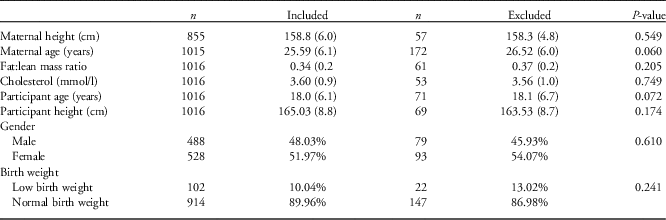
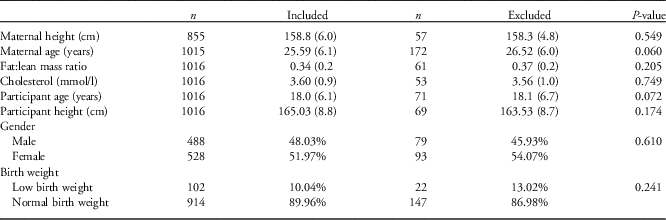
At age 18, male and female subjects (n=1935) who were free of congenital skeletal deformations, Down’s syndrome, chromosomal abnormalities, multiple congenital deformations, or inborn errors of metabolism were invited for a follow-up visit where anthropometric measures and venous serum samples were drawn. There were no significant differences between the study sample and the excluded participants with respect to key socio-demographic variables (See Table 1A).
Informed consent was obtained from the participants before the study and the Human Research Ethics Committee of University of the Witwatersrand, South Africa granted ethical clearance (M111182).
Exposures
Weight at birth, 12, 24 and 48 months
Birth weight was obtained from the participants’ birth records measured by fully trained staff using hospital scales. Low birth weight was defined as a weight at birth of <2500 g, as set internationally by the World Health Organization (WHO). Research staff using standardized methods took weight measurements at infancy and childhood. Weight was measured to the nearest 0.1 kg using a digital scale (Dismed, USA) and height was measured to the nearest 1 mm using a wall-mounted stadiometer (Holtain, UK) in the Frankfort horizontal plane. These measurements were used to calculate the body mass index [BMI (weight (kg)/height (m2)] of each individual.
Conditional weight independent of length/height
Examining the consequences of weight gain at different ages requires statistical methods to address the high correlation of weight with length, and of repeated measurements in the same individual over time.
Our conditional size measures are standardized residuals derived from regressing size at that age (represented as Fisher–Yates transformed weight or length/height Z-scores) on all prior size measures.Reference Thorogood, Connor, Tollman, Lewando Hundt, Fowkes and Marsh 28 , Reference Kimani-Murage, Kahn and Pettifor 29 Relative conditional weight gain (CW) is current weight accounting for current height and all prior weight and height measures. For example, CW at age 2 years (48 months) derives from regressing age 2 weight on age 2 length, weight and length at age 1 year, and BW. Conditional variables represent children’s deviation from expected size based on their own prior measures and on the growth of the other children in each cohort, and can be interpreted as representing faster or slower relative weight gain. For example, a child with a positive value for mid-childhood CW is weighs more than expected given his or her prior weight and size and thus had a faster rate of relative weight gain from age 2 to mid-childhood.
Outcome variables
Dual-energy X-ray absorptiometer (DXA)-derived body composition
Total body fat (FM) and fat-free mass (FFM) were measured by DXA scans performed according to standard procedures using a Hologic QDR 4500A dual-energy X-ray absorptiometry (Hologic Inc., Bedford, USA).
Lipid profiles
Serum from fasting blood samples were centrifuged at 200 g for 20 min at 4°C and aliquots were stored at −70°C until assayed. Total cholesterol (TC), HDL cholesterol, LDL cholesterol and triglyceride (TG) concentrations were measured by an auto-analyzer (Randox Daytona Clinical Analyzer Randox Laboratories, UK) using enzymatic methods. Coefficients of variance for all analyses were <8%.
Statistical analysis
All analyses were conducted using the STATA 12 statistical software. All data are presented as mean (s.d.) and percentages for continuous and categorical variables, respectively.
t-Independent tests were used to compare early life characteristics (birth weight, weight at 12, 24 and 48 months) and adult cardiovascular disease risk factors ((i) body composition variables: fat mass, fat free mass and fat to fat-free ratio (ii) lipid profile: HDL, LDL, TC, TG (iii) blood pressure) between groups (sex and birth weight categories). Bivariate and multiple linear regression models were computed and fitted for early life anthropometric characteristics and childhood weight gain using conditionals (independent variables) on the following adolescent cardiovascular disease risk factors (dependent variables): (i) body composition variables: fat mass, fat-free mass and fat to fat free mass ratio (ii) lipid profile: HDL, LDL, TC, TG. Regression data are presented as β (95%CI) and R 2 values. All statistical significant results were defined using a two-tailed P<0.05. Multiple linear regressions were adjusted for several confounders including wealth quantile index, breastfeeding duration, sex and height at 18. The wealth quantile index was derived from the total household assets score which was grouped into quantiles from the poorest (1) to the wealthiest (5) and breastfeeding duration.
Results
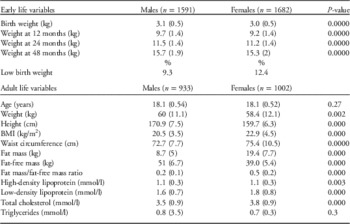
Table 1 presents early life and adolescent variables including cardiovascular disease risk factors (body composition, serum lipid concentrations, blood pressure) by sex as means (s.d.). The following early life variables were significantly higher in the boys as compared to the girls (P<0.05): birth weight [3.1 (0.5) v. 3.0 (0.5)], weight at 12 months [9.7 (1.4) v. 9.2 (1.4)], weight at 24 months [11.5 (1.4) v. 11.2 (1.4)] and weight at 48 months [15.7 (1.9) v. 15.3 (2)]. Weight, height, systolic blood pressure and fat free mass at 18 years were significantly higher in the boys while BMI, waist circumference, HDL, LDL, TC, FM and FM/FFM ratio were significantly higher in the girls (P<0.05). Low birth weight males and females accounted for 9.3 and 12.4% of the sample, respectively. In addition, the prevalence of risk, as per the National Cholesterol Education Program (NCEP), for each lipid profile indicator was: TC (4.8%), HDL (8.1%); LDL (2.2%) and TG (1.3%).
Baseline early life characteristics and adult cardiovascular disease risk factors by gender
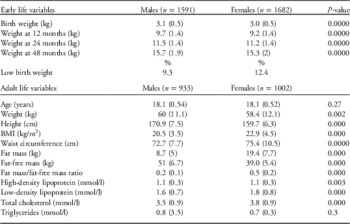
N, number; BMI, body mass index.
All values except birth weight are mean (s.d.) (P values based on independent t-test).
Significant difference based at level P<0.05.
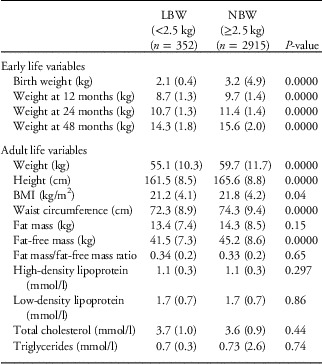
Table 2 compares early life and adult characteristics including cardio-metabolic disease risk factors by birth weight categories. As expected, all early life variables including birth weight, weights at 12, 24 and 48 months were significantly higher in the NBW group as compared to the LBW group (P<0.05). The following anthropometric variables at age 18: weights, adult height, BMI, adult waist circumference were significantly higher in the NBW group as compared with the LBW group (P<0.05). The lipid profiles (HDL, LDL, total cholesterol, triglycerides) were not statistically different between the two birth weight categories. For all body composition variables at age 18, only FFM was significantly higher in the NBW group as compared to the LBW group [41.5 (7.3) v. 45.2 (8.6) P<0.05].
Baseline early life characteristics and adult cardiovascular disease risk factors by birth weight category
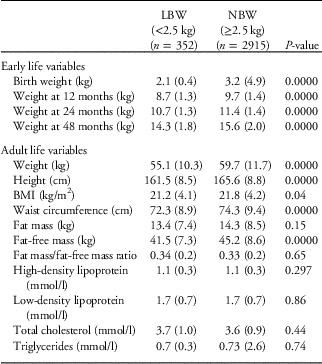
N, number; BMI, body mass index; LBW, low birth weight; NBW, normal birth weight.
All values except birth weight are mean (s.d.) (P values based on independent t-test).
Significant difference based at level P<0.05.
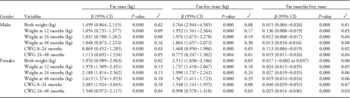
Table 3 presents bivariate linear regression coefficients β (95% CI) and r 2 values by sex for each of the early life variables (birth weight, weight at 12, 24 and 48 months) for FM, FFM, FM/FFM ratio at age 18. CWs (conditional weight gain z-scores independent of height) were positively associated with body composition (P<0.05) in both sexes, except that birth weight in the females did not significantly predict adult FM/FFM ratio.
Bivariate regression coefficients for early life variables and body composition at age 18 years
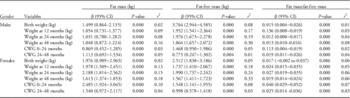
β, beta coefficient; r 2, square of the Pearson correlation coefficient; CI, confidence interval; CWG, conditional weight gain.
Significant difference based at level P<0.05.
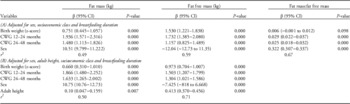
Table 4 shows multivariate linear regression coefficients β (95% CI) and r 2 values for CW during childhood adjusted for sex, socioeconomic class and breastfeeding duration (6 months). All early life variables were significantly and positively predictive of FM, FFM and FM/FFM ratio, respectively (P<0.05). After adjusting for adolescent height (body size), socioeconomic class and breastfeeding duration (Table 4), the associations with early life variable and fat mass and fat free mass (P<0.05) strengthened.
Multivariate regression coefficients for relative weight gain in early life and body composition at age 18 years adjusted for sex, socioeconomic class, adult height and breastfeeding duration
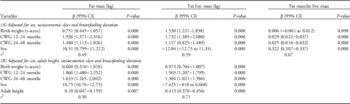
β, beta coefficient; r 2, square of the Pearson correlation coefficient; CI, confidence interval; CWG, conditional weight gain.
Significant difference based at level P<0.05.
Table 5 shows bivariate linear regression coefficients β (95% CI) and r 2 values by sex for each of the early life variables (birth weight, weight at 12, 24 and 48 months) for serum lipids (HDL, LDL, TC and TG) at age 18. In males, the only associations between early life variables and serum lipids at age 18 were found between birth weight and HDL and weight at 48 months and HDL. For every 1 kg increase in birth weight, HDL concentration decreased by 0.06 mmol/l (P<0.05). Similarly, for each 1kg increase in weight at 48 months was associated with a decrease in HDL levels by 0.01 mmol/l (P<0.05). There were no associations between early life variables and serum LDL, TC, TG concentrations at age 18. In females, early life variables were not associated with serum lipid levels at age 18.
Bivariate regression coefficients (95% CI) for early life variables for serum lipids at age 18 years
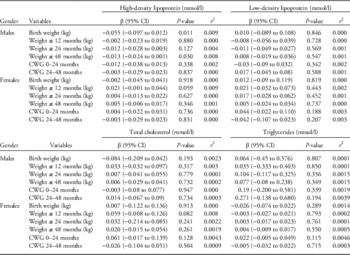
β, beta coefficient; r 2, square of the Pearson correlation coefficient; CI, confidence interval; CWG, conditional weight gain.
Significant difference based at level P<0.05.
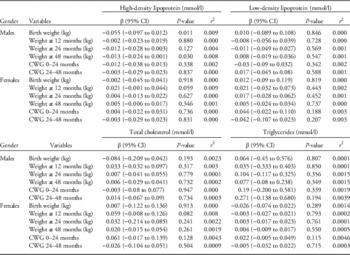
Table 6 presents multivariate regression coefficients β (95% CI) and r 2 values for CW during childhood and for serum lipids at age 18. Data were adjusted for sex, socioeconomic class and breastfeeding duration. CW 0–12 months, CW 12–24 months, CW 24–48 months were not associated with any of the lipid outcomes. Sex was the only factor significantly predicting LDL [β=0.203, (0.098, 0.307)] and TC [β=0.285, (0.156, 0.413)] in that being female had higher concentrations. After adding adolescent height to the model, being female was still the only factor significantly predicting lipid profiles but only for LDL and TC (Supplementary Table S1). When fat mass was added to the model, only sex was positively associated with HDL [β=0.06, (0.001, 0.119)] and TC [β=0.215, (0.037, 0.393)] (Supplementary Table S2).
Multivariate regression coefficients for weight gain in early life and serum lipids at age 18 years, adjusted for sex, socioeconomic class and breastfeeding duration

β, beta coefficient; r 2, square of the Pearson correlation coefficient; CI, confidence interval; CWG, conditional weight gain.
Significant difference based at level P<0.05.
Discussion
We investigated the association between birth weight, weight in infancy and mid-childhood and body composition and lipid profiles in black South African adolescents. The positive association between birth weight and childhood rapid relative weight gain and later metabolic disease risk, such as impaired fasting glucose,Reference Norris, Osmond and Gigante 33 and blood pressureReference Adair, Martorell and Stein 31 have been previously demonstrated in the BT20+ cohort. However, early life factors and its relationship with lipid profiles have not been previously studied. Our data indicated that by age 18 years there was a low but emerging prevalence of dyslipidaemia risk, but unlike in other population studies, birth weight, childhood weight and relative weight gain had little to no association with lipid outcomes in late adolescence. However, early life factors were associated with body composition indices.
Early life factors and adult body composition
Although early life factors strongly predicted both adult FM and FFM after adjusting for height at age 18, the fact that a larger percentage of the variance in FFM was explained by these exposures suggests that birth weight, a proxy for poor fetal growth, might programme FFM in later life. Additionally, the findings that lower birth weight individuals had lower FFM in comparison to normal birth weight individuals might explain the significant weight differences seen at age 18. But, despite differences in total weight and size, FM/FFM ratio as not different between low and normal birth weight groups. Earlier studies have shown conflicting associations between birth weight and adult body composition. Although a high birth weight is usually linked to a greater BMI in later life, it has also been linked to a reduced adiposity.Reference Okosun, Liao, Rotimi, Dever and Cooper 39 Data from a study in twins also contradicts the notion that fetal growth might influence on later adiposity by showing that difference in birth weight was related to differences in later height but not BMI.Reference Adair, Martorell and Stein 31 These inconsistent findings could be explained in part by the use of surrogate measures of obesity (BMI) rather than DXA-derived whole body composition. Alternatively, birth weight in other populations has been shown to be positively associated with adult FFM, and indicate that lower birth weight individuals are at a higher predisposition for cardiovascular disease.Reference Wells, Chomtho and Fewtrell 22 , Reference Yajnik 40 Rapid changes in childhood weight also predict body composition in adulthood and represent an important pathway by which early life might influence adult chronic disease risk.Reference Eriksson, Forsen, Tuomilehto, Osmond and Barker 1 , Reference Victora, Sibbritt, Horta, Lima, Cole and Wells 41 – Reference McCarthy, Hughes, Tilling, Davies, Smith and Ben-Shlomo 44 Previously published data from LMIC cohort studies have similar findings with those reported here, however none of studies relied on the use of CWs and simultaneous modelling of FM and FFM in their analyses. Data from the Cebu Philippines cohort showed that weight gain between 0 and 6 months was a strong predictor of FFM and muscle strength in males but not females.Reference Kuzawa, McDade, Adair and Lee 45 In India, rapid increases in BMI during infancy and early childhood were more related to adult FFM than with adiposity or central adiposity, whereas rapid increases in BMI during late childhood or adolescence were associated more with increased adult adiposity and central adiposity.Reference Sachdev, Fall and Osmond 21 In a Guatemalan cohort, BMI in infancy and later childhood was positively associated with adult BMI, percentage body fat, abdominal circumference, and FFM; from mid-childhood these associations were stronger with BMI, percentage body fat, and abdominal circumference than with FFM.Reference Corvalan, Gregory, Ramirez-Zea, Martorell and Stein 46 Studies from high-income populations such as the UKReference Singhal, Wells, Cole, Fewtrell and Lucas 47 , Reference Ong, Ahmed, Emmett, Preece and Dunger 48 and SwedenReference Ekelund, Ong and Linne 24 have also report similar findings showing that rapid weight gain during infancy predicts an adverse metabolic risk profile and body composition in adulthood. In summary, our findings initially seems to suggest that low birth weight might result in the programming of a lower fat free mass later in life which could have implications for adult disease as skeletal muscle is important for glucose uptake in response to insulin and less lean tissue mass might compromise insulin sensitivity. But examining the FM/FFM ratio it would appear that birth weight is more of an indicator of size with minimal impact on FM and FFM. However, rapid relative weight gain in infancy and childhood results in a great FM/FFM ratio. Sex was negatively correlated with FFM in our sample, and is in agreement with other studies,Reference Kuzawa, McDade, Adair and Lee 45 being female was significantly correlated with a lower FFM and higher FM compared to males by age 18 years.
Relationship between body composition and lipids
The amount of body fat an individual accumulates in his/her life course is an important determinant of adult lipid and lipoprotein profiles.Reference Nagaya, Yoshida, Takahashi, Matsuda and Kawai 49 – Reference Smith, Lovejoy and Greenway 52 BMI, as a proxy measure of adiposity, has mostly been used in adult studies and in adults, there is a strong positive association between BMI and TG, LDL and TC and a negative association with HDL cholesterol.Reference Folsom, Li and Rao 53 Such data must however be interpreted with caution as BMI does not distinguish between fat and fat-free tissues, both of which have distinct effects on lipid and lipoprotein levels. Data from a study conducted on healthy Caucasian men and women, participating in the Fels Longitudinal Study showed that increased FM contributed to elevated TG, LDL and TC concentrations and decreased HDL cholesterol levels. FFM on the other hand, was significantly associated with low HDL and high TG levels in both sexes.Reference Schubert, Rogers and Remsberg 54 In contrast to these studies, our study in adolescent urban African population showed that FM was only related to HDL concentrations. When adjusted for sex, our data showed that lower HDL and higher TC levels were related to females. Other studies in the Africans have also shown that lipids, with the exception of TG, were higher in adolescent females.Reference Going, Lohman, Cussler, Williams, Morrison and Horn 55 – Reference Bergstrom, Hernell, Persson and Vessby 61
Birth weight and differences in lipid profile
Associations between birth weight and other cardiovascular disease risk factors such as blood pressure and insulin resistance for example have been shown to increase with age,Reference Law, de Swiet and Osmond 62 although similar associations between lipid levels have not been suggested. From our data, birth weight was not associated with lipid outcomes after adjusting for current body size (height and fat mass) and does not support the fetal origins hypothesis in this population group. Studies investigating the relationship between birth weight and lipid concentrations in adolescents have demonstrated conflicting results with some studies.Reference Lauren, Jarvelin and Elliott 63 , Reference Clausen, Borch-Johnsen and Pedersen 64 A few studies from high-income settings have shown an association between low birth weight and high levels of total cholesterolReference Kawabe, Shibata, Hirose, Tsujioka, Saito and Saruta 65 LDL cholesterol,Reference Antal, Agfalvi and Nagy 66 and lower levels of HDL cholesterol.Reference Morley, Harland, Law and Lucas 67 Data from some low-income settings have also shown similar trends.Reference Li, Johnson and Goran 68 – Reference Boyne, Osmond and Fraser 70 In contrast, numerous studies show no association between low birth weight and lipid concentrations in young adults in both high and low income settings even after adjusting for confounders such as sex and current body size (waist circumference, weight, height and BMI).Reference Cowin and Emmett 59 , Reference Bergstrom, Hernell, Persson and Vessby 61 , Reference Levitt, Lambert, Woods, Hales, Andrew and Seckl 71 , Reference Stein, Conlisk, Torun, Schroeder, Grajeda and Martorell 72 The disparities between data in these studies may be due to various factors such as differences in study populations in terms of age, sex and ethnic or genetic background. In addition, although serum lipid concentrations are known to track from early childhood, it may be that the effects of an adverse prenatal influence emerge in later life. In a commentary to a review on the birth weight-adult lipid relationship,Reference Barker 73 Barker postulated that the effects of birth weight were being masked by the subsequent effects of infant feeding which have been shown to influence levels of total and LDL cholesterol in adult life.Reference Roseboom, van der Meulen, Osmond, Barker, Ravelli and Bleker 74 , Reference Owen, Whincup, Odoki, Gilg and Cook 75 Another suggestion was that intrauterine nutrition was probably a better indicator of future lipid profiles than birth weight. Irrespective of birth size, adults exposed to the Dutch famine in utero had higher levels of serum lipids in comparison to people not exposed to the same environment.Reference Mi, Law, Zhang, Osmond, Stein and Barker 76 Similarly, a study involving Chinese men showed that elevated total and LDL cholesterol concentrations were related to low maternal body mass index in early pregnancy and not related to low birth weight.Reference Petkeviciene, Klumbiene, Kriaucioniene, Raskiliene, Sakyte and Ceponiene 77 Adult studies serum lipid concentrations have demonstrated strong inverse associations with abdominal circumference at birth and not birth weight.Reference Barker, Martyn, Osmond, Hales and Fall 8 A small abdominal circumference at birth also predicted death from congenital heart disease among men.Reference Barker, Martyn, Osmond, Hales and Fall 8 Few studies, including ours, incorporate this birth measurement in analyses. Measures of maternal nutrition could introduce valuable variables required for a better understanding of the developmental origins of elevated serum lipid concentrations.Reference Owen, Whincup, Odoki, Gilg and Cook 75
Early weight gain and adult lipids
Our data showed that birth weight, rapid relative weight gain in infancy, and between infancy and mid-childhood were not associated with lipid profiles outcomes in late adolescence. These findings differ from other studies, particular in high-income settings and of other population groups, which suggest that excessive weight gain during childhood may be determinant of adult cardiovascular risk, such as lipid concentrations.Reference Sinaiko, Donahue, Jacobs and Prineas 58 , Reference Roseboom, van der Meulen, Osmond, Barker, Ravelli and Bleker 74 , Reference Mi, Law, Zhang, Osmond, Stein and Barker 76 In contrast to other ethnicities, Africans consistently appear to display an athero-protective lipid profiles even after adjusting for age, gender and BMIReference Norman, Bradshaw, Steyn and Gaziano 78 , Reference Sliwa, Lyons and Carrington 79 and differences in the genetic basis of lipid metabolism between ethnic groups may explain these disparities.
Limitations
As this research in is not in an older population and does not include confounders such as alcohol consumption and smoking may be limitations of the current analyses. We aim to repeat the analyses with additional confounders (socioeconomic class, maternal pre-pregnancy weight, breastfeeding duration) when the cohort is in their later adulthood. We could not include maternal pregnancy weight as a confounder as this data was not collected in the cohort.
In conclusion, our observations suggest that although birth weight and weight gain during infancy and early childhood did not correlate with adolescent lipid profile in this population, they were related to adolescent body composition. The implication is that developmental origins of cardio-metabolic disease in Africans may be differential to other population groups potentially due to genetic variation and susceptibility.
Acknowledgements
The authors would like to thank the Birth to Twenty plus staff, and the adolescents and parents of the BT20+ study for their participation.
Financial Support
The Wellcome Trust (UK) [grant number 092097/Z/10/Z], Human Sciences Research Council, National Research Foundation and the South African Medical Research Council and the University of the Witwatersrand, Johannesburg, supported this work. M.M., J.K. and S.N. were supported by the UK MRC/DfID African Research Leader Scheme.
Conflicts of Interest
None.
Ethical Standards
The authors assert that all procedures contributing to this work comply with the ethical standards of the relevant national guidelines on human experimentation and with the Helsinki Declaration of 1975, as revised in 2008, and has been approved by the University of the Witwatersrand on Human Research Ethics Committee.
Supplementary Material
To view supplementary material for this article, please visit http://dx.doi.org/10.1017/S2040174415007953
Appendix
Differences between included and excluded study participants from BT20 cohort sample