Introduction
In recent years, there has been an increasing appreciation of the phenomenon of the aging world population (Lloyd-Sherlock, Reference Lloyd-Sherlock2000). This has led to greater attention being paid to issues affecting older persons that previously might have been overlooked. Included among these issues has been alcohol use (Wang and Andrade, Reference Wang and Andrade2013). A number of studies have now explored alcohol use among older persons (Mirand and Welte Reference Mirand and Welte1996; Choi and DiNitto, Reference Choi and DiNitto2011; Rao et al., Reference Rao, Schofield and Ashworth2015). However, to date, there have been few focused or comprehensive reports on alcohol use among older persons in Jamaica or the rest of the English-speaking Caribbean.
An awareness of the prevalence of alcohol use and its associated factors among older persons is useful given the potential impact of alcohol consumption on the health of individuals in this age group. Among older persons, moderate alcohol use has been linked to lower rates of mortality than those that are found in non-drinkers (Paganini-Hill et al., Reference Paganini-Hill, Kawas and Corrada2007). On the other hand, heavy alcohol use has been associated with greater severity or poorer outcome for a raft of medical illnesses (Rigler, Reference Rigler2000; Liu et al., Reference Liu2010; Skliros et al., Reference Skliros, Papadodima, Sotiropoulos, Xipnitos, Kollias and Spiliopoulou2012) as well as increased mortality (Jayasekara et al., Reference Jayasekara, English, Room and MacInnis2014). Knowledge of the extent of alcohol use among older persons may give some indication about the urgency with which attention should be paid to encourage healthier practices pertaining to their consumption of alcohol.
Identifying the most common users of alcohol among older persons is also important for enhancing targeted approaches to addressing possible problems with alcohol use. In this regard, an examination of the prevalence of alcohol use by age and sex is potentially valuable. Whereas past research has indicated that among older persons alcohol use declines with age (Mirand and Welte, Reference Mirand and Welte1996; Breslow et al., Reference Breslow, Faden and Smothers2003) and is more prevalent among men than women (Mirand and Welte, Reference Mirand and Welte1996; Blazer and Wu, Reference Blazer and Wu2009), the extent to which these findings are relevant for Jamaica and the wider English-speaking Caribbean has not been firmly established. Findings from a general lifestyle survey of Jamaicans between 15 and 74 years of age indicate that rates of current alcohol use peak at 83% in persons aged 25 to 34 years and steadily decline to 48% among persons in the 65 to 74 age range (Wilks et al., Reference Wilks, Younger, Tulloch-Reid, McFarlane and Francis2008). Alcohol use beyond age 74 years was not explored. Neither were any differences of alcohol consumption with age investigated within the cohort of older persons. In the same survey, for all age groups, alcohol use was more common among men than women and was mostly restricted to weekends.
Apart from concerns about possible adverse associations between alcohol use and physical health, alcohol use has also shown some association with mental health problems including addiction (Bommersbach et al., Reference Bommersbach, Lapid, Rummans and Morse2015), cognitive decline (Hendrie et al., Reference Hendrie, Gao, Hall, Hui and Unversagt1996), depression (Hartka et al., Reference Hartka, Johnstone, Leino, Motoyoshi, Temple and Fillmore1991; Alati et al., Reference Alati, Lawlor, Najman, Williams, Bor and O'Callaghan2005; Graham et al., Reference Graham, Massak, Demers and Rehm2007), and suicide (Yi et al., Reference Yi2016). Although the current study's methodology did not allow for any investigation of most of these mental health issues, it did facilitate an exploration of the relationship between alcohol use and depression. Various types of relationships between alcohol use and depression have previously been described including even a lack of any association (Osborn et al., Reference Osborn2003) in a study of older persons. More commonly described is the phenomenon of the use of alcohol as a self-medicating strategy by persons who are depressed (Bolton et al., Reference Bolton, Robinson and Sareen2009) as well as a non-linear relationship between depression severity and alcohol consumption (Alati et al., Reference Alati, Lawlor, Najman, Williams, Bor and O'Callaghan2005; Graham et al., Reference Graham, Massak, Demers and Rehm2007; Kim et al., Reference Kim, Kim, Morris and Park2015). Knowledge of the nature of the relationship between alcohol use and depression among older persons of the English-speaking Caribbean could contribute to a better appreciation overall of the complex issues that underlie alcohol use among members of this population.
Besides depression, another useful parameter for exploration of association with alcohol use is life satisfaction. As Veenhoven (Reference Veenhoven, Saris, Veenhoven, Scherpenzeel and Bunting1996) pointed out, life satisfaction relates to the extent to which an individual appraises his or her life as a whole as being of an acceptable standard and also helps to determine the extent to which changes (to remediate any deficiencies) should be pursued. The relationship between alcohol use and life satisfaction is especially relevant for older persons given the fact that threats to life satisfaction that are attributable to alcohol use (such as chronic medical illnesses) may not become apparent until during the later years of life. Massin and Kopp (Reference Massin and Kopp2014) reported a non-linear relationship between heaviness of alcohol use and satisfaction with life. The nature of the relationship between alcohol use and life satisfaction has not previously been described among older Jamaicans and could potentially broaden the general understanding of the emotional correlates of alcohol use among this group of persons.
In this study, we sought to determine how prevalent alcohol use was among older Jamaicans as well as the extent to which it was associated with age, sex, depression, and life-satisfaction. Considerations of alcohol use were, however, restricted to the presence or absence of current alcohol use which was defined as use within the last 12 months.
Methods
The research on which we report met legal and ethical standards, and was approved by the relevant institutional review board.
A secondary analysis was conducted on data from a cross-sectional, nationally representative survey on health-related issues of 2,943 older persons, undertaken in four (4) of Jamaica's twelve (12) parishes in 2012. Details of the survey methods are contained in a report on previous analyses (Mitchell-Fearon et al, Reference Mitchell-Fearon, Waldron, James, Laws, Holder-Nevins and Eldemire-Shearer2014).
Study population
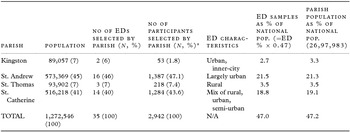
The study population included a representative sample of men and women, 60 years of age and older, living in the parishes of St Catherine; Kingston and St. Andrew; and St Thomas. Together these four parishes reflect the profile of the national population and comprise approximately 47% (1,272,546 persons) of the national population (Table 1).
Population and sample distribution by parish

Note: ED = enumeration districts.
a Parish of origin not recorded for one participant.
Sampling strategy
A two-stage cluster sampling methodology was used to recruit persons into the survey, with the first and second cluster units being enumeration districts and households, respectively. An enumeration district is a geographical area within a parish, enumerated by a single enumerator, and consists of up to 400 dwellings. The sampling strategy was designed in accordance with the “WHO common cluster survey sampling principles,” and sample size defined through use of the “C-Survey” software. This software was specifically designed by University of Indonesia and University of California, Los Angeles (UCLA) faculty to inform these surveys in developing countries.
Given the variations in the population size of enumeration districts, a “probability proportional to size” (PPS) sampling strategy was undertaken. Under this strategy, larger districts had a higher likelihood of being included in the sample than did smaller districts.
C-survey, which uses the PPS sampling strategy, was used to determine the overall survey sample size and the size of the clusters as well as to select the enumeration districts/clusters for inclusion in the survey. Based on the software requirements, the input variables were as follows:

“Attribute proportion” was assigned a value of 0.69, after using hypertension as the relevant “attribute” to be measured. Based on national surveys, the proportion of this attribute in the elderly population is estimated to be 69% (Wilks et al., Reference Wilks, Younger, Tulloch-Reid, McFarlane and Francis2008). Because a main focus of the survey was on the health profile of older persons, the chronic medical condition with the highest prevalence within older Jamaicans, i.e. hypertension, was chosen so as to allow a determination of the largest of the minimum sample sizes that could be derived from a consideration of any of the relevant chronic illnesses (sample size calculations that use prevalence rates greater or less than 50% would yield smaller minimum sample sizes).
“Number of clusters” to be included in the survey was pre-defined by the WHO principles to be a minimum of 25. The total number of clusters in our survey was 35. “Design effect” (DE) adjustments were employed to compensate for intra-cluster similarities resulting from not using simple random sampling. The selection of a DE of 2 was informed by previous surveys concerning health issues in Jamaica (Fletcher, et al., Reference Fletcher2013; Baker-Henningham et al., Reference Baker-Henningham, Scott, Jones and Walker2012; Le Franc et al., Reference Le Franc, Samms-Vaughan, Hambleton, Fox and Brown2008).
Based on these parameters, C-Survey indicated a minimum required sample size of 2,660 with each cluster having 76 participants. Participants were contacted via home visits beginning at a random starting point and proceeding sequentially in a predetermined direction (also randomly selected) emanating from a central location in the cluster. The minimum requirements were adhered to, and exceeded in the data collection phase, with approximately 85 persons per cluster and 2,943 in the total survey.
Participants ranged in age from 60 to 103 years. The mean (SD) age was 72.2 (8.9) years and 1,531 (52.0%) of the participants were women. As shown in Table 2, the age and sex distribution of participants was representative of the Jamaican population over 60 years of age. Of note, of the persons approached for participation in the survey, 95% consented and took part. The distribution of participants by parish is also shown in Table 1.
Characteristics of participants compared with characteristics of the national population of age 60 years or olderFootnote a

a Data pertaining to age were missing for three male and five female participants.
b Source: Statistical Institute of Jamaica.
Instruments
The survey questionnaire
Data on age, sex, alcohol use, and life satisfaction were gleaned from participants’ responses to a 200-item survey questionnaire with questions on functional status, community, and social relationships, lifestyle behaviors, health status, and access to and utilization of health services.
The Zung Self-rating Depression Scale (ZSDS)
Data on depressive symptoms were obtained from participants’ responses on the Zung Self-rating Depression Scale (ZSDS) (Zung, Reference Zung1965) which has been widely used in previous research on depression. It has shown significant correlation with clinical diagnoses of depression (Griffin and Kogut, Reference Griffin and Kogut1988) and similarity with other measures of the severity of depressive symptoms (Agrell and Dehlin, Reference Agrell and Dehlin1989), e.g. the Geriatric Depression Scale (GDS) (Yesavage et al., Reference Yesavage1982). The instrument has also been validated in Jamaica (Ward et al., Reference Ward, Matthies, Wright, Crossman and Hickling2001). In this study, it was not self-administered. Rather, the questions were asked by trained interviewers in order to avert potential problems with literacy, visual disability, and cognitive deficits among the targeted population of older persons. Scores of the ZSDS range from 20 to 80 with higher scores representing greater levels of depression. Scores of 50 or more are indicative of at least mild levels of depression. Conventionally, scores between 50 and 59 are interpreted to connote mild depressive symptoms; 60–69 moderate symptoms, and 70 or greater severe symptoms (Lam et al., Reference Lam, Michalak and Swinson2005). These cut scores were applied to the analysis of data in this study.
Variables of interest
The variables of interest were age in years (60–69, 70–79, 80–89, and 90 or more years), sex (male/female), current alcohol use (present if having drunk alcohol during the last 12 months), ZSDS score, ZSDS category (absent, mild, moderate, or severe depressive symptoms), and satisfaction with life in general (very dissatisfied, dissatisfied, neither satisfied nor dissatisfied, satisfied or very satisfied).
Because of issues with the quality of the data collected, there were no usable data on alcohol consumption besides current alcohol use.
The life satisfaction variable was derived from responses to a single item on the survey questionnaire which asked the question “Taking all things together, how satisfied are you with life as a whole these days?” Similar single questions have been used to assess individuals’ overall life satisfaction in previous research and have been considered valid. (Veenhoven, Reference Veenhoven, Saris, Veenhoven, Scherpenzeel and Bunting1996; Massin and Kopp, Reference Massin and Kopp2014).
Statistical analyses
Data were analyzed using the Statistical Package for the Social Sciences (SPSS; version 18.0). Frequencies were calculated for sex and the presence or absence of current alcohol use. Means and standard deviations (SD) were determined for age and ZSDS score.
The absence of any usable data on the quantities of alcohol consumed by respondents precluded any analyses involving alcohol consumption beyond considerations of the presence or absence of current use.
Bivariate explorations of associations between the presence or absence of current alcohol use and the other variables of interest were carried out using the Student's t-test for ZSDS score and the χ 2 test for sex, age category, ZSDS category, and satisfaction with life in general. For all analyses, statistical significance was considered to be present at p < 0.05.
Results
Information on current alcohol use was obtained for 2,873 (97.6%) of the participants and of this number 615 (21.4%) reported having drunk alcohol in the previous 12 months. These persons were regarded as current alcohol users.
Current alcohol use steadily declined with age. It was most prevalent among persons between 60 and 69 years (29.4%; 95% CI: 27.7%, 31.1%), followed by persons between 70 and 79 years (17.6%; 95% CI: 16.2%, 19.0%), then by persons between 80 and 89 years (11.8%; 95% CI: 10.6%, 13.0%), and then finally by persons of 90 years of age or older (9.0%; 95% CI: 8.0%, 10.0%). These differences were found to be statistically significant on application of the χ 2 test [χ 2(3) = 95.2, p < 0.001].
Current alcohol use was six times more prevalent among men (37.6%; 95% CI: 35.2%, 38.8%) than women (6.2%; 95% CI: 5.3%, 7.1%). This difference was also statistically significant [χ 2(1) = 420.7, p < 0.001].
With regard to depression among the total sample, on average current users of alcohol had lower mean (SD) ZSDS scores [34.7 (8.8)], and therefore lower levels of depressive symptom severity, than persons who were not current users [38.8 (9.3)]. There was a mean difference in scores of 4.1 which was found to be statistically significant with the Student's t-test [t(2380) = 9.18, p < 0.001]. The association between current use of alcohol and a lower level of depression symptom severity was also found when data from men [t(1186) = 4.60, p <0.001] and women [t(1192) = 3.12, p = 0.02) were analyzed separately.
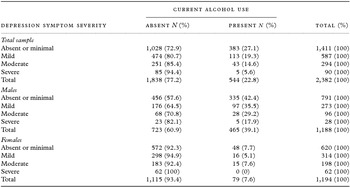
Statistically significant differences were also found with respect to comparing current alcohol users and non-users according to ZSDS categories. The proportion of current alcohol users steadily declined as categories of increasingly severe depressive symptoms were considered (Table 3). Of the total sample, just over one in every four persons (27.1%; 95% CI: 25.5%, 28.7%) who showed no substantial depressive symptoms were current users of alcohol, compared to almost one in twenty persons (5.6%; 95% CI: 4.8%, 6.4%) with severe depressive symptoms [χ 2(3) = 45.6, p < 0.001]. In men, these proportions were 42.4% (95% CI: 39.6%, 45.2%) and 17.9% (95% CI: 15.7%, 20.8%), respectively [χ 2(3) = 14.3, p = 0.003]. Among women, they were 7.7% (95% CI: 6.2%, 9.2%) and 0%, respectively [χ 2(3) = 7.1, p = 0.68].
Prevalence of current alcohol use by category of depressive symptom severityFootnote a among males, females, and the total sample

a Data pertaining to category of depressive symptom severity were missing for 497 (17%) of the total sample [207 (15%) males and 290 (19%) females]. Data pertaining to current alcohol use were missing for 70 (2.4%) of the total sample [21 (1.5%) males and 49 (3.2%) females].
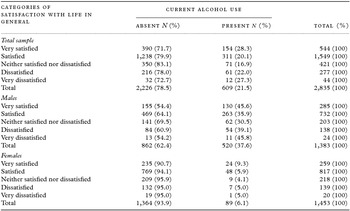
Satisfaction with life in general was also significantly associated with current alcohol use (Table 4). Of the total sample, persons who were very satisfied and persons who were very dissatisfied showed the highest rates of current use of alcohol (28.3%; 95% CI: 26.7%, 29.9% and 27.3%; 95% CI: 25.7%, 28.9%, respectively), compared to rates ranging from 16.9% (95% CI: 15.5%, 18.3%) to 22.0% (95% CI: 20.5%, 23.5%) for the other categories between these two extremes [χ 2(4) = 23.1, p < 0.001]. For men, the rates of current alcohol use were 45.6% (95% CI: 42.9%, 48.2) for those who were very satisfied; 45.8% (95% CI: 43.2%, 48.4%) for those who were very dissatisfied and 30.5% (95% CI: 28.1%, 32.9%) – 39.1% (95% CI: 36.5%, 41.7%) for other categories [χ 2(4) = 13.8, p = 0.008]. Among women, there were no significant differences in current alcohol use across categories of life satisfaction [χ 2(4) = 6.4, p = 0.167].
Prevalence of current alcohol use by category of satisfaction with life in generalFootnote a among males, females, and the total sample

a Data pertaining to satisfaction with life in general were missing for 39 (1.3%) of the total sample [9 (0.6%) males and 30 (2.0%) females]. Data pertaining to current alcohol use were missing for 70 (2.4%) of the total sample [21 (1.5%) males and 49 (3.2%) females].
Discussion
Almost one in every five participants consumed alcohol in the 12-month period prior to being interviewed. Alcohol use is therefore a prominent practice among older Jamaicans. The prevalence figure is, however, lower than has been observed among older persons in other settings. Studies on older persons in the USA have yielded rates of current alcohol use (defined, as in the current study, as use within the last 12 months) of 72% and 57% among males and females, respectively aged 60 years and older (Mirand and Welte, Reference Mirand and Welte1996) and 66% and 55%, respectively for men and women aged 55 years and older (Blazer and Wu, Reference Blazer and Wu2009). The rate of current alcohol use found in the current study is also lower than that which had been obtained from a previous lifestyle survey in Jamaica (Wilks et al., Reference Wilks, Younger, Tulloch-Reid, McFarlane and Francis2008). In that study, for both sexes combined, current alcohol use was found to be present in 66% of persons aged 55–64 years and 48% of persons aged 65–74 years.
An examination of the rates of alcohol use by sex for the current study may give some indication about the reasons for the overall low rate in comparison to other studies. From our sample, women were six times less likely to report current alcohol use than men. This may reflect culturally determined, gender-related patterns of alcohol use among older Jamaicans and may also have resulted in a dilution effect on the overall rate of current alcohol use. The rate of alcohol use among men was 37.6% which is not very far removed from the 48% previously observed by Wilks et al. (Reference Wilks, Younger, Tulloch-Reid, McFarlane and Francis2008) among Jamaican men and women between 65 and 74 years of age. In the study of Wilks et al. (Reference Wilks, Younger, Tulloch-Reid, McFarlane and Francis2008), men outnumbered women in the 55–74 age group thus possibly exaggerating overall rates of current alcohol use. Taking into consideration the findings and participant characteristics of the current study as well as those of the previously mentioned studies from the USA (Mirand and Welte Reference Mirand and Welte1996; Blazer and Wu Reference Blazer and Wu2009) and Jamaica (Wilks et al., Reference Wilks, Younger, Tulloch-Reid, McFarlane and Francis2008), it would appear that older Jamaicans have a relatively low, but appreciable, rate of current alcohol use and that this issue is primarily relevant for Jamaican men.
The finding of declining levels of current alcohol use with increasing age is not surprising and is similar to findings elsewhere (Mirand and Welte, Reference Mirand and Welte1996; Breslow et al., Reference Breslow, Faden and Smothers2003). This may be related to age-related physiological changes that affect the body's handling of alcohol and make older adults more sensitive to its effects (Breslow, et al., Reference Breslow, Faden and Smothers2003) including untoward ones such as altered consciousness and confusion. For this reason, greater avoidance of alcohol would be expected with advancing age. In addition, chronic medical illnesses are more likely with increasing age and the possible worsening of these conditions with alcohol use is fairly well established (Rigler, Reference Rigler2000; Liu et al., Reference Liu2010; Skliros et al., Reference Skliros, Papadodima, Sotiropoulos, Xipnitos, Kollias and Spiliopoulou2012). In recognition of the issue, older persons may opt to reduce or discontinue their use of alcohol.
Past research has suggested that persons at the extremes of alcohol use (abstinence and heavy use) have higher rates of depression than persons who drink alcohol in moderation (Alati et al., Reference Alati, Lawlor, Najman, Williams, Bor and O'Callaghan2005; Graham et al., Reference Graham, Massak, Demers and Rehm2007; Kim et al., Reference Kim, Kim, Morris and Park2015). These findings tend to yield a J-shaped curve when depression severity is plotted against alcohol use on a graph and has been found in diverse age-groups and settings (Alati et al., Reference Alati, Lawlor, Najman, Williams, Bor and O'Callaghan2005; Graham et al., Reference Graham, Massak, Demers and Rehm2007; Kim et al., Reference Kim, Kim, Morris and Park2015). The current study did not explore the intensity of alcohol use beyond the categories of “current use” and “no current use.” Its findings cannot, therefore, inform a comprehensive conclusion about the applicability of the J-curve phenomenon to the population of older Jamaicans. There was, however, some indication that at least some of the J-curve phenomenon may exist among this population: Abstainers had higher rates of depression than current users (no conclusions can be formulated about moderate versus heavy drinkers).
The reasons for the high rate of depression among abstainers may be related to the social aspect of drinking alcohol. Persons who are depressed are less likely to engage in social activities (Fiske et al., Reference Fiske, Wetherell and Gatz2009) (which include alcohol use). This finding and explanatory hypothesis contrast with the often observed phenomenon of high rates of depression among heavy drinkers of alcohol, ostensibly because alcohol is used by depressed individuals as self-medication for their depressive symptoms (Bolton et al., Reference Bolton, Robinson and Sareen2009). However, given the usual low proportion of heavy drinkers in the general population (Mirand and Welte, Reference Mirand and Welte1996; Blazer and Wu, Reference Blazer and Wu2009), it is likely that, overall, excessive users of alcohol were in the minority of the study participants who were identified as current users. Thus, the inverse relationship between alcohol use and depression observed in this study may reflect a phenomenon found when comparing abstainers with primarily low and moderate users of alcohol, as opposed to what might obtain had the current users of alcohol been predominantly heavy users.
Results from another aspect of our current analysis also tend to support our hypotheses about social and self-medicating issues playing a role in older Jamaicans’ motivation for consuming alcohol. The highest rates of current alcohol use were found among persons who were either highly satisfied or highly dissatisfied with their lives. Highly satisfied persons are likely to engage in social activities (Kelly et al., Reference Kelly, Steinkamp and Kelly1987) which might include alcohol use. On the other hand, highly dissatisfied persons are intuitively more likely than others to experience frustration and distress which could lead to alcohol intake as another type of self-medication strategy.
Of note, the association between current alcohol use and depression was less significant among women than men (with statistically significant findings from analyses of women's depression severity scores but not from analyses of the relevant depression categories). Also, the association between current alcohol use and life satisfaction was not at all significant among women although statistical significance was encountered among men. These sex differences may reflect the fact that current alcohol use among women was very low so that the demonstration of any significant associations would have been difficult. It is also possible that the associations in question lack relevance for the much less prominent public health issue of alcohol use among older women (in comparison to its use among older men).
Future research which incorporates quantification of past and current use of alcohol as well as participants’ stated reasons for drinking alcohol should be able to more definitively determine the extent to which the explanatory hypotheses that have been proposed for the current study's findings are true.
Apart from the absence of detailed quantification of alcohol use and of information on persons’ stated reasons for drinking alcohol, there are other limitations of the current study. The data were not collected with the objective of answering our research questions. Hence, the measures and variables of interest were selected based on availability rather than design. Additional measures of life satisfaction, in particular, could have made the analyses more robust. The absence of analyses to control for potential confounding variables, the inability to make causal inferences from the findings, and the participation of only community-dwelling older persons (thus restricting generalizability) are other limitations of the study.
Conclusion
In summary, alcohol use among older persons in Jamaica is fairly common but less so than in some other parts of the world. It is much more common among older men than older women and tends to be associated with low levels of depression and either low or high levels of satisfaction with life.
Conflicts of interest
None.
Description of authors’ roles
R.C. Gibson formulated the research questions, analyzed the data, and wrote the paper. N.K. Waldron contributed to the conceptualization of the research and the design of the study; he was involved in the supervision of data collection and critically reviewed drafts of the paper. W.D. Abel contributed to the conceptualization of the research and the design of the study; he also critically reviewed drafts of the paper. D. Eldemire-Shearer conceptualized the research and the design of the study; she supervised the data collection and critically reviewed drafts of the paper. K. James contributed to the conceptualization of the study and was responsible for its statistical design; he also critically reviewed drafts of the paper. K. Mitchell-Fearon contributed to the conceptualization of the study and its statistical design; she also critically reviewed drafts of the paper.