Introduction
Chemical, biological, radiological, and nuclear (CBRN) events include the uncontrolled release of hazardous chemicals (eg, toxic agents and nerve gas), biological agents (eg, infectious disease outbreak), or radioactive releases (eg, nuclear/radiological accident) into the environment, potentially combined with explosions (chemical, biological, radiological, nuclear, and explosive [CBRNE] events; eg, dirty bombs) that cause widespread damage. CBRN events are triggered by natural or malicious causes, accidents, or any combination of them. Prevention of these events is a crucial global health necessity. CBRN agents are invisible and sometimes imperceptible or contagious. Special healthcare responses such as decontamination, quarantine, and evacuation are needed, and cause a substantial burden to the authorities, healthcare personnel, and first responders.
Mass exposure to radioactive agents does not happen very often. Nuclear bomb attacks in Hiroshima and Nagasaki (1945, Japan) have shown mankind the devastating effect of nuclear weapons. Possible other scenarios, however, include nuclear power plant (NPP) accidents, criticality accidents, radiation source accidents, and terrorist attacks. Specifically, three severe NPP accidents took place in the past—Three Mile Island (1979, United States), Chernobyl (1986, former Soviet Union), and Fukushima (2011, Japan)—and the last two accidents were marked level 7 on the International Nuclear and Radiological Event Scale.
When radiological/nuclear events happen, the uncertain nature of the CBRN agents produces extreme fear to the otherwise healthy populations, and psychosocial disruption is massive. Hiroshima and Nagasaki survivors (called hibakusha) had experienced not only psychiatric sequelae (eg, post-traumatic stress disorder [PTSD]), but also fear of future health and genetic effects, discrimination, social stigma, and rejection from the public.Reference Cullings1 In the case of Chernobyl disaster, the survivors were also stigmatized by the general public and even by the medical community because of fear of contamination.Reference Bromet, Havenaar and Guey2 Chernobyl disaster studies have shown lower perceived health among the affected population, especially among mothers of young children.Reference Adams, Bromet and Panina3, Reference Bromet, Gluzman and Schwartz4 Clean-up workers and liquidators have been another population of concern owing to their exposure to radiation as well as the related stress experienced by them. Behavioral outcomes persist for decades after the disaster, especially increased alcohol consumption, alcohol-related morbidity, and suicide.Reference Laidra, Rahu and Tekkel5–Reference Rahu, Rahu and Tekkel7
The Fukushima nuclear disaster began on March 11, 2011, when the magnitude 9.0 earthquake and tsunami waves damaged the Tokyo Electric Power Company, Fukushima Daiichi NPP, located in the coastal area of Fukushima prefecture. The accident led to nuclear reactor meltdowns, hydrogen explosions, and release of radioactive materials. In the days after the disaster, hundreds of thousands of residents were ordered to evacuate from the area surrounding the NPP. Although evacuation orders had been lifted in some areas, tens of thousands of residents are still unable to return to their original homes. No one died from the direct effect of the radiation exposure, but dozens of elderly patients died in the immediate evacuation process,Reference Tanigawa, Hosoi and Hirohashi8 and by March 2015, 1914 individuals in Fukushima prefecture lost their lives owing to disaster-related deaths.Reference Hayakawa9 The disaster is still evolving, and the clean-up process is expected to take decades.
As of this writing (8 years after the Fukushima disaster), there have been extensive studies assessing the emotional and behavioral effects of the Fukushima disaster. The former outcomes include concern about radiation, lower perceived well-being, and resilience; the latter outcomes include increased use of alcohol or tobacco, changes in daily activities associated with radiation exposure, and suicidal behavior. Nonetheless, we are unable to systematically understand these effects because the research methodologies vary widely between studies. Chernobyl studies are not available in this time frame because health data were not released from the former Soviet Union, and studies were initiated after the 1991 Soviet Union breakup. To fill this research gap, we conducted a systematic review to better understand the emotional and behavioral changes of Fukushima survivors associated with this disaster exposure.
Methods
This systematic review was performed in accordance with Preferred Reporting Items for Systematic Reviews and Meta-Analyses (PRISMA) statement guidelines,Reference Moher, Liberati and Tetzlaff10 following a predetermined but unpublished protocol.
Search strategy
The searches for relevant manuscripts were carried out in PubMed, PsycINFO, Psychology and Behavioral Sciences Collection, and ICHUSHI databases. ICHUSHI is a medical literature database service operated by the Japan Medical Abstracts Society, and contains medical articles (mostly in Japanese language) published in Japan. We developed a search strategy to define keywords about the Fukushima nuclear disaster for all searches. The combinations of terms related to the Fukushima nuclear disaster were searched in titles, abstracts, and keywords. For example, the following search terms were used for PubMed: “Fukushima nuclear accident,” “Fukushima nuclear plant,” “Fukushima nuclear power station,” “Fukushima Daiichi NPP,” “Fukushima Daiichi disaster,” “Fukushima Daiichi accident,” “2011 Fukushima disaster,” and “2011 Fukushima accident.” For full search terms and search result counts, see Table S1 for those obtained from the MEDLINE, Table S2 for the PsycINFO, Table S3 for the Psychology and Behavioral Sciences Collection, and Table S4 for ICHUSHI. The searches were conducted between August 1, 2019 and August 5, 2019.
Inclusion and exclusion criteria
For this systematic review, we included peer-reviewed human studies published either in English or Japanese languages. We included observational studies but not conference proceedings or meeting abstracts. We included studies of individuals who were Fukushima prefecture residents either before or after the Fukushima nuclear disaster and experienced any disaster-related exposure. Inclusion criteria did not include age. Studies with a sample size of <10 were excluded from the review.
Outcomes
We defined the outcome measures as follows: “emotional consequences” (eg, perceptions of the nuclear disaster, subjective health changes, perceived discrimination and stigmatization, and resilience) and “behavioral consequences” (eg, completed suicide, suicidal attempts, alcohol use, tobacco use, and other substance abuse) reported among the individuals affected by the 2011 Fukushima nuclear disaster.
Selection of studies
Two review authors (J.S. and T.T.) independently assessed all titles and abstracts. We obtained full papers for studies that might have fulfilled the inclusion criteria. We independently assessed these studies to determine whether they satisfied the inclusion criteria. When there were disagreements between the two review authors, careful discussions were held to resolve the disagreements. Screening was done using Rayyan, a web-based literature screening program.Reference Elmagarmid, Fedorowicz and Hammady11 Rayyan allows easy screening of studies based on the abstract and full text, custom inclusion and exclusion criteria, as well as custom tags or labels that can be added to each entry. The two review authors (J.S. and T.T.) independently extracted data following the predefined protocol. We did not contact the original study investigators to request missing data.
Results
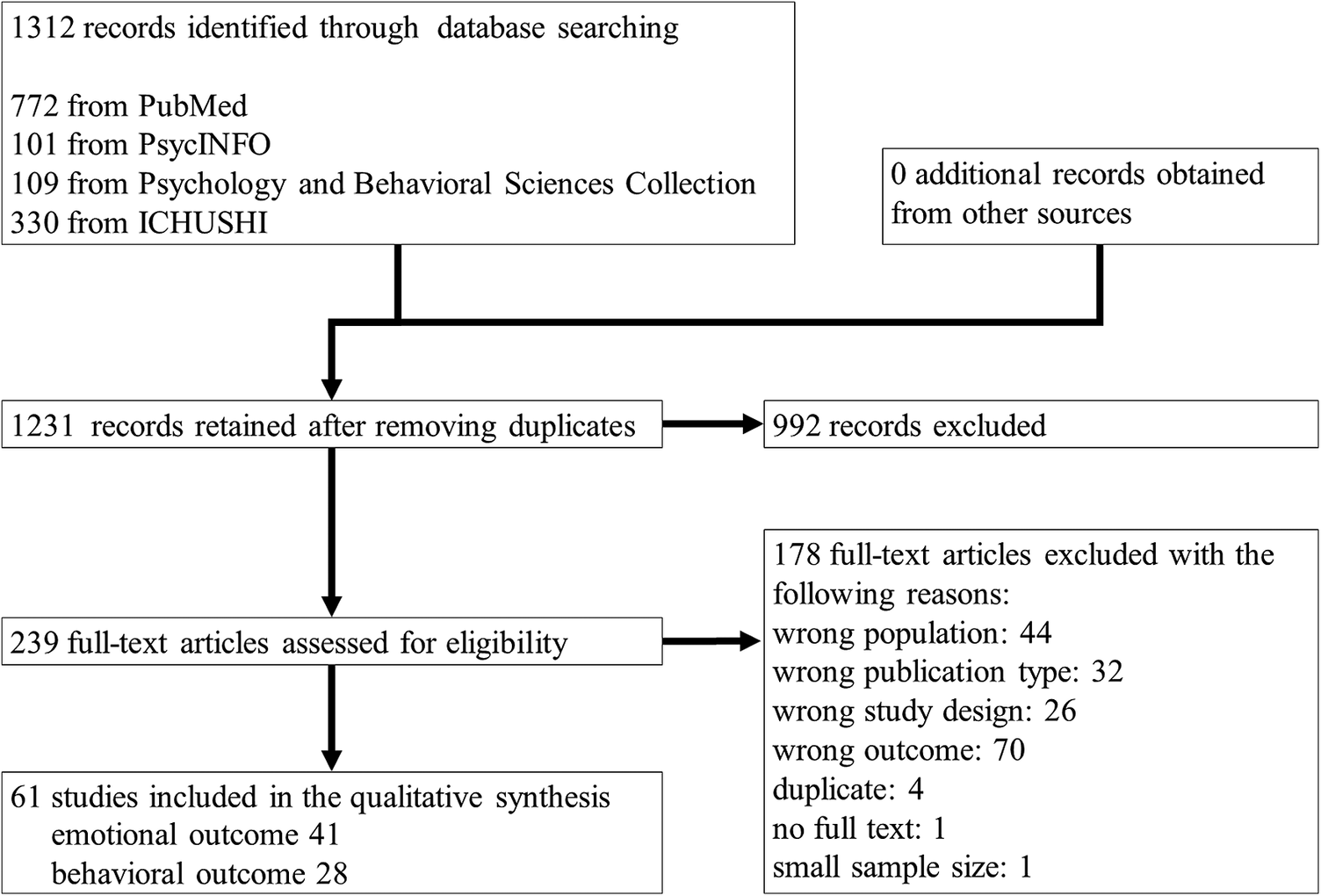
The PRISMA flow chart of study selection in this systematic review is demonstrated in Figure 1. The search strategy identified 1312 studies, of which 239 studies were judged to be eligible based on titles and abstracts. The full texts of the shortlisted studies were then screened, as a result of which 177 studies were further excluded. Finally, 61 studies were included in this review.
Preferred Reporting Items for Systematic Reviews and Meta-Analyses (PRISMA) flow chart of study selection.

Study characteristics
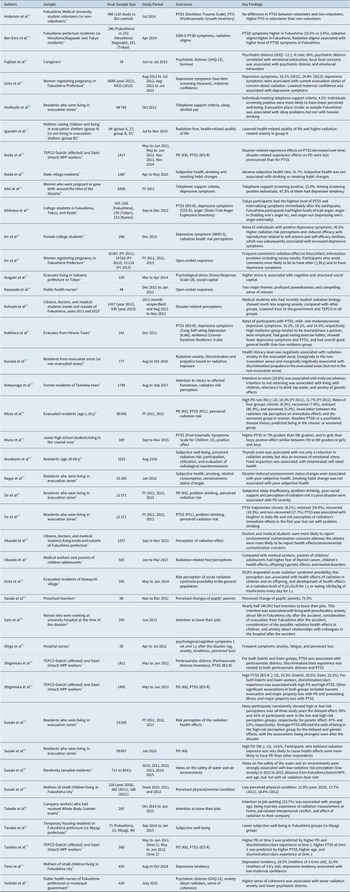
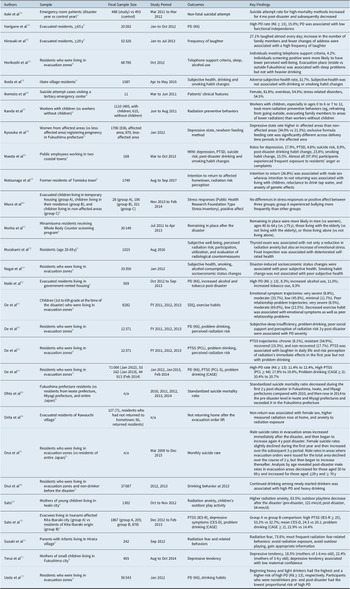
Of the extracted 61 studies, 41 studies (67.2%) assessed emotional consequences (Table 1),Reference Anderson, Prioleau and Taku12–Reference Yoshida, Shinkawa and Urata52 whereas 28 studies (45.9%) evaluated behavioral consequences (Table 2).Reference Horikoshi, Ohira and Yuuki16, Reference Ikeda, Kuroda and Moriyama19, Reference Matsunaga, Orita and Iyama29, Reference Murakami, Takebayashi and Takeda32–Reference Oe, Takahashi and Maeda35, Reference Terui, Goto and Yasumura51, Reference Aoki, Okada and Inokuchi53–Reference Ueda, Yabe and Maeda72 Eight studies (13.1%) evaluated both emotional and behavioral outcomes.Reference Horikoshi, Ohira and Yuuki16, Reference Ikeda, Kuroda and Moriyama19, Reference Matsunaga, Orita and Iyama29, Reference Murakami, Takebayashi and Takeda32–Reference Oe, Takahashi and Maeda35, Reference Terui, Goto and Yasumura51 Nearly half (n = 30, 49.2%) of the studies used community data. Eighteen studies (29.5%) were conducted as a part of the Fukushima Health Management Study (FHMS), a cohort study conducted by Fukushima prefecture for the entire population living in the prefecture.Reference Yasumura, Hosoya and Yamashita73 Given the nature of the prefectural data, the FHMS sample size was as large as 71 000.Reference Oe, Fujii and Maeda64 Three studies (4.9%) used government statistics data and made pre-post disaster comparisons for each study.Reference Suzuki, Murakami and Nishikiori46, Reference Ohto, Maeda and Yabe65, Reference Orui, Suzuki and Maeda67 Two studies (3.3%) used medical record data acquired immediately after the disaster.Reference Aoki, Okada and Inokuchi53, Reference Ikemoto, Komazawa and Murao56 A study reporting intervention methods or effects was not included in the present review.
Studies Assessing Emotional Consequences.

Abbreviations: CES-D, Center for Epidemiologic Studies Depression Scale; DSM5, Diagnostic and Statistical Manual of Mental Disorders, 5th edition; FY, fiscal year; GHQ, General Health Questionnaire; IES-R, Impact of Event Scale-Revised; K6, Kessler 6-Item Psychological Distress Scale; Mini-International Neuropsychiatric Interview; NPP, nuclear power plant; PCL, PTSD Checklist; PD, psychological distress; PTG, post-traumatic growth; PTSD, post-traumatic stress disorder; PTSS, post-traumatic stress symptoms; TEPCO, Tokyo Electric Power Company; WHO-5, World Health Organization-Five Well-Being Index.
a Convenience sample studies.
b Community sample studies.
Studies Assessing Behavioral Consequences.

Abbreviations: CAGE, CAGE scale; CES-D, Center for Epidemiologic Studies Depression Scale; FY, fiscal year; IES-R, Impact of Event Scale-Revised; K6, Kessler 6-Item Psychological Distress Scale; MINI, Mini-International Neuropsychiatric Interview; n/a, not available; PD, psychological distress; PTSD, post-traumatic stress disorder; PTSS, post-traumatic stress symptoms; SDQ, Strengths and Difficulties Questionnaire.
a Convenience sample studies.
b Community sample studies.
Quality assessment
Approximately two-thirds (n = 41, 67.2%) of the studies were written in English language while 20 (32.8%) of the studies were in Japanese language. Three-fourths of the studies (n = 46, 75.4%) utilized single wave cross-sectional design. Eleven studies (18.0%) used cross-sectional, multiple wave design, and among them, three studies (4.9%) adopted trajectory analysis.Reference Oe, Maeda and Nagai34, Reference Oe, Takahashi and Maeda35, Reference Oe, Maeda and Ohira63 Longitudinal studies were limited to four reports (6.6%).Reference Miura, Nagai and Maeda30, Reference Suzuki, Takebayashi and Yasumura44, Reference Tanisho, Shigemura and Kubota50, Reference Orui, Ueda and Suzuki68
Only a single study (1.6%) used face-to-face interview for data acquisition.Reference Maeda, Ueda and Nagai59 Other than the five medical record and government statistics reports, all other studies (n = 55, 90.2%) involved self-report questionnaires. Approximately three-fourths of the studies (n = 45, 73.8%) employed in-group comparison, and did not designate between non-survivors versus survivors outside of Fukushima as their control group.
Emotional consequences
Of the 41 studies assessing emotional consequences, 15 studies (36.6%) analyzed perceptions about the nuclear disaster, especially about radiation health effects.Reference Ito, Sasaki and Okabe22, Reference Ito, Goto and Ishii23, Reference Kuroda, Iwasa and Orui28–Reference Miura, Nagai and Maeda30, Reference Murakami, Takebayashi and Takeda32, 34-38, Reference Sato, Hayashida and Orita40, Reference Suzuki, Takebayashi and Yasumura44–Reference Suzuki, Murakami and Nishikiori46 These effects included not only the early health effects (ie, acute radiation syndrome and fetus/infant effect), but also late health effects (eg, effects on future generations).
Eight studies (19.5%) reported lowered subjective well-being of the affected individuals.Reference Horikoshi, Ohira and Yuuki16, Reference Igarashi, Nishizawa and Noto17, Reference Ikeda, Kuroda and Moriyama19, Reference Kukihara, Yamawaki and Uchiyama27, Reference Murakami, Takebayashi and Takeda32, Reference Nagai, Ohira and Zhang33, Reference Suzuki, Yoshida and Okubo47, Reference Tanabe, Takamura and Mitsunaga49 Two studies (4.9%) reported decreased maternal confidence in mothers of young children.Reference Goto, Bromet and Ota15, Reference Terui, Goto and Yasumura51 On the other hand, four studies (9.8%) noted resilience and positive emotional changes of the affected individuals.Reference Anderson, Prioleau and Taku12, Reference Kawasaki, Omori and Ono25, Reference Kukihara, Yamawaki and Uchiyama27, Reference Miura, Hisata and Nakamura31 These studies were cross-sectional, and thus did not show the causal relationships between disaster exposure, mental health adversities, and positive emotional changes.
Six studies (17.0%) reported perceived discrimination or stigmatization of the survivors.Reference Ben-Ezra, Shigemura and Palgi13, Reference Ikeda, Tanigawa and Charvat18, Reference Kuroda, Iwasa and Orui28, Reference Shigemura, Tanigawa and Nishi42, Reference Shigemura, Tanigawa and Saito43, Reference Tanisho, Shigemura and Kubota50 Four of these studies were conducted among the NPP workers—these workers were exposed to public criticism owing to public views to their electric company after the disaster.Reference Ikeda, Tanigawa and Charvat18, Reference Shigemura, Tanigawa and Nishi42, Reference Shigemura, Tanigawa and Saito43, Reference Tanisho, Shigemura and Kubota50 In these workers, an association between discrimination/slurs and worsening of mental health was confirmed in both cross-sectional and longitudinal studies.Reference Shigemura, Tanigawa and Saito43, Reference Tanisho, Shigemura and Kubota50
Behavioral consequences
Of the 28 studies examining behavioral consequences, two studies (7.1%) explored the changes of suicide rates using government statistics data.Reference Ohto, Maeda and Yabe65, Reference Orui, Suzuki and Maeda67 Ohto and colleagues compared the standardized suicide mortality ratios between Fukushima prefecture residents and other regions of Japan, including Iwate and Miyagi prefectures (ie, regions affected by earthquake and tsunami but not by the nuclear disaster).Reference Ohto, Maeda and Yabe65 They reported that the standardized suicide mortality ratio decreased during the first 2 years after the disaster in Fukushima, Iwate, and Miyagi prefectures compared with that in 2010, and then increased in 2014 to the pre-disaster level in Iwate and Miyagi prefectures and exceeded it in the Fukushima prefecture. Orui and colleagues compared monthly suicide rates of residents from the evacuation areas and across Japan.Reference Orui, Suzuki and Maeda67 Male suicide rates in evacuation areas increased immediately after the disaster, and then began to increase again 4 years after the disaster. Female suicide rates declined slightly during the first year and then increased over the subsequent 3-year period. Male suicide rates in areas where evacuation orders were issued for the total area declined over the course of 2 years, but then began to increase thereafter. Analysis by age revealed post-disaster male suicide rates in evacuation areas decreased for those aged 50 to 69 years and increased for those aged ≤29 years and ≥70 years.
Three studies (10.7%) assessed suicidal risk or non-fatal suicidal attempts.Reference Aoki, Okada and Inokuchi53, Reference Ikemoto, Komazawa and Murao56, Reference Maeda, Ueda and Nagai59 Maeda and colleagues reported that suicidal risk in 168 public employees working in two coastal towns was 8.9%.Reference Maeda, Ueda and Nagai59 A study of emergency room patients before and after the disaster addressed that the suicide attempt rate using high-mortality methods increased during the 4 months after the disaster and then subsequently decreased.Reference Aoki, Okada and Inokuchi53 Ikemoto and colleagues analyzed the clinical characteristics of suicide attempt cases reported in a tertiary emergency center, and found that more than half (54.5%) of them had stress-related disorders.Reference Ikemoto, Komazawa and Murao56
Ten studies (35.7%) scrutinized alcohol drinking behaviors of the disaster survivors.Reference Horikoshi, Ohira and Yuuki16, Reference Ikeda, Kuroda and Moriyama19, Reference Oe, Maeda and Nagai34, Reference Oe, Takahashi and Maeda35, Reference Maeda, Ueda and Nagai59, Reference Naiki, Morita and Takada62, Reference Oe, Fujii and Maeda64, Reference Orui, Ueda and Suzuki68, Reference Sato, Ishida and Hattori70, Reference Ueda, Yabe and Maeda72 In a large-scale FMHS study of evacuated residents, the age-adjusted rates of problem drinking among current drinkers were 20.7% in 2013 and 20.4% in 2014.Reference Oe, Fujii and Maeda64 Three studies reported an association between drinking habit and mental health,Reference Oe, Maeda and Nagai34, Reference Orui, Ueda and Suzuki68, Reference Ueda, Yabe and Maeda72 while two studies did not find a significant association between the two.Reference Ikeda, Kuroda and Moriyama19, Reference Oe, Takahashi and Maeda35
Four studies (14.3%) reported tobacco smoking behaviors of the affected people.Reference Ikeda, Kuroda and Moriyama19, Reference Nagai, Ohira and Zhang33, Reference Maeda, Ueda and Nagai59, Reference Naiki, Morita and Takada62 Among the 168 public employees working in two coastal towns, 15.5% of the participants reported smoking habit changes after the disaster.Reference Maeda, Ueda and Nagai59 Among 509 evacuated residents living in government-rented housings, 8.3% of them reported increased tobacco use.Reference Naiki, Morita and Takada62 Two studies reported that smoking habit change was not associated with subjective health.Reference Ikeda, Kuroda and Moriyama19, Reference Nagai, Ohira and Zhang33 Other study topics included behavior changes to avoid radiation exposure (eg, refraining from going outside, avoiding playing outdoorsReference Kanda, Sugaya and Takahashi57, Reference Oe, Maeda and Ohira63, Reference Sato69 remaining in one’s residence after the disaster,Reference Morita, Nomura and Furutani61 and not returning to one’s home after the evacuation order has been lifted.Reference Orita, Hayashida and Urata66).
Discussion
This present review attempted to capture emotional and behavioral changes of the survivors of the Fukushima nuclear disaster in the first 8 years after the disaster. Regarding emotional changes, studies mainly focused on radiation-related perception, subjective well-being emotional changes, and stigmatization. For behavioral changes, research topics converged on completed suicide, suicidal attempt or risk, and habit changes in alcohol or tobacco use. These outcomes were reported in studies of the Chernobyl disaster survivors,Reference Bromet, Havenaar and Guey2, Reference Bromet, Gluzman and Schwartz4, Reference Laidra, Rahu and Tekkel5, Reference Loganovsky, Havenaar and Tintle74 although Chernobyl studies are unavailable in the same time frame as ours. To our surprise, studies focusing on interventions were not found in the present review.
The main topics of studies measuring post-disaster emotional changes were perceived radiation fear and risk perceptions, (ie, the subject assessment of riskReference Glik75). In the case of the Fukushima nuclear disaster, the event was a combination of natural and technological disasters, and not an intentional malevolent act per se. Nonetheless, some people perceived the event as a human-made disaster considering the relationship between technological failures and multiple safeguards.Reference Funabashi76 In general, risk perceptions are heightened when the hazard is human-made, causes a dreadful situation, is non-voluntary, is geographically focused, is controversial among professionals, is such that it is difficult to detect the extent of exposure, and is out of people’s control.Reference Glik75 These general rules apply to the Fukushima disaster—the affected people were substantially frightened and uncertain because radioactive materials are imperceptible and it is impossible to measure or assess the health effect of radiation exposure without information from the NPP operators, authorities, scientists, and media. However, such information is affected by the extent of consistency, accuracy, clarity, and sufficiency of health-related messages.Reference Glik75 Furthermore, these messages can be confusing and contradictory, and exaggerated by excessive media coverage.Reference Ohtsuru, Tanigawa and Kumagai77
This present study demonstrated that risk perception topics were mainly radiation exposure-related.Reference Goto, Bromet and Ota15, Reference Horikoshi, Ohira and Yuuki16, Reference Ikeda, Kuroda and Moriyama19, Reference Ito, Goto and Ishii23, Reference Kohzaki, Ootsuyama and Moritake26, Reference Kuroda, Iwasa and Orui28, Reference Matsunaga, Orita and Iyama29, Reference Okazaki, Ootsuyama and Abe36, Reference Terui, Goto and Yasumura51, Reference Maeda, Ueda and Nagai59, Reference Oe, Maeda and Ohira63, Reference Orita, Hayashida and Urata66–Reference Sato69, Reference Suzuki, Suzuki and Hata71 These topics were not only about early radiation exposure (eg, acute radiation syndrome) and countermeasures (eg, evacuation, food and water selection, and stable iodine administration), but also delayed effects such as future cancer risks (ie, genetic effects) to themselves and their offspring.Reference Ohtsuru, Tanigawa and Kumagai77, Reference Kamiya, Ozasa and Akiba78 Studies from the Chernobyl disaster suggest a link between risk perception and lowered subjective health,Reference Bromet, Gluzman and Schwartz4, Reference Havenaar, de Wilde and van den Bout79 and studies from Fukushima are in line with this result.Reference Ikeda, Tanigawa and Charvat18, Reference Iwagaki, Tsujiuchi and Masuda24, Reference Hirosaki, Ohira and Yasumura55, Reference Kyozuka, Yasuda and Kawamura58, Reference Morita, Nomura and Furutani61, Reference Oe, Fujii and Maeda64, Reference Sato, Ishida and Hattori70 In order to provide effective health messaging, continuing efforts in risk communication will be needed. A “one-size-fits-all” risk communication approach will not be effective for a wide variety of people with different risk perceptions.Reference Kuroda, Iwasa and Orui28 As suggested by several literary accounts, community-engaged, “tailored” risk communication framework efforts will be effective to improve this situation.Reference Kuroda, Iwasa and Orui28, Reference Ohtsuru, Tanigawa and Kumagai77, Reference Hasegawa, Takahashi and Nemoto80
There were a limited number of studies regarding discrimination and stigmatization among the survivors despite many news reports highlighting this issue.81, 82 A series of NPP workers report the impact of discrimination and stigmatization on mental health in cross-sectional and longitudinal studies,Reference Ikeda, Tanigawa and Charvat18, Reference Shigemura, Tanigawa and Nishi42, Reference Shigemura, Tanigawa and Saito43, Reference Tanisho, Shigemura and Kubota50 but for other populations, this relationship is yet to be elucidated. Future studies focusing on discrimination and stigmatization experiences are needed to better understand the mental health burden in various survivor groups.
Among the diverse behavioral changes of the nuclear disaster-affected individuals, completed suicide was the most serious outcome.Reference Ohto, Maeda and Yabe65, Reference Orui, Suzuki and Maeda67 These studies utilizing government statistics data showed that suicide rates increased in Fukushima prefecture more than in the entirety of JapanReference Orui, Suzuki and Maeda67 or prefectures affected by earthquake and tsunami but not by the nuclear accident.Reference Ohto, Maeda and Yabe65 Three studies reported suicidal risk and non-fatal suicidal attempts in the affected individualsReference Aoki, Okada and Inokuchi53, Reference Ikemoto, Komazawa and Murao56, Reference Maeda, Ueda and Nagai59; these studies were cross-sectional, and the longitudinal impact of these conditions remains ambiguous. A study of Chernobyl clean-up workers reported increased suicidal ideation and completed suicides,Reference Rahu, Rahu and Tekkel7, Reference Loganovsky, Havenaar and Tintle74, Reference Rahu, Auvinen and Hakulinen83 and similar studies will be vital in assessing Fukushima disaster survivors as well.
A majority of literature focused on drinking or smoking behavioral changes in the Fukushima disaster survivors,Reference Horikoshi, Ohira and Yuuki16, Reference Ikeda, Kuroda and Moriyama19, Reference Oe, Maeda and Nagai34, Reference Oe, Takahashi and Maeda35, Reference Maeda, Ueda and Nagai59, Reference Naiki, Morita and Takada62, Reference Oe, Fujii and Maeda64, Reference Orui, Ueda and Suzuki68, Reference Sato, Ishida and Hattori70, Reference Ueda, Yabe and Maeda72 although the relationship between drinking or smoking and health measures was inconsistent. Previous literature reports use of alcohol or tobacco use as a maladaptive coping method in natural disaster survivors,Reference Flory, Hankin and Kloos84 September 11, 2001 terrorist attack survivors,Reference Vlahov, Galea and Ahern85 as well as Chernobyl clean-up workers.Reference Laidra, Rahu and Tekkel5, Reference Rahu, Bromet and Hakulinen6, Reference Rahu, Auvinen and Hakulinen83 It will be essential to provide education and interventions to disaster survivors with a specific emphasis on adaptive behavior.
In this review, several limitations warrant further discussion. Our literature search was limited to four databases and did not capture all the studies available within the scientific community. Our search was limited to manuscripts published in the first 8 years after the disaster, so there is limited understanding of emotional and behavioral consequences to the disaster survivors within a longer timeframe. Further, there might be other emotional or behavioral changes that have not been studied but relevant to the survivors’ well-being.
Conclusion
The present review compiled a variety of emotional and behavioral changes reported in the survivors of the Fukushima nuclear disaster. Intervention studies were not found in this present review. The most salient emotional change was risk perception related to fear of imperceptible radioactive materials. This risk perception was linked with not only immediate health effects (eg, acute radiation syndrome), but also future health effects (eg, future cancer and genetic effects) as well as lowered well-being. Numerous studies reported perceived discrimination/stigmatization in the disaster survivors, but intervention reports were not found. Given the negative effect of these events, studies focusing on intervention methods and their outcomes will be crucial.
The most pronounced behavioral change was increased completed suicide attempts compared with that in the residents of the entirety of Japan or affected by the earthquake and tsunami but not by the nuclear disaster. Increased rates of alcohol and tobacco use was reported in various studies; although the health effect of alcohol or tobacco was inconsistent at this time point, these behaviors can lead to future adverse health outcomes, such as alcohol-related gastroenterological disorders, tobacco-related respiratory disorders, and malignancies. The present study might be of importance in responding to future disasters—not only nuclear/radiological disasters, but also other CBRN events such as chemical and biological public health crises.
Acknowledgments
We would like to thank Editage (www.editage.jp) for English language editing.
Funding
The authors did not receive funding in connection with this study.
Disclosures
The authors do not have an affiliation with or financial interest in any organization that might pose a conflict of interest.
Supplementary Materials
To view supplementary material for this article, please visit http://dx.doi.org/10.1017/S1092852920000115.