Introduction
Goose barnacles (Lepadidae) are a cosmopolitan pelagic biofouling group, attaching themselves to almost any floating or moving substrate (Thiel & Gutow, Reference Thiel, Gutow, Gibson, Atkinson and Gordon2005). Although most common on debris such as pumice, wood or plastic, they can also attach to living organisms. Conchoderma virgatum is especially opportunistic and has been observed attached to a diverse range of other marine species, including sea snakes (Yamato et al., Reference Yamato, Yusa and Tanase1996; Alvarez & Celis, Reference Alvarez and Celis2004), sharks (Beckett, Reference Beckett1968), fishes (Balakrishnan, Reference Balakrishnan1969; Hastings, Reference Hastings1972; Nagasawa et al., Reference Nagasawa, Otani and Nagahama2020) and even penguins (Nascimento et al., Reference Nascimento, Vanstreels, Niemeyer, Ruoppolo and Catão-Dias2010).
Most observations of C. virgatum as epibionts, however, are on whales (Uchida & Araki, Reference Uchida and Araki2000; Ólafsdóttir & Shinn, Reference Ólafsdóttir and Shinn2013) or sea turtles (Hernández-Vázquez & Valadez-González, Reference Hernández-Vázquez and Valadez-González1998; Angulo-Lozano et al., Reference Angulo-Lozano, Nava-Duran and Frick2007), with the relatively slow speed of these hosts possibly facilitating easier attachment. Settlement on whales is often indirect, with C. virgatum attaching to other epibionts such as whale barnacles (Coronula spp.) rather than the smoother surface of the whales themselves (Félix et al., Reference Félix, Bearson and Falconí2006). Settlement on turtles is also biased towards hard or heterogeneous sites, such as carapace ridges and epidermal abrasions (Eckert & Eckert, Reference Eckert and Eckert1987). In cases of settlement on fishes, the same preference for hard substrates occurs (Crozier, Reference Crozier1916), with C. virgatum recorded as attaching to the spines or rough skin of hard-bodied tetraodontiforms such as porcupinefishes or filefishes (Crozier, Reference Crozier1916; Balakrishnan, Reference Balakrishnan1969), or to other hard body structures such as the bills of swordfishes (Beckett, Reference Beckett1968).
Results and discussion
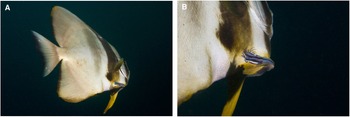
Here we present the first known record of Conchoderma virgatum attached to an ephippid fish, the longfin batfish (Platax teira), and only the second known record of C. virgatum attached to a perciform fish in the Tasman Sea. During a recreational dive on 9 June 2013 at the ex-HMAS Adelaide, an artificial dive reef ~1.8 km off the New South Wales Central Coast, Australia (33.46°S, 151.45°E), an adult P. teira with an epibiont attached to its right pelvic fin was observed and photographed at ~22 m water depth (Figure 1). The photographs were uploaded to the online biodiversity citizen science platform iNaturalist (www.inaturalist.org) on 3 July 2020, and the epibiont identified as C. virgatum. This observation is also the first known record of P. teira as a host for any lepadid barnacle species.
(A) Lepadid barnacle Conchoderma virgatum attached to the right pelvic fin of a longfin batfish (Platax teira); (B) Close-up of C. virgatum. Observation made on 9 June 2013 at the ex-HMAS Adelaide, an artificial dive reef ~1.8 km off the New South Wales Central Coast, Australia at ~22 m water depth (33.46°S, 151.45°E).

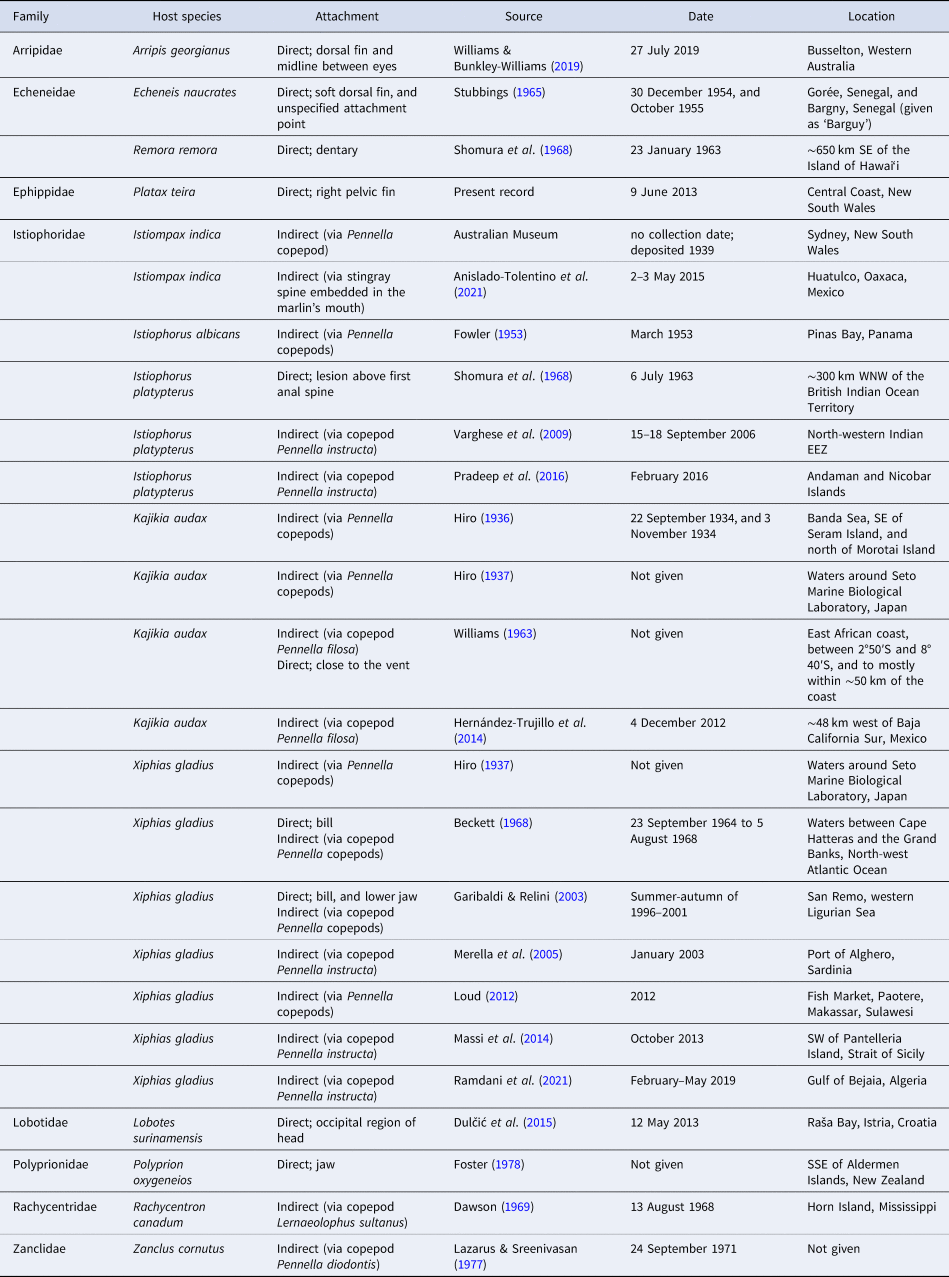
Given their typical lack of external hard body parts such as spines, perciform fishes are relatively rarely observed as hosts for C. virgatum (Table 1), and indeed many of these cases involve indirect attachment via settlement on ectoparasitic Pennella copepods (e.g. Lazarus & Sreenivasan, Reference Lazarus and Sreenivasan1977; Hernández-Trujillo et al., Reference Hernández-Trujillo, Funes-Rodríguez, González-Armas and Ortega-García2014; Massi et al., Reference Massi, Titone, Bottari, Busalacchi, Gancitano, Giusto, Sinacori and Vitale2014). Mucus secretions by perciform fishes may play a strong role in preventing direct attachment by barnacle larvae (Shomura et al., Reference Shomura, Rothschild and Jones1968; Dulčić et al., Reference Dulčić, Dragičević, Despalatović, Cvitković, Bojanić-Varezić and Štifanić2015). The relatively smooth bodies of perciform fishes likely also contribute to reduced attachment success; lepadid barnacles such as Conchoderma and Lepas typically show strong preferences for rough or irregular surfaces when attaching to floating debris (Foster & Willan, Reference Foster and Willan1979; Mesaglio et al., Reference Mesaglio, Schilling, Adler, Ahyong, Maslen and Suthers2021). In this record, direct settlement on P. teira was likely facilitated by the relatively slow swimming speed of this fish species, and by attachment to the right pelvic fin, allowing the barnacle to avoid the main mucus layer on the fish's body.
Known records of Conchoderma virgatum on perciform fishes

Interestingly, there are observations of C. virgatum as a pioneer species on smooth surfaces (Mesaglio et al., Reference Mesaglio, Schilling, Adler, Ahyong, Maslen and Suthers2021), however, settlement is almost always followed by rapid predation due to their soft bodies and immobility once attached (Iljin et al., Reference Iljin, Petrosyan, Bessonov and Dergunova2013; Mesaglio et al., Reference Mesaglio, Schilling, Adler, Ahyong, Maslen and Suthers2021). Attachment to perciform fishes may therefore be more common than realized, with the rarity of observations possibly driven by predation by e.g. cleaner wrasses (Losey et al., Reference Losey, Balazs and Privitera1994).
Conclusions
As the first record of C. virgatum as an epibiont on an ephippid fish (and by extension, the first on the species P. teira), and only the second record of C. virgatum attached to a perciform fish in the Tasman Sea, this observation extends our knowledge of the distribution of C. virgatum as an epibiont, and of the known hosts for C. virgatum.
Acknowledgements
We thank Shane Ahyong and Hayden Schilling for their comments which improved the manuscript. We also thank Helen Stoddart and Amanda Hay for the Australian Museum records they provided to us, Connie Fleischer and Fulvio Garibaldi for providing us with difficult to access papers, and Paul Mesaglio for translating a paper from Italian. Two anonymous reviewers provided thoughtful comments that improved this manuscript.
Author contributions
M.D. and G.M. made the original observation, and provided edits and comments on all drafts. T.M. conceived the idea for this paper and wrote the first draft. All authors read and approved the final manuscript.