Introduction
Since the nineteenth century there have been descriptions of acute schizophrenia-like psychotic symptoms in healthy subjects who had taken cannabis (Moreau de Tours, Reference Moreau de Tours1845; Ames, Reference Ames1958; Talbott & Teague, Reference Talbott and Teague1969; Chopra & Smith, Reference Chopra and Smith1974). The prevalence of cannabis use in psychotic patients presenting to psychiatric services for the first time is approximately double that found in the general population (Hambrecht & Hafner, Reference Hambrecht and Hafner2000; Van Mastrigt et al. Reference Van Mastrigt, Addington and Addington2004; Barnett et al. Reference Barnett, Werners, Secher, Hill, Brazil, Masson, Pernet, Kirkbride, Murray, Bullmore and Jones2007), and those patients who continue to use cannabis exhibit earlier and more frequent relapses compared to non-users (Linszen et al. Reference Linszen, Dingemans and Lenior1994; Caspari, Reference Caspari1999; Grech et al. Reference Grech, Van Os, Jones, Lewis and Murray2005). Furthermore, there is now considerable evidence that regular cannabis use is associated with an increased risk of schizophrenic illness (Arseneault et al. Reference Arseneault, Cannon, Witton and Murray2004; Barnes et al. Reference Barnes, Mutsatsa, Hutton, Watt and Joyce2006; Hall, Reference Hall2006; Moore et al. Reference Moore, Zammit, Lingford-Hughes, Barnes, Jones, Burke and Lewis2007; Murray et al. Reference Murray, Morrison, Henquet and Di Forti2007).
It is clear that the major psychoactive properties of cannabis are attributable to the molecule Δ9-tetrahydrocannabinol (THC), which acts as a partial agonist at cannabinoid CB1 receptors in the brain (Mechoulam et al. Reference Mechoulam, Shani, Edery and Grunfeld1970; Pertwee, Reference Pertwee2006). Several recent studies have investigated the acute pharmacological effects of marijuana, plant-derived THC extracts or synthetic THC under laboratory conditions, either in healthy controls (Curran et al. Reference Curran, Brignell, Fletcher, Middleton and Henry2002; D'Souza et al. Reference D'Souza, Perry, MacDougall, Ammerman, Cooper, Wu, Braley, Gueorguieva and Krystal2004; Henquet et al. Reference Henquet, Rosa, Krabbendam, Papiol, Fananas, Drukker, Ramaekers and van Os2006; Koethe et al. Reference Koethe, Gerth, Neatby, Haensel, Thies, Schneider, Emrich, Klosterkotter, Schultze-Lutter and Leweke2006; Ramaekers et al. Reference Ramaekers, Kauert, van Ruitenbeek, Theunissen, Schneider and Moeller2006; Juckel et al. Reference Juckel, Roser, Nadulski, Stadelmann and Gallinat2007) or in schizophrenic patients (D'Souza et al. Reference D'Souza, Abi-Saab, Madonick, Forselius-Bielen, Doersch, Braley, Gueorguieva, Cooper and Krystal2005), using a variety of drug administration routes.
Studies using smoked marijuana, although highly informative of herbal drug effects, are compromised by the presence of at least 60 other cannabinoid molecules, some of which are CB1 receptor antagonists (Pertwee, Reference Pertwee2006, Reference Pertwee2008; Ryan et al. Reference Ryan, Drysdale, Pertwee and Platt2006). Orally administered cannabinoids have the disadvantage of poor, irregular absorption and marked inter-individual variation in plasma concentrations (Grotenhermen, Reference Grotenhermen2003). By contrast, intravenous (i.v.) administration of synthetic THC offers a rapid and reliable delivery method with low inter-individual variation in bioavailability and a pharmacokinetic time-course that mirrors that of smoked marijuana (Ohlsson et al. Reference Ohlsson, Lindgren, Wahlen, Agurell, Hollister and Gillespie1980; Grotenhermen, Reference Grotenhermen2003; Naef et al. Reference Naef, Russmann, Petersen-Felix and Brenneisen2004). Previous studies of the effects of IV THC have used doses ranging from 2 to 5 mg, which approximate the levels of THC from smoking a standard cannabis ‘joint’ containing 1–3.5% THC (16–34 mg) (Ohlsson et al. Reference Ohlsson, Lindgren, Wahlen, Agurell, Hollister and Gillespie1980; Volkow et al. Reference Volkow, Gillespie, Mullani, Tancredi, Grant, Ivanovic and Hollister1991; D'Souza et al. Reference D'Souza, Perry, MacDougall, Ammerman, Cooper, Wu, Braley, Gueorguieva and Krystal2004, Reference D'Souza, Abi-Saab, Madonick, Forselius-Bielen, Doersch, Braley, Gueorguieva, Cooper and Krystal2005). Using this route, it was shown that THC elicited psychotic symptoms and cognitive impairments in a proportion of healthy subjects (D'Souza et al. Reference D'Souza, Perry, MacDougall, Ammerman, Cooper, Wu, Braley, Gueorguieva and Krystal2004) and worsened psychotic symptoms in schizophrenic patients (D'Souza et al. Reference D'Souza, Abi-Saab, Madonick, Forselius-Bielen, Doersch, Braley, Gueorguieva, Cooper and Krystal2005). This work used the Positive and Negative Syndrome Scale (PANSS; Kay et al. Reference Kay, Opler and Lindenmayer1989), an investigator-rated scale, to measure THC psychosis (D'Souza et al. Reference D'Souza, Perry, MacDougall, Ammerman, Cooper, Wu, Braley, Gueorguieva and Krystal2004).
Although the work by D'Souza and colleagues shows that THC induces an elevation of PANSS positive scores, it is to be recognized that the PANSS is a scale developed and validated in patients with chronic psychosis, is rated by the observer, and was not designed for immediate repeated administration (i.e. repeatedly within a few hours). Thus, we thought that it would be informative to obtain the subjective perspective on the THC-induced experience by administering a subjective scale previously used in healthy subjects: the Community Assessment of Psychic Experiences – state version (CAPE-state; Henquet et al. Reference Henquet, Rosa, Krabbendam, Papiol, Fananas, Drukker, Ramaekers and van Os2006). Furthermore, to fully explore the phenomenology of THC-induced acute psychosis as a possible ‘model’ for schizophrenia, we thought it crucial that its effects on mood and anxiety be explored concurrently; therefore, we included a validated structured instrument that is known to be sensitive to change: the University of Wales Institute of Science and Technology Mood Adjective Checklist (UMACL; Matthews et al. Reference Matthews, Jones and Chamberlain1990). We hypothesized that i.v. THC would be anxiogenic and aimed to explore the relationship between THC-elicited psychosis and THC-elicited anxiety. Finally, we wanted to further characterize the effect of THC on cognitive function and the relationship between psychotic symptoms and cognitive impairment. Deficits in cognitive function are regarded as a potential intermediate phenotype in schizophrenia and predict outcome (reviewed in Solowij & Michie, Reference Solowij and Michie2007). We hypothesized that cognitive performance would be poorer under THC compared to placebo conditions.
Method
The study was carried out at the Institute of Psychiatry following approval by the South London and Maudsley (SLAM) Regional Ethics Committee.
Design
The psychological properties of i.v. THC (2.5 mg) were investigated in an experimental study using a within-subject, double-blind, placebo-controlled design. Participants attended two experimental sessions, at least 2 weeks apart, in which either THC or placebo was given in a random, counterbalanced order.
Participants
Healthy male participants were recruited by way of email advertisements delivered to the staff and students of King's College London. Prospective participants, assessed by a trained psychiatrist at baseline, were required to be aged between 21 and 50 years; to have previously taken cannabis on at least one occasion; to score <15 on the General Health Questionnaire (GHQ-12; Goldberg & Blackwell, Reference Goldberg and Blackwell1970); and be willing to provide written informed consent. Exclusion criteria were a history of mental illness, substance dependence (excluding nicotine), current or past severe medical disorders or a history of major mental illness in a first-degree family member. Alcohol and drug dependence were excluded using the Michigan Alcohol Screening Test (MAST; Selzer, Reference Selzer1971) and the Drug Abuse Screening Test (DAST; Skinner, Reference Skinner1982). The nature and risks of the study were discussed. Participants were alerted to the possibility of transient anxiety and psychosis following THC and were made aware that they would be able to stop the experimental sessions at any stage without sanction and that rescue medication (lorazepam tablets 1–4 mg) would be available. Participants were asked to avoid alcohol and drugs for 24 h before, and to abstain from driving for 24 h after, experimental sessions. Participants were followed up by telephone the following day and a small monetary reimbursement was made at the end of their involvement in the study.
Pharmaceuticals
Dronabinol (THC) was supplied by THC Pharm GmbH (Frankfurt am Main, Germany) and prepared as (1 mg/ml) vials for i.v. injection by Bichsel Laboratories (Interlaken, Switzerland) according to the method of Naef et al. (Reference Naef, Russmann, Petersen-Felix and Brenneisen2004). Placebo and active vials were identical in composition (except for THC) and identical in appearance. After dilution in normal saline, preparations for injection contained 2.5% (v/v) absolute ethanol.
Experimental sessions
A psychiatrist assessed participants and a brief physical examination was conducted at the beginning of each session. Urine was taken for drug testing. Sterile cannulae (20G) were inserted into veins in the antecubital fossa of both arms, one for administration of pharmaceuticals and one for blood sampling. Participants were asked to sit comfortably on a clinical couch and given free access to water. Pharmaceuticals were administered in pulses at 1 ml/min over 5 min (total 5 ml).
Outcome measures
Psychological assessments and self-rated scales were administered at baseline (30 min prior to injection) and at 30, 80 and 120 min following the final injected pulse. Participants were instructed to complete rating scales as applied to the present moment. A trained psychiatrist conducted all assessments.
Positive psychotic symptoms
Momentary positive psychotic symptoms were assessed using the positive subscale of the PANSS and the CAPE-state. The CAPE-state is a validated 42-item self-reported questionnaire, derived from the Peters Delusions Inventory (PDI), which generates a positive, a negative and a depressive dimension score (Henquet et al. Reference Henquet, Rosa, Krabbendam, Papiol, Fananas, Drukker, Ramaekers and van Os2006). In the current study, the CAPE-state frequency score (0=never, 1=sometimes, 2=often, 3=nearly always) was collapsed to a yes/no response option.
Affect
The UMACL was used to assess changes in affect. Three dimensions of affect are measured: hedonic tone, energetic arousal and tense arousal (Matthews et al. Reference Matthews, Jones and Chamberlain1990). It has been suggested that a three-dimensional model of affect with separate pleasure–displeasure, awake–tiredness and tension–relaxation dimensions provides a more informative description of core affect (compared to one- and two-dimensional models) and fits better with experimental data (Matthews et al. Reference Matthews, Jones and Chamberlain1990; Schimmack & Grob, Reference Schimmack and Grob2000). For each dimension, subjects rated their level of agreement with four emotionally positive and four emotionally negative adjectives. The total score in each dimension was calculated by subtracting negatively valenced from positively valenced items. For each subject the total score in each dimension at baseline, 30, 80 and 120 min post-injection was a value between −12 and +12.
Cognitive testing
Cognitive assessments began 10 min post-injection. The order of tests was consistent across both sessions: (1) the Rey Auditory Verbal Learning Task (RAVLT)-immediate recall; (2) Digit Span; (3) Verbal Fluency; (4) RAVLT-20 min recall; and (5) the Baddeley Reasoning Task. Cognitive testing was complete within 45 min post-injection.
RAVLT
The standard administration format of the RAVLT was used. Immediate recall of a 15-word list was assessed over five trials. Two different, but equivalent, word lists were used. Free recall was assessed following a 20-min delay. (The interference component, List B, was included but the data are not reported here.)
Digit Span
The Digit Span task evaluates the capacity of attention and working memory. Participants were tested in their immediate recall of a sequence of digits; and given two attempts at each level of difficulty. In the reverse digit span condition, participants were required to recall the sequence in the reverse order.
Verbal fluency
The verbal fluency task evaluates speed of retrieval from semantic memory. Participants were given 60 s to generate words beginning with a specific letter of the alphabet and instructed that proper nouns and plurals did not score. The mean number of words generated from four trials was recorded as the total score.
The Baddeley Reasoning Task
Participants were given 3 min in which to verify the truth of 32 logical statements containing one of four grammatical constructs such as: ‘B does not precede A … AB’. The highest obtainable score was 32. This task evaluates the performance of the central executive.
Pharmacokinetic analysis
Blood (5 ml) was collected at baseline and at 1, 5, 15, 30, 60 and 120 min post-injection. Immediately after collection, samples were stored at 2–5°C, prior to being centrifuged. Plasma was stored at −70°C until analysis. The samples were extracted using solid phase extraction (SPE), then THC and its primary metabolite 11-OH-THC were derivatized and measured using gas chromatography with mass-spectrophotometric detection (GC–MS) as described previously (Steinmeyer et al. Reference Steinmeyer, Bregel, Warth, Kraemer and Moeller2002).
Statistical analyses
All analyses were performed in SPSS version 15.0 (SPSS Inc., Chicago, IL, USA). Data were assessed for normality using Kolmogorov–Smirnov test statistics. Because of absence of variance in positive psychotic scores under placebo conditions, Friedman's test, a non-parametric repeated-measures test, was used to compare positive psychotic scores under THC and placebo conditions. Two-way repeated-measures ANOVA was used to compare immediate recall in the RAVLT, with Trial (1–5) and Treatment (placebo versus THC) as within-subject factors. The Greenhouse–Geisser corrected F ratio was used because there was a violation of sphericity. For the remaining cognitive tasks and the UMACL, differences between placebo and THC were compared using paired t tests. Relationships between normally distributed variables were analysed using Pearson's product moment correlation. Relationships between non-parametric variables were tested using Spearman's rank correlation coefficient. Significance was accepted at p values <0.05. All comparisons were two-tailed.
Results
Of 24 volunteers, 22 attended both sessions. Participants were aged 28±6 years (mean±s.d.). All participants were Caucasian. Estimated lifetime exposure to cannabis ranged from 2 to about 1000 episodes. Self-reported last previous use of cannabis ranged from 12 h to 10 years (mean±s.d.=2±3.3 years). In urine drug screens, one participant tested positive for THC, but this was the case prior to both experimental sessions, thus the data were included in the main analyses. No participants tested positive for other common drugs of abuse (opiates, cocaine, amphetamines, methamphetamine, methadone, benzodiazepines) at either session.
Of the 22 participants, three subjects were unable to complete all parts of the protocol. One experienced nausea during the THC arm; another refused to participate in cognitive testing or to complete self-rated scales under THC; and one participant experienced profound anxiety during the THC arm and requested ‘rescue medication’ (lorazepam 3 mg); symptoms resolved completely within 30 min.
THC-induced positive psychotic symptoms
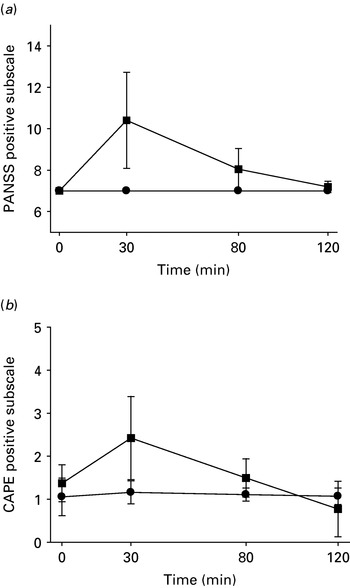
Scores on the PANSS positive subscale were increased from baseline following THC but not placebo administration (Friedman's χ2=62, df=7, n=21, p<0.001). At 30 min post-THC, PANSS positive scores had increased by a mean of 3.7 points (range 0–17), returning to baseline levels by 120 min (Fig. 1a). Similarly, subject-rated positive psychotic symptoms as measured by the CAPE-state increased from baseline following THC but not placebo (Friedman's χ2=20, df=7, n=17, p=0.005). By 80 min post-injection, CAPE-state scores had returned to baseline (Fig. 1b). Investigator-rated (PANSS) and subject-rated (CAPE-state) positive psychotic scores at 30 and 80 min post-THC administration were correlated (Spearman's ρ=0.62, p<0.001). Participants who had taken cannabis more extensively in the past were less likely to exhibit positive psychotic symptoms as rated by the PANSS under THC conditions at 30 min post-injection (Spearman's ρ=−0.45, p<0.05).
Mean positive psychotic symptoms as measured by (a) the Positive and Negative Syndrome Scale (PANSS) and (b) the Community Assessment of Psychic Experiences (CAPE) scale following intravenous Δ9-tetrahydrocannabinol (THC) (2.5 mg). Error bars show ±95% confidence interval. –•–, Placebo; –▪–, THC.

The impact of THC on core affect
Hedonic tone
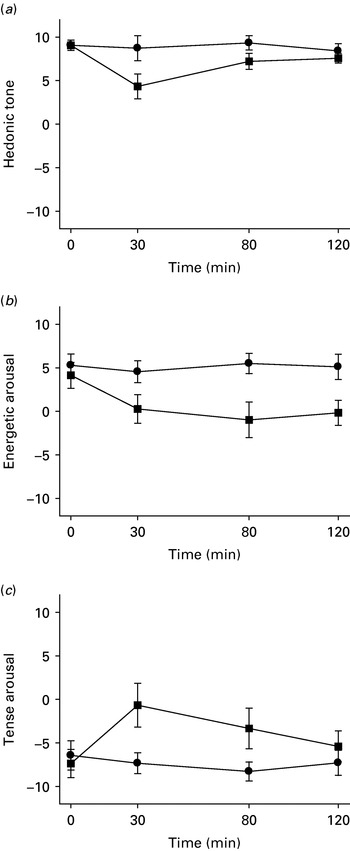
IV THC elicited transient feelings of dysphoria. Under THC conditions, self-rated hedonic tone as measured by the UMACL was decreased compared to placebo at 30 min post-injection [THC, mean=4.3, 95% confidence interval (CI) 2.9–5.8; placebo, mean=8.7, 95% CI 7.3–10.1, t(17)=3.24, p=0.005] and at 80 min post-injection [THC, mean=7.2, 95% CI 6.3–8.1; placebo, mean=9.3, 95% CI 8.5–10.2, t(15)=2.62, p<0.05]. By 120 min, there was no significant difference in hedonic tone between THC and placebo conditions (Fig. 2a).
Mean scores of (a) hedonic tone, (b) energetic arousal and (c) tense arousal as measured by the University of Wales Institute of Science and Technology Mood Adjective Checklist (UMACL) following intravenous Δ9-tetrahydrocannabinol (THC) (2.5 mg). Error bars show ±95% confidence interval. –•–, Placebo; –▪–, THC.

Energetic arousal
On the UMACL awake–tiredness dimension, THC induced feelings of tiredness at 30 min [THC, mean=0.3, 95% CI −1.8 to 2.4; placebo, mean=4.6, 95% CI 3.3–5.8, t(17)=4.09, p=0.001], at 80 min [THC, mean=−1.0, 95% CI −3.0 to 1.1; placebo, mean=5.5, 95% CI 4.3–6.7, t(15)=4.74, p<0.000] and at 120 min post-injection [THC, mean=−0.2, 95% CI −1.6 to 1.3; placebo, mean=5.1, 95% CI 3.7–6.6, t(9)=3.60, p<0.01] (Fig. 2b).
Tense arousal
On the UMACL tension–relaxation dimension, THC induced feelings of tense arousal at 30 min [THC, mean=−0.7, 95% CI −3.2 to 1.9; placebo, mean=−7.3, 95% CI −8.5 to −6.1, t(17)=−3.93, p=0.001] and at 80 min post-injection [THC, mean=−3.3, 95% CI −5.7 to −1.0; placebo, mean=−8.3, 95% CI −9.4 to −7.2, t(15)=−3.2, p<0.01]. By 120 min, there was no significant difference in tense arousal between THC and placebo conditions (Fig. 2c).
Notably, there was no relationship at 30 and 80 min post-injection between the degree of THC-elicited tense arousal and positive psychotic symptoms whether measured using the PANSS (Spearman's ρ=0.19, p=0.30) or the CAPE-state (Spearman's ρ=0.28, p=0.12).
The impact of THC on cognitive performance
RAVLT
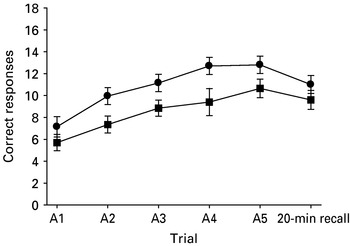
Immediate recall under THC or placebo conditions (Treatment) was compared in successive trials A1–A5 (Trial) of the RAVLT. There was a significant main effect of drug [F(1, 19)=16.6, p<0.005] and a significant main effect of trial [F(2.71, 51.49)=85.3, p<0.000] but only a trend towards a drug×trial interaction [F(3.04, 57.82)=2.24, p=0.09]. Whereas THC significantly decreased immediate recall, there was only a trend towards a difference in free recall (at 20 min post-encoding) between placebo (mean±s.d.=11.1±3.3) and THC (9.7±3.5) conditions [t(17)=1.75, p=0.10] (Fig. 3).
Performance in the Rey Auditory Verbal Learning Task (RAVLT) following intravenous Δ9-tetrahydrocannabinol (THC) (2.5 mg) or matched placebo. Mean scores are shown for consecutive trials of working memory (A1–A5) and for free recall at 20-min post-encoding. Error bars show ±95% confidence interval. –•–, Placebo; –▪–, THC.

Under THC conditions, the total diminution in immediate recall (sum of trials A1–A5) showed no relationship to PANSS positive scores at 30 min (Spearman's ρ=−0.29, p=0.20). Similarly, delayed free recall performance under THC conditions was unrelated to PANSS positive scores at 30 min (Spearman's ρ=−0.39, p=0.12).
Digit Span
THC decreased performance in the forward [mean raw score±s.d.: THC=7.0±1.2, placebo=7.8±0.9, t(18)=2.62, p<0.05] and reverse digit span task [THC=5.1±1.4, placebo=6.2±1.1, t(18)=3.3, p<0.005]. Diminished performance under THC conditions was unrelated to the magnitude of PANSS positive scores at 30 min post-injection, both for the forward (Spearman's ρ=0.11, p=0.61) and reverse (Spearman's ρ=0.30, p=0.20) arms.
Verbal fluency
Participants showed no difference in performance between THC (mean±s.d.=19.3±3.2) and placebo (18.9±4.2) conditions [t(15)=−0.3, p=0.7].
Baddeley Reasoning Task
Performance in the Baddeley Reasoning Task under THC (mean±s.d.=22.3±7.6) was significantly poorer than under placebo conditions (26.9±5.9) [t(15)=3.6, p=0.003]. There was no relationship between performance in the Baddeley Reasoning Task and working memory scores as indexed by the Digit Span task (r=−0.1, p=0.7), indicating that poorer executive function was not driven by the effect of THC on working memory. The magnitude of poorer performance in the Baddeley under THC conditions was unrelated to PANSS positive scores at 30 min post-injection (Spearman's ρ=0.08, p=0.77).
Pharmacokinetics
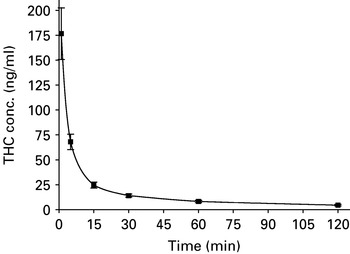
Following IV THC (2.5 mg over 5 min), plasma concentrations reached a maximum and then decreased rapidly over 15 min. Thereafter, concentrations decreased at a slower rate (Fig. 4).
Mean plasma concentrations following intravenous administration of Δ9-tetrahydrocannabinol (THC) (2.5 mg). Error bars show ±95% confidence interval.

At 1 min post-injection the plasma concentration of THC ranged between 96.1 and 206.6 ng/ml (mean±s.d.=176.7±33.7). Peak plasma concentrations of the main psychoactive metabolite of THC (11-OH-THC) occurred at 5 min post-injection and ranged from 1.5 to 7.8 ng/ml (mean±s.d.=4.4±2.1). THC area under the curve from time 0 to infinity (AUC0–∞) ranged from 1110.1 to 2995.4 ng min/ml (mean±s.d.=2047.3±423.7).
There was no relationship between positive psychotic symptoms, as measured by the PANSS, and plasma concentrations of THC at 5 min, or 11-OH-THC concentrations at 5 min. Similarly, PANSS positive scores following THC administration and AUC0–∞ were unrelated.
Discussion
The observed plasma concentrations and time-course of THC in the present study are in a similar range to those from previous studies in which individuals smoked cannabis cigarettes. In a study of healthy males, mean plasma levels of THC immediately after 10 puffs from cannabis cigarettes containing 1.75% or 3.55% THC were respectively 56.2 and 146.6 ng/ml (Azorlosa et al. Reference Azorlosa, Greenwald and Stitzer1995). Ramaekers et al. (Reference Ramaekers, Kauert, van Ruitenbeek, Theunissen, Schneider and Moeller2006) investigated the properties of high-potency marijuana cigarettes containing 13% THC in a sample of recreational cannabis users. The mean (s.d.) serum THC concentration at 5 min post-smoking was 93.6 (63.9) ng/ml. In the present study, the mean (s.d.) plasma THC concentration at 5 min post-injection was 68.0 (14.1) ng/ml.
Psychological responses to THC began during the redistribution phase (about 5–10 min post-injection) when the plasma concentration of THC had already fallen sharply (Fig. 4). The majority of the psychological effects tapered off between 60 and 120 min post-THC, despite the relatively small change in the absolute plasma concentration during that period (Fig. 4). Thus, in agreement with previous reports, the onset, peak and termination of psychological responses to THC were not related to concurrent plasma concentrations (Grotenhermen, Reference Grotenhermen2003).
Psychotic symptoms
There was wide inter-individual variation in psychosis scores. At 30 min post-injection, 50% of subjects had increases in the PANSS positive subscale score ⩾4, and similarly, 47% of subjects endorsed positive subscale items from the CAPE-state. Under THC conditions there was a significant correlation between increases in PANSS and CAPE-state positive scores at 30 and 80 min. This suggests that phenomena that were categorized as psychotic were likely to be ‘true’ psychotic experiences. THC psychosis as measured by the PANSS or the CAPE-state did not correlate with THC-elicited anxiety, suggesting that THC-elicited acute anxiety and THC-elicited acute psychosis are separable psychological effects. The most commonly endorsed items on the CAPE-state under THC conditions at 30 min post-injection were: Q.2 Do you feel as if people seem to be dropping hints about you or saying things with a double meaning? and Q.30 Do you hear your own thoughts being echoed back to you? We find this aspect of THC-induced phenomenology particularly interesting from the point of view of a model psychosis, as ideas of reference are one of the commonest symptoms in schizophrenia (Mass, Reference Mass2000; Startup et al. Reference Startup, Owen, Parsonage and Jackson2003). An influential hypothesis holds that delusional ideas emerge from a psychological state in which mundane events are attributed with inappropriate motivational salience (Kapur, Reference Kapur2003). Aberrant salience is thought to reflect pathological hyperdopaminergia in the ventral striatum. Recent work has shown that the dopamine and endocannabinoid systems are intimately linked throughout the reward system and it has become clear that some important effects of dopamine are mediated by downstream endocannabinoid signalling at CB1 receptors (Shen et al. Reference Shen, Flajolet, Greengard and Surmeier2008). The pro-psychotic effects of THC observed here may have arisen from direct overstimulation of CB1 receptors in the striatum.
Affect
As hypothesized, THC elicited pronounced changes in core affect. Overall, participants were more likely to rate themselves on the UMACL as dysphoric and anxious in the first hour following THC. (Anecdotally, many subjects gave verbal reports of feeling more relaxed following THC but in the majority of cases their verbal reports were in contradiction to their self-rated scores on the tense–arousal dimension of the UMACL and the overall clinical impression. Perhaps this reflects an underlying, widely held assumption that cannabis has tranquillizing properties.) Dysphoria and anxiety peaked in the early stages following i.v. THC and subsided more rapidly than subjective feelings of tiredness, which peaked later and were more persistent.
Cognitive function
In the 30 min following THC administration, there were marked deficits in working memory and executive functioning and a trend towards impaired episodic memory, all of which are largely consistent with previous studies (Curran et al. Reference Curran, Brignell, Fletcher, Middleton and Henry2002; D'Souza et al. Reference D'Souza, Perry, MacDougall, Ammerman, Cooper, Wu, Braley, Gueorguieva and Krystal2004; Ramaekers et al. Reference Ramaekers, Kauert, van Ruitenbeek, Theunissen, Schneider and Moeller2006). It is well established that schizophrenia is associated with deficits in tasks of working memory, executive functioning and episodic memory (Barch & Smith, Reference Barch and Smith2008; Ranganath et al. Reference Ranganath, Minzenberg and Ragland2008). Several recent reviews have drawn attention to the similarities between the cognitive deficits elicited by cannabis/THC and the cognitive deficits of schizophrenia and suggested a shared underlying neurobiology (Fletcher & Honey, Reference Fletcher and Honey2006; Solowij & Michie, Reference Solowij and Michie2007). In the current study we found no suggestion of any relationship between the extent of positive psychotic symptoms and working memory/executive function.
Most human studies that have explored the acute effects of THC and cannabis on mood have used visual analogue scales and have focused on vague concepts such as ‘stoned’ or ‘high’. To our knowledge, this is the first study to incorporate a validated, sensitive instrument to investigate the effects of cannabis/THC on the three core dimensions of mood. Animal and human work suggests that the effects of THC on anxiety is biphasic, with lower doses being anxiolytic and higher doses being anxiogenic (Ashton, Reference Ashton2001; Iversen, Reference Iversen2003; Viveros et al. Reference Viveros, Marco and File2005; Rubino et al. Reference Rubino, Guidali, Vigano, Realini, Valenti, Massi and Parolaro2008). The anxiety response observed here and in the study by D'Souza et al. (Reference D'Souza, Perry, MacDougall, Ammerman, Cooper, Wu, Braley, Gueorguieva and Krystal2004) may be attributable to high plasma levels of THC. Clearly, the setting and drug-delivery method are far removed from the naturalistic way of taking cannabis and may have facilitated an anxiety response. Furthermore, the purely synthetic preparation used in the present study was devoid of cannabidiol (CBD), which has known anxiolytic properties (Pertwee, Reference Pertwee2008). This is of interest because it has been suggested that CBD inhibits the anxiogenic properties of THC in humans (Zuardi et al. Reference Zuardi, Shirakawa, Finkelfarb and Karniol1982). Recent work shows that CBD can potently inhibit the pharmacological effects of CB1 agonists despite having low affinity for the orthosteric site of the CB1 receptor (Pertwee, Reference Pertwee2008). It is possible that the anxiogenic effects of THC observed here (and also the pro-psychotic effects) emerge from the unopposed actions of THC, rather than being a function of the plasma levels of THC per se. This may have relevance to cannabis consumption in more typical settings, and not be merely a laboratory phenomenon, given that CBD concentrations are almost undetectable in some ‘street’ forms of cannabis such as sinsemilla (Potter et al. Reference Potter, Clark and Brown2008).
In agreement with a previous study (D'Souza et al. Reference D'Souza, Ranganathan, Braley, Gueorquieva, Zimolo, Cooper, Perry and Krystal2008), participants who had taken cannabis more extensively in the past were less likely to exhibit positive psychotic symptoms following i.v. THC. However, because people who had used more cannabis in the past were also more likely to report having taken other substances, the finding here of a relationship between previous cannabis use and psychotic symptoms following i.v. THC may be attributable to other substances taken previously or to polydrug use rather than cannabis alone.
Limitations
A limitation of this study is that only a single dose of THC was used. Animal work has shown that the properties of THC are highly dose dependent and bidirectional effects are common (Iversen, Reference Iversen2003). To date, human studies have characterized the effects of THC within a narrow dose range. Despite the methodological difficulties, more extensive dose–response studies are required. Furthermore, the present study does not address the important question of why some individuals are more susceptible than others to experience psychotic symptoms following THC/cannabis.
The use of intravenous preparations is clearly different from the use of cannabis in a more natural setting. However, it can be argued that this is balanced by the pharmacokinetic advantages of the i.v. route and the pharmacodynamic advantage of a pure synthetic preparation, devoid of other active cannabinoid molecules. The plasma concentrations and time-course of THC in this study are in the same range as those observed following inhalational cannabis use.
In conclusion, in a sample of healthy male subjects, a pure, synthetic i.v. preparation of THC elicited acute positive psychotic symptoms, anxiety, dysphoria, working memory/executive deficits and, subsequently, feelings of tiredness. Our findings suggest that THC-induced positive psychotic symptoms are neither secondary to high levels of anxiety nor a cause of anxiety.
Acknowledgements
This study was supported by the Psychiatry Research Trust. We thank M. Diforti, S. Luzi and E. Barkus for helpful advice and suggestions.
Declaration of Interest
None.