Externalizing behavior problems constitute a range of highly prevalent adjustment problems that occur in childhood and adolescence, including oppositional behavior, aggression, and property and status violations (Heiervang et al., Reference Heiervang, Stormark, Lundervold, Heimann, Goodman, Posserud and Gillberg2007; Kessler et al., Reference Kessler, Avenevoli, Costello, Georgiades, Green, Gruber and Merikangas2012; Wichstrom et al., Reference Wichstrom, Berg-Nielsen, Angold, Egger, Solheim and Sveen2012). Externalizing behaviors rank among the most common mental health problems in childhood and adolescence. The estimated population rate in Norway for diagnosed behavioral disorders is 3.5% among 4-year-olds (Wichstrom et al., Reference Wichstrom, Berg-Nielsen, Angold, Egger, Solheim and Sveen2012), and 3.2% for 8- to 10-year-olds (Heiervang et al., Reference Heiervang, Stormark, Lundervold, Heimann, Goodman, Posserud and Gillberg2007). In the United States, Kessler et al. (Reference Kessler, Avenevoli, Costello, Georgiades, Green, Gruber and Merikangas2012) reported a prevalence rate of 7.6% for adolescents aged 13–17, and Merikangas et al. (Reference Merikangas, He, Burstein, Swanson, Avenevoli and Cui2010) reported lifetime prevalence rates of oppositional defiant disorder and conduct disorder combined of 16% for ages 13–14, 20% for ages 15–16, and 22% for ages 17–18. A substantial proportion of children have subclinical levels of externalizing behavior problems. For example, in a population-based Norwegian sample, 56%, 59%, and 57% of the children were described by their mothers as being difficult to manage “some of the time” or “most of the time” at ages 18 months, 2.5 years, and 4.5 years, respectively (Mathiesen et al., Reference Mathiesen, Kjeldsen, Skipstein, Karevold, Torgersen and Helgeland2007). Furthermore, 11%–15% of Norwegian adolescents are reported to have problems with temper control (Van Roy, Groholt, Heyerdahl, & Clench-Aas, Reference Van Roy, Groholt, Heyerdahl and Clench-Aas2006). Although moderate levels of externalizing behavior are developmentally normative (Tremblay et al., Reference Tremblay, Nagin, Séguin, Zoccolillo, Zelazo, Boivin and Japel2004), they are linked to a wide range of negative co-occurring outcomes, tend to persist, and predict adverse outcomes in multiple domains of later life. Given their high prevalence and their severe consequences, it is essential to understand the factors and mechanisms underpinning their development.
Trajectories of externalizing behavior problems
Moffitt's (Reference Moffitt1993) classic taxonomy has had a huge influence on the categorization of externalizing behavior problems. Her taxonomy outlines two mutually exclusive subgroups, namely Life Course Persistent (LCP) and Adolescent Limited (AL). These two subgroups follow different developmental trajectories. The LCP trajectory is characterized by both childhood contextual adversity (e.g., socioeconomic disadvantage) and intraindividual risk factors (e.g., difficult temperament), and Moffitt posits a biological and genetic vulnerability. These children tend to have problems in multiple domains later in life. By contrast, the AL children have externalizing behavior problems that are restricted to adolescence, are not characterized by early risk factors, and do not suffer long-term sequelae (Moffitt, Reference Moffitt1993). Large-scale longitudinal studies corroborate Moffitt's model, showing that individuals who follow the LCP trajectory are characterized by substantial negative outcomes in multiple domains in adulthood, including poor mental and physical health and poor material living conditions (e.g., Kretschmer et al., Reference Kretschmer, Hickman, Doerner, Emond, Lewis, Macleod and Heron2014; Odgers et al., Reference Odgers, Moffitt, Broadbent, Dickson, Hancox, Harrington and Caspi2008; Sentse, Kretschmer, de Haan, & Prinzie, Reference Sentse, Kretschmer, de Haan and Prinzie2016). Nevertheless, recent evidence indicates that a revision of the model is needed (Fairchild, Goozen, Calder, & Goodyer, Reference Fairchild, Goozen, Calder and Goodyer2013). First, AL youths have also been shown to experience negative long-term outcomes (although to a lesser extent than LCP youths do), indicating that this label is somewhat misleading and Adolescent Onset (AO) may be a more appropriate label (Fairchild et al., Reference Fairchild, Goozen, Calder and Goodyer2013; Odgers et al., Reference Odgers, Moffitt, Broadbent, Dickson, Hancox, Harrington and Caspi2008; Stringaris, Lewis, & Maughan, Reference Stringaris, Lewis and Maughan2014). Second, there seems to be a third broad trajectory pattern, a Childhood Limited (CL) subtype. This trajectory is characterized by early externalizing behaviors that desist by late childhood. However, children that follow this trajectory tend to develop other difficulties like internalizing problems (Odgers et al., Reference Odgers, Moffitt, Broadbent, Dickson, Hancox, Harrington and Caspi2008; Sentse et al., Reference Sentse, Kretschmer, de Haan and Prinzie2016). Third, findings also indicate that all three trajectories (LCP, AO, and CL) are characterized by contextual adversity and intraindividual risk factors in childhood (Barker & Maughan, Reference Barker and Maughan2009; Odgers et al., Reference Odgers, Moffitt, Broadbent, Dickson, Hancox, Harrington and Caspi2008; Roisman, Monahan, Campbell, Steinberg, & Cauffman, Reference Roisman, Monahan, Campbell, Steinberg and Cauffman2010). Based on these findings, Fairchild et al. (Reference Fairchild, Goozen, Calder and Goodyer2013) proposed that externalizing symptoms and etiological factors for the three trajectories differ quantitatively but not qualitatively. According to Fairchild's reformulation, variations in risk exposures (onset, chronicity, and adversity) are seen as the driving force behind the varying trajectory patterns.
Understanding risk factors
The concept of risk is central within the developmental psychopathology approach. A probabilistic risk commonly involves an increased likelihood of nonoptimal or maladaptive developmental outcomes. Given temporal precedence, i.e., when a characteristic or factor is present before the outcome, it may be a risk factor for the outcome. Even though risk–outcome associations do not establish the risk factor as the cause of the outcome, research on risk factors plays an important role for moving the status of knowledge of a research field toward greater understanding of mechanisms behind maladaptive development and potential (putative) etiological factors (Cicchetti, Reference Cicchetti, Cicchetti and Cohen2006). Thus, further understanding of how child and family risk factors are associated with the development of externalizing behavior problems across childhood and adolescence may contribute important knowledge on the broad context in which such behaviors develop. In turn, this may inform both prevention and early intervention efforts. In the following review of the literature, the concepts of “risk factors” and “risk exposure” are used in a descriptive way without implying causality. Therefore, for the purpose of the current study, child internalizing symptoms and other child factors are conceptualized as risk factors for externalizing development, while we also acknowledge that child internalizing and externalizing could have been studied as developmental outcomes in conjunction with each other. Child internalizing and externalizing may also, at least partly, reflect common causes (e.g., shared genes). Putative factors may be risk factors only to some individuals (e.g., those having certain genetic variants) or only in combinations with other risk factors (e.g., given alleles and family adversity).
Child development is influenced by a wide variety of risk and protective factors, as is illustrated by Bronfenbrenner's bioecological systems model (Bronfenbrenner & Morris, Reference Bronfenbrenner, Morris and Lerner2006). This model organizes the influences in nested social systems ranging from proximal factors like the child's genetic, biological, and psychological makeup (e.g., temperament) and immediate physical and social environments (e.g., family characteristics) to more distal factors (e.g., quality of the educational system). A wide number of risk and protective factors are thus likely to influence the development of externalizing behavior, and their effects may differ by individuals and groups.
Current research cannot fully explain why externalizing problems for some children emerge early and cease by late childhood (i.e., the CL type), while for others they emerge in adolescence (i.e., the AO type; Fairchild et al., Reference Fairchild, Goozen, Calder and Goodyer2013). While children who follow an LCP trajectory (often labeled High Stable, HS) tend to be exposed to higher levels of early risks than children who follow other trajectories do (Barker & Maughan, Reference Barker and Maughan2009; Odgers et al., Reference Odgers, Moffitt, Broadbent, Dickson, Hancox, Harrington and Caspi2008; Roisman et al., Reference Roisman, Monahan, Campbell, Steinberg and Cauffman2010), very little is known about the significance of the timing and duration of these risk exposures. To address these gaps, the present study examines how the timing, emergence, and stability of a range of relevant child and family-related risk factors are associated with externalizing behavior development. Timing, emergence, and stability in the risk factors are examined for different trajectories of externalizing behavior problems from infancy to middle adolescence.
Variations in risk factors across trajectory groups
Early risk exposure seems to characterize all externalizing trajectory patterns. Children following the HS trajectory are denoted by individual risks (e.g., undercontrolled temperament and hyperactivity; Figge, Martinez-Torteya, & Weeks, Reference Figge, Martinez-Torteya and Weeks2018; Odgers et al., Reference Odgers, Moffitt, Broadbent, Dickson, Hancox, Harrington and Caspi2008), family risks (e.g., maternal mental health problems; Barker & Maughan, Reference Barker and Maughan2009; Kjeldsen, Janson, Stoolmiller, Torgersen, & Mathiesen, Reference Kjeldsen, Janson, Stoolmiller, Torgersen and Mathiesen2014), and contextual risks (e.g., socioeconomic background, poor family economy, and single parenthood; Fergusson, Horwood, & Nagin, Reference Fergusson, Horwood and Nagin2000; Roisman et al., Reference Roisman, Monahan, Campbell, Steinberg and Cauffman2010).
Findings for the AO trajectory point to early exposure to individual (i.e., child temperament and child cognitive functioning) and family (e.g., maternal sensitivity, poor family economy, single parenthood, maternal mental health problems, child maltreatment, and family conflict) risk factors (Odgers et al., Reference Odgers, Moffitt, Broadbent, Dickson, Hancox, Harrington and Caspi2008; Roisman et al., Reference Roisman, Monahan, Campbell, Steinberg and Cauffman2010). The CL trajectory is also characterized by early family adversity, parental psychopathology, and undercontrolled temperament (Odgers et al., Reference Odgers, Moffitt, Broadbent, Dickson, Hancox, Harrington and Caspi2008; Roisman et al., Reference Roisman, Monahan, Campbell, Steinberg and Cauffman2010).
Most of these findings are based on comparing the trajectory groups with typically developing children (often labeled as a Low Stable, LS group). The very few studies that have tested differences in risk factors for the HS and AO trajectories have reported elevated levels on most risks but relatively higher levels for the HS group (Fergusson et al., Reference Fergusson, Horwood and Nagin2000; Odgers et al., Reference Odgers, Moffitt, Broadbent, Dickson, Hancox, Harrington and Caspi2008; Roisman et al., Reference Roisman, Monahan, Campbell, Steinberg and Cauffman2010). The few studies that have compared differences in risk factors for the HS and CL trajectories have also indicated higher levels for the HS group (Barker & Maughan, Reference Barker and Maughan2009; Kjeldsen et al., Reference Kjeldsen, Janson, Stoolmiller, Torgersen and Mathiesen2014). Finally, no comprehensive longitudinal studies have focused specifically on early risk factors that are related to developmental differentiation between the AO and CL groups except for a recent study that compared “mid-increasing” and “mid-decreasing” externalizing groups between age 10 and 16 years, which can be interpreted as AO and CL classes (Figge et al., Reference Figge, Martinez-Torteya and Weeks2018). Figge et al. found that these classes could be differentiated by gender, father involvement, and deviant peers. Current knowledge on the differences between these trajectories is therefore very limited.
Apart from the recent findings of Figge et al. (Reference Figge, Martinez-Torteya and Weeks2018), research suggests that children who follow the CL and AO trajectories typically have somewhat similar patterns of childhood risks. Their marked variability in externalizing outcomes has thus led Barker, Oliver, and Maughan (Reference Barker, Oliver and Maughan2010) to speculate that these two groups may differ in risk exposure as they approach adolescence. These authors point to “… CL and AO contrasts as an important avenue for future research, since very little is known about what may account for the developmental differences between these two groups. In particular, it is likely that there are environmental correlates that need to be characterized longitudinally in order to better understand and differentiate these particular pathways” (p. 7). One proposed explanation for desistance in externalizing problems when approaching adolescence is that CL children tend to have unfavorable personal characteristics, resulting in exclusion from the peer groups in which most delinquency occurs (Moffitt, Reference Moffitt, Cicchetti and Cohen2006). Other explanations focus on lowered family risks and on the emergence of more positive, adaptive child behavior (e.g., responding more successfully to remedial help), leading to less externalizing behavior (Smart et al., Reference Smart, Vassallo, Sanson, Richardson, Dussuyer, McKendry and Oberklaid2003; Veenstra, Lindenberg, Verhulst, & Ormel, Reference Veenstra, Lindenberg, Verhulst and Ormel2008).
The current study sought new insights into the risk factors for trajectories of externalizing behavior, with particular focus on the HS class and on what might discriminate the AO and CL trajectories across childhood and in early adolescence. We examined both within-child (e.g., temperament, internalizing problems, and hyperactivity symptoms) and family-related risk factors (e.g., maternal symptoms of anxiety and depression, family stressors, and social support). Special attention was given to the long-term associations between externalizing behavior and social support networks. Social support networks represent social capital that is associated with child well-being (Ferguson, Reference Ferguson2006). For example, previous research has indicated that lower parent-reported satisfaction with social support (e.g., intimate relationships, friends, family, neighbors, and organized groups) at child age 18 months is related to externalizing problems at school entry (Shaw, Owens, Giovannelli, & Winslow, Reference Shaw, Owens, Giovannelli and Winslow2001). However, measures of parents’ social support networks have rarely been included in comprehensive longitudinal studies on child externalizing problems. To our knowledge, only two such studies have been published to date, showing that low mother-reported social support during pregnancy and during the child's first two years predicts trajectories of externalizing behavior up until age 13 and middle adolescence, respectively (Barker & Maughan, Reference Barker and Maughan2009; Kjeldsen et al., Reference Kjeldsen, Janson, Stoolmiller, Torgersen and Mathiesen2014). Therefore, the purpose of the current study was to expand on the scarce knowledge about the longitudinal associations between social support networks and externalizing by examining the timing, emergence, and stability of the mothers’ perception of social support across the study period.
Timing, stability, and emergence of risk factors
Relatively little is known about the relationship between changes in risks and changes in externalizing behaviors. Some studies have found excess risk levels for the CL class in both middle childhood and middle adolescence (Moffitt, Reference Moffitt, Cicchetti and Cohen2006; Roisman et al., Reference Roisman, Monahan, Campbell, Steinberg and Cauffman2010; Veenstra et al., Reference Veenstra, Lindenberg, Verhulst and Ormel2008). Others have found intermediate risk levels at age 4 years, which then decrease until age 13 (Barker et al., Reference Barker, Oliver and Maughan2010). There are some indications that children who follow the AO trajectory might experience changes in family risk exposures as they approach adolescence (Barker et al., Reference Barker, Oliver and Maughan2010).
Many trajectory studies include risks from several developmental periods, but they do not explicitly examine their timing. In reports based on the Dunedin Multidisciplinary Health and Development study, composite indices of risk data from several developmental points were used. For example, their child maltreatment index combined data from ages 3, 7, 9, 11, and 26 years (Odgers et al., Reference Odgers, Moffitt, Broadbent, Dickson, Hancox, Harrington and Caspi2008). We are aware of only two comprehensive longitudinal studies that focused on time variations in risks across externalizing trajectory patterns. Barker et al. (Reference Barker, Oliver and Maughan2010) studied the co-occurrence of hyperactivity, emotional difficulties, peer relational problems, and low levels of prosocial behaviors across four trajectories of externalizing problems between the ages of 4 and 13 years. The development of these four problem behaviors corresponded with the development of externalizing problems (i.e., they showed similar trajectories). Interestingly, the HS pattern had the highest levels of co-occurring problems at all of the measurement points, suggesting that comorbidity may constitute a risk for stable externalizing problems. Roisman et al. (Reference Roisman, Monahan, Campbell, Steinberg and Cauffman2010) investigated how risk factors that were measured across development were related to trajectories of externalizing behavior. They found that children with elevated levels of externalizing at any time (in childhood, adolescence, or both) could be distinguished from children with low externalizing by several key child and family risk factors like cognitive functioning, health status, maternal insensitivity, and income/needs ratio regardless of whether these were assessed in early childhood, childhood, or adolescence. These two studies, while valuable, need replication in new samples that cover a broader range of predictors.
Risk factors like child temperament and personality (Neppl et al., Reference Neppl, Donnellan, Scaramella, Widaman, Spilman, Ontai and Conger2010; Skipstein, Janson, Stoolmiller, & Mathiesen, Reference Skipstein, Janson, Stoolmiller and Mathiesen2010), mothers’ liability to depressive symptoms (Ramos-Marcuse et al., Reference Ramos-Marcuse, Oberlander, Papas, McNary, Hurley and Black2010), and low family income (Statistics Norway, 2017), tend to be fairly stable over time. Associations between these risks and externalizing behavior may thus reflect stable risk exposure, but they may also be related to new risk variance that emerges over time or both stable and changing exposure.
To shed further light on the associations between the timing of risk factors and externalizing problems, the current study sought to relate the developmental pathways to a wide range of child- and family-related risk variables. Further knowledge on stability and change in risk exposure over time can deepen our understanding of the broader context in which externalizing development is embedded, thereby informing interventions. By taking advantage of six waves of data from a large community sample of Norwegian children, the Tracking Opportunities and Problems Study (TOPP), it was possible to examine the stable and changing within-child risk factors (e.g., temperament, internalizing, and hyperactivity) and family-related risks (e.g., maternal mental distress, family relationships, family health, socioeconomic status, and social support). The family risk factors are likely to affect the emotional climate and social interactions in the home negatively and may contribute to child externalizing behavior problems.
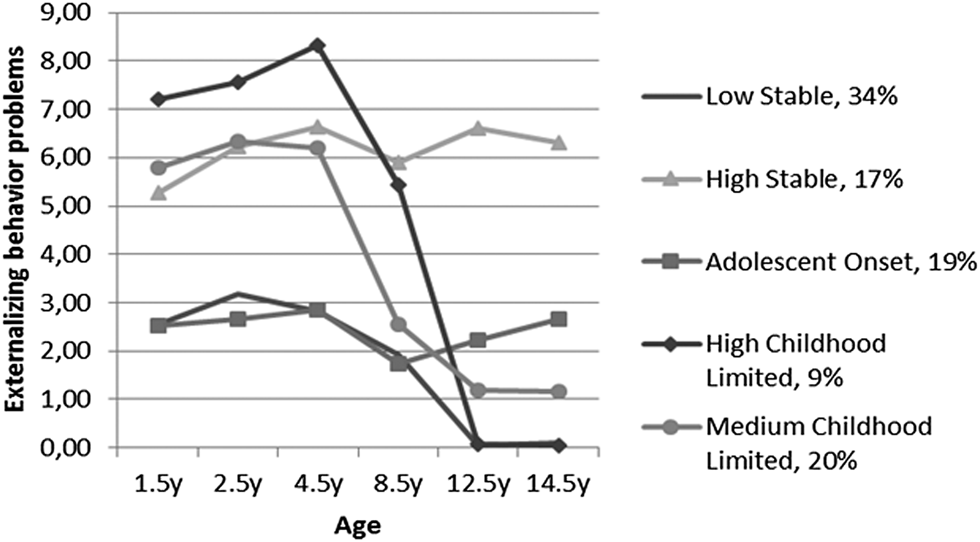
The current study built on a previous latent profile analysis of externalizing behavior that was collected across six waves from child age 1.5 years to middle adolescence that also used the TOPP data (Kjeldsen et al., Reference Kjeldsen, Janson, Stoolmiller, Torgersen and Mathiesen2014). This analysis revealed five externalizing trajectory classes: “High Stable” (HS), “High Childhood Limited” (HCL), “Medium Childhood Limited” (MCL), “Adolescent Onset” (AO), and “Low Stable” (LS). The trajectory model is presented in Figure 1. The predictive validity of the trajectory model has also been established, showing that children who were following the HS class across childhood had higher levels of anxiety (for girls) and depression (for boys) as well as reduced life satisfaction and flourishing for both genders at age 18.5 years than the children who were following the LS class did (Kjeldsen et al., Reference Kjeldsen, Nilsen, Gustavson, Skipstein, Melkevik and Karevold2016). The overall objective of the current study was to examine the timing, emergence, and stability of the risk factors for the five externalizing trajectory classes across four important stages of child development: infancy, early childhood, middle childhood, and middle adolescence. Given the extensive economic and mental health burden to society from children and youths on an HS trajectory, we placed particular focus on the stability and emergence of risk factors for this trajectory. Further, based on the knowledge gap that is described above, a special focus was also placed on examining the potential differences between the AO and CL classes. We also compared the risk scenarios for these two trajectories with those of (a) typically developing children (i.e., the LS class), and (b) children with chronically high levels of externalizing problems (i.e., the HS class).
Latent classes of mother-reported externalizing behavior problems at 18 months to 14.5 years of age. Due to change in measures, only relative change across groups can be interpreted and not absolute (developmental) change. Source: Kjeldsen et al. (Reference Kjeldsen, Nilsen, Gustavson, Skipstein, Melkevik and Karevold2016), Journal of Research on Adolescence has given permission to reproduce the figure.

Method
Sample and procedure
We used data from the TOPP, a population-based prospective longitudinal study of Norwegian children and their families who were followed from infancy onwards (Nilsen et al., Reference Nilsen, Kjeldsen, Karevold, Skipstein, Sand Helland, Gustavson and Mathiesen2017). The sample size of the TOPP is similar to that of the highly influential Dunedin Multidisciplinary Health and Development Study. More than 95% of Norwegian families with children attend public child health services for 8–12 health screenings during the first 4 years of their child's life. Every family who visited a child health clinic within six municipalities in Eastern Norway in 1993 for the scheduled 18 months vaccination visit was invited to complete a questionnaire. Of the 1,081 eligible families, 939 (87%) participated at Time 1 (t1). These parents received a similar questionnaire when the children were 2.5 years of age, Time 2 (t2); 4.5 years, Time 3 (t3); 8.5 years, Time 4 (t4); 12.5 years, Time 5 (t5); 14.5 years, Time 6 (t6); and 16.5 years, Time 7 (t7). The number of respondents in each follow-up wave were as follows: t2: n = 804 (86% of t1); t3: n = 760 (81%); t4: n = 535 (57%); t5: n = 610 (65%); t6: n = 481 (51%); and t7: n = 399 (46%). Health-care workers administered the questionnaires at t1 to t3. In subsequent waves, the questionnaires were sent by mail to the study participants. The parents chose whether the mother or the father completed the questionnaire at t1–t4 (mainly mothers answered). At t5 the mothers were encouraged to answer, and at t6 separate questionnaires were sent to the mothers and fathers. The numbers of questionnaires that were completed by the mothers at each wave were n=921 (t1), n=784 (t2), n=737 (t3), n=512 (t4), n=594 (t5), n=481 (t6), and n=399 (t7). Since relatively few fathers participated across time, the paternal questionnaires were not included in the current study.
The health care areas were generally representative of the diversity of social environments in Norway. In the TOPP sample, 28% of the families lived in large cities, 55% lived in small towns or densely populated areas, and 17% lived in rural areas. Child gender was nearly evenly divided, with 48.9% (n = 450) boys at t1. Maternal age ranged from 19 to 46 years at t1, with a mean of 30 years (SD = 4.7). At t1, 49% of the families had only one child, 37% had two, and 15% had three or more children. The participating families were predominantly ethnic Norwegians with middle-class socioeconomic status, which is representative of the majority of Norwegian families. In 1993, only 2.3% of the Norwegian population came from non-Western cultures (Statistics Norway, 2012). Data from the child health clinics showed that nonparticipants at t1 did not differ significantly from the study participants with respect to maternal age, education, employment status, number of children, or marital status (Mathiesen, Tambs, & Dalgard, Reference Mathiesen, Tambs and Dalgard1999).
The analyses of sample attrition from t1 to t7 (i.e., to child age 16.5 years) showed that the families who dropped out were not significantly different at t1 from the families who completed questionnaires at t7 in terms of maternal symptoms of depression and anxiety, maternal age, financial status, chronic stress, or social support (Gustavson, von Soest, Karevold, & Roysamb, Reference Gustavson, von Soest, Karevold and Roysamb2012). However, the dropout sample differed significantly from the remaining sample at t1 on maternal education, with somewhat fewer mothers with low education remaining in the study. Differential attrition by education is a common finding in longitudinal studies (Tambs et al., Reference Tambs, Ronning, Prescott, Kendler, Reichborn-Kjennerud, Torgersen and Harris2009; Torvik, Rognmo, & Tambs, Reference Torvik, Rognmo and Tambs2012). Additional analyses showed that child externalizing behavior at t1 did not predict study drop-out at t7, OR = 1.10, p = .152 (Kjeldsen et al., Reference Kjeldsen, Nilsen, Gustavson, Skipstein, Melkevik and Karevold2016). The Norwegian Ethical Committee for Medical and Health Research approved the data collection.
Measures
Externalizing trajectory data
Core aspects of mother-reported child and adolescent externalizing problems were measured at ages 18 months and 2.5, 4.5, 8.5, 12.5, and 14.5 years, on a 3-point scale: 0 = no difficulties, 1 = moderate difficulties, or 2 = substantial difficulties. At ages 18 months, 2.5 years, and 4.5 years, the average sum score based on three items from the Behavior Checklist (BCL; Richman & Graham, Reference Richman and Graham1971) was used to measure temper tantrums, manageability, and irritability. These questions represent the full item universe on externalizing behavior problems in the BCL scale. At age 8.5 years, the average of the conduct problem subscale from the Strengths and Difficulties Questionnaire (Goodman, Reference Goodman1994) was used to measure temper, obedience, fighting, lying, and stealing. Cronbach alphas based on polychoric correlations were .66, .91, .96, and .94 for the measures at age 18 months and 2.5, 4.5, and 8.5 years, respectively. At ages 12.5 and 14.5 years, the 18-item TOPP Scale on Antisocial Behavior (TSAB) was used as a broad measure of externalizing problems in adolescence, covering stealing, interpersonal aggression, loitering, and vandalism. The alpha coefficients were .69 and .75, respectively (Kjeldsen et al., Reference Kjeldsen, Janson, Stoolmiller, Torgersen and Mathiesen2014). The externalizing instruments were developmentally appropriate for the age in which they were used, as is emphasized in research on the normative development of externalizing behavior problems (Bongers, Koot, van der Ende, & Verhulst, Reference Bongers, Koot, van der Ende and Verhulst2004; Wakschlag, Tolan, & Leventhal, Reference Wakschlag, Tolan and Leventhal2010) and illustrated by the parallels to item content in other well-established measurement scales (CBCL 1.5–5 years and CBCL 6–18 years, Achenbach & Rescorla, Reference Achenbach and Rescorla2000, Reference Achenbach and Rescorla2001). The combination of different instruments made it possible to examine age-typical externalizing behaviors by using a longitudinal model (Kjeldsen, Reference Kjeldsen2013).
Child and family risk factors
Child and family risk data that were collected in infancy (age 18 months, t1), in early childhood (age 4.5 years, t3), in middle childhood (age 8.5 years, t4), and in middle adolescence (age 14.5 years, t6) were used and are described below.
Temperament
At age 18 months, 4.5, and 8.5 years, child temperament was assessed by using the EAS Temperament Survey for Children: Parental Ratings (Buss & Plomin, Reference Buss and Plomin1984), which contains four dimensions: (a) Emotionality—the tendency to become aroused easily and intensely (often named Negative Emotionality); (b) Activity—preferred levels of activity and speed of action; (c) Sociability—the tendency to prefer the presence of others to being alone; and (d) Shyness—the tendency to be inhibited and awkward in new situations. Because of ambiguity in translation, one item was deleted from each dimension. Therefore, each dimension was measured with four items. The items were scored on a Likert-type scale from 1 (very untypical) to 5 (very typical). At age 14.5, the EAS Temperament Survey for Adults was used (Buss & Plomin, Reference Buss and Plomin1984). As the adult version does not measure shyness, the shyness measure from the EAS Temperament Survey for Children that was collected at age 12.5 years (t5) was used. Cronbach alphas for the four-item scales based on the polychoric correlations at the four measurement points, respectively, were .72, .76, .75, and .68 for the emotionality scale; .80, .81, .80, and .69 for the shyness dimension; .79, .80, .80, and .68 for the activity dimension; and .62, .74, .73, and .68 for the sociability dimension.
Internalizing symptoms
Internalizing symptoms in infancy and early childhood (t1 and t3) were assessed with three items. Two items were taken from the BCL (Richman & Graham, Reference Richman and Graham1971), namely, ”Has many different worries, broods over things” and “Is often frightened by loud noises and unexpected things.” An additional item was created for the current study to assess sadness (“Seems to be unhappy often or for long periods”). The three items were all measured by using three response categories (0 = no difficulties, 1 = moderate difficulties, 2 = substantial difficulties). Cronbach alphas based on polychoric correlations were .64 and .61 at the two measurement points, respectively. At age 8.5 years, the internalizing problems subscale from the Strengths and Difficulties Questionnaire (SDQ; Goodman, Reference Goodman1994) was used to measure sadness, somatic complaints, general worries, nervousness, and fear. The items were measured on the same scale as above, and internal consistency was .81. Items for assessing anxiety and depressive symptoms from two different scales were used to measure internalizing problems at age 14.5 years. Depressive symptoms were measured with the 13-item Short Mood and Feelings Questionnaire (SMFQ; Angold et al., Reference Angold, Costello, Messer, Pickles, Winder and Silver1995). The items were rated on a 3-point Likert-type scale ranging from 0 (not true) to 2 (certainly true). Symptoms of anxiety were assessed with the Coolidge Personality and Neuropsychiatric Inventory for Children, General Anxiety Disorder Scale (GAD; Coolidge, Thede, Stewart, & Segal, Reference Coolidge, Thede, Stewart and Segal2002). The GAD consists of 12 items that were directly extracted from the DSM-IV criteria for generalized anxiety disorder, separation anxiety, and social anxiety. The items were rated on a 5-point scale from 0 (not true) to 4 (certainly true). After rescaling the SMFQ data to a 5-point scale, the SMFQ and GAD were combined to create a 25-item index of child internalizing symptoms at age 14.5 years, with Cronbach alpha = .89.
Hyperactivity symptoms
In infancy and early childhood, the mean of two items from the BCL (Richman & Graham, Reference Richman and Graham1971) was used to indicate hyperactivity, assessing activity level and concentration respectively. The items were measured on a scale of 0 (no difficulties), 1 (moderate difficulties), or 2 (substantial difficulties). The cross-time correlations were .35 (t1 to t2) and .43 (t2 to t3). At ages 8.5 and 14.5 years, the hyperactivity subscale from the SDQ (Goodman, Reference Goodman1994) was used to measure “being restless,” “always on the move,” “easily distracted,” “thinking before acting” (reversed), and “completing tasks” (reversed). The items were measured on a scale of 0 (no difficulties), 1 (moderate difficulties), or 2 (substantial difficulties), and the Cronbach alphas based on polychoric correlations were .84 and .78 in middle childhood and middle adolescence, respectively.
Maternal mental distress
At child age 18 months, 4.5, 8.5, and 14.5 years, the mothers reported on their own symptoms of anxiety and depression by completing the Hopkins Symptom Check List (HSCL-25; Hesbacher, Rickels, Morris, Newman, & Rosenfeld, Reference Hesbacher, Rickels, Morris, Newman and Rosenfeld1980). One of the 25 items was excluded at child age 4.5, 8.5, and 14.5 years, and two were excluded at child age 18 months because some participants in the pilot study perceived them as being intrusive. The reliability and validity of the HSCL has been well established in a number of studies (e.g., Strand, Dalgard, Tambs, & Rognerud, Reference Strand, Dalgard, Tambs and Rognerud2003). The items were scored on a 4-point Likert-type scale, from 1 (not at all) to 4 (very much). The alpha coefficients based on polychoric correlations were .95, .95, .96, and .90 at the four measurement points, respectively.
Family relationship and health stressors
Mother-reported partner support was assessed by using a composite (mean) score of three items (i.e., feeling attached to partner, whether partner valued one's opinion, and feeling outside at home) at child age 18 months, 4.5, 8.5, and 14.5 years. The items were scored on a Likert-type scale from 1 (totally agree) to 5 (totally disagree). The mothers also reported on enduring problems over the last 12 months in four areas that reflect family climate including (a) their relationship to their partner, (b) their partner's physical or mental health, (c) their children's physical health, and (d) their own physical health. The other four areas were measured with one item each and scored on a Likert-type scale from 1 (no problem) to 4 (huge problem), and a 1–5-point scale was created from the responses to these four questions. The mean of the scores on the five areas were labeled “family relationship and health stressors.” The alpha coefficients based on polychoric correlations were .70, .74, .73, and .73 at the different measurement points, respectively.
Stressors associated with the family's socioeconomic status
At child age 18 months, 4.5, 8.5, and 14.5 years, the mothers were asked to indicate whether they had experienced enduring problems in the last 12 months in three areas: housing, employment, and financial status, each scored on a Likert-type scale from 1 (no problem) to 4 (huge problem). Responses on these three items were used to create a composite score for stressors that are associated with the family's socioeconomic status (i.e., SES stress). The alpha coefficients based on polychoric correlations were .72, .75, .76, and .73 at the four measurement points, respectively.
Social support from friends, family, and neighbors
At child age 18 months, 4.5, 8.5, and 14.5 years, 14 questions were administered to tap the mothers’ experience of social support from friends, family, and neighbors. Four qualities of social support were measured for friends and family: closeness and contact, respect and responsibility, feeling of belonging (each on a 5-point Likert-type scale from 1 = totally agree to 5 = totally disagree), and practical help (measured on a 5-point scale from 0 = no to 4 = very often). Regarding social support from neighbors or the neighborhood, the mothers were asked about their sense of belonging to their neighborhood (one item on a Likert-type scale from 1 = low to 5 = high), number of neighborhood acquaintances (two items on a scale from 1 = no one to 5 = five or more), and practical help received from neighbors (three items with a 0 = no, 1 = yes format). A 1–5-point scale was created from the responses to these questions. The mean of all 14 items was used to form a composite score of “social support from friends, family, and neighbors.” The Cronbach alphas based on polychoric correlations were .77, .82, .75, and .78 for the four measurement points, respectively. Note that as social support is measured from low to high support, high scores reflect low risk, opposite of the other risk factors.
Analytic approach
As noted above, a latent class analysis (LCA) solution with five trajectories of externalizing problems from infancy to middle adolescence was identified in a previous study, consisting of High Stable (HS, 17%, n = 128), Adolescent Onset (AO, 19%, n = 145), High Childhood Limited (HCL, 9%, n = 66), Medium Childhood Limited (MCL, 20%, n = 223), and Low Stable (LS, 34%, n = 359) classes (Kjeldsen et al., Reference Kjeldsen, Janson, Stoolmiller, Torgersen and Mathiesen2014), see Figure 1. The LCA solution was kept as a latent model in all of the analyses to keep the uncertainties that were related to class assignments within the analyses. Thus, the n for each class was based on the maximum posterior probability rule. The percentage of girls in the various trajectories were HS (51%), AO (41%), HCL (68%), MCL (48%), and LS (53%).
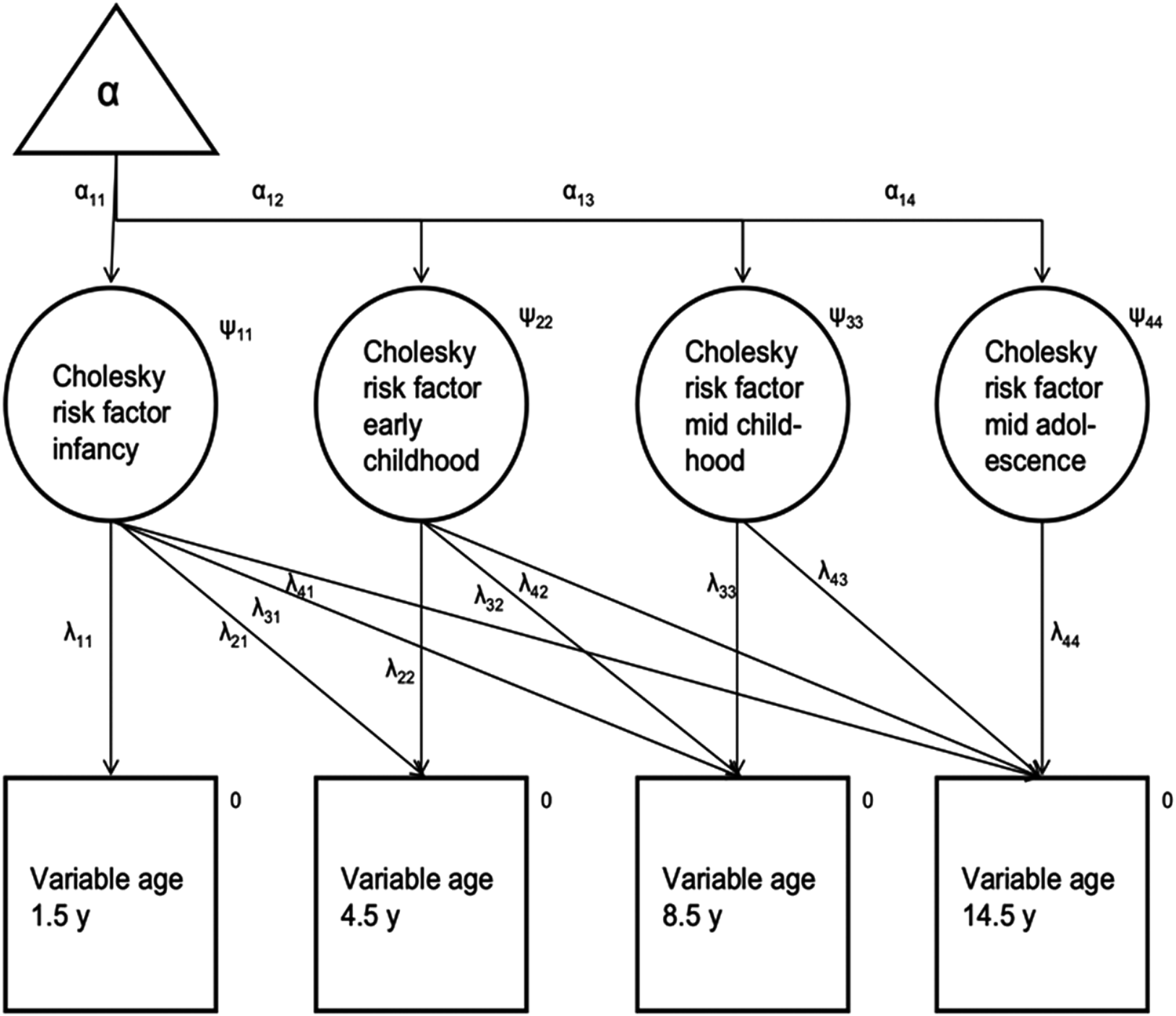
Structural equation modelling was conducted by using the maximum-likelihood estimator in Mplus 6.11 (Muthén & Muthén, Reference Muthén and Muthén2011). Data from all of the participants, including those with only partial data, were included in the analyses. To examine stable and emerging influences from child- and family-related risk variables at each specific measurement point, we parameterized an extended Cholesky, or triangular decomposition model (Loehlin, Reference Loehlin1996). The Cholesky decomposition is fundamentally atheoretical, and it basically decomposes the variance and covariance of the given risk factors (e.g., child temperament, social support) at each specific measurement point. A Cholesky model is more complex than the commonly used simplex model, which implies no time-invariant factors for the characteristics under study, an assumption we regarded as too constrained and unrealistic with regard to the developmentally sensitive characteristics that were studied here.
The Cholesky model, illustrated in Figure 2, shows a latent Cholesky risk factor infancy (CRF infancy, Ψ11) that represents the risk variance that is related to a given risk factor (e.g., emotionality) at child age 18 months, conferring risk at 18 months (λ11) and at all of the successive measurement points (i.e., from stable to λ21, λ31, and λ41). The Cholesky risk factor early childhood (CRF early childhood, Ψ22) is uncorrelated with the first latent risk factor and represents new risk variance (e.g., from emotionality) that emerges between child age 1.5 years and 4.5 years (λ22) and remains stable from then onwards (λ32 and λ42). The Cholesky risk factor middle childhood (CRF middle childhood, Ψ33) represents new risks that emerge between child age 4.5 and 8.5 years, contributing to new risk variance over this measurement period (λ33) and onwards (λ43), and the Cholesky risk factor middle adolescence (CRF middle adolescence, Ψ44) reflects new risk variance that emerges between child age 8.5 and 14.5 years and onwards (λ44). Finally, α represents the total dose of risk (latent means).
Cholesky factorization model. Models were run separately for each risk factor, including the risk variables measured in infancy (age 1.5 years), early childhood (age 4.5 years), mid childhood (age 8.5 years), and mid adolescence (age 14.5 years). The residual variance of the observed variables was fixed to zero. λ11, λ22, λ33, and λ44 were fixed to unity. All other remaining factor loadings were estimated and equal across classes. The latent factor variance (Ψ11 to Ψ44) was estimated as free parameters across all externalizing trajectory classes. The means of the latent variables (α11 to α14) were fixed to zero in the low stable class and freely estimated in the remaining classes.

Each risk variable was standardized before Cholesky factorization, and the models were run separately for each risk factor (e.g., the scores on emotionality in infancy, in early and middle childhood, and in middle adolescence were factorized for each of the externalizing trajectory classes). The Cholesky models were specified by fixing the variance of the observed risk variables to zero and by fixing the first factor loading to zero. The Cholesky means were set to zero for the LS externalizing class and estimated freely for the remaining four externalizing classes. The variance of the Cholesky risk factors (CRF) was estimated for all five classes. Thus, a CRF that was significantly different from zero (i.e., different from the LS class) was defined as elevated. The significance of trajectory group differences in the Cholesky-factorized child and family risks was evaluated by examining the overlap in the confidence intervals (CIs). This is generally considered to be a conservative criterion for evaluating group differences (Schenker & Gentleman, Reference Schenker and Gentleman2001). Cohen ds were calculated for the comparisons between CRF scores for the various classes by using the conventional criteria of 0.2 to 0.3 as a small effect, above 0.5 as a medium effect, and above 0.8 as a large effect (Cohen, Reference Cohen1988). Cohen d is the difference between two means divided by the pooled standard deviation of the data. In the pooling of the standard deviations, we weighted the standard deviations by the size of each group.
Results
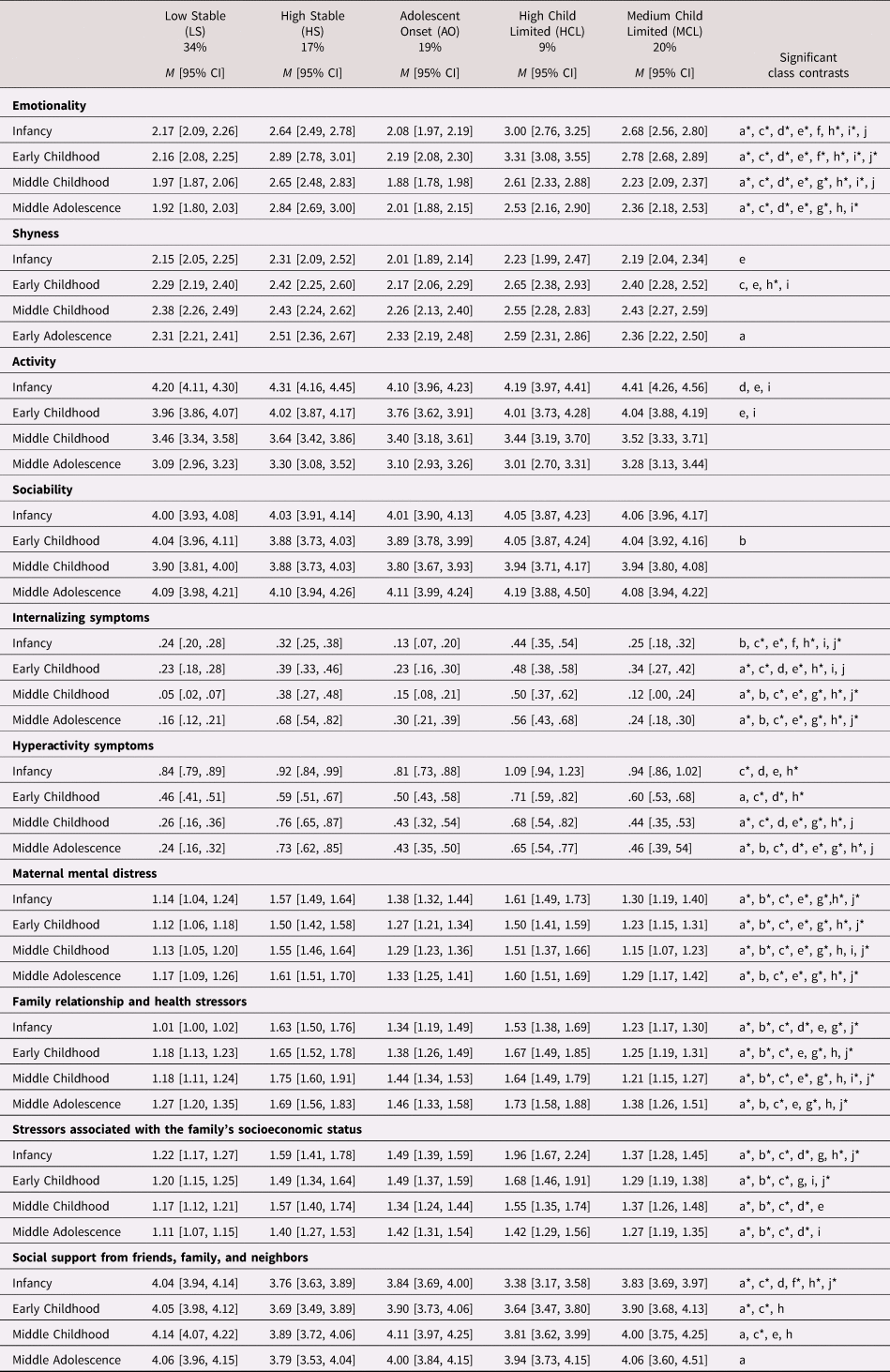
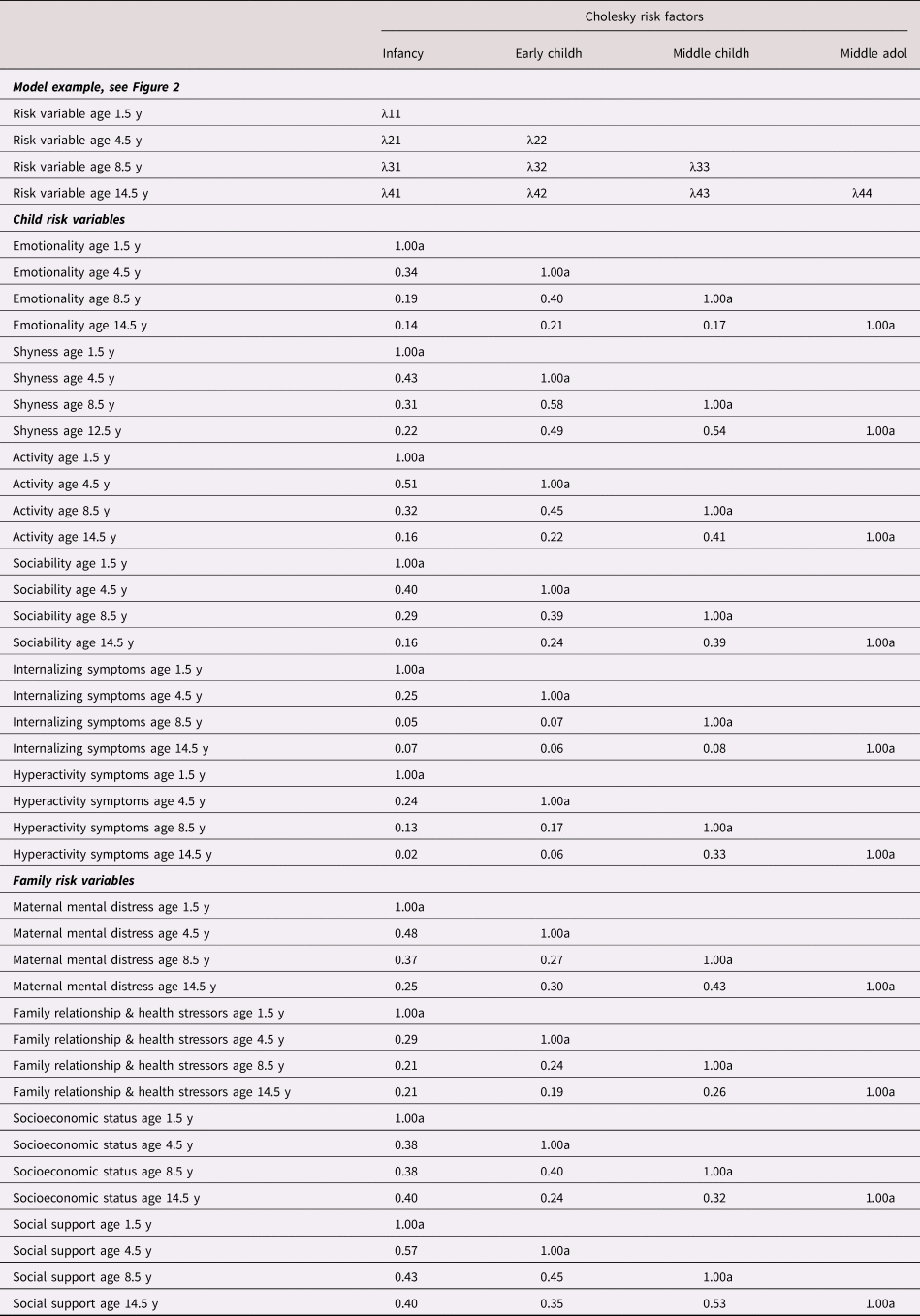
The descriptive statistics for the risk variables by externalizing trajectory classes are presented in Table 1. The loadings of child and family risk variables on the Cholesky risk factors for the sample as a whole are presented in Table 2.
Descriptive statistics for risk variables by externalizing trajectory class

Note: M = Mean, CI = Confidence Interval. Significant class contrasts: a = LS vs. HS; b= LS vs. AO; c = LS vs. HCL; d = LS vs. MCL; e = HS vs AO; f = HS vs HCL; g = HS vs MCL; h = AO vs HCL; i = AO vs MCL; and j = HCL vs MCL. * = significant contrast after Bonferroni correction (10 contrasts tested per variable).
Cholesky factorization of child and family risk variables, factor loadings

Note: a = fixed not estimated, childh = childhood, adol = adolescence, y = years.
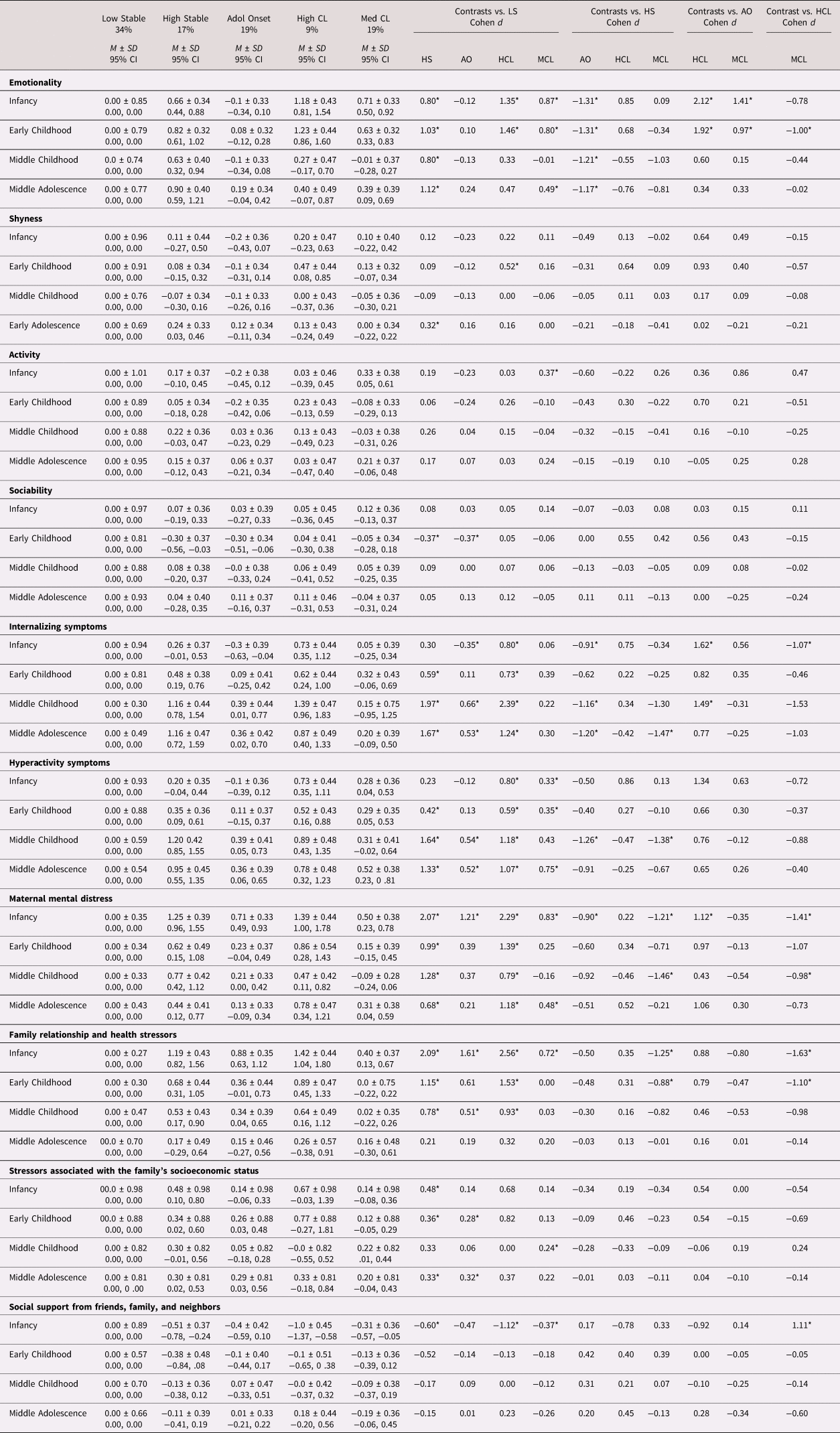
All of the family risk factors had relatively high loadings on both the stable and the emerging risk variance at all of the measurement points. The same held for the child risk factors, apart from child internalizing for which the loadings were particularly low. Means, SDs, and 95% confidence intervals for the Cholesky-factorized risk variables in infancy, early childhood, middle childhood, and middle adolescence for each externalizing trajectory class are presented in Table 3, together with the effect sizes for all of the group comparisons. There were significant differences between the trajectory classes for all of the risk variables. The following comparisons between the classes are based on the results from the Cholesky models.
Means, SD, 95% CI, and effect size for the Cholesky factorized risk variables by externalizing trajectory classes

Note: HS = High Stable, AO = Adolescent Onset, HCL = High Childhood Limited, MCL= Medium Childhood Limited, * = significant contrast. For the stressors associated with the family's socioeconomic status, the variance in each Cholesky risk factor was fixed to be identical across externalizing classes due to model nonconvergence. The significance of contrasts was judged by nonoverlapping confidence intervals.
Comparing HS and LS trajectory classes
Compared with the LS class, children in the HS class were characterized by substantially elevated levels on most of the risk variables in infancy that remained stable throughout the study period (i.e., the Cholesky risk factor infancy). Regarding child characteristics, a large effect size was observed for early (and stable) temperamental emotionality, Cohen d = 0.80, while internalizing and hyperactivity in infancy were not elevated. For the family factors, very strong effects were observed for maternal mental distress and partner relationship and family health stressors (Cohen ds were estimated as 2.07 and 2.09, respectively). Medium effects were estimated for stressors that were related to the families' SES and social support (Cohen ds of 0.48 and 0.60, respectively). Compared with the LS class, the HS class was also characterized by risk dosages in most areas emerging at successive developmental periods (i.e., the Cholesky risk factors early and middle childhood and middle adolescence). The magnitude of the new variance for temperamental emotionality was substantial at all of the measurement points (with Cohen ds of 1.03, 0.80, and 1.12 in early childhood, middle childhood, and middle adolescence, respectively). Furthermore, the HS children had lower sociability in early childhood and higher shyness in middle adolescence. In addition, significant new risk variance emerged for most family risks at later stages. For example, a large emerging effect was observed for maternal mental distress in middle childhood, Cohen d = 1.28. For social support, the contrasts were not significant at later measurement points. Finally, while there were no significant differences between the HS and LS classes on child internalizing and hyperactivity in infancy (described above), these contrasts were significant at subsequent stages with effect sizes that increased steeply with time, corresponding to Cohen ds of 1.67 (child internalizing) and 1.33 (hyperactivity) in middle adolescence.
Comparing HS and AO trajectory classes
Children in the HS class had substantially elevated levels on most of the infancy (stable) risk variables, and the AO class scored significantly lower than the HS class did on child emotionality, Cohen d = 1.31, and child internalizing, Cohen d = 0.91. Substantially lower scores for the AO class were also indicated at later stages for these two child factors, with class contrasts of similar magnitude. Further, hyperactivity symptoms in middle childhood and middle adolescence followed a similar pattern with lower scores for the AO class. However, the AO class did not differ from the HS class in terms of family risk exposures at any measurement point, indicating high family risk exposure for the AO class. These two classes differed on only one family risk variable, which was maternal mental distress in infancy, with lower scores for the AO than for the HS class, Cohen d = 0.90.
Comparing HS and HCL trajectory classes
There were no significant differences between these two classes for any risk factor throughout the study period. In other words, both classes had similar and substantially elevated levels of risk exposure from child and family factors at all of the measurement points covered by the study. It is noteworthy, however, that the risk levels tended to be somewhat higher for the HCL than for the HS class on some risk exposures, and particularly so for temperamental emotionality, internalizing symptoms, and maternal mental distress.
Comparing HS and MCL trajectory classes
These two classes had similar levels of child risk factors, although the MCL class had less hyperactivity in middle childhood and internalizing in middle adolescence (Cohen ds of 1.38 and 1.47, respectively). The MCL class also had lower levels of maternal mental distress and parental relationship and family health stressors in infancy, early childhood, and middle childhood.
Comparing AO and LS trajectory classes
None of the child risk factors were elevated for the AO class compared with the LS class in infancy. In fact, the AO class had significantly lower levels of child internalizing than the LS class (Cohen d 0.35). Further, the AO class displayed less sociability in early childhood (Cohen d of 0.37). Notably, the AO children were characterized by substantially elevated early family risks. The effect sizes for maternal mental distress and family relationship and health stressors in infancy were substantial (Cohen ds of 1.21 and 1.61, respectively). From middle childhood onwards, the AO children had elevated levels of internalizing (corresponding to Cohen ds of 0.66 and 0.53 for middle childhood and middle adolescence, respectively) and hyperactivity (corresponding to Cohen ds of 0.54 and 0.52 in middle childhood and middle adolescence). The social support levels did not differ across these two classes at any developmental period.
Comparing AO and HCL trajectory classes
The HCL trajectory was characterized by significantly higher emotionality and internalizing symptoms from infancy onward (Cohen ds of 2.12 and 1.62, respectively). The HCL children also had higher scores on emotionality from early childhood and internalizing symptoms from middle childhood (Cohen ds of 1.92 and 1.49, respectively). Furthermore, the HCL class also scored higher on the stable influence from maternal mental distress from infancy onwards, Cohen d = 1.12. No significant differences were observed between the AO and HCL classes for the remaining risk variables.
Comparing AO and MCL trajectory classes
The MCL class had significantly higher levels of emotionality from infancy and early childhood onwards than the AO class did (Cohen ds of 1.41 and 0.97, respectively). These two classes were not significantly different on any of the other risk variables.
Comparing HCL and LS trajectory classes
The child and family risk factors for the HCL class were elevated in infancy and early childhood compared with that of the LS class. In addition to the risk variances for emotionality (Cohen ds of 1.35 and 1.46, respectively), the HCL class was also characterized by more child internalizing and hyperactivity in infancy (i.e., Cohen d = 0.80 for both, respectively) as well as elevated shyness in early childhood. The HCL children were also characterized by strong and stable risk variance for maternal mental distress and family relationship and health stressors from infancy onward (i.e., Cohen ds of 2.29 and 2.56). The risk variance that was related to family SES stress was not significant. Furthermore, the HCL class had substantially elevated levels on most of the child (i.e., internalizing and hyperactivity) and family (i.e., maternal mental distress and family relationship and health stressors) risk factors in middle childhood and middle adolescence, while the effects of child emotionality and family SES were nonsignificant. With respect to protective influences, the HCL class had very low initial (and stable) levels of social support, but there was a trend toward higher levels of support (i.e., reduced risk) at each developmental period.
Comparing HCL and MCL trajectory classes
The MCL class had significantly lower levels of child risk on internalizing from infancy onward (Cohen d = 1.07), and emotionality from early childhood onwards (Cohen d = 1.0), compared with the HCL class. The MCL class also had lower family risks, including lower maternal mental distress from infancy and middle childhood (Cohen ds of 1.41 and 0.98, respectively) and less family relationship and health stressors from infancy and early childhood onwards than the HCL class did (Cohen ds of 1.63 and 1.10, respectively).
Comparing MCL and LS trajectory classes
The risk levels for the MCL class were elevated in infancy but more moderately than for the HCL class. The MCL children had elevated early and stable levels of emotionality, d = 0.87, activity, d = 0.37, hyperactivity, d = 0.33, maternal mental distress, d = 0.83, family relationship and health stressors, d = 0.72, and low social support from family, friends, and neighbors, d = 0.37. However, both child and family risks generally decreased over time, but emotionality, hyperactivity, and maternal distress remained substantially elevated in middle adolescence (Cohen ds = 0.49, 0.75, and 0.48, respectively). Similar to the HCL class, levels of family SES stress were not elevated for the MCL class at any of the developmental stages that were examined.
Discussion
Further understanding of the risk factors that are involved in the development of externalizing behavior problems is fundamental to prevention and early intervention. The present study is, to our knowledge, the first study within this area of research to use an analytic approach that separates initial (and stable) levels of risk from emerging risks that appear in later developmental periods. Our study extends current knowledge by examining the stability and emergence of a wide range of child and family risk variables for five trajectory classes from infancy through middle adolescence. The main focus was placed on risk factors for the High Stable (HS) trajectory class and on potential differences between the Childhood Limited (CL) and Adolescent Onset (AO) trajectories. The HS class was characterized by very high risk levels throughout the study period, with risk exposures being stable but also new ones emerging over time. Children in the High Childhood Limited (HCL) class had substantially elevated levels of temperamental emotionality, internalizing symptoms, and maternal mental distress in addition to environmental risk factors. Intrinsic factors were less salient for the AO class. Our results shed new light on why externalizing for some children emerges early and ceases by late childhood (the CL subtype), while for others the problems arise in adolescence (the AO subtype). Therefore, our study may contribute to improved differentiation between these trajectory patterns as well as to a better understanding of development and change in risk factors more generally.
The current study builds upon a trajectory model that was identified in previous work by Kjeldsen et al (Reference Kjeldsen, Janson, Stoolmiller, Torgersen and Mathiesen2014). This earlier study was restricted to studying risk factors at child age 18 months. The current study expands on this by examining the wider longitudinal context in which externalizing behaviors are embedded, shedding light on the stability and emergence of risk exposures across externalizing trajectories from infancy to middle adolescence.
Concerning the timing of risk exposures, a striking pattern of temporal correspondence between risk levels and externalizing levels was identified. Quite consistently, high levels of externalizing behavior problems in a given developmental period were associated with high risk exposure during the same period. This was particularly notable for children on the HS trajectory throughout the study period. Some important exceptions to this pattern were shown for the AO and the two CL classes. The HCL children showed remission in externalizing problems by late childhood, despite stable and emerging influences from child internalizing problems, hyperactivity, maternal mental distress, and family relationship and health stressors. The MCL children were characterized by stable hyperactivity problems, while the AO children were exposed to high levels of multiple family risks many years before the onset of their externalizing problems.
Findings on stability in, as well as emergence of new, variance in the various risk factors further contributed to the differentiation of the externalizing trajectories. The high levels of family adversity that were characteristic of HS children continued from infancy onward, and new family risks emerged consistently over the successive periods that were examined. The HS children were highly emotional as infants and became increasingly so with age. These children were also less sociable in early childhood. Further, co-occurring internalizing symptoms, hyperactivity, and shyness developed with age. Thus, for children in the HS group, externalizing problems in the context of stable and emerging family risks appear to set the scene for a diffusion of problems into new domains in accordance with the developmental cascade model (Masten et al., Reference Masten, Roisman, Long, Burt, Obradovic, Riley and Tellegen2005). In addition, studies indicate that there is a stronger genetic liability in this group for aggressive, pervasive externalizing behaviors to follow a life-course persistent pattern than in cases when such behaviors have late onset or are situational and transient (Moffitt, Reference Moffitt2005), which may apply to the trajectory classes in our study.
Our findings pertaining to stable and new risk variance differed across the AO and CL trajectories and further differentiate between these trajectories. The HCL children were highly emotional as infants and in early childhood. These children were also high on internalizing and hyperactivity symptoms in infancy and increasingly so with age. The high levels of family risk from maternal mental distress and parental relationship and health stressors continued from infancy onward, and new family risks emerged consistently throughout the study period for the HCL group. Notably, and in contrast to the findings for the other trajectory classes, the HCL class was not characterized by significant levels of family SES stressors. Overall, for children in the HCL group, the findings of stable risk exposures from infancy onward with new risk doses across multiple domains emerging at each successive period, may set the scene for the maintenance and acceleration of child problems over time. The type and loading of risk factors suggest a substantial intrinsic emotional basis for the externalizing problems of the HCL children. In addition, the HCL children seem to develop internalizing symptomatology as their externalizing problems were reduced. Therefore, the results for the HCL class are in line with research that indicates troubled outcomes also for children on childhood-limited trajectories, despite the desistance in externalizing problems (Odgers et al., Reference Odgers, Moffitt, Broadbent, Dickson, Hancox, Harrington and Caspi2008; Stringaris et al., Reference Stringaris, Lewis and Maughan2014). Our findings indicate that troubled outcomes, at least in terms of internalizing problems, characterize the HCL and not the MCL trajectory. The MCL children also experienced elevated early risks pertaining to the child and family domain (i.e., emotionality, activity, hyperactivity, maternal distress, family relationship and health, and social support), but new risk doses emerged less consistently at successive epochs. Notably, the MCL class was not characterized by child internalizing symptomatology at any stage.
Interestingly, the AO class scored low on temperamental emotionality, hyperactivity, and internalizing symptoms in infancy, and they scored significantly lower than the LS class did. However, from early childhood the AO children were characterized by less sociability than the LS children were. Substantially elevated levels of maternal distress and family relationship and health stressors were present from infancy, and new variance from stressors that were related to family relationship and health as well as SES emerged intermittently at later stages. Further, the AO children were characterized by emerging internalizing and hyperactivity problems that preceded or co-occurred with the onset of their externalizing behavior problems. Thus, the AO children might be more resilient early on, but exposure to stable and emerging family risks—even in the absence of early child risk factors—seems to contribute to vulnerability to adolescent onset of externalizing problems, hyperactivity, and internalizing symptoms. Interestingly, a late onset of externalizing problems appeared despite that the AO class was the only class in our study that was not characterized by poor support networks. One potential explanation for some of the increase in externalizing behavior in adolescence may be an age-normative decrease in agreeableness that typically starts in late childhood/early adolescence (Soto, John, Gosling, & Potter, Reference Soto, John, Gosling and Potter2011). In this period, youths start to develop greater autonomy, relate more strongly to peers than to parents, and are generally challenging parents’ and other adults’ rules, values, and norms. These changes are often followed by an increase in norm-breaking and risk-related behavior (Loeber & Farrington, Reference Loeber and Farrington2001). Early pubertal maturation is another factor that has been related to the onset of externalizing problems in (early) adolescence (Dimler & Natsuaki, Reference Dimler and Natsuaki2015; Ge & Natsuaki, Reference Ge and Natsuaki2009). Although our study does not shed light on puberty timing or normative decrease in agreeableness specifically, the patterns of our findings are in line with such influences.
Addressing the need for a better developmental differentiation between the AO and CL classes (Barker et al., Reference Barker, Oliver and Maughan2010), our findings show striking differences. First, exposure to socioeconomic risk factors seems to be characteristic of the AO class but not the HCL class at any point (compared with the LS class in the Cholesky model, noting that the confidence intervals for the AO–HCL comparisons on this variable were somewhat overlapping). Second, the HCL class had early child-related risks pertaining to temperamental emotionality, internalizing symptoms, and hyperactivity in infancy, which was not the case for the children in the AO class. Third, both classes were elevated on maternal mental distress (compared with the LS class), but the levels for the HCL class were significantly higher than were those of the AO class. Fourth, while new risks related to internalizing and hyperactivity from middle childhood onwards were indicated for both classes, these additional problems were more profound for the HCL class. The pattern of findings for the HCL class (i.e., early child risks and absence of SES stress) is suggestive of a substantial intrinsic emotional basis to the HCL class's externalizing problems. Shared family adversities (e.g., family relationship and health stressors) may have contributed to emerging comorbid conditions in both classes. Other variables that were not assessed in this study, such as peer relationships (Figge et al., Reference Figge, Martinez-Torteya and Weeks2018) and academic functioning, may also partly explain why externalizing behavior remits for the HCL class and emerges later in the AO class.
The two CL classes differed in terms of their levels of externalizing behavior problems and in the risk factors that were associated with them. Greater levels of both stable and emerging risks were observed for the HCL class than for the MCL class. This differentiation between the two CL classes points toward the value of dividing the overall CL pattern into two separate trajectories. This is consistent with Moffitt et al.'s (Reference Moffitt, Arseneault, Jaffee, Kim-Cohen, Koenen, Odgers and Viding2008) argument that the current lack of consensus about the prognosis of CL externalizing group may be caused by different definitions of this subtype in terms of severity. Some studies have defined the CL group as a broad group of children who display some disruptive behavior but whose mild problems are almost normative and need not portend a poor prognosis. In contrast, other studies have defined this group more narrowly to refer to a small group of children that exhibit more extreme but relatively short-lived problems, whose prognosis includes depression, anxiety, social isolation, and financial dependence on others (Moffitt et al., Reference Moffitt, Arseneault, Jaffee, Kim-Cohen, Koenen, Odgers and Viding2008). In the current study, the MCL class, comprising 20% of the children, appears to represent a more broadly defined CL class with a seemingly good prognosis (despite the emerging new variance in emotionality and hyperactivity in middle adolescence), whereas the HCL class (9.0% of the sample) had more severe externalizing problems and exhibited a switch into internalizing problems with age.
Temperamental activity, sociability, and shyness were the only potential risk factors included in this study that did not vary consistently across the trajectory classes. Only higher activity in infancy differentiated the MCL class from the LS class. Higher shyness characterized the HCL class only in early childhood and the HS class only in middle adolescence. Lower sociability was characteristic of both the HS and the AO classes but only in early childhood. A Norwegian longitudinal twin study covering five cohorts aged 7 to 17 years has reported on links between temperamental activity and sociability and externalizing behaviors 2 years later (Gjone & Stevenson, Reference Gjone and Stevenson1997). These researchers found that high activity predicted aggressive behaviors, especially in the younger children. Results from the Avon longitudinal study in the UK (Barker & Maughan, Reference Barker and Maughan2009) also found temperamental activity to be important in that it was related to an increased risk for a persistent pattern of behavior problems between ages 4 to 13 years as opposed to a childhood-limited pattern. Contrasting with these findings, Vassallo and et al. (Reference Vassallo, Smart, Sanson, Dussuyer, McKendry, Toumbourou and Oberklaid2002) found that activity, as measured in the Australian Temperament Project (ATP), was not related to externalizing in infancy or at ages 9–10, but higher activity at ages 11–14 was modestly related to persistent antisocial behavior. The different findings suggest that high activity levels in children may constitute a problem only in some circumstances. Recent findings have shown that child activity level acts as a risk factor for behavior problems in preschoolers (De Pauw, Mervielde, & Van Leeuwen, Reference De Pauw, Mervielde and Van Leeuwen2009) and also that the meaning (i.e., content) of activity changes with age and becomes more characteristic of motivation and competitive drive toward adolescence (Soto & John, Reference Soto and John2014). Previous research has indicated that sociability and shyness tend to be only modestly associated with later externalizing problems. Gjone and Stevenson (Reference Gjone and Stevenson1997) reported no association between externalizing behavior and sociability, and Vassallo et al. (Reference Vassallo, Smart, Sanson, Dussuyer, McKendry, Toumbourou and Oberklaid2002) found that shyness at 9–10 years did not predict externalizing behavior across adolescence in the ATP sample. Our findings suggest that temperamental activity, sociability, and shyness may have small time-limited effects, principally in early childhood.
Social support has rarely been examined in previous longitudinal studies. Here, low mother-reported social support was systematically associated with child externalizing behaviors. In fact, all of the trajectory classes with externalizing behavior problems from early childhood (i.e., HS, HCL, and MCL) were characterized by low social support. Notably, the association with low social support was stable from infancy onwards without new variance emerging at later developmental stages.
Which mechanisms may underpin the risk–outcome associations that were identified in our study? Most human traits and behaviors are influenced by both genetic and environmental factors (Polderman et al., Reference Polderman, Benyamin, de Leeuw, Sullivan, van Bochoven, Visscher and Posthuma2015), and externalizing behaviors are no exception (Hicks, Foster, Iacono, & McGue, Reference Hicks, Foster, Iacono and McGue2013; Moffitt, Reference Moffitt2005). Risk factors that are typically perceived as environmental may also be under substantial genetic influence (Kendler & Baker, Reference Kendler and Baker2007). Therefore, the mechanisms that underlie the associations are likely to be complex and the direction of causality that underlies the identified risk–outcome associations in our study may thus go in different directions to those which were originally conceptualized.
Genetic influences on externalizing behaviors correlate or interact with the environment (Samek & Hicks, Reference Samek and Hicks2014; Samek, Hicks, Keyes, Iacono, & McGue, Reference Samek, Hicks, Keyes, Iacono and McGue2017). Gene environment correlation (rGE) refers to the observation that environmental risk is not random. Passive rGE refers to situations when genes and environmental circumstances reinforce each other—such as when children inherit their parents’ genetic liability to externalizing behavior and also experience disruptive, ineffective parenting (i.e., double disadvantage; Bornovalova et al., Reference Bornovalova, Cummings, Hunt, Blazei, Malone and Iacono2014; Moffitt, Reference Moffitt2005). Active rGE describes how genetically influenced propensities lead individuals to “select” certain environments (Moffitt, Reference Moffitt2005). Active rGE is in line, for example, with theories and research that consistently indicates how gravitation toward a norm-violating peer group is central to the development of externalizing behavior problems (Moffitt, Reference Moffitt1993; Reid, Patterson, & Snyder, Reference Reid, Patterson and Snyder2002; Snyder et al., Reference Snyder, Schrepferman, McEachern, Barner, Johnson and Provines2008). Evocative rGE refers to how individuals elicit responses in others, partly based on their propensities (e.g., a difficult child evokes harsh parenting; Marceau et al., Reference Marceau, Horwitz, Narusyte, Ganiban, Spotts, Reiss and Neiderhiser2013; Moffitt, Reference Moffitt2005). Gene × Environment interaction alludes to a process where the genetic influence varies by environmental circumstances (Belsky & Pluess, Reference Belsky and Pluess2009; Samek et al., Reference Samek, Hicks, Keyes, Iacono and McGue2017) like when the effect of maternal sensitivity on early child externalizing was significant only for children with a DRD4 7-repeat allele (Windhorst et al., Reference Windhorst, Mileva-Seitz, Linting, Hofman, Jaddoe, Verhulst and Bakermans-Kranenburg2015). Finally, developmental twin study approaches have shown that both environmental and genetic influences are involved in stability and change in externalizing behaviors. For example, a study by Van Beijsterveldt et al. (Reference van Beijsterveldt, Bartels, Hudziak and Boomsma2003) suggests a dynamic developmental process that includes both stable genetic effects and new genetic risks that emerge at later developmental periods (labeled genetic innovation). Overall, we acknowledge that there are a number of possible mechanisms behind the risk–outcome associations that were identified in the current study. However, it is beyond the scope of our study to confirm or reject such mechanisms. Still, it seems likely that trajectories characterized with more internal risks (i.e., the HS and HCL classes) are more genetically influenced than are those with largely external risks (i.e., the AO class).
Interestingly, direct environmental effects are also found in genetically informed studies (Bornovalova et al., Reference Bornovalova, Cummings, Hunt, Blazei, Malone and Iacono2014; Hicks et al., Reference Hicks, Foster, Iacono and McGue2013). For example, several family-related risk factors (parent–child conflict, maternal use of physical punishment, and marital discord) had approximately equal effects on child disruptive behaviors in biological (i.e., genetically related) and adoptive (i.e. genetically nonrelated) families (Bornavalova et al., Reference Bornovalova, Cummings, Hunt, Blazei, Malone and Iacono2014). For the current study, this suggests that the association between parental relationship stressors and child externalizing, among others, may reflect a direct environmental causal relationship.
The findings from the present study shed light on how exposure to risk factors constitutes a developmental process that involves both stable and emerging risk factors, with different timing and duration from infancy to middle adolescence that is related to the five developmental patterns that we examined. Overall, our findings are in line with Fairchild's (Reference Fairchild, Goozen, Calder and Goodyer2013) notion that the loading on risk factors at particular times is related to the time of onset, chronicity, and adversity of outcomes. Our findings underscore the importance of a good (or bad) start in life in terms of both intrinsic and family-related risks. The continuous risk exposure that was characteristic of the HS class may involve a process that is characterized by the reproduction, interaction, and exacerbation of risks and reinforcement of problem behavior, resulting in the maintenance of externalizing problems. The process also seems to involve a diffusion of problems into other domains, in accordance with the developmental cascade model (Masten et al., Reference Masten, Roisman, Long, Burt, Obradovic, Riley and Tellegen2005). Although the current data cannot clarify the precise mechanisms that underlie this process, it seems likely that it involves poorer parenting practices and more negative parent–child relationships, as suggested by Patterson's notion of coercive cycles (Reid et al., Reference Reid, Patterson and Snyder2002; Snyder, Reference Snyder, Beauchaine and Hinslaw2015). In line with this model, coercive parenting (Roskam, Reference Roskam2018) and authoritarian attitudes and parental endorsement of aggression (Lansford et al., Reference Lansford, Godwin, Bornstein, Chang, Deater-Deckard, Di Giunta and Bacchini2018) are identified as being central to the development of externalizing behavior. The finding that infants that are high in emotionality are at increased risk may be understood in the light of deficits in emotion-based self-regulation (Eisenberg, Spinrad, & Eggum, Reference Eisenberg, Spinrad and Eggum2010; Perry, Calkins, Dollar, Keane, & Shanahan, Reference Perry, Calkins, Dollar, Keane and Shanahan2018). And again, as described above, these phenomena are influenced by both genetic and environmental factors.
The current study is strengthened by the longitudinal mapping of a broad range of child and family risk factors against externalizing development across time within a large community sample. To our knowledge, it is the first study within this area of research to use an analytic approach that separates initial (and stable) levels of risk from emerging risks that appear in later developmental periods, thus allowing the timing, emergence, and stability of the risk exposures to be examined. The results are suggestive of why children follow different trajectories—why some maintain high levels of externalizing behavior, while others remit or develop externalizing problems later in life. The successive exposure to substantial new risks throughout development, and the cascade effects, shed new light on the continuous risk processes that underlie externalizing trajectories and may help explain why such trajectories are difficult to change once established. This reinforces the conclusion that early prevention and early intervention efforts are highly desirable, especially for children that are facing substantial child- and family-related risk burdens early in life. Further, interventions aiming at reducing the emergence of new risk doses throughout development seem to be imperative. From a policy and practice point of view, determining the best time to initiate family-based and/or multisystemic interventions is important. With replication, the current findings would point towards the paramount importance of early identification of children at risk and suggest that early identification and intervention should simultaneously focus on both external and internal factors, including the family's material conditions, parental relationships, maternal mental health, social support, and adequate parenting practices.
What is the potential of the current findings to inform preventive and early intervention programs? Using Norway as an illustration of their potential relevance, child nurses at public child health clinics meet 95% of all of the families with small children in Norway. These family services could include a targeted mapping of the current child and family risk factors as part of their protocol. By doing so, they may identify children who are at risk of developing significant externalizing behavior problems. Programs that seek to prevent or address child behavior problems are already being implemented in several municipalities in Norway, e.g., Parent Management Training—Oregon (PMTO) and The Incredible Years (TIY), and they have shown effects on clinical levels of externalizing problems from age 4 and onwards (Hagen, Ogden, & Bjornebekk, Reference Hagen, Ogden and Bjornebekk2011; Larsson et al., Reference Larsson, Fossum, Clifford, Drugli, Handegard and Morch2009). Programs that address subclinical level behavior problems include the TIY Targeted Preventive Module and the PMTO's Brief Therapy Program. Based on the current findings, we recommend that an evaluation of child/family risk status prior to inclusion in such programs could include a targeted mapping of the set of risk factors that was identified here. Programs like the TIY and PMTO could be expanded to cover the whole country, and the latter could include children from age 1.5 years rather than the current minimum age limit of 3 years. These targeted interventions may be combined with structural measures to impact the risk factors (Boe, Overland, Lundervold, & Hysing, Reference Boe, Overland, Lundervold and Hysing2012; Marmot et al., Reference Marmot, Atkinson, Bell, Black, Broadfoot, Cumberlege and Mulgan2010) and service delivery in accordance with proportionate universalism, balancing universal and targeted interventions proportionate to disadvantage and needs (Marmot et al., Reference Marmot, Atkinson, Bell, Black, Broadfoot, Cumberlege and Mulgan2010). Finally, countries that do not have well-established monitoring and early intervention programs might consider implementing such services.
Despite this study's numerous strengths, it also has some potential limitations. As in all longitudinal studies, there has been some attrition over the years. Attrition analyses showed that some of the less educated mothers had left the study at follow up, indicating that some associations may be underestimated. However, all of the analyses were carried out by using full information maximum-likelihood estimation, which includes subjects with partial data and minimizes biases due to attrition. Another potential limitation is that the trajectory model was based on different (though developmentally appropriate) externalizing measures. Therefore, the externalizing construct is not identical across all of the developmental phases. Heterotypic continuity within the externalizing measures was reflected by substantial between-time correlations (i.e., t1 to t2, t2 to t3, etc.) of .46, .50, .32, .29, and. 43, respectively, with the lowest correlations corresponding to the longest intervals between waves. The combination of different instruments into one longitudinal model makes it possible to include the broad and developing constellation of externalizing behaviors, encompassing the shifts in modal externalizing behavior with increasing child age, and these are the behaviors that prevention and early intervention efforts seek to address (Kjeldsen, Reference Kjeldsen2013).
The categorical latent variables were estimated without random measurement error, leading to unattenuated and larger effect sizes. The homogeneity in the emerging risk factors (i.e., low variance) for some of the classes could explain the large effect sizes that were observed. This needs to be taken into account when interpreting the effect sizes. The findings may have been weakened by the modest internal consistency of some of the risk measures, which might have attenuated some associations. Somewhat small trajectory groups (especially HCL) with broader confidence intervals may have reduced the ability to detect relationships that actually were present in the data (i.e., type 2 errors), making new studies on larger samples warranted. In addition, because the mothers reported on themselves as well as their children, single-informant bias may have influenced the results. The quality of the mothers’ reporting may also have influenced our results. However, maternal reports tend to provide valid and useful information (Janson & Mathiesen, Reference Janson and Mathiesen2008; Rothbart & Bates, Reference Rothbart, Bates and Eisenberg2006). Further, potential maternal rater bias, which is constant across time, is adjusted for in the Cholesky decomposition (being included in the first factor of stability). This is a considerable strength of the study. Still, replication with multisource data is highly warranted. Future studies should also focus on gender differences in stability and the emergence of risk factors that are related to externalizing development. Finally, although the study has tapped a range of important influences on children's development, there are other potential sources of influence, such as children's peer relationships (Franken et al., Reference Franken, Moffitt, Steglich, Dijkstra, Harakeh and Vollebergh2016) and genetic variation, on which more information is needed to fully understand the development, maintenance, and patterning of externalizing problems.
Conclusion
The current study is to our knowledge the first to examine how the stability and emergence of risk factors are related to trajectories of externalizing behavior problems across childhood. The study contributes new knowledge on the broad context in which such behaviors develop and points towards the processes and mechanisms that underlie longitudinal patterns of externalizing problems from infancy to middle adolescence. The High Stable class was characterized by very high risk levels throughout the study period, with risk exposure being stable from infancy but also emerging over time. These findings also help to differentiate between the AO and CL trajectories more specifically, suggesting a substantial intrinsic emotional basis for the externalizing problems of the children in the HCL class, who developed internalizing symptomatology as the externalizing problems were reduced. Intrinsic factors were less salient for the AO class. These findings add to the scant literature on the effect of the timing, emergence, and stability of risk factors for the development, maintenance, remission, and late onset of externalizing behavior problems. Although replication of these findings is necessary, they support the importance of early identification of children at risk across multiple sectors, with interventions starting very early in life and addressing a broad set of risk factors as well as interventions that are directed at reducing the emergence of risk factors throughout childhood and adolescence.
Acknowledgments
We acknowledge all of the participating families in the TOPP-study and the founder of the study Dr. Kristin S. Mathiesen. We thank Dr. Harald Janson for his contribution to an earlier version of the manuscript.
Financial Support
We are grateful to the Research Council of Norway's Program for Mental Health (grant #164766) for funding the corresponding author.