Introduction: From Trash to Treasure – Connecting the History of Paleontology and Prehistoric Archaeology With the History of Waste
This Element is about how waste and food leftovers were transformed into evidence of the natural and human past, valuable collectors’ items, and museum specimens. In the nineteenth century, the rubbish pit became a fruitful evidentiary archive, a repository for new sources for the study of the non-written past. The following pages connect the history of nineteenth-century waste with the history of prehistoric archaeology, and the history of nineteenth-century reutilization of refuse with the history of excavation of ancient rubbish dumps, namely those artificial mounds that today are known, for example, as kitchen-middens in Northern Europe, sambaquis in Brazil, and terramare in Italy. It also considers how these shifts in evidentiary practice intersected with broader nineteenth‑century debates on value, scarcity, and the circulation of natural specimens.
Waste and trash are not transhistoric categories. What counts as waste for some actors may become a valuable object for others. Here, “waste” refers to a broad range of results of human activity: from deliberately constructed rubbish tips for unwanted items, to less organized discards in lake dwellings and peat bogs, and large-scale management of urban waste that reshaped landscapes – city refuse, war debris, and humanly constructed soils in South America. Recycling did not begin in the nineteenth century, but new considerations about reuse and the growing scale of waste disposal provided paleontologists and archaeologists with fresh lines of enquiry, new models for processes of change, and a framework for addressing the thorny problem of modern extinctions. This conceptual clarification is necessary before turning to the nineteenth‑century material and economic circuits in which these forms of waste circulated.
To guide the reader through this trajectory, the Element proceeds in five steps that move from the politics and economy of waste to the making of specific archaeological site-types and, finally, to the material and administrative/documentary traces of extinction in historical time. Section 1 outlines the nineteenth‑century economies, circulations, and administrative practices that made waste newly visible as a scientific resource. Section 2 turns to the formalization of these accumulations into a typology of “past waste” – the kitchen‑midden and its cognates – showing how such deposits became analytical tools for linking deep time to historical time. Section 3 follows the problem of “extinction in real time” and the evidentiary role of middens, archives, and bureaucratic records in establishing disappearance. Section 4 traces the global circulation of these methods and materials across the North Atlantic, North Pacific, and Indian Ocean. Finally, Section 5 examines scarcity, value, and auction markets as a parallel life of museum specimens, before the conclusion returns to the broader argument that “trash to treasure” was a literal historical process. The final section returns to these questions by examining how scarcity, value, and market logics shaped the afterlives of these materials, revealing that the nineteenth-century transformation of waste into scientific evidence also opened the door to parallel economies of collecting. Taken together, these five movements trace how discarded matter underpinned new scientific practices, new economic circuits, and new modes of historical reasoning.
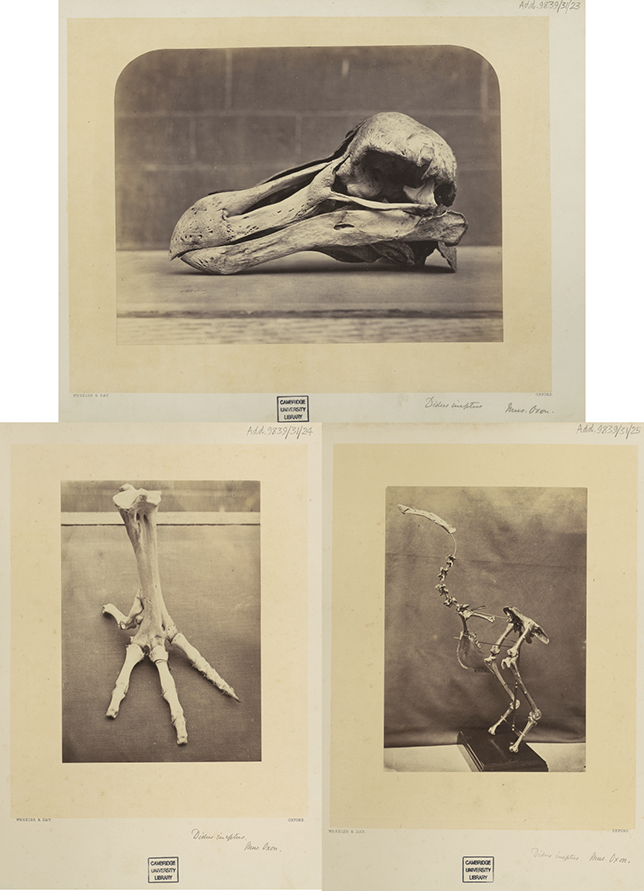
This Element focuses on two interconnected processes:
(1) The emergence in nineteenth-century Denmark of the kitchen-midden as an archaeological/prehistoric site, that is, the repository of evidence of past daily life, including the bones of animals that were used, eaten, or worshipped. In contrast to the prehistoric sites from deep time (namely, from Paleolithic times, and which show, inter alia, the coexistence of humans with extinct fauna), these kitchen-middens contained remains of animals that until very recently were still extant and which had been observed in the wild. However, the Danish kitchen-midden was recognized not only as a repository connecting the distant deep past to historical times, but also as a space where the evidence of very recent extinctions could be found; and (2) the global expansion of this method of archaeological enquiry to the unearthing and trade in the bones of recently extinct animals in such sites and which became a source of museum rivalry for the possession of such rarities as the extinct species known in the nineteenth century as Alca impennis, the North Atlantic great auk, and Rhytina stelleri, the North-Pacific manatee of the Commander Islands. This method was also used to recover the bones of other recently extinct species, such as the dodo and the Rodrigues’s solitaire, the famous, flightless Indian Ocean birds, whose bones were highly sought after. All of these animals became extinct before their skeletons could be collected for natural history museums. The history of the search for these skeletons also allows us to discuss the history and emergence of the very idea of historic extinction, the material remains that were used to validate that idea, and how the extraction of these bones gave a new role to both ancient and modern rubbish dumps. These two strands form the analytical backbone of the Element and anchor the transitions between the sections that follow. In this way, this Element addresses the recognition of new scientific spaces and the development of new practices in the history of collecting, and connects historiographies of natural history with the history of archaeology and the history of waste. All of these developments – together with the emergence of pedology, prehistoric archaeology, and the concept of extinction in the frame of Darwin’s Origin of Species (1859)- are essentially those of the nineteenth century, a period that some historians characterize as the “century of the museums.” The consolidation of soil science accompanied a growing interest in waste disposal and recycling systems: the natural world offered models, and waste became the building blocks of new land and landscapes. Consequently putrefaction could, and should, be understood as a stage in a cyclical process rather than the end of a linear one, turning what was once discarded into something valuable. These connections were uneven and often implicit, but they shaped the evidentiary landscape in which prehistoric archaeology and paleontology took form.
This Element has several dispersed geographic “centres” of interest, illuminating how scientific practices and collections were shaped by long‑distance maritime and administrative networks. Among others the Kattegat, namely the sea area bounded by the Jutlandic peninsula in the west, the Danish strait islands and the Baltic to the south and the Swedish provinces in the east, where the kitchen-midden were first observed and defined; the Po Valley, in Italy, where the terramare, small mounds formed by organic waste, were first described, and Neuchâtel, Switzerland, home to the prehistoric lake dwellings and the first studies on peat bogs. However, its geographic scope is wide, as maritime and islander societies in far-flung places were connected to those “centres” through other spaces via the stopovers of the great trade routes. These connections thus linked the North-Atlantic edge that stretches from Newfoundland to the Kattegat by Iceland, the Faroe Islands, and the north of Great Britain (MAP 1); the Indian Ocean islands of Rodrigues and Mauritius; the North-Pacific’s Commander Islands in the Russian Far East; and the central Atlantic, from Europe to South America via the islands of Cape Verde. This web not only produced some unexpected scientific spaces but also showed how the fragments of animals and scraps of data collected by individuals were embedded in networks of motion and administration. Therefore, these pages provide ideas to complement other publications from this and other series; in particular, Adrian Currie’s Scientific Knowledge and the Deep Past (2019), Catherine Frieman’s Archaeology as History. Telling Stories from a Fragmented Past (2023), Thomas Moynihan’s The History of Contingency and Future-Oriented Thought, and Thomas Stammers’s Collections and Collecting in Historical Perspective. I hope this volume also complements the Elements of Paleontology series and Marco Armiero’s Element in Environmental Humanities: Wasteocene: Stories from the Global Dump (Reference Armiero2021), which frames waste as a global socioecological regime.
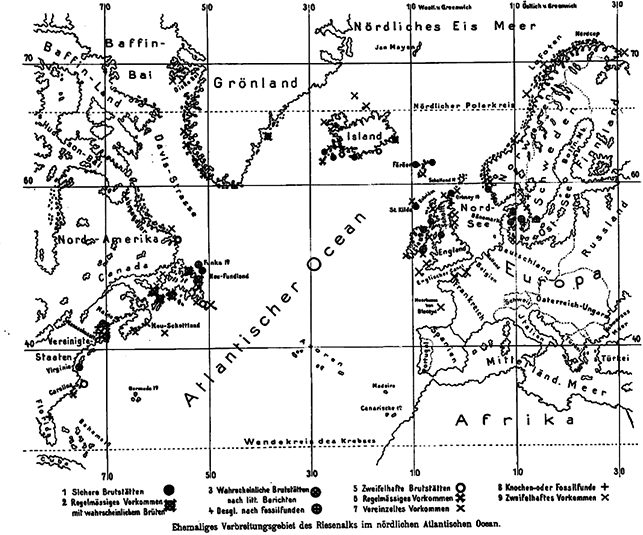
Former distribution of the Great Auk in the Atlantic Ocean.
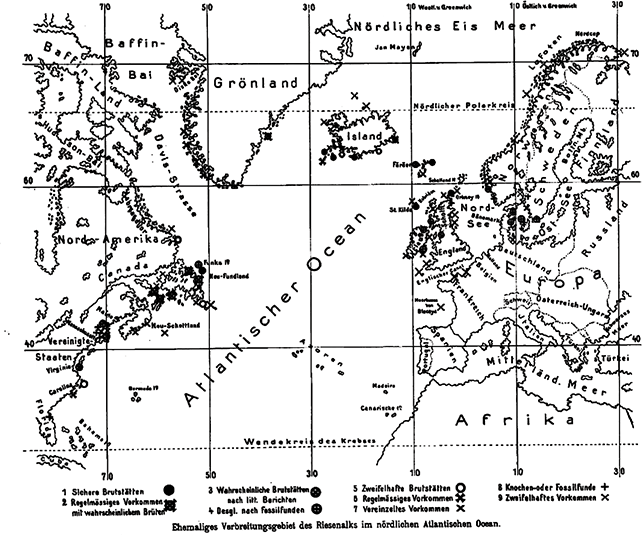
(1) Confirmed breeding locations
(2) Regular occurrences with probable breeding
(3) Probable breeding locations according to the literature
(4) Probable breeding locations according to fossil findings
(5) Dubious breeding locations
(6) Regular occurrences
(7) Sporadic occurrences
(8) Bone, or fossil findings
(9) Dubious occurrences
Waste, Bones, and Society
This Element’s central themes originate from working on a seemingly irrelevant protocol for the history of the sciences of the past, namely the 1819 instructions of Juan Manuel de Rosas (1793–1877), future governor of Buenos Aires, which were compiled for the administrators of his extensive estate in the pampas.Footnote 1 He emphasized the need for constant observation and the recording of even small events. Every man on the estancia who was able to read and write kept pen and paper at hand to register observations to be transmitted to his superiors. In particular, workers had to keep an eye on the bones of dead livestock in order to maintain the estancia’s cleanliness. Juan Manuel de Rosas stipulated that
In no way should there be scattered bones … Men should not live surrounded by rubbish. I insist: it is unacceptable for bones and little bones to be scattered everywhere, everything must go to the rubbish dump … Skeletons of all kind of animal, regardless of their quality, must be gathered in a place devoted to this end. Therefore, there must be no skeletons in the field, all must be collected and brought together for the branding of livestock.Footnote 2
“Skeletons of all kinds” ended up including the mighty bones of South American fossil mammals that emerged from the earth every dry season, and which only recently had become objects of study and collection. It is not surprising, therefore, that travelers wandering the pampas in search of specimens of bones found them accumulated in small heaps, formed by the piling up of skeletons in rubbish dumps that eventually could be recycled for the production of bone-based products such as animal-bone glue or agricultural fertilizers.Footnote 3
Rosas’ insistence on gathering all bones into designated dumps created centralized heaps and, crucially, bureaucratic paper trails (notes, reports, instructions) that made those bones visible to travelers and naturalists. Upon entering the urban sphere, these administrative chains of information set in motion a structured process of notification: estate owners were apprised of the finds and, acting as intermediaries, communicated this knowledge to those invested in searches for fossils. Consequently, this flow of information ensured that the bones were rerouted from the bone‑crusher to the analytical purview of comparative anatomists. What this “move” entailed was the circulation of information through a small but efficient administrative chain. The notes kept by mayordomos and overseers were periodically consolidated by the estate administrators, who communicated notable findings to the landowners; these owners, in turn, often informed travelers or naturalists with whom they were connected. In this way, a bureaucratic protocol devised for managing rural labor and cleanliness inadvertently created a structured flow of information that was capable of diverting bones away from industrial recycling and toward scientific analysis.
This example, taken from my work on the fossil dealers from the pampas, shows how happenstance works (see Moynihan’s Element) and how the administration of waste and garbage contributed to making visible those objects previously considered merely as refuse or the raw materials for industry. As this Element argues, visibility is connected to the new economic and epistemological values of the waste and leftovers, reintegrating them into the economic circuit not only as raw materials but also as museum specimens, and providing a new source of jobs for people who would specialize in finding, restoring, assembling, selling, and studying them. These new ventures placed paleontology, archaeology, and related sciences of the past as parts of a new economic circuit of recycled materials.
American historian Susan Strasser, in her valuable work on waste and consumption, identified herself as a scholarly scavenger: “My method was that of the ragpicker,”Footnote 4 she wrote, recognizing that she was not the first in comparing historians’ practices with collecting discarded items; others before her had also pursued this research strategy. French poet Charles Baudelaire considered the ragpicker as an urban archivist, someone who sorted through “everything that the big city has cast off, everything it lost, everything it disdained, everything that it broke.” Or Irving Wohlfarth, who studied Paris chiffonniers, describing the historian as a researcher “wandering the archives, sifting through a detritus from the past that has been used for other purposes and recycling the figurative and literal rags he turns up to give them new meaning.”Footnote 5 Or the early twentieth-century artists who incorporated recycled materials into their work, including later developments such as French filmmaker Agnès Varda, who claimed that for her, artistic gleaning is about picking ideas, images, and emotions from other people and to make it into a film.Footnote 6, Footnote 7
Thus, social historians and artists have used the metaphor of ragpicking and/or gleaning for their reflections about how they think, how they compose their work in bits and pieces, which John Ulrich, referring to Thomas Carlyle, described as the “paleontological articulation of the past.”Footnote 8 While traces of these concerns appear sporadically in the nineteenth‑ and early twentieth‑century historiography of archaeology and paleontology, they were only partially addressed and rarely examined as coherent analytical categories. By contrast, late twentieth‑ and early twenty‑first‑century archaeology has begun to theorize refuse explicitly – from Rathje’s “garbology” to more recent studies of waste and recycling.
At the same time, several strands of archaeological scholarship – ranging from work on fragmentation and ambiguity to recent studies of waste management and recycling in ancient and contemporary contexts – demonstrate that refuse has long been a productive analytical category within archaeology. My aim here is not to deny these contributions but to show that their nineteenth‑century antecedents operated within very different administrative, economic, and epistemic configurations.Footnote 9 This volume focuses on those nineteenth-century scientific, administrative, and economic dimensions of waste that have not been systematically analyzed as part of the historiography of the sciences of the past.
This is a significant point given the fact that leftovers, scrap, waste, disposal, debris, and so on, are the core materials of these disciplines, archaeologists in particular being literally waste material dealers. This Element is an attempt to describe the emergence of waste and the rubbish bin as objects of scientific study, and upon which the history of culture started to be tracked.
There is a vast literature dealing with “waste” creation and “disposal” (including reuse). In Australia, for instance, Betty Meehan’s 1975 thesis, Shell Bed to Shell Midden, is a biography of marine shell from collection to discard and reuse. The seminal Tucson Garbage Project, an archaeological and sociological study instituted in 1973 by William Rathje (1945–2012) in the city of Tucson, Arizona, was an effort to understand how garbage deposition patterns are or are not related to socioeconomic status. Rathje not only studied garbage, but framed it as a category of archaeological inquiry. While archaeologists have long worked on modern and ancient refuse, some syntheses in the history of waste management – as Sarah Newman (Reference Newman2023) has recently remarked – remain geographically uneven and often date the consolidation of municipal, industrial-scale systems to the late eighteenth and nineteenth centuries. In what follows, I connect those chronologies of waste management to the parallel emergence of the sciences of the past. If, by 1900, for the first time in human history, disposal became separated from production, consumption, and use, it was also the time when some past waste became national heritage in many countries and was put in museums to be preserved “forever”. Far from being excluded from economic circulation, this waste was transformed into more valued goods. Eventually, the garbage pit as an archaeological site became a mine of new materials that, perhaps ironically, had to be protected from processes of damage and decay and, instead, allowed them to illuminate nineteenth-century concerns about waste such as accumulation and disposal, recycling, soil processes, and chemistry.
Human-Made Heaps
Holocene science required and requires the collaboration of history, archaeology, and earth sciences, including pedology, to study the natural physical processes that affect archaeological sites, providing information about the potential anthropogenic origins of landscapes and geological features previously perceived as of natural origin. While historiography considers that the multidisciplinary approach is relatively new, this Element shows that the science of the prehistoric past emerged in a constellation created by the analysis of soil composition and of structures such as mounds and artificial hills, which revealed two different chronologies: one connected with when they were made, the second, when they were recognized as artificial structures and a monument from the past created by human waste.
Accumulations of waste and remnants create heaps and mounds. German media historian Markus Krajewski has argued that there is a strong connection between this accumulation and the term “world”. Drawing on the work of German etymologist Wolfgang Pfeifer, he traces the New High German term Welt back to the Old High German weralt, which itself originates from the Indo–Germanic root al, meaning “growth” or “nourishment.” This etymological lineage underscores a semantic field in which Welt denotes not only “globe,” “earth,” and “humanity,” but – remarkably – also “toilet,” as documented in the Latin etymological dictionary by Alois Walde and later expanded by Johann Baptist Hofmann in 1954. This latter sense evokes a space where everyday human activities occur, where the remnants of sustenance accumulate and ultimately return to the earth. From this perspective, Krajewski contends that “world” emerges from waste, insofar as discarded matter provides the starting point for new cycles of formation: what appears as garbage reenters the fertile soil as humus or manure, and the assembled remnants become the material basis for renewed vegetal growth and its nourishing fruits. Waste, in this view, is not an endpoint but a generative substrate.Footnote 10
Also following Krajewski, a similar association between world‑making and accumulation appears in one of Rome’s oldest cosmological and urban concepts: the mundus. Although commonly translated as “world,” the mundus was, in ritual practice, a pit, a hollowed cavity dug at the founding of the city and filled with offerings, first fruits, and even handfuls of soil brought by settlers from their homelands. Ancient authors noted the identity of the name with the world, suggesting that the word designated both the cosmic whole and the earth-filled cavity that anchored it. The mundus thus functioned as a controlled site of accumulation: a receptacle of organic matter, ritual debris, and symbolic residues that periodically opened onto the realm of the dead. In this sense, it was a kind of ritual midden, an early recognition that deposits of refuse – material, vegetal, ancestral – could generate a place, a boundary, and a world.
Such a concept resonates strongly with the historical landscapes of pre‑modern Europe. In the Middle Ages, dumpsites formed from bulky refuse and the drainage of pit privies – or through the work of early street‑cleaning services – were a common feature of some cities. Originally located at the city gates, these accumulations were soon encircled by expanding urban settlements and relocated to the outskirts, where they often grew into substantial hills and mounds. Over time, these formations became absorbed into the urban topography, their human origin forgotten or literally buried beneath layers of soil, vegetation, and memory.Footnote 11 Thus, medieval waste heaps embodied the same logic that Krajewski identified: residues generating new terrains, new forms, and ultimately new worlds.
On the other side of the Atlantic, recent research on the landscapes produced by prehistoric human occupation in Amazonia and the Lowlands of South America describes their similarities to and connections with mounds of natural origin. In the lowlands of South America, earthen mounds less than 30 cm in height, known as aterros or tesos (in Portuguese) and cerritos de indios (in Spanish), are articulated with other built structures such as elongated platforms, borrow pits, tracks, pathways, and artificial lakes. These features create archaeological complexes situated in flooded environments in the pampa from Uruguay, Argentina, and southern Brazil. The cerritos (dated between 4,700 and 200 years BP) include soils of human origin, as indicated by the presence of stone tools, faunal and botanical remains, ceramic shards, and human remains. In the Amazon basin, the study of Terra Preta de Índio or Amazonian Dark Earth, a type of fertile artificial soil with a high content of carbon, has revealed not only its composition but also that this product has a very long history that reflects the constant interaction between human occupation and pedogenetic processes. Studies on the dark earth, the Amazonian mounds devoted to agriculture and the fluvial deposits of shells (sambaquis in Portuguese), dating from the Holocene (8,000 BP)- contributed to the elucidation of an interrelated deep past that shows that the Amazonian forest was not “natural” but the result of thousands of years of human intervention, including agriculture, selection and domestication of trees and plants, as well as cooperation with other animal species.Footnote 12
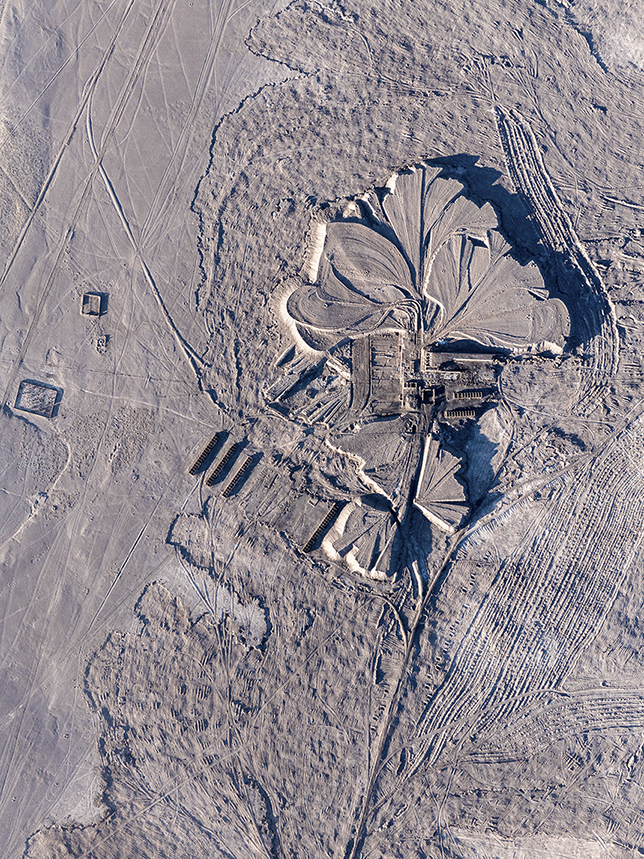
This kind of analysis shows that pedology is a crucial tool for archaeologists trying to understand the past in areas where remains are elusive or difficult to identify with traditional fieldwork methods. In Newfoundland, for example, Canadian archaeologist Amanda Crompton, examining the transatlantic French cod fishery, is trying to understand how mariners have shaped the island’s coastlines since the sixteenth century. Aerial data captured by drone flights combined with soil chemistry analysis revealed the anthropogenic origin of today’s deserted “natural” landscape. The same techniques have been used by Chilean architect Alfredo Thiermann, who, with his team, recorded the accumulations resulting from the nitrate industry established in the Atacama Desert in the early twentieth century. The material, explored through various visual and sonic media, highlighted the alchemical transformation into financial capital, namely nitrates into saltpeter used to fertilize European soils (Figure 1). As they said,
Being the driest place on the planet, pulverized dinosaur bones, fossilized bird excrement, stardust, atmospheric sediments, and the material echoes of long-extinct volcanic and marine life have accumulated on its surface for millions of years. When walking on its rugged crust, one steps on the surface of a millenary archive, a memory device as vast as it is precise, which, due to the lack of rain, has stored everything. (see the exhibition Chilehaus,)Footnote 13
While some “anthropo/geogenetic” processes are rooted in the past, some are still in action and visible in the European chains of hills composed of household waste, war debris, and industrial spoil. In Leipzig’s Auenwald reserve, for instance, Rosenthal Hill was formed between 1887 and 1896 by dumping 120,000 m³ of household waste to create a 20‑meter mound, later landscaped and topped by successive lookout towers, the current one built in 1975. Similar rubbish mounds – Schutteberg and Trümmerberg – were created from the tens of millions of cubic meters of rubble generated by bombing in World War II. Berlin alone has eight such hills, including Teufelsberg, which rises to 114.7 m and contains 12 million m³ of debris. While these hills have been greened and converted into parks, other accumulations continue to grow, such as the potash‑plant tailing piles known as Monte Kali or Kaliberg. The highest, in Heringen (Hessen), reaches 200 m and grows by 9 million m³ per year, with others in Philippsthal, Bokeloh, Sehnde, Wathlingen, Giesen, Zielitz, Sollstedt, and Neuhof. Composed of rock salt, clay, anhydrite, and other by‑products, they also serve as sites for guided tours and open‑air events. The stratigraphy of these human‑made hills – many contemporaneous with the rise of prehistoric archaeology – reflects industrial and urban waste accumulation since the mid‑nineteenth century, shaping new sensibilities around modern and ancient waste landscapes.
22°1'11.2” S 69°37'3.8” W. View of the Buena Esperanza office, the first saltpeter works bought by Henry B. Sloman from Eduardo Squire in 1892. The irregular geometry of the ripio torta is visible. The shape was regularized in later saltpeter works with the introduction of new industrial processes, which were imported from Germany from 1895 onwards. Oficina Buena Esperanza, Cantón del Toco.
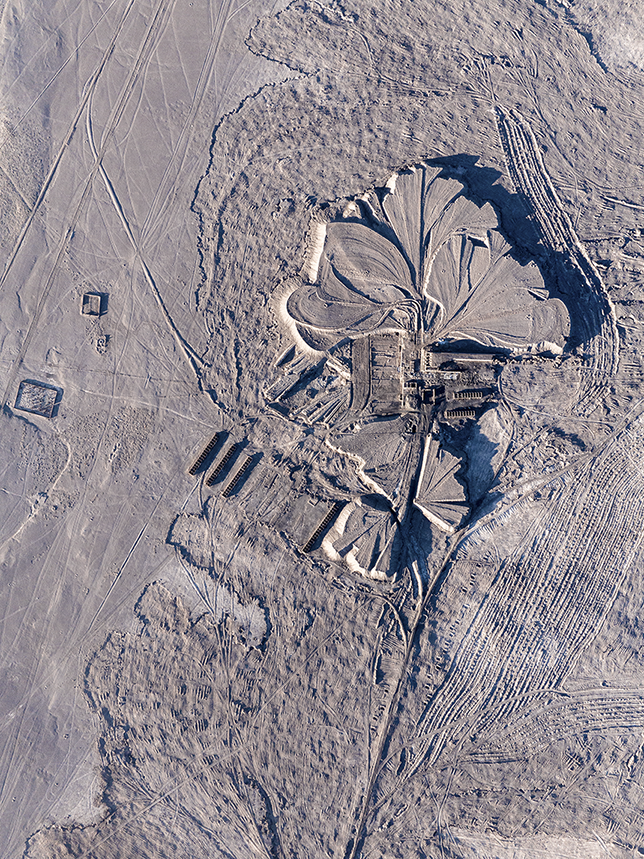
Figure 1
A view of the Buena Esperanza office, the first saltpetre works bought by Henry B. Sloman from Eduardo Squire in 1892. The shape was regularised in later saltpetre works with the introduction of new industrial processes, which were imported from Germany from 1895 onwards. Oficina Buena Esperanza, Cantón del Toco. Copyright Alfredo Thiermann (courtesy Alfredo Thiermann).
In various ways and places, these examples show how diverse forms of discarded matter – organic residues, industrial by-products, and the humble debris of daily life – became entangled with the emerging sciences of the past, while the bureaucratic traces generated in managing these materials created parallel channels through which waste acquired visibility, value, and historical meaning. Through these interwoven material and documentary circuits, nineteenth-century scholars learned to read refuse not merely as detritus but as a stratified archive that linked local practices to global networks of extraction, circulation, and comparison.
The following section builds upon this foundation by turning from conceptual framing to the concrete infrastructures and economies that governed the movement of waste: it examines how excreta, bones, scraps, and their attendant administrative residues circulated between countryside and city, and how these flows – at once economic, material, and epistemic – created the conditions under which refuse first became legible as scientific evidence. Section 1, therefore, begins by examining the nineteenth‑century economic and administrative systems. Later sections return to the question of how waste, value, and scarcity shaped collecting practices and the parallel economies around natural history specimens.
1 Waste Economy and the Remains from the Past
The concept of “waste” is shaped not only by its material reality but also by social attitudes and status. This conceptual mapping provides the foundation for examining how nineteenth‑century actors mobilized these materials – excreta, bones, scraps – within economic, agricultural, and scientific circuits, a trajectory that structures the remainder of this section.
As Barles argues, the histories of waste and the vocabulary used to describe it are inseparable.Footnote 14 In English, the term “waste” carries a number of meanings other than “rubbish.” According to the Oxford English Dictionary, it derives from Old Northern French “wast” or “waste” which, in turn, is derived from the Latin “vastus” meaning unoccupied or uncultivated. Today, “waste” may refer not only to refuse but also to barrenness, something unused or unusable, or something consumed without purpose. This section provides the material and economic backdrop against which nineteenth‑century actors began to treat waste as a scientific resource and made it useful in new ways. By tracing how excreta, bones, scraps, and other forms of refuse circulated between city and countryside, and how these movements intersected with emerging industrial and agricultural demands, the section shows how discarded matter gained analytical visibility. These circuits, together with the bureaucratic and administrative procedures that rendered waste legible, created the conditions under which particular deposits would later crystallize into archaeological site‑types – an argument developed in Section 2.
Barles’ quick survey shows that three different types of vocabulary have emerged to describe “waste”. In the first category, terms are associated with the themes of loss and uselessness: déchet in French, refuse and also garbage in English, rifiuti in Italian, Abfall in German. In the second category, terms emphasize the dirty or repulsive nature of waste materials: immondice in French, immondizia in Italian; ordure in French. Finally, terms in the third category describe the things that make up the waste: boues in French, spazzatura in Italian, Müll and Schmutz in German, rubbish in English (derived from rubble). In Spanish, the term basura means “filth or a collection of waste of any kind, such as that which accumulates daily in the home: sweepings, and old items thrown away when cleaning out what is no longer useful.” (suciedad o conjunto de desperdicios de cualquier clase, como los que se hacen a diario en la casa, las barreduras, las cosas viejas que se tiran al hacer limpieza de lo desechado).Footnote 15 The word waste belongs in the first category defined by Barles. It was first used to depict a desolate, ruined, or neglected region. Later, the term was used to describe a wasteful expenditure until finally acquiring its additional, current meaning in the fifteenth century. These linguistic distinctions mattered because they underpinned the classificatory and economic practices through which waste circulated.
However, the original meaning of waste has always had a spatial dimension. The “useless” waste materials became harnessed to useful effect by moving them through the landscape in continuous and circuitous systems. Excreta, bones, and scraps moved from the city to the countryside to enhance the production of food and other commodities for consumption back in the urban centers. These circuits also created the conditions for refuse to become an object of science. Whatever the semantics of the word “waste” they fail to acknowledge the complex material pathways along which waste moved and the economic pressures that intensified the scientific and industrial value of organic refuse.
Thanks to its agricultural and industrial importance, the value of excreta, particularly urban excreta, increased in the period between 1770 and 1860. Both industrialization and urbanization imposed new strains on food resources and the supply of raw materials required for industrial use. Demographic growth, especially in towns, required a concurrent increase in agricultural production, and one way to achieve this was by improving yields through better fertilization of arable land. By the late eighteenth century, a shortage of farm manure prevailed, leading to a search for other fertilizing materials. Indeed, the numerous studies on putrefaction during the eighteenth century and the identification of the great material cycles by chemists showed that death was critical to life and that human and animal excreta, as well as food residues, could be used as fertilizers. These wastes were most concentrated in cities and it was there that mud from streets, the drainage of pit privies, beef blood, old shoes – indeed any organic waste – were collected. Throughout Europe, scientists and intellectuals stressed the need for cities to return their food waste as fertilizer to the countryside. Furthermore, an important part of the emerging industry was reliant on using raw materials, such as the rags used for papermaking, that could be supplied in quantity only by cities. Similarly, there was a growing industrial use of animal bones, which were also concentrated in urban areas since slaughtering took place in city abattoirs. Increasing quantities of bones were needed for their traditional uses – the manufacture of objects, grease, and glue – as well as for new market products and opportunities. From the 1820s, phosphorus was used to make matches ignited by friction; animal charcoal was employed to refine sugar whose consumption was growing; gelatin was needed for some food preparations; and, later, superphosphates became prized for agricultural fertilizers. Rozas’ instructions regarding bones on his estancia are certainly related not to “aesthetics” but to the maintenance of hygiene and this new, potential economic use of bones. Other butchery by-products also found market opportunities in the manufacture of candles, Prussian blue pigment, glue, ropes, and combs. According to Barles, as late as 1882, the French hygienist Henri Napias (1842–1901) urged that: “In industry, there must not be any actual scrap, and everything must be used either for industry itself or for agriculture.”Footnote 16
This early nineteenth-century trend coincides with the first field study of the waste disposals from the past located on the outskirts of a city. It coincides too with the definition of coprolites, the fossilized feces first described by British geologist William Buckland (1784–1856) in 1829. Buckland not only showed their value to science in indicating past environments but he also promoted the agricultural value of crushed coprolites as a source of phosphate fertilizer and, with his wife Mary Morland (1797–1857), their use as polished nodules for jewelry and the decorative arts. Fossilized dung and the bones of creatures from prehistoric times thus became not only a rich source of phosphates for English agriculture but, as polished nodules, as semiprecious stones. These developments in circulation and reuse also shaped the emerging scientific interest in earlier waste deposits, a trajectory that becomes clearer in the first nineteenth‑century studies of ancient refuse. Taken together, these overlapping economies of excreta, bones, scraps, and industrial by‑products formed the material and administrative preconditions for the emergence of archaeological “waste deposits” as formal site‑types. What follows in Section 2 examines the moment when these accumulations were no longer understood merely as resources within agricultural or industrial circuits but became analytical objects within prehistoric archaeology.
Such practices prefigured the typological formalization examined in Section 2, where specific forms of accumulated refuse became recognized as archaeological evidence. This association between dung, waste, decorative arts, and luxury will reappear in further sections below.Footnote 17 Having traced how waste gained economic value through reuse and circulation, the focus now turns to the medium that both receives and records those processes: soil. This shift links disposal to excavation by following how nineteenth‑century actors measured, analyzed, and reclassified the ground as an archive of discarded matter.
The Soil We Walk On
Nineteenth-century farmers, chemists, investors, and scholars of all kinds were turning over the soil they walked on, not only the deep geological strata but the shallower organic components and nutrients of the most recent sediments, analyzing them from a chemical point of view and recording the objects and organic remains and materials they found in it.Footnote 18 The literature has already shown that the history of archaeology is related to the engineering works that, since the eighteenth century, have been uncovering buried structures, such as the cities of Pompeii and Herculaneum or the Roman ruins being unearthed in Spain. But in the nineteenth century, unearthing also took place in smaller excavations and more humble spaces. While the history of archaeology is well known to be deeply entangled with geology – stratigraphy, uniformitarianism, and other geological principles having shaped the discipline since the nineteenth century – the explicit incorporation of pedology into archaeological method emerged only in the mid‑twentieth century. By contrast, nineteenth‑century observers rarely differentiated geological processes from anthropogenic soil change produced through waste practices. Clarifying this distinction helps to situate the present argument historiographically: the period examined in this Element did not yet conceptualize “soil analysis” as a separate scientific domain, even though waste‑shaped strata were already central to the formation of archaeological sites.
Histories of archaeology have rightly emphasized the discipline’s long entanglement with geology and with techniques of recording and training; even when they are concerned with the same protagonists. What has been followed less systematically is how practices of waste disposal and anthropogenic soil change shaped the very structures archaeologists excavated, and how chemists, agronomists, and (later) soil scientists framed those deposits as data worthy of analysis. As this subsection argues, the history of archaeology is also the history of soil science, investigations into peat, and the development (and fall) of the guano trade.
The word “pedology” first appeared in German in the works by Friedrich Albert Fallou (1794 – 1877), who, in 1857, published “First Principles of Soil Science” followed by “Pedology or General and Special Soil Science” in 1862. In his work he developed his field observations of soil into a systematic approach and made the case for the recognition of soil science as a discipline, published in the Journal for German farmers.Footnote 19
It was becoming clear that in addition to physical forces, plants and animals, including humans, were heap- and soil-builders and/or destroyers. In 1844, the Swiss Léo Lesquereux (1806–1889), who would become an expert on the peat bogs of Europe and North America, published Quelques recherches sur les marais tourbeux en général devoted to restoring the Neuchatel region’s bogs due to concerns about the fate of their timber industry. Lesquereux was commissioned by the King of Prussia to study the peat swamps of Jura, and on the coasts of the North and Baltic Seas, and later Denmark, Sweden, and Norway. While the chemistry of peat bogs was hitherto unknown, peat was crucial for several industries and had been used for combustion since ancient times. In Denmark, as we will see in the next section, Japetus Steenstrup devoted a monograph on the typology of peat bogs, and in so doing described also the archaeological remains that they contained.
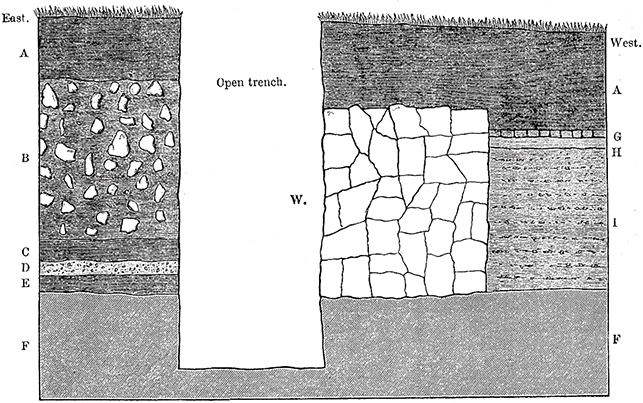
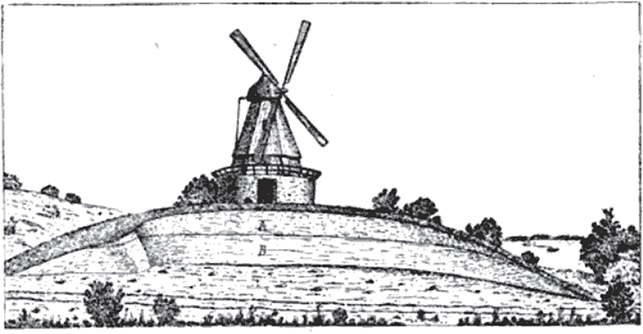
The formation of organic soils was a worldwide concern. When Charles Darwin published his last book in 1881 The Formation of Vegetable Mould Through the Action of Worms, with Observations on their Habits it sold thousands of copies in its first few weeks. This success was not only because of Darwin’s fame but also because his experiments on the movement of ancient and modern objects deposited in the Earth addressed the hot topics of the day: what to do with things that accumulated on the surface? How fast did things disappear? How could vegetable mould be produced?Footnote 20 Darwin, for instance, analyzed the part which worms have played in the burial of ancient buildings, calculating the amount of earth brought to the surface by worms by the rate at which objects on the surface are buried and by weighing the earth brought up in a given time. Information from farmers on marl, cinders, and so on, sinking into the ground helped Darwin to make his calculations. Objects of all sorts “work themselves downwards” as farmers say. He visited Stonehenge and found some outer stones partly buried, the turf sloping up to meet them (Figure 2). Large stones sink because worms fill up any hollows with castings, then eject them beyond the perimeter, and the ground around them starts to rise. Darwin weighed castings per unit area per year, then worked out how thick a layer casting would make, compared with rates of sinking.
Section through the foundations of a buried Roman villa at Abinger. A A, vegetable mould; B, dark earth full of stones, 13 inches in thickness; C, black mould; D, broken mortar; E, black mould; F F, undisturbed subsoil; G, tesseræ; H concrete; I, nature unknown; W, buried wall (Figure 8 of Charles Darwin’s The formation of vegetable mould, through the action of worms, with observations on their habits. London: John Murray, 1881)
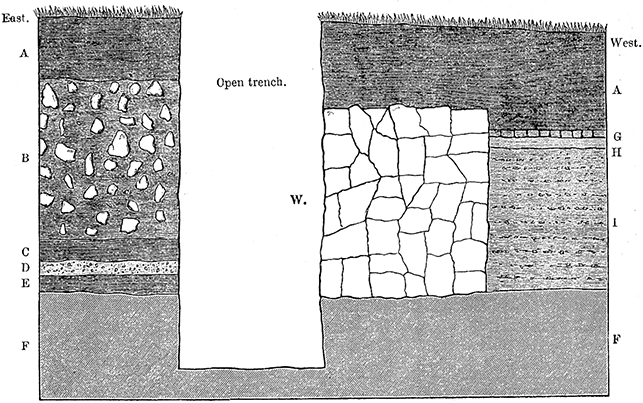
Figure 2
Section through the foundations of a buried Roman villa at Abinger. A, vegetable mould; B, dark earth full of stones, 13 inches in thickness; C, black mould; D, broken mortar; E, black mould; F F, undisturbed sub-soil; G, tesseræ; H concrete; I, nature unknown; W, buried wall (Fig. 8 of Charles Darwin’s The Formation of Vegetable Mould).
The discussion of mould, worms, and burial rates sets up a broader nineteenth‑century obsession with accumulation and depletion. The next example – guano – shows the same problem at another scale: deposits that are simultaneously ecological archives, agricultural inputs, and objects of extraction.
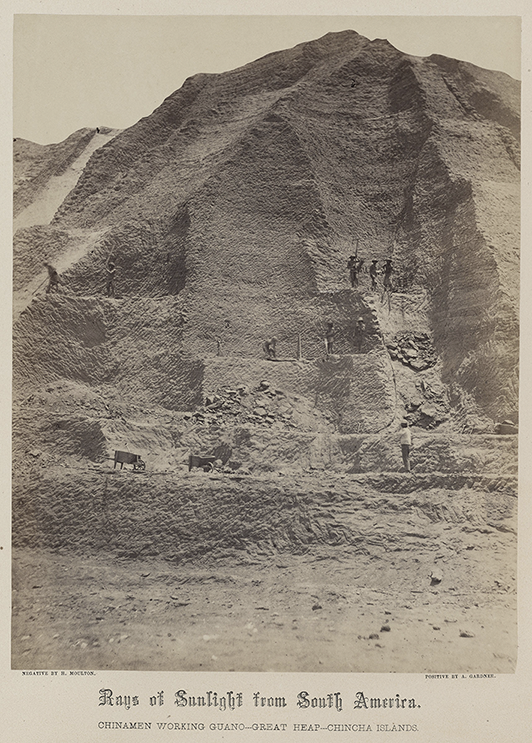
The rate of soil deposition in the formation of peat bogs, mould, and other natural/artificial structures was key to several economic activities. This included the exploitation of guano deposits, such as those from the three tiny Chincha Islands off the southern coast of Peru that have served as home for seabirds, possibly for millennia. The birds fed in the rich waters packed with fish but an absence of predators, allowing their droppings to accumulate onshore to a depth of up to 60 m. The dry weather and cool ocean currents there maintained the guano’s nitrate-rich quality. However, by the late 1870s, nearly all of the Chincha Islands’ guano was gone, and the seabird habitat was ruined by the mining operations (Figure 3).
“Chinamen working guano. Great Heap, Chincha Islands, 1865, Chincha Islands (Peru), Guano industry, Peru,” Albumen silver print, Print Size: 8 3/4 × 6 3/4 in. (22.2 × 17.1 cm), Mat / Mount: 17 × 12 in. (43.2 × 30.5 cm), Date Issued: 1865, Place: Washington, D.C., Publisher: Philp & Solomons, “Guano’s heavy toil, Chinamen’s sweat-drenched labor yields, Peru’s rich deposit.”
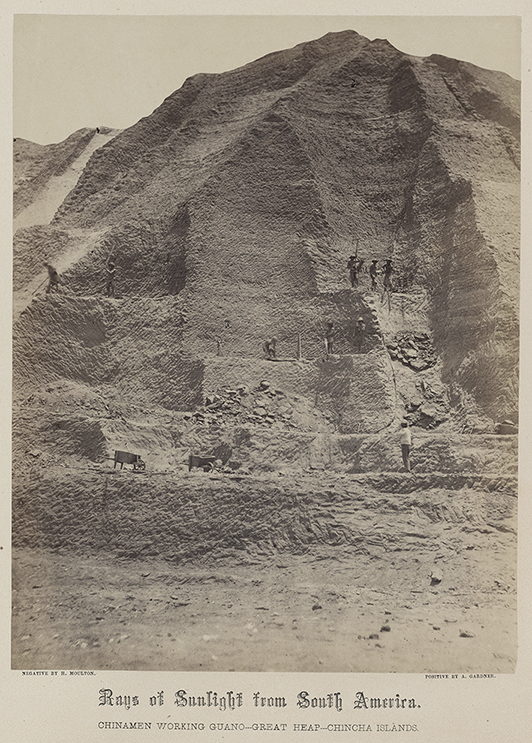
Figure 3
Chinamen working guano. Great Heap, Chincha Islands, 1865, Chincha Islands (Peru), Guano industry, Peru, Albumen silver print, Print Size: 8 3 by 4 times 6 3 by 4 inches (22.2 by 17.1 c m), Mat / Mount: 17 by 12 inches (43.2 by 30.5 c m), Date Issued: 1865, Place: Washington, D.C., Publisher: Philp and Solomons, Guano’s heavy toil, Chinamen’s sweat-drenched labor yields, Peru’s rich deposit.
In the early nineteenth century, farmers and chemists worldwide claimed that Chincha Islands guano was the world’s finest fertilizer and that farmers needed it to replenish the nutrients in their fields and increase their crop yield. Guano produced by cormorants, boobies, and pelicans off the coast of Peru had a remarkably high nitrogen content that promoted plant growth. Beginning in the early 1840s, it was commercially mined, transported, and sold in Germany, France, England, and the US. American farmers, especially in the mid Atlantic region, lobbied their congressmen to get more and more of the acrid stuff to replenish the soils of their tobacco and produce farms, which could yield three times the normal growth with an application. American shippers and their business partners were allowed to seek and claim islands in the Pacific and Atlantic for this trade. Within a few years, nearly 200 guano island claims were made.Footnote 21
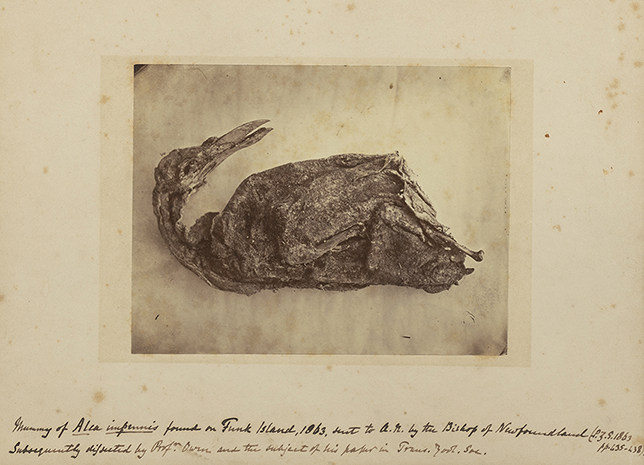
Around the same time, huge deposits of nitrates and phosphates were found on land, and for the first time, fertilizers could be blended to local needs, so the mining of guano islands ended without lasting impact on the world’s agriculture or history. While the Americans exploited some 200 islands in the Pacific and the Caribbean, the North Atlantic also provided several deposits, such as those from Fogo and Funk Islands, the latter a small, barren, isolated, uninhabited island approximately 65 km northeast of Musgrave Harbor, Newfoundland, Canada. The name Funk, which means evil odor or vapor, is thought to have been given to the island because of the foul odor emanating from the nitrate and phosphate concentrations found in the guano deposited by the many millions of birds that have nested there over the centuries.
The National Museum of American History in Washington, DC, has devoted an exhibition to the links between the Smithsonian and the trade in guano (See the exhibition here: https://wayback.archive-it.org/3340/20160510135136/http://americanhistory.si.edu/norie-atlas/atlas. In March 1858, the US Navy Secretary asked the Smithsonian’s first Secretary, Joseph Henry (1797–1888), to analyze samples of seabird guano from the Pacific New Nantucket and Jarvis islands. Three months later, Henry reported that “the deposits submitted to examination do not possess the peculiar characteristics of Peruvian guano … and are not equal to it in value.” The second Smithsonian Secretary, Spencer Baird (1823–1887), was also involved in the guano business through his work at the port of Woods Hole, Massachusetts. He was interested in mixing nutrient-rich meal from the abundant menhaden fish with the rapidly depleting Pacific guano to extend its supply. In 1875 he urged the Pacific Guano Company of Woods Hole to exhibit its products at the 1876 Philadelphia Centennial. Several specimens kept in Natural History collections from Europe and North America are a subsidiary result of this trade.
The preceding examples of various waste economies developing in the late nineteenth century show how different types of refuse became materials of significant economic status and commerce, and significant enough to be celebrated as such in contemporary exhibitions and collections. In the following section I show how the recognition and legibility of refuse was mirrored in the burgeoning discipline of archaeology through the definition of a new kind of evidentiary site type. The identification of mounds of shell, food refuse, and other domestic residues as kitchen‑middens provided a rich new source of data about the recent past. However, as these middens bore evidence that linked human actions to recently vanished fauna, the new site type also linked the historical period with deep time. My narrative, therefore, turns to the evidentiary frameworks that shaped nineteenth‑century debates on extinction – particularly those emerging from St. Petersburg’s zoological networks. Having traced how nineteenth-century waste economies and administrative practices made discarded matter newly visible as a resource for scientific inquiry, we now move from the new economic and material circuits to the classificatory frameworks that emerged from them.
2 A Typology for Past Waste Deposits
The name of Japetus Steenstrup (1813–1897) is very well-known among historians of prehistoric archaeology.Footnote 22 Professor for Zoology at the University of Copenhagen, he was connected with an innovative study of material culture from the prehistoric past: the stratigraphic excavation of kitchen middens or kjokkenmoeddinger, the name he gave to those deposits or heaps of marine shells found at certain points of the Danish coast. The collections amassed by the Danish scholars became the subject of correspondence and scrutiny of European zoologists, including Darwin, Strobel, and Ernst von Baer. They discussed their procedures, translated the Danish works into English, French, and German, not only because of their prehistoric findings but also due to the growing interest in the records of historic extinctions.Footnote 23 Their research, based on excavation and analysis of faunal and botanic remains associated with human prehistory, also expanded into a transatlantic space. Bringing together linguistics, history, zoology, ethnography, and geology, this research agenda was going to reach the Indian-Pacific Ocean and define the search for the remains of other historic extinct animals.
As Bruce Trigger summarized, as early as 1837, piles of cockle and oyster shells containing numerous prehistoric artifacts had been observed in Sjaelland, a short distance inland from the present coastline of Denmark. In 1843 the Royal Danish Academy of Sciences appointed a commission to study these shells. This commission was headed by Steenstrup, archaeologist Jens Jacob Asmussen Worsaae (1821–1885), and geologist Johan Georg Forchhammer (1794–1865), who, from 1850 to 1856, published six volumes on their studies of these “kitchen-middens,” showing their human origin and describing the patterns of shell and refuse accumulation. They also determined that the ancient environment consisted of pine and spruce forests, with some oak, that the only animal that may have been domesticated was the dog, and that the sites were occupied during the autumn, winter, and spring, but not during the summer.Footnote 24
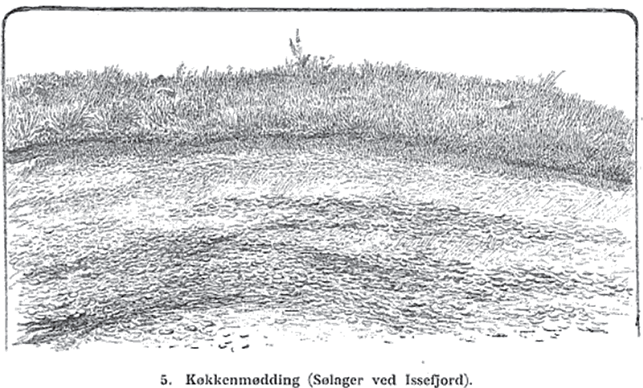
Until early in the nineteenth century, those heaps of marine shells had been taken to be natural deposits, indicating an ancient level of the sea higher than at present. On close examination, it was shown that they contained the bones of some species now extinct, splinters of silex, flint, or quartz, with roughly fashioned instruments of the same material, very coarse pottery, charcoal, and cinders. The extensive excavations and minute investigations also established that there was a complete absence of any metal. In the 1840s it was acknowledged that these heaps were the unmistakable refuse of repasts, mingled with the remnants of the inventions of a people that had lived on the seashore in the most remote antiquity, subsisting on fish and game, and discarding remnants and refuse which accumulated in one spot during a long series of centuries. The heaps were thus called Kjoekkenmoedding, from Kjoekken kitchen and Moedding refuse, rubbish, filth, a term which was also used in Yorkshire, England, in the form of midding, and with exactly the same meaning. (Figures 4.a and 4.b)
Køkkenmødding, from Menneskeslægtens ælde, Andreas Martin Hansen 1899 (a), and Danmarks Riges Histoire. J. Steenstrup [and others]1897 (b) (Public Domain)
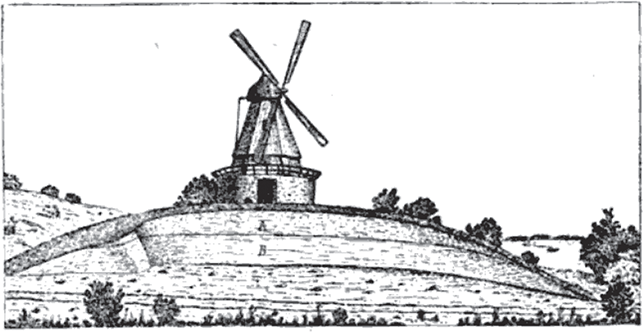
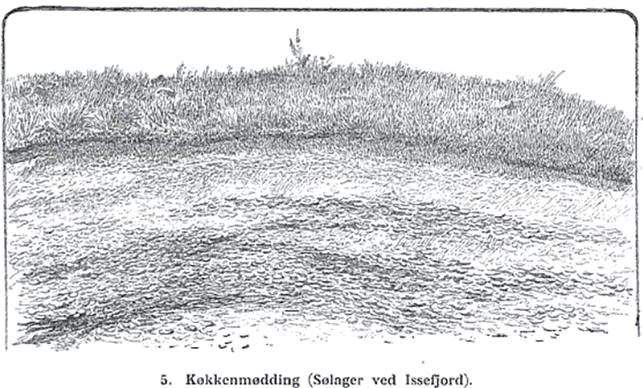
Figure 4b
It shows a low mound of accumulated shells and organic remains in the foreground, with stratified layers visible across the exposed ground. The mound appears set in a coastal landscape with grass and low vegetation in the background, illustrating an archaeological deposit formed by human activity over time.
The Kjoekkenmoedding were defined as “real zoological museums of the animal kingdom, of the fauna, which man found on arriving in the country, and they thus form a link which binds the geological past of our globe with the present historical period.”Footnote 25
Forchhammer, Worsaae, and Steenstrup, the latter an expert in peat bogs, gathered a collection which contained some ten thousand specimens of bones. Each piece was labeled according to where it was found, and the collection as a whole was housed in the Museum of Antiquities of the North as a representation of the Kjoekkenmoedding assemblages. These middens were rarely found anywhere but along the fjords and arms of the sea, in places where the action of the waves has little power, and especially in Seeland, along the Isefjord, in the isles of Fyen, Moen, and Samsoe, in Jutland, and along the Liimfjord, the Mariagerfjord, the Randersfjord, the Kolindsund, and the Horsenfjord. But soon deposits corresponding to this site type were found in many countries. Thus, M. Bruzelius, conservator of the Museum of Antiquities of Lund, found similar site types on the coast of Sweden, near Kullaberg, in Scania. Forel de Morges discovered seaside caves near Menton in the Gulf of Genoa, with deposits containing quantities of shells from edible species, broken bones of animals, charcoal, and splinters of flint, fashioned like those in the north. Steenstrup examined the collection deposited by Forel in the Museum of Turin, finding this correspondence complete. Little by little, deposits of this kind were described on the coast of Newfoundland in North America. As Trigger remarked many years ago, there was an explosion of mound builders elsewhere. Trigger focused on the ideas and description of these ancient peoples and not on the new epistemological value that leftovers and waste accumulation acquired for history-writing.Footnote 26 However, these deposits were described in their shape and dimension as an indicator of the amount of information they contained and the multiple dimensions of past human life they could illuminate. Thus:
The Danish Kjoekkenmoedding present a thickness from three to five feet. Their extent varied, reaching to a thousand feet in length, with an irregular width, never exceeding from one hundred and fifty to two hundred feet. In the case of these great deposits, their surface was undulating, the mass having accumulated more at certain points than at others. The interior of the deposits alluded to presents no sign of stratification, at certain points the predominance of certain species of shells, indicating the particular circumstances of season and fishery. Of the vegetable kingdom there was left but few determinable remains. There were observed in the soil adjoining them, deposits rather considerable of a dark and pulverulent matter, resulting evidently from the carbonization of vegetable substances, which, however, were not wood, and which appear to have had their lye extracted. Chemical analysis revealed the existence of a large proportion of manganese in them, which is also found in pretty large quantities in the eel-grass, (Zostera marina, L.) This vegetable was gathered into heaps, which were set on fire, the remains were then sprinkled with sea-water, and on the surface were formed saline efflorescence, which were collected. The product was a salt that was tolerably good, and this presence was understood as if the ancient inhabitants of those sited had the habit of manufacturing salt by the incineration of the eel-grass.Footnote 27
As for the animals, it was determined that the most abundant species of oyster had disappeared from all the regions situated farther into the interior than the Kattegat, and more southerly than the northern shoreline of Seeland. As regards the crustacea, there were but few remains of crabs, while fish were in great quantity, an abundance that was read as evidence that the population used to fish in the open sea. Mammals were represented by the remains of deer, including roe buck, wild boar, auroch (Bos urus or primigenius, extinct), beaver, seals, wolf, fox, lynx, wild-cat, sable, and otter. But the species, which was very surprising to find and which was very difficult to identify, was Alca impennis as museum specimens were restricted to skins stuffed with straw and without any skeleton. Alca impennis or the great auk frequented small islands, and in the Middle Ages, it was found near the coasts of Newfoundland and Cape Cod in the US, near the southern shores of Iceland, and in the Faroe Islands, and on St. Kilda, to the west of the Scottish Hebrides.
The analysis of the faunal remains was very detailed in terms of how the birds were butchered, showing how the method compared to the patterns used and found among contemporary hunters. It could be one of the first analyses of leftovers as evidence of past food preparation methods:
It was surprising not to find, among the exuviæ of birds any but the middle part of the long bones, the heads having been broken off very irregularly. Whilst, numerically, the long bones form very nearly the fifth part of the sum total of the bones of a bird, they are in the Kjoekkenmoedding from twenty to twenty-five times more numerous than the other. Whence comes this singular preponderance of the long bones? It was thought at first that the ancients had consumed on the spot merely the limbs of the birds, reserving the carcasses for a stock of provisions at sea. This was rather far-fetched. Mr. Steenstrup bethought himself of keeping some dogs in confinement, and giving them for a certain time birds to eat. He then found that all that the dogs left were the same long bones, such as the Kjoekkenmoedding present. All the rest had been devoured. Some other carnivorous animal, such as the wolf or the fox, might, it is true, have done the same, although the wolf, for example, generally drags off his prey, and does not devour it on the spot. But as these numerous fragments of birds, thus gnawed, are found everywhere, in all the Kjoekkenmoedding that have been examined and in every part of each of these deposits, it follows, that the people were accompanied by a domestic carnivorous animal, which is only represented by the dog. This induction is confirmed by the abundance of gnawed bones of quadrupeds. Nearly all the cartilaginous and more or less soft parts of the bones have been irregularly subtracted. Often the marks of the teeth that have gnawed the bone are sharply defined. Thus one rarely finds a shoulder-blade that has not been gnawed, or a rib whose extremities are entire.Footnote 28
Experiments – as Darwin did later with the worms – were carried out with animals in order to decipher mysteries such as the fact that a large number of the auk’s long bird bones were found with missing ends, in contrast to the small number of other bones in the skeleton. Steenstrup devoted his later research to tracking this animal in other waste accumulations.
While the Kjoekkenmoedding furnished valuable data for the study of the ancient fauna of Denmark, they presented very few resources for the study of the ancient flora. For that, the Danish scholars used the peat bogs studied by Steenstrup after Lesquereux. Denmark was very rich in peat, which Steenstrup classified into different kinds according to the circumstances of location, extent, and internal composition. The peat bogs of Denmark are littered with antiquities of all kinds and of all ages, and these were soon displayed in the museums. Steenstrup estimated that there was scarcely a vertical column a meter square at the base, and taken anywhere, in any peat bog whatsoever in the country, in which at least one antique object would not be found. Equally important as the finding of artifacts was the determination of former vegetation patterns that no longer existed in the area, with evidence that some tree species had disappeared. Some wood remains were shown to have been deposited after fire events; some of these specimens were preserved in the Museum of Copenhagen.
The archaeology of the waste deposit that was being developed in northern Europe provided a model that was applicable worldwide. In Switzerland, for example, lake levels dropped to unprecedented levels after the drought of 1853 and revealed the existence of ancient settlements that had been preserved submerged under water. The first of these settlements, a Bronze Age site at Obermeilen, was surveyed the following summer by Ferdinand Keller (1800–1881), professor of English and president of the Zurich Society of Antiquaries. His initial study led to the identification of hundreds of other sites, including the Neolithic settlement of Robenhausen, which was excavated in early 1858.Footnote 29 These so-called “lake settlements” were interpreted as built on pylons driven into the bottom of lakes. Wooden handles, mats, basketry, and a wide range of food containers were recovered. These Neolithic and Bronze Age sites provided Swiss archaeologists with the opportunity to study changes in the environment, economy, and way of life of these people. Switzerland was already at that time a major tourist center and the continued study of these prehistoric remains was an attraction of great interest. This was instrumental in convincing Western Europeans that ancient societies could be studied using past waste as a data source.Footnote 30
In Northern Italy, in 1860, a number of sites on stilts were discovered in the Po Valley, soon to be known as terramare, a term introduced into the scientific vocabulary in 1862 by Luigi Pigorini (1845–1925) and Pellegrino Strobel (1821–1895). It is a word taken from the vernacular, from farming practices in Emilia, and one of the many words used there to describe sediments used as fertilizer. These sites, with their well-preserved archaeological material, soon became the focus of intense excavation activity and debate around the ideas and finds of Bartolomeo Gastaldi (1818–1879), Pigorini, and Strobel. In this context, the terramare were compared with køkkenmødding (the archaeological site type introduced by Steenstrup), deposits of kitchen scraps or heaps of culinary and household debris, made up of shells and excavated at the same time on the shores of the Baltic and North Seas. The concept of terramare spread to designate the small mounds remaining from these marshland sites and formed by the organic waste accumulated between the supporting pilings of the buildings. These concepts changed on the move, being renamed with local vernacular terms but retaining their association with ancient organic and nonorganic residues of human activity: paraderos in Argentina, concheros in Chile, and sambaquis in Brazil.Footnote 31
Having followed the concept of terramare as it took shape in northern Italy, the next case shows the same vocabulary and method in motion across the Atlantic. Strobel’s “paraderos” demonstrate how site‑types travel through itineraries, correspondence, and comparative collecting.
In 1867, Pellegrino Strobel reported in Italian on the prehistoric sites around Carmen de Patagones in northern Patagonia, which he believed to be remains left by the historic population of the Tehuelches or Patagons. Strobel classified the artifacts according to their function as instruments and weapons, on the basis of a comparison with material he had collected in Emilia–Romagna and with other collections in Brazil, Chile, and Argentina. Throughout the work, he refers to prehistoric sites as paraderos, which he does not translate into Italian. This word, like terramare and køkkenmødding, belongs to the regional vernacular. In Spanish, it means a place where you stop, and in Strobel’s work and in Argentine anthropological literature, it becomes synonymous either with a prehistoric settlement or with the accumulations of ancient objects of a nomadic race. Strobel, in describing several Argentinian paraderos, points out that they are formed by small (perhaps artificial) prominences that reminded him of the prominences on the terramare. Paraderos were found throughout the vast province of Buenos Aires, particularly in the south and on the Atlantic coast. This is why Strobel thought it was a slightly modified continuation of the Kjoekkenmoeddinger on the Brazilian coast.
Strobel’s choice of the term paradero is linked to the debates on the Italian terramare and to the observations he made during his travels in northern Italy, Denmark, Switzerland, Cape Verde, Brazil, and Patagonia. His career thus enabled him to make comparative studies of humanity in different times and spaces.Footnote 32 Strobel was not, however, merely interested in questions of classification and typology. His work also encompassed considerations of the human behaviors that led to the formation of these seemingly similar types of sites. How did these waste deposits come into being, and how could observers recognize them as such? Strobel used an ethnographic opportunity to suggest how “prehistoric” structures were still being made in the present.
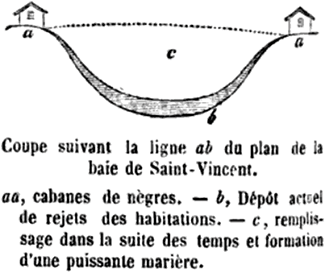
The origin of terramare deposits was a central question in the 1860s. Pigorini and Strobel had tried to show that the terramare of Italy had been the settlements of ancient peoples, more “barbaric” than the “savages” of America, and even more so than the ancient Mexicans and Peruvians, and the population of Saint–Vincent, Cape Verde, where Strobel stopped in 1865 on his way to South America. It was precisely from the island of Saint Vincent that he wrote a letter relating his observations on the formation of what he interpreted as a contemporary terramare. The debate about the origin of terramare had been raging just as Strobel was setting off on his transatlantic voyage. On the island of Saint Vincent, he observed the contemporary formation of structures similar to those of the Italian marshes, but in this case the work of the Cape Verdean population. (Figure 5) Strobel was able to observe their way of depositing waste, which seemed to him to be similar to that of several peoples of the past,
Ainsi que le faisaient les Mexicains, les Péruviens et les Sauvages, [ils] jettent tous les débris des repas et tous les objets domestiques ou industriels devenus inutiles, ferraille, débris de planches, poteries cassées, vieilles chaussures, chiffons, etc., dans la vallée …, à peine au–delà de la porte de leur cabane. Ainsi, avant qu’il s’écoule un grand nombre de lustres, cette dépression en sera remplie. De cette façon se sera formé, à Saint–Vincent, un dépôt artificiel qui, bien que différant, par sa position, des terramares et de kiokkenmoeddings, tiendra de l’un et de l’autre, et sera leur analogue. Il ressemblera aux kiokkenmoeddings par son voisinage de la mer, par ses coquilles et autres débris d’animaux marins, nourriture des nègres …, par son dépôt à sec, sans l’intervention d’eau courante ou stagnante, et même presque sans eaux atmosphériques. Par contre, il contiendra, comme les terramares, des objets en métal, des débris de poterie …, un grand nombre d’os des animaux domestiques.Footnote 33
Cut of the landfill of Saint–Vicent, Cape Vert, after Strobel, Formation actuelle, 512. (Public Domain)
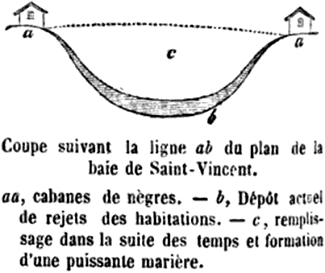
Strobel was perhaps one of the first to reflect on the processes that led to the formation of prehistoric sites by analyzing from observation how the waste of everyday life accumulated; he was, therefore, also an early exponent of what would much later come to be known as ethnoarchaeology. Strobel also envisaged a classification and typology of human waste deposits, to which he attributed an essential role in the study of life in the past. While some Italian scholars wanted to see terramare as tombs, Strobel showed that, as in the case of the Danish køkkenmødding, terramare were not funerary monuments but products of everyday life. For Strobel, prehistoric archaeology should use waste, leftovers from meals, broken plates, scraps, bits and pieces, excrement, lost objects – in short, anything that any domestic, industrial, or commercial unit takes out of use. In this way, he unwittingly fosters the development of a more or less complex discipline, combining history and geology. And indeed, one of the most relevant scientific discoveries of the early nineteenth century was precisely the shell heap, the escargotière, the Brazilian sambaqui, or the Danish køkkenmødding. These various accumulations of rubbish, transformed into objects of scientific research, have produced accumulations of another kind in museum storerooms and collections, where all these items have been labeled and classified. These structures also interested geologists and archaeologists, who began to look at them and excavate them on every continent. When Strobel himself arrived in Argentina, he put together collections for the Museo de Parma and shared his scientific concerns not only with European readers but also with the Argentinians.
The kitchen middens linked the geological past to the historical period. It had come as a surprise to find in the Danish sites species that had already vanished from the Jutland Peninsula, such as the pine trees and the great auk. While the remains from the kitchen middens seemed to indicate that 3000 or 4000 years ago, prehistoric humans ate these birds, in the nineteenth century there were no records of these birds in continental Europe.Footnote 34 The archaeological findings in Denmark activated not only the search for more bones and historical evidence, but also generated an awareness of the scarcity of great auk specimens in collections despite its former wide geographical distribution. Steenstrup searched in historical sources and collections to prove that the bone remains did indeed belong to Alca impennis. Given the absence of bones of the great auk in the collections, the remains were very difficult to identify. However, Steenstrup would be able to identify the bones thanks to a fortuitous event. In 1841, a naturalist sent by the Norwegian Government to inquire into the state of the Newfoundland cod fisheries mentioned that immense numbers of a bird called “penguins” used to frequent the area and bred upon the islands off the coast. A remarkable quantity of remains was sent to Europe. Identified to have belonged to the flightless bird that in English was called “great auk” or “garefowl,” they were used by Steenstrup to compare with the bones found in European localities. The kitchen midden repositories were now shown to have the evidence for a new field of study: the concept of extinction within (near) living memory, and the problem of how to establish disappearance rather than presence.
3 Extinction in Real Time
This section turns from the classification of past waste deposits to the evidentiary problems they made newly visible and the opportunities they made possible. While kitchen‑middens and related sites helped link deep time to historical time, nineteenth‑century naturalists also mobilized these deposits – together with archival traces and administrative records – to argue for the disappearance of species in historical time. While there was nothing to suggest that extinction, a fact proven for deep time, had stopped with the beginning of human history, the problem lay in the type of record that could track it. This section explores how nineteenth‑century naturalists confronted this problem by not only investigating archaeological deposits but also administrative records and ethnographic testimony to create a new evidentiary apparatus for assessing disappearance in historical time.
Kitchen-middens and other rubbish dumps emerged as a source of the bones that were sought to gather the evidence of the existence of species that had been abundant and alive, chased and eaten within living memory, but which had disappeared before museums could gather their skeletons. Species were gone and, apparently, nothing had been left except for vernacular names, vague representations, rumors, and a few memories of their shape and taste.
Shortly after Charles Darwin published his Origin of Species (1859), the German–Baltic zoologist Ernst von Baer (1792–1876) gave an address in St. Petersburg on the problem of extinction in historical times, that is, within the 5,000 years of human written culture, a process that, for several reasons, was not well-recorded. The Russians, however, thanks to their bureaucratic and tax systems, had observed that there was no news about certain animals that until recently had lived in their territories. Baer referred to Rhytina stelleri, today Hydrodamalis gigas, namely Steller’s sea cow, a kind of manatee described for the first time in the late eighteenth century.Footnote 35 However, even in the 1860s, museums had almost no remains of this animal, or as Baer said, from Steller’s sea cow there was nothing left, other than its obituary. The same could be said of the North Atlantic great auk and the Indian Ocean’s dodo and Rodrigues’ solitaire, three birds that went extinct before the museums had time to collect their bones. Partly because the process had been so violent and sudden, Baer described it as “extermination war,” a concept he imported from Kant to underline the extent of human impact on nature, in a period which today is called the Anthropocene era. In addition to the notion of an origin of species, there is thus also a history and theory of disappearance, which began with Cuvier and others and in which Baer played a decisive role. These conceptual debates intersected with the growing evidentiary potential of middens and refuse sites, which provided concrete material for evaluating disappearance materially anchored traces through which disappearance could be argued, contested, or denied.
This section traces the debate over the role of humans in historical extinctions around 1860, in particular the reluctance of British paleontologists to accept modern extinction and the evidence provided from St. Petersburg. We will look at arguments for the possibility that populations of these animals survived in unexplored territories, the impact of catastrophic events, and the problem of observing in real time processes occurring on a scale then beyond human observation. In view of the potentially unlimited diversity of species, Kant, in his Critique of the Power of Judgement, proposed that nature still had to assume a peculiar parsimony in order to consider a natural order possible at all. An infinite number of species would not fit into any tableau of knowledge. The natural history of the eighteenth century was thus confronted with the problem of an excessive abundance of living beings, which increased almost daily due to the endeavors of naturalists. Part of this history of discovering new species was the finding of extinct animals and plants, which further increased the abundance of species. At the same time, extinction as a biological phenomenon gained importance, especially since Georges Cuvier set limits to the seemingly unlimited abundance and productivity of nature, providing evidence that species that had disappeared had possibly not migrated to other regions and that they had actually disappeared completely, that is, become extinct. The case of Steller’s sea‑cow becomes a paradigm for how fleeting human–animal contact, fragmentary archives, and imperial expeditions complicated the task of proving extinction in real time.
The Short Co-Existence of Humans and Sea-Cows
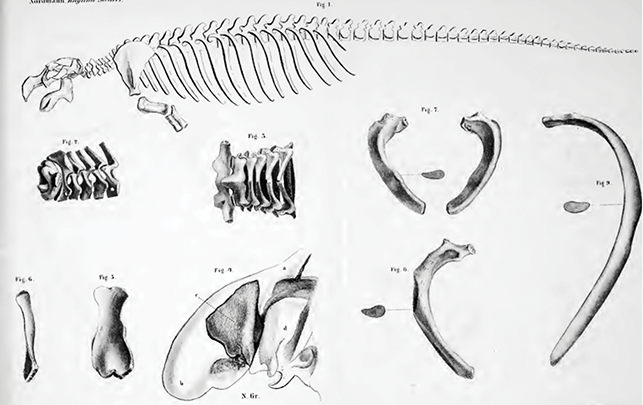
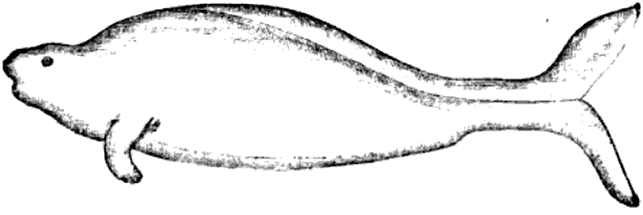
In 1840 Karl Ernst von Baer published in St. Petersburg the story of the extermination of the northern sea cow, a large, slow-moving marine mammal that, until the mid-eighteenth century, had lived in the North Pacific islands between Asia and North America. It was a rather short history: the cow had become extinct by the late 1760s, just a few years after its first description in 1741 by Georg Alexander Steller, the Bavarian naturalist and physician who accompanied Vitus Bering’s Russian expedition to the coasts of Alaska and Kamchatka. After a shipwreck, which occurred in the vicinity of an uninhabited and unnamed island, but which has since sheltered the remains of the illustrious commander and bears his name, Steller had the opportunity to observe, eat, dissect, and draw this hitherto unknown animal. According to Steller, its abundance guaranteed food for all the Kamchatka adventurers who set out to hunt seals and other fur-bearing sea mammals. This proved to be a reckless claim that sealed the animal’s fate: in 1768, the last of Steller’s sea cows was killed or, at least, from that year on, no one saw them again. The islands, incorporated into the Russian administration through the Russian–American Company, were dedicated to the marine fur industry and began to be populated by administrators and hunters, many of them Aleuts, experts in the art of tracking their prey in the icy landscape of the strait named after the Danish-born seafarer Bering.
Steller died in 1746. He never returned to his port of departure, but some of his drawings and notes did reach it. In these notes, he claimed that the beast he discovered was a manatee, the Vacca marinae of the Dutch, the sea cow of the English. He thus transferred to an animal from the North Pacific the name of a mammal that lived in more southern areas, in the rather warm regions of Africa, America, and the coasts of the Indian Ocean and the southwest Pacific. No one really knew how the manatees of the different regions differed, or how they were related to each other or to other groups in the animal kingdom. Very shortly before Steller’s posthumous reciprocal encounter with his cow, Peter Artedi (1705–1735) and Linnaeus had placed them in the fish group. It was not until 1756 that Mathurin-Jacques Brisson (1723–1806), the first zoologist who created the class of cetaceans separate from fishes, would place manatees and dugongs among the quadrupeds.
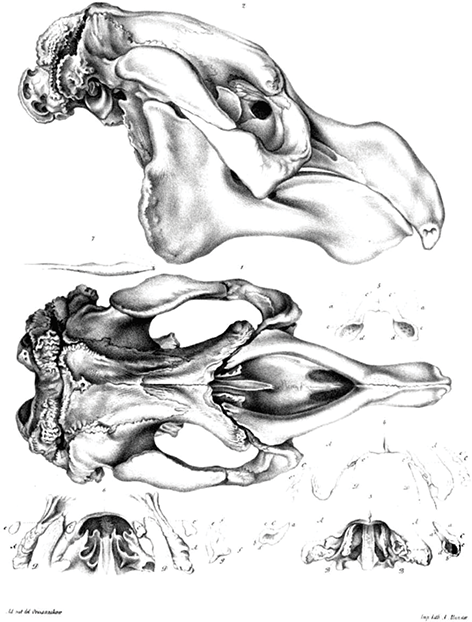
When Steller’s notes were published by the Academy of Sciences in St. Petersburg in 1751 – five years before Brisson’s publication – plate XIV showed the lower and upper masticatory plates of the northern sea cow. Without a clear idea of the shape of their teeth, which were absent from European collections and from the pictures accompanying the descriptions of animals known as manatees, no one could say exactly what they ate and, therefore, to which class they belonged.
Despite the evidence presented by the Russian zoologists, the ritinas, a name between scientific and common that was used to designate them, were considered a living species until well into the nineteenth century. Thus, in Georges Cuvier’s description of the “northern manatee” published in the various editions of his Ossements fossiles (1823, 1836), no one thought that the call for an exact drawing of the animal taken from the living one could not be fulfilled even if a single depiction had been sufficient to meet all the needs of the modern anatomist. Although Cuvier was wrong about the animal’s possible survival, he was right to identify that more accurate information was needed to classify it, that is, the bones, real or drawn. With the exception of Steller’s sketch – lost in the consignment that arrived in St Petersburg – and a rather vague drawing published in Pallas’ work (Figure XX), naturalists had only one proof of the existence of this animal, namely two ribs and a dental plate, both deposited in the collections of the Zoological Museum of the Academy of Sciences in St Petersburg. The images finally appeared but the story of how that happened is extraordinary and involved several attempts to fix an image of animals that had become extinct in historical times, had been seen by very few travelers, and of which not even the bones remained.
The new evidentiary frameworks for recently vanished fauna, particularly those emerging from St. Petersburg’s zoological networks, shaped nineteenth‑century debates on extinction, required natural scientists to theorize extinction and, in so doing, move from scattered observations to broader conceptual, linguistic, and legal debates.
Extinction: A Matter of Fact
Until the nineteenth century, the word “extinction” in European languages was used to refer either to the end of a contract or to the inability of the male line of noble families to produce heirs. The transfer of extinction from the law of nations to natural history began with the assumption that there were species that had disappeared from the face of the earth forever. Historiography generally assumes that Georges Cuvier introduced extinction as a fact in his work on living and fossil elephants. However, the word “extinction” did not appear in Cuvier’s work. In the four volumes of his Recherches sur les ossemens fossiles from 1812, the adjective “éteint” (extinct) appears only four times: as a mere synonym for “espèces fossiles, perdues, détruites” and in the Discours préliminaire, where Cuvier describes the traces of extinct peoples (“Les traces presque efacées de tants de nations éteintes”) with those of the so-called revolutions of the earth.Footnote 36
The use of the word “éteint” did not refer to the result of an extinction process, as per Darwin, but was intended to mean a sudden disruption of the order of nature through catastrophes that regularly created new orders. As with revolutions in history, the temporal process of the disappearance of the old was short and violent, so it is not surprising that Baer would later compare extinction to a war of extermination. For Cuvier, however, the bones of the fossil quadrupeds did not record a process, but only the fact that life was different in the deep past. The reason for the changes, therefore, had to be sought not only in the bones themselves, which only served to testify to the existence of species unknown in the present. Cuvier referred to “temps moindre” (shorter time), the observation of which would help to understand deep time. This shorter time of a few thousand years extended to the temporal limit that could be reached through historical sources, whether in the form of texts, images, or monuments. He used the writings of the ancient Greeks and Romans, as well as modern travelogues, to argue that the number and type of almost all large living quadrupeds had been identified and that no new species could or would be found. Cuvier’s observations, which have already been examined in the context of his dispute about species transformation, also make it possible to analyze the use of historical evidence in the practice of comparative anatomy.Footnote 37 But what is even more important are the media that were used to record the history of animals. Cuvier examined images of animals engraved on Egyptian obelisks and the mummies of animals, such as the ibis, found during Napoleon’s Egyptian campaign. Both forms of evidence showed an astonishing similarity between the animals of the present day and those from the time of the pharaohs, which led him to conclude that three thousand years had not actually brought about any changes. While Cuvier used the sources of antiquity, for Baer these sources were not sufficient to answer the question of extinction during this period. New methods and media were required. The central problem was how to register the disappearance of a natural entity and compile observations of something that was happening in real time and on scales of difficult calibration.
New Fossils
In contrast to the number of extinct species being identified geologically in the nineteenth century, the number of historically recorded extinctions, Baer remarked, was not large. While the strata from deep geological time provided huge numbers of bones and the petrified remains of animal forms that the human eye had never seen alive, the historic sources seemed to indicate no important changes in the fauna of the last millennia. However, the invisibility of the occurrence of historic extinction was due to culture, language, and recording systems; namely, linguistic differences and the lack of a universal, systematic register of animals in the eighteenth century. Baer took the year 1766, corresponding to the publication of the twelfth edition of Linnaeus’ Systema Naturae, as the beginning of the systematic recording of extant animals. As he considered that the depictions of animals in woodcuts and engravings were a reliable recording device, he decided that the record could be extended, in a very limited amount of cases, to 300 years before the present. However, the comparison of traditional or historic animal names with the current register of extant species was never straightforward: understanding what was in an animal name involved philological and historic linguistic research to track transfers and displacements from one kind of taxon to another. Thus, accounting for current extinction confronted the zoologists with the critical study of traditions and historical sources. Baer referred to the problem he described as Namen-Übertragungen (transfers of names), that is, the transfer by travelers, hunters, seamen, soldiers, naturalists, colonists, and so on, of the popular name of an animal kind living in one particular region to a similar animal kind from another part of the world. Thus, the transfer of names from one linguistic tradition to another created apparent continuities in time and space and, often falsely, expanded the geographical distribution of a certain animal kind and prolonged its existence in another place.Footnote 38 Baer believed that historians, philologists, and paleontologists should work together to show the delusional character of this apparent permanence and stability. He predicted that, thanks to the systematic register of species, the ongoing nature of extinction would become much more visible in the centuries to come.Footnote 39 For historic extinctions to become visible, Baer showed that the history of life and the discipline of paleontology needed to be tied to the practices of archeology and history, the reading and understanding of several European languages, fieldwork, and ethnographic research.
While historic depictions, names, and descriptions were not entirely reliable, the new science of prehistory created a concrete, physical register of fauna beyond the records started in the eighteenth century. The excavation of prehistoric sites revealed not only human tools and remains, but also the bones and fragments of the animals hunted and eaten by prehistoric or protohistoric societies. But excavations also provided the bones of species that had been observed alive, but not scientifically described, in historic times. These are what I propose to call “new fossils” and were the remains of animals observed alive in the early years of the Linnaean system, but which became extinct before they could be fully described following the standards of the nineteenth century, that is, the comparative anatomy of the skeletons and skulls, and especially, the study of their teeth and limbs.Footnote 40 These “new fossils” exemplified how nineteenth‑century naturalists relied simultaneously on archaeological deposits and living memories – a dual register that defines the evidentiary structure of this section.
Naturalists’ own eyes have never seen the extinct animals that lived in the geological past. Their reconstructions were and are based on fragments and the principles of comparative anatomy. This enabled them to connect teeth and feet to functions, forms, and the shape of existing species. Colors, sounds, taste, and texture were qualities later attached to those mute bones that late eighteenth-century preparators and anatomists had been mounting as hypothetical skeletons. The fossils of historically exterminated animals, on the contrary, were of a different nature: people still living had seen and named them, they still resided in the memories of fishermen, mariners, peasants, fowlers, and hunters; these animals had colors, sounds, and movements. They had been touched, traded, and eaten. It was not only in the sediments of Earth that their fragmentary remains were to be found: these animals had been depicted and described. Emerging from the records of history and ethnography, the gathering of the evidence of recent extinction demanded the combination of the skills of the naturalist with those of the man of letters. And, more importantly, it required defining how to register the vanishing of a natural entity, how to compile observations of something that was not going to be observed again.
Russian and Danish collections had gathered material evidence of these recently vanished species. Steller did not know that his sea cows, whose herds, he believed, were so abundant that they could feed the whole Kamchatka, were going to become extinct two decades after his own death in 1746.
Bering’s second voyage made known the valuable resources of the Commander Islands, stimulating the fur trade and many expeditions among the Aleutians in search of other regions inhabited by fur seals. Immediately, numerous trading companies began to develop, nearly resulting in the destruction of the fur seal herds. As an example of the dimension of the slaughtering from those years, Baer mentioned that in 1745 a single Cossack´s boat transported around 1,900 fur seals and 1,670 see otters’ furs, more than one and a half what the American company traded in a year.Footnote 41 These figures were to be found in the expedition reports, which accounted for the amount of furs as part of the requisites implemented by the regulation of the trade: to get the permission to hunt sea otters and fur seals, one-tenth of the game had to be given to the Russian State.Footnote 42 From these reports it became obvious that the numbers of animals was decreasing. To prevent the extermination of the herds, the fur trade passed into the control of a single company, the Russian–American company, established in 1799.Footnote 43 While this move saved the herds of sea otters and fur seals, the sea cows, one of the most important sources of food and fat for the mariners and traders, disappeared. Following the reports of an expedition led by Joseph Billings, an English officer of the Russian Navy (1783–1793), the last records of the existence of the sea cow date from 1768, when the last specimen was killed. In 1838, Baer remarked that, although there were naturalists who thought the animal still lived between Kamchatka and America for longer than fifty years, there had been no news about the existence of this animal. The idea that the sea cow retired to islands further north than Bering`s was not supported. The sea cow must be considered extinct and the only way in which to obtain a specimen of it was to exhume a well-preserved skeleton from any of the shores that they used to inhabit.Footnote 44
Ilya Gavrilovich Wosnessenski (or Voznesenski), traveler–naturalist and conservator of the Academy Zoological Museum, was sent in 1839 to Alaska, by and at the cost of the Imperial Academy of Sciences of St. Petersburg, to make collections. He sailed on a Russian American Company’s ship from Kronstadt and reached Sitka (New Archangel), the capital of Russian America in Alaska, in 1840. He traveled on the American coast from Upper California (1840–1841) to Kotzebue Sound and the Bering Sea (1842–1843), the Aleutian Islands (1842–1843), the Kurile Islands (1844), and into the Sea of Okhotsk and Kamchatka (1845–1848). He returned to Sitka at the end of July 1849. He found an incomplete skull of the sea cow on Bering’s Island after spending eight years trying to find a live animal.Footnote 45 Described by the director of the Zoological Museum of the St Petersburg Academy of Sciences, the German Russian naturalist Johan Friedrich von Brandt (1802–1879), the skull encouraged further bone-seeking. The Academy, following Baer and Brandt´s advice, called for a prize to obtain more remains of Rhytina gigas.Footnote 46 A complete, big skull, ribs, scapulae, a mandible, and occipital bones, found in different areas of the Bering Strait and the northern seas, were shipped to Saint Petersburg by officers of the Russian–American Fur Company.Footnote 47 A nearly complete skeleton arrived in the early 1860s, which made some European zoologists think that the sea cow was really still alive. Brandt clarified that it had been disinterred.Footnote 48 (Figure 6)
Skull of Rhytina stelleri as described by Brandt (public domain)
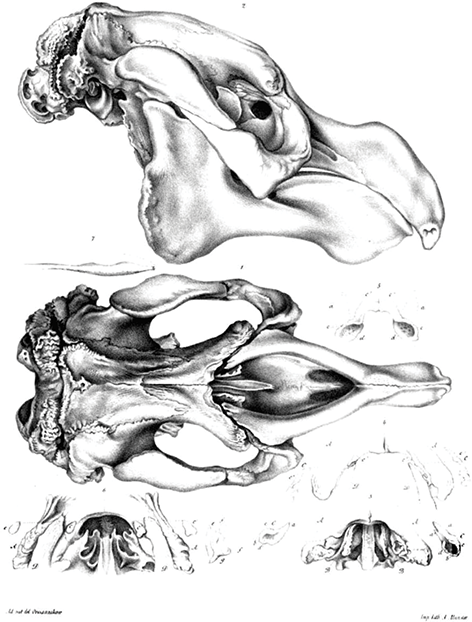
In 1861, Alexander von Nordmann (1803–1866), professor of zoology at the Imperial Alexander University of Helsingfors in the Russian Grand Duchy of Finland, described in detail the skeleton of an immature sea cow. It was collected following instructions given in 1858 to the Finnish–Russian vice-admiral Johan Hampus Furuhjelm (1821–1909), Governor of the Russian–American colony. In December 1860, Furuhjelm reported that two Aleuts had found a sea cow skeleton on Bering Island. These bones appeared to be genuinely associated, unlike all the other existing skeletons, which were museum composites. Once in Helsinki, Nordmann took a photograph of the complete skull and sent it to his colleagues Brandt and Baltic–German zoologist Leopold von Schrenck (1826–1894), both at St. Petersburg.Footnote 49 (Figure 7)
Skeleton of Rhytina stelleri as mounted by Nordmann (public domain)
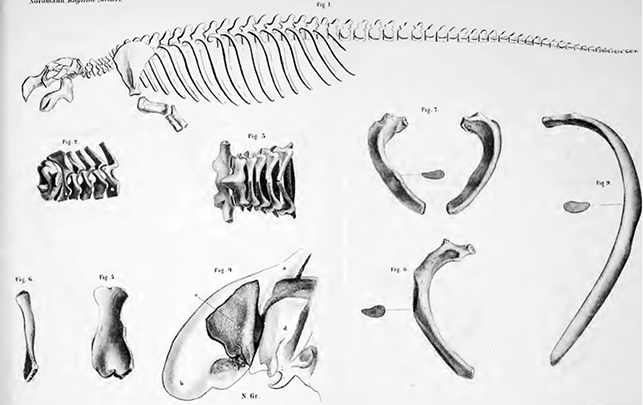
However, the debate about the status of the species continued. Baltic–German geologist Karl Eduard von Eichwald (1795–1876), author of the Paleontology of Russia, suggested that it was difficult to assess the extinction of sea animals because oceans were practically unknown, and, therefore, that the claim of extinction was premature.Footnote 50 Eichwald insisted, too, that there was always the possibility of hidden places to which poorly known animals could have moved: the ocean depths, the peaks, the poles, the jungle. A disinterred skeleton proved that an individual had been there, but it was not enough to say anything about the subsequent history of its congeners. As had happened with the acceptance of the mere idea of extinction, the possibility of migration and the existence of refuges in some remote corners of the world moderated the acceptance of total obliteration in contemporary times.
Almost at the same time, A. impennis attracted the attention of English oologist and egg dealer John Wolley (1823–1859), who had become acquainted with Steenstrup during a visit to Copenhagen in 1856. In April 1858, Wolley, accompanied by British ornithologist Alfred Newton (1829–1907), sailed to Iceland to track the elusive great auk.Footnote 51 They had become aware that, since the late 1830s, there were warnings that the great auk was to become extinct, having long disappeared from the coasts of Norway, the Faroe, and Iceland. Up to the nineteenth century, the bird and its eggs had been much used as a food supply by mariners doing the North Atlantic routes. In the 1840s there was still a constant, though very limited, supply of specimens, which kept dribbling into the market of natural history.Footnote 52 Old narratives and voyages to the Faroe Islands mentioned that the inhabitants of those regions eviscerated penguins, thrusting a wick into the cavity of its stomach, setting fire to it, and letting this singular apparatus burn as if it were a lamp, so very fat and oily was the bird. On a little island near the coast of Newfoundland they burned these birds, for want of other fuel, as if they were logs of wood, and in this way they cooked one individual by the help of his companion.
While in Iceland, Wolley and Newton gathered evidence on the former distribution of the great auk, the number of birds fowled and remembered by the informants, the spots where they used to breed, and where they had been hunted or seen by others. Newton divided the evidence into two classes: that which may be considered documentary and could be found in libraries and that which was merely oral, offered by living witnesses, either as traditional information handed down from one generation to another or as personal observation.Footnote 53 Newton elaborated on the information-gathering process and explained that Wolley wrote much of the evidence down “in a most painstaking manner, having passed through an interpreter.” All of these explanations referred to the problematic nature of the disappearance of a species because such a claim relied on the observation of absence and the problem of transferring words from one linguistic tradition to another. It became clear that a critical analysis of the historical sources should therefore be applied to the study of animals mentioned within them. Fragmented and contradictory versions of reports were examined, cross-examined, and reexamined, but still, the inaccuracies and contradictions remained, as did the possibility of the survival of the birds on some remote islet.
The elusive and contested character of the evidence appeared over and over again, not only regarding the existence of the bird but also regarding geological events and the identification in the maps of the spots where the bird had bred. Volcanic eruptions were dated in the Icelandic historic records and, as such, incorporated into the history of the extinction of the great auk.Footnote 54 Newton, Wolley, and the English doctoral student William T. Preyer (1841–1897) investigated in the historic annals of Iceland the volcanic events that could be correlated with the destiny of the great auk.Footnote 55 Thanks to this combination of historical research and the study of natural events, Preyer identified all the outbreaks and eruptions off Cape Reykjanes, beginning in ad 1219. In 1240, during the eighth historic eruption, a number of small islands were formed but afterward mostly disappeared. The twelfth eruption occurred in 1830, when the sea stack on which the great auk bred disappeared beneath the waves. This event had a most important impact, as it greatly hastened the extinction of the species, compelling the birds to seek a home on skerries that were easier to access from the mainland.Footnote 56 Newton questioned the data gathered by Preyer and his statement that in March 1830, shortly after the volcanic submergence of the skerry, a colony of birds appeared at Eldey, an almost circular sea stack, where the so-called “last pair of great auks” was supposedly killed in 1844. Newton questioned not only the formation of the Eldey colony in 1830, but also thought that Preyer had wrongly identified the location of the birds’ previous breeding localities
However, another kind of evidence helped to track the natural history of the bird in a most conclusive manner. Wolley and Newton spent some weeks at Reykjavik and then departed for a hamlet, close to the rocky islet where the bird was presumably last seen. At Cape Reykjanes, Wolley had picked up from a heap of blown sand two or three birds’ wing bones – bone-seeking having become one of their main occupationsFootnote 57 – and compared them to those depicted in Steenstrup’s engravings. They dug in the kitchen refuse of the place, but contrary to the Danish mounds, no bird bone was found. Instead, two or three bones were retrieved from the wall of a churchyard, sticking out of the turf used to keep the stones in place. In another spot they found remains that belonged to at least eight individual birds, many of them bearing marks of a knife. In contrast to the inaccuracy of some historic sources and locally sourced information, the successful search for bones of Alca impennis had anchored the existence of the bird to some concrete locations.
Artifacts of the State
Wolley, the egg collector, died soon after his return to England, but not before he had donated his collection to the Norwich Museum and his manuscript notes on the great auk to Alfred Newton, who would champion Wolley’s calls for a register of the existing British birds. Baer had also considered a register of species as the requisite for understanding and “observing” extinction processes in real time. But, as we shall see, the mere introduction of this idea created the problem of how to assess the changes occurring in time and space.
The relationship between hunting, game, and preservation/ conservation movements is not new in the literature.Footnote 58 Less attention, however, has been paid to the registers of hunting activities and the accounting of cattle. While accounting for domesticated herds was a practice as old as the domestication of animals,Footnote 59 accounting for the numbers of wild animals required new procedures and strategies. While there were examples of methods for counting cattle and registers of game, both relied on the organization and administration of landed properties and state resources.
As mentioned before, from the late eighteenth century, Baer worked with the records of the Russian American colonies, which indicated the number of traded furs. By extrapolating the number of animals the furs represented, he analyzed the decrease or the status of the animal herds over the years. The register of the fur trade was also a means to transform the animals into artefacta produced by the work of the State in the sense defined by Kant for sheep, cattle, and domestic fowl:
There are various kinds of products of nature in a country which must nevertheless, as concerns the quantity of a certain kind, also be considered artifacts (artefacta) of the state, since the country would not produce them in such quantities if there were not a state and an orderly, ruling government and the inhabitants had remained in the state of nature.Footnote 60
The records of the fur trade and the issuing of hunting and fishing permits have to be understood in the frame of the new policies that characterized the administration of the resources of the State at the end of the eighteenth and in the early nineteenth centuries. From the Danish Kingdom to the Spanish and Russian empires, whether in the North or South Atlantic or on the Pacific coasts, the exploitation of some animals was regulated by the State: to fish or to hunt whales, sea otters, cod, or fur seals required gaining permits, the payment of taxes, and the submission of reports. Other measures emerged from specific circumstances, such as the potential decrease in the revenues of the fur trade or the intervention of the Danish State to counterbalance the effect of the Icelandic famine that started in 1783 after the eruption of a submarine volcano and subsequent earthquakes. As fisheries were ruined, livestock died, and the population declined, Danish commissions tallied the numbers of people and animals affected by this natural disaster, producing reports that were later going to be read by British and other European naturalists traveling to Iceland.Footnote 61 When Baer referred to “artificial precautions” he meant also these bureaucratic means that transformed animals into artifacts of the State, and gave them legal protection. Administration, paperwork, and policies governed these animals, and provided the conditions to regulate exploitation and to avoid extermination. As Baer showed, animals such as the sea cow and the great auk could be annihilated if left “on their own.” Extermination, from this point of view, was a collateral effect of the exploitation of the regulated species.
The methods for counting hunted animals and the study of prehistoric remains and written sources are related only to the study of phenomena that had already occurred. The present, however, remained elusive. On the eve of taking the human census of the British Empire of 1861, Alfred Newton proposed the idea of a somewhat similar enumeration as regards the fauna of England. However, assessing the number of living animals in England seemed even more difficult than accounting for people in the British Empire. With this in mind, he communicated to the Linnaean Society some remarks bearing upon the question of a general zoological census and called the attention of ornithologists to the particular application of a project that Wolley had proposed before passing away: a census of the birds of England taken with the involvement of nearly all the ornithologists in the country. Newton wished to make a few observations on the subject; however, he remarked: “I am not at present prepared to offer any suggestions as to the method to be employed.”Footnote 62
Among Wolley’s papers, there were only a few memoranda or suggestions bearing upon the subject. Newton acknowledged that Wolley first acquainted him with his idea in a letter dated June 7, 1856, in which he stated that, at the meeting of Scandinavian naturalists, he was going to “give some account of the British birds, of which so little is known on the Continent beyond the bare list.” He wished to begin “by naming the birds which are commonest in England and most characteristic of our bird-fauna”. Above all, he wanted “to be able to represent by numbers the relative abundance of each species: throughout Great Britain put a Sparrow at 1,000,000, and an Osprey at 1, what will be the intermediate figures?” Newton was unable to supply such data, and consequently Wolley’s design was abandoned. However, they discussed the matter many times and some ideas were proposed. Wolley, who had studied medicine, ran a detailed account of his commercial affairs as a dealer in birds’eggs. Moreover, as a member of two ancient, landed gentry families – the Wolleys, owners of Allen Hill, and the Hurts, owners of Alderswasley and WirksworthFootnote 63 – he was aware of the methods for registering (dead) animals for the administration of game on their lands. Newton alluded to the “Game Books,” which were commonly kept on different manors and proposed that the inspection of these registers would furnish a sufficiently accurate return to assess in what districts it would be possible or impossible to increase the stock.Footnote 64
By the 1860s, there were two kinds of game books: printed and manuscript. The printed game books were published each year and consisted of printed tables, which enabled “the Lover of Field Sports to keep a Register of Sporting Occurrences from year to year, in the manner of a Journal.” They were similar in plan to the older practice of the nobility and gentry for keeping at the residences, in manuscript books, a record of the shooting done in their estates. These books, in folio or quarto size and bound in vellum, showed the amount of game killed each day. The manufacturing of printed “game-books” for personal use started around 1815. They were printed in a small volume adapted to the pocket and game bag of the sportsman, or in a book, large enough to contain the “sporting annals” of many years. Normally they were offered and designed by stationers, account book manufacturers, and printers. The printed game books were also marketed as serviceable to the game keeper, in keeping their account of the disposal of game through presents, and distribution amongst acquaintances, the local brewer, butcher, baker, and sundry farmers. In the columns was entered the produce of each day’s sport, every head of game that was bagged, under their several names and descriptions. Some were printed on both sides with headings “Game killed, from/ Gentlemen’s names/Total brought forward&” printed horizontally; and with columns printed horizontally for the animal kind. Other printed game books had vertical columns that included “where killed,” “when,” “killing and missing shots,” “observations,” blank columns, the number of head killed, guns, and shots, total each day and week. Horizontal ruling divided each page into six days of the week and a total.Footnote 65 Invented and standardized in the nineteenth century, the game books recorded the number of heads hunted in connection with the place and meteorological conditions. The records were restricted to the lands where the hunter had hunting privileges or the gamekeeper had to keep control of the disposal of game. In this way, private property and bookkeeping organized the data available for the study of animals. Some game books also presented a summary of all the game shots annually over a period of several decades. The game books showed that some birds were uncommon or difficult to hunt and, since the columns were organized by animal (bird) kind, they also indicated population changes of the recorded species. Even if the game was artificially stocked, the game books – as protocols used in the private administration of the gentry’s landscapes and hunting rights – provided a format to record the occurrence of animals and to do so over time. Wolley’s own account of the great auk on Iceland had followed this way of organizing information in terms of pieces hunted and memories of the fowlers. Several accounts on the extinction of the great auk referred to the fowling regulations established by the governors of Iceland or the colonial administrations in Canada. Depending on the scarcity or abundance of birds, the governors gave or declined permission to fowl. Thus, restocking and the regulation of hunting privileges were practices linked to the administration of supplies and hunting.
The brothers Alfred and Edward Newton, however, incorporated the organization of data of the game books – including meteorological observations – into their wider observations of birds at their family estate of Elveden, Suffolk, adding new categories such as movements, nesting, and their general habits. A. Newton insisted on two things: on the experimental character of his first trials, and on the difficulties of recording a continuous series of observations and the keeping of a regular journal for any length of time.Footnote 66 With the system they adopted, they recorded the bird species, their sex, singing, abundance, pairing, arrival date, and number in the flocks (Figure 8).
(Two to be combined) Newton’s records
Recording life processes in real time confronted naturalists with the question of how to record so many different dimensions at once and how to organize these observational data in devices that could be “read” at a simple sight; some authors have called this problem “the compression of knowledge.”Footnote 67 As a former hunter of birds, Alfred Newton was well acquainted with the devices for recording game and transferred them to his zoological observations of wild species. Thus, by the proposed method, the results of a day’s observation could be recorded in less than five minutes. The register of birds, which ran from 1849 to 1859, produced a book about eleven inches in height by about fourteen in breadth.Footnote 68 The counting of the game not only appeared in the registers but also in the method by which this was done. To count the observed individuals, observers transferred a common gun wadding from one coat pocket to another, and “as shooting-coats have usually many pockets, the process was not difficult; and it was even possible to appropriate a pocket to each of the three species we wished to number.”Footnote 69 Thus, game apparel, game books, and game equipment, as well as the patience of hunters, were used to account for wild animals, shaping the methods and means to organize data in a relatively small book.
Having examined how kitchen‑middens and related deposits provided crucial evidence for debates about extinction within historical time, this section turns to the global itineraries through which those methods, materials, and expectations traveled. From the Danish shores to North America, the North Pacific, and the Indian Ocean, the same practices of excavation, comparison, and collecting were redeployed across imperial and commercial networks, generating new forms of scarcity and new ambitions for museums and naturalists. As establishing extinction was recognized as an evidentiary problem I now turn to the practical response: bone‑seeking, excavation, and the mobilization of administrative and colonial networks to recover “new fossils” for museums. The global pursuit of these new fossils – and the networks that sustained it – is the subject of Section 4.
4 From the Danish Shores to the Indian Ocean With Stopovers in the North Pacific
The following two sections, starting from the paths and processes followed and set in motion by the search for the bones and other remains of extinct animals, will show how the collections of those objects acquired a special character and sparked an economy of scarcity that began to play an important role in the context of museum collections. The search generated, once again, a mercantile activity, new professions, and a new commodity to be traded. These pages tell the story of the endeavors to secure specimens for European and American collections, including the transcription of secondary and archival sources. The North American rubbish heaps not only helped to interpret the ancient bones through comparison but also gave modern rubbish heaps and leftovers a new value as a source for the remains of recently extinct animals. It can be said that the research in Denmark had stimulated an archaeology of modern extinction that has become a model worldwide and the archaeology of new fossils expanded to the waste deposits and peat bogs of North Asia and the Indian Ocean. Historiography has concentrated on the specimens available in collections,Footnote 70 but this section concentrates on the new recycling practices and ragpicking techniques that were used for collecting the remains of recently extinct animals, as well as the subsidiary use of peat bogs and guano deposits for making such collections.
Alfred Newton tried to interest people who had connections to Funk Island in Newfoundland in the search for bone remains and skeletons of A. impennis. Newton sent letters with sketches of bones to the Bishop of Newfoundland, who, in 1863, persuaded an entrepreneur who had permission to excavate the guano-like humus soil of Funk’s Island and transport it to Boston, to instruct his workers to look for bones while working. As a result, eight naturally preserved auk mummies were found in the island’s peat soil, where there were remains of large slaughter sites where the birds had been killed and stripped of their feathers. These mummies and bones were sold in England (London and Cambridge), Boston, and Dresden and made into skeletons. By 1880, the individual bones of Alca impennis held in the collections had a fivefold origin: (1) from sacrificed or preserved skins; (2) from fresh or dry preserved specimens; (3) from prehistoric kitchen waste; (4) from more recent deposits of kitchen waste; and (5) from dead or killed animals left in the guano-like peat layers from the islands where the great auk lived.
Newton extended the method even further: When his brother worked as a British colonial administrator on Mauritius from 1859 to 1877, he organized the excavation and collection of bone material from the dodo and Rodrigues solitaire, which had become extinct, leaving behind even fewer remains than the great auk. Newton also activated colonial networks in Rodrigues and the Seychelles.Footnote 71 In February 1865 he announced the arrival of three bones and, with enthusiasm, called for the search for further remains of the dodo and its relatives. Shortly afterwards, the magistrate of Rodrigues sent a box to Mauritius full of bird bones obtained from the excavation of local rubbish dumps. Alfred’s brother, Edward Newton, sorted them out and counted at least sixteen or seventeen individuals of the same species but of different sizes, a diversity attributed to sex. A pair of limbs remained in Mauritius, but the rest traveled to London, where they were used to raise money for further excavations. The success could not have been more resounding: in December 1865, A. Newton announced the discovery of dodo bones in Mauritius, which would soon arrive in London to be auctioned on the natural history market.Footnote 72 (Figure 9)
Dodo’s bones
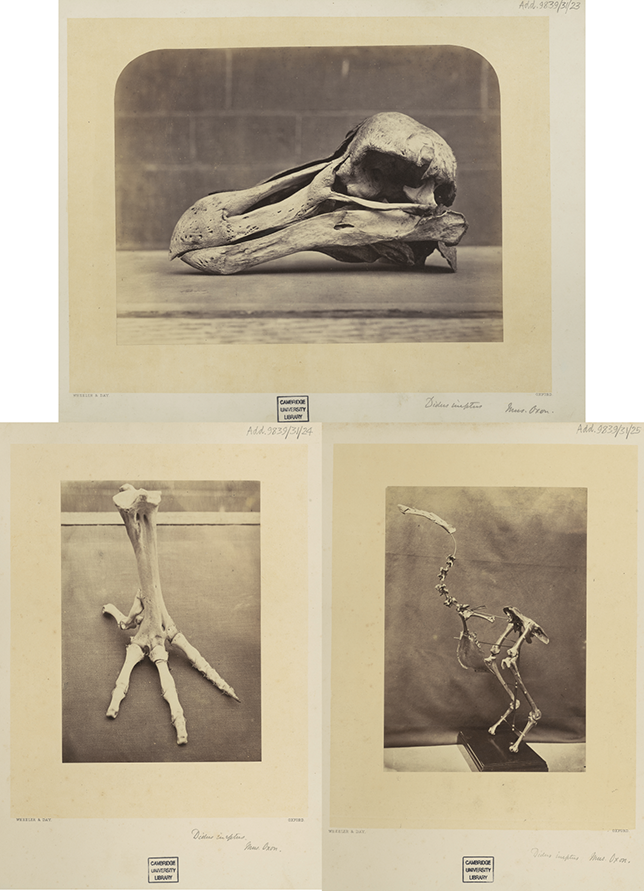
That proved that the Danish model for specimen acquisition also worked in the Indian Ocean islands. Newton did not fail to compare these finds with those of the European middens in terms of expectations and possibilities.
I much wish I was not compelled to come to this conclusion; for, if it be so, the experience of the Danish archaeologists shows that the chances of obtaining, I will not say a complete skeleton, but such a series as would contain a perfect specimen of every bone in the skeleton, are very much diminished, since some bones there are which, I believe, are never found under these circumstances.Footnote 73
Indeed, Danish researchers participated in the evaluation of this evidence, studying the human-made marks present on the Rodrigues bones. Newton, taking advantage of a visit by Steenstrup to England, showed him his collection and, as Steenstrup had done with the remains of his shells, he corroborated that the remains showed marks of having been eaten by humans or some other animal. The identification of cut marks and patterns provided more evidence of human impacts, and they started being considered everywhere where leftovers were unearthed, as can be observed in this report from Funk Island:
Having a strong wish to secure some relics of this bird, and my time for their discovery being limited to less than an hour, it was with considerable excitement that I rushed from point to point and overturned the turf. At nearly every trial, bones were found; but there was nothing that could be identified as ever having belonged to the bird for which I searched. At the eleventh hour the tide turned, and in a small grassy hollow, between two huge boulders, on the lifting of the first sod I recognised an alcine beak. That rare element called luck was in operation. In less than half an hour, specimens indicating the pre-existence of at least fifty of these birds were exhumed. The bones were found only from 1 ft. to 2 ft. below the surface, and in places even projected through the soil into the underground habitations of the puffins. With the exception of one small tibia and two or three tips of long and thin beaks, probably those of the tern, all the bones were those of the great auk. The only traces of these birds having been used as fuel was a burnt fragment of a sacrum (?). Nor do they appear to have been killed, or probably the effects of some blow or cut would be visible; but both are wanting. The only evidence of this sort appears in the crushed cranial portion of a skull, which may have arisen from similar causes producing the twisting and contortions of the other bones. These twisting and contortions are chiefly noticeable in the bones of the sternum and furculum, which, in whatever position they were laid, must have offered resistance to any force tending to flatten them, as would be the case with superimposed earth. This force of weight was probably aided by the contractions and expansions produced by frosts and thaws … In several cases, whilst exhuming the skeletons, I noticed that the vertebra followed each other successively, and were evidently in the same position which they occupied when in the live bird. This is in part confirmed by one curious case, where the rootlet of some plant has grown through the neural canal, and expanded, so as to firmly fix the vertebræ in position. This, together with the fact that there remains no evidence of cuts or blows, leads to the supposition that these birds may have died peacefully. Nevertheless, it may be that they were the remains of some great slaughter where the birds had been killed, parboiled, and despoiled only of their feathers; after which they were thrown in a heap, such as the one I have just described. In several of the bones there is a considerable difference in size; but from the definite character of the various ridges and concavities on the bones, it would seem to indicate that the bulk of them were old. On some of the metatarsal bones a small splint about one eighth of an inch in length is seen projecting a curious variation. The inner linings of a few eggs were also found. The remains, on the whole, are of such a fragmentary nature, that it is probable they will hardly suffice to complete a perfect skeleton … This singular repository may cause some future wanderer to halt, otherwise the island might be passed unnoticed.Footnote 74 (Figure 10)
Great Auk Mummy from Newfoundland
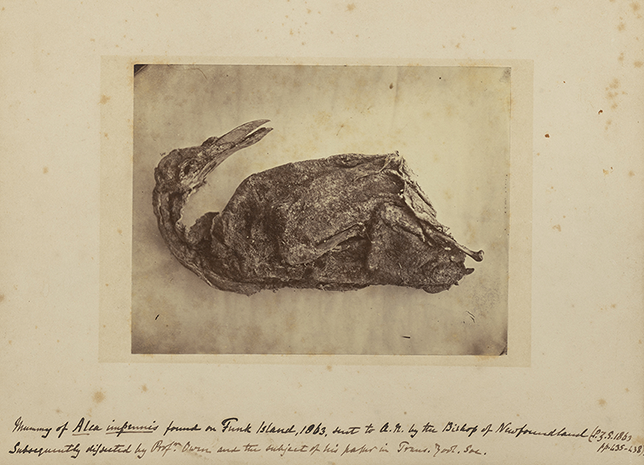
So, people were instructed not only to look for bones in the deposits of guano, waste, or peat but also to observe the marks on them that might identify them as the leftovers and remains of past slaughters. Furthermore, the search was done with visual materials that helped to identify the bones as belonging to the great auk. As we will see later, this was also the case for the sea cow.
On the North Pacific side, the Aleuts, newcomers to the Commander Islands, had learnt how to exploit and recycle the sea cow’s bones. New instruments and techniques were developed to find bones in the waste, as the Rhytina bones there were not found at the water’s edge but on a beach elevated 2–3 m above sea level, covered with dense, lush grass and by a layer of earth and gravel 30–50 cm thick. To find them, the ground was tested with an iron spike, a bayonet, or some similar device, as it was too difficult to excavate the entire grassy wall. Bones were detected by the resistance and the type of sound; locals knew if the spike had hit a stone, a piece of wood, or a bone. Because of their hard, ivory-like texture, the ribs had been used for shoeing sledges in large quantities, and for that reason, they were rarer than other bones. The finger bones, which may originally have been cartilaginous, seemed to have been completely destroyed in most cases, as had the outermost tail fins ones. The Aleuts knew exactly where to find such bones and kept them for their own purposes. This means that the Rhytina bones – in contrast to their scarcity in natural history collections – existed quite commonly in what had become the natural landscape, namely in the waste disposal sites of the former/recent human exploitation of marine resources.
Over the years of their life on the island, the Aleuts learnt to use the Rhytina bones as a substitute for other traditional materials, that is, bones from other animals, in their everyday objects. Through the curiosity of the travelers and the instructions from St. Petersburg, they also learned that the Rhytina bones could be exchanged for money, and they developed an additional activity from this. As various sources show, it was the Aleuts or the “Creoles” (“half Aleuts, half Russians”) who dominated the procurement of skeletons and bones in the field:
One of the controllers of the Alaska Company,’ writes Nordenskiöld, “Mr Osche, a native of Livonia and now resident on Copper Island, told me that manatee bones should also be found on the western side of this island. On the other hand, such bones are not said to occur on the small island off the colony on Berings Island …, although Rhytina bones are common on the nearby beach of the main island. This is the scant information I was able to gather from the natives and other people living in the area about the animal in question. In contrast, my efforts to obtain Rhytina bones were crowned with better success, as I actually managed to bring together a very large and beautiful collection of skeletal parts. When I first made the acquaintance of the Europeans on the island, they told me that there was little prospect of achieving anything worth mentioning in this respect. The company had offered 150 roubles for a skeleton in vain. But I had not been on land for many hours when I learnt that larger or smaller collections of bones could be found here and there in the huts of the natives. I bought these up, deliberately paying for them in such a way that the seller was more than satisfied and the neighbour a little envious. A large part of the male population now began to search for bones, and I collected so much that 21 barrels, large boxes and tonnes were filled with Rhytina bones, including three whole, particularly beautiful skulls, as well as various more or less damaged skulls, several significant collections of bones from the same skeletons and so on.Footnote 75
The specimen deposited in the British Museum was obtained from compact peat, and all the vertebrae and other bones having cavities in them were full of peat growth when they arrived, as was also the skull. In the Alaskan territory, bones of the Rhytina had been obtained in a similar manner from deposits of peat. In the following years, as the next section shows, the “natives” offered several Rhytina skeletons to the European and American markets through the chief administrators of the colony on Bering Island, and through their offices in Alaska and San Francisco, or through the Ammurian section of the Russian Geographical Society in Khabarovsk. Just as in Iceland, where the search for the great auk developed new activities and skills, the desire for Rhytina bones created a new, lucrative profession, which was later considered part of the local identity of the “natives.” Section 4 concludes by exploring the visual dimension of extinction evidence – how sketches, engravings, and circulating images became crucial substitutes for the physical remains of vanished animals and shaped the epistemology of disappearance.
The Power of Images
The relationship between knowledge and image is part of the so-called visual turn, developing a great deal of literature after Bruno Latour’s concept of “immutable mobiles.” Latour, referring to the phenomenon of the transfer of knowledge through objects and paper (maps, drawings, or descriptions), invited us to reflect on the link between the spaces of the field and the cabinet, notes, measurements, sketches, and the characteristic and determining elements of Western science. According to him, modern science was established thanks to this capacity to produce – and accumulate – a standardized, communicable, and mobile knowledge.
This subsection will refer to the sketches of the sea cow sent by Steller to Russia. Even when the real animals were lost, they survived thanks to this capacity to reproduce them as “immutable mobiles.”Footnote 76 These drawings, an economical and manageable way of transporting information, made it possible to tackle the zoological enterprise in another fashion.
Leonhard Stejneger (1851–1943), the Norwegian-born American zoologist in charge of the Smithsonian Institution’s collections for many years, wrote an extensive biography of Steller, devoting an appendix to “The pictures of the sea cow” that serves as the basis for this section. Stejneger reconstructed the intricate itinerary of the only pictures made of the “living animal,” tracing its copies and its life independent of the author. Apparently, the Bering expedition, for lack of space, left without a draughtsman. Steller was not a draughtsman either, and to make up for this deficiency, the skills of pilot Friedrich Plenisner were called upon to draw sea charts and, at Steller’s request, plants and animals. Plenisner drew two plates of the sea cow, images which Steller, together with the manuscript and other plates depicting a sea lion and pinnipeds, sent to St Petersburg on the annual Kamchatka supply ship in 1743. By 1746, the year of Steller’s death, the Academy retained the manuscript but the plates had been lost, which is why they do not appear in the 1751 publication. However, because other copies had been made, Plenisner’s drawings survived both their loss and the extinction of the animal.
Stejneger was able to discern that all the images of the sea cow that had been made from the second half of the eighteenth century onward came from two series of images, both made by Plenisner to serve different documents recording the expeditions to the farthest regions of the Russian Empire. The story Stejneger tells could well be that of any other series of images made: safeguard copies sent privately to colleagues and kept in personal collections, copies of copies that were reproduced beyond the author’s will or knowledge. Contrary to the idea that manuscripts – be they textual or images – are immobilized in archives, the images of Steller’s sea cow had a life of their own, were used in their “manuscript” state, were copied and moved in circuits that were uncommon but by no means nonexistent. The images, through the most diverse agents, managed to reach publication, in this case the work of the German naturalist Peter Pallas, who accessed Plenisner’s sketch and published it, posthumously and without major modifications, in his work on the fauna of Russia.
When Brandt published the first comprehensive description of the northern sea cow, he enclosed an “Icon idealis” (ideal image) of the animal and several plates showing the composition of the skull. The sketch of the outer form merely recomposed the sketch published in Pallas’ work, that is, the Plenisner/Steller drawing. Brandt’s plates were sent to the Russian–American colonies together with instructions for collecting the bones, so as to visually instruct the residents who were unable to read Latin, the language of Brandt’s work. However, the new “natives” were not only used to the bones but also to the depictions of the extinct animal, which started being seen as if they had been acquainted with it. (Figure 11) Despite this account:
Two creoles, Feodor Mertchenin and Stepnoff, stated, that about twenty-five years ago /namely, ca. 1850) at Tolstoj-mys, on the east side of the island, they had seen an animal unknown to them which was very thick before, but grew smaller behind, had small fore-feet, and appeared with a length of about fifteen feet above water, now raising itself up, now lowering itself. The animal “blew,” not through blowholes, but through the mouth, which was somewhat drawn out. It was brown in colour with some lighter spots. A back fin was wanting, but when the animal raised itself it was possible, on account of its great leanness, to see its backbone projecting. I instituted a through examination of both my informants. Their accounts agreed completely, and appeared to have claims to be regarded as trustworthy. That the animal which they saw was actually a sea-cow, is clearly proved both by the description of the animal’s form and way of posturing in the water, and by the account of the way in which it breathed, its colour, and leanness … As these natives had no knowledge of Steller’s description of the animal, it is impossible that their statement can be false.Footnote 77
Brandt’s Icon Idealis of Rhytina stelleri (public domain)
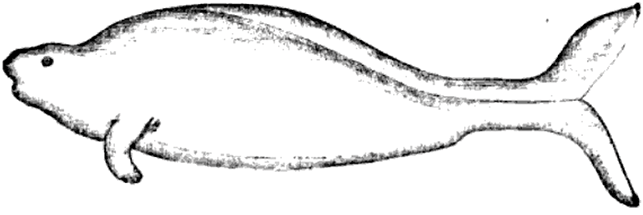
Nevertheless, on the basis of these testimonies, it was proposed to date the extinction of the species to 1854. Stejneger, however, pointed out that the natives, although not familiar with Steller’s text, had been instructed to collect bones for the St. Petersburg’s museum, receiving the images through Brandt’s work: “Those natives,” said Stejneger, “were far from being unaware of the oldest descriptions of the animal; a copy of the plates of the first part of Brandt’s work, Symbolae Sirenologica, was sent to the island very soon after it was published.”Footnote 78 The observation of reality was sifted by the history of the circulation of images. These “natives” had learned to see living “sea cows,” or at least to ascribe to some animals of dubious shape the forms they had learned through the instructions of the Tsar’s museum. Stejneger, in order to unravel the “realities” created by the images mixed up in real memory, did an almost psychoanalytical work, interviewing the “natives,” confronting words with the images and the texts of the books, and discovering more than one error. In fact, books, texts, and images using Pallas’ and Brandt’s sea cow plates and photos of some skeletons already mounted in museums, went back and forth to Bering. The experience of the natives also included them, to the extent they were unable to distinguish what they had seen on paper from what appeared in the sea or had heard as stories told by the campfire.
In 1882 Stejneger had been sent to the Commander Islands under the auspices of the US Signal Service to establish observation stations. While there he studied the islands’ natural history, the fur seals, and made specimen collections, including the skeleton of a sea cow. As the problem of the fur seals and commercial sealing became an international economic and political concern, Stejneger’s studies of the seals and the sealing conditions became more involved. In 1895 he was sent to the North Pacific as an attaché of the US Fish Commission. The next year, President Cleveland appointed Stejneger to the International Fur-Seal Commission and he spent most of this time on the Pribilof and Commander Islands, as well as some time in Hakodate, Japan. He returned to the Bering Sea again in 1897 to continue his studies and investigations. His last trip to the Commander Islands was in 1922 as a representative of the US Department of Commerce. During Stejneger’s stay of about two years (1882–1883) on Bering Island, he succeeded in finding a number of skulls, ribs, vertebrae, and other bones. And, most importantly, he recorded the testimonies of his contemporaries in a wonderful interview that is revealing as to how natural history has always been a human science.Footnote 79 One complete skeleton was found buried in the sand, but the bones were too far decayed to permit handling. From the various individual bones that were found, a fairly good skeleton was “made up” for the National Museum in Washington. This, together with the two skeletons in St. Petersburg and Helsingfors, and the two ribs in London, constituted the total amount of material pertaining to the sea cow found in the museums of the world.
This section has reviewed how the extraction and circulation of scarce remains were facilitated by networks of expertise and empire. The remains, however, did not only find a new home in museum collections. The following section follows some of those objects into the auction room, where scarcity was prized and priced accordingly, and they acquired a parallel life as luxury commodities.
5 Furta Non-Sacra
The global itineraries linking Danish kitchen‑middens, North American shell heaps, North Pacific peat deposits, and the Indian Ocean’s archaeological landscapes did not merely expand the geographic range of evidence. They also heightened competition among museums and collectors, revealing how the same processes of excavation, circulation, and comparison that produced scientific knowledge simultaneously generated scarcity. Section 5 turns to this parallel economy, where the afterlives of extinct species unfolded not only in research and museums but also in auction rooms, investment strategies, and new regimes of value.
Inspired by works on early modern antiquarianism but also by Patrick Geary’s seminal work on the economy of relics, this last section traces the economic processes set in motion by objects that were scarce on the natural history market and shows how the scientific revaluation of waste intersected with nineteenth‑century regimes of scarcity and collecting.Footnote 80
Scarcity plays an important role in the history of museum collections, in this case by driving up the price of the animal bones and great auk’s eggs, which became a luxury collector’s item at the end of the nineteenth century. It was in the auction houses that the status of museum specimens as both economic and scientific things played out. This section is based on materials from Alfred’s Newton Archives kept at the University of Cambridge Library.
Some natural history dealers specialized in furnishing great auk skins and eggs, such as merchant Detlhef Thomsen from Elsey, who had been buying dead birds since 1831. The skins were prepared by his wife and her sister, A. C. Lewer, who cut the skin under the wing, removed the bones, and stuffed the cavity with hay, a trademark of their handicraft and an explanation of why the few specimens kept in the collections were useless for comparative anatomy. The ladies were also skillful in the art of blowing out great auk eggs, which by then each cost less than thirty cents of a Prussian thaler.
By the 1860s it was accepted that only a few auk skins and eggs survived in the possession of museums and private collectors, even if some museums failed to realize the market value of those specimens. The Mainz Museum, for example, valued their auk specimen but not so much as an embalmed tapir. The latter animal was obtained through a transaction that the German museum administrators, by handing over the bird and obtaining the largest mammal in South America, believed to be an excellent deal. However, prices would soon start to rise at crazy rates, demonstrating the strategic mistake they had made. In 1880, there were only sixty-six known eggs left of the auk, forty-three of which were in England and Ireland, and some eighty skins, ten skeletons, and some 130 loose bones, recovered from the rubbish dumps of Denmark, the Hebrides, Iceland, and Newfoundland.
On March 13, 1888, thirty years after the Dethlef Thomsen transaction, the Pall Mall Gazette of London published an account of one of the many auctions in the city. The day before, in the salerooms of Mr. John Crace Stevens at 38 King Street in Covent Garden, a great auk egg had been auctioned at the extraordinary price of 225 pounds sterling, the highest price ever paid for an egg. The record was surprising but somewhat in line with recent increases. It had been announced days earlier that the specimen, bought for £18 from an Oxford Street egg dealer in 1851 by the late Mr. Wise, would be offered for sale as part of Mrs. Wise’s egg collection.
Stevens, the owner of a house that had specialized in the auctioning of exotic and natural history objects since the 1830s, had made sure to promote the exceptional and perfect condition of the specimen. The catalogue presented it as an egg of stupendous quality, with no cracks or dents. It would be priced with a reserve of 100 guineas. In the language of ordinary merchants that would have been written “105 pounds” but great auk eggs were already figuring in the investments of gentlemen and the more refined classes. Like works of art, horses or the services of professionals, auk’s eggs were now sold in guineas. (Figure 12)
Steven’s catalogue
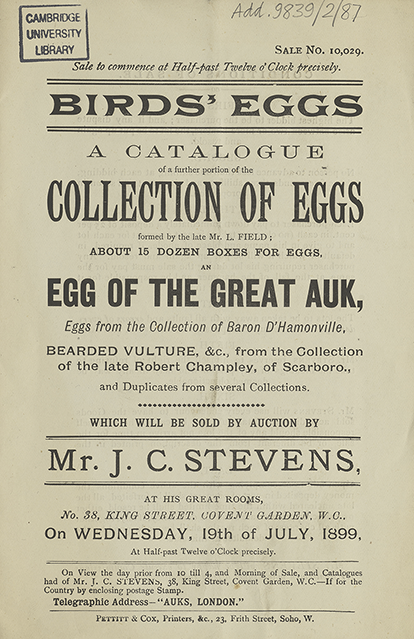
Mrs. Wise’s egg was bought by James Gardner, the heir to a famous family of taxidermists who owned a store which, between 1840 and 1920, was also located in Oxford Street. The Gardners specialized in the manufacture of dioramas of birds and mammals, which are still sold today and preserved almost intact thanks to the enormous amount of arsenic used in their preparations. The Gardners had already been involved in the acquisition of three other great auk eggs. Deposited in the Museum of Boulogne-sur-Mer, around 1850, the curator exchanged them for an ostrich skin prepared in Oxford Street. Once in London, the eggs were sold to a Mr. Potts, who auctioned two of them in 1853 and then left for New Zealand, taking with him a third egg which he kept until his death in 1888. Mr Potts’ widow gave her husband’s egg to the Canterbury Museum in Christchurch. The Gardners were merely intermediaries in a chain of investments that helped to drive up prices, and so, after the 1887 sale, it was rumored in London that Gardner would resell his most recent investment to a collector in the US.
By that time an auk egg had become a great investment and an inheritance that saved widows and orphans: the prices, at every opportunity – and there were not many – were increasing. Thus, while in 1865 four eggs were auctioned at thirty pounds each, in 1876 they cost £64, and in 1880 the auction of two eggs had brought prices of £105 and £107. In December 1887 – barely three months before the King Street Auction – they fetched £188. The newspapers wondered how much they would fetch in 1988 should any of these specimens survive the perils of time, fire, and water. Thousands of pounds? Or would it be the same as with tulips, which, after the eighteenth-century furor, dropped in price at the end of the Enlightenment to the level of a penny and thus returned to the domain of gardening and the flower market rather than the halls of major finance?
Auk eggs were undoubtedly rare and their price was unpredictable. The Standard commented with astonishment on the emergence of this Victorian-era “aukmania,” perhaps a new milestone in the long history of nonsense that from time to time infected at least a portion of humanity. How to explain the prices paid for empty eggs, devoid of any scientific interest? After all, they were nothing more than calcium carbonate stained with brownish-black spots. Even if it bordered on the absurd, it was understandable that a zoologist might go broke for a collection of butterflies or a box of bird skins, materials that would ultimately be useful for study. It was one thing to pay £600 for an Archaeopteryx or £200 for the casts of fossil footprints found in the red sandstones of Connecticut, but for an egg filled with air?
The counterfeiters were already appearing, employing painters of stains on the eggs of other species, and profiteering from this passion, which combined three things: the possibility of making good business, the interest in collecting the remains of extinct animals, and the British and North Americans’ love affair with embalmed birds and empty eggs. The great auk eggs, however, kept breaking records, such as that of Potts’ widow, which, far from remaining in a museum in New Zealand, returned to England in 1897, where it was auctioned for £294 pounds, making it the egg that had traveled the furthest in history. In 1894 Stevens again broke a milestone and summoned the most prominent collectors of eggs and curiosities in the British Isles to his saleroom.
Gentlemen! – said Stevens, addressing the audience, ‘I think I have every right in the world if, in describing this egg, I say that it is the most interesting of all the eggs I have had the privilege of selling. The most beautiful,’ he continued, as his palm caressed a dirty egg, about three and a half inches high and a little less in diameter at its widest point. It has a story. William Yarrell, the London professor for Zoology, paid a franc for it to a Boulogne fisherwoman, who in turn had obtained it from a North Sea fisherman. In 1856, after Yarrell’s death, it was sold on this very spot for 20 guineas, but not by me,’ said Stevens, with a hint of sadness, who, at that time, was only a schoolboy. Twenty years later it changed hands again, and passed into the possession of Baron Louis d’Hamonville. Without hesitation, I can say that I have known this egg almost from the moment it was laid.
Stevens had ended his speech as an expert auctioneer by appealing to the most resonant fibers of his audience: “It is a matter of patriotism that this egg should not leave Europe: its place is in the British Museum!” Such effervescence was followed by silence. No one knew how much to offer for the egregious egg. Stevens gave a hint: he would not accept anything less than a hundred guineas. And the palaver was successful: the egg was sold for 300 to Sir Vauncey Crewe, a baronet who owned a bird sanctuary that fed his passion for hunting and taxidermy. Sir Vauncey, in fact, was one of the most important late-Victorian collectors of eggs, embalmed birds and butterflies, a reputation that the Yarrell egg must have helped to cement.
Eggs, with their stories of travel and prices, tell us about the absurd values that useless things can acquire in the market of luxury objects, which, in the end, depend on fashions and empty words, such as those of Stevens, calling for national self-respect while praising and caressing an egg of a bird that no longer existed. These speeches, as hollow as the egg itself, merely concealed the transactions between the traders of natural history and the lovers of still life; the egg of the late giant auk was perhaps the best symbol to celebrate this alliance. (Figure 13) In this way, the nineteenth-century traffic in auk eggs and other extinct animals exemplifies the broader dynamic explored throughout this Element: the transformation of refuse and remains into objects of knowledge, value, and desire.
Great Auk Specimens. Two preserved specimens of great auk, flightless birds, mounted in display cases with eggs at a museum, March 31, 1971. The great auk species was declared extinct in 1852.
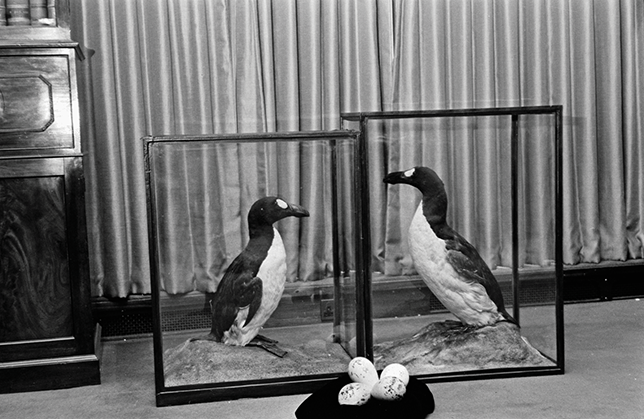
Conclusions: Rags to Riches
This conclusion draws together the threads developed across the Element – waste economies, typologies of past refuse, and the evidentiary traces of extinction – to underline how discarded materials became both scientific resources and valued objects.
In writing this Element I wanted to reconstruct the circuits and circumstances in which bones and the new scientific space of the rubbish dump linked European, the North Pacific, the Indian Ocean, and the North Atlantic to show how knowledge literally developed in bits and pieces assembled through different mechanisms. I\ also wanted to show how these circuits gave economic, scientific, and symbolic value to leftovers found in the landfills from the past to argue that trash to treasure, in the case of archaeology and recent sciences, is more than a metaphor: it might be taken literally.
But what kinds of treasures emerged and were made possible by the new focus on middens and waste as sources of collectibles, information, and new knowledge? This Element refers to some of them, such as the marked bones and the empty eggs of recently extinct animals, but this story can be found behind any artifact that would have delighted the gaze of the visitors of the museums of the day. Regarding them as rubbish and not as a treasure is also a way to remember that they had an economic history (in the past and in the present) that transformed unwanted things into the objects that today are protected and displayed in showcases, generating admiration, controversies, and disputes.
British archaeologist Paul Bahn once sarcastically wrote: “Some archaeologists dig up rubbish, others write it down.” That sarcasm, I argue, veils the fact that the originality of prehistoric archaeology is a new ontology that took old rubbish and recycled it into new knowledge, new skills, and professions. This is nothing new, given the fact that the process of converting waste materials into new materials and objects has been a common practice for most of human history. What was significantly new was that the new practices of subfossil paleontology and prehistoric archaeology were more than a specific type of recycling; they were the basis for scholarship and academic institutions that had previously neglected the potential of waste.
The refuse of ordinary people started telling as much history as the more obvious archaeological remains associated with the great, the beautiful, and the good. The leftovers of past barbeques and abattoirs, the humble midden – and other kinds of waste deposits – not only allowed new kinds of history to be written but a new type of history about people who were previously invisible, and by extension, unimportant.
Not only did the middens of the masses contribute to a history of their creators, but they also became key evidentiary data in the developing consciousness of “extinction” as a major feature of evolution and natural change and, therefore, a key contributor to the development of scientific research and enterprise. The role of middens as data sources and the efforts to make the best analytical use of those new and often difficult data are a salutary lesson that new ways of field data collection must be considered as major contributors to developments in theory as well as method. Thus, studies of rubbish lead to new systems of enquiry through cross-disciplinary collaboration: the new discipline of prehistoric archaeology emerged very early, advantageously entwined with – and dependent upon – other disciplines.
I also wanted to show how the study of the prehistoric and protohistoric past recycled the objects found in past landfills situated outside of the city, close to the sea, or in “remote” islands. Leftovers, the new and valuable evidence of past everyday lives, were transferred into private collections and/or urban museums where they eventually became part of national heritages. Extracted from the rubbish bin, their future depended on where they continued their afterlives. Were they integrated into the market of natural history and/or antiquities, or were they circulated further as rare and valued merchandise? Were they put into national or public collections, transformed into scientific and/or symbolic objects, or apparently subtracted from economic circulation? Leftovers, in the museums, gained still-lives or the illusion of being saved for posterity and protected from irreversible harm. However, far from being out of the economic machine, they are still in: integrated into the cultures of preservation, they are part of “the human struggle with the nature of matter”.Footnote 81 Caring, storing, and repairing those discarded objects had generated new professions, new spaces, and new products that, of course, produce more refuse and new scholarship.
So, can the history of archaeology and related sciences of the past be compared to that process as described by Sabine Barles, who considers urban waste as a relatively recent invention? According to her, the analysis and exploitation of the materials cycle was a determining factor during the first industrial revolution, and led to the organization of their circulation, from the home to the street, from the street and the cesspit to the factory or the field. This continuous circulation of materials contributed to the first boom in urban consumption, whether of food or of various objects and products. Scientists, industrialists, and farmers – sometimes all at the same time – saw the city as a mine of raw materials and, alongside the municipal authorities, technical services, and ragpickers, took part in the implementation of an urban project designed to ensure that nothing was wasted – a project that would guarantee urban health, economic dynamism, and food survival. However, as soon as industry and agriculture were able to do without the city, they abandoned its excreta in favor of other more abundant, more profitable, and more convenient raw materials, and all the more so as these activities dispersed and the city expanded, making the collection of urban raw materials more difficult. As a result, chemists and agronomists also turned their backs on the city, which no longer seemed to be part of their remit.
The city remained the main place of consumption, a consumption that, as it seems almost evident, included the creation of public spaces where the waste from the past started being collected, exhibited, and/or accumulated in the form of those artificial heaps transformed into entertainment spaces. From the 1870s onward the fertilizer revolution, the rapid development of coal, and the search for more convenient and plentiful materials undermined the recycling industry. By the 1880s monumental museums had been built in the main capitals of Europe and the Americas to store the growing number of bones and leftovers recovered in excavations taking place outside of the city. Those urban museums became new deposits of past waste but transformed it into antiquities that bore witness to distant times and, perhaps for the first time, made refuse collections and collecting a fitting subject for scholarship. In this sense, the afterlives of auk eggs and other extinct animals exemplify the broader dynamic explored throughout this Element: the transformation of discarded matter into objects of knowledge, value, and desire.
Appendix Acquisition of skeletons of sea cows (1902−1903)
Archives Nationales de France (AJ/15/840)
Dossier for the acquisition of a skeleton of the sea cow for the Comparative Anatomy Gallery, the Paris Museum of National History. Since 1894, A. L. Lalande, the French consul in San Francisco, USA, had been engaged in the affair of finding a specimen for France. A. L. Lalande, former French Consul at Messina, had been appointed to represent France in a similar capacity at San Francisco in October 1892. These letters show how he managed his endeavors and expectations:
“J’ai reçu l’information qu’une lettre de ce consulat portant la date du 21 novembre 1894, et relative à la recherche e \à la valeur de plusieurs spécimens anatomiques (Rhytina Stelleri, loutres marines, etc.) dont M. le Professeur G. Pouchet, lors d’un voyage à San Francisco, en Juin 1893, m’avait vivement manifesté le désir de poursuivre l’acquisition dans l’intérêt des collections du Muséum d’Histoire Naturelle à Paris, avait été communiquée à Notre Excellence.
En même temps, et conformément à la réponse de votre Département, je recevais l’instruction de donner une conclusion aux pourparlers par moi engagés depuis plus d’une année pour l’achat: 1° d’un squelette de « Rhytina Stelleri » (vache marine) au prix de Mille Dollars (5299 f) et de deux squelettes de loutres marines (mâle et femelle) au prix de Cinquante dollars (260 f chacun) prix indiqués et convenus, et de faire parvenir les pièces au Muséum à Paris, par la voie la plus économique.
En ce qui concerne l’achat du squelette de Rhytina Stelleri considéré encore aujourd’hui comme pièce rarissime de cette espèce disparue, je crois avoir mis la main sur un spécimen à peu de choses près complets, et, apprécié comme tel, par des spécialistes, professeurs d’universités en Californie, and so on. entre autres, un membre correspondant de l’Institut de France, M. le Professeur G. Davidson, savant très distingué, qui l’ont vu.
Je me suis attaché, d’autre part, à retarder dans la Note ci annexée, l’historique des 2 ou 3 spécimens de Rhytina Stelleri qui, à ma connaissance figurent dans les collections du Muséum de la Smithsonian Institution et de l’Académie de Sciences de San Francisco. Le directeur de cette Académie a bien voulu sur ma demande, m’autoriser à faire rendre une photographie et les dimensions du squelette en sa possession (…)
L’envoie de ces diverses pièces anatomiques au Muséum a été effectué le 27 mars à destination du Havre (?), ainsi qu’il résulte du Connaissement ci-annexé, par la voie de Panama, la plus économique; je joins également un Bordereau détaillé du contenu de chaque caisse au nombre de cinq (5).
Désireux de ménager autant que possible les désirs du Muséum j’ai tenté, une fois muni des pouvoirs nécessaires, une dernière démarche auprès de M. Malowansky (de l’Alaska commercial Co.) pour l’amener à faire une concession sur le prix de Mille dollars (5200 f.) sans lequel il s’était jusqu’au dernier moment positivement refusé à céder les squelettes de Rhytina Stelleri en sa possession.
J’Ai eu en fin de compte, la satisfaction d’obtenir sur ce prix une diminution non insignifiante de trois cents dollars + 1160 f. ce qui réduisait à Sept Cents dollars (3626 f.) le prix de ce spécimen (aux charges de 5f 18 cens)
Toutes les pièces comptables relatives aux frais divers d’achat, d’emballage, d’assurance, de transport et des acquisitions en question faites par ce consulat ont été, conformément aux prescriptions des art. 214 à 219 de l’Instruction ministérielle du 10 mai 1891 (Affaires étrangères- comptabilités) couverts par une traité sur le Trésor pour la Compte du Ministère de l’Instruction Publique (Muséum) portant la date du 28 Mars 1891 (?)- ont été transmises le même jour, par lettre spéciale N° modèle 25. Cette dépense’est élevée au chiffre total de huit cent soixante-douze dollars $ 872 55/00 francs 4519 + 81 cents.
Translation
“I have received notice that a letter from this consulate dated November 21, 1894, concerning the search for and the value of several anatomical specimens (Rhytina stelleri, sea otters, etc.) which Professor G. Pouchet, during a trip to San Francisco in June 1893, had strongly expressed the desire to acquire for the benefit of the collections of the Muséum d’Histoire Naturelle in Paris, had been communicated to Your Excellency.
At the same time, and in accordance with the response from your Department, I received instructions to conclude the negotiations that I had undertaken more than a year earlier for the purchase of:
a skeleton of Rhytina stelleri (sea‑cow) at the price of one thousand dollars (5,299 francs), and two sea‑otter skeletons (male and female), at the price of fifty dollars each (260 francs), as agreed; and to have these pieces forwarded to the Muséum in Paris by the most economical route.
With regard to the purchase of the Rhytina stelleri skeleton – still considered today an extremely rare specimen of this extinct species – I believe I have secured an almost complete specimen, appreciated as such by specialists and by university professors in California, among them a corresponding member of the Institut de France, Professor G. Davidson, a very distinguished scholar who has examined it.
I have also taken care, in the attached Note, to provide the history of the two or three Rhytina stelleri specimens which, to my knowledge, are held in the collections of the Smithsonian Institution and the Academy of Sciences of San Francisco. The director of that Academy kindly authorized, at my request, the taking of a photograph and measurements of the skeleton in their possession.
Shipment of these various anatomical items to the Muséum was carried out on March 27, bound for Le Havre (?), as indicated by the enclosed bill of lading, via the Panama route, the most economical. I also attach a detailed inventory of the contents of each of the five (5) crates.
Wishing to meet, as far as possible, the expectations of the Muséum, and once I had received the necessary authorization, I made one final attempt with Mr. Malowansky (of the Alaska Commercial Co.) to persuade him to reduce the price of one thousand dollars (5,200 francs), below which he had steadfastly refused to part with the Rhytina stelleri skeletons in his possession.
In the end, I had the satisfaction of obtaining a not insignificant reduction of three hundred dollars (+ 1,160 francs), which lowered the price of the specimen to seven hundred dollars (3,626 francs), plus charges of 5 francs 18 centimes.
All accounting documents relating to the various expenses for the purchase, packing, insurance, transport, and acquisition of the mentioned items by this consulate have been, in accordance with Articles 214 to 219 of the ministerial instructions of May 10, 1891 (Foreign Affairs – Accounting), covered by a draft on the Treasury for the account of the Ministry of Public Instruction (Muséum), dated March 28, 1891 (?). They were transmitted the same day by special letter No. 25. The total expenditure amounted to eight hundred seventy‑two dollars ($872.55), or 4,519 francs and 81 centimes.”
Lalande expressed his will that the specimens in Paris made mandatory mention of the fact “que s’est par l’entremise et les recherches d’un agent du Ministère des Affaires Étrangères, consul à San Francisco, qu’il a fu être trouvé, identifié et obtenu”
This transaction is connected with this Russian report:
Letter from I. Chaffanjon, representative of the “Muséum d’histoire naturel1e” in Paris, with a request to send to the museum duplicates of the collections of the Khabarovsk Museum of Anthropology, Ethnography and Zoology.
Decision. To satisfy the earlier requests of the Russian museums, and then to send to Paris what will be possible.
Report. Letters: (1) from the chief of the Commander Islands stating that the foreigner Trifon Sinitsyn wishes to sell two specimens of the fossil cow Rhytina Steller, which he found, for $100 in gold per specimen, and (2) from the Imperial Russian Consul in S. Francisco V. Artsimovich for assistance in authorizing the sale of one copy of “Rhytina Steller” to the French Consul de Lalande.
Order. To give permission to the Governor-General’s office to sell one cow to the consul; then to include in the next year’s budget an expense of $100 in gold for the purchase of one copy of the sea cow Rhytina Steller for the Khabarovsk museum.
accepted by the Ministry of Public Instruction and Arts in March 1903
« Entre les soussignés: M. Edmond Perrier, membre de l’Institut, directeur du Muséum d’Histoire Naturelle y demeurant, 57 rue Cuvier, à Paris et Constantin Pfaffius, ingénieur civil agissant au nom de las Société Impériale Russe de Géographie (section amourienne à Khabarowsk) et muni des pleines pouvoirs de son Excellence le général Alexandroff, gouverneur du Territoire de l’Amour et Président de la Section, il a été convenu ce qui suit:
Article 1er. - La Société Impériale Russe de Géographie (section Khabarowsk) cède au Muséum d’Histoire Naturelle un squelette de Rhytina Stelleri.
Article 2. - Cette cession est consentie moyennant la somme convenue à forfait de Cinq mille francs payable à la livraison du squelette au Muséum d’Histoire Naturelle.
Article 3. -Les frais d’emballage et de transport du squelette jusqu’au port d’embarquement seront à la charge de la Société Impériale Russe de Géographie,
Fait au triple à Khabarowsk, «
Translation: “Between the undersigned: Mr. Edmond Perrier, member of the Institut, Director of the Muséum d’Histoire Naturelle, residing at 57 rue Cuvier, Paris, and Constantin Pfaffius, civil engineer acting on behalf of the Imperial Russian Geographical Society (Amur Section in Khabarovsk) and vested with full powers by His Excellency General Alexandroff, Governor of the Amur Territory and President of the Section, the following has been agreed:
Article 1. – The Imperial Russian Geographical Society (Khabarovsk Section) transfers to the Muséum d’Histoire Naturelle a skeleton of Rhytina stelleri.
Article 2. – This transfer is granted for the fixed sum of five thousand francs, payable upon delivery of the skeleton to the Muséum d’Histoire Naturelle.
Article 3. – The costs of packing and transporting the skeleton to the port of embarkation shall be borne by the Imperial Russian Geographical Society.
Drawn up in triplicate at Khabarovsk.”
On June 15th 1903, the French chargé d’affaires in Japan reported to Perrier that he had just dispatched to Paris 5 boxes enclosing the remains of Rhytina and addressed to the Minister. They were onboard the 142 m Paquebot Annam, belonging to the Compagnie des Messageries Maritimes, which, in this case, traveled from Yokohama to Marseille. This French merchant shipping company, originally created in 1851 as Messageries nationales, later called Messageries impériales, was famous in shipping circles, especially on the Europe–Asia trade lanes in the period of French colonial expansion and of interventionism in the Middle and Far East. The Marseille liners continuously served in the Mediterranean Sea, the Black Sea, then the Red Sea, the Indian Ocean, the China Sea, and finally the Pacific Ocean. Ships of this line were some of the first large vessels to be fitted with the new water tube boilers. In the Indian Ocean, the line served Mahé, Seychelles, La Réunion, Mauritius, Zanzibar, and Madagascar, as well as the French establishments in India. The Annam had been launched on November 6, 1898, and assigned to the Far East line with her “sisterships” Laos, Tonkin, and Indus. The shipment was not free of charge, as the letter explained. Under the agreement, the Russian geographical society paid for the transportation of the skeleton until the port of embarquement, and all the rest was charged to the Museum budget, including the transport from Russia to Nagasaki, and storage there, which had been formerly paid by the local French consul. This cost was 7.87 yen, which at the change rate of 2.60 francs made 20.46 francs, to be wired to a friend of the consul living in Paris.
Acknowledgments
I would like to thank Adriana Miranda, Susana García, Felipe Rojas, Sarah Newman, Wolfgang Schäffner, Maribel Martínez Navarrete, Sebastián Frete, Betina Keizman, Alfredo Thiermann, Gabriela Soto Laveaga, and Pablo Gómez for their help at different moments of this project, which was discussed at a workshop at Columbia University in May 2023. Their ideas and encouragement convinced me it was worth writing this Element that finally took shape while on a Visiting fellowship at the Max Planck Institute for the History of Science, Department 3, Artefacts, Action and Knowledge, directed by Dagmar Schäfer. Hers and Lisa Onaga’s ideas and useful suggestions helped me in conceiving these pages. As always, it has benefited from the professional help of MPI librarians. I visited Alfred Newton’s archives at Cambridge University Library in 2014 thanks to a Georg Forster Research Award from the Alexander von Humboldt Foundation.
This Element, part of the project PIP 2021–2647 and PICT 2020–3693, was revised on a fellowship at the Käte Hamburger Centre for Cultural Practices of Reparation (CURE) funded by the German Federal Ministry of Research, Technology, and Space (BMFTR) under funding code 01UK2401. The author is solely responsible for the content of this publication. Much of this Element’s current shape is due to the invaluable help of my old friend and colleague David Roe, as well as the guide provided by the editor of the series, Daniel Woolf, and the comments of two anonymous reviewers.
It is dedicated to my daughter and my mother, no matter where they are, both providing eternal support to what I have done in the past and will do in the future.
Daniel Woolf
Queen’s University, Ontario
Daniel Woolf is Professor of History at Queen’s University, where he served for ten years as Principal and Vice-Chancellor, and has held academic appointments at a number of Canadian universities. He is the author or editor of several books and articles on the history of historical thought and writing, and on early modern British intellectual history, including most recently A Concise History of History (CUP 2019). He is a Fellow of the Royal Historical Society, the Royal Society of Canada, and the Society of Antiquaries of London. He is married with three adult children.
Editorial Board
Dipesh Chakrabarty, University of Chicago
Marnie Hughes-Warrington, Adelaide University
Ludmilla Jordanova, University of Durham
Angela McCarthy, University of Otago
María Inés Mudrovcic, Universidad Nacional de Comahue
Herman Paul, Leiden University
Stefan Tanaka, University of California, San Diego
Richard Ashby Wilson, University of Connecticut
About the Series
Cambridge Elements in Historical Theory and Practice is a series intended for a wide range of students, scholars, and others whose interests involve engagement with the past. Topics include the theoretical, ethical, and philosophical issues involved in doing history, the interconnections between history and other disciplines and questions of method, and the application of historical knowledge to contemporary global and social issues such as climate change, reconciliation and justice, heritage, and identity politics.