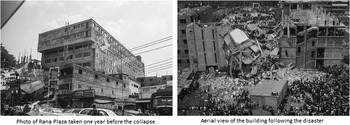
Rana Plaza building collapse is the 6th deadliest industrial disaster and the worst incident in the garments sector of Bangladesh. 1 The 9-storied multipurpose structure at Savar, near the capital Dhaka, housed 4 garments factories, banks, and a number of commercial shops and offices that collapsed suddenly on April 24, 2013 morning with more than 4000 people inside (Figure 1). This tragic disaster killed 1132 people and injured many more.Reference Biswas, Rahman and Mashreky 2
Photographs of Rana Plaza Before and After the Tragic Incident.

Bangladesh Armed Forces played a key role in the massive rescue operations along with the other government and nongovernment agencies in the following 21 days. The Armed Forces were tasked to coordinate the whole operation from the very first day of the incident. The field units of the Army Medical Corps (AMC) along with their civilian counterparts carried out triage and instituted first aid and resuscitation, while also arranging evacuation of the cases to military hospitals and nearer similar civil facilities wherever appropriate. A total of 423 injured victims were rescued and managed by the AMC personnel from April 24, 2013 to May 12, 2013. It is worthy of note that a female garments worker was rescued alive on the 17th day after the collapse incident. The death toll reached 24 out of the injured 423, including 1 rescue person.Reference Pramanik, Hossain and Azad 3
This unprecedented disaster was mitigated by extraordinary responses from almost all of the government bodies and also from nongovernment bodies. All available medical resources were utilized for immediate, short-, and long-term management of the injured. This study was conducted to find out the injury pattern in this catastrophe and to document the prehospital, in-hospital, and posthospital management.
MATERIALS AND METHODS
The Rana Plaza building collapse occurred on April 24, 2013 and rescue operations were carried out in the following 21 days. Among the injured individuals of the tragedy who were taken (n=423) to the nearest Combined Military Hospital (CMH), Savar was included in this cross-sectional observational study. From the point of rescue, each of them was followed for a period of months. Data were collected from history taking (wherever possible), interviews, observing and studying the records of field medical units, secondary hospitals, and rehabilitation centers. Relevant data from laboratory investigations were documented.
All treatment and evacuation stages were monitored. Frequent interviews were carried out by rescue workers, physicians, social workers, hospital authorities, and other bodies. In all, a huge amount of data was collated, analyzed, and converted into results by adopting simple statistical procedures.
RESULTS
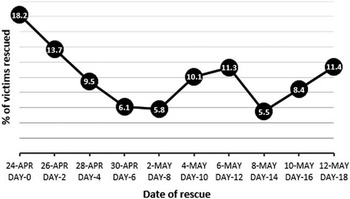
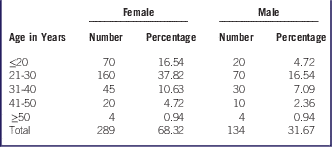
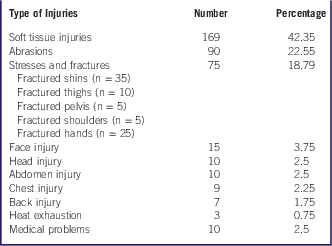
The initial rescue efforts appeared slower as illustrated in Figure 2. This preliminary delay was due to the extreme sternness, severity, paucity of befitting machineries, and unpreparedness to handle an incidence with such gravity. Only 40% of the victims could be released in the first week of the collapse whereas one-third of the victims were rescued during the last week of the operation with heavy armamentariums. The casualties were evacuated mainly to the nearest hospitals, clinics, and temporally-established medical camps. The majority of the injured were young females (68.32%). As shown in Table 1, more than one-half of them (55.36%) were between 21 to 30 years of age. Soft tissue injuries, abrasions, stresses, and fractures were the most common injuries. As illustrated in the Table 2, out of 423 hospitalized patients, 169 (42.35%) sustained soft tissue injuries involving lower limbs, upper limbs, chest walls, abdomen, back, and faces, whereas 90 (22.55%) had abrasions in the extremities, face, abdomen, scalp, and chest walls. Varieties of fractures and contusions were found in 75 (18.79%) cases, which involved tibia-fibula, femur, radius-ulna, and small bones in the hands and feet.
Percentage of Victims Rescued Across the Days of Rescue Operation (n=423).

Age and Sex Distribution of Patients (n=423)

Note: Percentage figures are column %. Mean age 35 years (SD=±12.75).
Pattern of Injuries in Hospitalized Cases (n=399)

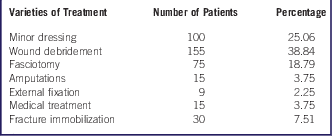
Among the survivors (n=399), the majority of the injuries were treated by wound debridement 155 (38.84%), and minor dressing 100 (25.06%). Patients of soft tissue injuries to limbs, particularly lower limbs, developed an impending limb compartment syndrome where fasciotomy (75 [18.79%]) saved the limbs (Table 3). The sacrifice of the limbs due to obvious sign of nonvitality were done as different forms of amputations (15 [3.75%]).
Treatment Provided to the Victims (n=399)

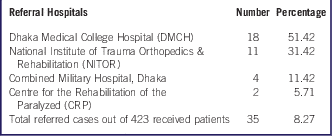
A total of 388 cases could be rescued by the Armed Forces Medical Team and managed at CMH Savar. The remaining 35 victims were evacuated to 4 tertiary hospitals after initial emergency management among which 18 patients were transferred to the Dhaka Medical College Hospital (DMCH), 11 to the National Institute of Trauma Orthopedics and Rehabilitation (NITOR), 4 to the CMH at Dhaka, and 2 patients to the Centre for the Rehabilitation of the Paralyzed (CRP), a specialized nongovernment renowned center for the disabled (Table 4).
Referral State of the Patients from CMH Savar (n=35)

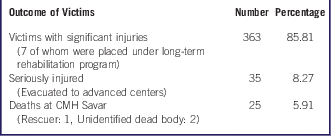
Twenty-five victims died out of the 423 rescued alive during the treatment process due to acute kidney injury (AKI) following crush syndrome, acute respiratory distress syndrome (ARDS) following blunt chest trauma, and due to complications developed as the consequences of head injuries and multiple traumas. One of the voluntary rescuers also died due to sustenance of an accidental severe head injury during a rescue operation (Table 5). The total human loss revealed in this center was 25 (5.91%) deaths, including 1 rescuer; there were 42 victims with serious injuries, 7 were enrolled in a long-term rehabilitation program, and 363 had significant injuries.
Rana Plaza Tragedy Victims at a Glance in CMH Savar

DISCUSSION
According to official reports 1132 people were killed and 2438 others were injured in this disaster.Reference Murshed and Sultana 4 Out of the total affected victims (3570), only 423 (11.84%) were taken by our rescue team to the CMH at Savar. The large number of severe casualties from the first day overwhelmed the public hospitals, whereas the few private hospitals were in a position to admit more people than they did. We believe that in the event of a disaster, all hospitals that have the ability to admit patients should do so, and that local authorities should later meet the expense.Reference Rokach, Pinkert and Nemet 5
The study revealed that many of the injured victims had multiple site traumas. Most life-threatening injuries sustained in the building collapse involved limb fracture, head injury, chest trauma, and renal failure. The results of our study are similar to other studies done in patients from the Marmara earthquake in Turkey.Reference Sengül, Ozer and Salman 6 Different types of injuries not requiring hospital admission totaled 100 (25.06%) cases as shown in Table 3. All 423 patients sustained various degrees of physical and psychological trauma due to massive collapse. One hundred percent of patients received initial resuscitative measures with intravenous fluids and plasma expanders. They were also kept nil per os for at least 6 hours until further assessment.
This study showed that 155 (38.84%) patients with various injuries needed a different form of wound debridement. Seventy-five (18.79%) patients underwent fasciotomy but many of them developed AKI due to crush syndrome following rhabdomyolysis. Massive building collapse of industrial accidents, earthquakes, and mining disasters are causes of rhabdomyolysis.Reference Sever and Vanholder 7
In this study, nonexertional heat-related illness was found in 3 (0.75%) of cases. Heat exhaustion occurs when relative humidity is 60% or more, hampering sweat evaporation, which hinders the body’s ability to cool itself. It occurs more if there are stagnant atmospheric conditions and poor air quality. On the other hand, concrete stores heat during the day and gradually releases it at night, resulting in higher night-time temperature. In our finding, no patient progressed to heat stroke, which can damage the brain and other organs and even cause death. All heat exhaustion patients had uneventful recovery with fluid replacement and were placed in a cool environment. One of the volunteer rescuers accidentally was burned on over 50% of his body; he was sent to National University Hospital Singapore for better treatment but later died.
Combined Military Hospital Savar, located near an industrial belt, is a level 2 hospital with limited capacity (100 beds), manpower, and equipment facilities. Efficient management of mass casualty was a great challenge for this CMH; but extra manpower support of a medical team from CMH Dhaka and equipment support from Armed Forces Institute of Pathology (AFIP) made it successful. Long-term follow-up of the disabled patients and their multimodal rehabilitation required determination and is still ongoing on a substantial level.
The mortality rate (5.91%) of this disaster in this particular center is lower than in similar past events like Buenos Aires in 1999 (8.3%)Reference Biancolini, Del Bosco and Jorge 8 as it is associated with the nature of the event (bomb, earthquake, or technological accident), the structure of the building, and the location of people inside and underneath the fabrication. It is also related to the presence of specific rescue techniques, medical treatment in the field, the feasibility of transportation to hospital, and medical treatment at the hospital,Reference Sever, Vanholder and Lameire 9 which had constraints in our settings.
The injuries related to the building mimic the findings of earthquake casualties, which have complex causal pathways including many behavioral and environmental variables. Many potential points of intervention could be identified in these pathways. Mass psychological assault is one of the impending scenarios following this sort of disaster, which was present with this disaster.Reference Fitch, Villanueva and Quadir 10 But, unfortunately, remedying these aspects like post-traumatic stress disorder is yet to be addressed properly in this developing country perspective.
CONCLUSION
Disaster involving a building collapse mimics disaster surrounding earthquake-related incidents. Injury patterns and management of mass casualties in this building collapse provided the rescuers and caregivers with a valuable experience to be utilized in dealing with a similar type of disaster that might take place in densely populated cities in an earthquake-prone country like Bangladesh. The death of a voluntary rescuer once again warrants the necessity of using the helmet and safety gear during any rescue operation.