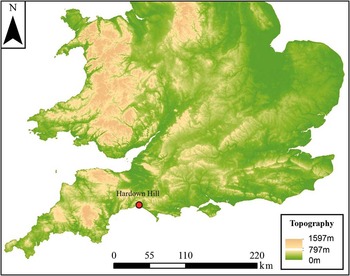
In 1916, an assemblage of fifteen early Anglo-Saxon artefacts was retrieved from a mound at Hardown Hill in Dorset (fig 1).Footnote 1 The discovery of a spearhead by a boy hunting rabbits prompted the excavation. Wingrave excavated the mound in question and found a second spearhead, ‘about a foot [0.3m] below the surface amongst loose chert fragments and flints’, as well as the rest of the assemblage, in loose blackened soil, at an unspecified depth below.Footnote 2 He interpreted the assemblage as the associated objects of an early Anglo-Saxon inhumation barrow burial where no skeletal evidence remained, presumably owing to an acidic burial environment.Footnote 3 Many years later the mounds at Hardown Hill were classified as Bronze Age disc and bowl barrows on the basis of visual inspection and an improved understanding of British prehistory.Footnote 4 Drawing on this, and noting the substantial size of the assemblage, Evison argued that the objects represented at least five Anglo-Saxon interments, being secondary burials in Bronze Age barrows.Footnote 5 Based on this interpretation, Hardown Hill has since stood unquestioned as our westernmost early Anglo-Saxon cemetery by quite a considerable distance. This paper seeks to reassess the objects and revisit this interpretation.
The location of Hardown Hill. Drawing: author

THE SITE
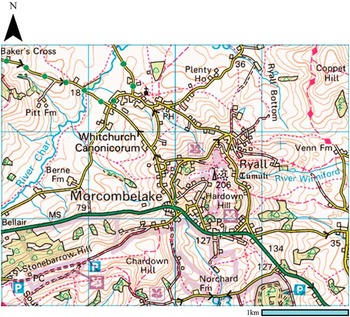
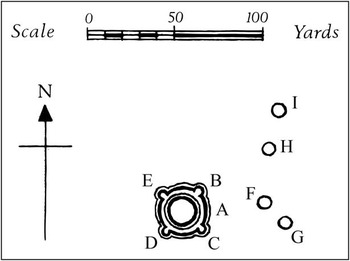
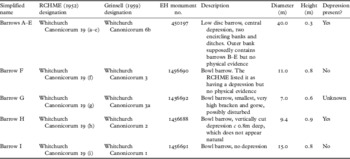
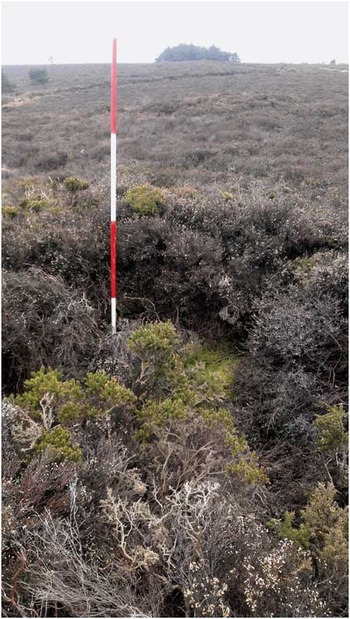
The flat-topped hill has an elevation of 207m and is situated 6km west of Bridport, 7.5km east of Lyme Regis and 500m from the A35 trunk road (fig 2). The small villages of Morcombelake and Ryall are to the immediate west and north respectively. It is geologically composed of chert bedding, slightly acidic clays and gravel topping, and is well drained by three streams, which feed the Char, to the north, the Winniford, to the east, and the English Channel to the south.Footnote 6 The barrows are situated on the northern part of the hill, and are recorded on Ordnance Survey maps from 1769. They consist of a complex of five ‘Dorset type’ low disc barrows (A to E) – although it has been argued that four of them (barrows B to E) do not actually exist – and a series of four bowl barrows (F to I) (fig 3).Footnote 7 Further details are given in table 1. We are not told which barrow was excavated, only that it ‘had a depression in the top’.Footnote 8 The lack of visible depressions means we can rule out barrows F and I as those in which the finds were made, and we can similarly discard barrows B to E as ghosts. Barrow A has quite a large circular depression and the noticeably higher bracken and gorse on barrow G might indicate human (or animal) activity in the past, but the most convincing evidence for intervention is the 0.8m-deep vertically cut depression in barrow H (fig 4). It is likely that barrow H was the site of Wingrave's excavation, but it is impossible to be certain without further investigation.
Hardown Hill in relation to Ryall, Morcombelake and Whitchurch Canonicorum. Map: © Crown Copyright and database rights 2012 Ordnance Survey

Plan of the Hardown Hill barrows. Drawing: digitally redrawn by the author, based on Evison Reference Evison1968, 239

The barrows

The central depression of barrow H, as seen looking south. Photograph: author

THE ASSEMBLAGE
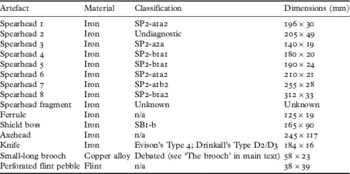
The artefacts are published in two different accounts.Footnote 9 For details of the assemblage, see table 2. In the following review, they will be reclassified where possible, using the latest typo-chronological scheme.Footnote 10 The chronological implications of these reclassifications, and the results of a correspondence analysis, will then be discussed. This will provide a secure date range for the assemblage and serve as a starting point for further discussion.
The assemblage

Note: The numbering system used for the spearheads is derived from the order in which they were positioned in the original photograph (see fig 5).
The spearheads
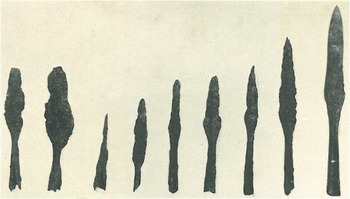
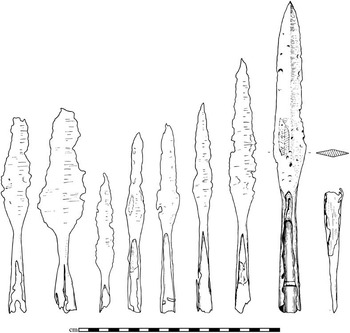
The original report lists ten spearheads, which included a misinterpreted conical ferrule and a now-lost socket fragment (figs 5 and 6).Footnote 11 They are of variable but clearly Germanic form, and were initially classified by Wingrave as two broad-bladed, six narrow-bladed and one pike-headed, but have subsequently been reclassified by Evison and Swanton.Footnote 12 Using the most recent typological system, which emphasises precise measurements over visual characteristics, we can classify the spearheads as: two SP2-a1a2 (tapered short-medium angular-bladed), one SP2-a1b2 (tapered medium-long angular-bladed), one SP2-a2a (short-medium angular-bladed), two SP2-b1a1 (short-long concave-bladed with maximum width close to the middle of the blade) and one SP2-b1a2 (short-long concave-bladed with maximum width relatively high on the blade).Footnote 13
The spearheads; the socket fragment was never recorded. Photograph: Wyatt Wingrave, after Wingrave Reference Wingrave1931, 247

The spearheads, reordered to mirror Wingrave's photograph (see fig 5). From left to right: SP2-a1a2, undiagnostic, SP2-a2a, SP2-b1a1, SP2-b1a1, SP2-a1a2, SP2-a1b2 and SP2-b1a2, ferrule. Drawing: digitally redrawn by the author, based on Evison Reference Evison1968, 235

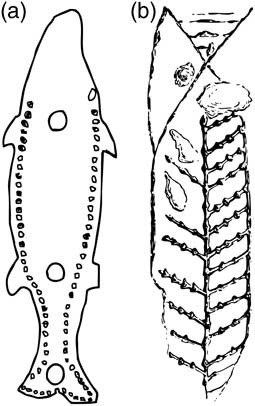
During the cleaning of spearhead 8, an incomplete symbol made from incised lines and punch marks was noticed near the socket end of the blade.Footnote 14 Two vertical lines, curving inwards at the base and crossing at the top, frame a herringbone design decorated by oval- and teardrop-shaped features. Evison suggested that the symbol might represent a fish, and therefore be of Christian significance.Footnote 15 Whilst it is true that fish-like designs occur on zoomorphic shield fittings from the period (fig 7), it seems more likely, especially when one considers the early date of the assemblage (see below), that such an image invoked some form of pre-Christian spiritual protection, referenced some part of now-forgotten folklore or acted as a maker's mark.Footnote 16 Spearhead symbols have been found at Great Chesterford (Grave 51) in Essex and both Holborough (Grave 7) and Buckland (Grave 301) in Kent, but the herringbone design of the Hardown spearhead seems unique.Footnote 17
(a) Type ia fish design from Eriswell, Suffolk. Drawing: digitally redrawn by the author, based on Dickinson Reference Dickinson2005, 130; (b) the Hardown Hill symbol. Drawing: digitally redrawn by the author, based on Evison Reference Evison1968, 235

The shield boss
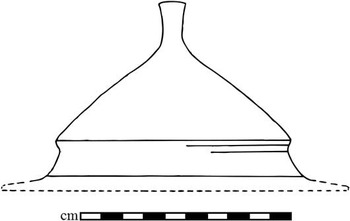
The shield boss, succinctly described by Evison as ‘a common low, wide type of the fifth to sixth century’, has a height of 90mm and a width of 165mm (120mm excluding the flange).Footnote 18 Wingrave's photographs give us plan and section views of this object and Evison's paper includes a highly schematic drawing (fig 8), which can be considered representative of the original form.Footnote 19 Under the new typological scheme it is classifiable as SB1-b (medium-height concave-walled with straight to slight convex cone).Footnote 20
The Hardown Hill shield boss. Drawing: digitally redrawn by the author, based on Evison Reference Evison1968, 237

The axehead
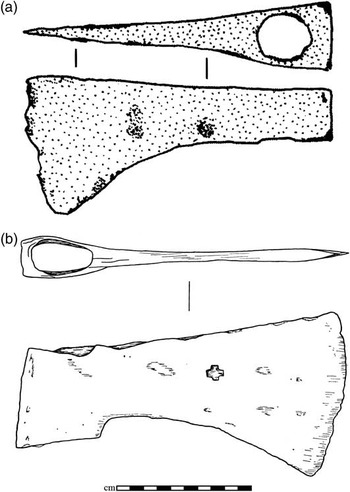
The 245mm-long axehead has a straight top contour, bowed bottom contour and slightly curved blade. Wingrave speculated that it may have been of Roman date, and therefore part of ‘the spoils of the conqueror converted to warlike uses’, which is a credible interpretation when one compares it to the axehead from Roman Combend, Gloucestershire (fig 9).Footnote 21 A deeply incised cross stamp was discovered during cleaning, which Evison took as evidence for a medieval date.Footnote 22 She did not explain this dating, and I can find no medieval parallel in support of such a claim, but presumably her assumption was that it was a Christian symbol. The rarity of axeheads and the lack of a robust typological scheme make dating difficult. Roman or not, if we are to discount Evison's medieval date as unconvincing and are to use as a basis Härke's suggestion that the majority of Anglo-Saxon axeheads were deposited before ad 600, we can tentatively argue that the axehead is unlikely to have been deposited much later than the sixth century.Footnote 23
(a) Roman axehead from Combend, Gloucestershire. Drawing: digitally redrawn by the author, based on Ulrich Reference Ulrich2007, 23; (b) the Hardown Hill axehead. Drawing: digitally redrawn by the author, based on Evison Reference Evison1968, 237

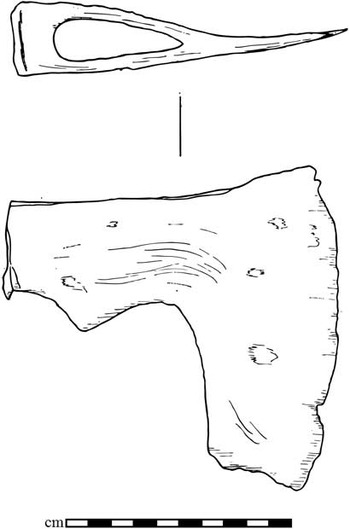
Wingrave's report also mentioned another axehead, which was retrieved from a pond at the nearby village of Whitchurch Canonicorum in 1920 (fig 10).Footnote 24 This axehead is of a bearded design with a deeply curved angular blade, slightly flared top contour and a distinctive point over the shaft. After studying both, Evison considered this second axehead to be more likely of Anglo-Saxon date, and concluded that ‘the two axes had become mixed up’.Footnote 25 Whilst this was convenient for the purposes of her argument, the evidence for a medieval date is weak, and there is certainly no reason to doubt Wingrave's account.
The Whitchurch Canonicorum axehead. Drawing: digitally redrawn by the author, based on Evison Reference Evison1968, 237

The knife
The knife, with a blade length of 142mm, is quite large and is well paralleled by knife 2 from Church Down, Hampshire (153mm), and the knife from Strood, Kent (165mm).Footnote 26 The angle at which the back and handle of the blade meet is quite curved, and there is a slight disparity between Wingrave's photograph and Evison's drawing (fig 11).Footnote 27 The flat blade edge and curving back is classifiable to Evison's Type 4 and fits between both Drinkall's D2 and D3 and Härke's ‘medium’ and ‘large’ categories.Footnote 28 A knife of this size and form, then, probably belongs to the sixth century and, given its size, was probably associated with a man.Footnote 29 The martial character of the Hardown Hill assemblage as a whole concurs with interpreting this as a ‘male’ blade.
The Hardown Hill knife. Photograph: Wyatt Wingrave, after Wingrave Reference Wingrave1931, 248. Drawing: digitally redrawn by the author, based on Evison Reference Evison1968, 237

The pebble
This object, now missing, measured 38mm by 39mm and was described by Wingrave as a ‘Flint pebble, with natural perforation … [that] may have been used as an amulet’ (fig 12).Footnote 30 Burial with pebbles, often with perforations, was a widespread practice across Anglo-Saxon England.Footnote 31 Although white quartz pebbles were most common, burials with flint pebbles are occasionally found, such as Grave 64 at Risely (Horton Kirby II), Kent.Footnote 32 Such objects may have served different functions, from the spiritual and magical to the decorative and ordinary, and it is difficult to argue any particular interpretation with confidence.Footnote 33 Considering that Wingrave mentioned finding other loose chert and flint fragments, it could just be a natural object of no archaeological consequence.Footnote 34
The perforated flint pebble from Hardown Hill. Photograph: Wyatt Wingrave, after Wingrave Reference Wingrave1931, 248

The brooch
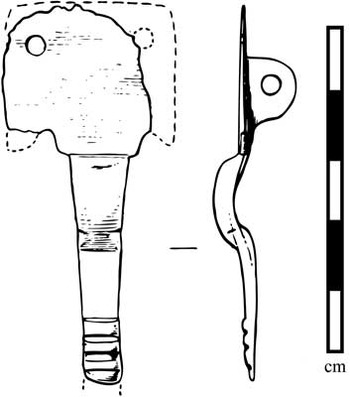
The small-long brooch is made of copper alloy and measures 58mm in length (fig 13). It has a heavily damaged square headplate with only one surviving perforation. Considerable deterioration is also evidenced by the worn-down bow tip and the lack of a catch piece on the footplate, which would have rendered the object functionally useless. It can be considered mid-fifth to mid-sixth century in date and can be classified as Leeds' cross pattée derivative group d (ii) or group e (i).Footnote 35 It has been argued that small-long brooches were quite common and of relatively low status.Footnote 36 In this sense, then, it seems peculiar that this broken object was held on to for so long. That the brooch could have been damaged by post-depositional processes or the activity of burrowing rabbits is possible but seems unlikely, given the condition of the rest of the assemblage.
The Hardown Hill brooch. Drawing: digitally redrawn by the author, based on Evison Reference Evison1968, 235

DATING THE ASSEMBLAGE
In order to procure a secure date range for the assemblage, the classifiable material (seven of the spearheads and the shield boss) was added as a single assemblage to a correspondence analysis of 272 fifth- to seventh-century grave assemblages.Footnote 37 It should be stated that assessing the temporal position of the assemblage in this way did not assume a funerary or hoard association; both are equally valid for the exercise. The assemblage fits within the seriation in phase AS-MB, which begins cal ad 525–50 (95% probability) and ends cal ad 545–65 (95% probability).Footnote 38 Four of the artefact-types are recorded in phases AS-MA and AS-MB, and four in AS-MB and AS-MC (in one case also in later phases).Footnote 39 These dates are consistent with the date range of c ad 450–550 suggested by Evison, although clearly they fall in the latter end of that range.Footnote 40
HARDOWN HILL IN THE CONTEXT OF POST-ROMAN DORSET
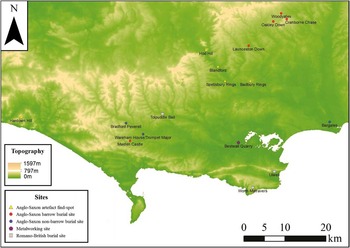
Early Anglo-Saxon material is limited in Dorset but a brief survey seems appropriate in order to place the significance of Hardown Hill in context (fig 14). Among the barrow burials discovered by Hoare in the early nineteenth century, the barrow at Woodyates contained a high-status female inhumation with an iron hook, clench bolt, buckle, ivory bracelet and necklace of jet and blue glass beads with gold attachments.Footnote 41 Nearby, at Cranborne Chase, another barrow contained a spearhead, two knives and ‘an article of bone’.Footnote 42 Fourteen beads (two long pulley beads of glass and twelve of amber), a button brooch, three finger-rings and some iron fragments accompanied another secondary interment at Oakley Down.Footnote 43 More recent excavations of a Bronze Age round barrow at Launceston Down have revealed three Anglo-Saxon secondary interments with seventh-century grave goods, including a knife, possible sheath, buckle, plate and part of an awl.Footnote 44 In the secondary interment near the eastern end of the Neolithic long mound at Maiden CastleFootnote 45 the male burial had fragmentary belt fittings, a small knife (somewhat similar to the Hardown Hill knife) and a seax, which can be classified under the new scheme as SX1-c (narrow with pommel), dating it to around the mid-sixth century.Footnote 46 The unfurnished burial of a disarticulated male who had been subjected to considerable violence was found just south of the long mound. It was originally thought to be Neolithic, but subsequent radiocarbon dating has determined a post-Roman date.Footnote 47 It seems, then, that none of the barrow burials of post-Roman Dorset, with their skeletal remains and small-scale assemblages, offer a parallel to Hardown Hill.
Location of post-Roman sites discussed in the text. Drawing: author

Evidence is also limited for non-barrow cemeteries. Excavations at Wareham House revealed only three burials with Anglo-Saxon artefacts, one with a comb, another with a knife and an iron nail and one with four glass beads and three silver rings.Footnote 48 Bradford Peverell, also in the Dorchester area, has revealed eighteen burials with associated knives, rings, beads, pins, mounts and buckles, but much of the material dates to the seventh century.Footnote 49 These two cemeteries can be seen as ‘typical’ of the period in that jewellery and dress accessories feature heavily, and they are quite unlike the martial assemblage from Hardown Hill. The thirty inhumations and four urned cremations at Bargates in Christchurch represent the region's largest cemetery with Germanic material, but even here we find only nine spearheads and six shield bosses.Footnote 50 To find eight spearheads and a shield boss at Hardown Hill, then, in the supposed context of only five or six burials, is worthy of note.
It is also interesting that Hardown Hill represents the only substantial collection of early Anglo-Saxon artefacts in Dorset without associated human remains, and is similarly unique in terms of distribution. For example, the scatter of artefacts found in the vicinity of Hod Hill amounts to only three objects, and even these were found on separate occasions.Footnote 51 Whilst the two brooches, one cruciform and one equal-armed, date to the early–mid-fifth century, the spearhead can be reclassified under the new typological scheme to SP2-b1b (short-long concave-bladed with pronounced outline), making it broadly contemporary with the Hardown Hill artefacts (fig 15).Footnote 52 The broadly contemporary button brooch found near Blandford, some 5km south east of Hod Hill, is a similar stray find worthy of mention.Footnote 53 A stray, and unpublished, fifth- or sixth-century spearhead was found at Badbury Rings sometime in the late nineteenth century.Footnote 54 Finally, mention must be made of the unpublished sixth- or seventh-century assemblage at Spetisbury Rings, which included two seaxes and four spearheads.Footnote 55
The spearhead from Hod Hill. Drawing: digitally redrawn by the author, based on Eagles and Mortimer Reference Eagles and Mortimer1993, 137

From this survey of post-Roman funerary and non-funerary material, it becomes apparent that the assemblage at Hardown Hill is the largest collection of early Anglo-Saxon artefacts in the county – more than double the size of the similarly important but neglected assemblage from Spetisbury Rings. It is also something of an enigma, occupying such a striking westerly position in the local and national distribution of early Anglo-Saxon material culture.
RETHINKING HARDOWN HILL
Despite the limited attention it has received, it is apparent that the Hardown Hill assemblage is significant to both our local and national understanding of the post-Roman period. Although it was initially interpreted as a primary barrow burial, the general consensus has been to view the objects as representing secondary interments within a Bronze Age barrow.Footnote 56 More nuanced accounts have entertained the notion that the assemblage could represent something else – perhaps even a hoard.Footnote 57 In this context, the lack of skeletal remains is particularly significant. When one considers how thirty-four graves were identified at Bargates, even with the relatively harsh burial environment there, it seems peculiar that no skeletal evidence at all was found at Hardown Hill.Footnote 58 The available geological data suggest a slightly acidic soil, which could have had a negative effect on the preservation of skeletal remains,Footnote 59 but the complete destruction of bone generally occurs only in particularly acidic environments and, whilst no pH tests have been undertaken, there is no reason to assume that this was the case at Hardown Hill.Footnote 60 This point is particularly relevant for considerations of multiple burials, as it would take a highly acidic burial environment to destroy fully all five or so skeletons that Evison envisioned. That the artefacts were found in a discrete pile, as opposed to being scattered over an area of several metres (the expected distance of five or more furnished graves), is tentatively suggested by Wingrave's remark that ‘the rest of the objects were found in loose blackened soil’.Footnote 61 In this context the blackened soil could also represent decayed organic matter, not destroyed bone. Whilst there can be no certainty, it is clear that there are significant problems in assuming a funerary context for the assemblage. Taken with the local and national significance of the site, the need for a revised interpretation is clear.
A funerary interpretation, whilst still possible, no longer seems probable. Instead, viewing the assemblage as a hoard could explain the absence of skeletal remains and the considerable quantity of artefacts present. The prominent and dramatic location of Hardown Hill lends some support to a case for ritual deposition.Footnote 62 It is not unfeasible that this collection of martial objects was deposited to honour the supernatural or request spiritual favour.Footnote 63 There is no real evidence for the artefacts undergoing any form of ritualistic activity, however, and with the exception of the brooch, they seem in good general condition. The lack of evidence for contemporary Anglo-Saxon settlement in the surrounding area, or even for post-Roman settlement of any form, raises the question of who might have deposited the items and the extent to which they could justify doing so for ritual purposes. It seems unlikely that successful North Sea migrants straying this far west would so soon reach such a level of acculturation with native Britons and the natural environment that they could justify the deposition of enough weapons to defend a small settlement. Likewise, a band of raiders would no doubt need such weapons to further their advances inland, or defend their ships on the journey home. It is conceivable, of course, that the possessions of a defeated warband were deposited at Hardown Hill, into presumably pre-existing funerary monuments, to mark their ‘otherness’, although such a case is difficult to make convincingly. Artefacts of Germanic character, particularly the brooch, could potentially have been obtained by a native community through trade and communication with the east, but there are similar difficulties in discerning convincing reasons for ritualistic deposition by a British community.
Whilst we should not rule out the possibility of ritual deposition, it is less of an interpretative leap to consider the assemblage in more practical terms. A large metalwork assemblage such as this would have been of significant economic value at a time of limited metal resources. Perhaps it was simply a hoard of useful metalwork, kept and deposited, to be reforged and recycled at a later date. Flemming has recently highlighted the importance and extent of metal recycling in late and sub-Roman Britain.Footnote 64 Her paper brings together evidence from across lowland England to identify a widespread practice of reusing, recycling and reforging metal objects, a good example being the deliberate salvaging of iron clamps from the stone walls of the Roman temple and bathing complex at Bath.Footnote 65 Instances of Romano-British artefacts in Anglo-Saxon burials demonstrate how metallic objects could remain in circulation for some time, either as keepsakes or as a practical source of reforgeable metal. It is also not difficult to envisage that a post-Roman collection of metalwork could include both Germanic and Romano-British objects. The most convincing evidence for an economic interpretation is the brooch: it is unlikely that a functionally useless object would have been kept for any purpose other than metal recycling. Although some 50km to the east of Hardown Hill, the fifth-/sixth- to ninth-century radiocarbon determinations from charcoal pits and metalworking debris at Bestwall Quarry offer a possible context for such post-Roman metalworking.Footnote 66
The continuation of the late Roman custom of west–east-aligned unfurnished inhumation offers an interesting angle for the consideration of post-Roman Dorset. Excavations at Tolpuddle Ball, Ulwell and Worth Matravers have all revealed significant numbers of such burials, although their dating is often tenuous.Footnote 67 Tolpuddle Ball can be viewed as the most confidently dated site, where four radiocarbon determinations returned sixth- or seventh-century dates.Footnote 68 Mention must also be made of the small number of inscribed stones found in Dorset, presumably dating between the fifth and the eighth centuries, which may indicate a British, and perhaps Christian, presence.Footnote 69 There clearly appears to be a post-Roman presence in Dorset that was not dominated by Germanic material culture. Examples are present, of course, but to a lesser extent than in the east. Perhaps Dark's application of the ‘Late Antiquity’ hypothesis to western Britain has some traction here, for it is not unreasonable to propose a longer sub-Roman transitionary period in the county, particularly in the west, where a British population might have maintained a more conservative, pseudo-Roman attitude.Footnote 70 The finding of a large assemblage of Germanic artefacts to the very west of the county is difficult to fit into such a paradigm, but can most comfortably be explained as an anomaly. Be it through trade or the movement of people, these artefacts somehow reached west Dorset much earlier than they should have done historically. The lack of evidence for a settlement within even 20km of Hardown Hill means it is not possible to argue this with conviction, but it seems most likely that a community came into contact with the objects, in either an arranged or an unplanned manner, and it was decided to store them for safekeeping until their presumably planned, but not actioned, retrieval.
CONCLUSION
In 1960, Hoskins wrote of Hardown Hill: ‘the whole site calls out for expert investigation’.Footnote 71 The context, geographical position and significance of this material is essential to our understanding of the fifth- and sixth-century Anglo-Saxon material culture fringe. There are several remaining questions that can be answered only by survey and excavation.Footnote 72 Until any such further work is undertaken, all we can do is draw reasonable conclusions from the available evidence. When discussing the post-Roman evidence for Dorset, Green noted that Hardown Hill ‘is exceptional both in position and the range of finds; they are either the contents of a mass grave, the result of an isolated military excursion way beyond the Saxon territory, or are perhaps a hoard of weaponry buried under circumstances not now explicable and in an earthwork of an exceptional and not necessarily funerary nature’.Footnote 73 Reanalysis of the artefacts and their context has shown how viewing the assemblage in terms of a hoard, rather than as representing burials, is a more credible interpretation. We can be less certain as to the reason behind such deposition, but perhaps the debate can now progress from burial versus hoard to economic versus symbolic interpretations.
Acknowledgements
For information and access to the assemblage I would like to thank Graham Davies and Mike Applegate of Lyme Regis Museum, and Jenny Cripps, Richard Breward and John Singleton of Dorset County Museum, Dorchester. The paper has greatly benefited from the critical feedback of Gabor Thomas, FSA, Alan Lane, FSA, and the two anonymous referees who commented on earlier drafts of this paper. My greatest thanks go to John Hines, FSA, for specific assistance with typological matters and for more general encouragement and guidance over a number of years.