The sparse fossil record of tetrapods from the end Devonian to the mid Carboniferous was first noted by A. S. Romer (e.g., Romer Reference Romer1956) and is famously known as “Romer's Gap”. It spans the entire Tournaisian stage of the Carboniferous, and has until recently been punctuated by only a handful of tetrapod discoveries. Only one articulated tetrapod, Pederpes finneyae Clack (Reference Clack2002a), has been described from this stage, although further articulated and semi-articulated specimens have recently been discovered (Smithson et al. Reference Smithson, Wood, Marshall and Clack2012; Clack et al. Reference Clack, Bennett, Carpenter, Davies, Fraser, Kearsey, Marshall, Millward, Otoo, Reeves, Ross, Ruta, Smithson, Smithson and Walsh2016).
The paucity of Tournaisian tetrapod fossils has hampered inferences of the interrelationships of Palaeozoic tetrapods and given rise to palaeobiological scenarios regarding animal evolution during this stage (e.g., Ward et al. Reference Ward, Labandeira, Laurin and Berner2006). No quantitative analyses have tested whether this is due to a real taxic signal, or simply the unavailability of appropriate facies (Coates et al. Reference Coates, Ruta and Friedman2008). Nevertheless, each new datum from this interval has the potential to alter previous phylogenetic hypotheses or extend the ranges of major diversification events deeper into the Carboniferous. Although most tetrapod remains from the Tournaisian are isolated or fragmentary, available data are already beginning to suggest the cryptic presence of tetrapod groups that first appear in Viséan strata, as well as the survival of Devonian-grade tetrapods (Clack & Carroll Reference Clack, Carroll, Heatwole and Carroll2000; Smithson et al. Reference Smithson, Wood, Marshall and Clack2012; Anderson et al. Reference Anderson, Smithson, Mansky, Meyer and Clack2015; Clack et al. Reference Clack, Bennett, Carpenter, Davies, Fraser, Kearsey, Marshall, Millward, Otoo, Reeves, Ross, Ruta, Smithson, Smithson and Walsh2016).
Since the discovery of Whatcheeria deltae from Delta, Iowa (Lombard & Bolt Reference Lombard and Bolt1995), a number of important discoveries have been made, which bridge the morphological and phylogenetic gap between Late Devonian and Carboniferous tetrapods. A postcranial skeleton of a terrestrially adapted, amniote-like tetrapod Casineria kiddi from the Mid Viséan of Scotland was reported by Paton et al. (Reference Paton, Smithson and Clack1999). The disarticulated limb and girdle fragments from the Tournaisian Horton Bluff Formation of Nova Scotia, Canada, were described by Clack & Carroll (Reference Clack, Carroll, Heatwole and Carroll2000) and again more recently by Anderson et al. (Reference Anderson, Smithson, Mansky, Meyer and Clack2015). The first near-complete and fully articulated Tournaisian tetrapod, Pederpes finneyae from the Ballagan Formation of Dumbarton, western Scotland, was described by Clack (Reference Clack2002a) and in more detail by Clack & Finney (Reference Clack and Finney2005). An isolated tetrapod jaw, Occidens portlocki, was described from Northern Ireland by Clack & Ahlberg (Reference Clack, Ahlberg, Arratia, Wilson and Cloutier2004); the exact locality is uncertain, but it probably derives from Tournaisian or Viséan strata. Outside Euramerica, the mid-Viséan tetrapod Ossinodus pueri was described from extensive semi-articulated material collected in the Ducabrook Formation, Queensland, Australia (Warren & Turner Reference Warren2004; Warren Reference Warren2007). The recent discovery of several new tetrapod taxa from the Ballagan Formation in the Scottish Borders (Smithson et al. Reference Smithson, Wood, Marshall and Clack2012; Clack et al. Reference Clack, Bennett, Carpenter, Davies, Fraser, Kearsey, Marshall, Millward, Otoo, Reeves, Ross, Ruta, Smithson, Smithson and Walsh2016) promises to further illuminate tetrapod evolution during the Tournaisian and begins to suggest that Romer's Gap is more of a sampling artifact than a real biological phenomenon.
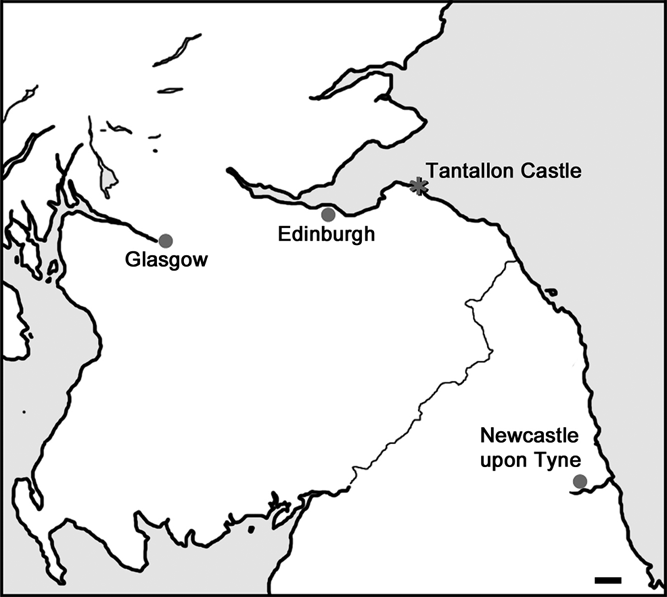
In this paper, we report a partial lower jaw of a previously unknown tetrapod from the late Tournaisian or earliest Viséan of Tantallon near North Berwick, Scotland (Fig. 1). Although it represents only a small part of the animal, it is distinctive enough to merit description as a new taxon, and adds new data and a new locality to help populate Romer's Gap.
Map showing the location of Tantallon Castle. Scale bar = 10 km.

1. Systematic palaeontology
Tetrapodomorpha Ahlberg, Reference Ahlberg1991
Tetrapoda Haworth, 1825 sensu Goodrich, Reference Goodrich1930
Family Undesignated
Genus Tantallognathus nov.
Derivation of name. After Tantallon Castle, sometime seat of the Red Douglases, near which the holotype and only specimen was collected, and the Greek gnathos, meaning jaw. Also a play on the tantalising quality of the specimen.
Type species. Tantallognathus woodi sp. nov.
Diagnosis. A stem-group tetrapod possessing a mesial lamina of the angular that sutures with the prearticular; an open and ventrally positioned lateral line sulcus on the angular; a narrow Meckelian fenestra; a surangular that lacks a distinct crest and does not carry an oral canal sulcus or pit line; a raised dorsal denticulated field on the prearticular; a concave prearticular margin to the adductor fossa; and a prearticular growth centre positioned below the middle of the adductor fossa. Differs from all other known stem-group tetrapods by combining coarsely sculpted ornament on the angular with finely striated ornament on the surangular.
Tantallognathus woodi sp. nov.
Derivation of name. In memory of Mr Stan Wood, for his outstanding contributions to the study of Carboniferous tetrapods.
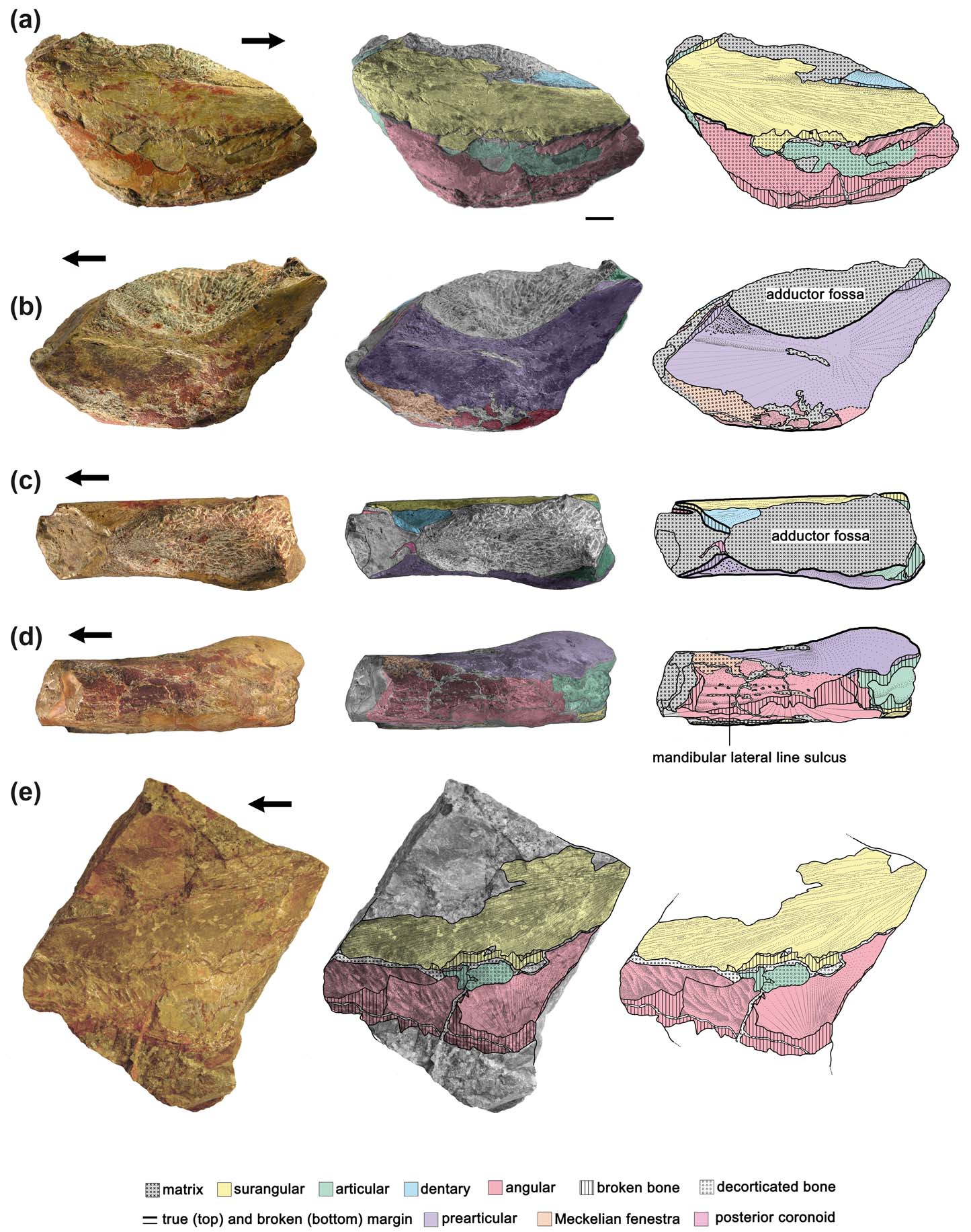
Holotype. A partial lower jaw, NMS G. 1977.43.3 (Fig. 2).
NMS G. 1977.43.3, holotype of Tantallognathus woodi, in lateral (a), mesial (b), dorsal (c), ventral (d) and counterpart of lateral (e) views. In each figure component, the image on the left shows a true colour photograph, the middle image a black and white photograph with false colour overlay identifying the bones, and the image on the right an interpretative drawing with false colour overlay. Arrows indicate anterior. Scale bar = 10 mm.

Diagnosis. As for genus.
Locality and age. Gin Head, Tantallon, near North Berwick, Scotland. Ballagan Formation, Early Carboniferous, late Tournaisian or earliest Viséan.
Remarks. NMS G. 1977.43.3 was presented to the Royal Scottish Museum (as it then was) in 1977 by Dr J. S. Richardson, Honorary Curator of Burgh Museum, North Berwick. Together with six other specimens it comprises the Whitecross Collection, presumably deriving from that museum. Locality notes with the specimens state that they were collected 800 feet due north from Tantallon Castle; in 1999, Stan Wood was able to identify the locality on the basis of the characteristic matrix – a green-coloured carbonate breccia containing argillaceous pebbles and vertebrate fragments – that attaches to the specimens. NMS G. 1977.43.3 is identified in the specimen documentation as a rhizodont jaw, a determination presumably made by Dr S. M. Andrews. The Whitecross Collection also contains a probable tetrapod ulna, NMS G. 1977.43.4, which would have been about 8 cm long when complete and thus derives from an animal similar in size to Tantallognathus (T. R. Smithson, pers. comm.).
On the foreshore at Gin Head, Tantallon [NT 5943 8531], fluvial, cross-bedded sandstone and laminated siltstone and interbedded limestone of the Ballagan Formation (formerly known as the Calciferous Sandstone Measures; Davies et al. Reference Davies, McAdam and Cameron1986), are overlain in the cliff by crudely bedded coarse volcaniclastic sedimentary rocks of the basal part of the Garleton Hills Volcanic Formation. Though the limestone containing the tetrapod element, along with bivalves, ostracods and fish teeth, is no longer exposed, substantial numbers of blocks of the lithology are present just above the high-water mark. This succession is similar to that seen at the anatomically preserved plant locality at nearby Oxroad Bay (Cleal & Thomas Reference Cleal and Thomas1995 and references therein) and can be compared to that in the East Linton Borehole 9 km to the south, where nine beds of limestone and limestone breccia, rather than dolostone (the characteristic carbonate rock in the formation), were recorded in the uppermost 27 m of the Ballagan Formation. The bed from Tantallon containing the tetrapod elements probably correlates with one of these limestones. Palynomorph sequences in the Spilmersford and East Linton boreholes, 9 km to the south and 20 km to the southwest of Tantallon, respectively, show that the upper part of the Ballagan Formation in this area lies within the Pu palynozone, indicating a possible age from latest Tournaisian to early Arundian (Neves et al. Reference Neves, Gueinn, Ioannides, Neville and Kruszewska1973; Neves & Ioannides Reference Neves and Ioannides1974; Davies et al. Reference Davies, McAdam and Cameron1986; Waters et al. Reference Waters, Somerville, Jones, Cleal, Collinson, Waters, Besly, Dean, Stephenson, Davies, Freshney, Jackson, Mitchell, Powell, Barclay, Browne, Leveridge, Long and McLean2011). This is consistent with the 40Ar/39Ar ages of c.342 Ma obtained from the Garleton Hills Volcanic Formation (Monaghan & Pringle Reference Monaghan, Pringle, Wilson, Neumann, Davies, Timmerman, Heeremans and Larsen2004).
Description. NMS G. 1977.43.3 is an incomplete right mandible that has lost most of the region anterior to the adductor fossa, as well as the posteroventral face up to and including the articular (Fig. 2). Split on the lateral side, the imprint or superficial lamina of the angular and surangular are preserved on the counterpart. The length as preserved is 10.5 cm, suggesting a total mandibular length of about 25 cm. The overall shape is notably deep and robust, with the deepest part of the ramus being level with the growth centre of the angular bone (Fig. 2a). Posterior to this point, the ventral margin of the jaw rises rapidly towards the articular, although the exact shape cannot be determined as the posterior face of the ramus has been spalled off.
Surangular. The surangular is a thin and rather featureless bone, which carries faint striated ornament (possibly composed of vascular grooves) radiating from a point near the posterior end, but shows no sign of a pit line, mandibular lateral line, or oral lateral line. The dorsal margin is essentially straight. Parallel to the striations, the dorsal margin curves inward anteriorly as a platform for the dentary to lie on. More posteriorly, this platform becomes a shallow groove to enfold the postdental process dorsoventrally and borders partially the lateral margin of the adductor fossa. The anterior portion of the surangular overlaps the angular, while the posterior ventral margin of the surangular sutures with the dorsal margin of the angular smoothly.
Dentary. Only a small portion of the posterior part of the dentary is preserved, overlapping the anterodorsal margin of the surangular. Although the natural bone surface and a short length of the dentary–surangular suture are clear, little else about the shape of this bone can be ascertained. The ornamentation is composed of fine parallel raised striations, similar to those in the lower jaw of Pederpes (Clack & Finney Reference Clack and Finney2005). The posterior end of the dentary is exfoliated; however, it is likely that the postdental process tapers to a point at the anterior one-third of the adductor fossa and is embedded into a groove of the surangular, as in many Devonian and Early Carboniferous tetrapods.
Angular. The angular is strongly sculptured on both lateral and ventral face, with a slightly sculptured mesial lamina. In ventrolateral view, part of the angular exhibits furrow-and-ridge dermal ornament that radiates from the midventral portion, which probably represents the ossification centre of the bone. The furrows bifurcate toward the dorsal margin into an irregular network. Although the anterior portion of the angular is absent, the sculpture on its external face is preserved as an imprint on the counterpart (Fig. 2e). In addition, moulds of vessels inside the angular are clearly visible on the imprint. The courses of the vessels are arranged in a radial orientation that reflects the direction of the sculpture and the growth of the bone. They are straight, almost parallel and close to each other, though branching or confluence are occasionally observed. They can be traced for a long way, interrupted by the furrows or ridges here and there. They restart from the edge of the furrows or ridges with a slightly expanded tip, which is always at the proximal end and probably represents the vascular opening on the surface. However, the vessels are running along both the furrows and ridges. This does not fit into the vascularisation pattern suggested by Witzmann et al. (Reference Witzmann, Scholz, Müller and Kardjilov2010), where the vessels are restricted to the furrows and never spread over the ridges.
Along the anteroposteriorly elongated parallel furrows on the ventral side, an almost entirely open sulcus and rows of foramina show the course of the mandibular sensory canal (Fig. 2d). This canal, similar to that of Greererpeton (Bolt & Lombard Reference Bolt and Lombard2001), divides the furrow-and-ridge radiation that extends over the ventrolateral surface of the angular from the subtle netlike ornament of the mesial lamina. In contrast to the lateral position of the canal in Devonian tetrapods, the canal of Tantallognathus is situated in a more ventral position on the angular and can hardly be seen in lateral view. The canal can only be traced backward for a short distance from the center of radiation, since the posteriormost parts of both the angular and surangular are missing.
The posterior portion of the lateral lamina of the angular contacts the surangular, whereas the anterior portion is overlapped by the surangular and separated from it by a narrow gap, so the angular–surangular suture appears to be bevelled, as that in Greererpeton. The angular is broken away about midway along its suture with the surrangular, exposing a lamina of perichondral bone of the articular that extends under both the posterior infradentaries (Fig. 2a, e). The posterior portion of the angular is split from the part and preserved on the counterpart (Fig. 2e). Thus, the interior surface is visible and courses of vessel imprints are found on it. These vessels also radiate from the centre of the bone, with vascular openings located proximally, but they are more delicate than those on the external surface.
The lateral lamina of the angular curves inward ventrally. The ventral margin of the angular wraps round onto the mesial face of the jaw, to form a small mesial lamina that contacts the prearticular. Anteriorly, there is a wide gap between the prearticular and the mesial margin of the angular, which was probably filled with a strip of Meckelian cartilage in life (Fig. 2b). Posteriorly, the Meckelian cartilage is concealed by the contact of the mesial lamina of angular and the prearticular. The contact region is obscured by a jumble of crushing, but it is likely that the angular sutures intimately with the prearticular.
Articular. The main body of the articular is lost. Two remnants of the articular are sheathed posteroventrally by the surangular and the prearticular respectively. The mesial process is much stouter but at the same level as the lateral one (Fig. 2c). They can be described as forming two plates of a posterior wall that support the surangular and the prearticular and converge at the broken end of the angular. In other words, the articular is surrounded by the surangular, angular and prearticular in ventral view (Fig. 2d). A thin anterior lamina of the articular is exposed under the damaged dorsal margin of the angular, separated from it by a thin layer of matrix (Fig. 2a).
Prearticular. The mesial face of the jaw is dominated by the prearticular (Fig. 2b). The posterior section of the prearticular is preserved as a broad lamina, which reaches back to the articular but lacks the posterior edge. The ventral border of the prearticular is smooth anteriorly and easily followed for a short distance where it forms the dorsal margin of the Meckelian fenestra. Posteroventrally, it reaches down to suture with the mesial lamina of the angular very intimately or irregularly. Due to some breakage, the prearticular–angular contact and the extent of the Meckelian bone are difficult to determine.
Similar to many Carboniferous tetrapods, the prearticular has a deeply concave dorsal margin bounding the adductor fossa, which thus faces dorsomesially rather than dorsally. The prearticular is radially ornamented by faint striations, with larger pores of vascular openings scattered over the surface. The centre of radiation for the striations is approximately level with the middle of the adductor fossa. Anterior to the radiation centre, the dorsal portion of the prearticular is developed into a denticulated ridge. A longitudinal patch of denticle bases can be seen on the anterior part of the ridge, but this is interrupted by the loss of the anterior portion of the prearticular. Posteriorly, the edge of the end of the ridge fades out ventrally. Ventral to the ridge, the prearticular is developed into a thin, smooth and flattish plate facing mesially. By contrast, the posterior part of the prearticular curves ventrolaterally and thins from the robust dorsal margin to the delicate ventral margin.
Coronoid. The only trace of the coronoid series is the cross-section of the posterior coronoid exposed in the anterior broken face of the specimen (Fig. 2b, c). It serves as a landmark to define the anterior margin of the adductor fossa. This cross-section has the form of an inverted L. The joint of the L is in the middle of the gap between the dentary and the prearticular. The horizontal short arm of the L enlarges medially becoming triangular and appears to attach loosely to the dorsal edge of the prearticular. The vertical long arm is very thin and parallel to the prearticular, and extends ventrally about half of the width of the prearticular denticle ridge at that level. No contact is observed between the cross-section of the coronoid and the dentary. The shape of the cross-section suggests a narrow coronoid that probably (by comparison with other early tetrapods: see Ahlberg & Clack Reference Ahlberg1998) carried an organised tooth row, although no teeth are preserved.
2. Morphological comparison
Comparison of Tantallognathus with known Devonian and Carboniferous tetrapod jaws (Ahlberg & Clack 19983; Bolt & Lombard Reference Bolt and Lombard2001, Reference Bolt and Lombard2006; Clack & Ahlberg Reference Clack, Ahlberg, Arratia, Wilson and Cloutier2004; Lombard & Bolt Reference Lombard, Bolt, Carrano, Blob, Gaudin and Wible2006), as well as the jaws of elpistostegid and rhizodont fishes (Ahlberg & Clack Reference Ahlberg1998; Brazeau Reference Brazeau2005), reveals a distinctive and consistent picture that is also reflected in the phylogenetic analysis (see below). The jaw can be confidently assigned to a tetrapod rather than a sarcopterygian fish, as shown by numerous characters including its overall shape, the radiating dermal ornament on the angular and surangular, the raised denticulated dorsal ridge on the prearticular, and the open lateral line sulcus on the angular.
Among tetrapods, its characteristics consistently align Tantallognathus with post-Devonian rather than Devonian taxa. The major derived characters that distinguish it from Devonian tetrapods are the open lateral line sulcus on the angular; the position of this sulcus on the ventral edge of the jaw rather than on the lateral surface; the presence of a mesial lamina of the angular; the concave dorsal margin of the prearticular, which causes the adductor fossa to face mesially as well as dorsally; and the position of the growth centre of the prearticular slightly posterior to the mid point of the adductor fossa. With the exception of the open lateral line sulcus, which is present in an angular associated with Tulerpeton (Lebedev & Clack Reference Lebedev and Clack1993), none of these characters occurs in a known Devonian tetrapod. The Devonian forms, as represented most fully by Ichthyostega, Acanthostega, Ventastega, Metaxygnathus, Densignathus and Ymeria (Ahlberg & Clack Reference Ahlberg1998; Daeschler Reference Daeschler2000; Clack et al. Reference Clack, Ahlberg, Blom and Finney2012), have partly or fully enclosed lateral line canals located on the lateral face of the angular, lack a mesial lamina of the angular, and have a prearticular with a straight dorsal margin bounding the adductor fossa and a growth centre located level with the anterior margin of that fossa.
Carboniferous tetrapod jaws show a considerable amount of variation, ranging from primitive forms such as Sigournea (Bolt & Lombard Reference Bolt and Lombard2006), Whatcheeria (Lombard & Bolt Reference Lombard, Bolt, Carrano, Blob, Gaudin and Wible2006) and Pederpes (Clack & Finney Reference Clack and Finney2005) to much more derived ones such as Megalocephalus, Gephyrostegus (Ahlberg & Clack Reference Ahlberg1998) or Pholiderpeton (Clack Reference Clack1987). The character polarities among these taxa are generally clear, but the character distributions are not highly congruent. It thus makes sense to compare these forms with Tantallognathus character by character, rather than taxon by taxon.
Surangular crest. Tantallognathus lacks a surangular crest. In this respect, it agrees with the Devonian tetrapods Whatcheeria, Sigournea and, probably, Pederpes; whereas Greererpeton and temnospondyls have low surangular crests and a strongly developed crest is present in Gephyrostegus, embolomeres and amniotes. The condition in baphetids appears to be variable (Beaumont Reference Beaumont1977; Ahlberg & Clack Reference Ahlberg1998).
Mesial lamina of the angular. The angular of Tantallognathus has a small but distinct mesial lamina that sutures with the prearticular. Such a lamina is absent in all Devonian tetrapods, as well as in Whatcheeria and Pederpes. It is present in Sigournea, Crassigyrinus, baphetids, Gephyrostegus, embolomeres, amniotes and temnospondyls (Ahlberg & Clack Reference Ahlberg1998).
Mesial lamina of the postsplenial. In Tantallognathus the postsplenial is not preserved. However, the presence of an elongate Meckelian fenestra below the prearticular, anterior to the mesial lamina of the angular, indicates that the postsplenial lacked a mesial lamina; if one had been present, it would have filled this fenestra and been preserved. A mesial lamina of the splenial is absent in all Devonian tetrapods as well as the majority of Carboniferous forms, but is characteristic of temnospondyls and baphetids (Ahlberg & Clack Reference Ahlberg1998).
Meckelian fenestra. The Meckelian fenestra of Tantallognathus is low and elongated. In this respect it agrees with the great majority of Devonian and Carboniferous tetrapods; the exceptions are Greererpeton, embolomeres and (to a lesser degree) Gephyrostegus, in which the fenstra is in some way or another expanded vertically. Tetrapods with a mesial lamina of the postsplenial (see above) by definition lack a Meckelian fenestra.
Denticulated ridge of the prearticula. A raised, denticulated ridge on the dorsal part of the prearticular is present in all known Devonian tetrapods except Ichthyostega, and in Whatcheeria, Crassigyrinus and Tantallognathus amongst known Carboniferous forms.
Concave dorsal margin of the prearticular. The dorsal margin of the prearticular that bounds the adductor fossa is essentially straight in all Devonian tetrapods. In post-Devonian forms, by contrast, it is almost invariably concave. This contributes to a shift in the orientation of the adductor fossa, from dorsal in Devonian tetrapods to dorsomesial in Carboniferous and later tetrapods; the effect is particularly marked when a surangular crest is also present, as in embolomeres or Gephyrostegus (see above). The only Carboniferous tetrapod in which the prearticular margin is not markedly concave is Sigournea.
Overall, the impression given by the Tantallon jaw is of a rather primitive Carboniferous tetrapod, somewhat more derived than Whatcheeria and Pederpes. This intuitive assessment of its morphology is borne out by the phylogenetic analysis.
3. Phylogenetic analysis
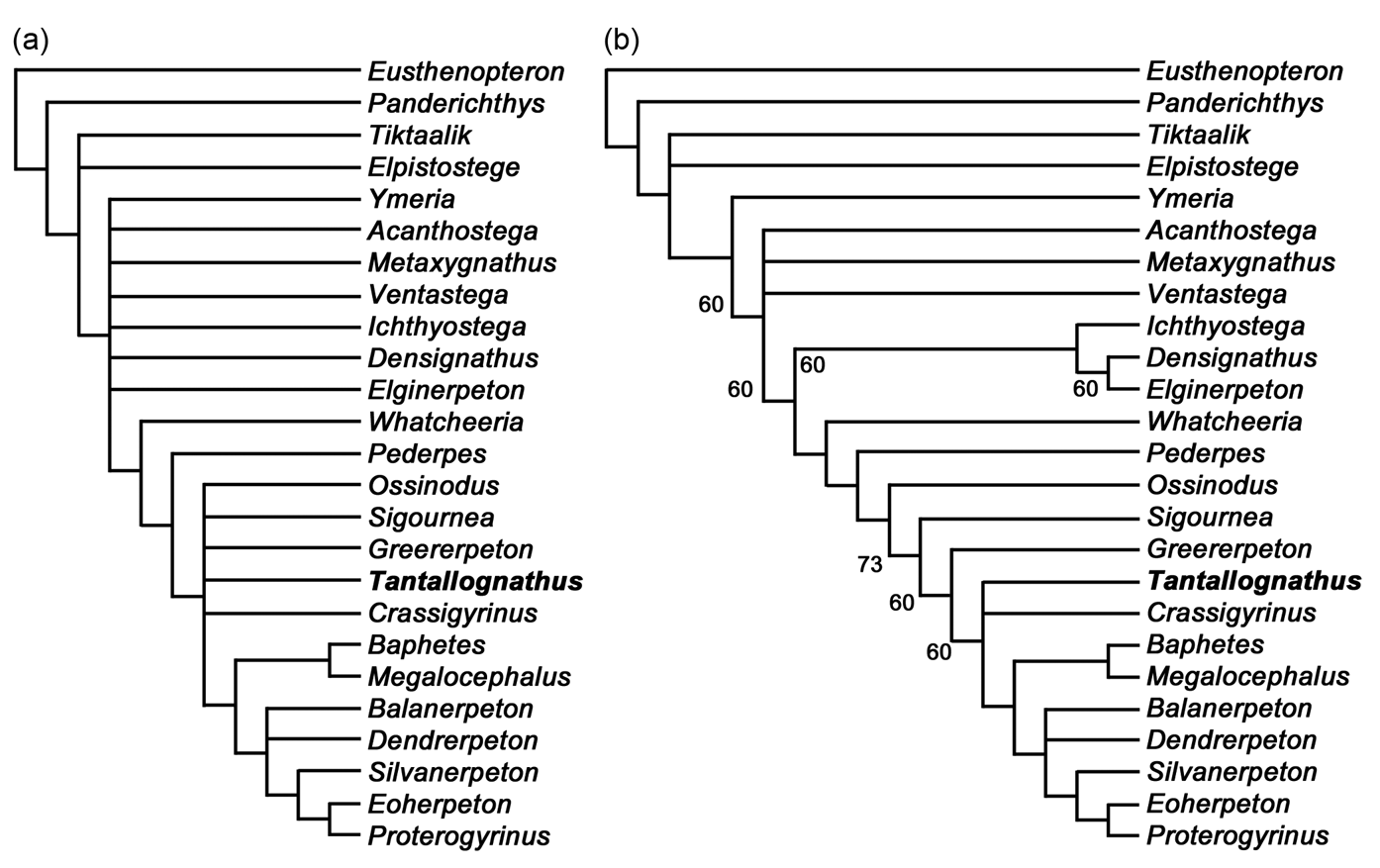
A phylogenetic analysis was performed using a data matrix modified from that in Clack et al. (Reference Clack, Ahlberg, Blom and Finney2012) (See Appendices 1 and 2 and ). The new matrix contains 109 characters scored for 25 taxa (Acanthostega, Balanerpeton, Baphetes, Crassigyrinus, Dendrerpeton, Densignathus, Elginerpeton, Elpistostege, Eoherpeton, Eusthenopteron, Greererpeton, Ichthyostega, Megalocephalus, Metaxygnathus, Ossinodus, Panderichthys, Pederpes, Proterogyrinus, Sigournea, Silvanerpeton, Tantallognathus, Tiktaalik, Ventastega, Whatcheeria and Ymeria). Analysed with PAUP* 4.0b (Swofford Reference Swofford2003), using a Branch and Bound algorithm with all characters coded as unordered and Eusthenopteron specified as the outgroup, this matrix yields 270 trees of 259 steps, with a Consistency Index of 0.517, Retention Index of 0.697 and Rescaled Consistency Index of 0.360 (Fig. 3). Resolution is relatively poor, but there is a clear separation between Devonian and post-Devonian tetrapods, as well as between elpistostegids and Devonian tetrapods. The post-Devonian tetrapods resolve into a sequence of increasingly crownward plesions, from Whatcheeria and Pederpes up to the temnospondyls (Balanerpeton and Dendrerpeton) and anthracosaurs (Silvanerpeton, Eoherpeton and Proterogyrinus), which in this analysis represent the tetrapod crown group. Ossinodus, Sigournea, colosteids, Crassigyrinus and baphetids occupy intermediate positions. The overall arrangement is strongly reminiscent of that in the preferred supertree (“Analysis II”) presented by Ruta et al. (Reference Ruta, Jeffery and Coates2013). Tantallognathus falls into an unresolved polychotomy with Ossinodus, Sigournea, Greererpeton, Crassigyrinus and baphetids + higher tetrapods (strict consensus tree) or a trichotomy with Crassigyrinus and baphetids + higher tetrapods (50 % majority rule tree).
Strict consensus tree (a) and 50 % majority rule tree (b) produced by parsimony analysis of data matrix in Appendix 2. In (b), numbers at nodes indicate the percentage of trees in which that node is recovered. Nodes without numbers are recovered in all trees.

Tantallognathus is admittedly very incomplete (15 out of 109 characters) and our phylogeny is only an approximate indicator of its likely affinities. Although we do not conduct measures of support statistics here, a post-Devonian clade is supported by a large number of transformations of which three are unambiguously distributed lower jaw characters observed in Tantallognathus: mesially facing adductor fossa (character 41, CI: 0.500); dentary not external to angular and surrangular, and lacking a chamfered edge (character 47, CI: 0.333); and the location of the prearticular centre of radiation at the level of the mid-length of the adductor fossa (character 65, CI:1.000). The highly clustered placement of Tantallognathus to the exclusion of Whatcheeria is supported by the presence of a mesial lamina of the angular suturing with the prearticular (character 43, CI: 0.400).
4. Discussion
Although the unique specimen of Tantallognathus represents only a small part of the animal, it represents a significant addition to the tetrapod fauna from the Ballagan Formation. The size of the fragment suggests a total mandibular length in the region of 25 cm, making this the largest tetrapod currently known from the formation. It is clearly distinct from, and more derived than, the slightly smaller Pederpes. Its phylogenetic position appears to be close to Crassigyrinus, but the shape of the jaw ramus is rather different – deep and robust with a sharply curved ventral margin, as against shallower with a gently curved margin in Crassigyrinus – and in fact more reminiscent of baphetids. Given the large amount of missing data, a baphetid identity for Tantallognathus is not impossible, but this would imply a considerable amount of homoplasy in the lower jaw. For the present it is best simply to note that Tantallognathus cannot be assigned to any known Carboniferous tetrapod group. The forthcoming descriptions of diverse and in some cases more complete tetrapods recently discovered in the Ballagan Formation during the TW:eed project (Smithson et al. Reference Smithson, Wood, Marshall and Clack2012) will add greatly to our understanding of Tournaisian tetrapod diversity and will hopefully help to provide a context for this intriguing jaw fragment.
5. Acknowledgements
We thank the National Museums of Scotland for the loan of NMS G. 1977.43.3. Stig Walsh (NMS) and Tim Smithson (University of Cambridge) provided valuable information about the history and provenance of the specimen. PEA gratefully acknowledges the support of an ERC Advanced Investigator Grant (233111) and a Wallenberg Scholarship (from the Knut and Alice Wallenberg Foundation), which financed DC. MDB was supported by the Fonds québecois de la recherche sur la nature et les technologies (FQRNT) bourse de maîtrise (graduate scholarship) at the time the specimen was recognised. DM publishes with the permission of the Executive Director, British Geological Survey (NERC). Two referees (John Long and Jason Anderson) provided helpful comments that helped to improve the manuscript.
6. Appendix 1. Sources and character list for phylogenetic analysis
6.1. Sources of phylogenetic codings
The principal published data sources for the phylogenetic data matrix are as follows:
Acanthostega: Clack (Reference Clack1994a, Reference Clack2002b); Coates (Reference Coates1996); Ahlberg & Clack (Reference Ahlberg1998); Callier et al. (Reference Callier, Clack and Ahlberg2009).
Balanerpeton: Milner & Sequeira (Reference Milner and Sequeira1994).
Baphetes: Beaumont (Reference Beaumont1977); Milner & Lindsay (Reference Milner and Lindsay1998).
Crassigyrinus: Panchen (Reference Panchen1985); Panchen & Smithson (Reference Panchen and Smithson1990); Clack (Reference Clack1997); Ahlberg & Clack (Reference Ahlberg1998).
Dendrerpeton: Godfrey et al. (Reference Godfrey, Fiorillo and Carroll1987); Holmes et al. (Reference Holmes, Carroll and Reisz1998); Robinson et al. (Reference Robinson, Ahlberg and Koentges2005).
Densignathus: Daeschler (Reference Daeschler2000).
Elginerpeton: Ahlberg (Reference Ahlberg1991, Reference Ahlberg1995, Reference Ahlberg1998); Ahlberg & Clack (Reference Ahlberg and Clack1998); Ahlberg et al. (Reference Ahlberg, Friedman and Blom2005b).
Elpistostege: Schultze & Arsenault (Reference Schultze and Arsenault1985).
Eoherpeton: Panchen (Reference Panchen1975).
Eusthenopteron: Jarvik (Reference Jarvik1980).
Greererpeton: Smithson (1982); Godfrey (Reference Godfrey1989); Bolt & Lombard (Reference Bolt and Lombard2001).
Ichthyostega: Jarvik (Reference Jarvik1996); Ahlberg & Clack (Reference Ahlberg and Clack1998); Clack et al. (Reference Clack, Ahlberg, Finney, Dominguez Alonso, Robinson and Ketcham2003); Ahlberg et al. (Reference Ahlberg, Clack and Blom2005a); Callier et al. (Reference Callier, Clack and Ahlberg2009).
Megalocephalus: Beaumont (Reference Beaumont1977); Ahlberg & Clack (Reference Ahlberg and Clack1998).
Metaxygnathus: Ahlberg & Clack (Reference Ahlberg and Clack1998).
Panderichthys: Vorobyeva & Schultze (Reference Vorobyeva, Schultze, Schultze and Trueb1991); Ahlberg & Clack (Reference Ahlberg and Clack1998); Brazeau & Ahlberg (Reference Brazeau and Ahlberg2006); Boisvert et al. (Reference Boisvert, Mark-Kurik and Ahlberg2008).
Pederpes: Clack & Finney (Reference Clack and Finney2005).
Proterogyrinus: Holmes (Reference Holmes1984).
Sigournea: Bolt & Lombard (Reference Bolt and Lombard2006).
Silvanerpeton: Clack (Reference Clack1994b); Ruta & Clack (Reference Ruta and Clack2006).
Tiktaalik: Daeschler et al. (Reference Daeschler, Shubin and Jenkins2006); Shubin et al. (Reference Shubin, Daeschler and Jenkins2006, Reference Shubin, Daeschler and Jenkins2014); Downs et al. (Reference Downs, Daeschler, Jenkins and Shubin2008); Callier et al. (Reference Callier, Clack and Ahlberg2009).
Ventastega: Ahlberg et al. (Reference Ahlberg, Lukševičs and Lebedev1994, Reference Ahlberg, Lukševičs, Blom and Zupiņš2008); Ahlberg & Clack (Reference Ahlberg and Clack1998).
Whatcheeria: Lombard & Bolt (1995, 2006).
Ymeria: Clack et al. (Reference Clack, Ahlberg, Blom and Finney2012).
6.2. Character list
skull roof, palate
1. Anterior tectal/septomaxilla: anterior tectal (external bone, dorsal to nostril) = 0; septomaxilla (external or internal bone, posterior to nostril) = 1; absent = 2
2. Ectopterygoid /palatine exposure: more or less confined to tooth row = 0; broad mesial exposure additional to tooth row = 1
3. Ectopterygoid reaches subtemporal fossa: no = 0; yes = 1
4. Frontal: absent = 0; present = 1
5. Intertemporal: present = 0; absent = 1
6. Jugal: does not extend anterior to orbit = 0; extends anterior to orbit = 1
7. Lacrimal: contributes to orbital margin = 0; excluded from margin = 1 (Note: this character has been scored as “?” for baphetids because it isn't clear whether the anterior “keyhole” extension of the orbit (see also character 86) should be considered equivalent to the anteroventral margin of the orbit in other taxa.)
8. Lateral rostral present: yes = 0; no = 1
9. Maxilla makes interdigitating suture with vomer: no = 0; yes = 1
10. Maxilla external contact with premaxilla: narrow contact point not interdigitated = 0; interdigitating suture = 1
11. Maxilla extends behind level of posterior margin of orbit: yes = 0 no = 1
12. Median rostral: single = 0; paired = 1; absent = 2
13. Opercular: present = 0; absent = 1
14. Prefrontal: twice as long as broad, or less = 0; three times as long as broad or more = 1
15. Prefrontal: transverse anterior suture with tectal = 0; tapers to point anteriorly = 1
16. Preopercular: present = 0; absent = 1
17. Pterygoids separate in midline = 0; meet in midline anterior to cultriform process = 1
18. Pterygoid quadrate ramus margin in subtemporal fossa: concave = 0 with some convex component = 1
19. Vomers separated by parasphenoid>half length: yes = 0; no = 1
20. Vomers excluded from margin of interpterygoid vacuity: yes = 0; no = 1
21. Vomers nearly as broad as long, or broader = 0; about twice as long as broad, or longer = 1
braincase
22. Basipterygoid process: not strongly projecting with concave anterior face = 0; strongly projecting with flat anterior face = 1
23. Ethmoid: fully ossified = 0; partly or wholly unossified = 1
24. Hypophysial region: solid side wall pierced by small foramina for pituitary vein and other vessels = 0; single large foramen = 1
25. Otic capsule: lateral commissure bearing hyomandibular facets: present = 0; absent = 1
26. Parasphenoid: does not overlap basioccipital = 0; overlaps basioccipital = 1
27. Parasphenoid: denticulated field: present = 0; absent = 1
28. Sphenoid: fully ossified, terminating posteriorly in intracranial joint or fused to otoccipital = 0; separated from otoccipital by unossified gap = 1
palatal dentition
29. Ectopterygoid fang pairs: present = 0; absent = 1
30. Ectopterygoid row (3+) of smaller teeth: present = 0; absent = 1
31. Ectopterygoid / palatine shagreen field: absent = 0; present = 1
32. Maxilla tooth number: >40 = 0; 30-40 = 1; <30 = 2
33. Palatine row of smaller teeth: present = 0; absent = 1
34. Pterygoid shagreen: dense = 0; a few discontinuous patches or absent = 1
35. Premaxillary tooth proportions: all approximately same size = 0; posteriormost teeth at least twice height of anteriormost teeth = 1
36. Vomerine fang pairs: present = 0; absent = 1
37. Vomerine fang pairs noticeably smaller than other palatal fang pairs: no = 0; yes = 1
38. Vomer anterior wall forming posterior margin of palatal fossa bears tooth row meeting in midline: yes = 0; no = 1
39. Vomerine row of small teeth: present = 0; absent = 1
40. Vomerine shagreen field: absent = 0; present = 1
lower jaw
41. Adductor fossa faces dorsally = 0; mesially = 1
42. Adductor crest: absent = 0; peak anterior to adductor fossa, dorsal margin of fossa concave = 1; peak above anterior part of adductor fossa, dorsal margin of fossa convex = 2
43. Angular – prearticular contact: prearticular contacts angular edge to edge = 0; absent = 1; mesial lamina of angular sutures with prearticular = 2
44. Coronoid (anterior) contacts splenial: no = 0; yes = 1
45. Coronoid (posterior) posterodorsal process: no = 0; yes = 1
46. Coronoid (posterior) posterodorsal process visible in lateral view: no = 0; yes = 1
47. Dentary external to angular + surangular, with chamfered ventral edge and no interdigitations: no = 0; yes = 1
48. Dentary ventral edge: smooth continuous line = 0; abruptly tapering or ‘stepped' margin = 1
49. Mandibular sensory canal: present = 0; absent = 1
50. Mandibular canal exposure: entirely enclosed, opens through lines of pores = 0; mostly enclosed, short sections of open grooves = 1; mostly open grooves, short sections opening through pores = 2; entirely open = 3
51. Mandible: oral sulcus/surangular pit line: present = 0; absent = 1
52. Meckelian bone floors precoronoid fossa: yes = 0; no = 1
53. Meckelian bone ossified in middle part of jaw: yes = 0; little or no ossification = 1
54. Meckelian foramina/ fenestrae, dorsal margins formed by: Meckelian bone = 0; prearticular = 1; infradentary = 2
55. Meckelian foramina/ fenestrae, height: much lower than adjacent prearticular = 0; equal to or greater than depth of adjacent prearticular = 1
56. Adsymphysial lateral foramen present: no = 0; yes = 1 (Note: in this character list we implement a terminology change from “parasymphysial” to “adsymphysial” for the small dermal bone that lies anterior to the coronoid series, and the foramina that are associated with its posterior end. This reflects a conclusion, based on the study of early osteichthyan jaws such as those of porolepiforms and Psarolepis, that their tooth-whorl-bearing parasymphysial plates are probably not homologous with the adsymphysial plates of tetrapodomorphs.)
57. Adsymphysial mesial foramen present: no = 0; yes = 1
58. Postsplenial with mesial lamina: no = 0; yes = 1
59. Postsplenial pit line present: yes = 0; no = 1
60. Postsplenial suture with prearticular present: no = 0; yes, but interrupted by Meckelian foramina or fenestrae = 1; uninterrupted suture = 2
61. Prearticular sutures with surangular: no = 0; yes = 1
62. Prearticular sutures with mesial lamina of splenial: no, mesial lamina of splenial absent = 0; yes = 1; no, mesial lamina of splenial separated from prearticular by postsplenial = 2
63. Prearticular with longitudinal ridge below coronoids: no = 0; yes = 1
64. Prearticular with mesially projecting flange on dorsal edge along posterior border of adductor fossa: no = 0; yes = 1
65. Prearticular centre of radiation of striations: level with posterior end of posterior coronoid = 0; level with middle of adductor fossa = 1; level with posterior end of adductor fossa = 2
66. Splenial has free ventral flange: yes = 0; no = 1
67. Splenial, rearmost extension of mesial lamina: closer to anterior end of jaw than to adductor fossa = 0; equidistant = 1; closer to anterior margin of adductor fossa than to the anterior end of the jaw = 2
lower jaw dentition
68. Coronoids: at least one has fang pair recognisable because at least twice the height of coronoid teeth: yes = 0; no = 1
69. Coronoids: at least one has fangs recognisable because noticeably mesial to vertical lamina of bone and to all other teeth: yes = 0; no = 1
70. Coronoids: at least one has organised tooth row: yes = 0; no = 1
71. Coronoids: at least one carries shagreen: no = 0; yes = 1
72. Coronoids: size of teeth (excluding fangs) on anterior and middle coronoids relative to dentary tooth size: about the same = 0; half height or less = 1
73. Dentary teeth: same size as maxillary teeth = 0; larger than maxillary teeth = 1; smaller than maxillary teeth = 2
74. Dentary with a row of very small teeth or denticles lateral to tooth row: yes = 0; no = 1
75. Adsymphysial tooth plate: present = 0; absent = 1
76. Adsymphysial plate dentition: shagreen or irregular tooth field = 0; organised dentition aligned parallel to jaw margin = 1; no dentition = 2
77. Adsymphsial plate has fang pair: no = 0; yes = 1
78. Adsymphysial plate has tooth row: no = 0; short tooth row, separated from coronoid tooth row by diastema = 1; long tooth row reaching coronoid = 2
79. Prearticular shagreen field, distribution: gradually decreasing from dorsal to ventral = 0; well defined dorsal longitudinal band = 1; scattered patches or absent = 2
general skull characters
80. Anterior palatal fenestra: single = 0; double = 1; absent = 2
81. Dorsal fontanelle on snout: absent = 0; present = 1
82. Interpterygoid vacuities: absent = 0; at least 2×longer than wide = 1; <2×longer than wide = 2
83. Intracranial joint: present in dermal skull roof = 0; absent = 1
84. Nature of dermal ornament: tuberculate = 0; fairly regular pit and ridge = 1; irregular = 2; absent or almost absent = 3
85. Nature of ornament: ‘starbursts' of radiating ornament on at least some bones: no = 0; yes = 1
86. Keyhole-shaped orbits
postcranium
87. Anocleithrum: oblong with distinct anterior overlap area = 0; drop-shaped with no anterior overlap area = 1; absent = 2
88. Cleithrum: ornamented = 0; not ornamented = 1
89. Cleithrum, postbranchial lamina: present = 0; absent = 1
90. Digits: absent = 0; present = 1
91. Humerus: narrow tapering entepicondyle = 0; square or parallelogram-shaped entepicondyle = 1
92. Pectoral process of humerus: absent = 0; present = 1
93. Proximal limb of oblique ridge of humerus: present, separated from anterior margin of humerus by prepectoral space = 0; absent, replaced by deltopectoral crest = 1
94. Latissimus dorsi attachment of humerus: diffuse ridged area = 0; distinct process = 1
95. Foramina piercing oblique ventral ridge of humerus: many = 0; one moderately large foramen in addition to entepicondylar foramen = 1; entepicondylar foramen is the only large opening – other foramina are tiny pinpricks or absent = 2
96. Ilium, iliac canal: absent = 0; present = 1
97. Ilium, posterior process: oriented posterodorsally = 0; oriented approximately horizontally posteriorly = 1
98. Interclavicle: small and concealed or absent = 0; large and exposed = 1
99. Interclavicle shape: ovoid = 0; kite-shaped = 1; with posterior stalk = 2
100. Lepidotrichia in paired appendages: present = 0; absent = 1
101. Posttemporal+supracleithrum: present = 0; absent = 1
102. Radius and ulna: radius much longer than ulna = 0; approximately equal length = 1
103. Ribs, trunk: no longer than diameter of intercentrum = 0; longer = 1
104. Ribs, trunk: all straight = 0; at least some curving ventrally = 1
105. Ribs, trunk: all cylindrical = 0; some or all bear flanges from posterior margin which narrow distally = 1; some or all flare distally = 2
106. Scapular blade: absent = 0; small with narrow top = 1; large with broad top = 2
107. Scapulocoracoid: small and tripodal = 0; large plate pierced by large coracoid foramen = 1; very large plate without large coracoid foramen = 2
108. Subscapular fossa: broad and shallow = 0; deeply impressed posteriorly = 1
109. Squamation: complete body covering of scales, all similar = 0; ventral armour of gastralia = 1
7. Appendix 2. Data matrix

8. Supplementary material
The NEXUS matrix file supporting the phylogenetic analysis is provided as Supplementary Material with the online version of this paper (Chen et al. ). This is hosted by Cambridge Core and can be viewed at http://journals.cambridge.org/tre