INTRODUCTION
CO2 emitted during the combustion of fossil fuels (Suess Reference Suess1955) contains no 14CO2 and is depleted in 13CO2. Trees assimilate CO2 via stomata in their leaves. Carbon isotopes are not retranslocated after fixation into the structure of the needle (when the growth process is over) (Barszczowska and Jędrysek Reference Barszczowska and Jędrysek2005). Due to a mixture of CO2 originating from different sources, variations in 14C and 13C in atmospheric carbon dioxide can be reflected in the isotopic composition of trees (Suess Reference Suess1955; Keeling Reference Keeling1973; Rakowski Reference Rakowski2011; Pazdur et al. Reference Pazdur, Kuc, Pawełczyk, Piotrowska, Sensuła and Różański2013). Moreover, gaseous and dust air contaminants associated with different human activities, such as industry, road transport, low and high-stack emission, may impact the photosynthesis rate (A) and stomatal conductance (g s), which indicate leaf transpiration and affect the water use efficiency (WUE), which is defined as the relation between water used to fix the carbon. Intrinsic WUE (iWUE) relates photosynthesis to the stomatal conductance of water. Physiological responses of trees to the air pollution is usually connected with changing the stomata conductivity and photosynthesis rate, which results in higher δ13C values in tree rings and leaf tissues. The photosynthesis rate and the conductivity of the stomata can be influenced by many factors: climatic (temperature, drought increase) and anthropogenic (e.g., an increase in SO2 and O3 reduces conductivity and at the same time inhibits the photosynthesis process, while the photosynthesis rate may be increased during short-term exposure to increased NOx concentration (Cherubini et al. Reference Cherubini, Battipaglia and Innes2021). The impact of pollutants in the most industrialized part of Poland, Silesia, on the tree conditions, including changes in the width of annual tree growth and changes in the isotopic and elemental composition of annual shoots and pine (Pinus Sylvestris L.) wood, has been the subject of previous studies (for example: Sensuła et al. Reference Sensuła, Wilczynski and Opala2015, Reference Sensuła, Michczyński, Piotrowska and Wilczyński2018, Reference Sensuła, Fagel and Michczyński2021; Piotrowska et al. Reference Piotrowska, Pazdur, Pawełczyk, Rakowski, Sensuła and Tudyka2020). Analyses made in the last decade have shown a high concentration of 14C in Silesia (higher concentration than those of “clean” air, as well as variations in the carbon isotopic composition of plants, water use efficiency, and elemental composition.
During our investigations in 2012–2014 in Silesia (Sensuła et al. Reference Sensuła, Wilczynski and Opala2015, Reference Sensuła, Michczyński, Piotrowska and Wilczyński2018, Reference Sensuła, Fagel and Michczyński2021), we noted a higher radiocarbon concentration in foliage and tree rings in pine trees grown in the forests in the industrial area of Silesia compared with the concentration in clean air based on data from Jungfraujoch (Hammer et al. Reference Hammer and Levin2017); this phenomenon has not been explained yet and requires more detailed analysis of the carbon cycle in this area. We cannot exclude underestimation of the Suess effect for all investigated sites. Many factors affect biological and physical processes controlling the carbon cycle, for example heterotrophic respiration, biomass burning, oceanic CO2 sources, and nuclear-industry-produced 14C. In the Silesia we can exclude the two latter ones, however, CO2 emissions from biomass burning may be most important. The burned biomass is enriched in 14C compared to the background. In particular, the wood growing in the time of the 14C bomb-peak (ca. 50 years old) may add considerable 14C load to the local carbon cycle. In the investigated area the biomass has been used for heating the houses and cooking by householders, and also used in industrial sector. Burning of 14C-enriched biomass may suppress the Suess effect, thus the results showed a similar Δ14C value as Jungfraujoch, however, we are lacking the detailed statistical data for the Silesia.
In this study, we assessed the characteristics of pine needles exposed to multi-source pollution in Silesia and determined their carbon isotopic composition, WUE, and trace element concentrations in pine needles to verify the homogeneity of data obtained at 10 sampling sites near the heat and power plant in Laziska, roads, and houses.
MATERIALS AND METHODS
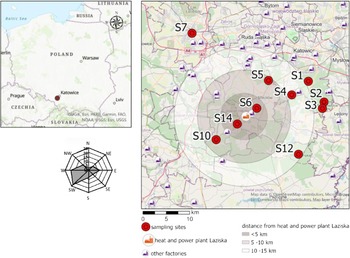
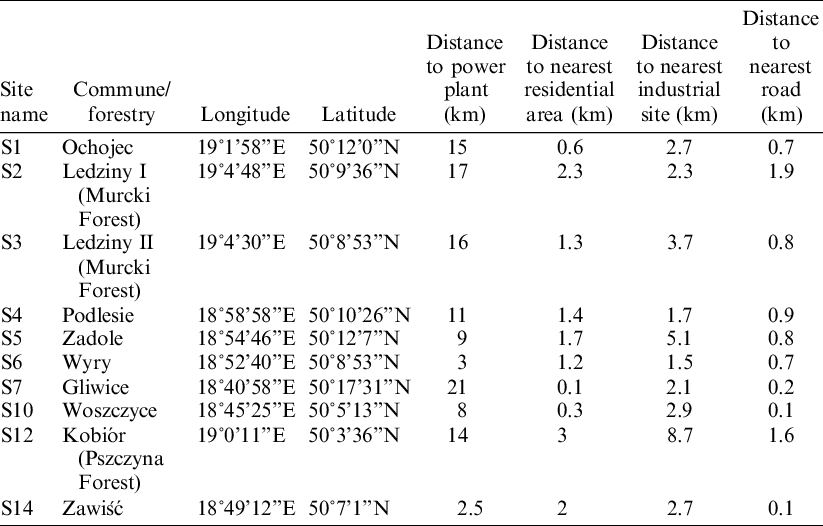
The sampling sites were located near the heat and power plant Łaziska (HPP Łaziska) in a multi-source pollution industrial area (Figure 1; Table 1). Two of these sampling sites (S4 and S5) were the same as those investigated in 2012–2014 (Sensuła et al. Reference Sensuła, Fagel and Michczyński2021). In this study, pines growing at 10 sampling sites located at different distances from factories, roads, and households were investigated. Nine of them were located (S1, S2, S3, S4, S5, S6, S10, S12, S14) at distances of 2 to ca. 20 km from HPP Łaziska. The sampling sites were selected to be near the streets and considering the direction of the dominant southwestern winds. Sites S10 and S5 are located close to the road no. 81 (on the west of the road), site S14 is located close to the route no. 81 (on the east of the road), site S1 is located close to the road no. 86 (on the west of the road) and site S3 is located close to the road S1 (on the north of the road). A comparative site (S7) was located in Gliwice nearby road no. 902. Sites S2 and S12 were located deep in the forests: Lasy Murckowskie and Lasy Pszczyńskie, respectively. Samples of one-year-old needles that began growing in 2020 were collected in April 2021, on the same day to avoid weather influences. Needles were collected from the tree crowns of 20-year-old Scots pine (Pinus Sylvestris L.), placed in plastic bags, and separated manually in the laboratory.
Sampling sites and localization of the factories in the investigated area (the location of other factories is based on data from gugik.gov.pl).

Sampling site locations in the Silesia region.

Carbon Isotope Analysis
The dried needles were extracted using a Soxhlet column to remove waxes and resins with the following solvents: Toluene (100ºC, 4 hr), ethanol (100ºC, 4 hr), and water (100ºC, 4 hr). Next, the samples were rinsed in hot water until they were neutralized and dry. α-Cellulose was extracted by applying procedures based on Green’s method (1963) used in the mass spectrometry laboratory of the Silesian University of Technology (Pazdur et al. Reference Pazdur, Kuc, Pawełczyk, Piotrowska, Sensuła and Różański2013; Sensuła and Pazdur Reference Sensuła and Pazdur2013). Old wood (“Olga”) to be used as the background material was subjected to the same α-cellulose extraction procedure. δ13C was determined at the mass spectrometry laboratory of the Silesian University of Technology using an Isoprime continuous-flow isotope ratio mass spectrometer (GV Instruments, Manchester, UK). The standard deviation of the repeated analysis of internal standards (C-3 and C-5, IAEA) was better than 0.2‰.
The relative deviation of the isotopic composition is expressed in parts per thousand (‰, VPDB) as:
 $${\rm \delta} = \left( {{R_{\rm sample}}/{R_{\rm standard}} - 1} \right)\cdot1000$$
The intrinsic WUE, which is directly linked to the ratio of intercellular (c i)-to-atmospheric (c a) CO2 (c i/c a), was calculated according to the equations:
 $$\Delta {}_{}^{13}{C_{cel}} = ({{\delta {}_{}^{13}{C_{air}} - \delta {}_{}^{13}{C_{cel}}){\rm{\;}}} \over {1 + {{\delta {}_{}^{13}{C_{cel}}} \over {1000}}}}$$
Thus,
 $${}_i^{}WUE = {A \over {{g_s}}} = {{ca - ci} \over {1.6}} = {c_a}{{b - \Delta {}_{}^{13}{C_{cel}}} \over {1.6\left( {b - a} \right)}}$$
where δ13Ccel is the carbon isotope composition of plant cellulose, and δ13Cair is the carbon isotope composition of the air; a is the isotope fractionation during CO2 diffusion through stomata (4.4‰); b is the isotope fractionation during fixation by RuBisCO (27‰). The iWUE (intrinsic water-use efficiency) was derived from the carbon isotope composition of the needles and carbon isotope composition of atmospheric CO2, where 1.6 is the molar diffusivity ratio of CO2-to-H2O (i.e., g CO2 = g H2O/1.6).
According to NOAA (NOAA 2021) the mean CO2 concentration in the air based on the monthly average between May 2020 and April 2021, when the needles were growing, was 412 ppm. A δ13C level of –8.47‰ was calculated based on Graven’s model (Graven et al. Reference Graven, Allison, Etheridge, Hammer, Keeling, Levin, Meijer, Rubino, Tans, Trudinger, Vaughn and White2017).
Graphite for AMS radiocarbon measurements was prepared using an AGE-3 system (Wacker et al. Reference Wacker, Nemec and Bourquin2010). Subsamples of ca. 3 mg of extracted α-cellulose were packed into tin boats and combusted in a Vario Micro Cube (ElementarTM) elemental analyzer. The CO2 in a 1 mg sample of carbon was reduced by reaction with H2 in the presence of a Fe catalyst at 580ºC. Oxalic Acid II (NIST SRM4990C), which was used as a modern reference material and background material, was prepared in the same manner. 14C concentrations were determined at the Poznan Radiocarbon Laboratory, Poland (Goslar et al. Reference Goslar, Czernik and Goslar2004).
The carbon modern fraction, F14C or Δ14C value (‰), was calculated according to the equation below (van der Plicht and Hogg Reference van der Plicht and Hogg2006):
 $${\Delta ^{14}}{\rm{C}} = \left( {{{\rm{F}}^{14}}{\rm{C}}.\,{{\rm{e}}^{ - {\rm{ }}\lambda (Ti - 1950)}}-1} \right).{\rm{ }}1000$$
where: F14C is normalized radiocarbon concentration; λ is decay constant for radiocarbon isotope equal to 8267yr–1; T i is calendar year.
The blank for “Olga” α-cellulose was 0.86 ± 0.05 pMC, which is higher than the usual coal blank value of 0.3 pMC obtained by the Gliwice AMS Laboratory. This was caused by elaborate multi-step chemical treatment of the material; however, for modern samples, the difference in the pMC value calculated using two blanks was negligible (< 0.01 pMC).
ICP-AES Analysis
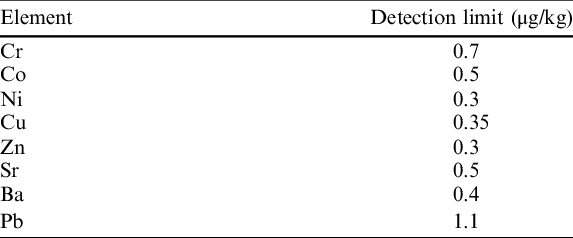
The dried and ground (fraction size: 0.1 mm) needles were mineralized in a 65% solution of nitric acid (HNO3) and 37% solution of hydrochloric acid (HCl) in a 1:4 proportion using a UniClever microwave mineralizer (Ayrault, Reference Ayrault2005). The process was repeated twice for each sample (for replication purposes). The prepared solutions were subjected to Cr, Co, Ni, Cu, Zn, Sr, Ba, and Pb analysis using a JY 2000 – Sequential ICP-AES spectrometer (Jobin Yvon). The repeatability of measurements was controlled by replicating the preparations and measurements for each sample twice. Additional analyses for sample S1-1 were duplicated to verify if the instrument was correctly calibrated. The results of duplication and variability were satisfactory for each element (RSD < 10%), meaning that the spectrometer provided reliable and repeatable data. The detection limits are shown in Table 2.
Detection limits for ICP-AES, JY 2000.

RESULTS AND DISCUSSION
δ13C
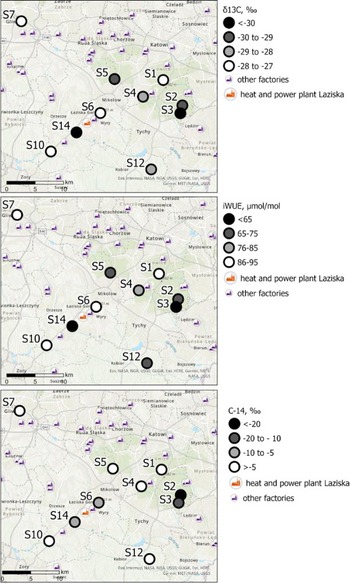
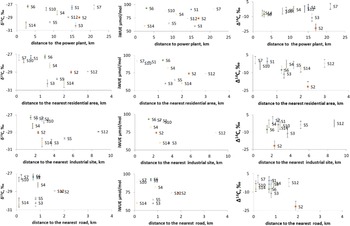
Variations in the isotopic composition of the pine needles may be due to fossil fuel combustion and the mixing of CO2 in the atmosphere. The higher CO2 concentration affects δ13C and thus iWUE. The result of the “blending” of carbon isotopes origin from different sources is depletion of δ13C in atmospheric CO2 and in the biosphere. According to Zimnoch et al. (Reference Zimnoch, Jelen, Galkowski, Kuc, Necki, Chmura, Gorczyca, Jasek and Różański2012), in southern Poland the δ13C in coal is ∼ –24‰, and in petroleum products in gasoline is ∼ –31‰. Althought the observeation made by Kawashima and Haneishi (Reference Kawashima and Haneishi2012) who δ13C linked to suspended particulate matter from biomass combustion (C3 plants) shown that could varied between –35 to –28‰, there is little chance that the observed variability of δ13C in needle cellulose arises from aerosols deposited on the surface of the needles, but the CO2 origin from biomass compustion in this region cannot be excluded. In 2008, Górka et al. (Reference Górka, Sauer, Lewicka-Szczebak and Jędrysek2011), had noted that δ13C in gasoline car was –31.7‰, in diesel car was –31.9‰, in liquid petroleum gas car was –33.5‰, in coal burning chimney was –24.1‰, in wood burning chimney was –28.1‰ and in natural gas burning chimney was –29.8‰, respectively. In 2021, we have observed that the δ13C in pine needles fluctuate between –30.2 to –27.3‰. The spatial distribution of δ13C in pine needles can be associate with emission of carbon dioxide connected with different human activities (Figure 2b).
Top image: Spatial variation in the stable carbon isotopic composition of the one-year-old pine needles collected in Silesia in 2021; middle image: spatial variation in iWUE of the one-year-old pine needles collected in Silesia in 2021; bottom image: spatial variation in the 14C of the one-year-old pine needles collected in Silesia in 2021.

Spatial variation in the carbon isotopic composition and iWUE of the one-year-old pine needles collected in Silesia in 2021.

Less negative δ13C (∼ –27‰) values have been observed in pine growing close to the edge of the forests and near to the residential area (S7, S10, S1, S6). We cannot exclude that in the residential area not only coal but also biomass may be used by citizens during cooking and heating houses. A distance between these sampling sites and the nearest residential area is less than 1.5 km. The most negative δ13C (∼ –30‰) values was observed in S14, S3, and S5 located close to the edge of the forests and near the road (less than 1 km) and farther from residential area (1.5–2.5 km). In site S4, it has been observed that carbon dioxide can origin from different sources. This site is at the same distance from the nearest road and residential area as S3, however this site is nearer to the nearest industrial factory. Despite the fact that the site S7 has been very close to the street, the effect of gasoline combustion by cars has not been observed in δ13C in trees growing there. It can be associated with a fact that the pines, at S7, grow behind a sound screen, which can be an important barrier not only for the noise but also for distribution of contamination emitted by traffic. In the investigated area we cannot observe a direct link between variation in δ13C in pines and distance from power plant to sampling stands (Figures 3a and 3b). That can be due to a fact that most of the industrial factories have been implemented pro-ecological policy since the 1990s. Detailed spatial analysis showed that the variation in δ13C in pines may be linked with other human activities such as residential heating and cooking, including not only coal but also biomass combustion or road traffic and petroleum and gas combustion.
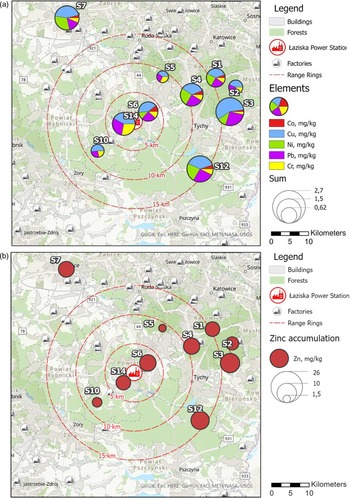
(a) Accumulation of Cr, Co, Ni, Pb, and Cu in Pinus Sylvestris L. needles located different distances from pollution emitters (Łaziska Power Plant, other industrial sites, and residential areas). (b) Accumulation of Zn in Pinus Sylvestris L. needles located different distances from pollution emitters (Łaziska Power Plant, other industrial sites, and residential areas).

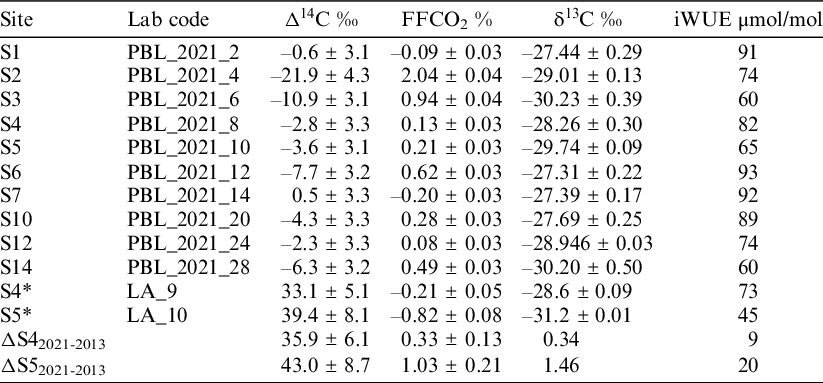
δ13C in pine growing in the sampling sites located deep in the forest (S2,S12) was equal to –29‰. This value may be probably a result of the “blending” of carbon isotopes origin from different sources. In this moment it cannot be excluded, another hypothesis, that these sampling sites are too far from potential local emitters, to record local signal connected householders and traffic, and these δ13C values could be associated with long-range transport of air contamination and deplation of δ13C in the atmopshere. δ13C values in the needles of pines depend on time and localization of the sampling sites. The stomata co-regulate the influx of CO2 for photosynthesis and the transpirational loss of water to the atmosphere. According to Asseng (Asseng et al. Reference Asseng, Ewert, Martre, Rötter, Lobell, Cammarano, Kimball, Ottman, Wall and White2015), the increasing CO2 may positively impact the δ13C and iWUE of C3 species. (In the tree rings, an increase in iWUE has been noted at the local and global scales since the 1960s, which implies an associated modification to the local carbon and/or hydrological cycles [Loader et al. Reference Loader, Walsh, Robertson, Bidin, Ong, Reynolds, McCarroll, Gagen and Young2011]). In Silesia, the level of iWUE in pine needles was between 44 and 73 µmol/mol in 2012 (the needles created in 2012 and collected in January 2013), between 45–66 µmol/mol in 2013 (the needles created in 2013 and collected in September 2013), and 46–81 µmol/mol in 2014 (the needles created in 2014 and collected July 2014) (Sensuła Reference Sensuła, Wilczynski and Opala2015). In Silesia in 2021, we have noted that iWUE is not constant and iWUE ranged from ca. 60 (S3, S5, S14) to ca. 90 µmol/mol. The lowest iWUE value was observed in sites (S3, S5 and S14) located in close approximetly to the streets and the highest iWUE value in the sites localizated near the residential area (S1, S6, S7, S10).
Radiocarbon
The samples had a consistent average carbon content of 44%. The Δ14C values were calculated for 2020. A high variation of Δ14C was observed from –21.9‰ to +0.5‰ (Table 3). The 14C concentration in “clean air” was estimated to be Δ14CJFJ = –1.5 ± 0.48‰, based on data from Jungfraujoch (Emmenegger et al. Reference Emmenegger, Leuenberger and Steinbacher2021) extrapolated to 2020. Most of the investigated sites (except for sites S1 and S7) have lower Δ14C than Δ14CJFJ, indicating a local Suess effect. The fraction of fossil carbon (FFCO2) calculated according to Piotrowska et al. (Reference Piotrowska, Pazdur, Pawełczyk, Rakowski, Sensuła and Tudyka2020) increased from –0.2 to +2% and was +0.45 ± 0.62% on average. These values are consistent with FFCO2 obtained for pine needles growing near the Laziska power plant in AD 2013: –0.21 ± 0.05% for S4 and –0.82 ± 0.08 for S5 (Sensuła et al. Reference Sensuła, Michczyński, Piotrowska and Wilczyński2018). Also, the FFCO2 determined for the tree rings around Gliwice City for AD 2008–2012 ranged from –0.23 to +0.89% (Piotrowska et al. Reference Piotrowska, Pazdur, Pawełczyk, Rakowski, Sensuła and Tudyka2020). At some sampling sites, Δ14C seems to be higher than the Δ14C concentration in clean air in the Alps. A similar effect was observed in this region in 2012–2014 (Sensuła et al. Reference Sensuła, Fagel and Michczyński2021) and for some sites near Gliwice city (Piotrowska et al. Reference Piotrowska, Pazdur, Pawełczyk, Rakowski, Sensuła and Tudyka2020).
The carbon isotope results of 1-year-old pine needles grown in 10 sampling sites (S1, S2, S3, S4, AS5, S6, S7, S10, S12, S14) in a multi-point air pollution source area in Silesia in 2021. The data of the previous analysis (Sensuła at al. 2018, 2021) of 1-year-old pine needles formed in 2012 collected in 2013 (winter) and growing in S4 and S5 are marked by *, year-to-year differences in carbon isotopic composition of the needles is marked as Δ.

Elemental Analysis
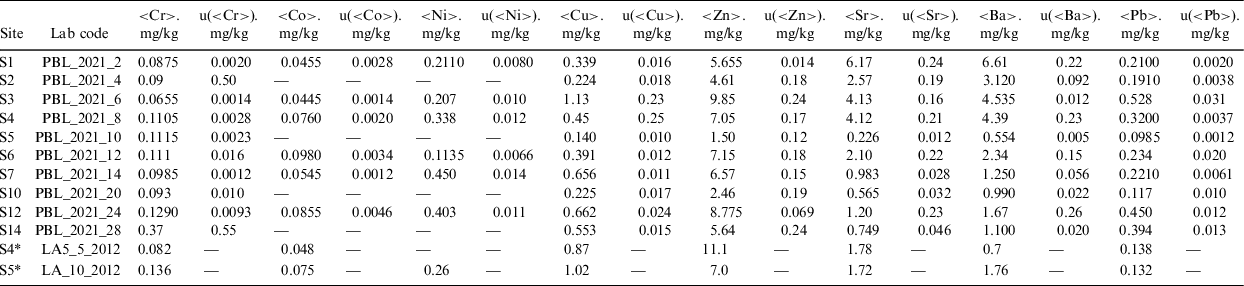
The average concentrations of heavy metals in collected samples are presented in Table 4. These concentrations followed the order Zn > Cu > Pb > Cr, which was consistent with a previous study performed for the Silesian industrial region (Sensuła et al. Reference Sensuła, Fagel and Michczyński2021). In this study, high concentrations of Cu, Ni, and Pb were obtained in all samples, indicating that the Silesian region is characterized by unfavorable air conditions in terms of plant health. Especially high concentrations of Zn, Cu, and Pb were obtained at sites S3, S4, and S12 (up to 237% concentration relative to the mean obtained in the whole study for a given element) (Table 4). The concentrations of the elements measured in pin needles were lower than results of the research by Pietrzykowski et al. in 2009 (Pietrzykowski et al. Reference Pietrzykowski, Socha and van Doornd2014), in which the average heavy metal concentrations in pine needles were as follows: Zn from 33 to 77 mg/kg, Cu from 3.0 to 28 mg/kg, and Pb from 0.8 to 3.2 mg/kg. The results of studies conducted by other authors vary greatly, and the metal content depends on the species of needle and the region, for example in Poland (Gamrat and Ligocka Reference Gamrat and Ligocka2018) in three research areas: Świeradów Zdrój, Świnoujście, Byszyno, Zn range from 46.29 mg/kg to 151.72 mg/kg, Pb range from 0.05 mg/kg to 2.96 mg/kg, Cr from 2.38 mg/kg to 6.18 mg/kg, Ni from 4.22 mg/kg to 36.53 mg/kg, Co from 0.04 mg.kg to 0.65 mg/kg. In another study, the concentrations of heavy metals in the needles of different pine species varied, with Cu ranging from 7 to 10 mg/kg, Ni from 41 to 90 mg/kg, and Zn from 42 to 119 mg/kg (Parzych et al. Reference Parzych, Mochnacky, Sobisz, Kurhaluk and Polláková2017).
The results of trace element concentrations in 1-year-old pine needles grown in 10 sampling sites in a multi-point air pollution source area in Silesia. Values below the detection limit are marked as *. The data of the previous analysis of 1-year-old pine needles formed in 2012 collected in 2013 (winter) and growing in S4 and S5 are marked as *.

According to a study performed in coal mining regions (Pietrzykowski et al. Reference Pietrzykowski, Socha and van Doornd2014), high concentrations of these heavy metals were recorded near coal mines. After investigating sites S3 and S4, it was established that both sites were relatively close to two coal mines, KWK Wesoła and KWK Staszic-Murcki (site S3 was located < 5 km from KWK Wesoła, and site S4 < 7 km from KWK Staszic-Murcki). These results indicates that dust rich in heavy metals released from the mines could be absorbed by plants growing at the collection sites. Site 12 was located farther (∼14 km) from KWK Wesoła, but another coal mine, KWK Piast (distance ∼10 km) was located near site S12. Thus, the higher concentrations of heavy metals in sample from site 12 than in other collected samples (Table 4) were possibly related to mining facilities in the region.
CONCLUSIONS
Trees can be used in biomonitoring of the environment. The determination of foliage properties may be important for analyzing local and regional changes in environments affected by contaminants originating from different sources. Variations in carbon isotope in pine needles may occur due to a mixture of air contaminants originating mostly from different sources (coal, gasoline, burning of biomass), which has been used for heating the houses and cooking by householders and also in different industrial sectors. This is probably the reason why radiocarbon concentration in the needles samples shows a similar value as Jungfraujoch.
The 14C do not show any variation, except in some specific sites, whereas the spatial variability in δ13C (3‰) is greater than the temporal one (0.3–1.5‰), suggesting variability in carbon stable isotopes could be mostly related to local effects. The analysis of the stable isotopes composition in the needles showed the fluctuation in carbon isotopic composition due to gasoline (linked to traffic) and coal combustion (linked to householders and industry). The δ13C in pines growing close to the edge of the forest and close to the roads has been less negative (δ13C is equal to ca. –27‰) whereas δ13C in pines growing close to the edge of the forest and close to the heating and cooking at residential area has been more negative (δ13C is equal to ca. –30‰) when compared to the δ13C in pines growing deep in the forest, where δ13C was equal to –29‰. Further additional analyses would help to improve our understanding of the variability of 13C and 14C in pine foliages.
The elements of the concentrations in pine needles varied widely, and the temporal and spatial variations were evident. The obtained results indicate that the heavy metals’ concentration in the samples of needles was relatively high and it decreased with the distance from the pollution emitters.
ACKNOWLEDGMENTS
This study was a part of the Project-Based Learning “Applied Physics and ArcGIS technology in the Environmental Research-Air pollutants accumulation the foliage – a case study of biomonitoring of the industrial area (ACCUM)” (PI: Barbara Sensuła, Team Leader: Dawid Lazaj). The research was supported by the Ministry of Science and Education through a special grant for the 14C and Mass Spectrometry Laboratory (209848/E-367/SPUB/2018/1).