Robert Gjerdingen's Music in the Galant Style was published more than three years ago, and has not only already been acknowledged in numerous reviews, but has meanwhile also become a classic of contemporary music-theoretical discourse. In the following, therefore, I am not so much concerned with portraying Gjerdingen's method faithfully yet again as with highlighting a few central aspects of his theory and engaging with them productively.
The book is an event. Anyone working through its almost five hundred pages will see the music of the eighteenth century with different eyes, and hear it with different ears. And it is indeed a case of ‘working through’ the book: it cannot simply be read passively. Its content must be actively acquired: one needs to play it, to have the countless examples in one's ear, in order to follow Gjerdingen's argument, which is by no means always simple.
Wilhelm Seidel once emphasized the notion of ‘galant’ as above all an ‘attitude’ (‘Galanter Stil’, in Die Musik in Geschichte und Gegenwart, second edition, Sachteil, volume 3 (Kassel: Bärenreiter, 1995), 983–989), and Gjerdingen likewise makes a point of avoiding any historical restriction: ‘My focus is thus on “galant” as a code of conduct, as an eighteenth-century courtly ideal (adaptable to city life), and a carefully taught set of musical behaviors’ (6). This ‘code of conduct’ becomes compositionally and technically concrete in ‘a particular repertory of stock musical phrases employed in conventional sequences’ (6).
Gjerdingen then takes the galant style as an example within which to develop his well-known theory of musical schemata, which is the book's primary content. His analogy between the musical ‘galant style’ and ‘educated’ courtly discourse, with its cultivated forms of interaction, may at first glance seem overly simple and direct; one central aspect of the galant, after all, is that of a courtly code of behaviour breaking the social boundaries of its origins, to the point that it virtually embodies the zeitgeist of an era and, above all, becomes the model for a new aesthetic. Johann Mattheson already speaks explicitly of a ‘galant musical science’ (galante Musicalische Wissenschaft), demonstrating the adaptation of the term in an early Enlightenment, bourgeois context (Johann Mattheson, Das Neu-Eröffnete Orchestre (Hamburg: author, 1717), 3). That categories of the bourgeois and the aristocratic merge in the galant is something that Gjerdingen concedes, but barely emphasizes.
Just as one has to participate musically – with the piano constantly at one's side – while reading the book, so Gjerdingen's occasionally generalized statements take on increasing detail and internal differentiation as one progresses: while it is difficult to offer a concise definition of the term ‘galant’, it does become clear what Gjerdingen has in mind by the time one reaches the end of the book. Perhaps his initial focus upon the ‘courtly’ is somewhat misleading: around the middle of the book, he describes the (new) bourgeois spirit emanating from a string quartet by Wanhal in didactic terms: ‘He [Wanhal] was in part teaching them [the bourgeois audience]’ (282). Belehrung (instruction) is undoubtedly a central characteristic of bourgeois art, and Gjerdingen here describes in a powerful and stirring fashion what he is really concerned with: the encounter between a new ‘bourgeois’ and an older ‘aristocratic’ understanding of work, society and art, the last of these being the true focus of his study.
One achievement whose significance cannot be overemphasized is Gjerdingen's capacity to bring a lost music back to our awareness, and make it sound anew. By ‘lost’, I do not simply mean that the music of the galant repertoire is inaccessible – what, after all, cannot be accessed in a short time in the age of the internet? Rather, and as Gjerdingen rightly notes, this music is ‘lost’ in the sense that modern ears bring attitudes and expectations that originated in the nineteenth century, and that often prevent us from being open to music like this. Such problems of understanding, incidentally, apply not only to this particular repertoire within eighteenth-century music, but also to a large part of aristocratic culture from (chiefly) the first half of the eighteenth century, and indeed to a substantial proportion of the artistic products of an ‘aristocratic’ aesthetic.
According to the criteria of a bourgeois concept of art and the work, this art is quickly disparaged as mere ‘aristocratic’ entertainment: music without any idea, any higher purpose or deeper content. It is – and this is perhaps its greatest flaw in the eyes of the bourgeois – a servile music. Richard Wagner, the epitome of the bourgeois composer, still heard the clatter of dishes in the background whenever he listened to Mozart: the sonic backdrop for aristocratic table music (Richard Klein, ‘Zwangsverwandtschaft: Über die Nähe und Abstand Adornos zu Richard Wagner’, in Richard Wagner und seine Zeit, ed. Eckehard Kiem and Ludwig Holtmeier (Laaber: Laaber, 2003), 200).
Anyone looking for motivic-thematic development, or such categories as ‘competitive emulation’, ‘breakthrough’ (Durchbruch) or ‘problem-solving’ in galant music will soon be disappointed. By contrast, those who, with Gjerdingen's help, immerse themselves in the elements of this ‘aristocratic’ form of communication, who genuinely penetrate its material and technical workings, who train their ears and eyes to recognise the finest nuances and undertones of the idiom and can thus take part in its sophisticated game of schemata, will find a music speaking to them that may previously have remained mute. Gjerdingen offers nothing less than an instruction manual for an appropriate encounter with this music, showing us how to learn to evaluate and appreciate it on its own terms, to recognize its artistry and understand its subtle self-referentiality.
It has often been pointed out that the category of the galant is not unproblematic. Like Daniel Heartz, Gjerdingen assigns the galant style to a period extending from 1720 to 1780 – sixty years encompassing exciting changes in the history of music and theory that can be summarized in a single term only with difficulty and a certain amount of contradiction (Daniel Heartz, Music in European Capitals: The Galant Style 1720–1780 (New York: Norton, 2003)). But the term undoubtedly helps us leave behind the narrow field of a restricted canon and a heroizing approach to history as a tale of ‘great men’ – and, above all, the excessive and one-sided fixation on an Austro-German music historiography. One substantial achievement of this study is therefore to remind us time and again that the origin of eighteenth-century music – including the great works of Viennese Classicism – lies in Italy.
A number of reviewers, especially in Germany, have criticized Gjerdingen for his terminology (Folker Froebe, ‘Historisches Panoptikum der Satzmodelle’, Zeitschrift der Gesellschaft für Musiktheorie 4/1–2 (2007), 189; Ulrich Kaiser, ‘Was ist ein musikalisches Modell?’, Zeitschrift der Gesellschaft für Musiktheorie 4/3 (2007), 279; Markus Neuwirth, ‘Robert O. Gjerdingen, Music in the Galant Style’, Zeitschrift der Gesellschaft für Musiktheorie 5/2–3 (2008), 13–55; Florian Edler, ‘Anton Bruckner und Simon Sechter: Zum Verhältnis von Komposition und Theorie im späten 19. Jahrhundert’, in Musiktheorie als interdisziplinäres Fach, ed. Christian Utz (Saarbrücken: Pfau, 2010), 104). If one accepts it and enters the exciting discourse of his examples, however, the peculiarity of Gjerdingen's formulations quickly disappears behind the phenomena they describe. In addition, Gjerdingen is well aware that precisely those terms that seem jarring at first are the ones that have a lasting effect.
Time will tell whether they establish themselves. The context in which they have to assert their validity is a discourse of schemata and models that not only describes the galant style, but also the music of the preceding and subsequent periods. Thus it is possible that the boundary within this discourse between, on the one hand, overarching and historically enduring models that take on specific stylistic forms in successive periods and, on the other, autonomous stylistic models (schemata) should be drawn rather more strictly than Gjerdingen has done.
Gjerdingen's use of the term ‘Romanesca’ has attracted particular criticism, the charge being that this ‘Romanesca’ has little to do with the historical ground-bass model. It should be noted from the start that this criticism misses the point, since the term in Gjerdingen's theory of schemata is intended to describe a particular prototype with a clear historical place: his ‘Romanesca’ is precisely not the historical Romanesca (such as the progression III–VII–V–I in a minor key), but a specific prototypical schema native to the galant style. Nevertheless, this line of criticism touches on a key point, which demands a closer examination of Gjerdingen's derivation of the galant Romanesca.
Starting on page 26 Gjerdingen offers three examples that begin with a descending fourth and an ascending second, stating that these are all ‘common variants of a schema known as the Romanesca’. We learn that the Romanesca was ‘first widely noticed and named by musicians in the sixteenth century, and during the seventeenth century it reigned as one of the most common ground basses. In more recent times, the Romanesca has been described as a common solution to a practical problem in composition: how to add a third voice, without introducing parallel fifths or octaves, to a pair of voices that move in parallel descending thirds’. (27)
The reference to ‘more recent times’, incidentally, is directed at Dahlhaus's Untersuchungen über die Entstehung der harmonischen Tonalität, a book that appeared as long ago as 1965. In contrast, studies by Markus Jans and others, which have had a major effect on German music theory in particular, are not mentioned (Markus Jans, ‘Alle gegen eine: Satzmodelle in Note-gegen-Note-Sätzen des 16. und 17. Jahrhunderts’, Basler Jahrbuch für historische Aufführungspraxis 10 (1986), 101–120, and ‘Modale “Harmonik”: Beobachtungen und Fragen zur Logik der Klangverbindungen im 16. und frühen 17. Jahrhundert’, Basler Jahrbuch für historische Aufführungspraxis 16 (1992), 167–188). In fact, the whole body of German-language contributions to this subject, which has since become quite substantial, is neglected to an amazing degree. Neither the work of Ulrich Kaiser summarizing the early Berlin ‘model theory’ of the 1980s and 1990s nor Wolfgang Budday's ground-breaking study on Viennese music theory is mentioned at all. (Ulrich Kaiser, Gehörbildung: Satzlehre, Improvisation, Höranalyse. Ein Lehrgang mit historischen Beispielen, 2 volumes(Kassel: Bärenreiter, 1998); Wolfgang Budday, Harmonielehre Wiener Klassik: Theorie – Satztechnik – Werkanalyse (Stuttgart: Berthold & Schwerdtner, 2002)).
But back to our topic. Gjerdingen's historical derivation brings together two things: first, the standard compositional technique of interval progression from the third to the fifth and from the octave to the tenth, derived in fact from the polyphonic improvisational practice of the fifteenth century, and which is fundamental throughout the fifteenth, sixteenth and early seventeenth centuries; and secondly, the ostinato bass forms of Romanesca, Folia, passamezzo antico, Ruggiero and so on, all of which are based upon this old compositional texture. One could indeed be tempted to interpret the opening with the descending-fourth / ascending-second model as a transference of the old Romanesca to a ‘modern’ harmonic context.Historically, however, the old Romanesca almost never appears as a chord progression, instead representing a broadly spread harmonic skeleton that is often embellished to the point that it is almost unrecognizable (in the hands of Frescobaldi, for example). The Romanesca and the descending-fourth / ascending-second sequence are instead two distinct phenomena: the one an ostinato model, the other a particular compositional technique.
Gjerdingen identifies three Romanesca schemata, which he assigns to three different periods. They belong together because they show a ‘family resemblance’ (Gjerdingen, A Classic Turn of Phrase: Music and the Psychology of Convention (Philadelphia: University of Pennsylvania Press, 1988), 59). The ‘galant Romanesca’ becomes a prototype, as it appears conspicuously often within the posited time frame. The prototype constitutes a ‘network’ of specific attributes (features, events and so forth), each of which can be isolated; this allows the different variants to be related to one another.
So what connects these three schemata? The Romanesca with leaping bass and that with stepwise bass share ‘the same sequence of sonorities’ (32) and the same melodic line ( ), as well as the same number of events. The middle voice of the leaping Romanesca (
 ), which lies in the bass in the stepwise variant, is not central to the schema prototype. Thus the connection between these schemata is not the ‘old’ contrapuntal relationship between framework thirds, which represent a central ‘foreground’ feature in the schema prototype, but that ‘same sequence of sonorities’. Such a derivation is self-evident from a modern harmonic perspective: the two variants are connected by the principle of chord inversion, by no means a foreign concept even in the early eighteenth century.
And yet the two versions of the Romanesca were different. In the pedagogical practice of the seventeenth and early eighteenth centuries in particular they were rarely equated. Here one finds a long-standing resistance to the influence of inversional thinking, particularly within the Italian partimento tradition. The leaping Romanesca is the harmonization of a sequence of leaps, while the stepwise version is the harmonization of a scale; hence, in terms of this particular tradition, they belong to two distinct categories that are central to an understanding of seventeenth- and eighteenth-century thoroughbass pedagogy: leap and step (Ludwig Holtmeier, ‘Heinichen, Rameau, and the Italian Thoroughbass Tradition: Concepts of Tonality and Chord in the Rule of the Octave’, Journal of Music Theory 51/1 (2007), 28ff).
One can pass over this as a minor issue, or one can take a closer look. Practical work with partimenti helps one to break free of the logic of modern, mainly nineteenth-century, chord-derivation theory and to give the individual suites, movimenti and Gänge back their autonomy. This applies especially to the sequences: in modern harmony teaching they are almost all traced back to the circle of fifths, while in the radically bass-oriented partimento tradition they once more become autonomous bass sequences that reveal their historical independence and true contrapuntal implications.
This does not mean playing modern inversion-oriented thought (Roman numerals) and assumed contemporary scalar thought (rule of the octave) off against each other; the two stand naturally side by side throughout eighteenth-century music theory. What must be acknowledged, however, is that within both music theory and comprehensive musical training they belong to quite different levels; this is an observation to which I shall return in the context of Gjerdingen's ‘Prinner’ schema.
According to Gjerdingen, the galant Romanesca comes about as ‘an abbreviated hybrid of the two main variants’; that is, of the stepwise descent through a sixth and the twofold sequential repetition of the ‘leaping’ falling-fourth / rising-second pattern as shown in his Figure 2.3 (33; see my Example 1). Even in the terms of Gjerdingen's own theory of schemata this proves problematic: the ‘hybrid’ prototype, which in Gjerdingen's definition (454) ends with the fourth chord (as shown by his Examples 2.10 (33) and 3.2–3.8 (46–50)), has neither the same number of events as its schema variants nor a shared melody or bass. Indeed, not even the chord progression connects the variants; the only thing shared by the galant and the stepwise Romanesca, if anything, is the numbering of the thoroughbass.
The derivation of Gjerdingen's ‘galant Romanesca’; see Figure 2.3 (33)

What is even more significant, however, is that the galant Romanesca schema, unlike its variants, isnot self-contained but open in a way that distinguishes it from almost all other schemata. Although the
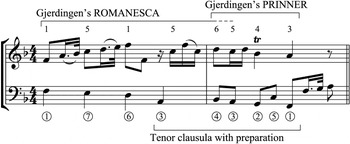
prototype is defined as a four-event unit, the brackets in Gjerdingen's analyses also contain the fifth chord, and end with dotted lines. The fact that Gjerdingen is concerned precisely with establishing the galant Romanesca as an ‘opening gambit’ that requires connections with other elements does not change the intrinsic contradictions resulting from this derivation. Somehow the derivational esprit du système prevails over the musical phenomenon it seeks to describe. In my view, the all-important fourth chord does not belong syntactically to the Romanesca at all, but rather to the shape immediately following it. This is shown in Example 2, where the introductory  progression is followed by a classic
 tenor clausula in the bass, beginning with a strong introductory third scale degree as the leading note that belongs syntactically to the cadence.
Marcello, Sonata Op. 1 No. 1 (Amsterdam, 1732), Largo, bars 1–2. Gjerdingen's example 3.4 (48) gives the analysis shown here above the top stave; his brackets beneath the bottom stave have been replaced in order to show the tenor clausula

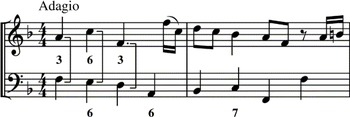
It is a central characteristic of this otherwise cohesive model that the syntactical caesura between the descending scale progression of the opening and the subsequent cadence is in general respected. The model itself, however, was anything but new to the galant: Gjerdingen concedes that ‘almost every type of Romanesca … can be found in Corelli's Op. 5’ (60). Example 3 gives an obviously relevant example; its opening 3–6–3 interval progression, a traditional upper voice to a descending scale, clearly anticipates the galant examples cited by Gjerdingen. Nevertheless, the strangely ahistorical argument that follows leaves the reader at a loss: ‘though Corelli did not invent the galant style, he played an important role in its dissemination’ (60).
Corelli, Sonata Op. 5 No. 10 (Rome, 1700), Preludio, bars 1–2

Juliane Brandes has been able to trace the origins of this opening gambit, which usually begins with the third scale degree in the melody but often with the first, a long way into the first half of the seventeenth century (Juliane Brandes, ‘Fußnote zu einem “Essay über verschiedene Schemata in der Musik des galanten Stils”’ (master's thesis: Schola Cantorum Basiliensis, 2011)). It is one of a number of typical bass formulas for the ciacona; indeed, it seems evident to me that Gjerdingen's galant Romanesca derives from the ciacona opening formula. It is therefore against this historical background that we must judge Gjerdingen's own derivation, which virtually equates the systematic and historical origins of the schema:
The musicians who developed the galant Romanesca preserved a number of venerable traits from its sixteenth- and seventeenth-century antecedents. But they also added the melodic focus on [scale steps] 1 and 5, shortened its length from six events to four, blended the stepwise bass with the leaping bass, and chose the  sonority that would seamlessly connect to a following cadence or other schema. (39)
To be quite clear: Gjerdingen's Romanesca schema, as questionable as its historical derivation may be, remains a central model (especially as an opening gambit) that is genuinely of great significance for the galant style. Gjerdingen pays little attention to historical detail here because his derivation of the models, and his explanation of their historical backgrounds, remain completely external to his essentially systematic notion of the schema: from the start, he is looking for ‘a more abstract concept of the underlying schema’ (29). Such an approach, however, displays a number of quite fundamental characteristics and problems that I would like to examine more closely.
All of the historical objections proposed thus far essentially miss the essence of Gjerdingen's approach, since he does not think historically. Considering the wealth of new historical information and sources that are certainly not least among the many attractions of this splendid book, and his illuminating reading of writings such as Riepel's, this statement may seem inappropriate. But, though Gjerdingen clearly mounts a case against a supposedly deficient current practice in the name of what is historically appropriate, he does not really attempt a historical approach that penetrates deeper into the material.
Yet from a historical perspective, questions remain: concrete traces of his classification system cannot, to my knowledge, be found in eighteenth-century sources (the obvious exceptions being Riepel's Monte, Fonte and Ponte). As David Temperley has noted, ‘the Prinner, the Meyer, and most of the other schemata … were apparently not part of the declarative knowledge of galant composers; at least Gjerdingen presents no evidence that they were’ (review, ‘Robert O. Gjerdingen, Music in the Galant Style’, Journal of Music Theory 50/2 (2006), 284). Gjerdingen's cognitive approach has not undergone any fundamental changes since his ground-breaking 1988 study A Classic Turn of Phrase. (For more general discussion of this approach, which falls outside the scope of this review, see Kofi Agawu, review of Gjerdingen's A Classic Turn of Phrase: Music and the Psychology of Convention, Music Theory Spectrum 13/1 (1991), 112–116, and the Neuwirth review cited above.) In his earlier work, nevertheless, Gjerdingen's schemata were phenomena not rooted consciously and explicitly in the compositional thought of the time, let alone in its pedagogical practices, but rather deduced directly from the music and from musical perception. In this respect Gjerdingen's theory of schemata is related to the ‘model theory’ of Hartmut Fladt and his school (Fladt, ‘Satztechnische Topoi’, Zeitschrift der Gesellschaft für Musiktheorie 2/2–3 (2005), 189–196).
Gjerdingen's encounter with partimenti and the Neapolitan pedagogical tradition confirmed his earlier, fundamental insights – which are in turn used as confirmation – but did not lead to any substantial alteration, let alone redefinition, of his original method. (Though one must note that in his more recent work in particular Gjerdingen has devoted himself to these very questions; again, the present context does not permit us to do justice to these works.) Only in the Appendix does one find a few brief comments on the rule of the octave and the structure of the partimento textbooks; these remarks do indeed seem appended, and have no bearing on the substance of his theory of schemata.
The rule of the octave, cadences and sequences (suites, movimenti and so on) are the central ‘units of order’ in the partimento tradition, and indeed the entire thoroughbass tradition of the eighteenth century; they also define contemporary model-based tuition in the historically oriented Satzlehre. One of Gjerdingen's most interesting and important chapters is devoted to cadences (chapter 11). The sequential models, however, which form an absolutely central aspect of practical training in the seventeenth, eighteenth and even nineteenth centuries, do not appear in Gjerdingen's theory as autonomous elements; they are only ever subcategories of larger schemata. The ascending 5–6 interval progression, for example, is subsumed under the Monte schema (which by virtue of its name potentially includes nearly all ascending sequential models),while almost all progressions that can be traced back via inversion to the circle of fifths are assigned to the Prinner category. And yet it is precisely the sequences that are so compositionally inexhaustible andrequire comprehensive study: they are not always easy to recognize and assign in analysis (see Johannes Menke, ‘Historisch-systematische Überlegungen zur Sequenz seit 1600’, in musik theorien der gegenwart 3, ed. Clemens Gadenstätter and Christian Utz (Saarbrücken: Pfau, 2009), 87–111).
The Prinner is the schema in Gjerdingen's theory. He shows convincingly how far the alto clausula's melodic  in the upper voices defines the structure of galant and Classical pieces, and how much our perception of the formal structure is determined by this Gang. It is precisely because the Prinner is so useful in a practical context that I shall use it to demonstrate the main concern of my preceding observations: the question is whether those compositional models and thoroughbass patterns that occupy such a prominent position in the partimento tradition and in thoroughbass theory as a whole, and that so often determine our surface perception, are adequately considered in Gjerdingen's theory, and indeed whether their classification according to Gjerdingen's overarching, ‘hierarchizing’ schema concept is genuinely productive. (On thoroughbass as theory see Holtmeier, ‘Heinichen, Rameau, and the Italian Thoroughbass Tradition’, 5–49, and Felix Diergarten and Ludwig Holtmeier, ‘Nicht zu disputieren? Beethoven, der Generalbass und die Sonate op. 109’, Musiktheorie 26/3 (2011), forthcoming).
Gjerdingen's treatment of the Prinner schema reaches a climax at his discussion of Mozart's well-known Piano Sonata in C major k545 (‘Sonata facile’): ‘From a galant perspective, one might better subtitle this work “The Art of The Prinner”.’ (359). The first two Prinners (bars 3–4 and 5–8), shown in his Example 26.6 (365), wonderfully match Gjerdingen's definition. His description of the first as a form in which ‘the Prinner's normal inner voice [ ] appears in the bass’ (359) is very appealing. Gjerdingen's explanation is thoroughly convincing, as one can easily verify by replacing this ‘exchanged’ Prinner with a ‘normal’ Prinner (in other words, by moving Mozart's
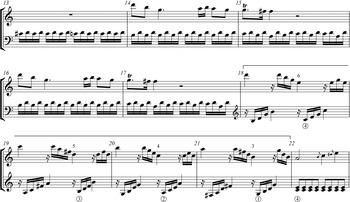
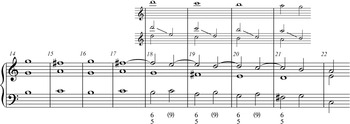
 inner voice to the bass). The following four-bar Prinner, a so-called ‘Prinner riposte’, also corresponds wonderfully to Gjerdingen's definition, this time exploiting a slower harmonic rhythm and ornamented with semiquaver scale passages. It is followed later in the movement by a third Prinner in the form of the splendid passage shown in Example 4.
Mozart, Sonata in C major k545 (1788), Allegro, bars 13–22. The bracket indicates the passage labelled ‘Prinner’ by Gjerdingen

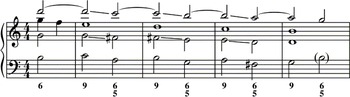
Comparing Mozart's Prinner with two rather beautiful and very similar examples by Dittersdorf and Galuppi (361), Gjerdingen remarks upon Mozart's deviations from the Prinner prototype such that ‘each stage of the Prinner is preceded by a less stable chord’, so that we are dealing with ‘an alternation of and  chords’, as well as characteristic ‘melodic descents of a sixth [sic!] from the chords’ (361). This would mean that this particular Prinner is based on the following bass model, a classic sequence of descending thirds:
Falling-third / ascending-second progression (Terzfall)

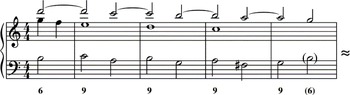
On playing this sequence, whatever upper voice is chosen, it turns out that both Mozart's sequence and Gjerdingen's Prinner are arrived at with some difficulty. This is, in fact, one of the complex sequence models that are so typical of Mozart, as I have elsewhere attempted to demonstrate (Holtmeier, ‘Reconstructing Mozart’, Music Analysis 21/3 (2002), 307–325). The two-voice textures in the examples given by Gjerdingen are actually pianistic figurations of a virtual polyphonic texture that was named differently in the sources of the time (heterolepsis, tenue and so on). The sequences of Dittersdorf and Galuppi in particular are based on a model whose foundation is the three-part texture shown in Example 6, where it is transposed into the key of Gjerdingen's Mozart example.
Sequential ninth (Sequenz-None) progression in three voices

In bars 18 to 21 of the Mozart sonata the three voices shown in Example 6 are joined by a fourth, making it into one of the most complex and frequently debated compositional models of the seventeenth and eighteenth centuries (Example 7). The additional voice produces those infamous consecutive fifths between the soprano and tenor that some considered merely Augenquinten (eye fifths) and hence permissible, but others Ohrenquinten (ear fifths) and thus forbidden. For Carl Philipp Emanuel Bach, for example, ‘where a ninth chord and a  chord alternate, only one register can be used without committing errors, namely that in which the ninth lies in the lower voice. The [parallel] fifths that occur in the two other registers, no matter how much some might defend them, are and shall forever remain disgusting to the ear’ (‘wo der Nonen- und Sextquintenaccord abwechseln, ist nur eine Lage, nehmlich die, wo die None in der Unterstimme lieget, ohne Fehler zu gebrauchen. Die Quinten, welche in den zwo übrigen Lagen vorgehen, sie mögen auch noch so sehr vertheidigt werden, sind und bleiben allezeit dem Ohr eckelhaft.’ Carl Philipp Emanuel Bach, Versuch über die wahre Art das Clavier zu spielen. Zweyter Theil (Berlin: Winter, 1762), 158).
9– progression in four voices

This four-part model appears to have originated in the art of polyphonic composition for five or more voices, in which even ‘ear fifths’ often do not constitute technical errors, and which to many constituted the supreme contrapuntal discipline – in some milieus, well into the second half of the eighteenth century. Reducing this texture to two parts through figuration is a very appealing and rewarding task, for the constraints of voice leading in four-part counterpoint are partially suspended because of the free-floating character of the figuration; thus the parallel fifths can easily be avoided. One could devote an entire book merely to describing how these highly dissonant contrapuntal models were constantly reinvented in the use of figuration during the eighteenth century.
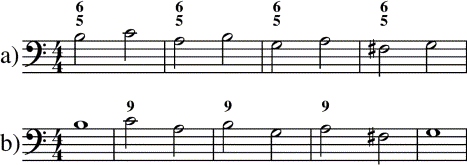
Comparing Example 7 with Mozart's sequence, however, it quickly becomes obvious that Mozart does something very special here: he seems to place the entire model on the ‘wrong’ metric unit. Here he is surely playing, perhaps even ironically, on his own childhood experiences: anyone who teaches partimento or thoroughbass knows that the Terzfall often leads to confusion. This is because there is a significant difference in its execution, depending on the rhythmic placement of the descending thirds. In Example 8a the result is a sequence of – progressions, whereas 8b results in what I call the sequential ninth (see Holtmeier, ‘Rameaus langer Schatten: Studien zur deutschen Musiktheorie des 18. Jahrhunderts’ (PhD dissertation, Freie Universität Berlin, 2010), 263ff).
The two ‘falling-third’ progressions (Terzfälle)
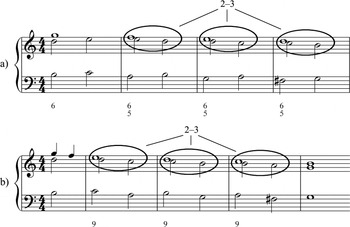
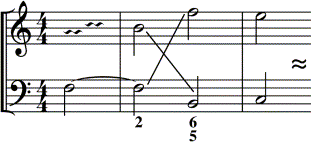
The bass parts of both of the models in Example 8 are descended historically from hierarchically subordinate and supplementary lower voices inserted beneath the structural voices of dissonant 2–3 (or 7–6) interval progressions (Example 9). This contrapuntal approach is essentially what Rameau means when he speaks of ‘supposition’ (Holtmeier, Rameaus langer Schatten, 263ff; see also Gjerdingen's discussion of his ‘Porpora Prinner’ (243)).
Two dissonant 2–3 interval progressions with bass added ‘par supposition’

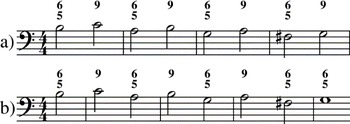
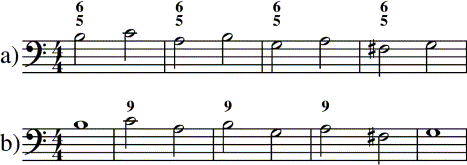
Both models can now be enriched with further dissonances. The two bass lines shown in Example 10 share the same thoroughbass figures, yet these mean two quite different things: in Example 10a the ninth results from an additional voice (Zusatzstimme) joining the three-part texture as a filling voice (Füllstimme), while in Example 10b it stems from one of the structural voices belonging to the two-voice framework (Gerüststimmen). In 10a the sixth and fifth represent the framework voices: the sixth is the agente voice of the secunda subsyncopata, which forms a quinta dissonans in relation to the bass. In 10b, on the other hand, the sixth is purely a filling voice. These voice-leading details and a knowledge of the hierarchy of pitches were significant for the enactment of these compositional textures: both thoroughbass models contain exactly the same notes and figures, yet they are fundamentally different. Which model one is dealing with is determined partly by its metric position, of course, but – as one can see in Mozart's ‘Sonata facile’ – above all by which of the voices is presented as belonging to the two-voice framework.
The two Terzfälle modified to include the ninth: (a) the –9 progression; (b) the 9– progression

And here Mozart's game of deception begins, because this passage is certainly not heard as a sudden disruption of the hypermetrical order. Although Mozart keeps the conventional figurations of the Dittersdorf and Galuppi examples in the right hand, thereby stressing the d3 as a structural ninth (that is to say, as a ninth that seems to be caused by one of the framework voices) in accordance with the prevailing metrical order, it is the –9 progression, not the 9–, that becomes manifest as the underlying thoroughbass model (Example 11).
Mozart, Sonata in C major k545 (1788), Allegro, bars 13–22: underlying five-voice structure

How artfully Mozart hints at the implicit five-voice compositional texture shown in Example 11. The alto f♯2 in bar 17 is actually a tenue (the tie in virtual two-part polyphony) of the structural voice resolving onto e2 in the next bar. But this tenue is only present as sous-entendu; Mozart does not explicitly stress it. The main reason for this it that the passage from the dominant  chord (bars 15 and 17) on the fourth scale degree to the strongly dissonant chord on the third scale degree in bar 18 is not really expected: rather we hear a
clear tonic–dominant pendulum in bars 14–17 (Gjerdingen's passo indietro), which demands a consonantresolution onto the (tonic) chord of the sixth on the third scale degree. In place of the implied f♯2, then, the d3 in bar 18 is stressed.
This d3 originates in a soprano filler voice in parallel thirds with the bass (shown in Example 11 on the additional stave immediately above the right hand), with its typical doubling of the notes of resolution in the implied alto voice. But as Mozart's figuration spreads these ascending seconds into falling sevenths, so he opens up a virtual two-voice polyphony with the alto: the d3 is heard not as part of an ascending second progression, but within a dissonant 7–6 interval progression which effectively creates the fifth voice on the uppermost stave, with typical ‘filler ninth’, and consecutive fifths between soprano and tenor voices.
One could say, then, that by means of figuration Mozart has staged the artificial superimposition of two different compositional textures (Satzmodelle) and the interaction of two opposing rhythmic contexts: the two models merge in the listener's perception. On the one hand, there is the metrically ‘correct’, and finally prevailing –9 progression (Example 11), while on the other, there is the 9– progression of Galuppi and Dittersdorf, which is here dislocated, so to speak. What in the examples of his two contemporaries was a movement of framework voices becomes in Mozart's hands the movement of filling voices, which nevertheless constantly struggle against this role, demanding to be perceived instead as part of the structural framework.
Before returning to the relationship between this and Gjerdingen's Prinner schema, it would be instructive to consider how this example from Mozart might be adequately expressed as a two-part reduction of its complex model, a problem that constituted one of the central pedagogical exercises throughout the eighteenth century. The object, in short, is to remove all voices in turn until all that remains is a two-part substratum containing all the essential voice-leading information; but what would the correct two-voice reduction of this passage look like?
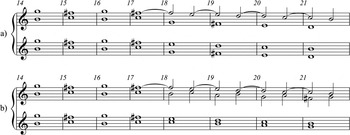
If we consider the –9 progression, accepting the classic syncopated dissonances as framework voices, then the result is a two-voice 7–6 interval progression (Example 12a); by contrast, if the bass voice – entirely in keeping with eighteenth-century practice and pedagogy – is regarded a priori as always a framework voice, the result would be a 5–3 progression involving the quinta dissonans (Example 12b). If we now remove the syncopationes, leaving a note-against-note texture that, in the still widespread thinking of the trias harmonica tradition, stood behind all dissonance, we arrive at the textures shown in the two lower staves in Example 12. These ‘desyncopated’ examples, as artificial as they are, reveal how weak the connection between the opening four bars and the –9 progression actually is in harmonic terms.
Mozart, k545, Allegro, bars 13–22. Two-voice reductions showing –9 progression: (a) 7–6 progression as framework voices, (b) the bass as a framework voice. In each case the lower stave shows a further level of reduction after the removal of the syncopated dissonances

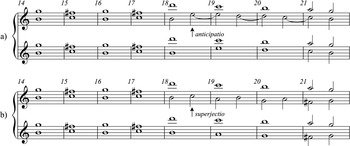
There are also two solutions for the two-voice reduction of the 9– progression, as shown in Example 13; indeed, the three-part sequential ninth (Example 6) permits an even less clear separation between two-voice framework and accompanying voice: here all three voices are framework voices. If the syncopationes are removed in Example 13 too, then everything seems strangely to be back in its rhythmic place: the actual rhythmic displacement of the texture appears in the two-part fabric as (a) an anticipatio of the following note, and (b) a ‘heavy’ superjectio in the second half of the bar.
Mozart, k545, Allegro, bars 13–22. Two-voice reductions showing rhythmically displaced 9– progression: (a) 7–6 progression as framework voices, (b) the bass as a framework voice. In each case the lower stave shows a further level of reduction after the removal of the syncopated dissonances

The reductions in Example 13 surely contradict the dominant rhythmic structure of this passage; nevertheless, they stress exactly those notes in the upper voice that are clearly perceived. Ultimately, of the four two-voice reductions I have proposed, no single one renders the model correctly – nor can any of them be described as ‘wrong’: only in sum do they approach the perceptual phenomenon of hearing Mozart's sequence.
What, then, of Gjerdingen's reading of bars 18–21 of Mozart's sonata as an instance of the Prinner schema? The foregoing examples suggest that what we have here is not a matter of a Prinner texture with movement in parallel tenths being artfully ‘worked out’. Gjerdingen's Prinner structure is undoubtedly there (most obviously in Example 12b), but surely not situated in the foreground of this compositional model. Its ‘inversion’, the movement in parallel sixths (Example 13a), is more convincing in the context of the whole reduction, but the overarching melodic movement is apparently  , not as in the Prinner. In the second two-voice reduction of the 9– progression (Example 13b), which one can perhaps hear most clearly in Mozart's sequence, the lower voice of the Prinner prototype would be in the melody, accompanied by a lower voice that could perhaps be viewed as a variant of the Prinner's inner voice (which is, as noted above, not among the central features of the schema). Naturally Gjerdingen's definition of the schema as a network of interactive, non-binding relationships opens up the possibility of applying the term to these forms too; in Gjerdingen's own analyses, however, the Prinner is tied exclusively to the appearance of at least one of the two outer voices.
Thus the identification of the schema in this passage seems very forced. Gjerdingen's Prinner is convincing in the examples from bars 3–4 and 5–8 of the sonata because the parallel thirds in the outer voices are genuinely perceived there: the starting point on the sixth scale degree can truly be experienced. By contrast, the third Prinner has to be read – or heard – into bars 18–21. I would argue, however, that if one wishes to understand this highly artificial style it is important, precisely because it constantly uses the same patterns, to gain an awareness of their subtle compositional details and the precise differences between them.
I do not think it very likely – and this is the primary concern of my meandering deliberations – that models such as those implied in bars 18–21 of Mozart's sonata were imagined and realized in the eighteenth century, whether in composition or improvisation, as elaborations of an overriding Prinner model, as it were. Rather, what the Prinner catches is something very general: the integration and the overarching functionality of a particular model in a specific harmonic space. In Ulrich Kaiser's schema theory Gjerdingen's Prinner is labelled Pendelmodell (pendulum model), because of its recourse to a ‘IV–I–V–I –Pendeln’ (Kaiser, ‘Was ist ein musikalisches Modell?’, 279). In a comparable sense, Gjerdingen's Prinner also describes a general harmonic-functional determination that remains valid for quite a number of sequential models. But this general determination has in a certain way been absorbed by the models themselves. The aim of the practice is rather to recognize and to master the model in its individuality – against the background of its general functional determination.
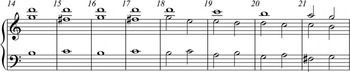
In bars 18–21 of the sonata, then, we are dealing with an autonomous, complex and dissonant sequential model that requires ‘initiation’, a point de repère, from which the sequence machine starts moving, as Rameau puts it (‘la machine qui marche’). Although the f♯2 in bar 17 is a potential candidate, a more convincing fixed point is the d3 in bar 18 that initiates the implicit sequence of ninths. This is also why, in the previous bars, the d3 is set so clearly as a virtual third voice: essentially, the music is conceived as a genuine three-part texture from the start, as shown in Example 14. One can see how the four bars preceding the cadence charge the d3 with the very tension that is then released so impressively in the sequence of ninths:contrapuntally speaking, they constitute the preparation of the ninth dissonance. The two-part resolution that would do justice to the whole passage, then, would be that in Example 15.
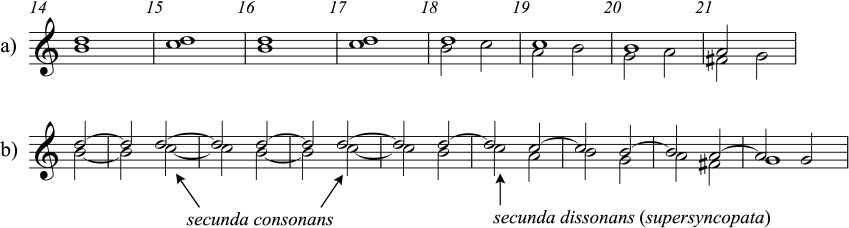
Mozart, k545, Allegro, bars 13–22. Two-voice reduction showing secunda consonans in the outer voices

Mozart, k545 Allegro, bars 13–22. (a) Two-voice reduction based on Example 14, (b) demonstration of its implicit rhythmic implications
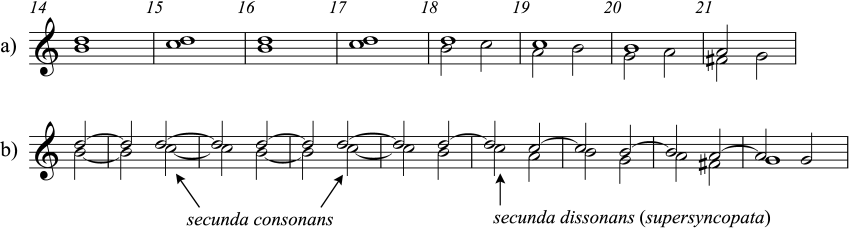
Gjerdingen's schema, then, fails to do justice to the complexity of the musical fabric in this passage, whose larger rhythmic implications cannot be discussed here (but see Example 15b); furthermore, it actually distracts our attention from the compositional individuality of the phenomenon, instead drawing it time and again towards the location of the same basic constants. How does this differ substantially from the crude classificatory and reductionist procedures of the nineteenth-century harmonic theory that Gjerdingen so passionately rejects? And is it not precisely the thoroughbass and partimento practice of the eighteenth century that can teach us – having now shaken off the dominance of that nineteenth-century Harmonielehre tradition, as it were – to give back to musical phenomena their autonomous value? It is precisely the classic sequential models, such as those explored above, that form the heart of thoroughbass and partimento theory, and that constitute in my view the central artistic means of the highly artificial music of the galant style. And it is just these models that remain insufficiently explored in Gjerdingen's theory of schemata. This is problematic because the same models determine our perception of musical events and our ‘functional’ assignment of them to a specific context.
It is vital to acknowledge that Gjerdingen's analyses are always judged by ear: a more conventional Prinner placed in bars 18–21 of Mozart's sonata, despite seeming somewhat out of place in voice-leading terms, would not sound fundamentally ‘wrong’. But why is this? What do Mozart's sequence of ninths and the Prinner have in common? It is the cadence.
Gjerdingen illustrates the functional origins of his Prinner schema with an example from Johann Jacob Prinner's ‘Musicalischer Schlissel’ (manuscript, Salzburg, 1677), in which a simple motion in the bass is expanded in two alternative voicings (his Example 3.1 (46)). In the first bar the melody is a soprano clausula and the additional voice (Zusatzstimme) doubles the bass in thirds (alto clausula). In the second bar, meanwhile, the upper voices are exchanged in such a way that the bass is doubled at the tenth in the soprano and the line becomes an inner voice. These two voicings ‘represent the old and the new’, Gjerdingen writes on page 46; ‘the voicing in his first measure had long functioned as a form of the ancient clausula vera … while the voicing in his second measure – what I term the Prinner – would become a preferred riposte in the nascent galant style’.
But why should the voice leading in the second bar change anything about the general status of the cadence? All that has changed is that the original middle voice, the alto clausula, now lies in the upper voice, and even by the seventeenth century the exchanging of individual cadential voices had long been common practice. It seems to me to result primarily from the fact that Gjerdingen's concept of cadence encompasses only shapes that end in the octave, and hence constitute a relatively strong point of punctuation. Nevertheless, even in Gjerdingen's theory of cadence, a cadence with a bass clausula ending with a third in the upper voice remains – entirely in keeping with eighteenth-century practice – a cadence, even if it is then ‘incomplete’, or not fully connectable (166).
In fact, almost all the Prinners in Gjerdingen's examples in chapter 3 are clausulae tenorisantes, and in a rhythmic and melodic form that had already become a musical colloquialism by the second half of the seventeenth century. A typical model analysis in the (historically oriented) Satzlehre would be Quinteröffnung (opening fifth) – tenorisanz – tenorisanz, whereas Gjerdingen would turn it into opening gambit – Prinner – Prinner. But what is Gjerdingen's deeper reason for removing the Prinner so far from its cadential origin? What he really has in mind with the Prinner are precisely not these obvious ‘tenor clausula Prinners’, but rather four-bar structures such as the second Prinner in Mozart's ‘Sonata facile’ (bars 5–8) with its famous scalar figures. Gjerdingen's definition of the Prinner prototype, in which the classic tenor clausula appears only as a variant, makes this very clear.
In this (Mozartean) compositional form, the tenor cadence has emancipated itself from an elementary, purely punctuating (interpunktisch) function. The first two ‘preparatory’ bars, formerly subordinate elements of the cadence, almost become the main event: they are now carriers of extended sequential figurations that can also spread to affect the entire model. As early as 1670, Spiridionis described in impressive fashion the (improvisational) procedure of stretching out precadential elements in this manner (Spiridionis a Monte Carmelo, Nova Instructio, Pars Prima (Bamberg: Immel, 1670; reprinted Colledara: Andromeda, 2003, ed. Edoardo Bellotti), 14). What is fundamental is that this ‘autonomous’ Prinner breaks away from the central attribute of the tenor cadence, namely its rhythmic shape: the double duration of the penultima, in which the ligatura resolves, is practically evened out: the two introductory notes, penultima and ultima are all assigned the same extension.
This is not the place to discuss all the variants, especially rhythmic ones, of the Prinner/tenor cadence, which I feel could and should be distinguished from one another more clearly in their functions. My concern is a more general one: I would always consider a Prinner such as that in Example 2 above to be a tenor cadence, whereas in the case of Mozart's ‘Sonata facile’, I am happy to embrace the new term, which here describes something independent.
Gjerdingen's schema theory knows no overall music-theoretical or compositional principles; at least, he does not develop them explicitly anywhere, least of all at the start of the book. And this is no coincidence, as Gjerdingen's schemata doctrine is absolutist in its aims: it seeks to represent the whole from the perspective of the individual element, namely the schema – or, put differently, the schema is its own superstructure.
The schema of the Prinner, which encompasses so many different forms and functions, essentially expresses the overarching context of a cadential discourse. This context is more important to Gjerdingen than the individual realizations of the Prinner schema themselves. It is important to point this out, because his espousal of hands-on practice, and the invective against the ‘false’, ahistorical and fundamentalist music theory of the nineteenth and twentieth centuries that runs throughout the book, can easily disguise how much Gjerdingen is concerned with the large-scale music-theoretical whole.
I would therefore prefer to distinguish between the tenor clausula and the Prinner, as I believe that the musical connections rendered visible by the omnipresence of the Prinner in Gjerdingen's analyses are, in fact, implicit in the determinacy of the harmonic space in which the music enacts itself, and hence given from the start. Whether we say that everything is tonic, subdominant and dominant, or everything is the Urlinie, or everything is alto clausula above / tenor clausula below (Prinner), ascending tenor clausula above / soprano clausula below (do–re–mi), or whatever – and no matter how different the conceptions of the harmonic space and process behind these terms might be – the fact remains that all harmonic explanatory systems rely heavily upon reductionist abstraction at this fundamental analytical level.
Rameau's notorious ‘Tout est cadence’ applies not only from the eighteenth century onwards, but even more clearly during the seventeenth. A piece of music is a succession of cadences. But by the first half of the eighteenth century, almost all significant music theorists found this doctrine inadequate and attempted to counter the abundance of ‘descantizing, tenorizing or falsetto cadences and other unnecessary stuff’ (‘Discantisirenden, Tenorisirenden, oder Fistulirenden Clausuln und andern unnöthigen Zeuge’; Johann David Heinichen, Neu erfundene und Gründliche Anweisung zu vollkommener Erlernung des General-Basses (Hamburg: Benjamin Schiller, 1711; reprinted Kassel: Bärenreiter, 2000), 64) with a system of organization built on a few basic principles. In his 1722 Traité de l'harmonie Rameau traced all harmonic progressions back to central cadential steps. Barely ten years later he had already abandoned this position, for a variety of reasons. He still clung – allowing for a change of perspective – to the idea of a theory of connections between sounds that originated from the cadence (marches fondamentales), but from then on he distinguished very clearly between a general theory of harmonic progression (a ‘theory of harmony’) and a theory of the repos (the audible, ‘rhetorical’ cadential caesuras in the melody). Rameau was not developing a speculative theory divorced from musical practice, but rather an astute analysis of – as Adorno would put it – the current state of the musical material: everything in music was based on the cadence, but not every cadence was a repos. Applied to our topic, one could formulate Rameau's distinction as follows: every Prinner is a tenor clausula, but not every Prinner is simultaneously a repos.
One must make distinctions, however: what makes Gjerdingen's Prinner especially convincing is the fact that the galant style, coming from the sphere of dance, sets itself critically apart from the drawn-out sequential models of baroque music. The entire galant discourse operates with cadential models whose four-square construction makes them particularly comprehensible and clear in their contours. Almost every Prinner therefore has some palpable remnant of repos. It is not least this aspect that lends the music its ‘speaking’, communicative character.
The ubiquity of the Prinner in Gjerdingen's analyses makes it clear that in this idiom the old tenor cadence, with outer-voice parallel tenths (alto clausula in the upper voice), is a building-block that can be employed with great flexibility and has consequently become an important element in the formation of musical context. Alongside this, subtle variations of function and voice leading move into the background. If, however, one retained from the start an overarching organizing system that also encompassed that building block, the resulting model theory would rather have to provide exactly that functional differentiation: the Prinner would be a tenor clausula that was not a repos, or at most a repos peu sensible with little relevance in terms of formal punctuation. The function of such a Prinner within the musical fabric would be significantly more limited.
In this context we should also remember that the rule of the octave itself, or the harmony based on it, grew directly from the tenor clausula. I have discussed this at length elsewhere (Holtmeier, ‘Heinichen, Rameau, and the Italian Thoroughbass Tradition’, 17ff). In the rule of the octave the tenor cadence was divided up into
its component parts, which are ‘frozen’, as it were, on specific scale degrees. Thus the sounds were freed from the original rhythmic and textural constellations of the cadence, but the tenor clausula remained present in the scalar progression. It is no coincidence that the simple rule of the octave progression , where the fourth degree that opens the progression is viewed as a ‘leaped-in’ degree and therefore permitted to carry a stable chord, recalls some of the ‘late galant’ Prinners cited by Gjerdingen: here the nature of the Prinner almost completely matches the rule of the octave progression. Gjerdingen's Prinner is convincing in so far as it describes procedures active at the ‘deep middleground’ level. But the question remains whether a historically oriented schema theory should not pay special attention to processes functioning in the ‘near middle ground’: the Prinner could then be described and identified as a style-specific rule of the octave model () operating at a deeper level than the subtle manipulations of progressions found in passages such as bars 18–21 of Mozart's ‘Sonata facile’.
Gjerdingen's Prinner is not only at home in the rule of the octave, however; in its voice-leading disposition it follows the general sonic tendencies of the time. The texture of parallel outer tenths in this cadence is the result of a historical development that Markus Jans once strikingly termed the ‘pip principle’ (developing an idea by Klaus-Jürgen Sachs in Der Contrapunctus im 14. und 15. Jahrhundert: Untersuchungen zum Terminus, zur Lehre und zu den Quellen (Wiesbaden: Steiner, 1974), 121). In the course of music history the frequency of perfect consonances decreased more and more and their functional tasks became ever more restricted: what started as perfect–imperfect–perfect (pip) ultimately turned into piiiiiiiiiiiiiiiip. The stile nuovo sound-world of the late seventeenth-century trio sonata actually resulted from a conspicuous avoidance of perfect consonances. This tendency became increasingly pronounced in the course of the eighteenth century, until Jérôme-Joseph de Momigny laconically remarked at its end that in the style of Haydn the perfect fifth should be viewed as a dissonance. And indeed, perfect consonances actually take over the role of dissonances in the galant ‘outer voice texture’: they hardly appear any more outside of the repos, and, where they do, they are placed on weak beats as passing harmonies or ‘prepared’ as a dissonance is prepared by a perfect consonance. The clausula formalis perfectissima (139), the full cadence, also appeared increasingly rarely in the course of the eighteenth century. Increasingly the cadence referred to by Gjerdingen as ‘complete’, Koch's ‘formal’ (förmliche) cadence with the ‘perfect’ octave ending, was reserved for large-scale formal divisions. Between these formal cadences, the cadential ending on the third or tenth in the outer voices became the standard ‘middle cadence’. In purely external terms, then, the outer-voice textures of the eighteenth century – with the exception of certain sequential progressions – presented themselves as continuous, only occasionally interrupted, series of imperfect consonances. Gjerdingen's Prinner riposte constituted the norm for an intervallic texture based on the tenor cadence in that place, that time and that style.
Recognition of this increasing avoidance of formal repos also permits us to refine the notion of the galant ciacona opening (Gjerdingen's galant Romanesca): a typical characteristic, as opposed to the ciacona opening of the late seventeenth century, would be the predominance of the tenor-clausula riposte rather than the older bass clausula, a preference which stems from more general changes in the whole sound-world and particularly in the overarching phrase structure. The galant style emphasizes – even more clearly than was previously the case – the cadenze di grado with their repos peu sensible: the gliding, smooth changes of section, which find direct analogy in the predominance of stepwise melodic movement.
Gjerdingen's theory, then, raises a number of questions in connection with the identity and origins of specific schemata and their application in practice, which in turn lead to more general considerations, such as the relationship between particular cadential progressions and their use according to a hierarchy of syntactic function, as explored here. In the remainder of this review I turn to another such general issue that arose particularly in our consideration of the passage from Mozart's ‘Sonata facile’: the understanding of counterpoint in terms of intervallic structure, and the kind of harmonic thought and practice that accompanies such an understanding.
Thinking in terms of intervallic textures is one of the most essential preconditions of compositional theory in the seventeenth and eighteenth centuries. Ever since people began to think about the organization of vertical harmonies in Western music theory, intervallic texture has been the decisive point of reference; indeed, while the nature of this intervallic approach changed in the course of the eighteenth century, its central significance remained unchallenged until well into the nineteenth century, at least in the professional teaching of composition (Nicola Sala's Regole del contrappunto pratico (1794) would be a good example of the application of this kind of thinking in the context of the Neapolitan school, as would the various rules and exercises associated with Leonardo Leo). Viewed from the perspective of a historically oriented music theory, then, it is surprising to find that analysis of intervallic textures plays a marginal role at best within Gjerdingen's theory of schemata. Intervallic relationships are certainly highlighted at places, such as the parallel tenths in the Prinner, but the relationships between the voices of a schema are defined not by their intervallic properties, but rather by their position within the prevailing scale. Through this radical and one-sided dependence on the scale, the defining voices of Gjerdingen's schemata gain the (melodic) autonomy they require in order to permit the identification of each schema even in passages where they are heard in isolation, often (as we saw in the case of Mozart's sonata) in quite different contexts.
Just as intervallic structure is neglected, the whole matter of harmony is largely passed over: chord structure and progression, treatment of dissonance, and indeed, many of the things that eighteenth-century music theory viewed as its central subjects, and which were unified in the overarching principle of thoroughbass as the true fundamentum of all music, fail to be mentioned by Gjerdingen (see Felix Diergarten, ‘“The True Fundamentals of Composition”: Haydn's Partimento Counterpoint’, Eighteenth-Century Music 8/1 (2011), 53–75). When he introduces the cadence galante, for example (his ‘Cudworth cadence’, ‘the most famous of galant cadences’ (146)), he completely neglects to describe that aspect that music theorists of the time perceived as central, namely the particularly conspicuous dissonant quarta superflua that results from a transitus irregularis and is here resolved almost against its own nature. For Gjerdingen, the dissonance simply results from the coincidence of scale degrees 7 and 4; the specific dissonance produced is considered irrelevant.
Thinking in terms of intervallic texture and thoroughbass nevertheless raises fundamental questions about the compositional practice of the galant: what meaning, for example, did the concepts of consonance and dissonance have at that time and in that style? What makes the music theory of the late seventeenth and early eighteenth centuries especially exciting is the fact that all music-theoretical categories are seemingly in motion and subject to scrutiny. At the start of the eighteenth century the generally accepted ‘classical’ division of dissonances into two categories – those arising per syncopatione and those arising per celeritate (passing notes and so forth) – was even augmented by a new category, the anschlagende Dissonanzen (‘attacked’ or unprepared dissonances; see Holtmeier, Rameaus langer Schatten, 232ff).
This introduced a new class of intervals sometimes termed semi-consonances or semi-dissonances; that is to say, dissonances that, like every dissonance, must be resolved, but that, like consonances, can appear freely without preparation (Gjerdingen's Jommelli schema (159) is an anschlagende Dissonanz on the raised fourth scale degree, for example). These anschlagende Dissonanzen cannot be defined absolutely, however, according to their interval class alone. Rather, their status depends on their function within an overarching harmonic frame of reference whose centre is the scale: in other words, they are assigned to particular scale degrees. The most important of all anschlagende Dissonanzen (although it does not really belong to this category historically) is the diminished or ‘false’ fifth (fausse quinte / falsche Quinte), an especially important feature of the galant style. Indeed, it was a general tendency of the eighteenth century, and the galant style in particular, that more and more dissonances were treated freely in this way.
In the harmonic language of the eighteenth century, however, and especially the idiom of the galant style, it is more than the anschlagende Dissonanzen that are tied to particular (bass) degrees: the rule of the octave not only assigns specific chordal sonorities to all degrees, but also specific intervals that serve to clarify the harmonic function of those sounds in two-part counterpoint. This approach is sometimes described as the beste Lage (best register) in the Viennese school of thoroughbass. The ascending seventh degree, for example, is assigned a diminished fifth in both major and minor keys, the ascending second degree a major sixth (Rameau's dissonance majeure), the descending second degree the minor third (to avoid a ‘dissonant’ octave
in the outer voices on the first degree), and the descending fourth degree an augmented fourth (triton / große Quarte). Although Gjerdingen shows no interest in such principles, they are by no means foreign to the phenomena he describes: if one takes the bass of the Meyer (111), for example, and completes the upper voice in the way I have described, this leads almost automatically to the  upper voice which forms one of the central features of this schema.
The Meyer itself, however, is based on a further compositional procedure: the ‘theatrical resolutions of dissonances’ (den Theatralischen Resolutionibus der Dissonantien) described by Heinichen, the overarching principle being the ‘recombination of the harmony before its resolution’ (Verwechslung der Harmonie vor erfolgter resolution; see Johann David Heinichen, Der General-Bass in der Composition (Dresden: author, 1728), 623). Heinichen considered this technique to be central to the new expressive operatic style of the eighteenth century, describing it and illustrating it in considerable depth; his fundamental model is shown in Example 16. Its primary technical element is voice exchange, as Joel Lester pointed out more than twenty years ago (Lester, review of Gjerdingen, A Classic Turn of Phrase: Music and the Psychology of Convention, Journal of Music Theory 34/2 (1990), 375).
Heinichen's ‘recombination of the harmony before its resolution’; after Johann David Heinichen, Der General-Bass in der Composition (Dresden: author, 1728), 623
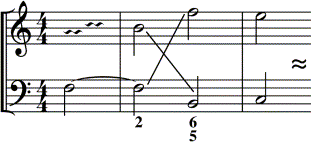
The second chord in Example 16 (l'accord du triton) is the epitome of baroque harmonic Verwechslung: a strong syncopated dissonance is usually altered into a semi-dissonant anschlagende Dissonanz. By contrast, the sound world of the galant voice-exchange model (Gjerdingen's Meyer schema) consciously sets itself apart from older syncopated dissonances and the harsher sonority of Verwechslung: one might say that Gjerdingen's Meyer results historically from a galant critique of syncopated dissonance. Only in the wake of this new, lighter sonic idea can a mildly dissonant harmony without syncopation like the chord or the  on the second scale degree (the second resulting from the quarta italica or quarta irregolare in the chord is not a syncopatio), with its low-tension semi-consonant sixth in the outer voices, become the starting point of a process of ‘recombination of the harmony before its resolution’. Incidentally, the Prinner could also be described historically as a tenor clausula of the cadenza doppia with the syncopated dissonance removed.
‘Anschlagende Dissonanzen’, ‘recombination of the harmony before resolution’, ‘best register’, ‘virtual polyphony’, ‘pip principle’, ‘avoidance of syncopated dissonance’, ‘intervallic texture’, ‘rule of the octave harmony’, indeed, ‘thoroughbass’: many such overarching categories never or only rarely appear inGjerdingen's theory of schemata. One reason for this is that Gjerdingen was simply not concerned with such matters. Another, however, is that his entire book has an openly anti-theoretical, or rather ‘anti-speculative’ tenor. One of his aims is to present a counter-project to the conventional methods of analysis in traditional harmonic theory, especially in opposition to Schenkerian analysis (in this context see also the review by Matthew Pritchard, ‘In the Galant Composer's Workshop’, Early Music 37/4 (2009), 669–671). He constantly states that he is not offering a theory in the usual sense of the word, but rather one that comes directly from practical music-making: theory and musical craftsmanship are perfectly unified. The paradoxical aspect is that Gjerdingen's schemata are themselves by no means the direct, practical historical models taught in thoroughbass or partimento teaching, but rather complex contemporary constructs that aim for universal validity.
To stay with the Meyer example, this schema contains the principle of Verwechslung within itself, as well as that of voice exchange: thus each recombination and each voice exchange in turn tends towards the Meyer (or the Fenaroli). But what is the use in deriving such general compositional procedures from these schema prototypes? Is one not putting the cart before the horse in perception-theoretical terms?
Surely the Meyer is a galant schema because it represents the intervallic texture of imperfect consonances so perfectly, because it realizes the rule of the octave harmony and the ‘best register’ so completely and because it adapts the principle of recombination to a new sonic ideal and rhythmic design. It is precisely because Gjerdingen's schema prototypes do not start from these general provisions that one might think the attributes of a given schema are located only on the outermost surface of the phenomenon it describes, in isolated voice movements, dyad groups or the like. At times, therefore, Gjerdingen's analyses are not wrong, but seem strangely redundant – if, for example, the close, almost normative connection between the seventh and fourth degrees is one of the fundamental conditions of this sonority, could one not find the Meyer almost everywhere? It is precisely the claim to comprehensiveness that causes the schemata to sacrifice internal differentiation, as I have tried to show above.
One might suppose that the early abstraction and theorization of its schemata is, as it were, the other side of the book's latent anti-theoretical tenor. In this respect Gjerdingen's study recalls the writings of Wolfgang Budday and Thomas Daniel, which were published over ten years ago and exercised a lasting influence on historical Satzlehre: they are characterized by a veritable hatred of the post-Riemannian ‘Funktionstheorie’, which was the dominant paradigm in German-language music theory at the time (see Budday, Harmonielehre Wiener Klassik and Daniel, Kontrapunkt: Eine Satzlehre zur Vokalpolyphonie des 16. Jahrhunderts (Cologne: Dohr, 1997)). With the benefit of hindsight, it clear today that this was not beneficial to historical analyses in either case (see Budday, Harmonielehre Wiener Klassik, and Thomas Daniel, Kontrapunkt Eine Satzlehre zur Vokalpolyphonie des 16. Jahrhunderts (Köln: Dohr, 1997)).
It is always dangerous to turn against a contemporary theoretical practice in the name of a historical-hermeneutical interpretation that claims to approach its subject in a more appropriate way, a manner closer to the spirit of the respective time. Firstly, one often remains more dependent on the thing one is attacking than one would like to admit, and secondly, one can easily forget to view contemporary practice historically, taking into account its origins.
In one of the most important and promising chapters of his book (chapter 27), Gjerdingen develops the outline of a theory of form based on schemata. His descriptions are ground-breaking and full of utopian potential. Nevertheless, it is also in this chapter that Gjerdingen rails once more against the misguided analytical approaches of the nineteenth and early twentieth centuries, the ‘quasi-magical properties of harmonically tonal forces and the Hegelian mysteries of sonata form’ (370). Thus he rejects the term ‘tonality’ as ahistorical, and ‘tonal hierarchies’ are only of marginal interest. As much as one has to agree that, in its compulsive search for organic cohesion, the music theory of the nineteenth and twentieth centuries did an injustice to the history of composition and theory in the eighteenth century in particular, Gjerdingen nevertheless neglects the fact that the first half of the eighteenth century, in parallel with the rule of the octave and the heyday of the partimento tradition, saw the development of both the modern theory of scale degrees (Stufentheorie) and – from the 1730s onwards – Rameau's theory of harmonic functions (see Holtmeier, Rameaus langer Schatten).
Alexandre Étienne Choron later described very reasonably how these different ‘theories’ belonged to different explanatory levels, came from different traditions and refer to different repertoires (see Nathalie Meidhof, ‘“La règle de l’octave” und “les tierces superposées”: Zum Akkordbegriff Alexandre Étienne Chorons', in Kreativität: Struktur und Emotion, ed. Ariane Jeßulat and Andreas C. Lehmann (Würzburg: Königshausen & Neumann, forthcoming)). Outside of the partimento tradition, it is true that the extension of harmonic space and the question of tonal hierarchies were examined intensively and discussed at length; to deny that these ideas had any significance for the ‘Neapolitan teaching tradition’, or even the galant style, strikes me as a rather bold claim. One should generally bear in mind that hardly any composer of the eighteenth century operated purely within a single musical style, or was in command of only one kind of texture and its mediating forms. The eighteenth century undoubtedly saw a decline in musical ‘idiomatics’, along with the increasing predominance of a single lingua franca that levelled out the older and more varied stylistic landscape of opera, church, aristocratic and bourgeois chambers and so on; nonetheless, stylistic multilingualism was an important principle for all significant composers, especially in the first half of the century.
This perhaps leads us to one final general reservation concerning the theory of schemata, which by definition starts from a monostylistic context: a schematic prototype is determined by a very concrete style. It was part of the ars of a church or court musician, by contrast, to be able to work in different styles, which not only meant the stile nuovo of the trio sonata, but also the supreme contrapuntal discipline of polyphonic composition in many voices. Each stylistic context had its own didactic content, sometimes even its own partimenti, as well as its own ‘theory’, with its own ideas about harmonic progression and space. Against such a background, how productive is it to assume the existence of ‘autonomous’ galant schemata? Does this polystylistic background not make it clear, rather, that thoroughbass was in fact the fundamentum of all composition? While there are indeed schemata like the Meyer or the sol–fa–mi that, even if they are historically traceable, can be termed genuinely ‘galant’, most of Gjerdingen's galant schemata are based on more basic thoroughbass models whose compositional (harmonic, contrapuntal) realizations varied in different historical and stylistic contexts. Perhaps one might do greater justice to the galant style, then, by understanding the models of which it consists with reference to their historical origins.
My engagement with this major book by Gjerdingen has ended on a more critical note than I had originally intended. Some books, however, bring up so many new ideas and open up such significant future perspectives that one needs to come into conflict with them and work through the resulting problems. These are the books that truly endure.