Introduction
In contrast to lichens, relatively few non-lichenised fungi were recorded from the Falkland Islands before the 1980s. During the classic period of mycological development the number of collections of fungi from the archipelago could be counted on one hand. Although some new species have been described from the Falkland Islands, very little fieldwork has been carried out there compared with other, often just as inhospitable and isolated, areas of the world. A summary of the Falkland Islands basidiomycetes was published as part of a much wider study covering the whole of the Antarctic and Southern Ocean area (Horak, Reference Horak, Laursen and Ammirati1982). Even this account, however, relied heavily not on new fieldwork but on material collected by R. I. Lewis Smith and compiled by Pegler and his colleagues at the Royal Botanic Gardens, Kew (Pegler et al., Reference Pegler, Spooner and Smith1980). All previous authors have called on the records published by Gaudichaud (Reference Gaudichaud and Freycinet1827), who described the biological results of a circumglobal expedition in the ships Uranie and Physicienne from 1817 to 1820, records by Berkeley (Reference Berkeley and Hooker1847) in his enumeration of specimens collected apparently by Hooker whilst on the Antarctic voyages of H.M. discovery ships Erebus and Terror from 1839 to 1843, and material collected by Mrs Vallentin and listed by Cotton (Reference Cotton1915). Some species described have not been found again, for example Psathyrella falklandica Cotton. Many of the specimens from these expeditions are housed at the Royal Botanic Gardens, Kew, but some are very fragmentary.
After Horak’s (Reference Horak, Laursen and Ammirati1982) study no further fieldwork was undertaken until Leo Jalink and Marijke Nauta visited the Falkland Islands in 1992 (Jalink & Nauta, Reference Jalink, Nauta, Petrini and Laursen1993; Nauta, Reference Nauta1999), by which time the recorded mycota consisted only of 13 agarics, eight larger ascomycetes, three gasteromycetes, a polypore, and 20 microascomycetes. After the publication of their first records of larger fungi, based on 369 collections, the mycota stood at 110 species, of which 90 were new to the islands. Tom Eggeling moved to the Falkland Islands soon after diplomatic relations were restored between the UK and Argentina in 1989. He collected fungi in the islands and, as Island Planner, was able to visit many outlying areas of the archipelago, and some islands that had not been surveyed for fungi before. The results from the analysis of all Eggeling’s material presented a much better idea of the total mycota of the Falkland Islands and, particularly, an in-depth knowledge of the several fungal elements to be found in this subantarctic province. Records from other Southern Ocean localities, for example Chile, Argentina, South Georgia and the French Kerguelen Islands, are also mentioned when relevant for considering the occurrence and distribution of these fungi in the area.
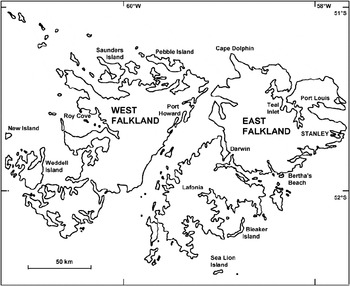
The present paper deals only with the coprophilous elements of the mycota, but still adds considerably to records previously published and demonstrates how important it is to have someone permanently in an area so that collecting can be conducted over a long period of time and throughout the year. The total mycota now approaches 370 species (Watling, unpublished), a three-fold increase since Jalink & Nauta (Reference Jalink, Nauta, Petrini and Laursen1993) and Nauta (Reference Nauta1999), and includes the first records of fungi from New and Weddell Islands (West Falkland), and Bleaker and Sea Lion Islands (East Falkland), and also adds to Nauta & Jalink’s (1993) collections from Pebble and Saunders Islands (West Falkland) (see Fig. 1).
Map of the Falkland Islands, showing main areas of collecting.

Materials and Methods
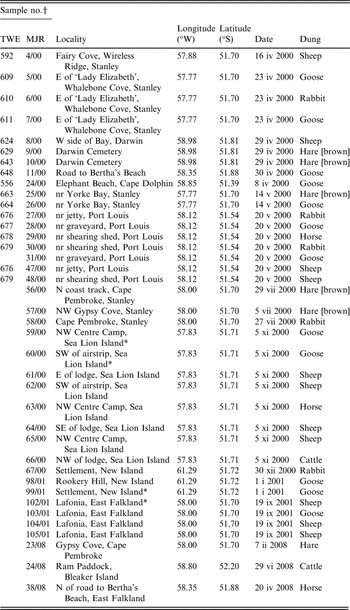
Larger fungi were described and dried by Tom Eggeling following the directions of the British Fungus Flora (Henderson et al., Reference Henderson, Orton and Watling1969) before transport to the UK. Over 1500 collections were sent for examination to Edinburgh, many of which were coprophils. Some additional specimens were received from R. Lewis (Kew). Collection details of specimens collected in the field are given with locality and collector [TWE, RL] number in the records. In addition, 39 samples of dung from sheep (11), cattle (2), horse (3), rabbit (5), hare (6) and goose (12) were dried and returned to the UK, rehydrated and incubated in moist chambers to record the fungi that developed (Richardson & Watling, Reference Richardson and Watling1997). Table 1 shows the collection locality of dung samples that were then incubated and the fungi recorded. The sample numbers in that table are used to refer to the occurrence of species in the text below, with an ‘E’ at the end when a specimen has been deposited at the Royal Botanic Garden Edinburgh, Scotland.
Collection details of dung samples collected and incubated

†TWE = numbers assigned by T. W. Eggeling to his collections; MJR numbers are part of a continuing series ‘sample no./year’, and are assigned in sequence of receipt and incubation. * samples did not yield any target fungi.
Natural Communities and Ecology
The natural vegetation of the Falkland Islands has been speculated as originally resembling that of the Atlantic heath in the northern hemisphere, being covered in well-developed dwarf shrub and upland grasslands but, in contrast, with valleys filled with dense bushes of Chiliotrichum diffusum (G.Forst.) Kuntze (Asteraceae). The introduction of livestock, however, first cattle and then sheep around 1867, undoubtedly had considerable influence on the vegetation, a summary of which is given by Cotton (Reference Cotton1915). European rabbits (Oryctolagus cuniculus L.) were probably first introduced by the French colonists in 1764 when they set up their settlement in Port Louis, East Falkland. Their population seems to be quite stable but they have not spread on their own; those on New Island were introduced at the end of the 1700s or the beginning of the 1800s, although there is some debate as to their true identity; Strange (Reference Strange1992) has suggested that they resemble the North American eastern cottontail (Sylvilagus floridanus J.A.Allen), but at least two pelts have been identified as Oryctolagus. Hares (Lepus europaeus Pallas) are confined to East Falkland and have not spread to other areas, although they have colonised the whole of mainland East Falkland. It is doubtful whether these lagomorph introductions have had as much effect on the native vegetation and coastal fringe of tussock grass (Poa flabellata (Lam.) Raspail) as the domesticated animals.
Large areas are still covered in oceanic heath of Empetrum rubrum Vahl, often accompanied by Gaultheria pumila (L.f.) D.J.Middleton (both Ericaceae) and Baccharis (Asteraceae). On poorly drained soils, grazed by sheep, there is a characteristic development of Cortaderia pilosa (d’Urv.) Hack., a grass dominating many areas of the whole island group, although under heavy stocking even this is flattened. Stocking by domestic sheep, estimated at 650,000, with a few thousand cattle and horses, strongly influenced the vegetation everywhere, and their dung has been a source of many fungi. At higher altitudes Gaultheria is frequently a co-dominant and there may be substantial development of fibrous peat. In some places the heathland is replaced by stands of Blechnum magellanicum Desv. with Gunnera and other coarse herbs. The mountainous areas of West and East Falkland are capable of supporting only a thin and dry soil colonised by cushion plants and feldmark formations. In wetter areas extensive bog formation has taken place. Tussock formation, for which the Falkland Islands are well known, is confined to the coastal areas and, although formerly more extensive, has been much reduced by uncontrolled grazing. On the coast there are developments of the introduced Elymus and Ammophila in dune formations and landward to these are short turf areas including Armeria macloviana Cham. and Cotula scariosa (Cass.) Franchet, which are grazed by geese and sheep and frequented by penguins. The lightly grazed or ungrazed areas, previously often seeded with Holcus lanatus L., are now more or less neglected and, nearer settlements, several improved grasslands and meadows occur, sometimes ploughed and seeded with foreign European grasses. Shrubs, such as the Hebe associations, are now confined to inaccessible areas of the coast and have become scarce because of earlier grazing regimes and, in some areas, they have been replaced by the introduced and invasive gorse (Ulex europaeus L.). Thus the influence of domesticated and, to a lesser extent, native animals on the vegetation has been very marked. Destruction of the grassland ecosystems has been accentuated by the grazing of the rabbits, and to a lesser extent hares, introduced from Europe.
It is difficult to determine precisely the level of endemism that might be expected in the Falkland Islands mycota. The almost 350 species of larger fungi now recorded for the Falkland Islands reflect a remarkably similar mycota to that seen in the north temperate or alpine-type climates. This supports a similar statement made by Pegler et al. (Reference Pegler, Spooner and Smith1980) based on an even smaller number of species and concurred more recently by Bridge et al. (Reference Bridge, Spooner and Roberts2009). Certainly the coprophils so far identified would fit that pattern. The marked Australian distribution of some species of larger fungi recorded can be assigned to human activity, whilst other species have an Australian/South American pattern. There is every likelihood that many if not all the coprophils so far identified have been introduced, although Chalmers et al. (Reference Chalmers, Harper and Marshall1996) have shown that air moves from South America to Antarctica on a regular basis.
Diversity and Species Richness
One of us (MJR) has, over the past 15 years, collected and incubated over 1100 samples of herbivore dung from various localities worldwide. Data from these samples have allowed estimates of diversity and species richness of the coprophilous mycota to be made for different regions and latitudes (e.g. Richardson, Reference Richardson2001, Reference Richardson2007a). The records from the 39 samples of dung incubated from the Falkland Islands have been analysed in the same way. The average number of species per sample was 5.3, which is lower than one would normally expect from earlier studies, even considering a higher proportion of samples from hare and goose in the Falkland Islands collections. These typically have a lower species richness of coprophils than, for example, rabbit, cattle, sheep and deer (Richardson, Reference Richardson2001). The small and remote nature of the islands could also be expected to contribute to the lower species richness and diversity. A small collection of samples from another Southern Ocean locality, the Kerguelen Islands (49–50°S), showed similar low diversity (Richardson, Reference Richardson2008a). The equation for the cumulative species curve from the Falkland Islands samples (total no. of species recorded with successive samples, y), y = 4.367x 0.7586, gives an estimate of 85 species for x = 50 samples. This compares with values of 81 species per 50 samples for collections from the higher latitude, but larger and more coherent, land mass of Iceland (64–66°N), and an estimate of 94–96 species from the latitude of the Falkland Islands (c.52°S) obtained by solving the equation for the relationship between latitude and species richness (y = 132.2 + 0.086x – 0.012x 2, where y = no. of species/50 samples, x = latitude [°N or S, negative if S]) (Richardson, Reference Richardson2007a). This shows that there is a latitudinal gradient of increasing species richness of coprophilous fungi with decreasing latitude.
Records of Fungi
Basidiomycota
Tricholomataceae
Clitocybe amarescens Harmaja
This is a member of the Clitocybe metachroa (Fr.) P.Kumm. group and is strongly nitrophilous, growing either on old dung or on soil in heavily dunged fields. It has been found throughout West and East Falkland grouped around dung, on cattle dung-enriched ground or sheep dung-enriched soil (TWE139, Stanley, 1 iv 2008; TWE3181, near Manager’s House, Teal Inlet, 25 iv 1999; TWE3196, on sheep, Government House, Stanley, 27 vi 1999 (also 24 v 1999); TWE3487, 3491, on old horse dung, near Manager’s House, Teal Inlet, 1 iv 2000; TWE3521, garden soil, Snake Hill, Stanley, near Airport, 1 iv 2000; TWE3619, sheep and cattle-enriched soil, near N gate to Goose Green, 29 iv 2000; TWE3627, on dung in enriched grassland, near Cemetery, Darwin, 29 iv 2000; TWE3630, dung-enriched grass, near Lodge, Darwin, 29 iv 2000; TWE3650, sheep and goose dung-enriched grassland, by road to Bertha’s Beach, 30 iv 2000; TWE3670, sheep and cattle-enriched soil, N side of bay from Darwin, 29 iv 2000; TWE3672, 3673, grouped around dung, Settlement, Bleaker Island, 17 v 2000; TWE3686, dung-enriched area near Jetty, Port Louis, 20 v 2000; TWE3715, on cow near Manager’s House, Teal Inlet, 2 vii 2000), with four records from Bleaker Island (TWE271, 279, 285, 301). This agaric has only comparatively recently been recognised in Europe; additional names are Clitocybe harmajae Lamoure and C. nitrophila Bon, a name used for the Falkland Islands collections. It is rather common in the Netherlands, and may be common in a single locality on the Falkland Islands, but is always associated with anthropogenic activities. It is probably not truly coprophilous as it is doubtful whether the thin-walled spores would pass without damage through an animal’s gut.
Coprinaceae
Coprinus has been redefined in recent years (Redhead et al., Reference Redhead, Vilgalys, Moncalvo, Johnson and Hopple2001), based on molecular studies and the fact that the anatomical details of the type species, Coprinus comatus (O.F.Müll.) Pers., which has been found in the Falkland Islands, are more closely related to Agaricus (Agaricaceae) than to many other fungi traditionally placed in Coprinus. Twenty-two species of Coprinus, as traditionally circumscribed, have been recorded from the Falkland Islands, of which 12 are coprophils.
Coprinellus brevisetulosus (Arnolds) Redhead, Vilgalys & Moncalvo (syn.: Coprinus brevisetulosus Arnolds)
This was recorded by Jalink & Nauta (Reference Jalink, Nauta, Petrini and Laursen1993) as Coprinus stellatus Sacc., although there is no doubt this record is in the sense generally accepted in Europe, sensu M.Lange & A.H.Sm.; it was found on old horse dung (TWE3440, Paddock, West of Community School, Stanley, 15 iii 2000). This is a very small species that resembles Coprinellus pellucidus q.v., but differs in the presence of pleurocystidia and ovoid-oblong cheilocystidia. Like that species it is widespread in distribution but very ephemeral.
Coprinellus curtus (Kalchbr.) Vigalys, Hopple & Jacq.Johnson (syn.: Coprinus curtus Kalchbr.)
One collection on horse dung from Sea Lion Island, East Falkland (63/00). Coprinellus curtus, although widespread in the northern hemisphere, is rather rare. It is characterised by the brown, thick-walled globose to ellipsoid velar remnants and subcapitate pileocystidia. It has been recorded several times, as Coprinus curtus or Coprinus plicatiloides Buller, from Australia (May & Wood, Reference May and Wood1997).
Coprinellus heptemerus (M.Lange & A.H.Sm.) Vigalys, Hopple & Jacq.Johnson (syn.: Coprinus heptemerus M.Lange & A.H.Sm.)
A single collection noted by Jalink & Nauta (Reference Jalink, Nauta, Petrini and Laursen1993). This small species is frequent and widespread and often isolated from dung samples incubated in the laboratory; it is related to Coprinellus curtus q.v., differing in the non-capitate pileocystidia and spine-like elongations to the velar remnants.
Coprinellus pellucidus (P.Karst.) Redhead, Vilgalys & Moncalvo (syn.: Coprinus pellucidus P.Karst.)
One collection from cattle dung from Bleaker Island, East Falkland (24/08), and another, which might have been this species, recorded by Jalink & Nauta (Reference Jalink, Nauta, Petrini and Laursen1993). Coprinellus pellucidus is common and widespread and frequently occurs on incubated dung samples. It is known from Australia (May & Wood, Reference May and Wood1997).
Coprinopsis cordispora (T.Gibbs) Watling & M.J.Richardson, comb. nov. (Basionym: Coprinus cordisporus T.Gibbs, The Naturalist, London: 100 (1908))
Five records from cattle (TWE3364, near Mt Harriet, Stanley, 23 ii 2000) and horse (TWE3199, by L’Antioja Stream, 30 iv 1999; 29/00; TWE3602, N slopes of Sappa Hill, Stanley, 22 iv 2000; TWE3834, on horse, near Pump House, Millet Creek, Stanley, 11 ii 2000) dung and rabbit (6/00E) pellets from West and East Falkland; a single record from Pebble Island, West Falkland (TWE3113, W of Elephant Bay, Pebble Island, 21 iii 1999). This is a very common and widespread small, delicate species in northern latitudes and frequently fruits on a range of dung samples incubated in the laboratory. It is rarely collected intact in the field. It has long been confused with Coprinus patouillardii Quél. (for which no combination in Coprinopsis has been made), a species identified by Jalink & Nauta (Reference Jalink, Nauta, Petrini and Laursen1993) from Falkland. This latter species differs from Coprinopsis cordispora in its non-coprophilous habit and globose to broadly ellipsoid cheilocystidia. This species is probably recorded as Coprinus patouillardii for Chile (Singer, Reference Singer1969) and from several sites in Australia (May & Wood, Reference May and Wood1997; MJR, unpublished).
Coprinopsis ephemeroides (DC.) Watling & M.J.Richardson, comb. nov. (Basionym: Agaricus ephemeroides DC. in DC. & Lam., Flore français, ed. 3, 2: 145 (1805)) (syn.: Coprinus ephemeroides (DC.) Fr.)
Two records on horse dung from East Falkland (TWE3200, by L’Antioja Stream, 30 iv 1999; TWE3210, by Whalebone Creek, Stanley, 1 v 1999). This is a relatively common, small and delicate species with a widespread distribution. It is easily identified in the field from the small annulus. It is close to both Coprinopsis cordispora q.v. and Coprinus patouillardii, differing particularly in the presence of an annulus and yellow tinges to the pileus. Singer (Reference Singer1969) and Richatt & Castillo (Reference Richatt and Castillo1980) record this species from Chile under the synonym Coprinus bulbillosus Pat., and it is known from Tierra del Fuego (Horak, Reference Horak, Guarrera, Gamundi de Amos and Matteri1979).
Coprinopsis nivea (Pers.) Redhead, Vigalys & Moncalvo (syn.: Coprinus niveus (Pers.) Fr.)
Nine collections on cattle and horse dung from East Falkland (TWE48, 49, west of Racecourse, Stanley, 18 iv 2008; TWE3197, paddock at Stanley, 28 iv 1999 and 18 v 1999; TWE3341, on horse, Pond near Yorke Bay Dunes, Stanley, 18 ii 2000; on horse, near Gypsy Cove, Stanley, 12 iii 2000; TWE3560, on horse, Kent Road, Stanley, 2 ii 2000; TWE3628, on cattle, N side of Bay, Darwin, 29 iv 2000; Racecourse, Stanley, 2008 and 2009), and one from Roy Cove, West Falkland (TWE3079, 24 iv 1999). A single collection was noted by Jalink & Nauta (Reference Jalink, Nauta, Petrini and Laursen1993). Two collections from East Falkland agreed with Orton’s (Reference Orton1972) description of Coprinus latisporus P.D.Orton (for which no combination in Coprinopsis exists), which is said to differ from Coprinopsis nivea in the shape and size of the basidiospores. Modern authors, however, consider it to fall within the range of variation of Coprinopsis nivea and not worthy of separation. Coprinopsis nivea is common and widespread and can be frequently found and recognised in the field, even if collapsed and dried. It is known from several Australian localities (May & Wood, Reference May and Wood1997). A record believed to be close to this species was made for the Kerguelen Islands by Hennings (Reference Hennings and Drygaslski1906).
Coprinopsis pachysperma (P.D.Orton) Redhead, Vigalys & Moncalvo (syn.: Coprinus pachyspermus P.D.Orton)
A single collection on horse dung is known from West Falkland (TWE3336, near Community School, Stanley, 16 ii 2000). It is closely related to Coprinopsis nivea, differing in the 2-spored basidia. Its world distribution is not known since the number of basidiospores per basidium is rarely recorded.
Coprinopsis radiata (Bolton: Fr.) Redhead, Vilgalys & Moncalvo (syn.: Coprinus radiatus (Bolton) Gray)
Cotton (Reference Cotton1915) recorded this taxon and assumed Berkeley’s Coprinus sp. was also this species. It was neither recorded by Jalink & Nauta nor found amongst the material submitted by Eggeling. It is a common and widespread species and, although small, can be recognised in the field by its clustered habit and fluffy veil. It is especially common on rather damp dung samples; it is surprising it was not found during the present study. It is also known from Australia (May & Wood, Reference May and Wood1997; MJR, unpublished).
Coprinopsis stercorea (Fr.) Redhead, Vilgalys & Moncalvo (syn.: Coprinus stercoreus Fr.)
Three records of this extremely small species developed on one sample each of horse (29/00) and sheep (105/01) dung and rabbit pellets (30/00) from East Falkland. It is easily recognised by the white, glistening, rapidly collapsing basidiomes and small basidiospores. It is widespread and common worldwide, with Southern Ocean records, especially as Coprinus stercorarius (Bull.) Fr., from South Georgia (Pegler et al., Reference Pegler, Spooner and Smith1980), the Kerguelen Islands (Hennings, Reference Hennings and Drygaslski1906), New Zealand (Bell, Reference Bell1983) and Australia (May & Wood, Reference May and Wood1997; MJR, unpublished).
Coprinopsis vermiculifera (Joss. ex Dennis) Redhead, Vilgalys & Moncalvo (syn.: Coprinus vermiculifer Joss. ex Dennis)
One collection on cattle dung from Sea Lion Island, East Falkland (66/00). Although apparently widespread it is rarely recorded. It can be identified by the large basidiospores and the thick-walled, diverticulate velar elements with brown ends. It is also known from South Georgia (Pegler et al., Reference Pegler, Spooner and Smith1980) and Australia (May & Wood, Reference May and Wood1997).
Parasola misera (P.Karst.) Redhead, Vigalys & Hopple (syn.: Coprinus miser P.Karst.)
Ten collections on several dung types (horse (63/00), cattle (66/00), sheep (4/00, 8/00, 47/00, 48/00), hare (9/00E, 57/00) and rabbit (6/00, 67/00)), all of which were from 26 non-goose samples that were incubated. It was the most frequent species of Coprinaceae recorded. Most samples were from East Falkland and Sea Lion Island, but one was from New Island, West Falkland. Jalink & Nauta (Reference Jalink, Nauta, Petrini and Laursen1993) published a single record from Falkland and there is also a record from the Kerguelen Islands (Richardson, Reference Richardson2008a). This is an extremely tiny but widespread species, frequently seen in the field as minute primordia, and is very commonly isolated on incubated dung samples. The occurrence, at approximately 40%, is at a similar level to that found in many other high latitude areas of the world (e.g. Iceland, Faroe Islands, UK and France; Richardson, Reference Richardson2001, Reference Richardson2004, Reference Richardson2005, Reference Richardson2007a, Reference Richardson2008a).
Bolbitiaceae
Agrocybe fimicola (Speg.) Singer
Two collections from East Falkland (TWE39, on horse, Gypsy Cove, Cape Pembroke, 7 ii 2008; TWE3183, on cattle, Manager’s House, Teal Inlet, 25 iv 1999). Described by Singer (Reference Singer1951), it is well known from South and Central America and the southern states of North America. The related Agrocybe neocoprophila Singer is recorded from Australia (Hilton, Reference Hilton1988).
Bolbitius vitellinus Pers.
A member of this group, with larger than normal basidiospores, was found on old horse or cattle dung, West Falkland (TWE3490, near Manager’s House, Teal Inlet, 1 iv 2000). Bolbitius vitellinus is an extremely variable, widespread and common agaric and it is possible that this form falls within the limit of the taxon. Singer (Reference Singer1969) considers this a common South American agaric; recorded from Brazil (Watling, Reference Watling1992). It is also known from several sites in Australia as Bolbitius boltonii (Pers.) Fr., B. flavidus (Bolton) Massee, B. fragilis (L.) Fr. and B. vitellinus (May & Wood, Reference May and Wood1997).
Conocybe digitalina (Velen.) Singer
A worldwide species (including Conocybe subpubescens P.D.Orton, Conocybe cryptocystis sensu auct.) recorded from two sites by Jalink & Nauta (Reference Jalink, Nauta, Petrini and Laursen1993), and also from Tierra del Fuego. Singer (Reference Singer1969) includes this under Conocybe cryptocystis (Atk.) Singer sensu Singer, but that differs in minute details according to Hausknecht (Reference Hausknecht2003).
Conocybe magnispora (Murrill) Singer
This species has been found on cattle dung on three occasions, from both West and East Falkland (TWE3173, Sapper’s Hill, Stanley, 24 iv 1999; TWE3546, short turf by pond, Elephant Beach, Cape Dolphin, 8 iv 2000; TWE3957, near Quarantine Site, Navy Point, Stanley, 9 ix 2000). It has also been recorded from Argentina by Singer (Reference Singer1969) and Brazil by Watling (Reference Watling1992). It was originally described from Florida, and has more recently been recorded from Europe.
Conocybe pubescens (Gillet) Kühner
Five collections on horse dung and dung-enriched soil in both East and West Falkland (TWE3033, on old horse dung, Stanley, 16 ii 1999; TWE3523, on horse, dunes on way to Yorke Bay, Main Dunes, near Airfield, Stanley, 2 iv 2000; TWE3622, cattle and sheep-enriched greens, W side of Bay, Darwin, 29 iv 2000; TWE3792, on cattle, Settlement, Weddell Island, 20 i 2009; 24/08); single collection incubated on dung from Bleaker Island (TWE292, on old cow dung, 29 vi 2008). Three additional collections from similar localities in West and East Falkland are probably referable here. This species is also known from Argentina (Singer, Reference Singer1953) and Brazil (Watling, Reference Watling1992), and is widespread in Europe.
Panaeolus antillarum (Fr.) Dennis
Six collections from East Falkland on cattle and horse dung (TWE3, on horse, Green House, Stanley; TWE5, on horse, Racecourse, Stanley; TWE3159, N of airport, Penguin Walk, Stanley, 18 iv 1999; TWE3270, Cape Pembroke, Stanley, 12 vi 1999; TWE3317, Jeremy Moore Av., Stanley, 12 ii 2000; TWE3639, by cemetery, Darwin, 29 iv 2000). This species differs from Panaeolus semiovatus (see below) in the lack of veil. It is a widespread tropical–subtropical coprophil, although the distribution extends into northern temperate areas.
Panaeolus papilionaceus (Bull.) Quél.
Several collections of Panaeolus campanulatus (L.) Quél. and P. sphinctrinus (Fr.) Quél. are brought together under this name. Gaudichaud first recorded this species under this name as Agaricus and Jalink & Nauta (Reference Jalink, Nauta, Petrini and Laursen1993) record it in their compilation. In the present study Panaeolus campanulatus was found three times on horse dung in East Falkland (TWE3074, Cape Pembroke, Stanley, 12 vi 1999; TWE3513, Yorke Dunes, Airport, Stanley, 2 iv 2000; TWE3520, near Manager’s House, Teal Inlet, 1 iv 2000) and P. sphinctrinus nine times on horse droppings and dunged soil in both West and East Falkland (TWE466, on horse dung, Cape Pembroke, Stanley, 19 iii 1999; TWE3066, on horse, Port Howard, 24 iv 1999; TWE3345, 3348, 3349, on peaty soil with horse dung, Jeremy Moore Av., Stanley, 21 ii 2000; TWE3409, 3410, on horse, Jeremy Moore Av., Stanley, 24 ii 2000; TWE3466, on horse, Cape Pembroke, Stanley, 19 iii 2000; TWE3893, on dung, Bertha’s Beach, 12 v 2000). Also collected from Yorke Bay Pond, Stanley, 26 i 2009 (RL466).
Panaeolus papilionaceus is a very common and widespread agaric, characterised especially by the prominent appendiculate velar remnants to the pileus. The concept adopted in the identification of the Falkland Islands material was that Panaeolus papilionaceus has a whitish pileus that soon cracks, P. campanulatus has a red-brown pileus and P. sphinctrinus has a grey, sepia or almost black pileus. Panaeolus sphinctrinus is known from Argentina, including Tierra del Fuego (Horak, Reference Horak, Guarrera, Gamundi de Amos and Matteri1979, as P. papilionaceus and P. sphinctrinus), Chile (Richatt & Castillo, Reference Richatt and Castillo1980, as P. retirugis (Fr.) Gillet and P. sphinctrinus), and Mexico (Singer, Reference Singer1969). It is also known from South Georgia (Pegler et al., Reference Pegler, Spooner and Smith1980) and from many sites in Australia under the names Panaeolus campanulatus, P. papilionaceus and P. sphinctrinus (May & Wood, Reference May and Wood1997).
Panaeolus semiovatus (Sowerby) S.Lundell & Nannf.
Many collections, including one assignable to Panaeolus semiovatus var. minor (J.E.Lange) Bon (TWE3824), have been found on West and East Falkland. It generally occurs on horse droppings and very much less commonly on cattle dung (TWE264, on cattle, Stanley, 6 vi 2008; TWE295, on cattle, Port San Carlos, vi 2008; TWE297, on cattle, Port Sussex, 29 vi 2008; TWE3026, on horse, Bertha’s Beach, 24 i 1999; TWE3107, on horse, Stanley, 17 iii 1999; TWE3125, on horse, Airstrip, Pebble Island, 20 iii 1999; TWE3144, on horse, Pebble Island, 28 iii 1999; TWE3179, on horse, Whalebone Cove Point, 28 iii 1999; TWE3184, cattle, Bleaker Island, 12 iv 1999; TWE3347, enriched soil with horse dung, Jeremy Moore Av., Stanley, 21 ii 2000; TWE3363, on horse, near Community School, Stanley, 22 ii 2000; TWE3423, on horse, SE of Airport, Cape Pembroke, 11 iii 2000; TWE3437, on horse, near Beaver Hangar, Rors Road, W Stanley, 15 iii 2000; TWE3462, on horse, E of Estancia Road, W of Two Sisters, Stanley, 25 iii 2000; TWE3555, on horse, Elephant Bay, Cape Dolphin, 8 iv 2000; TWE3578, on cattle, Fairy Cove, Wireless Ridge, Stanley, 15 iv 2000; TWE3603, on horse, N slopes of Sappa Hill, Stanley, 22 iv 2000; TWE3625, on cattle, N side of Bay, Darwin, 29 iv 2000; TWE3824, on horse, near Swan Pond, Cape Dolphin, 27 i 2000; TWE3835, on horse, near Pump House, Millet Creek, Stanley, 11 ii 2001; TWE3852, on horse, W of Community School, Stanley, 10 iii 2001; (TWE reported with no specimens, on horse, W of FIGAS ship, Stanley, 10 iii 2001; Cape Pembroke, Stanley, 10 iii 2001). Jalink & Nauta (Reference Jalink, Nauta, Petrini and Laursen1993) record four sites for this species, so making it one of the commonest coprophilous agarics in the Falkland Islands. It is widespread and common in northern Europe and America. An evelate form has been identified from four samples from West Falkland; such forms were identified as Panaeolus antillarum but are now considered to be Panaeolus semiovatus var. phalaenarum (Fr.) Ew.Gerhardt. The species is known from Argentina (Singer, Reference Singer1969). There are several records from Australia as Anellaria semiovata (Sowerby) A.Pearson & Dennis, Panaeolus separatus (L.) Quél., P. fimiputris sensu auct. mult. and P. phalaenarum (Fr.) Quél. (May & Wood, Reference May and Wood1997).
Panaeolus subfirmus P.Karst.
Identified as Panaeolus speciosus P.D.Orton, this agaric seems to be identical to P. subfirmus P.Karst. It has been found four times on both West and East Falkland (TWE3132, on horse, Capricorn Hill, Stanley, 28 iii 1999; TWE3158, on horse, N of Stanley, Penguin Walk, 18 iv 1999; TWE3508, on horse, near Manager’s House, Teal Inlet, 1 iv 2000; TWE3904, on horse or cattle, Bertha’s Beach, 12 v 2000). Recorded from Australia as Panaeolus speciosus (Hilton, Reference Hilton1988).
Entolomataceae
Clitopilus passeckerianus (Pilát) Singer
This agaric developed on one sample of sheep dung from near the shearing shed, at Port Louis, East Falkland (48/00). It normally occurs on hay, straw, woodchip and similar substrates. It has also been recorded from Europe. The closely related but non-coprophilous Clitopilus hobsonii (Berk. & Broome) P.D.Orton var. chilensis Singer has also been recorded from the Falkland Islands.
Strophariaceae
Psilocybe coprophila (Bull.) P.Kumm.
One record from East Falkland on horse droppings (TWE3838, on horse, near Pump House, Millet Creek, Stanley, 11 ii 2000). It is also known from South Georgia (Pegler et al., Reference Pegler, Spooner and Smith1980). Several collections are known from Australia (May & Wood, Reference May and Wood1997). It has been recorded from Tierra del Fuego (Horak, Reference Horak, Guarrera, Gamundi de Amos and Matteri1979) and Chile (Richatt & Castillo, Reference Richatt and Castillo1980).
Psilocybe ? cubensis (Earle) Singer
A single collection on very old dung in East Falkland (TWE3618, old dung, at the memorial to H. Jones & Men, Darwin, 29 iv 2000) agreed in part with this magic mushroom, often called Mexican gold top. Psilocybe cubensis is widespread in farmland and other suitable areas in Australia, especially tropical and subtropical regions (May & Wood, Reference May and Wood1997).
Psilocybe moelleri Guzmán
Records of this member of the Psilocybe merdaria (Fr.) Ricken consortium are based on horse dung from East Falkland (TWE288, east of Trig. Point, Bleaker Island, 29 vi 2008; TWE3427, on horse, Gypsy Cove, Stanley, 11 iii 2000; TWE3541, Elephant Beach, Cape Dolphin, 8 iv 2000; TWE3734, on horse, valley SE Cemetery, Darwin, 22 vii 2000; TWE3850, on horse, paddock west of Community School, Stanley, 10 iii 2000; RL464, Whalebone Cove, Stanley, 25 ii 2009). Jalink & Nauta (Reference Jalink, Nauta, Petrini and Laursen1993) recorded it from two further sites. Psilocybe merdaria is known from South Georgia (Pegler et al., Reference Pegler, Spooner and Smith1980) and from Chile (Richatt & Castillo, Reference Richatt and Castillo1980). A further collection approaching this taxon, apparently unassociated with raw dung, was found on Bleaker Island.
Psilocybe subcoprophila (Britzelm.) Sacc.
This appears to be one of the commonest coprophilous agarics throughout the Falkland archipelago, with several collections on horse droppings and cattle dung in East and West Falkland, including Pebble Island (TWE130, Bertha’s Beach; TWE150, Cape Pembroke; TWE3036, on horse, Pebble Island Airfield, 14 ii 1999; TWE3111, valley at Fish Creek, Pebble Island, 19 iii 1999; on cattle, Settlement, Pebble Island, 21 iii 1999; TWE3156, on horse, Cape Pembroke, Stanley, 8 v 1999; TWE3160, 3161, on horse, Penguin Walk, N of Stanley Airport, 18 iv 1999; on horse, Cape Pembroke, Stanley, 25 iii 2000; TWE3519, on horse, near Manager’s House, Teal Inlet, 1 iv 2000; TWE3890, on horse and cattle dung, Bertha’s beach, 12 v 2000). It has been recorded from Tierra del Fuego (Horak, Reference Horak, Guarrera, Gamundi de Amos and Matteri1979, as Deconica subcoprophila (Britzelm.) E.Horak) and Chile (Richatt & Castillo, Reference Richatt and Castillo1980), and occasionally in north temperate areas.
Stropharia semiglobata (Batsch) Quél.
This species has been found on horse, cattle and sheep dung, and possibly hare pellets, from 40+ collections from East and West Falkland, including Weddell and Bleaker Islands; it also occurs on dung-enriched pastures. There is a more recent collection from Stanley, 22 xii 2008 (RL185). It was also recorded by both Cotton (Reference Cotton1915) and Jalink & Nauta (Reference Jalink, Nauta, Petrini and Laursen1993), in the latter from three sites. It is undoubtedly the commonest and most widespread coprophilous agaric in the Falkland Islands. It is common and widespread in South and North America and in Europe. It is common throughout Australia (see May & Wood (Reference May and Wood1997) for references). It is also known from Tierra del Fuego (Horak, Reference Horak, Guarrera, Gamundi de Amos and Matteri1979) and from Chile (Richatt & Castillo, Reference Richatt and Castillo1980).
Ascomycota
Pezizales, Pyronemataceae
Cheilymenia fimicola (de Not. & Bagl.) Dennis
Four collections on cattle dung from near Stanley (TWE3006, near Green Patch, East Falkland, 24 viii 1997; TWE3011, near Gypsy Cove, Cape Pembroke; TWE3098, Whalebone Cove, Cape Pembroke, 24 xi 1998; TWE3370, on cattle, near Mt Harriet, Stanley, 23 ii 2000), and two from Bleaker Island (TWE277, on old cow dung, Trig. Point, 29 vi 2008; TWE292, on old cow dung, Ram Paddock, 30 vi 2008). It was noted on cattle dung by Berkeley (Reference Berkeley and Hooker1847) from Port Louis, East Falkland, as Peziza stercorea Pers. (det. Pegler in Pegler et al., Reference Pegler, Spooner and Smith1980), and by Cotton (Reference Cotton1915), as Cheilymenia stercorea (Pers.) Boud. (see Pegler et al., Reference Pegler, Spooner and Smith1980). It is common and widespread in Europe where it most commonly occurs on cattle dung, and less frequently on horse and occasionally on rabbit dung. It has been recorded from Chile (Richatt & Castillo, Reference Richatt and Castillo1980, as Cheilymenia coprinaria (Cooke) Boud.), from cattle dung from Argentina (Gamundi, Reference Gamundi, Guarrera, Gamundi de Amos and de Halperin1975), and as Cheilymenia coprinaria var. megaspora Gamundi, with much larger ascospores, from Tierra del Fuego (Gamundi, Reference Gamundi, Guarrera, Gamundi de Amos and de Halperin1975).
Cheilymenia raripila (Phill.) Dennis
A single collection on horse dung from East Falkland (TWE3009, near Whalebone Cove, Cape Pembroke, 8 xi 1998). It is also known from Australia (Bell, Reference Bell2005), and on horse and cattle dung from Tierra del Fuego (Gamundi, Reference Gamundi, Guarrera, Gamundi de Amos and de Halperin1975).
Cheilymenia stercorea (Pers.) Boud.
On horse/cattle dung from Pebble Island, West Falkland (TWE3129, Elephant Bay, Pebble Island, 21 iii 1999), and on East Falkland (TWE3516, 3517, on horse, near Manager’s House, Teal Inlet, 1 iv 2000). A further collection, with spores 22 μm long, has been found on cattle dung. It was also recorded by Cotton (Reference Cotton1915, teste Pegler et al., Reference Pegler, Spooner and Smith1980). It is also known from Australia (Bell, Reference Bell2005) and is common and widespread in the northern hemisphere. It is known from Tierra del Fuego on horse and cattle dung (Gamundi, Reference Gamundi, Guarrera, Gamundi de Amos and de Halperin1975), and also from Chile (Richatt & Castillo, Reference Richatt and Castillo1980). Cheilymenia humarioides Gamundi described from Tierra del Fuego differs in its small hairs and large ascospores (Gamundi, Reference Gamundi, Guarrera, Gamundi de Amos and de Halperin1975).
Coprobia granulata (Bull.) Boud.
A single collection on cattle dung from Pebble Island, West Falkland (TWE3116, on cattle, Settlement, Pebble Island, 21 iii 1999). Cattle dung is the common substrate for this discomycete, considered by some to be a Cheilymenia. It is also known from Chile (Richatt & Castillo, Reference Richatt and Castillo1980) and is very common in Europe.
Pezizales, Ascobolaceae
Ascobolus albidus P.Crouan & H.Crouan
Two occurrences, on hare pellets (25/00) and cattle dung (66/00E), from near Yorke Bay, Stanley, East Falkland, and Sea Lion Island. It is one of the commonest Ascobolus species worldwide, on many types of dung, but is most common in north temperate regions (Richardson, Reference Richardson2007b). It is known in the southern hemisphere from New Zealand (Bell, Reference Bell1983) and Australia (Bell, Reference Bell2005), but is not recorded from nine samples from the Kerguelen Islands, another Southern Ocean archipelago (Richardson, Reference Richardson2008a).
Ascobolus brantophilus Dissing
A single collection on goose droppings from near Yorke Bay, Stanley, East Falkland (26/00E). It is particularly interesting because all other records of this fungus, also from goose dung, are from high latitudes in the northern hemisphere – Canada, Greenland and Norway (Dissing, Reference Dissing1989), Iceland (Richardson, Reference Richardson2004), and Yell, one of the northernmost UK Shetland Islands (Richardson, Reference Richardson2007a). It is of interest both in its occurrence at high latitudes and in its, so far, exclusive occurrence on goose dung. This distribution is similar to that of another goose-associated, high latitude species, Saccobolus quadrisporus (q.v.).
Ascobolus degluptus Brumm.
On goose droppings. Three collections from East Falkland (24/00E, 26/00E, 28/00E). It is closely related to, and possibly not distinct from, Ascobolus stictoideus (q.v., and see Richardson, Reference Richardson2007b), but with the exospore peeling from the spore. It is known from Europe on a range of dungs including goose, and is also reported from New Zealand by Bell (Reference Bell1983).
Ascobolus furfuraceus Pers.
A single record from East Falkland (TWE3076, Airstrip, Port Howard, East Falkland, 24 iv 1998). It is also known from New Zealand (Bell, Reference Bell1983) and Australia (Bell, Reference Bell2005) and is common and widespread worldwide on a range of dung types. It is known from Argentina, including Tierra del Fuego (Gamundi, Reference Gamundi, Guarrera, Gamundi de Amos and de Halperin1975), and Chile (Richatt & Castillo, Reference Richatt and Castillo1980).
Ascobolus hawaiiensis Brumm.
A collection on horse dung, East Falkland (TWE3678, on horse, Shearing Shed, Port Louis, 25 v 2000). An occasional and widespread species, with southern records from New Zealand (Bell, Reference Bell1983), Australia (Bell, Reference Bell2005), as well as on a TWE collection of sheep dung from the Torres del Paine National Park, Chile.
Ascobolus immersus Pers.
One collection each on goose droppings (28/00), horse dung (29/00) and rabbit pellets (30/00), all from Port Louis, East Falkland. It is also known from New Zealand (Bell, Reference Bell1983) and Australia (Bell, Reference Bell2005), as well as on a TWE collection of hare dung from the Torres del Paine National Park, Chile. It is common and widespread worldwide on a range of dung types but tends to be more frequent at lower latitudes (Richardson, Reference Richardson2007b). It is known on alpaca dung from Peru (Muroi et al., Reference Muroi, Udagawa, Otani and Inoue1987), several dung types from Brazil and Argentina, including Tierra del Fuego (Gamundi, Reference Gamundi, Guarrera, Gamundi de Amos and de Halperin1975), and from Chile (Richatt & Castillo, Reference Richatt and Castillo1980).
Ascobolus michaudii Boud.
Two collections on sheep dung from East Falkland and Sea Lion Island (61/00E, 105/01). It is an infrequent but widespread species, also recorded by Bell (Reference Bell2005) from Australia.
Ascobolus stictoideus Speg.
Very frequent, comprising 44% of all Ascobolus records from the archipelago, with 12 records in total from East Falkland and Sea Lion Island, and from New Island in the west, particularly on goose (5/00, 7/00E, 31/00E, 98/01, 103/01) and sheep droppings (61/00E, 62/00E, 64/00, 104/01) but also on rabbit dung (27/00E, 30/00, 67/00). Additionally, there were three occurrences of Ascobolus degluptus (q.v.), which is very similar to A. stictoideus in both morphology and ecology. Spores with the peeling exospore that defines Ascobolus degluptus have been found in the same apothecium, and even in the same ascus, as spores that are more typical of A. stictoideus. Described from South America (Spegazzini, Reference Spegazzini1879), this is a common species that appears to be cosmopolitan, with records from the Falkland Islands to Iceland and NE Greenland in the north, but with a significantly lower frequency at lower latitudes. The records are from a wide range of substrates, but by far the highest proportion is from goose droppings, with it occurring on 55% of the 29 samples studied. It occurs at much lower frequencies on rabbit, cattle and sheep dung (10–20%) (Richardson, Reference Richardson2007b). It is also known from New Zealand (Bell, Reference Bell1983) and Australia (Bell, Reference Bell2005).
Saccobolus beckii Heimerl
A single collection on sheep dung, East Falkland (8/00). This is an uncommon species and distinguished from the closely related Saccobolus versicolor by a much more coarsely warted episporium. A collection from Australia, identified by Dade as Saccobolus beckii, has been redetermined as S. verrucisporus Brumm. (Bell, Reference Bell2005), and it is unclear how distinct these two species are. Saccobolus verrucisporus was originally described from New Guinea, and has smaller spores and spore-mass than S. beckii. Saccobolus beckii has been reported on llama, alpaca and sheep dung from Peru (Muroi et al., Reference Muroi, Udagawa, Otani and Inoue1987) and MJR also has five records from Brazil, two Caribbean islands and Malaysia.
Saccobolus depauperatus (Berk. & Broome) Rehm
One record on rabbit pellets from East Falkland (30/00). It is also recorded from Australia (Bell, Reference Bell2005; MJR, unpublished) but Bell has determined that slides of three collections identified by Dade as Saccobolus depauperatus are in fact S. versicolor. It is a widespread species and occurs on a wide range of dung types.
Saccobolus quadrisporus Massee & E.S.Salmon
Two collections on goose droppings, East Falkland (7/00E, 28/00E). This species appears to be restricted to goose droppings and is characteristically found on samples from high latitudes (Richardson, Reference Richardson2007b). The occurrences from the Falkland Islands appear to be the only reports from the southern hemisphere.
Saccobolus versicolor (P.Karst.) P.Karst.
On hare pellets (10/00) and sheep dung (47/00) from East Falkland and rabbit (67/00) from New Island, West Falkland. It is also known from sheep and hare dung collected by TWE from the Torres del Paine National Park, Chile. It has been recorded from Australia (Bell, Reference Bell2005; MJR, unpublished) and is widespread worldwide on a range of dung types.
Pezizales, Pezizaceae
Iodophanus carneus (Pers.) Korf
Nine isolations from East Falkland, on cattle (24/08), sheep (8/00, 47/00) and horse dung (29/00; TWE3517, on horse, near Manager’s House, Teal Inlet, 1 iv 2000) and hare (25/00) and rabbit pellets (6/00E, 27/00, 30/00). Also known from a TWE collection of sheep dung from the Torres del Paine National Park, Chile, from the Kerguelen Islands (Richardson, Reference Richardson2008a), from New Zealand (Bell, Reference Bell1983), and from Australia (Bell, Reference Bell2005). This is a very common dung fungus worldwide and may also be isolated from or found fruiting on soil. The closely related Iodophanus testaceus (Moug. ex Fr.) Phill. has been recorded on soil from Signy Island, South Georgia (Pegler et al., Reference Pegler, Spooner and Smith1980).
Peziza fimeti (Fuckel) Seaver
Known from three collections on enriched soil, East Falkland (TWE3406, soil with horse, 4 Capricorn Rd, Stanley, 4 iii 2000; TWE3455, on horse-enriched soil, Jeremy Av., Stanley, 22 iii 2000; TWE3471, on horse-enriched soil, Jeremy Av., Stanley, 25 iii 2000). It is also known from Tierra del Fuego (Gamundi, Reference Gamundi, Guarrera, Gamundi de Amos and de Halperin1975) and has been frequently reported from Europe and North America.
Pezizales, incertae sedis
Lasiobolus ciliatus (J.C.Schmidt) Boud.
Two records on horse (TWE3469, on horse, near Gypsy Cove, Stanley, 25 iii 2000; 63/00) and cattle dung (66/00) from Sea Lion Island. Common and widespread on a variety of dung types in the northern hemisphere. It has often been called Lasiobolus papillatus (Pers.) Sacc. and L. equinus var. pilosus (Fr.) Sacc. It is also known from Australia (Bell, Reference Bell2005) and has been recorded under the latter name on a range of dung types from Paraguay and Argentina, including Tierra del Fuego (Gamundi, Reference Gamundi, Guarrera, Gamundi de Amos and de Halperin1975), and as L. pilosus (Fr.) Sacc. and L. equinus (O.F.Müll.) P.Karst. from Chile (Richatt & Castillo, Reference Richatt and Castillo1980). The closely related Lasiobolus ruber (Quél.) Sacc. has been found on cattle dung in Tierra del Fuego (Gamundi, Reference Gamundi, Guarrera, Gamundi de Amos and de Halperin1975).
Lasiobolus cuniculi Velen.
Four records on horse (TWE3470, on horse, near Mt Harriet, Stanley, 25 iii 2000; 29/00) and sheep dung (TWE3503, on sheep, valley E of Teal Inlet, 1 iv 2000; 8/00), East Falkland. It is common and widespread and often synonymised with Lasiobolus ciliatus, under which name it is recorded from Chile (Richatt & Castillo, Reference Richatt and Castillo1980). It is known from llama and sheep dung from Peru (Muroi et al., Reference Muroi, Udagawa, Otani and Inoue1987).
Thelebolales, Thelebolaceae
Thelebolus stercoreus Tode
De Hoog et al. (Reference De Hoog, Göttlich, Platas, Genilloud, Leotta and Van Brummelen2005) found that many cultures from phenotypically very different teleomorphs, including cultures from uniascal and polyascal types, with small to large asci, and few- to very many-spored types, and with many names, are molecularly indistinguishable from each other, and accept only four species of Thelebolus: T. stercoreus, T. microsporus, and two new species described from biomats in Antarctica. As a consequence, they consider Thelebolus nanus Heimerl and T. polysporus (P.Karst.) Otani & Kanzawa to be synonyms of T. stercoreus. One collection of what would have been identified as Thelebolus nanus (small apothecia, with single asci) was obtained from sheep dung from East Falkland (8/08), and five collections of T. polysporus (small polyascal apothecia) were recorded from one sample of rabbit (6/00, 67/00) and goose dung (28/00, 98/01) from each of East Falkland and New Island, West Falkland, and one from hare (23/08) from East Falkland. Thelebolus species are common and widespread worldwide, with different forms having different substrate preferences. It has also been recorded from the Kerguelen Islands (Richardson, Reference Richardson2008a), New Zealand (Bell, Reference Bell1983), Australia (Bell, Reference Bell2005; MJR, unpublished), and South America (Spegazzini, Reference Spegazzini1879). Thelebolus stercoreus (as T. crustaceus (Fuckel) Kimbr.), on guanaco and dog dung, and Ryparobius spegazzinii Gamundi (possibly also a synonym of T. stercoreus) on cattle dung are reported from Tierra del Fuego (Gamundi, Reference Gamundi, Guarrera, Gamundi de Amos and de Halperin1975).
Sordariales, Chaetomiaceae
Chaetomium crispatum (Fuckel) Fuckel
One collection on rabbit pellets, East Falkland (27/00). Chaetomium species occur occasionally on dung, but are not true coprophils.
Sordariales, Coniochaetaceae
Coniochaeta hansenii (Oudem.) Cain
One collection each on hare pellets (56/00) and sheep dung (48/00), East Falkland. It is occasional and widespread worldwide, especially on rabbit and hare pellets, including New Zealand (Bell, Reference Bell1983), Australia (Bell, Reference Bell2005; MJR, unpublished) and Chile (Muroi & Udagawa, Reference Muroi, Udagawa and Inoue1984).
Coniochaeta leucoplaca (Berk. & Ravenel) Cain
A single collection on hare pellets, East Falkland (25/00). It is known from Australia (Bell, Reference Bell2005) and Europe, especially from deer dung. Also recorded on donkey and llama dung from Peru (Muroi et al., Reference Muroi, Udagawa, Otani and Inoue1987) and on hare dung from southern Chile (Muroi & Udagawa, Reference Muroi, Udagawa and Inoue1984).
Coniochaeta ligniaria (Grev.) Massee
Four records from hare pellets (10/00, 56/00, 57/00, 23/08) and one from sheep dung (47/00) from East Falkland, and one from rabbit from New Island, West Falkland (67/00E). Also recorded on a conifer plank, Signy Island and on a piece of timber at Grytviken Whaling Station, South Georgia (Pegler et al., Reference Pegler, Spooner and Smith1980). Also known from Chile (Richatt & Castillo, Reference Richatt and Castillo1980). It is difficult to see any differences between the material on wood and that on dung, although the latter has been separated out and called Coniochaeta discospora (Auersw.) Cain.
Coniochaeta saccardoi (Marchal) Cain
One collection on rabbit pellets, East Falkland (58/00E). It is also known on the same substrate in Europe.
Coniochaeta scatigena (Berk. & Broome) Cain
Collections from hare (25/00) and two sheep (47/00, 48/00E) samples from West Falkland, one each from sheep (65/00) and horse (63/00) from Sea Lion Island, and one from rabbit (67/00E) from New Island, West Falkland. It is also recorded from New Zealand (Bell, Reference Bell1983), Australia (Bell, Reference Bell2005; MJR, unpublished), and southern Chile on hare dung (Muroi & Udagawa, Reference Muroi, Udagawa and Inoue1984). It is frequent on hare, rabbit, cattle and sheep pellets in Europe.
Sordariales, Lasiosphaeriaceae
Bombardioidea stercoris (DC.) N.Lundq.
Two collections on hare pellets from East Falkland (9/00E, 56/00). It is uncommon but widespread, at least in the northern hemisphere, on a range of dung types. It is also known from Australia (Bell, Reference Bell2005), and on hare dung from southern Chile (Muroi & Udagawa, Reference Muroi, Udagawa and Inoue1984).
Podospora australis (Speg.) Niessl
One record on sheep dung, East Falkland (105/01). Described from South America (Spegazzini, Reference Spegazzini1880), Podospora australis is infrequent but widespread, with several records from Australia (Bell, Reference Bell2005; MJR, unpublished), and on donkey and horse dung from Peru (Muroi et al., Reference Muroi, Udagawa, Otani and Inoue1987).
Podospora communis (Speg.) Niessl
A single record on sheep dung, East Falkland (105/01). It was described from South America (Spegazzini, Reference Spegazzini1880) and is also known from Australia (Bell, Reference Bell2005; MJR, unpublished). It is frequent worldwide on the dung of a wide range of mainly domesticated animals. Lundqvist (Reference Lundqvist1972) notes that verified records from the tropics are few, but in the experience of one of us (MJR) it is a low latitude species, with the majority of records from between 37°N and 32°S (Richardson, Reference Richardson2008b). The high latitude exceptions are this collection from the Falkland Islands (52°S) and one from Finland (62°N).
Podospora decipiens (G.Winter ex Fuckel) Niessl
Five collections on horse (29/00, 48/00) and sheep (8/00, 47/00, 48/00) dung, East Falkland. It is also known from New Zealand (Bell, Reference Bell1983), Australia (Bell, Reference Bell2005; MJR, unpublished), Chile (Richatt & Castillo, Reference Richatt and Castillo1980), and on alpaca, cattle and llama dung from Peru (Muroi et al., Reference Muroi, Udagawa, Otani and Inoue1987). One of the commoner species of Podospora worldwide, but especially from temperate regions.
Podospora intestinacea N.Lundq.
One collection each on hare pellets (25/00E) and sheep dung (48/00E), East Falkland. It is known from New Zealand (Bell, Reference Bell1983), Australia (Bell, Reference Bell2005; MJR, unpublished), and from Peru on horse dung (Muroi et al., Reference Muroi, Udagawa, Otani and Inoue1987). It occurs on a range of dung types, but mainly from ruminants, in the northern hemisphere.
Podospora perplexans (Cain) Cain
Single record on horse dung, Stanley, East Falkland (TWE3468, near Gypsy Cove, Stanley, 25 iii 2000). It is known from Australia (Bell, Reference Bell2005) and the northern hemisphere, also on horse but equally cattle and rabbit pellets.
Podospora setosa (G.Winter) Niessl
Two collections from sheep dung from East Falkland (105/01) and Sea Lion Island (61/00E) and one from goose droppings (91/08), New Island, West Falkland. Frequent and widespread, on various dung types, and known from New Zealand (Bell, Reference Bell1983) and Australia (Bell, Reference Bell2005; MJR, unpublished).
Schizothecium conicum (Fuckel) N.Lundq.
Nine collections on goose droppings (11/00), rabbit pellets (27/00, 30/00), horse (29/00, 63/00), cattle (66/00E) and sheep dung (8/00E, 48/00, 61/00), from East Falkland, including Sea Lion Island. Also recorded from the Kerguelen Islands (Richardson, Reference Richardson2008a). Recorded from New Zealand (Bell, Reference Bell1983) and Australia (Bell, Reference Bell2005; MJR, unpublished). Recorded as Podospora curvula (de Bary ex G.Winter) Niessl from Chile (Richatt & Castillo, Reference Richatt and Castillo1980) and on alpaca, llama and sheep dung from Peru (Muroi et al., Reference Muroi, Udagawa, Otani and Inoue1987). Common and widespread worldwide.
Schizothecium dakotense (Griffiths) N.Lundq.
One collection on goose droppings from New Island, West Falkland (98/01). It is also known on horse dung from Peru (Muroi et al., Reference Muroi, Udagawa, Otani and Inoue1987).
Schizothecium glutinans (Cain) N.Lundq.
Two collections each from hare pellets (9/00, 25/00) and sheep (47/00, 48/00) droppings from East Falkland, and one on cattle from Bleaker Island (24/08). It is also known from New Zealand (Bell, Reference Bell1983) and Australia (Bell, Reference Bell2005; MJR, unpublished). It is widespread worldwide on several dung types, including that of small rodents. It has been recorded, as Podospora glutinans (Cain) Cain, from cattle, horse, llama and sheep dung from Peru (Muroi et al., Reference Muroi, Udagawa, Otani and Inoue1987).
Schizothecium tetrasporum (G.Winter) N.Lundq.
Five collections, on goose droppings (7/00) and hare pellets (25/00, 23/08) from East Falkland, sheep dung (65/00) from Sea Lion Island, and rabbit pellets (67/00) from New Island, West Falkland. Also recorded from the Kerguelen Islands (Richardson, Reference Richardson2008a), New Zealand (Bell, Reference Bell1983), Australia (Bell, Reference Bell2005; MJR, unpublished), and on hare dung from Peru (Muroi & Udagawa, Reference Muroi, Udagawa and Inoue1984). Very common and widespread on various dung types, but especially on rabbit and rodent pellets.
Schizothecium vesticola (Berk. & Broome) N.Lundq.
Nineteen collections on goose (7/00, 26/00, 28/00, 103/01), hare (9/00, 10/00, 25/00, 57/00, 23/08), rabbit (6/00, 27/00, 30/00), sheep (4/00, 8/00E, 47/00, 48/00, 104/01), and horse (29/00, 38/08) droppings from East Falkland, on one horse (63/00) and two sheep (61/00, 62/00E) samples from Sea Lion Island, and on rabbit pellets from New Island, West Falkland (67/00). It is also known from sheep and hare dung, collected by TWE from the Torres del Paine National Park, Chile, and from New Zealand (Bell, Reference Bell1983) and Australia (Bell, Reference Bell2005; MJR, unpublished). It is very common and widespread on various dung types worldwide.
Sordaria fimicola (Roberge ex Desm.) Ces. & de Not.
A single record on goose droppings from New Island, West Falkland (98/01). It is also known from New Zealand (Bell, Reference Bell1983) and Australia (Bell, Reference Bell2005; MJR, unpublished). It is common worldwide on a range of dung types.
Sordaria superba de Not.
One record on sheep dung from Sea Lion Island, East Falkland (65/00). It is occasional and widespread and, according to Lundqvist (Reference Lundqvist1972), sometimes confused with Sordaria macrospora Auersw. The latter species has larger spores which, at the smaller end of their range, may overlap with large spores of Sordaria superba. The spores of the Falkland Islands collection were 25.5–26.5 × 15–16 μm, which are well within the range for Sordaria superba (23–29 × 14.5–17 μm, cf. 28–35 × 18–22 μm for S. macrospora; Lundqvist, Reference Lundqvist1972).
Hypocreales, Ceratostomataceae
Melanospora brevirostris (Fuckel) Höhn.
Two collections from goose (11/00, 28/00E) and one from sheep (47/00) from East Falkland.
Sphaerodes fimicola (E.C.Hansen) P.Cannon & D.Hawksw.
One collection on sheep dung from Sea Lion Island, West Falkland (65/00). A second species so far undetermined has been found on goose droppings in the Falkland Islands.
Hypocreales, incertae sedis
Selinia pulchra (G.Winter) Sacc.
One collection on goose droppings, East Falkland (11/00E). It is widespread but infrequent and mostly on the dung of domesticated animals. It is also known from New Zealand (Bell, Reference Bell1983), Australia (Bell, Reference Bell2005; MJR, unpublished) and Chile (Richatt & Castillo, Reference Richatt and Castillo1980).
Xylariales, Xylariaceae
Hypocopra. A genus that produces perithecia in limited stromata, that may have one or several perithecia, and which are largely immersed in the substrate. Last monographed by Krug & Cain (Reference Krug and Cain1974), who accepted 25 species, of which 14 were newly described. Bell (Reference Bell2005) has observed that identification is difficult, since it ultimately relies largely on spore size, with many overlapping ranges between species. Seven collections were obtained from the Falkland Islands material, which could be identified to species. As well as one collection of Podosordaria ianthina, the Falkland Islands collections, all from East Falkland, can be divided into two groups.
Hypocopra brefeldii (Zopf) Zopf
Four collections from hare pellets (9/00E, 23/00, 25/00E, 57/00) and one from sheep dung (48/00E), East Falkland, all with relatively small spores which are broad-ellipsoidal, mostly symmetrical, 21–26 × 11–14.5 μm, with germ slits 11–16 μm long, with an indication of a small basal hyaline second cell at the base of the spore. These collections agree with the description of the long-established Hypocopra brefeldii, but could be assigned to more recently described but closely related species.
Hypocopra cf. stephanophora J.C.Krug & Cain
Two collections from hare pellets (10/00E, 25/00E) and one from sheep dung (47/00E), East Falkland, had larger spores 26–38 × 11.5–15 μm, with germ slits 16–23 μm long, and no indication of a second basal hyaline cell. These best fit the description of Hypocopra stephanophora, rather than H. planispora J.C.Krug & Cain, which has narrower spores, but the distinction is not clear, and they are longer than the maximum size for both species as described. Further, the germ slit length agrees better with that given for Hypocopra planispora. They were both among species newly described by Krug & Cain (Reference Krug and Cain1974), and the Falkland Islands collections may best be considered to be near to what might be called Hypocopra merdaria (Fr.) J.Kickx f. until more information about the difference between these species and the useful taxonomic characters can be obtained.
Podosordaria ianthina J.C.Krug & Cain
One collection from hare from East Falkland (10/00E). Closely related to Hypocopra, Podosordaria ianthina is one of the sessile species that was included by Krug & Cain (Reference Krug and Cain1974) in their key to Hypocopra, with spores with germ slits that extend the full length of the spore. In this collection spores were 30–35.5 × 15–19 μm.
Xylariales, incertae sedis
Phomatospora coprophila M.J.Richardson
A single collection on sheep dung, from Darwin, East Falkland (8/00E). Quite frequent in the UK on a range of mostly ruminant dung types, but rarely recorded from other countries. There is a published record on goat dung from Germany (Welt & Heine, Reference Welt and Heine2007), and it developed on cattle dung collected in 2008 from France. One might speculate that the fungus arrived in the Falkland Islands with the sheep when they were introduced. It occurs late in the incubation period and is very small, so could be easily missed. There is another coprophilous species, Phomatospora minutissima (P.Crouan & H.Crouan) N.Lundq., which has been recorded by one of us (MJR) from France, Brazil, Australia, Guadeloupe, St Lucia, Dominica and St Helena.
Dothideales, Phaeotrichiaceae
Trichodelitschia bisporula (P.Crouan & H.Crouan) Munk
Two collections on hare pellets, East Falkland (9/00E, 10/00E). It has a worldwide distribution but is only occasionally found. It is also known from Australia (Bell, Reference Bell2005; MJR, unpublished), Chile (Richatt & Castillo, Reference Richatt and Castillo1980), and on alpaca and llama dung from Peru (Muroi et al., Reference Muroi, Udagawa, Otani and Inoue1987).
Trichodelitschia munkii N.Lundq.
On rabbit pellets, New Island, West Falkland (67/00E). Infrequent but worldwide, and known from Australia (Bell, Reference Bell2005; MJR, unpublished), and on alpaca and llama dung from Peru (Muroi et al., Reference Muroi, Udagawa, Otani and Inoue1987).
Pleosporales, Sporormiaceae
Delitschia niesslii Oudem.
Two collections on sheep dung, East Falkland (47/00, 48/00). In the northern hemisphere known on several dung types.
Sporormiella australis (Speg.) S.I.Ahmed & Cain
Nine collections on sheep dung (4/00, 48/00) and rabbit (58/00) and hare pellets (9/00, 10/00, 57/00, 23/08), East Falkland, including Sea Lion Island (62/00), and New Island, West Falkland (67/00). Described from South America (Spegazzini, Reference Spegazzini1887) and known from a TWE collection on sheep dung from the Torres del Paine National Park, Chile, the Kerguelen Islands (Richardson, Reference Richardson2008a), New Zealand (Bell, Reference Bell1983) and Australia (Bell, Reference Bell2005). Widespread and common on many dung types worldwide.
Sporormiella grandispora S.I.Ahmed & Cain ex J.C.Krug
One collection each on hare (10/00) and sheep dung (47/00) from East Falkland, one on cattle from Bleaker Island (24/08), and one from rabbit from New Island (67/00E); TWE3203, on old dung, by L’Antioja Stream Darwin Rd, Stanley, 30 iv 1999. It is also known from Australia (Bell, Reference Bell2005) and occurs on several dung types in Europe.
Sporormiella intermedia (Auersw.) S.I.Ahmed & Cain ex Kobayasi
Ten collections on sheep dung (8/00, 47/00, 48/00, 65/00), rabbit (6/00) and hare (9/00, 10/00, 25/00, 56/00, 23/08) pellets, East Falkland, including Sea Lion Island, and one from rabbit from New Island, West Falkland (67/00). Also known from sheep and hare dung collected by TWE from the Torres del Paine National Park, Chile, the Kerguelen Islands (Richardson, Reference Richardson2008a), New Zealand (Bell, Reference Bell1983), Australia (Bell, Reference Bell2005), Chile (Richatt & Castillo, Reference Richatt and Castillo1980), and on sheep dung from Peru (Muroi et al., Reference Muroi, Udagawa, Otani and Inoue1987). Widespread and probably the commonest Sporormiella species worldwide on many dung types.
Sporormiella lageniformis (Fuckel) S.I.Ahmed & Cain ex Kobayasi
On horse dung from East Falkland (38/08). Widespread and worldwide in distribution. Recorded from Chile (Spegazzini, Reference Spegazzini1921).
Sporormiella leporina (Niessl) S.I.Ahmed & Cain
One collection on old cattle dung, Bleaker Island, East Falkland (24/08). Infrequent but widespread, often at higher latitudes or elevations, and known from Australia (Bell, Reference Bell2005; MJR, unpublished).
Sporormiella megalospora (Auersw.) S.I.Ahmed & Cain
On old cattle dung, Bleaker Island, East Falkland (24/08). Also on sheep dung collected by TWE from the Torres del Paine National Park, Chile. Infrequent but widespread and worldwide, and known from Australia (Bell, Reference Bell2005; MJR, unpublished).
Sporormiella minima (Auersw.) S.I.Ahmed & Cain
On sheep dung, East Falkland (105/01). Widespread and worldwide including from Australia (Bell, Reference Bell2005; MJR, unpublished), and on donkey and llama dung from Peru (Muroi et al., Reference Muroi, Udagawa, Otani and Inoue1987).
Sporormiella ovina (Desm.) S.I.Ahmed & Cain
On horse droppings, East Falkland (TWE3834, near Pump House, Millet Creek, Stanley, 11 ii 2000). It is also known from Australia (Bell, Reference Bell2005) and from Europe.
Sporormiella systenospora S.I.Ahmed & Cain
Two collections on sheep dung from East Falkland (47/00, 48/00). It is not a well-known species, with few records since its description in 1972.
Anamorphic fungi
Volutella ciliata (Alb. & Schwein.) Fr.
Incubated on old cattle dung from Bleaker Island, East Falkland (24/08).
Volutella sp.
One record on rabbit pellets from East Falkland (6/00), but species not determined. Occasionally members of this genus are found on dung samples incubated in the laboratory.
Zygomycota
Mucorales, Pilobolaceae
Pilaira moreaui Y.Ling
Eight records on rabbit pellets (6/00, 27/00, 30/00) and goose droppings (5/00, 7/00, 11/00, 26/00, 28/00), East Falkland, and one on goose from New Island, West Falkland (98/01). It is widespread but less common than Pilaira anomala Y.Ling, which has smaller spores.
Pilobolus crystallinus (F.H.Wigg.) Tode var. crystallinus
One record each on rabbit pellets (30/00) and sheep dung (105/01) from East Falkland. This species is characterised by small ellipsoid spores and is common and widespread. It is recorded from Chile (Richatt & Castillo, Reference Richatt and Castillo1980).
Pilobolus crystallinus var. kleinii (Tiegh.) R.Y.Zheng & G.Q.Chen
A single record on sheep dung, East Falkland (TWE3575, Elephant Beach, Cape Dolphin, 8 iv 2000). This species is distinguished by the large, orange, cylindro-ellipsoid spores.
Pilobolus roridus (Bolton) Pers. var. umbonatus (Buller) F.M.Hu & R.Y.Zheng
One record on sheep dung, Sea Lion Island, East Falkland (61/00).
Zoopagales, Piptocephalidaceae
Piptocephalis repens Tiegh. & G.Le Monn.
A single occurrence on rabbit pellets, East Falkland (30/00). Piptocephalis species are obligate parasites on mucoraceous fungi.
Myxomycetes, Physarales, Physaraceae
Physarum didermoides (Ach. ex Pers.) Rostaf.
One record on horse dung, East Falkland (TWE3440, Paddock west of Community School, Stanley, 15 iii 2000). This slime-mould is worldwide in distribution and occurs on many kinds of substrate.
Acknowledgements
The authors are indebted to Tom Eggeling who made it possible for this study to be undertaken through his diligent collecting and his enthusiastic assistance in all things connected with the Falkland Islands.