I. INTRODUCTION
The fuel cells are considered to be the first choice of power supply technology in the 21st century due to their environmental concern and efficiency. The metal-air fuel cells, in particular, are new concept fuel cells, which use the metal fuel instead of hydrogen that is frequently used in the traditional fuel cells. Proper utilization of oxygen in the metal-air fuel cells brings high energy density, environmental friendliness, high power density, and high platform voltage, Reference Girishkumar, McCloskey, Luntz, Swanson and Wilcke1 which make the investigation become an interesting research topic. The gradual matured technology is entering the commercial application now.
In a metal-air fuel cell, the gas diffusion electrode serves as the cathode, providing reaction field for the oxygen in air, while the metallic active substances, such as zinc, magnesium, aluminum, and lithium, act as the anode. The air cathode composition and structure are overriding keys for the performance of metal-air fuel cells while the oxygen reduction reaction (ORR) catalyst is the core of the air cathode. The ORR catalytic activity directly determines the depth and rate of discharge, thus determining the performance of the metal-air fuel cell. So far, the duration and performance of the metal fuel cells are not as good as expected because of the performance of the current ORR catalysts. Selecting an ORR catalyst with high catalytic ability becomes a critical subject. Reference Neburchilov, Wang, Martin and Qu2,Reference Chen, Higgins, Yu, Zhang and Zhang3
The pure Pt was the earliest used ORR catalyst with striking catalytic effect. However, due to its high cost, the loading of Pt must be further reduced for commercialization. The researchers are seeking for alloying Pt with other precious metals, such as Ru, Rh, Pd, Au, Re, and Os, Reference Zhang, Vukmirovic, Sasaki, Nilekar, Mavrikakis and Adzic4,Reference Chen, Yu, Higgins, Li, Wang and Chen5 to reduce the Pt loading while improving the catalytic performance. The studies on the catalytic effects of other Pt-based binary catalysts by mixing the nonprecious metals with Pt, such as Pt–Co, Pt–Ni, and Pt–Fe, have also been reported. Reference Lopez, Lennartz, Goia, Becker and Chevalliot6,Reference Oezaslan, Hasche and Strasser7 They exhibit a higher activity than Pt alone. Furthermore, some researchers also loaded Pt on carbon materials with large specific surface area, such as Vulcan XC-72 carbon blacks, carbon nanotubes, and graphene, Reference Yu, Hu, Vosgueritchian, Wang, Xie, McDonough, Cui, Cui and Bao8,Reference Geim and Novoselov9 which had significantly improved the catalytic activity per unit mass.
However, there are no many reports on Pt–Zn binary ORR catalyst in alkaline media and there are few reports using carbon aerogels as the support. In the present work, we prepared Pt–Zn binary alloy catalysts loaded on carbon aerogels using the impregnation reduction method and compared their performance with Pt/carbon black (Pt/CB), Pt/carbon aerogel (Pt/CA), and Pt–Co/carbon aerogel (Pt–Co/CA) catalysts. In addition to the traditional characterization methods such as XRD, XPS, TEM, CV, and discharge curves of magnesium-air batteries, scanning electrochemical microscopy (SECM), Reference Snook, Huynh, Hollenkamp and Best10 a relatively new electrochemical measurement technique, was utilized for the first time to study the catalytic abilities of the Pt-based catalysts in an alkaline medium. All the tests showed that the carbon aerogel supported Pt–Zn catalyst exhibits the best catalytic properties among all the compared groups, indicating that it may be used for future commercial applications.
II. EXPERIMENTAL
A. Preparation of carbon aerogels
All the reagents, including resorcinol (99.0%, Sigma-Aldrich), furfural (99.0%, Sigma-Aldrich), hexamethylenetetramine (99%, Aladdin), and ethanol (99.5%, Aladdin), were mixed in a volume ratio of 1:2:0.02:19 and stirred by a magnetic stirrer at room temperature for 2 h. The pH value of the solution was then adjusted to 4.8 by adding acetic acid (AR, Aladdin) dropwise, after which the solution was left at room temperature for 24 h for stabilization. Then, the solution was placed in an oven at 80 °C for 5 days for cross-linking. After being dried in the air for 8 h, the dried gels were heated to 900 °C with a heating rate of 3 °C min−1 and were kept at this carbonization temperature for 3 h in the N2 flow. Finally, the resulting gels were heated to 950 °C with a heating rate of 5 °C min−1 and were kept at this activation temperature for 1 h in the CO2 flow; the carbon aerogels were synthesized. Reference Wu, Fu, Dresselhaus and Dresselhaus11
B. Preparation of Pt-based catalysts
50 mg carbon materials (carbon blacks (Super P, TIMCAL)/carbon aerogels) were added to 30 mL distilled water and the resultant suspension was sonicated for 15 min. 1.2814 mL of 50 mmol/L H2PtCl6·6H2O (Pt 37.5% min, Aladdin) water solution was added to the suspension and stirred well. After that, 80 mg NaBH4 (98%, Aladdin) in 50 mL distilled water was added and the suspension was stirred for 4 h before it was centrifuged. The resultant solid was washed with distilled water and dried at 60 °C for 3 h. Reference Deivaraj and Lee12 When the binary Pt–M alloy catalysts (Pt–Co/CA and Pt–Zn/CA) were to be synthesized, a certain amount of nitrate hexahydrate for metal M (AR, Aladdin) in distilled water was added before the introduction of NaBH4. For a fair comparison, all the catalysts were prepared with the same nominal Pt loadings, i.e., at 20 wt%.
In addition, the Pt–Co/carbon aerogel catalyst was prepared with a molar ratio of 2:1 (Pt:Co) and the Pt–Zn/carbon aerogel catalyst with a molar ratio of 3:1 (Pt:Zn) since that based on a study of Pt–Co binary catalyst, when it has the molar ratio of 2:1, it gives the best performance in oxygen reduction catalytic activity Reference Xiong, Kannan and Manthiram13,Reference Paulus, Wokaun, Scherer, Schmidt, Stamenkovic, Radmilovic, Markovic and Ross14 and according to a DFT study, Pt and Zn can form relatively stable structure with the molar ratio of 3:1. Reference Seminario, Agapito, Yan and Balbuena15 Therefore, 0.4271 mL of 50 mmol/L Co(NO3)2·6H2O water solution was used for the Pt–Co/CA synthesis while 0.641 mL of 50 mmol/L Zn(NO3)2·6H2O water solution was added for the Pt–Zn/CA synthesis.
C. Characterization
X-ray diffraction measurement of the samples was carried out on a D/max 2550VL/PCX diffractometer equipped with a Cu Kα radiation source in the 2θ range of 10°–90°, at a scanning rate of 1°/min. The contents of the metallic elements in the catalysts were analyzed by the Agilent 7500a ICP-MS System. The microstructure and morphology of the nanoparticles were observed on a JEM2100 transmission electron microscope. The acceleration voltage for TEM was 200 kV. The pore sizes and the surface areas of the carbon aerogels were determined by N2 adsorption at Micromeritics ASAP 2020 and analyzed by using Brunauer–Emmett–Teller (BET) and Barrett–Joyner–Halenda (BJH) methods. To know the surface chemical states of the samples, XPS analysis was performed on an AXIS ULTRA DLD photoelectron spectrometer, with a beam of monochromatic Al Kα x-rays as the radiation source.
D. Electrode preparation and electrochemical measurement
The working electrode used in cyclic voltammetry (CV) was prepared by processing a 3-mm-diameter glassy carbon (CH Instruments, Inc.) in the following way. Before each experiment, the glassy carbon electrode was polished with 1.0 and 0.3 μm Al2O3 (CH Instruments, Inc.) and washed with dilute nitric acid (Aladdin, AR), ethanol (99.5%, Aladdin), and distilled water, respectively. 10 μL of catalyst ink, which was made by ultrasonically shaking a mixture of 10 mg catalysts, 2 mL ethanol, and 100 μL of 5% Nafion solution (Dupont), was added dropwise on the glassy carbon electrode and dried in the air for 1 h. A Pt wire served as the counter electrode and a saturated calomel electrode (SCE) served as the reference electrode when CV was conducted on a CHI660C electrochemical workstation in the O2-saturated 1 M NaOH (AR, Aladdin) solution. Reference Hara, Ishihara, Matsumoto, Arao, Imai, Kohno, Matsuzawa, Mitsushima and Ota16,Reference Han, Li and Zhang17
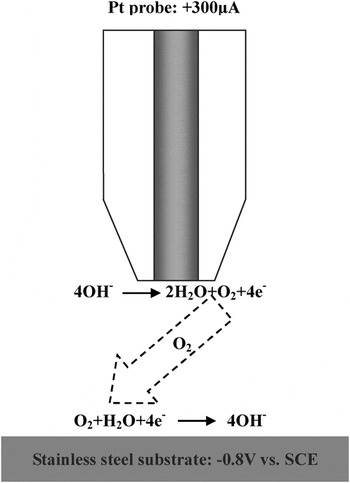
For electrochemical microscopy test, a M370 scanning electrochemical workstation was used. The electrochemical system was composed of four electrodes, with a 25-μm-diameter Pt probe as the oxygen generator, a stainless steel plate which had discrete catalyst spots formed by dropwise addition of 1 μL above-mentioned catalyst ink of different compositions on it as the substrate, Reference Black, Cooper and McGinn18 a Pt wire as the counter electrode, and a SCE as the reference electrode. The diameter of each catalyst spot on the substrate is about 5 mm. The electrolyte used in the experiment was 1 M O2-free NaOH prepared by bubbling N2 for 30 min in advance. The tip generation/substrate collection (TG/SC) mode was used where the tip oxidation current was set at 300 μA and the substrate voltage was set at −0.8 V. Reference Lu, Cooper and McGinn19,Reference Fernández and Bard20 SECM line scan was performed at each catalyst spot at a rate of 300 μm s−1 with 0.1 mm as a step up to 4 mm. The approach curve should be made before the line scan started to ensure that the probe was at an appropriate height. Figure 1 gives the schematic diagram of how the SECM works in this experiment. Reference Xu, Beak and Jung21
Schematic diagram of reactions in the SECM line scan test.

E. Single-cell tests
The discharge curves of the assembled magnesium-air batteries were tested at the ambient temperature on a LAND battery measurement system with a discharge rate of 5 mA cm−2. The magnesium-air battery composed of a piece of magnesium sheet (4 cm × 9 cm) as the anode, a piece of carbon sheet (4 cm × 4 cm) with 7.5 mg as-prepared catalysts coated on it as the cathode, and 3.5% NaCl (AR, Aladdin) solution as the electrolyte. Reference Lee, Park, Higgins, Nazar and Chen22
III. RESULTS AND DISCUSSION
A. Physical characterization
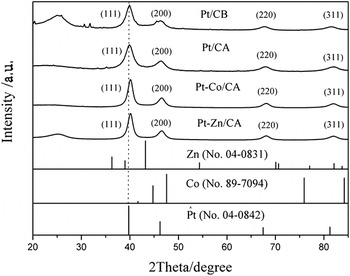
The XRD patterns of differently prepared Pt-based catalysts are shown in Fig. 2. And the standard peaks of Pt (JCPDS No. 04-0842), Zn (JCPDS No. 04-0831), and Co (JCPDS No. 89-7094) are also included in this figure. All of the four kinds of Pt/carbon material catalysts display diffraction peaks at around 39.6°, 46.3°, 67.4°, and 81.4°, which are attributable to the Pt(111), Pt(200), Pt(220), and Pt(311) crystal planes. These peaks indicate that the crystal structure of Pt in these catalysts is FCC (face-centered cubic). All the peaks of the four catalysts are relatively broad, which is an indication of the nanometer-scale grain size.
XRD patterns of different catalysts.

From the Pt/CB XRD patterns, an obvious peak and several small peaks can be seen from 15° to 35°, which are due to the reflections of carbon blacks. Reference Xiong, Kannan and Manthiram13 No such peaks are presented in the XRD patterns of Pt/CA, Pt–Co/CA, and Pt–Zn/CA catalysts since carbon aerogels are amorphous. From the absence of peaks of Co and Zn in Pt–Co/CA and Pt–Zn/CA, respectively, and the fact that peaks of these two catalysts shift to higher degrees slightly compared with pure Pt, we can infer that the alloy contents of Co and Zn in Pt form solid solutions without any phase segregation since changes in the peaks of XRD will take place when the solid solution is formed. We can further study this hypothesis by calculating the lattice constants, which can be calculated by cell refinement. The lattice constant is 3.894 Å for Pt–Zn/CA and 3.881 Å for Pt–Co/CA, both of which are turned out to be smaller than pure Pt (3.923 Å). According to Lange's Handbook of Chemistry, Reference Speight23 the atomic radius of Pt is 138.5 pm, and the corresponding values for Co and Zn are 125 and 134 pm. The radius difference between Pt and Co is less than 15%, the same is true for Pt and Zn. Therefore, they meet the criterion to form substitutional solid solution, which might cause lattice contraction when a smaller atom substitutes a larger one. This is in conformity with the calculated lattice constants' contraction.
The inductive coupled plasma emission spectrometer (ICP) result suggests that Zn takes up 1.81 wt% of Pt–Zn/CA and Pt accounts for 18.35 wt%. Converted to atomic percentage, Zn takes up 22.73 at.% in the Pt–Zn binary system because carbon only acts as the support. According to the Pt–Zn binary phase diagram, Reference Massalski24 there is only one phase of Pt–Zn solid solution. As to the Pt–Co/CA catalyst, the content of Pt is 2.87 wt% while that for Co is 16.46 wt%. That is to say, Co accounts for 36.60 at.% in the Pt–Co binary system. Based on the Pt–Co binary phase diagram, Reference Massalski24 at ambient temperature, Pt and Co also form a single-phase solid solution.
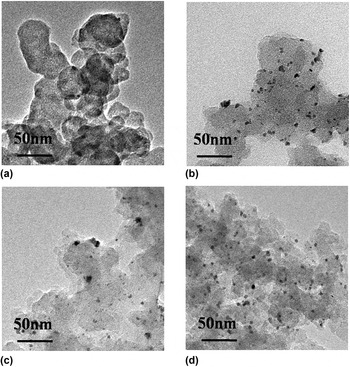
Figure 3 shows the TEM images of Pt/CB, Pt/CA, Pt–Co/CA, and Pt–Zn/CA, respectively. The magnification of the images is 60,000 times. The dark spots correspond to Pt nanoparticles while the lighter parts correspond to the support. We can conclude, from the images, that the morphology of carbon blacks and carbon aerogels is relatively irregular. Compared with the carbon aerogel supported Pt-based catalysts, the carbon black supported ones seem to have less compact and uniform Pt particles. That is why Pt-based catalysts with carbon aerogels have narrower particle size distribution. The relatively homogeneous distribution of Pt-based particles on carbon aerogels can be attributed to the large numbers of mesopores in it.
60,000 magnification TEM images of (a) Pt/CB, (b) Pt/CA, (c) Pt–Co/CA, and (d) Pt–Zn/CA catalysts.

The average sizes for the nanoparticles in Pt/CB, Pt/CA, Pt–Co/CA, and Pt–Zn/CA are 6.0, 4.6, 4.9, and 5.4 nm, respectively. In addition, 32, 53, 49, and 56% of the particle sizes are in the range of 5–6 nm for Pt/CB, Pt/CA, Pt–Co/CA, and Pt–Zn/CA, respectively. These results were acquired by counting over 100 randomly chosen nanoparticles in TEM images. We can infer from the TEM results that small mesopores of carbon aerogels may have a positive influence on decreasing particle size and producing narrower size distribution. In addition, doping with alloy elements may increase grain size to some extent.
Nitrogen adsorption analysis shows that the CA has the average pore size of 19.0 nm and the surface area of 1267.1 m2/g. The average pore size of the carbon blacks is 1.3 nm and the BET surface area is 62.0 m2/g while the corresponding values for carbon aerogels are 19.0 nm and 1267.1 m2/g. Since a mesoporous material is a material containing pores with diameters between 2 and 50 nm, and the pore sizes of the microporous materials are smaller than 2 nm, carbon blacks are turned out to be microporous materials while carbon aerogels are mesoporous ones. The surface content and chemical states of the different elements in the Pt–Zn/CA catalyst were analyzed by XPS. The C element possesses up to 76.87 wt% on the surface, the Pt element takes up to 21.63 wt%, while Zn takes up the rest 1.50 wt%. According to the literature, Reference Miedema, De Chatel and De Boer25 the formation energy of Pt–Zn is calculated to be −108 kJ mol−1. Considering that the formation energy of Pt–Zn is negative, and combined with the related analysis mentioned above, we can conclude that Pt–Zn binary solid solution alloy is formed. The Zn mass content of the catalyst particle surface is less than 1.81%, which is the value tested by ICP in the bulk Pt–Zn/CA catalyst. It may be attributable to the formation of a structure with Pt-rich and Zn-poor surface, which will increase the effectiveness of the catalyst.
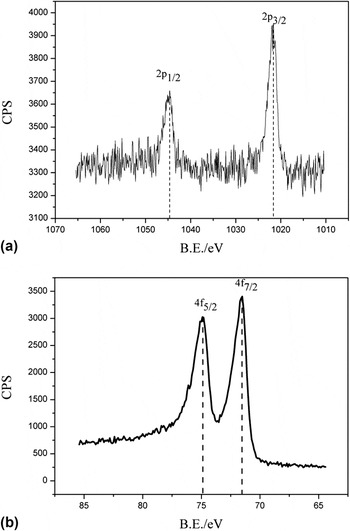
The narrow scan XPS Zn 2p spectrum and Pt 4f spectrum are depicted in Figs. 4(a) and 4(b), respectively. Both of the spectra have been revised by the C 1s spectrum peak at 284.6 eV. The Zn 2p narrow scan XPS spectrum is relatively rough due to the low content of Zn in the tested catalyst. Nevertheless, the two obvious peaks at 1044.6 and 1021.7 eV are clear, corresponding to 2p1/2 and 2p3/2, respectively. The energy difference between the two peaks is 22.9 eV. According to the Handbook of XPS, Reference Moulder, Chastain and King26 zero-valent Zn has two standard peaks at binding energy (BE) values of 1044.4 and 1021.5 eV with the same BE difference as ours, revealing that the Zn element present in the tested catalyst mainly possesses a valence of zero. As to the Pt 4f spectrum, the two peaks at 74.9 and 71.5 eV have a BE difference of 3.4 eV, the same as the zero-valent Pt standard peaks listed in the Handbook of XPS, Reference Fernández and Bard20 but with a slight shift of 0.6 eV to the higher energy. The shifts of Zn 2p and Pt 4f peaks in both spectra may be attributed to the alloying effect.
Narrow scan XPS spectra of the different entities for Pt–Zn/CA catalyst: (a) Zn 2p and (b) Pt 4f.

B. Electrochemical characterization
The oxygen reduction behaviors of the catalysts were first tested electrochemically by CV, which was performed in the O2-saturated 1 M NaOH solution. The working electrode was swept between −1 and 0.5 V at a rate of 50 mV s−1. The resulting voltammograms are shown in Fig. 5, which illustrates the electrocatalytic oxygen reduction behaviors of the four catalysts, mainly by the parameters of the onset potentials and the maximum current densities at the cathodic peaks. For the ORR, the more positive the onset reduction potential is, the more easily the reduction reactions will take place; the larger the maximum current density is, the faster the reactions will happen. The onset potentials of Pt/CB, Pt/CA, Pt–Co/CA, and Pt–Zn/CA catalysts are almost the same, at around −0.18 V (versus SCE). The maximum current densities of them are significantly different from each other with the corresponding values for Pt/CB, Pt/CA, Pt–Co/CA, and Pt–Zn/CA at 85.5, 191.6, 232.3, and 293.0 mA g−1. Compared with the Pt/CB catalyst, Pt/CA displays a better oxygen reduction activity, indicating that the carbon aerogels are better carriers than the carbon blacks. According to the literature, Reference Xiong, Kannan and Manthiram13,Reference Paulus, Wokaun, Scherer, Schmidt, Stamenkovic, Radmilovic, Markovic and Ross14 Pt–Co catalysts are a kind of ORR catalyst with a relatively excellent activity. When Pt–Co binary catalyst has the molar ratio of 2:1, it gives the best performance in oxygen reduction catalytic activity. By comparing Pt–Co/CA and Pt–Zn/CA, we find that Pt–Zn performs better than Pt–Co, indicating that Zn is a more effective alloying element based on the ORR catalytic activity.
CV curves of electrodes with different catalysts in the O2-saturated 1 M NaOH solution.

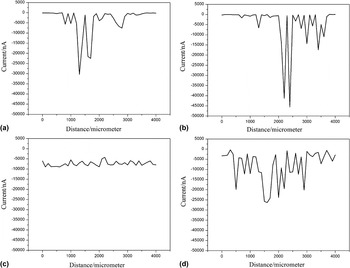
Figures 6(a)–6(d) present the TG/SC SECM line scan images over 4 mm on different catalyst spots in the O2-free 1 M NaOH solution at a rate of 300 μm s−1 with each step of 0.1 mm. A constant O2 flow was electrochemically produced at the tip through OH− oxidation when the ultramicroelectrode (UME) tip with 300 μA oxidation current was scanned on the catalyst spots. In the meanwhile, the stainless steel substrate was set at −0.8 V, and the ORR occurred at the point where the tip was. The substrate current collected at this point could show the catalytic activity. The larger the substrate current is, the better the catalytic performance is. Reference Sánchez-Sánchez, Solla-Gullón, Vidal-Iglesias, Aldaz, Montiel and Herrero27 Because of the existence of electronic noise and slightly uneven distribution of the catalyst ink, the signals obtained from each catalyst spot are not uniform, as we can see from Fig. 6. Therefore, the average values of the substrate currents measured from each catalyst spot were calculated and are listed in Table I. We can easily conclude from the table that Pt–Zn/CA, with the mean current value of 8140 nA, has the best catalytic ability among all the tested catalysts, followed by Pt–Co/CA, Pt/CA, and then Pt/CB, which is basically in conformity with the results of CV.
TG/SC SECM line scan images over 4 mm on different catalyst spots in the O2-free 1 M NaOH solution at a rate of 300 μm s−1 with each step of 0.1 mm: (a) Pt/CB, (b) Pt/CA, (c) Pt–Co/CA, and (d) Pt–Zn/CA.

SECM line scan average currents for different catalyst spots.

C. Single-cell tests
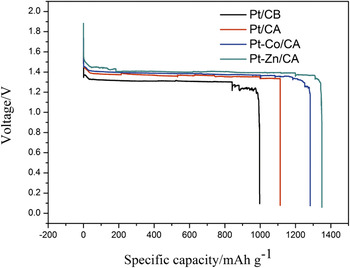
Figure 7 depicts the discharge curves of magnesium-air batteries with the prepared four samples as catalysts at a discharge rate of 5 mA cm−2. The discharge plateau occurs at 1.3111 V for Pt/CB, 1.3673 V for Pt/CA, 1.3842 V for Pt–Co/CA, and 1.4025 V for Pt–Zn/CA catalysts. The specific discharge capacities of Pt/CB, Pt/CA, Pt–Co/CA, and Pt–Zn/CA catalysts are 997.01, 1113.53, 1283.38, and 1349.46 mA h g−1, respectively. As the discharge plateau occurs at a higher voltage, the discharge capacity is larger, thus the ORR catalytic ability is better. All the single-cell tests of magnesium-air batteries reveal that Pt–Zn/CA catalyst performs the best, followed by Pt–Co/CA, Pt/CA, and Pt/CB catalysts in sequence, which is in consistent with the previous tests, including CV curves and SECM line scans.
Discharge curves of magnesium-air batteries using as-prepared Pt-based catalysts.

Both, alloying with Zn and utilization of carbon aerogels, contribute to the relatively high activity of Pt–Zn/CA catalyst. Reference Sode, Li, Yang, Wong, Gyenge, Mitchell and Bizzotto28,Reference Wei, Wu, Shang and Fu29 Pt and Zn can form alloy through liquid or solid reactions during which the Pt-rich surface can be formed. The Pt-rich surface is advantageous for improving the catalytic performance of the catalysts per unit mass, which is confirmed by the density functional theory study of Seminario's group. Reference Seminario, Agapito, Yan and Balbuena15 To be more specific, the microscopic function of Zn mainly lies in the formation of strong bonds with Pt. The doping of Zn changes the electronic nature of the catalyst by rehybridization. During this process, the electron density from Pt 5d is shifted toward higher energies, namely Pt 6s and 6p orbitals, which are closely related to the bimetallic bond between Pt and Zn. For Pt, this process results in the formation of 5d-band vacancies. While for Zn, Zn 2p and 3d bands are shifted toward lower binding energies. The Pt 5d vacancies can lead to improvement in ORR kinetics since the d-band vacancies can form chemical adsorption bond with oxygen, promoting the oxygen reduction process. According to a density functional theory analysis about the bonding of Pt–Zn binary system, Reference Sode, Li, Yang, Wong, Gyenge, Mitchell and Bizzotto28 the Pt–Zn bond length is 2.65 Å, which is much smaller than the Pt–Pt bond length in bulk Pt and the Zn–Zn bond length in bulk Zn. This result suggests that bimetallic Pt–Zn bond is strong and stable. The strength in Pt–Zn bond may result in an enhanced stability of Pt–Zn catalyst by reducing the leaching problem present in Pt-based catalysts. Therefore, the doping of Zn promotes the formation of Pt-rich surface and many d-band vacancies as well as reduces the leaching problem. The three aspects are all beneficial to the enhancement of the ORR catalytic ability.
In the meanwhile, the carbon aerogels that we synthesized possess many uniformly distributed mesopores, promoting the uniform dispersion of the Pt nanoparticles. The carbon aerogels develop the special three-dimensional interconnection inside themselves, which benefits more efficient diffusion of ORR reactants and products.
IV. CONCLUSION
Pt-based catalysts with carbon aerogels as supports have narrower particle size distribution than those with carbon blacks as supports. The ORR catalytic activity of the Pt particles in an alkaline medium can be improved by alloying with Zn. The catalytic performance of the catalysts studied follows the order of Pt–Zn/CA > Pt–Co/CA > Pt/CA > Pt/CB, which is verified by both CV and SECM tests. The single-cell tests of the magnesium-air batteries also supported the test results above when the sodium chloride solution was used as an electrolyte.
Among all the catalysts in our studies, Pt–Zn/CA shows the best ORR catalytic activity in alkaline medium and sodium chloride. According to the XPS results, the Pt-rich surface is formed on it, and the metal elements exist in the form of zero-valent Pt and zero-valent Zn. Both doping with Zn and use of carbon aerogels contribute to the relatively high activity of Pt–Zn/CA catalyst. The doping of Zn promotes the formation of Pt-rich surface and many d-band vacancies as well as reduces the leaching problem while the carbon aerogels develop the special three-dimensional interconnection inside themselves, thanks to the existence of mesopores in it. Therefore, the catalytic ability is enhanced by doping with Zn and using carbon aerogels as the support, and Pt–Zn/CA catalyst may be used in metal-air fuel cells in the future.
ACKNOWLEDGMENTS
The research was supported by National Natural Science Foundation of China (No. 51274140) and Research Fund for the Doctoral Program of Higher Education of China (No. 20110073130001).