Introduction
Consumers are increasingly focusing on production conditions for farm animals and intensive systems are perceived as providing poorer welfare than alternative systems that better fulfil the behavioural repertoire of the animals. A number of studies have investigated the effects of production systems on pig behaviour and all of these have shown that on-farm aggression is higher in intensively raised pigs compared with pigs raised outdoors or in environmentally enriched systems (O’Connell and Beattie, Reference O’Connell and Beattie1999; Beattie et al., Reference Beattie, O’Connell and Moss2000; Cox and Cooper, Reference Cox and Cooper2001). The effects of outdoor or environmentally enriched systems on pig pre-slaughter behaviour, i.e. during transport and in the abattoir lairage, has received less scientific attention. De Jong et al. (Reference De Jong, Prelle, van de Burgwal, Lambooij, Korte, Blokhuis and Koolhaas2000) showed that pigs raised in barren housing tended to spend more time walking, standing and manipulating other pigs during transport than pigs from the enriched environment and in the lairage they tended to spend more time walking and fighting. However, Webster and Dawkins (Reference Webster and Dawkins2000) did not find differences in the level of skin blemish at slaughter between indoor and outdoor bred pigs.
Mixing unfamiliar animals in the pre-slaughter period has been shown to increase aggression and lead to higher cortisol levels in blood or saliva (Warriss and Brown, Reference Warriss and Brown1985; Geverink et al., Reference Geverink, Bradshaw, Lambooij, Wiegant and Broom1998; De Jong et al., Reference De Jong, Prelle, van de Burgwal, Lambooij, Korte, Blokhuis and Koolhaas2000), as well as increasing the incidence of unacceptable levels of skin damage and dark, firm and dry (DFD) muscle, especially when entire males are involved (Guise and Penny, Reference Guise and Penny1989; Sather et al., Reference Sather, Jones, Squires, Schaefer, Robertson, Tong and Zawadski1995; Warriss, Reference Warriss1996). However, mixing at loading and then keeping animals in vehicle compartment groups of about 15 pigs in the lairage has been shown to promote resting behaviour, reduce aggression and skin damage and to facilitate forward movement out of the lairage compared with the more common system, where lorry compartments are mixed on arrival at the abattoir and pigs are kept in larger groups (Barton Gade et al., 1992). Keeping pigs in farm pen groups, without mixing at all, further reduces skin damage (Karlsson and Lundström, Reference Karlsson and Lundström1992) and this study also showed that ultimate pH in the longissimus dorsi (LD) muscle was significantly higher with mixing in pigs fasted 16 to 20 h before slaughter. While mixing of unfamiliar animals is almost unavoidable in commercial production, it may be possible to keep pigs in their social groups or limit mixing in niche productions.
The aim of this study was to investigate the effect of mixing at loading for pigs raised outdoors or conventionally on behaviour during transport and lairage, blood chemistry at slaughter as well as meat quality characteristics commonly used to assess welfare.
Methods
Animals and treatments
The experiment was carried out under practical commercial conditions. First, an outdoor producer was found that could provide the requisite number of pigs and this producer was then matched to a conventional producer situated close by, who used the same crossbreed, the same fasting period before collection and who had a delivery system capable of keeping pigs from different farm pens separate before loading. In this way production factors known to affect ultimate pH values and the incidence of pale, soft and exudative (PSE) meat were taken as far as possible into account. Although not controlled, it is likely that the pigs were free of the halothane-sensitive allele, as this has been the goal in Danish breeding work since 1986.
The experimental material consisted of 114 outdoor pigs and 120 conventional pigs, equally divided into mixed and non-mixed groups. Pigs were mainly DY-LY with some D-LY crosses, where D = Duroc, Y = Large White and L = Landrace. Outdoor pigs were born outdoors in huts. Tails were not docked and weaning took place no earlier than 4 weeks of age. After weaning the pigs continued outdoors with huts as shelter. Conventionally raised pigs were born indoors in crates. Tails were docked shortly after birth and weaning took place no earlier than 3 weeks of age. All male piglets in both systems were castrated within the first week of life according to Danish legislation. After weaning, pigs were raised indoors on fully slatted flooring with no straw at a stocking density fulfilling legislation (0.65 m2 at 85 to 110 kg live weight). Pigs from both systems were fasted for about 17 h before collection.
The transport vehicle used was a single decker with tailgate lift, natural ventilation with openings along the sides of the vehicle at pig and ceiling height, full air suspension and non-slip rubber flooring. A single-decked vehicle was chosen, as this allowed sufficient height to be able to observe all pigs in each of the four compartments during transport. Compartment sizes varied slightly, being 5.6, 5.4, 5.5 and 5.2 m2 for compartments 1 to 4, respectively. The vehicle was rigged with video cameras above each compartment as well as audio equipment the day before the start of the experiment.
Pigs were first collected from one producer. At loading all pigs were marked with an unambiguous identification number on their backs such that it was possible to see whether pigs came from different farm pens or not. One of the compartments was filled with pigs from the same farm pen and one with pigs from at least two farm pens. Sex and live weight were randomly distributed within experimental group. The transport vehicle then drove to the second farm where the procedure was repeated. The following day this procedure was repeated but with collection from the second farm first and 3 weeks later the whole procedure was repeated, such that at the end of the experiment all experimental groups had been transported in all vehicle compartments once. This procedure meant that despite differences in transport time between days, the average transport time for experimental groups was similar with a maximum variation between groups of 3 min. A group size of 15 was initially aimed at, corresponding to a stocking density of 0.35 m2 per 100 kg pig, which was the Danish regulation for transport of less than 4 h at that time. However, the outdoor pigs turned out to be heavier than expected and conventionally raised pigs lighter (average live weight 107 (range 88 to 125) and 93 (range 80 to 106) kg, respectively), so that even though the number of outdoor pigs per compartment was reduced to 14 after the first day, stocking densities were on average 0.36 and 0.39 m2 per 100 kg pig for outdoor and conventionally raised pigs, respectively. Pig behaviour was recorded in all four compartments throughout the transport, including the stop while pigs from the second producer were being loaded, using video and audio equipment. The first pigs were loaded at 0633 till 0737 h (average 0707 h) and the average journey time, i.e. time from loading the first pig at the first farm to off-loading the last pig at the abattoir was 3 h 13 min (range 2 h 56 min to 3 h 41 min). Pigs in compartments 3 and 4 were transported on average 55 min less than pigs in compartments 1 and 2 (range 47 to 66 min). The average temperature was 4.8°C at the start of the journey (range 3.5°C to 6°C) and 5.8°C on arrival at the abattoir (range 3.7°C to 7.4°C), corresponding to typical Danish winter conditions. Relative humidity was high, average 94.5% (range 93% to 96%), both at the start and at end of the journey but winds were light, average 3 m/s (range 2 to 4 m/s). Temperature and humidity were measured at the farm using the Testo 635 equipment (Testo, Inc., Sparta, NJ, USA) and temperature, humidity and wind speed at the factory using the weather station there. The roads traversed were of good standard but varied from minor winding roads to motorway transport. Details of the journey (stops, turns, roundabouts etc.) were noted continuously throughout the transport.
Pigs were carefully off-loaded at the abattoir without the use of an electrical goad and lairaged in the same groups as on the transport vehicle. A video camera was mounted over each lairage pen to monitor pig behaviour during lairage and the audio equipment measured sound. Floor space per pig was on average 0.51 to 0.56 m2 per 100 kg pig for outdoor and conventionally raised pigs, respectively. Average time from arrival in the lairage to driving the first pigs to stunning was 2 h 2 min (range 1 h 38 min to 2 h 25 min). Pigs were driven considerately in lairage groups to groupwise stunning using CO2, without the use of an electric goad (Barton Gade et al., 1995; Christensen and Barton Gade, Reference Christensen and Barton Gade1997). Pens were emptied in the same order as they were filled to ensure that the average lairage times of experimental groups were similar (maximum difference 3 min), despite day-to-day variation in lairage time. Pigs were tattooed at sticking and the identification number on their backs read off, so that it was possible to couple behaviour to blood and meat quality measurements.
Variables
Blood samples were collected at sticking in heparinised tubes for the evaluation of cortisol using an ELISA assay (DRG, Marburg, Germany) and creatine kinase (CK) using a CK-NAC 1552147 test kit from Boehringer Mannheim. Blood samples were centrifuged as soon as possible after sticking and the plasma samples frozen to −20°C until analysis. Each carcass was evaluated on the slaughter line for skin damage in the rear, middle and shoulder area according to the scale described by Barton Gade et al. (1996), where 1 = no skin damage, 2 = slight skin damage, 3 = skin damage affecting quality and 4 = severe skin damage with possible downgrade. Temperature and pH were measured 38 min post mortem in Semimembranosus (S) and LD muscles using, respectively, a Testotherm 9010 equipment and a Knick Portamess pH meter with a Mettler Toledo combination electrode LOT 406-M6-S7/25. The day after slaughter all carcasses were measured for pH in S, LD, Biceps femoris (BF) and Semispinalis capitis (SC) muscles, and internal reflectance (MQM) value was registered for S, BF and LD. MQM values are an on-line measure of protein denaturation and hence PSE meat (Borgaard et al., 1989). Actual measuring points used for the four muscles are as shown in Barton Gade et al. (1996).
The general behaviour of pigs during transport and lairage at the abattoir was noted, where appropriate. Otherwise, factors such as body posture, which indicates to what degree pigs are comfortable and resting, and behaviours that can lead to skin damage and trauma, and hence increased stress and discomfort, were focused on. The body posture of each pig, standing, sitting, lying, was noted at 2½ min intervals throughout the journey, after which the percentages of pigs standing, sitting and lying were calculated.
The total number of aggressive events during the whole journey was noted, as follows:
• threat (fast sideways movement of the head by one pig towards another, that does not react other than by moving away);
• mutual threat by two pigs that does not escalate to a bite;
• one pig bites (or tries to bite) another, that does not reciprocate;
• mutual biting by two (or more) pigs, i.e. a fight proper.
In the event of mutual biting, the duration of the encounter was noted in seconds and divided into short fights (encounters lasting less than 15 s), a medium long fight (15 to 30 s) and a long fight (> 30 s). If the pause between bouts was longer than 10 s, the next bout of fighting was considered to be a new fight.
Statistical analyses
Quantitative characteristics
Quantitative characteristics such as blood chemistry and meat quality parameters were investigated using an analysis of variance (PROC MIXED procedure, SAS, 2002–2003) with the following model:

where i refers to system (outdoor or conventional), j to treatment (mixing or non-mixing), k to repetition (slaughter days 1 to 4), ατij to the interaction between system and treatment, Pijk to the random effect of pigs within the same group and εijkl to residual error. Slaughter weight was included as covariate in the analysis to take the unintentional slaughter weight differences between rearing systems into account.
Changes in posture
The changes in posture of pigs during transport and lairage were investigated using a general linear model procedure (SAS, 2002–2003), where system, mixing, posture at certain time intervals after the commencement of transport or lairage and all two-way interactions between these were included. Non-significant interactions were excluded. For transport, compartments one and two and compartments three and four were analysed separately, as the transport pattern was different. Compartments 1 and 2 had a short transport, a stationary period as pigs from the second farm were loaded and then a longer transport to the abattoir. Compartments 3 and 4 only had the final stage of the transport. For lairage all compartments were treated together.
Events during transport and lairage
The experimental procedure only demanded that a mixed group originated from minimum two pens at the farm, so that the producer had freedom to collect the number of pigs required. For outdoor pigs, mixed groups originated from two to three pens and for conventional pigs from two to seven pens. The effect of number of farm pens on aggression levels in mixed groups was investigated using a χ 2-test on the total material. An increase in the number of farm pens did not lead to increased aggression, so that this factor, as such, was ignored in the analysis of the behavioural data. It will, however, remain as a component of the day-to-day variation in the model. The number of aggressive events during transport was investigated using both a Poisson model (GENMOD procedure) and the following basic model:

where μ is the general level, α system gives the effect of rearing system, β mixing the effect of mixing, γ time the effect of loading pigs first or last, δ day is the systematic effect of day and αβ and γβ are two-way interactions. Events during lairage were treated similarly but the time factor was excluded, as there was no difference in the average lairage time of experimental groups. For each type of event a goodness-of-fit test was carried out and this showed that the model was not applicable for some of the parameters, due to over dispersion or to too few observations. In these cases it was necessary to include an over dispersion parameter or to adjust the model. Model adjustment was necessary for fights, where the following models were used:

A similar procedure was carried out for mixed groups only, where the number of aggressive events during transport and lairage was related to system and familiarity, i.e. whether pigs in mixed groups originated from the same farm pen or not. In this analysis, β mixing in the above was replaced by β familiarity. Again model adjustment was necessary for fights during transport and lairage, where δ day was added to the above models.
The GENMOD procedure was not suitable for the analysis of unacceptable skin damage, due to too few observations. Here, a χ 2-test was used on the total material to give an indication of the effect of system and mixing. Finally, inter-relationships between the measured parameters were investigated using Pearson correlation coefficients.
Results
Posture during transport and lairage
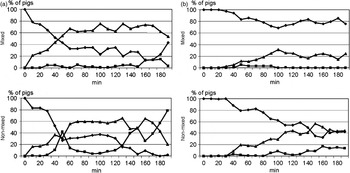
Changes in posture are illustrated in Figures 1a, 1b and 2, where results were blocked at 10-min intervals for clarity. The main resting posture during transport was sitting and it was only towards the end of the journey that pigs in some of the groups began to lie down. Changes in posture during transport were different for compartments 1 and 2 and compartments 3 and 4. For the longest transport of just over 3 h (compartments 1 and 2), there was a significant interaction between rearing system and mixing group for all postures (P < 0.05, P < 0.001 and P < 0.01 for the percentage of pigs standing, sitting and lying, respectively). Mixed outdoor pigs showed a progressive decrease in the percentage of standing pigs and an increase in the percentage of sitting pigs as transport progressed, whereas non-mixed outdoor pigs showed a similar picture but with increasing percentages of pigs lying down towards the end of the journey (Figure 1a). In this group, nearly 80% were lying at the end of the journey compared to 3% for the mixed group. Non-mixed outdoor pigs also showed an increase in the percentage of pigs lying down from 35 to 55 min of transport, corresponding to the loading period at the second producer but the pigs changed posture, mainly to the sitting position, as the vehicle moved again. Mixed conventionally raised pigs on the other hand mainly remained standing during the journey and only 22% were sitting towards the end. Non-mixed conventionally raised pigs showed a greater decrease in the percentage of standing pigs and an increase in the percentage of sitting pigs as the journey progressed. As with non-mixed outdoor pigs, non-mixed conventionally raised pigs began to lie down towards the end of the journey but to a lesser extent (Figure 1b). Posture changes followed a similar pattern for the shortest and direct transport (compartments 3 and 4) but there was no interaction between rearing system and mixing group (data not shown). Rearing system significantly affected all postures (P < 0.001 for all) but mixing only affected the percentage of pigs lying down (P < 0.01), highest in the non-mixed group.
(a) Posture during transport for outdoor pigs, compartments 1 and 2. Posture: ––⧫––, standing (%); ––▴––, sitting (%); ––▪–– lying (%). (b) Posture during transport for conventionally raised pigs, compartments 1 and 2. Posture: ––⧫––, standing (%); ––▴––, sitting (%); ––▪––, lying (%).

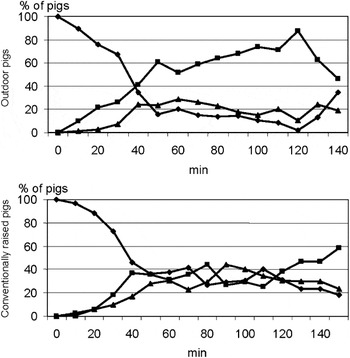
Pig posture during lairage in relation to rearing system. Posture: ––⧫––, standing (%); ––▴–– sitting (%); ––▪––, lying (%).

In contrast to transport, lying was the predominant resting posture in the lairage. Posture in the lairage was affected by rearing system (P < 0.001 for all postures). Both rearing systems showed a relatively fast drop in the percentage of standing pigs during the first 40 min of lairage but the proportion of outdoor pigs lying down continued to increase in the subsequent period, whereas conventionally raised pigs showed relatively little change thereafter (Figure 2). Mixing had no significant effect on posture during lairage.
Behaviour during transport and lairage
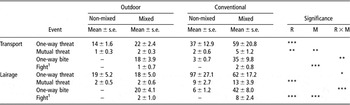
Table 1 shows the number of aggressive events in relation to rearing system and mixing. For fights during transport and lairage, where there were zero occurrences in some groups, the Poisson models did not give a standard error. In these cases, the Tables show the means and standard errors calculated from the actual, non-transformed values. There were a number of significant interactions between rearing system and treatment.
Number of aggressive events during transport and lairage in relation to rearing system and mixing

1Values shown in the table are based on actual, non-transformed values.
Significance levels: ***P < 0.001, **P < 0.01, *P < 0.05.
During transport, outdoor pigs showed fewer one-way and mutual threats compared to conventionally raised pigs but the same (low) level of fights. No outdoor pig showed one-way biting, when non-mixed, whereas this occurred at a low level in non-mixed conventionally raised pigs. For lairage, mutual threats and fights were more prevalent in conventionally raised pigs. Non-mixed, conventionally raised pigs had a higher incidence of one-way threats compared to mixed conventionally raised pigs. Outdoor pigs had the same incidence irrespective of treatment. As with transport, conventionally raised pigs showed one-way biting in the lairage, even when non-mixed. Non-mixed outdoor pigs did not show this behaviour. Fights were always less than 15 s in outdoor pigs, both during transport and lairage, whereas fights between conventionally raised pigs could be of much longer duration. Thus, two of the seven recorded fights during transport and 11 of the 30 recorded fights in the lairage were longer than 15 s in conventionally raised pigs. In some of the mixed groups, conventionally raised pigs showed a series of one-way bites, where one pig constantly attacked another, which did not respond other than by fleeing. Biting could be from behind or the side in these situations. Such activity was never seen in outdoor pigs.
Mixing led to a higher incidence of mutual threats and fights during transport and there was a tendency to a higher level of one-way threats (P = 0.075). Mixing also led to a higher incidence of fights during lairage and a tendency to more mutual threats (P = 0.052).
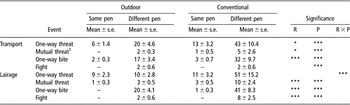
An evaluation of mixed groups only (Table 2) showed that most aggressive interactions and all fights proper, both during transport and lairage, occurred between unfamiliar animals within the group, i.e. between pigs originating from different farm pens. For one-way threats during lairage there was an interaction between rearing system and farm pen. The number of one-way threats was higher in conventionally raised pigs originating from different farm pens, i.e. that were not familiar with one another, whereas outdoor pigs showed the same level of one-way threats, irrespective of whether they were familiar or not.
Number of aggressive events in mixed groups in relation to whether pigs involved in the conflict originated from the same farm pen (familiar pigs) or from different farm pens (unfamiliar pigs)

1Values shown in the table are based on actual, non-transformed values.
Significance levels: ***P < 0.001, **P < 0.01, *P < 0.05.
Skin damage
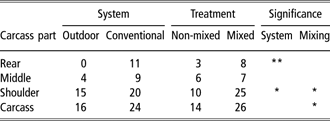
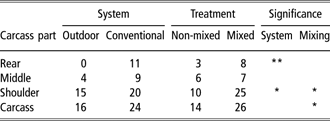
The percentage of pigs with unacceptable skin damage scores (scores 3 and 4) was generally low for all groups (Table 3). Conventionally raised pigs had significantly more unacceptable skin damage in the rear and shoulder part of the carcass compared with outdoor pigs. Mixing led to more skin damage in the shoulder area and in the whole carcass compared to non-mixing. The level of unacceptable skin damage was almost non-existent in non-mixed outdoor pigs, being 0%, 1% and 2% for the rear, middle and shoulder area, respectively.
Percentages of pigs with unacceptable skin damage scores (scores 3 and 4)
Significance levels: ***P < 0.001, **P < 0.01, *P < 0.05.
Blood chemistry and muscle pH and temperature measured early post mortem
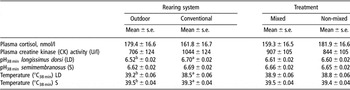
pH values for LD on the slaughter line were higher in conventionally raised pigs compared to outdoor pigs (Table 4, P < 0.01). S showed a similar tendency (P = 0.07). The pH level was, however, high in both rearing groups and no pig showed pH values below 6.0 early post mortem, corresponding to risk of PSE meat. Muscle temperature was significantly lower in LD and S in conventionally raised pigs compared to outdoor pigs (P < 0.01 and P < 0.05, respectively). Mixing had no effect on pH or temperature in LD and S.
Blood chemistry and muscle pH and temperature early post mortem in relation to rearing system and mixing

Means with different superscripts are significantly different, P < 0.05. There was one significant interaction between rearing system and mixing (CK: P < 0.05).
Cortisol in plasma taken at slaughter was not affected by rearing system or mixing. For plasma CK, there was a significant interaction between rearing system and mixing, where conventionally raised pigs had higher CK activities, when mixed at loading, compared to no mixing (1132 v. 761 U/l, respectively). Outdoor pigs showed no effect of mixing on CK activities (682 and 771 U/l for mixed and non-mixed, respectively).
Ultimate pH and internal reflectance (MQM values)
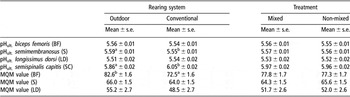
Ultimate pH values were higher in S but lower in SC for outdoor pigs compared to conventionally raised pigs (P < 0.05 and P < 0.01, respectively, Table 5). MQM values were highest in outdoor pigs for BF (P < 0.05) but similar for the two rearing systems for S and LD. Mixing had no effect on ultimate pH or MQM values.
Ultimate pH and internal reflectance (MQM) values in relation to rearing system and mixing

Means with different superscripts are significantly different, P < 0.05. There were no significant interactions.
The percentage of pigs with higher than normal ultimate pH values was low but tended to be higher in conventionally raised pigs than in outdoor pigs. Thus, 9% of conventionally raised pigs had ultimate pH values higher than 6.29 in SC compared with none for outdoor pigs. The corresponding figures for LD were 4% and 2%, respectively. Only 1% of conventionally raised pigs had higher than normal pH values in BF and S compared to none for outdoor pigs. MQM values indicative of PSE meat were only found in two non-mixed, outdoor pigs, where each showed PSE in one of the three muscles measured. Mixing had no significant effect on the incidence of higher than normal pH values or PSE meat.
Inter-relationships
Inter-relationships between the measured parameters were in general low or non-significant. There was a significant correlation between cortisol concentration in slaughter blood and muscle temperature in LD on the slaughter line (r = 0.16; P < 0.05). Plasma CK at slaughter was correlated with skin damage scores (middle: r = 0.15, P < 0.05; shoulder: r = 0.18, P < 0.01), ultimate pH in LD (r = 0.16; P < 0.05) and SC (r = 0.29; P < 0.001), as well as MQM values (BF: r = 0.28, P < 0.001; S: r = 0.18, P < 0.01; LD: r = 0.21, P < 0.01). Slaughter line pH and temperature in S were negatively and positively correlated with ultimate pH in S (r = −0.16 and 0.16, respectively, P < 0.05). For LD, slaughter line pH was positively correlated with ultimate pH and negatively correlated with MQM value (r = 0.29 and −0.46, respectively, P < 0.001) and muscle temperature was positively correlated with MQM value (r = 0.23; P < 0.001). Skin damage scores also showed significant correlations with ultimate pH and MQM values. Skin damage score in the rear part of the carcass was correlated with ultimate pH in LD (r = 0.23; P < 0.001), ultimate pH in SC (r = 0.21; P < 0.01), MQM value in BF (r = −0.28; P < 0.001), MQM value in S (r = −0.18; P < 0.01) and MQM in LD (r = −0.20; P < 0.01). Skin damage score in the middle part of the carcass was correlated with ultimate pH in LD (r = 0.24; P < 0.001), ultimate pH in SC (r = 0.14; P < 0.05), MQM value in BF (r = −0.16; P < 0.05) and MQM value in LD (r = −0.19; P < 0.01). Finally, skin damage score in the shoulder was correlated with ultimate pH in LD (r = 0.23; P < 0.001), ultimate pH in SC (r = 0.21; P < 0.001) and MQM value in BF (r = −0.14; P < 0.05).
Discussion
Posture
Outdoor pigs showed a decrease in the percentage of standing pigs and an increase in the percentage of sitting and lying pigs, as transport progressed, whereas conventionally raised pigs remained standing for a longer time and were less likely to sit and lie during transport. Mixing led to more disturbance in both groups with fewer pigs sitting and lying, compared with non-mixed groups. There was an unintentional difference in stocking density during transport in this study. Previous research investigating the effect of stocking density in relation to posture during transports of 3 to 4 h (Barton Gade and Christensen, Reference Barton Gade and Christensen1998; Barton Gade, 2000) has shown that pigs are less likely to sit and lie during transport if they are given more space, possibly as a result of greater difficulty in keeping their balance on the road types traversed on shorter journeys. Some of the differences in posture between outdoor and conventionally raised pigs during transport may therefore have been affected by the lower stocking densities used for conventionally raised pigs. Mixing did not affect posture during lairage, but outdoor pigs lay down more quickly and to a greater extent than conventionally raised pigs. De Jong et al. (Reference De Jong, Prelle, van de Burgwal, Lambooij, Korte, Blokhuis and Koolhaas2000) also showed that pigs reared in an enriched environment tended to spend less time walking and standing, both on the truck and in the lairage compared with pigs reared in a barren environment.
Behaviour
Rearing system also affected aggressive interactions between pigs. Outdoor pigs showed a low level of aggression with similar levels of one-way bites and fights during transport and lairage, whereas the level of aggression was much higher in conventionally raised pigs, and higher during lairage than during transport. Fighting during transport is, of course, more difficult due to the tighter stocking densities used and the motion of the vehicle. Aggressive individuals may have less opportunity to take up the preferred fighting position, where pigs face one another, shoulder to shoulder. Only in such cases is fighting possible, and once started, can continue as the combatants make an arena by pressing other pigs into the corners of the compartment.
Rearing system not only affected the level of aggression. It also affected its manifestation. One-way threats, which were observed to occur when one pig annoys another e.g. by forcing itself past during changes in position, or competition for interesting objects, were far more prevalent in conventionally raised pigs and in the lairage were higher in non-mixed conventionally raised pigs compared with mixed pigs. The higher incidence of one-way threats in the latter was particularly associated with competition at the drinker. It was not the impression that the pigs were thirsty but that the drinking cup was novel to them and worthy of investigation. One-way threats were sometimes observed to escalate to a one-way bite, if one of the pigs did not give way in a competing situation. Thus, one-way bites also occurred, though at a low level, in non-mixed conventionally raised pigs. Non-mixed outdoor pigs never showed this escalation. In certain groups of conventionally raised pigs one-way biting did not cease, when the attacked pig tried to flee. Biting from behind or from the side was therefore more prevalent in conventionally raised groups. Such behaviour was never seen in outdoor pigs. Fighting could also be of much longer duration in conventionally raised pigs. All fights between outdoor pigs terminated before 15 s, whereas they could be longer than a minute in conventionally raised pigs. These results indicate that conventionally raised pigs may lack the ability to terminate aggression, when the attacked animal clearly signals that it is submissive. Outdoor piglets have the possibility to meet unfamiliar piglets early in life, so that it seems likely that social behaviour learned before and after weaning is important, both for the level of aggression and its manifestation during transport and in the abattoir lairage.
With the exception of one-way threat during transport and mutual threat during lairage, all aggressive events not showing an interaction between rearing system and mixing were significantly more frequent, when groups were mixed at loading than when no mixing occurred. Moreover, the majority of one-way bites and all fights proper were between pigs from different farm pens, i.e. between unfamiliar individuals. It had been thought that the close contact between pigs during transport may have led to confused olfactory signals during lairage. This finding shows that pigs were still able to differentiate between familiar and unfamiliar individuals, despite being transported close together during transport. Pigs showing aggression during transport did not always show aggression during lairage and in half of the groups the most aggressive pigs during lairage showed no or only minor activity during transport. Thus, this study did not show consistency in behaviour during the two phases of pre-slaughter handling, although a previous study (Geverink et al., Reference Geverink, Bradshaw, Lambooij, Wiegant and Broom1998) has indicated that the frequency and duration of fighting under simulated lairage conditions was positively related to a pigs’ level of aggression in their home pen.
Skin damage
The behavioural differences seen during transport and lairage affected the level of unacceptable skin damage, so that the frequency of unacceptable skin damage was higher in conventionally raised pigs compared to outdoor pigs. This result is in contrast to Webster and Dawkins (Reference Webster and Dawkins2000), who did not find differences in skin blemish at slaughter between indoor and outdoor bred pigs. Mixing led to more unacceptable skin damage in the shoulder area and the whole carcass compared with non-mixing. Karlsson and Lundström (Reference Karlsson and Lundström1992); Warriss (Reference Warriss1996) and Brown et al. (Reference Brown, Knowles, Edwards and Warriss1999) have all previously shown that the frequency of skin damage is highest in mixed pigs. The normal fighting pattern in pigs leads to most skin damage in the shoulder area, so that the higher frequency of skin damage in the rear area of conventionally raised pigs in this study may be a reflection of their chasing activity.
Blood chemistry
Rearing system had no effect on cortisol values in slaughter blood. Cortisol is commonly accepted to be a measure of psychological stress in the pre-slaughter situation (Warriss et al., Reference Warriss, Brown, Knowles, Edwards, Kettlewell and Guise1998), so that these results indicate that the pigs in the two rearing systems are likely to have reacted psychologically to pre-slaughter handling in the same way. De Jong et al. (Reference De Jong, Prelle, van de Burgwal, Lambooij, Korte, Blokhuis and Koolhaas2000) also concluded that there was no difference in the psychological reaction of pigs reared in an enriched and barren environment to pre-slaughter handling. Mixing had no effect on cortisol values either, in contrast to Bradshaw et al. (Reference Bradshaw, Parrott, Goode, Lloyd, Rodway and Broome1996), who found that salivary cortisol concentrations were higher at the end of transport with mixing compared to no mixing. For CK values in slaughter blood, there was a significant interaction between rearing system and mixing. Mixed conventionally raised pigs had higher CK activities than non-mixed conventionally raised pigs, whereas outdoor pigs showed similar CK activities, irrespective of mixing. CK-activity slaughter blood is considered to be a measure of physical stress in the pre-slaughter situation or of muscle damage (Warriss et al., Reference Warriss, Brown, Knowles, Edwards, Kettlewell and Guise1998), so that these results are consistent with the higher level of physical activity in mixed conventionally raised pigs. The lack of effect of mixing on outdoor pigs may be a reflection of their rearing environment. Their physical condition is likely to have been better, so that they are likely to be more resistant to the physical rigours of transport and lairage. In addition, their levels of aggression were lower on mixing compared to conventionally raised pigs.
Meat quality characteristics
pH values early post mortem were generally higher in conventionally raised pigs than in outdoor pigs and muscle temperatures were lower, which could indicate that conventionally raised pigs have been less affected by the pre-slaughter treatment. However, such a conclusion is not supported by the results for cortisol and CK in slaughter blood. A possible explanation could be differences in slaughter weight between rearing systems, which could have led to a slightly faster cooling rate in the carcass, and hence to a slower post mortem glycolysis, as the rate of pH fall is dependent on muscle temperature (Maribo et al., Reference Maribo, Olsen, Barton Gade, Møller and Karlsson1998). However, slaughter weight was included as covariate in the analysis of variance, so that this factor should have been eliminated in the results obtained. On the other hand mixing had no effect on pH values on the slaughter line in this study, in contrast to Karlsson and Lundström (Reference Karlsson and Lundström1992), who showed that pH values 50 min post slaughter were lower with mixing, and D’Souza et al. (Reference D’Souza, Dunshea, Leury and Warner1999), who showed that mixing led to higher pH values 40 min post mortem. However, none of the pigs showed pH values lower than 6.0, indicative of a faster than normal post mortem glycolysis with risk of development of PSE meat and, in fact, PSE meat only occurred in two (outdoor) pigs, each of which showed PSE in one of the three muscles measured. Geverink et al. (Reference Geverink, de Jong, Lambooij, Blokhuis and Wiegant1999) also found no difference in PSE incidence between pigs raised with or without environmental enrichment. Other studies (Barton Gade and Blaabjerg, 1989; Vautier et al., Reference Vautier, Bataille, Bouyssiere, Minivielle and Chevillon2003; Lambooij et al., Reference Lambooij, Hulsegge, Klont, Winkelman-Goedhart, Reimert and Kranen2004), however, have found a greater tendency to PSE meat or to higher drip losses in outdoor or environmentally enriched pigs, whereas Klont et al. (Reference Klont, Husegge, Hoving-Bolink, Gerritzen, Kurt, Winkelman-Goedhart, de Jong and Kranen2001) have found the opposite effect.
There were some indications that pre-slaughter handling may have had the greatest effect on conventionally raised pigs. Ultimate pH was higher in SC in conventionally raised pigs, and MQM values were lower in BF. The frequency of pigs with higher than normal pH values tended to be highest in conventionally raised pigs. Barton Gade and Blaabjerg (1989), Vautier et al. (Reference Vautier, Bataille, Bouyssiere, Minivielle and Chevillon2003) and Lambooij et al. (Reference Lambooij, Hulsegge, Klont, Winkelman-Goedhart, Reimert and Kranen2004) also showed that pigs reared indoors have higher ultimate pH values than pigs raised outdoors or with environmental enrichment as well as a smaller tendency to higher than normal ultimate pH values. However, others have found no effect (Geverink et al., Reference Geverink, de Jong, Lambooij, Blokhuis and Wiegant1999; Hill et al., Reference Hill, McGlone, Fullwood and Miller1998; Gentry et al., Reference Gentry, McClone, Miller and Blanton2004) or even a higher ultimate pH value in pigs with environmental enrichment (Klont et al., Reference Klont, Husegge, Hoving-Bolink, Gerritzen, Kurt, Winkelman-Goedhart, de Jong and Kranen2001). Differences in genotypes used, fasting time and transport and lairage conditions as well as stunning method and post-slaughter chilling between studies may have been the cause of this lack of consistency in meat quality results.
Inter-relationships
Correlations between the measured parameters were low or non-significant, although mainly in the expected directions. Cortisol concentration in slaughter blood was not related to skin damage score or ultimate meat quality. Higher CK activities on the other hand were related to higher skin damage scores, higher ultimate pH values in some muscles and lower MQM values. Higher skin damage scores are also associated with higher ultimate pH values in LD and SC and lower MQM values in some muscles. These results support the hypothesis that a greater degree of physical stress and activity, caused by aggression, affects CK activity and ultimate pH and MQM values. The magnitude of the correlations is, however, mainly in the range 0.14–0.29, and hence much lower than the results reported by Terlouw et al., Reference Terlouw, Porcher and Fernandez2005, who showed that fighting behaviour during mixing could explain between 13% and 32% of the variability in muscle lightness in LD, BF and S.
Conclusions
This study showed that a niche production, such as outdoor pig production, can improve some aspects of pig welfare pre-slaughter. Outdoor pigs settled more quickly during transport, lay down to a greater extent towards the end of the journey and lairage period, showed less aggression during transport and lairage and had lower levels of unacceptable skin damage compared with conventionally raised pigs. In addition, there were some indications that outdoor pigs were less physically affected by pre-slaughter handling. Mixing pigs at loading on the other hand led to poorer welfare compared with keeping pigs in their social groups, irrespective of rearing system, even though no further mixing took place at the abattoir. Systems that are marketed as welfare friendly should avoid mixing pigs during pre-slaughter handling to reduce aggression and injury.
Acknowledgements
The author would like to acknowledge the team behind this project, particularly Lars Blaabjerg, Maiken Baltzer and Peter Vorup for expert field work, Eli V. Olsen and Marjatta Oksama for statistical advice, Birthe Pedersen, Danish Crown, who helped to find producers for the project and finally Steve Brown and colleagues at the University of Bristol for cortisol analyses. This research was partly financed by the 5th framework programme of the European Commission, Contract No. QLK5-CT-2000-00162 and partly by the Danish Meat Association in Copenhagen.