Introduction
Schizophrenia is a complex heterogeneous disorder of unknown origin with an array of characteristics, including psychotic symptoms (van Os & Kapur, Reference van Os and Kapur2009) and motor abnormalities such as dyskinesia, parkinsonism and akathisia (Wolff & O'Driscoll, Reference Wolff and O'Driscoll1999; Pappa & Dazzan, Reference Pappa and Dazzan2009; van Harten & Tenback, Reference van Harten and Tenback2009). Both subtle movement disorders and schizotypal traits have been reported in the pre-morbid period of schizophrenia, during childhood and adolescence, and may thus be related to an increased risk (Schiffman et al. Reference Schiffman, Walker, Ekstrom, Schulsinger, Sorensen and Mednick2004; Mittal & Walker, Reference Mittal and Walker2007; Cannon et al. Reference Cannon, Cadenhead, Cornblatt, Woods, Addington, Walker, Seidman, Perkins, Tsuang, McGlashan and Heinssen2008). Schizotypal traits and movement disorders are also prevalent in unaffected siblings of patients with schizophrenia (Vollema et al. Reference Vollema, Sitskoorn, Appels and Kahn2002; Calkins et al. Reference Calkins, Curtis, Grove and Iacono2004; Delawalla et al. Reference Delawalla, Barch, Fisher Eastep, Thomason, Hanewinkel, Thompson and Csernansky2006; Koning et al. Reference Koning, Tenback, van Os, Aleman, Kahn and van Harten2010), who have an increased genetic risk of developing the disease (Cardno et al. Reference Cardno, Marshall, Coid, Macdonald, Ribchester, Davies, Venturi, Jones, Lewis, Sham, Gottesman, Farmer, McGuffin, Reveley and Murray1999).
However, no studies of the co-occurrence between movement disorders and schizotypy in unaffected siblings have been reported. This association is of theoretical and clinical relevance; theoretically, because it would suggest that (dopamine-related) vulnerability factors for psychosis or schizophrenia could cluster in a subgroup of subjects. Clinically, it could be of use in early detection because, in contrast to psychotic symptoms, movement disorders can be measured reliably and objectively with the use of mechanical instruments even in an early stage (Dean et al. Reference Dean, Russell, Kuskowski, Caligiuri and Nugent2004; Koning et al. Reference Koning, Kahn, Tenback, van Schelven and van Harten2011). Furthermore, recent studies on adolescents with schizotypal personality disorders suggest the predictive value of dyskinetic movement disorders for psychotic disorders (Mittal & Walker, Reference Mittal and Walker2007) and the progressive relationship between dyskinetic movement disorders and psychotic symptoms (Mittal et al. Reference Mittal, Neumann, Saczawa and Walker2008).
To analyse the inter-relationship between movement disorders and schizotypy, we conducted a cross-sectional study and hypothesized (i) that unaffected siblings would have more movement disorders and schizotypy than controls, and (ii) that movement disorders and schizotypy co-occur.
Method
Subjects were recruited from the Genetic Risk and Outcome of Psychosis (GROUP) programme at the University Medical Centre Utrecht, The Netherlands. Included were unaffected siblings of patients with a non-affective psychosis and healthy controls without a first- or second-degree relative with a non-affective psychosis. Age for both groups was between 16 and 50 years and IQ was >70. To prevent the inclusion of individuals with other causes of movement disorders, exclusion criteria for both groups were psychiatric diagnosis, neurological disease, life-time drug or alcohol abuse or dependency, and psychotropic medication use. If more than one subject per family was recruited, the sibling who matched the patient in age most closely and then in gender was included. All participants gave written informed consent to take part in the study.
Clinical assessments
Residents in psychiatry and research assistants evaluated all participants with the Comprehensive Assessment of Symptoms and History (CASH) for clinical history and use of psychotropic medication, and the Composite International Diagnostic Interview (CIDI) for drug abuse.
Movement disorders were assessed with the Abnormal Involuntary Movement Scale (AIMS; Guy, Reference Guy1976) for clinical dyskinesia, the Unified Parkinson Disease Rating Scale (UPDRS; Martinez-Martin et al. Reference Martinez-Martin, Gil-Nagel, Gracia, Gomez, Martinez-Sarries and Bermejo1994) for clinical parkinsonism, the Barnes Akathisia Rating Scale (BARS; Barnes, Reference Barnes1989) for akathisia, and one separate item for dystonia. Schizotypy was assessed in three dimensions (positive, negative and disorganization) and a total score was calculated with the use of the Structured Interview for Schizotypy –Revised (SIS-R; Vollema & Ormel, Reference Vollema and Ormel2000).
We defined movement disorders using the following criteria: for dyskinesia or dystonia the criterion was ‘mild’ involvement (score ⩾2) on any of the items of the AIMS (Glazer, Reference Glazer2000) or on the separate item for dystonia, or ‘mild’ involvement on the item ‘global clinical assessment’ for akathisia (Barnes, Reference Barnes1989). Parkinsonism was defined as ‘mild’ involvement (score ⩾2) on the items of rest tremor or rigidity, or a score of at least ‘moderate’ (score ⩾3) or twice ‘mild’ for the other items such as bradykinesia (van Harten et al. Reference van Harten, Matroos, Hoek and Kahn1996). This more stringent criterion for items concerning bradykinesia and other items of the UPDRS was chosen because these symptoms are less specific for parkinsonism (van Harten et al. Reference van Harten, Matroos, Hoek and Kahn1996).
For the credibility of this study it was important that the raters be blind to (or unaware of) our focus on the association between movement disorders and schizotypy during the assessments. It was not possible to prevent the raters from knowing whether a subject was a sibling or a control. However, the raters were unaware of the hypothesis of this study. They could not know from the literature about this association, neither were they told by the researchers. However, raters had to indicate if subjects used psychotropic medication or drugs. Knowing this could induce a bias, as raters do know from the literature that psychotropic medication or drug abuse can cause movement disorders or induce psychotic symptoms. To prevent the possibility of such a bias (and because psychotropic medication or drug abuse can induce movement disorders and/or psychotic symptoms), we excluded from the analysis subjects who used psychotropic medication or had a diagnosis of drug abuse.
Analyses
To evaluate differences between the groups, the Student's t test, Mann–Whitney, χ2 and Fisher's exact tests were used, depending on the type and distribution of data.
Inter-rater reliability was calculated with the intra-class correlation coefficients (ICCs) based on the raters' scoring of eight videos with movement disorders and four videos with schizotypy.
Post-hoc correlation analyses between the mean scores of each movement disorder and schizotypy were carried out to provide additional information about the direction and magnitude of the reported associations. For the correlation analyses, only siblings with at least a minimal sign of a movement disorder were included, as the great majority of the siblings would be healthy and therefore would not display any variation on either movement or schizotypy scale.
Data analyses were performed using SPSS version 17 (SPSS Inc., USA).
Results
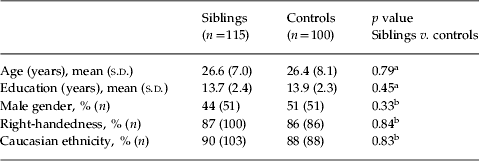
A total of 215 subjects met the inclusion criteria (115 unaffected siblings and 100 healthy controls). We excluded from the initial sample 27 siblings and eight controls due to a DSM-IV diagnosis of substance abuse and four siblings and one control due to a diagnosis of alcohol abuse. Both groups were comparable with regard to demographic variables (Table 1). The included siblings and controls did not differ in their pattern of current cannabis use (χ2=3.49, df=3, p=0.32). One sibling had used cocaine the previous week.
Demographic characteristics of unaffected siblings of patients with a non-affective psychosis and healthy controls

s.d., Standard deviation.
a Independent Student's t test.
b χ2 test.
The ICCs for movement disorders varied between 0.78 and 0.98; the ICC for schizotypy was 0.76.
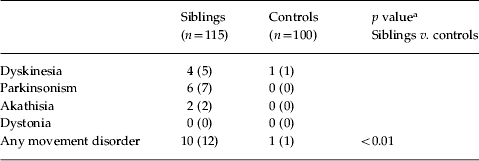
Based on the definition criteria for movement disorders, siblings exhibited significantly more movement disorders than controls [10% (n=12) v. 1% (n=1); Fisher's exact test p<0.01; Table 2). Two siblings exhibited more than one type of movement disorder [(dyskinesia and akathisia) and (dyskinesia and parkinsonism)].
Distribution of movement disorders in unaffected siblings of patients with a non-affective psychosis and healthy controls

Case definitions movement disorders: see Method section – Clinical assessments. Two siblings exhibited more than one type of movement disorder [(dyskinesia and akathisia) and (dyskinesia and parkinsonism)].
Values given as % (n).
a Fisher's exact test.
The overall sibling group (with and without a movement disorder) did not exhibit significantly more schizotypy as compared to the controls. Individual mean (s.d.) scores and Mann–Whitney p values for siblings and controls were respectively: positive schizotypy, 0.23 (0.29) and 0.18 (0.23) (p=0.33); negative schizotypy, 0.18 (0.21) and 0.16 (0.16) (p=0.78); disorganization schizotypy, 0.02 (0.07) and 0.02 (0.07) (p=0.98); total schizotypy, 0.21 (0.20) and 0.17 (0.16) (p=0.31).
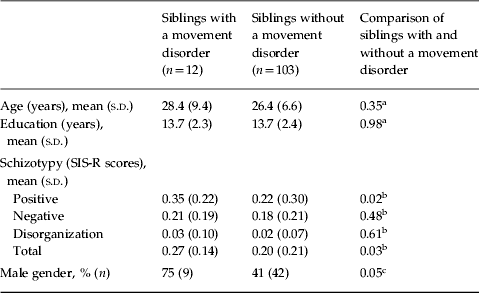
Siblings with a movement disorder had significantly higher scores for positive and total schizotypy compared to siblings without a movement disorder (p=0.02 and 0.03 respectively) (Table 3). This subgroup included more males. There was no difference between siblings with or without a movement disorder in the pattern of current cannabis use (χ2=0.52, df=3, p=0.92). One sibling without a movement disorder had used cocaine the previous week.
Demographic and clinical data of unaffected siblings of patients with a non-affective psychosis with and without a movement disorder

SIS-R, Structured Interview for Schizotypy – Revised; s.d., standard deviation.
a Independent Student's t test.
b Mann–Whitney test.
c χ2 test with continuity correction.
Post-hoc Spearman correlation analyses
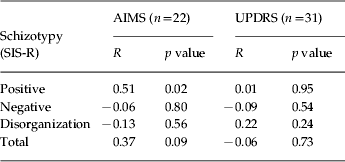
There was a significant correlation between dyskinesia and positive schizotypy and a trend for a correlation with total schizotypy (Table 4). Parkinsonism was not associated with any domain of schizotypy. There were too few cases of akathisia (n=4) to perform a correlation analysis, and no cases of dystonia.
Correlation coefficients between individual movement disorders and domains of schizotypy in unaffected siblings of patients with a non-affective psychosis

AIMS, Abnormal Involuntary Movement Scale; UPDRS, Unified Parkinson Disease Rating Scale; n, number of siblings with at least a minimal movement disorder (item score ⩾1); R, Spearman's correlation coefficient.
Correlations for the Barnes Akathisia Rating Scale (BARS) could not be calculated because of the limited number of siblings with akathisia (n=4). No sibling displayed any sign of dystonia.
Discussion
This is the first study to report a significant association between movement disorders and (positive) schizotypy in unaffected siblings of patients with a non-affective psychosis. Furthermore, we found that movement disorders are more prevalent in unaffected siblings than in healthy controls.
This association between movement disorders and (positive) schizotypy has been found previously in individuals with a high risk for a psychotic disorder, such as adolescents with a schizotypal personality disorder (Mittal & Walker, Reference Mittal and Walker2007; Mittal et al. Reference Mittal, Neumann, Saczawa and Walker2008). Those studies reported that, in adolescents with schizotypal personality disorders, the presence of baseline dyskinetic movement abnormalities was associated with psychotic symptoms and differentiated high-risk individuals who eventually developed a psychotic disorder. Therefore, finding a similar association in symptomatically unaffected subjects with an increased genetic risk, such as siblings of patients with a non-affective psychosis, supports the hypothesis that certain vulnerability factors for schizophrenia could cluster in a subgroup of subjects at risk.
Our results are also supported by the findings of neurological soft signs (NSS) in first-degree relatives of patients with schizophrenia (Ismail et al. Reference Ismail, Cantor-Graae and McNeil1998; Egan et al. Reference Egan, Hyde, Bonomo, Mattay, Bigelow, Goldberg and Weinberger2001; Yazici et al. Reference Yazici, Demir, Yazici and Gogus2002; Mechri et al. Reference Mechri, Gassab, Slama, Gaha, Saoud and Krebs2010). One element of the NSS in particular, soft motor signs, has been associated with movement disorders in antipsychotic-naive patients with schizophrenia spectrum disorders. Both ‘soft’ motor signs and ‘hard’ movement disorders may be aspects of a more global motor dysfunction (Whitty et al. Reference Whitty, Owoeye and Waddington2009; Peralta et al. Reference Peralta, de Jalon, Campos, Basterra, Sanchez-Torres and Cuesta2010). Moreover, soft motor signs have been associated with (positive) schizotypy in unaffected siblings (Mechri et al. Reference Mechri, Gassab, Slama, Gaha, Saoud and Krebs2010). Indeed, there is even further evidence that only the positive dimension of schizotypy is linked to the genetic vulnerability for schizophrenia (Vollema et al. Reference Vollema, Sitskoorn, Appels and Kahn2002).
The mean age of the siblings in this study was 27 years, but it could be hypothesized that mainly siblings who have yet to reach the modal age of onset for psychosis or schizophrenia are at risk (modal age at onset for males is between 18 and 25 years and for females between 25 and the mid-30s) (APA, 2000). Of note, in this study the siblings with ‘mild’ or ‘moderate’ dyskinesia (n=5) were relatively young, with a mean age (s.d.) of 23 (7) years. Additionally, based on the correlation analysis, only dyskinesia correlated significantly with positive schizotypy (Spearman's ρ=0.51, p=0.02). This finding is consistent with previous studies examining dyskinetic movement disorders in association with (positive) schizotypy and with psychosis conversion (Mittal & Walker, Reference Mittal and Walker2007; Mittal et al. Reference Mittal, Neumann, Saczawa and Walker2008). It is noteworthy that the association between hypokinetic movement disorders (related to a decreased striatal dopamine activity) and schizotypy has never been investigated in high-risk individuals. However, our correlation analysis found no evidence for such an association (Table 4). In addition, the siblings with ‘mild’ or ‘moderate’ parkinsonism (n=7) were relatively older, with a mean age (s.d.) of 31 (11) years.
Finding an association between movement disorders (dyskinetic in particular) and (positive) schizotypy could be clinically important, if it were to facilitate the identification of subjects at risk for psychosis, particularly because movement disorders can be measured objectively. However, our study design was cross-sectional, and therefore it is not known whether these ‘siblings at risk’ will develop psychosis or, in the absence of other (environmental) risk factors such as cannabis (van Os & Kapur, Reference van Os and Kapur2009), have not developed a psychotic disorder.
We can speculate about the underlying pathophysiological mechanism; it could be a shared vulnerable dopamine-mediated dysfunction affecting the dopaminergic pathways in the brain (Tenback et al. Reference Tenback, van Harten, Slooff and van Os2010), with the nigrostriatal pathway leading to movement disorders (Carlsson, Reference Carlsson1988; Mittal & Walker, Reference Mittal and Walker2007) and the mesolimbic pathway explaining the presence of positive schizotypal symptoms (Carlsson, Reference Carlsson1988). Indeed, an increased presynaptic dopamine capacity in the striatum, leading to an accumulation of labelled dopamine, has been confirmed in positron electron tomography (PET) imaging in first-degree relatives of patients with schizophrenia (Huttunen et al. Reference Huttunen, Heinimaa, Svirskis, Nyman, Kajander, Forsback, Solin, Ilonen, Korkeila, Ristkari, McGlashan, Salokangas and Hietala2008) and in subjects with schizotypy (Abi-Dargham et al. Reference Abi-Dargham, Kegeles, Zea-Ponce, Mawlawi, Martinez, Mitropoulou, O'Flynn, Koenigsberg, Van Heertum, Cooper, Laruelle and Siever2004; Soliman et al. Reference Soliman, O'Driscoll, Pruessner, Holahan, Boileau, Gagnon and Dagher2008). Additionally, supersensitivity of ascending dopamine pathways, specifically the striatal pathway mediated by the D2 receptor subtype, is considered to cause hyperkinetic movement abnormalities such as dyskinesia (Smith et al. Reference Smith, Bevan, Shink and Bolam1998; Casey, Reference Casey2004). Moreover, striatal hyperdopaminergia is associated not only with psychotic symptoms in schizophrenia (Howes & Kapur, Reference Howes and Kapur2009) but also with prodromal signs of schizophrenia (Howes et al. Reference Howes, Montgomery, Asselin, Murray, Valli, Tabraham, Bramon-Bosch, Valmaggia, Johns, Broome, McGuire and Grasby2009). Although hypothetical, these findings could explain the correlation we found between dyskinetic motor abnormalities and positive schizotypy in a subgroup of unaffected siblings of patients with schizophrenia.
In the same vein it has been suggested that, in schizophrenia, striatal dopamine dysfunction initially manifests itself in the form of dyskinetic movement disorders and gradually leads to prodromal and eventually to psychotic symptoms as the development of the striatal circuitry becomes further disturbed during late adolescence (Walker, Reference Walker1994; Mittal et al. Reference Mittal, Neumann, Saczawa and Walker2008).
Our finding that unaffected siblings display more movement disorders compared to controls is in line with our recent meta-analysis on dyskinesia and parkinsonism in antipsychotic-naive patients and their first-degree relatives (Koning et al. Reference Koning, Tenback, van Os, Aleman, Kahn and van Harten2010). It suggests that movement disorders, and by inference abnormalities in the nigrostriatal pathway, are not only associated with schizophrenia itself but may also be related to the (genetic) risk of developing the disease.
In addition, siblings in the present study had higher scores compared to controls on all but the disorganized aspects of schizotypy, although the results were not significant. This could be due to our more strict inclusion criteria compared to other studies assessing schizotypy in relatives of patients with schizophrenia. Indeed, a study including relatives with more overt psychotic symptoms (such as schizotypal personality disorders) did find significantly more schizotypy (Kendler et al. Reference Kendler, Thacker and Walsh1996). Moreover, it has been pointed out that relatives respond more defensively as they fear the discovery of schizotypal phenomena (Grove et al. Reference Grove, Lebow, Clementz, Cerri, Medus and Iacono1991; Lenzenweger, Reference Lenzenweger, Chapman, Chapman and Fowles1993). Our results on schizotypy are (partially) consistent with previous studies reporting elevated scores in first-degree relatives of positive (Laurent et al. Reference Laurent, Biloa-Tang, Bougerol, Duly, Anchisi, Bosson, Pellat, d'Amato and Dalery2000; Vollema et al. Reference Vollema, Sitskoorn, Appels and Kahn2002; Appels et al. Reference Appels, Sitskoorn, Vollema and Kahn2004; Delawalla et al. Reference Delawalla, Barch, Fisher Eastep, Thomason, Hanewinkel, Thompson and Csernansky2006) and negative schizotypal symptoms (Kendler et al. Reference Kendler, Thacker and Walsh1996; Laurent et al. Reference Laurent, Biloa-Tang, Bougerol, Duly, Anchisi, Bosson, Pellat, d'Amato and Dalery2000; Calkins et al. Reference Calkins, Curtis, Grove and Iacono2004; Delawalla et al. Reference Delawalla, Barch, Fisher Eastep, Thomason, Hanewinkel, Thompson and Csernansky2006), but not for disorganized traits.
Thus, finding a significant association between movement disorders and (positive) schizotypy in unaffected siblings despite our strict inclusion criteria suggests a true relationship between movement disorders and (positive) schizotypy in subjects at risk.
Some limitations of this study should be taken into consideration. The results are based on a relatively small sample size; however, because a clear a priori hypothesis was formulated and because of the inclusion of more obvious movement disorders [item score of at least ‘mild’ (⩾2)], the probability of a type I error is small. In addition, it was not possible to prevent raters from knowing whether a subject was a sibling or a control. However, we do not think that this influenced the results because, as mentioned earlier, raters were unaware of the hypothesis of the study and could not have known it from the previous literature. Moreover, subjects who used psychotropic medication or had a diagnosis of drug abuse were excluded.
Furthermore, the sibling group with a movement disorder and increased (positive) schizotypy included more males (n=9) than females (n=3). However, because of the small number of cases, it was not possible to check for gender interactions. Nevertheless, it can be assumed that male gender does not have an effect on the association between movement disorders and schizotypy because in fact females had higher scores for positive and total schizotypy (data not shown). This applied to the overall sibling group (with and without a movement disorder) (n=115) and also to the subgroup of siblings with a movement disorder (n=12).
In conclusion, our results indicate that movement disorders (dyskinetic in particular) are associated with (positive) schizotypy in unaffected siblings of patients with a non-affective psychosis. This suggests that both vulnerability indicators share an underlying mechanism, which could be of etiological interest in the quest for the genes or origin of schizophrenia or a psychotic disorder. Further prospective studies are needed to examine whether this subgroup of siblings with both (dyskinetic) movement disorders and (positive) schizotypy are more at risk of developing a psychotic disorder than siblings with only one of these vulnerability factors.
Acknowledgements
We thank all of the participants in this study.
Declaration of Interest
None.