Introduction
The European oak borer (EOB), Agrilus sulcicollis Lacordaire (Coleoptera: Buprestidae), is native to most of Europe where it attacks primarily Quercus Linnaeus (Fagaceae), and occasionally Castanea Miller (Fagaceae), Carpinus Linnaeus (Betulaceae), and Fagus Linnaeus (Fagaceae) (Bílý Reference Bílý2002; Evans et al. Reference Evans, Moraal and Pajares2004; Jendek and Grebennikov Reference Jendek and Grebennikov2009). Adult EOB lay eggs in the bark crevices of host trees. Eggs hatch and the larvae bore into the subcortical region where they feed and eventually pupate (Bílý Reference Bílý2002). In Europe, EOB and two other Agrilus Curtis species, Agrilus biguttatus (Fabricius) and Agrilus angustulus (Illiger), have been associated with oak decline (Moraal and Hilszczanski Reference Moraal and Hilszczanski2000; Evans et al. Reference Evans, Moraal and Pajares2004; Hilszczanski and Sierpinski Reference Hilszczanski and Sierpinski2008). However, A. biguttatus is considered to be the most destructive of these three oak-infesting Agrilus species (Moraal and Hilszczanski Reference Moraal and Hilszczanski2000).
In 2008, EOB was first discovered in Ontario, Canada (Jendek and Grebennikov Reference Jendek and Grebennikov2009), and later the same year in Michigan, United States of America (Haack et al. Reference Haack, Petrice and Zablotny2009). Previously unidentified and misidentified specimens of this beetle were later found that date back to 1995 in Ontario (Jendek and Grebennikov Reference Jendek and Grebennikov2009), and 2003 in Michigan (Haack et al. Reference Haack, Petrice and Zablotny2009). Many of these specimens were captured on sticky traps used in surveys and studies of the emerald ash borer, Agrilus planipennis Fairmaire, an exotic borer introduced into the United States of America and Canada that has become a serious pest of ash, Fraxinus Linnaeus (Oleaceae) (Haack et al. Reference Haack, Jendek, Liu, Marchant, Petrice and Poland2002; Cappaert et al. Reference Cappaert, McCullough, Poland and Siegert2005; Poland and McCullough Reference Poland and McCullough2006; Kovacs et al. Reference Kovacs, Haight, McCullough, Mercader, Siegert and Liebhold2010). In Michigan, EOB has emerged from Quercus robur Linnaeus, a native host of EOB in Europe (Haack et al. Reference Haack, Petrice and Zablotny2009), and in Ontario it has emerged from Q. rubra Linnaeus (Jendek and Grebennikov Reference Jendek and Grebennikov2009). The current known geographical range of EOB in North America as of 2013 includes 10 counties in southern Michigan, United States of America, two counties in northwestern New York, United States of America, and six counties in southeastern Ontario, Canada (National Agriculture Pest Information System 2013; B. Gill, Canadian Food Inspection Agency, personal communication). It is likely that the range of EOB in North America is much larger than what has been documented to date, given that there are currently no federal or state/provincial quarantines for EOB in either Canada or the United States of America. Therefore, few delimiting surveys have been conducted for EOB.
EOB adds to the list of at least 42 native Agrilus species that are associated with Quercus in North America (Nelson et al. Reference Nelson, Walters, Haines and Bellamy2008; Haack et al. Reference Haack, Petrice and Zablotny2009). Although no direct Quercus mortality has been linked to EOB since its discovery in North America, its association with Quercus decline in Europe raises concerns regarding potential impacts it could have on Quercus in North America when combined with other significant Quercus pests such as the native twolined chestnut borer (TLCB), Agrilus bilineatus (Weber) (Haack et al. Reference Haack, Petrice and Zablotny2009). In 2010–2011, we conducted several life history studies on EOB in southern Michigan including: seasonal flight, attraction to different colours of sticky traps and artificially girdled trees, host preference and within tree distribution, larval morphology, and parasitism. In addition, whenever possible, we collected similar data on TLCB so that comparisons could be made between the two species.
Materials and methods
Study sites
Studies took place in Quercus provenance plantings at two sites in southern Michigan, United States of America. The first site was at the Michigan State University, Tree Research Center (TRC), Ingham County (42.67°N, 84.47°W), which consisted of primarily Q. robur and some Quercus alba Linnaeus. The second field site was at the Michigan State University, Kellogg Experimental Forest (KF), Kalamazoo County (42.37°N, 85.36°W), which consisted of a mixture of Q. robur, Q. alba, and Q. rubra. Trees at each site were ∼30 years old and averaged 13 m in height.
Trap colour and seasonal flight
Sticky traps were used to determine seasonal flight and the trap colours most effective for capturing Agrilus adults in 2010 and 2011. We tested green, purple, white, and yellow sticky traps that were 15-cm-wide × 30-cm-tall. Studies have shown that buprestid adults are often attracted to the colours green, purple, and white (Sakalian et al. Reference Sakalian, Dimova and Damianov1993; Oliver et al. Reference Oliver, Fare, Youssef and Klingeman2003; Oliver et al. Reference Oliver, Mastro, Lance, Francese, Youssef and Lavallee2004; Francese et al. Reference Francese, Mastro, Oliver, Lance, Youssef and Lavallee2005; Crook et al. Reference Crook, Francese, Zylsra, Fraser, Sawyer and Bartels2009; Petrice et al. Reference Petrice, Haack and Poland2013). Yellow is the standard colour used for sticky traps that are readily available through multiple retailers and are used to capture numerous species of leaf feeding insects. A FieldSpec Pro full range spectrophotometer (Analytical Spectral Devices, Inc., Boulder, Colorado, United States of America) was used to measure spectral reflectance of each colour tested. Reflectance was measured approximately every 3 nm within the visible and near-infrared portion of the spectrum (350–1000 nm). Green (peak reflectance: 530–536 nm, 57.6%), purple (433–436 nm, 26.7%), and white (peak reflectance: 436–438 nm, 96.0%) traps were cut from sheets of corrugated plastic (Coroplast, Inc., Vanceburg, Kentucky, United States of America), and yellow traps (peak reflectance: 561–572 nm, 70.4%) were standard insect sticky traps (Olson Products, Inc., Medina, Ohio, United States of America). One card of each of the four colours was stapled to a single, 1-m-long wooden pole in random order with 15 cm spacing between cards. All traps, including yellow sticky traps, were coated on each side with clear Pestick™ insect glue (Hummert International, Earth City, Missouri, United States of America). Wooden poles with traps were placed on Q. robur and Q. alba trees situated along the edges of the plantations or on trees that were open grown and exposed to the sun. Wooden poles with traps were suspended horizontally using twine, just below the foliage on the lower limbs of trees with no more than one pole per tree and a minimum of 10 m between trees with traps. Traps were suspended between 1.5–2.0 m above the ground. In 2010, 10 sets of traps (40 traps total) were placed at each site on 12 May. In 2011, 10 sets of traps were placed at KF on 4 May, and 12 sets of traps were placed at TRC on 10 May. All Agrilus adults were removed from traps every week through early July, after which all Agrilus were removed at two-week intervals through August. Insects were frozen until they were cleaned with hexane to remove Pestick™, and prepared for identification. All Agrilus were sexed and identified to species using the keys in Fisher (Reference Fisher1928), Wellso et al. (Reference Wellso, Manley and Jackman1976), and MacRae (Reference MacRae2003). Keys of North American Agrilus did not include EOB, so specimens that resembled its species description (Jendek and Grebennikov Reference Jendek and Grebennikov2009) and voucher specimens in our collection, were sent to James Zablotny (United States Department of Agriculture Animal Plant and Health Inspection Service, Romulus, Michigan, United States of America) for confirmation. Voucher specimens are stored at Michigan State University Insect Collection, East Lansing, Michigan, United States of America.
Girdled trees
Attraction to girdled trees and within-tree distribution was studied for EOB and TLCB on Q. robur trees that were girdled in 2010 or 2011. Trees were girdled to cause stress, which is known to enhance attraction of trees to several species of Agrilus beetles (Cote and Allen Reference Cote and Allen1980; Haack and Benjamin Reference Haack and Benjamin1982; Dunn et al. Reference Dunn, Kimmerer and Nordin1986; McCullough et al. Reference McCullough, Poland and Cappaert2009). In 2010, we girdled 12 Q. robur trees at TRC by making a single girdle ∼1 m above the ground on each tree using a chainsaw. Girdles were deep enough to sever the cambium and the outer few growth rings of xylem on each tree but depth did vary slightly among trees. Girdled trees were located on the edge of each plantation. We girdled six trees on 15 April 2010, just before leaf flush, and six more trees on 21 May 2010, just after leaf expansion was complete. Tree diameter at breast height (DBH, 1.3 m above the ground) ranged from 14 to 27 cm (mean = 19 cm). We recorded if foliage of girdled trees appeared healthy, i.e., green and fully expanded, or showed evidence of stress, i.e., wilting or browning, on 4 June and 12 August 2010. These 12 trees were left standing until they were felled in January–February 2011. When the trees were felled, we cut a 1-m-long tree section below the girdle (∼0–1 m above the ground), another directly above the girdle (∼1–2 m), and then a section every 2 m along the main stem, stopping ∼2 m from the top of each tree. We also cut 1-m-long sections from two branches in the mid-crown to upper crown of each tree. One half of each tree section was dissected and the other half was placed in a rearing container indoors (ambient temperature of ∼22 °C) soon after the tree was felled to allow insects to complete development and emerge. In addition, two Q. robur trees that were not girdled and appeared healthy were felled in March 2011 at TRC and a 0.5-m-long section was cut and dissected from 1, 4, and 8 m above the ground to determine if these apparently healthy trees had been attacked.
In 2011, we girdled 21 Q. robur trees at TRC, including eight trees on 8 March (when the trees were dormant), six on 4 May (just before leaf flush), and seven on 27 May (just after full leaf expansion). Tree DBH ranged from 11.8 to 30.8 cm (mean = 20.3 cm), and each tree was double girdled with a chainsaw ∼1 m above the ground, with girdles ∼5 cm apart and a minimum depth of 2.5 cm into the xylem tissue. Trees were double girdled in 2011 to increase the level of tree stress because some single-girdled trees from 2010 showed no effect from girdling at the end of the 2010 growing season.
At KF, we girdled 18 trees in 2011, six trees each of Q. alba, Q. robur, and Q. rubra, to determine EOB host preference. We girdled three trees of each species on each of the following dates: 4 May (just before leaf flush) and on 27 May (just after leaves were fully expanded). Trees were double girdled following the same procedure used at TRC in 2011. Tree DBH ranged from 17.2 to 26.0 cm (mean=20.6 cm).
For all trees girdled in 2011, we recorded if foliage appeared healthy or stressed on 6 June and 8 August 2011. The girdled trees were left standing until they were felled during February–March 2012, after which a 0.5-m-long section was removed from each tree just below the girdle (∼0.5–1.0 m above the ground), just above the girdle (∼1.0–1.5 m), and at mid-stem (∼4.5–5.0 m). We also collected several branches and twigs from each tree for rearing to determine if EOB developed in smaller host material. Logs, branches and twigs were placed in rearing containers soon after trees were felled and held indoors at ∼22 °C to allow insects to complete development and emerge.
Trap logs
Trap logs of different Quercus species were cut from the trunks of Q. alba, Q. robur, Q. rubra, and Quercus velutina Lamarck trees that appeared to be healthy, i.e., buds and expanding leaves appeared healthy throughout the crown, and therefore assumed to be uninfested by Agrilus. Trap logs were cut on 6 May 2010 and placed at KF and TRC on 12 May 2010 to allow natural colonisation by Agrilus. Logs were 1 m long and ranged from 9 to 18 cm diameter (mean = 15 cm). Five replicates were placed at each of the two sites and each replicate consisted of one log of each oak species. Each log within the replicates was stood upright ∼15 cm from other logs in the replicate and tied to a metal fence post that was driven into the ground. Replicates were at least 25 m apart and situated along the edge of the oak plantings. Logs were collected in February 2011 and transported to our laboratory where one half of each log was dissected and the remaining half was placed in a rearing tube and held indoors (ambient temperature ∼22 °C) to allow insects to complete development and emerge.
Log dissections
Tree and trap log sections were stored at 5 °C until dissections were performed in the laboratory, usually within 1–4 weeks after they were collected from the field. Before dissecting tree and trap log sections, the diameter and length were recorded. Also, mean bark thickness (outer and inner bark combined) of each section was determined by averaging measurements taken at four equidistant points around the log circumference. Then, bark was carefully removed with a drawknife and the location of each larva found was recorded, i.e., feeding in inner bark, or pupal cell in outer bark or wood. The amount of live phloem, i.e., tissue cream coloured and moist as opposed to brown and drying, was visually estimated to the nearest 5% for each tree section dissected from girdled trees.
All Agrilus larvae found were examined under a dissecting microscope and it was apparent, based on Agrilus larval characters described by Bílý (Reference Bílý1982) and Chamorro et al. (Reference Chamorro, Volkovitsh, Poland, Haack and Lingafelter2012), that there were two species of Agrilus in the logs. We reared a subset of the two larval morphotypes to adults to determine the species for each. Parasitoids found on Agrilus larvae were placed in petri dishes and held at 24 °C and 75% humidity in growth chambers to allow them to complete development. The Agrilus cadaver that the parasitoids were found on was used to determine which Agrilus species was parasitised. Adult parasitoids that were reared from Agrilus cadavers in petri dishes or emerged from logs were preserved in 95% ethyl alcohol and sent to specialists for identification.
Statistical analyses
Mean number of adults captured per trap, pooled by sample dates within years, on different coloured sticky traps in 2010 and 2011 was compared using PROC Mixed (SAS 2008), with study site and sampling year as random variables. Adult flight was compared by calculating percent of total adults of each Agrilus species captured for each collection date at each site within each sample year. Degree-day accumulations, calculated with the numerical integration method with 10 °C as the base temperature and 1 January as the start date, for adult flight were taken from Michigan State University Enviro-Weather (2011). The weather station used for TRC degree-day data was located at the Michigan State University Horticulture Teaching and Research Center, ∼1 km west of the TRC study site, and the weather station used for KF degree-day data was located at the Kalamazoo Nature Center, ∼20 km west of the KF study site.
Insect emergence (or dissection) density was calculated by dividing the number of beetles recovered by the surface area of the respective log they emerged (or were dissected) from. The density of EOB or TLCB per m2 for different tree heights, girdle dates, foliage conditions, tree species, and trap logs species was compared using PROC GLM (SAS 2008). Density values were transformed using Log 10 prior to analyses to help normalise the data. Means were separated using Student–Neuman–Keuls multiple range test when they were significantly different at the P < 0.05 level.
Results and discussion
Trap colour and seasonal flight
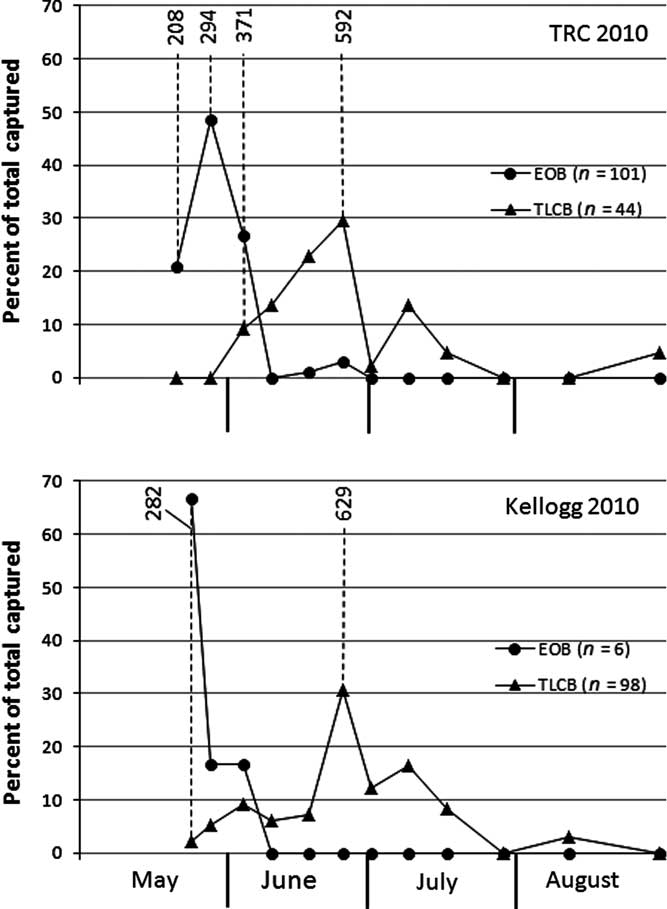
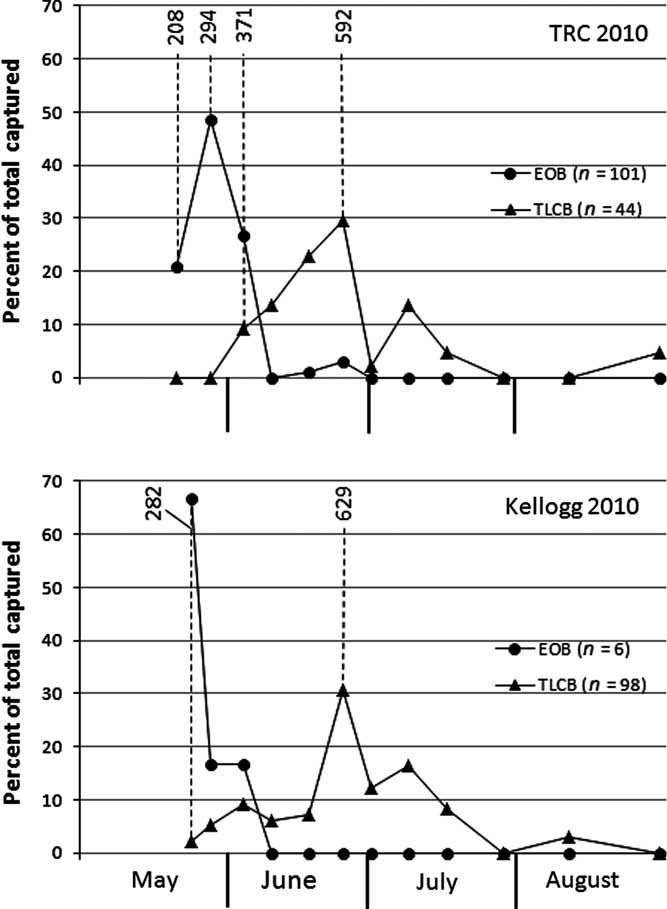
In 2010, EOB flight had already started at both study sites before the first trap collections were made on 21 May at TRC and 24 May at KF (Fig. 1), and thus timing of initial flight could not be determined. Degree-day accumulations (DD; base = 10 °C; start date = 1 January) for the first collection were 208 at TRC and 282 at KF. At TRC in 2010, the peak EOB capture rate was during the weekly collection period ending on 28 May (294 DD). Most EOB collected at KF were from the first trapping period, so we cannot be sure if our traps documented the actual peak flight at KF or if the peak had already occurred prior to us placing traps in the field.
Mean percent of European oak borer (EOB), Agrilus sulcicollis (Coleoptera: Buprestidae) and twolined chestnut borer (TLCB), A. bilineatus, captured on sticky cards by date in 2010 at two locations in southern Michigan, United States of America (TRC, MSU Trees Research Center, Ingham Co.; KF, Kellogg Forest, Kalamazoo Co.). Degree days (base 10 °C; start date 1 January 2010) are listed at the top of each figure for the approximate date of initial flight and peak flight of each species.
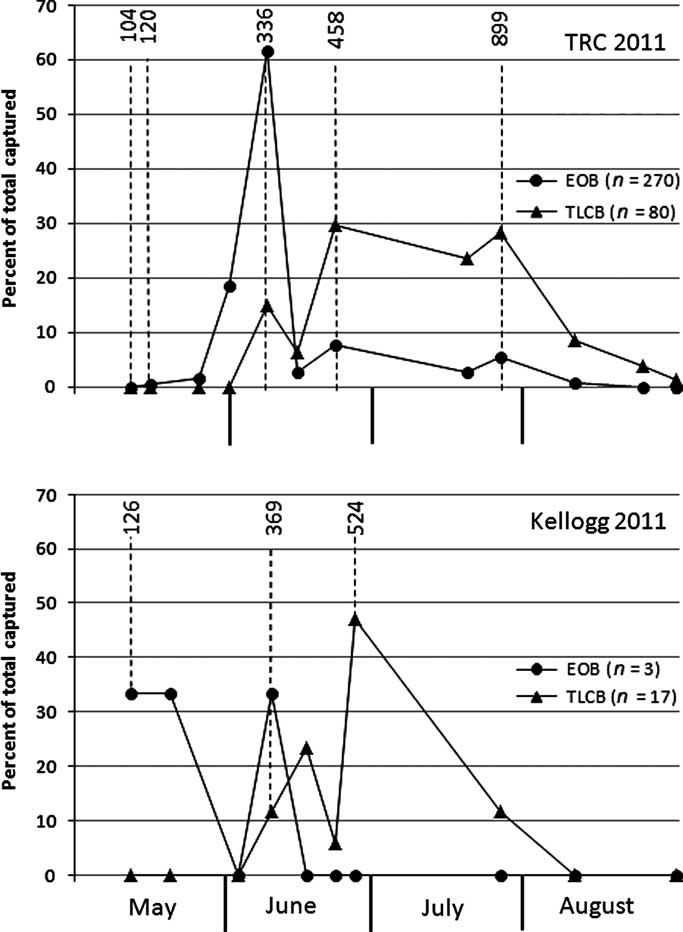
In 2011, the first trap collection at KF was on 12 May (126 DD) and 1 EOB was collected on that day (Fig. 2). No EOB had been captured at TRC when traps were checked for the first time on 13 May (116 DD), while one EOB had been captured at TRC when traps were checked on 16 May (120 DD). In 2011, EOB flight peaked on 9 June (336 DD) at TRC. At KF, only three EOB adults were captured in 2011 (12 May = 126 DD; 20 May = 163 DD; 10 June = 369 DD), and therefore it was not possible to determine when peak flight occurred.
Mean percent of European oak borer (EOB), Agrilus sulcicollis (Coleoptera: Buprestidae) and twolined chestnut borer (TLCB), Agrilus bilineatus, captured on sticky cards by date in 2011 at two locations in southern Michigan, United States of America (TRC, MSU Trees Research Center, Ingham Co.; KF, Kellogg Forest, Kalamazoo Co.). Degree days (base 10 °C; start date 1 January 2011) are listed at the top of each figure for the approximate date of initial flight and peak flight of each species.
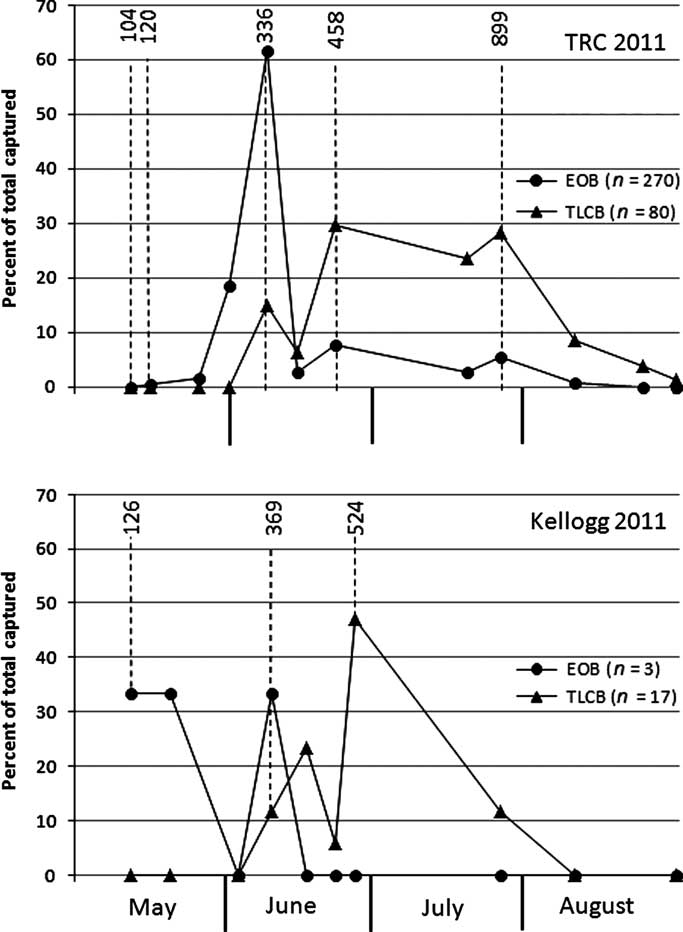
Initial flight for TLCB generally started after EOB initial flight in 2010 and 2011 (Figs. 1–2). At TRC, TLCB peak flight occurred approximately four weeks after EOB peak flight in 2010, and approximately two weeks after EOB peak flight in 2011. The same trend occurred at KF, however, we lacked data for EOB peak flight to make exact comparisons. Degree-day accumulations for TLCB peak flight ranged from 592 at TRC to 629 at KF in 2010, and 458 at TRC and 524 at KF in 2011. Our TLCB adult flight data are consistent with what has been previously documented for TLCB in southern Michigan (Wellso et al. Reference Wellso, Manley and Jackman1976), as well as similar latitudes in the states of Wisconsin (Haack and Benjamin Reference Haack and Benjamin1982), Pennsylvania, and New York, United States of America (Cote and Allen Reference Cote and Allen1980).
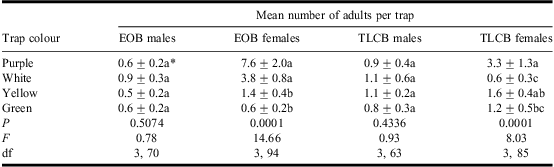
Purple and white were the most attractive colours to EOB females based on mean number of adult females captured per trap (Table 1). EOB males did not show a significant preference to any particular trap colour, although it should be noted that many more females were captured than males (sex ratio = 1.00♂:6.60♀). TLCB females were most attracted to purple, followed by yellow traps, while males did not show any significant preference (Table 1). As with EOB, the sex ratio of TLCB was skewed towards females (sex ratio = 1.00♂:2.32♀).
Mean number of male and female (EOB), Agrilus sulcicollis (Coleoptera: Buprestidae) and TLCB, Agrilus bilineatus, adults captured per trap per trapping season on different coloured sticky traps suspended from live Quercus robur and Quercus alba branches May–August 2010 and 2011 in Ingham County and Kalamazoo County, Michigan, United States of America (data pooled by site and year).

EOB = European oak borer; TCLB = twolined chestnut borer.
*Means followed by the same letter (within columns) are not significantly different at the P < 0.05 level (Student–Neuman–Keuls multiple range test).
Previous studies have found Agrilus adults, including A. planipennis, to be highly attracted to purple and green (Oliver et al. Reference Oliver, Fare, Youssef and Klingeman2003; Francese et al. Reference Francese, Mastro, Oliver, Lance, Youssef and Lavallee2005; Crook et al. Reference Crook, Francese, Zylsra, Fraser, Sawyer and Bartels2009; Petrice et al. Reference Petrice, Haack and Poland2013). There is some anecdotal evidence that suggests that Agrilus anxius is significantly attracted to white, presumably because many of its hosts, Betula Linnaeus (Betulaceae) species, have white bark (Petrice et al. Reference Petrice, Haack and Poland2013). It is unclear why EOB is attracted to white given that Quercus bark is usually a shade of gray. Species belonging to another buprestid genus, Chrysobothris Eschscholtz, have also shown some attraction to white sticky traps (Oliver et al. Reference Oliver, Fare, Youssef and Klingeman2003; Petrice et al. Reference Petrice, Haack and Poland2013).
It is possible that the placement of traps in the lower canopy and close to the ground may have influenced attraction and sex ratios of Agrilus. Francese et al. (Reference Francese, Crook, Fraser, Lance, Sawyer and Mastro2010) found that male A. planipennis capture rates were highest when traps were suspended mid-canopy in ash trees as opposed to 1.5 m above the ground. Furthermore, A. planipennis females tend to be more attracted to purple than males, while A. planipennis males tend to be more attracted to green traps compared to females (Crook et al. Reference Crook, Francese, Zylsra, Fraser, Sawyer and Bartels2009; Francese et al. Reference Francese, Crook, Fraser, Lance, Sawyer and Mastro2010). Perhaps if our traps had been suspended higher in the tree canopies, more Agrilus males would have been captured and they would have shown a significant trap colour preference.
Seasonal development
Most (95%; n = 324) EOB larvae had completed development, and constructed and entered their pupal cells when tree sections were dissected in January–February 2011 from the Q. robur trees that had been girdled and subsequently attacked in the spring and summer of 2010. Similarly, 97% (n = 691) of TLCB individuals were mature larvae and had entered their pupal cells when the tree sections were dissected in January–February 2011. Assuming that all trees were attacked the same year that they were girdled, most EOB and TLCB completed development in one year and thus were univoltine at our study sites. Both species have been reported as being primarily univoltine with the exception of populations found in more northern ranges or individuals under less than optimal host conditions (Palm Reference Palm1959; Cote and Allen Reference Cote and Allen1980; Haack and Benjamin Reference Haack and Benjamin1982; Bílý Reference Bílý2002).
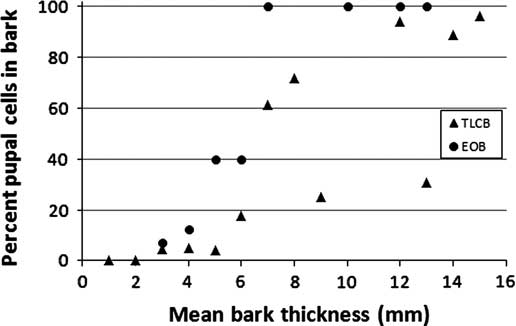
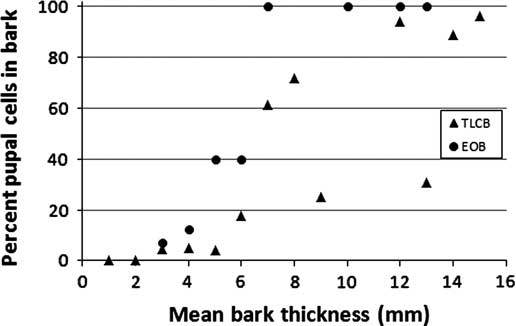
Although the exact number of larvae was not recorded, the majority of mature EOB and TLCB larvae encountered were doubled over in their pupal cells. These doubled-over larvae have been referred to as J-larvae by some authors and as prepupae by others; see Duan et al. (Reference Duan, Bauer, Abell and van Driesche2012) for a comparison of J-larvae and prepupae. Almost 89% (n = 309) of the EOB pupal cells were created in the bark as opposed to the outer xylem, compared with only 19% (n = 669) of TLCB pupal cells being created in the bark. Interestingly, Bílý (Reference Bílý2002) reported that EOB preferred to pupate in the xylem, however, bark thickness was not mentioned. In the present study, few EOB pupal cells were constructed in the bark when mean bark thickness (inner + outer bark) was < 4 mm, whereas there was a sharp increase in the percent of pupal cells in the bark when mean bark thickness was 5 mm or greater (Fig. 3). The percent of TLCB pupal cells in the bark sharply increased when mean bark thickness was 6 mm or greater. This slight difference compared with EOB, is likely attributed to the fact that TLCB adults (and thus mature larvae) are slightly larger than EOB (Fisher Reference Fisher1928; Bílý Reference Bílý1982). All EOB pupal cells were constructed in the bark when mean bark thickness was 7 mm or greater, while some TLCB pupal cells were constructed in the outer sapwood even when mean bark thickness exceeded 10 mm. Emergence of EOB from logs reared in the laboratory averaged 14 days before TLCB. The sex ratio for Agrilus adults reared in the laboratory from 2010 girdled trees was 1.0♂:1.5♀ (n = 110) for EOB and 1.0♂:1.0♀ (n = 424) for TLCB.
Percent of European oak borer (EOB), Agrilus sulcicollis (Coleoptera: Buprestidae) and twolined chestnut borer (TLCB), Agrilus bilineatus, pupal cells constructed in bark of Quercus robur trees in comparison to mean bark thickness (both inner and outer bark were combined) of logs they were dissected from.
Within-tree distribution
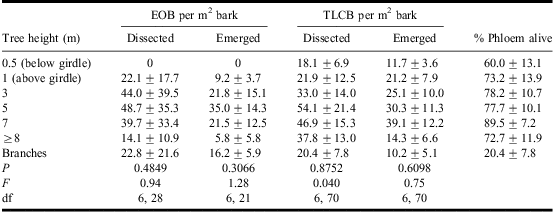
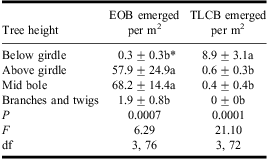
We reared or dissected EOB from 80%, TLCB from 83%, and both EOB and TLCB from 67% of the 30 Q. robur trees girdled at TRC in 2010 and 2011. In 2010, EOB were recovered only from tree sections above the girdle, while TLCB was recovered both above and below the girdle (Table 2). There was a trend for EOB and TLCB densities to be higher between 3 and 7 m above the ground in 2010; however, these differences were not significant for either Agrilus species because of the high variation among trees (Table 2). In 2011, significantly more EOB were found immediately above the girdle and at mid-bole compared with below the girdle, while significantly more TLCB were found below the girdle compared with immediately above the girdle and at mid-bole (Table 3). All 2011 girdled trees died quickly as a result of the double girdle (two rings of cutting), compared with trees that were girdled once (one ring) in 2010. The only live phloem that remained in 2011-girdled trees was below the girdle, while the phloem above the girdle was discoloured and appeared dead when trees were cut in the winter following girdling. In contrast, Tluczek et al. (Reference Tluczek, McCullough and Poland2011) reported that ash trees girdled in mid-spring died below the girdle while the tissue above the girdle appeared healthy when trees were dissected the winter following girdling. In their study, however, trees were only phloem girdled, i.e., only the outer and inner bark was removed and the xylem tissue was not severed and therefore upward conduction in the outer xylem was probably not greatly impacted. In addition, Tluczek et al. (Reference Tluczek, McCullough and Poland2011) found that A. planipennis grew larger and faster below the girdle as compared with above the girdle.
Mean densities per m2 of bark surface area of EOB, Agrilus sulcicollis (Coleoptera: Buprestidae) and TLCB, Agrilus bilineatus, that were dissected from logs or emerged from logs reared indoors soon after felling, and the percent of phloem that was alive at the time of felling at different heights above the ground for Quercus robur trees that were girdled in spring 2010 and felled January–March 2011 in Ingham County, Michigan, United States of America.
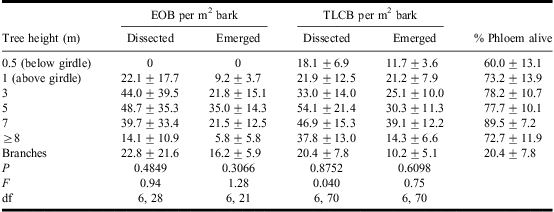
EOB = European oak borer; TCLB = twolined chestnut borer.
Mean densities per m2 of bark surface area of EOB, Agrilus sulcicollis (Coleoptera: Buprestidae) and TLCB, Agrilus bilineatus, that emerged from logs reared indoors soon after felling collected from different positions within Quercus robur trees girdled March–June 2011 and felled January-March 2012 in Ingham County, Michigan, United States of America.
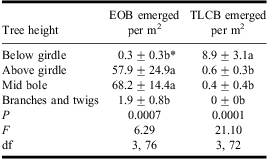
EOB = European oak borer; TCLB = twolined chestnut borer.
*Means followed by the same letter (within columns and within sites) are not significantly different at the P < 0.05 level (Student–Neuman–Keuls multiple range test).
Host material examined in this study ranged from a maximum of 32 cm in diameter for lower-trunk sections and a minimum of 0.6 cm in diameter (measured at midpoint) for twigs. EOB adults emerged from logs that were up to 31 cm in diameter and twigs as small as 2.6 cm in diameter (measured at the exit hole). Some studies in Europe report that EOB prefers the upper crown and branches of trees (Moraal and Hilszczanski Reference Moraal and Hilszczanski2000; Hilszczanski and Sierpinski Reference Hilszczanski and Sierpinski2008). We did not see this preference in our study; however, the trees in our study succumbed to EOB attack because they were artificially girdled, while the European studies mentioned above examined trees that were attacked by EOB under natural conditions. TLCB emerged or was dissected from tree sections up to 32 cm in diameter and twigs as small as 2.3 cm in diameter.
Effect of girdle date
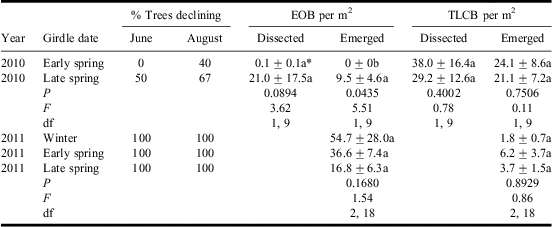
Mean number of EOB per m2 of bark surface area that emerged from reared material was significantly higher for trees girdled in late spring compared with early spring in 2010, and the mean number of EOB per m2 found in the dissected tree sections showed the same trend as the reared material but was only marginally significant (Table 4). The mean number of TLCB per m2 that emerged or were recovered upon dissection did not vary significantly among the girdle dates. Half of the trees girdled in late spring 2010 showed evidence of stress on 4 June, which was two weeks after trees were girdled and during EOB peak flight, whereas none of the trees girdled in early spring appeared stressed at this time (seven weeks after they were girdled; Table 4). In temperate climates, trees are most effectively killed if they are girdled when root carbohydrates are most depleted (Noel Reference Noel1970), which would have been the case for late spring girdled trees in our study, which had just completed leaf expansion before they were girdled. However, our single girdle method and inconsistent girdling depths in 2010 may have also influenced effectiveness of girdling given that all trees that were girdled with a double girdle in 2011 died quickly (discussed below) despite the time of the season they were girdled.
Mean densities per m2 of bark surface area of EOB, Agrilus sulcicollis (Coleoptera: Buprestidae) and TLCB, Agrilus bilineatus, that were dissected from logs or emerged from logs reared indoors soon after felling and percent of trees showing foliage decline (wilting) in June and August for Quercus robur trees that were girdled at different dates in 2010 and 2011, and felled January–March 2011 and 2012, respectively, in Ingham County, Michigan, United States of America.

EOB = European oak borer; TCLB = twolined chestnut borer.
*Means followed by the same letter (within columns and within years) are not significantly different at the P < 0.05 level (Student–Neuman–Keuls multiple range test).
No live Agrilus were found in the two ungirdled control trees that were dissected in March 2011. However, some galleries were found where the Agrilus larvae had tunnelled in 2010 and died. The appearance of these galleries resembled TLCB galleries that we had encountered during previous log dissections where most of the tunnelling was perpendicular to the wood grain, as compared with EOB galleries that were mostly parallel with the wood grain (T.R.P., personal observation). In addition, the remaining ungirdled Quercus trees at the study sites that were not used for this study did not show evidence of decline in 2010 or 2011.
The decline and death of the 2010 late-spring girdled trees coincided with EOB peak flight in 2010, while these same trees were most likely dead, except for tissue below the girdle, when TLCB flight peaked around 25 June 2010. TLCB was only found below the girdle on trees that appeared stressed in early June, while EOB was only found above the girdle in these same trees (data not shown). Foliage of the trees girdled in early spring 2010 did not appear to be stressed during EOB peak flight and these trees were not attacked by EOB. We did not evaluate foliage condition of girdled trees during TLCB peak flight, however, two of the early-spring girdled trees showed evidence of stress when they were evaluated on 12 August 2010 and TLCB was found both above and below the girdle on both of these trees. TLCB was only found above the girdle in early-spring girdled trees that did not appear stressed in August (data not shown).
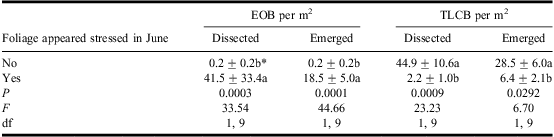
To further illustrate the difference in host condition preference between EOB and TLCB, trees girdled in 2010 were grouped according to evidence of stress in June regardless of girdle date (Table 5). Girdled trees showing stress in June had significantly higher EOB densities and significantly lower TLCB densities compared with girdled trees with foliage that appeared healthy in June. Furthermore, in the trees that had both live TLCB present and appeared stressed on 4 June, we only found TLCB below the girdle where some live tissue still remained.
Mean densities per m2 of bark surface area of EOB, Agrilus sulcicollis (Coleoptera: Buprestidae) and TLCB, Agrilus bilineatus, that were dissected from logs or emerged from logs reared indoors soon after felling, and if foliage appeared stressed, i.e., wilting or browning, on 4 June 2010 for Quercus robur trees girdled on 15 April or 21 May 2010 and felled in January–March 2012 in Ingham County, Michigan, United States of America.

EOB = European oak borer; TCLB = twolined chestnut borer.
*Means followed by the same letter (within columns) are not significantly different at the P < 0.05 level (Student–Neuman–Keuls multiple range test).
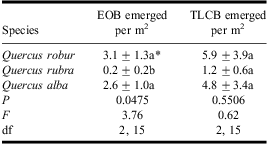
Mean number of EOB or TLCB that emerged per m2 of bark did not vary significantly among the three 2011 girdle dates (Table 4). All girdled Q. robur trees showed evidence of stress in June, likely because of the effectiveness of the double-girdle treatment interrupting translocation regardless of when the trees were girdled. All 2011-girdled trees were dead before EOB and TLCB flight peaked in 2011, with the exception of late-spring girdled trees and EOB peak flight. As discussed in the previous section, TLCB were mostly found below the girdle where some live tissue remained in the trunk, while most EOB were found above the girdle where most tissue was moribund.
Apparently, TLCB prefers at least some live phloem for larval development, while EOB prefers to develop in recently dead phloem. Haack and Benjamin (Reference Haack and Benjamin1982) found similar results for TLCB, where live larvae were only found below the girdle of artificially girdled oak trees, and only dead TLCB larvae were found above the girdle where all phloem had died. Dunn et al. (Reference Dunn, Kimmerer and Nordin1986) found that TLCB was attracted to girdled oaks within 24 hours after trees were girdled, however, TLCB attraction to these trees decreased as trees died. In contrast, Bílý (Reference Bílý1982) noted that EOB developed in live trees, however, we did not find evidence of this in our study.
Host tree species
Foliage of all 2011-girdled trees for each of the three oak species tested showed evidence of stress in June. EOB emerged from all three oak species that were girdled in 2011 (Table 6). This is not surprising, given the large number of oak species that EOB attacks in Europe (Bílý Reference Bílý2002; Evans et al. Reference Evans, Moraal and Pajares2004; Jendek and Grebennikov Reference Jendek and Grebennikov2009). Significantly more EOB were reared from Q. robur and Q. alba trees compared with Q. rubra trees (Table 6). Agrilus biguttatus, a species frequently associated with EOB in Europe, rarely attacks North American Q. rubra trees that have been planted in Europe (Moraal and Hilszczanski Reference Moraal and Hilszczanski2000). TLCB emergence did not vary significantly among these three oak species, all of which have been documented as hosts of TLCB (Nelson et al. Reference Nelson, Walters, Haines and Bellamy2008; Hansen et al. Reference Hansen, Petrice and Haack2011).
Mean densities per m2 of bark surface area of EOB, Agrilus sulcicollis (Coleoptera: Buprestidae) and TLCB, Agrilus bilineatus, that emerged from logs reared indoors soon after felling for different Quercus species girdled May–June 2011 and felled January–March 2012 at Kellogg Forest, Kalamazoo County, Michigan, United States of America, in 2011.

EOB = European oak borer; TCLB = twolined chestnut borer.
*Means followed by the same letter (within columns) are not significantly different at the P < 0.05 level (Student–Neuman–Keuls multiple range test).
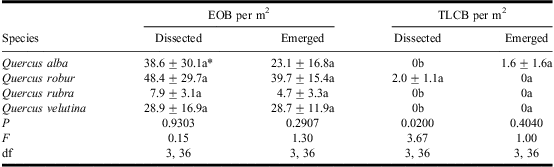
Trap logs
EOB attacked and successfully emerged from traps log of all four Quercus species tested (Table 7). Although fewer EOB were recovered from Q. rubra logs in absolute terms, no significant differences were found among Quercus species. Studies in Europe have reported that EOB attacked Quercus logs in slash piles from recent logging activity (Hedin et al. Reference Hedin, Isacsson, Jonsell and Komonen2008), so it is not surprising that many of our trap logs were well infested by EOB. TLCB were dissected only from Q. robur logs and emerged only from one Q. alba log (Table 7). To our knowledge, it has never been documented that TLCB will lay eggs on and successfully develop in cut logs. It is possible that Q. robur and Q. alba trees were infested with TLCB before they were cut even though the trees appeared healthy and showed no external signs or symptoms of infestation such as dead crowns or limbs, bark damage from woodpeckers foraging for larvae, or D-shaped exit holes. However, we feel that this is highly unlikely given that TLCB usually completes its development in one year throughout its North American range (Cote and Allen Reference Cote and Allen1980; Haack and Benjamin Reference Haack and Benjamin1982). Furthermore, trees were cut for trap logs well before TLCB adult flight began in 2010, so adult TLCB would not have had an opportunity to oviposit on them before logs were placed at the study sites in 2010. Nevertheless, the low number of reared and dissected TLCB compared with EOB from trap logs illustrates how uncommon it is for TLCB to infest and develop in trap logs. Moreover, Haack and Benjamin (Reference Haack and Benjamin1980) found that most TLCB larvae died if trees were cut in June, soon after oviposition and larval eclosion, and left on the forest floor throughout the summer.
Mean densities per m2 of bark surface area of EOB, Agrilus sulcicollis (Coleoptera: Buprestidae) and TLCB, Agrilus bilineatus, that emerged from logs reared indoors soon after they were removed from the field in February 2011 for 1-m-long logs cut from different Quercus species from live, uninfested trees and placed in oak plantings in late spring 2010 at two sites in southern Michigan, United States of America.

EOB = European oak borer; TCLB = twolined chestnut borer.
*Means followed by the same letter (within columns) are not significantly different at the P < 0.05 level (Student–Neuman–Keuls multiple range test).
Distinguishing larvae of EOB from TLCB
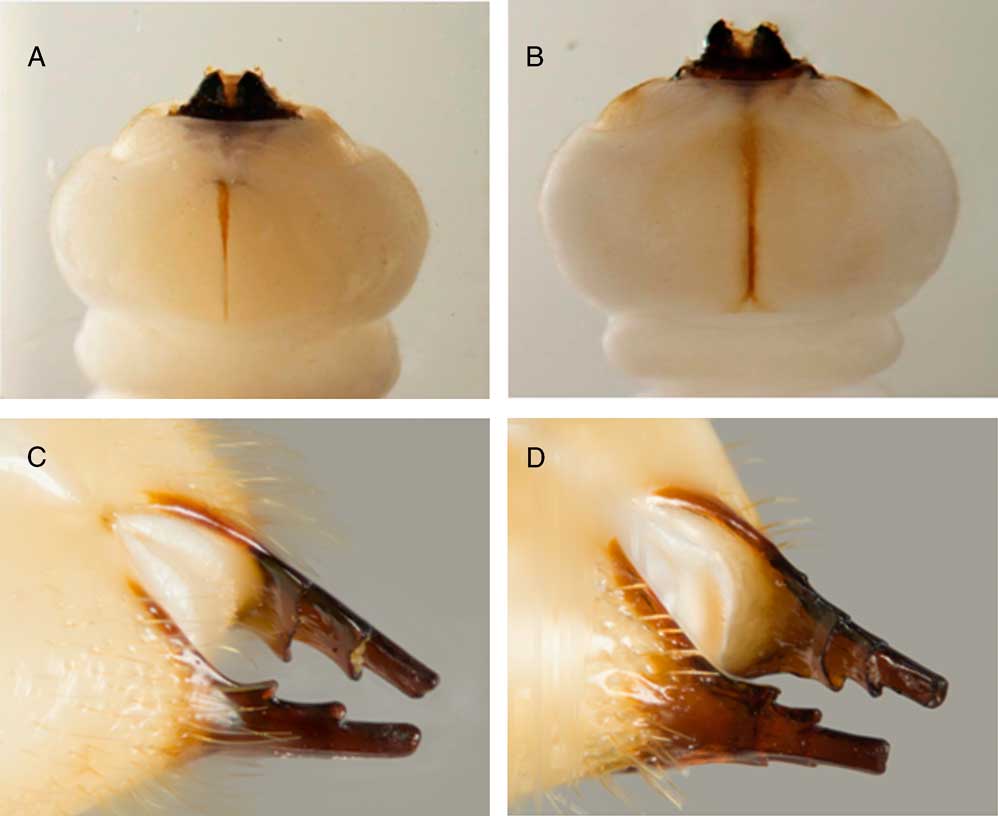
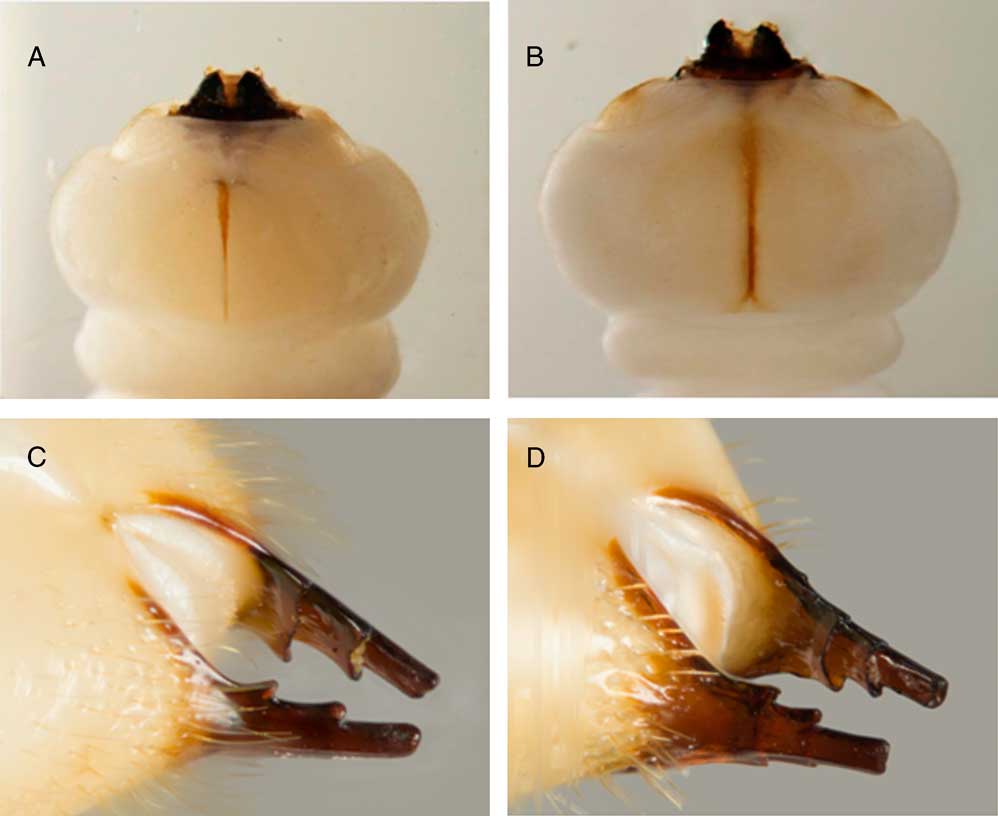
During examination under a dissecting microscope of mature fourth instar EOB and TLCB larvae that had not yet entered their pupal cells and J-larvae recovered from pupal cells, we noted differences in the shape of the pronotal groove, which allowed for easy separation of the larvae of these two species. The pronotal groove of TLCB, when viewed dorsally, i.e., abdominal spiracles were visible from above, was bifurcate near its posterior end, while the pronotal groove of EOB remained entire along its length (Figs. 4A, 4B). The terminal processes, as defined by Chamorro et al. (Reference Chamorro, Volkovitsh, Poland, Haack and Lingafelter2012), or urogomphi by others (Cote and Allen Reference Cote and Allen1980; Haack and Benjamin Reference Haack and Benjamin1982; Loerch and Cameron Reference Loerch and Cameron1983; Petrice et al. Reference Petrice, Haack, Strazanac and Lelito2009), on the 10th abdominal segment also differed between the two species. The basal excretory duct on the inner, lateral surface of each terminal process was straight or sometimes jagged in EOB, whereas it was slightly concave and smooth in TLCB (Figs. 4C, 4D). Also, the general shape of the EOB terminal processes appeared more laterally flattened compared with TLCB. Drawings and descriptions of EOB larvae can also be found in Palm (Reference Palm1962) and Bílý (Reference Bílý1999).
Pronotal groove and terminal processes of European oak borer (EOB), Agrilus sulcicollis (Coleoptera: Buprestidae) on left (A and C) and twolined chestnut borer (TLCB), Agrilus bilineatus, on right (B and D).
Parasitoids
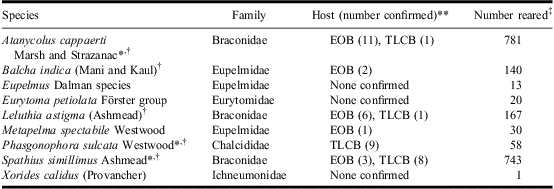
At least nine species of hymenopteran parasitoids were reared from the girdled trees and trap logs (Table 8). Examination of Agrilus cadavers from which parasitoids were individually reared confirmed five of these species attacked and emerged from EOB larvae, while four species were confirmed from TLCB larvae. None of the five species reared from EOB have been previously reported in the literature to attack EOB. Leluthia astigma (Ashmead) (Hymenoptera: Braconidae) was the only parasitoid species, of the four reared from TLCB, which had not been previously reported from TLCB in the literature (Krombein et al. Reference Krombein, Hurd, Smith and Burks1979; Taylor et al. Reference Taylor, Duan, Fuester, Hoodle and van Driesche2012). The braconids Atanycolus cappaerti Marsh and Strazanac, L. astigma, and Spathius simillimus Ashmead were reared from both EOB and TLCB in this study. In addition, five of the species reared have been reported from emerald ash borer, A. planipennis (Table 8; Bauer et al. Reference Bauer, Liu, Haack, Gao, Zhao and Miller2005; Cappaert and McCullough Reference Cappaert and McCullough2009; Duan et al. Reference Duan, Fuester, Wildonger, Taylor, Barth and Spichiger2009; Kula et al. Reference Kula, Knight, Rebbeck, Bauer, Cappaert and Gandhi2010; Taylor et al. Reference Taylor, Duan, Fuester, Hoodle and van Driesche2012).
Hymenoptera parasitoid species that were dissected from or emerged from girdled Quercus trees and trap logs that were infested with EOB and TLCB in Ingham Co. and Kalamazoo Co., Michigan, United States of America in 2010 and 2011, confirmed host association by positive identification of cadaver (EOB, Agrilus sulcicollis (Coleoptera: Buprestidae); TLCB, Agrilus bilineatus) and rearing immature parasitoids to adults, and if host-parasitoid association has been previously reported in the literature for each species.

*Species reported in the literature as attacking Agrilus bilineatus.
†Species reported in the literature as attacking emerald ash borer, Agrilus planipennis.
**Number of parasitoid–host associations that we confirmed by identifying Agrilus larvae or cadaver and successfully rearing immature parasitoids to adults.
‡Total number of parasitoid adults that emerged from girdled trees and traps logs that were reared in the laboratory.
Summary
Our studies in southern Michigan found that EOB adult flight began and peaked before TLCB initial and peak flight. EOB females were most attracted to purple and white sticky traps, while males did not show a significant colour preference. Almost all EOB and TLCB larvae completed development within one growing season, and thus are primarily univoltine in southern Michigan, but may require two years to complete development under some circumstances. EOB attacked and completed development in all three species of girdled Quercus trees and all four species of Quercus trap logs in our study, suggesting it will be able to develop in most North American Quercus species. EOB prefers more moribund tissue compared with TLCB, and therefore it will likely not be an aggressive tree killer like TLCB. There are several parasitoids that attack EOB in North America, and most of these are known parasitoids of TLCB.
Acknowledgements
The authors would like to thank the staff at Michigan State University Kellogg Forest and Tree Research Center for use of trees and field assistance; Tom Baweja, Randi Bradley, Tina Ciaramitaro, and Scott Schooltz for field and laboratory assistance; James Zablotny for Agrilus identifications; John Strazanac and Paul Marsh for Hymenoptera parasitoid identifications; John Strazanac for photographing Agrilus larvae; Joseph Francese for spectrophotometer scanning of trap colours; and Krista Ryall, Daniel Herms, and two anonymous reviews for comments on an earlier draft of this manuscript.