Introduction
Autoimmune diseases (ADs) are common (4.5–7%), associated with significant threat to quality of life, and are responsible for substantial direct and indirect societal costs (Autoimmune Diseases Coordinating Committee, 2005; Miller et al. Reference Miller, Alfredsson, Costenbader, Kamen, Nelson, Norris and De Roos2012). ADs are a group of chronic inflammatory diseases that develop as a result of the loss of immunological tolerance to self-antigens. ADs afflict specific target organs or multiple organ systems depending on the specific disorder (Anaya, Reference Anaya2012). Interactions between genetic and environmental factors are thought to be the main explanatory mechanisms for their susceptibility and onset (Miller et al. Reference Miller, Alfredsson, Costenbader, Kamen, Nelson, Norris and De Roos2012). Still, current known genetic risk factors and environmental exposures are unable to fully explain the occurrence of these diseases.
The literature increasingly suggests a link between depression and physical health, particularly relating to disorders associated with dysfunction of the immune system (Penninx et al. Reference Penninx, Milaneschi, Lamers and Vogelzangs2013). For example, depression has been found to be associated with increased risk of the onset and progression of chronic diseases such as cardiovascular, neuroplastic, and neurodegenerative diseases (Penninx et al. Reference Penninx, Milaneschi, Lamers and Vogelzangs2013). Depression is one of the most common diseases globally: 6% of the population meet criteria for major depressive disorder (past year) and one in five individuals experiences a depressive episode during their lifetime (Alonso et al. Reference Alonso, Angermeyer, Bernert, Bruffaerts, Brugha, Bryson, de Girolamo, Graaf, Demyttenaere, Gasquet, Haro, Katz, Kessler, Kovess, Lepine, Ormel, Polidori, Russo, Vilagut, Almansa, Arbabzadeh-Bouchez, Autonell, Bernal, Buist-Bouwman, Codony, Domingo-Salvany, Ferrer, Joo, Martinez-Alonso, Matschinger, Mazzi, Morgan, Morosini, Palacin, Romera, Taub and Vollebergh2004). As such, depression constitutes a major global problem that has profound social and economic consequences for both individuals and society (Alonso et al. Reference Alonso, Angermeyer, Bernert, Bruffaerts, Brugha, Bryson, de Girolamo, Graaf, Demyttenaere, Gasquet, Haro, Katz, Kessler, Kovess, Lepine, Ormel, Polidori, Russo, Vilagut, Almansa, Arbabzadeh-Bouchez, Autonell, Bernal, Buist-Bouwman, Codony, Domingo-Salvany, Ferrer, Joo, Martinez-Alonso, Matschinger, Mazzi, Morgan, Morosini, Palacin, Romera, Taub and Vollebergh2004).
To date, few studies have examined the association between depression and ADs. In general, clinical AD patient populations tend to have higher rates of depression compared to those without ADs (Valtysdottir et al. Reference Valtysdottir, Gudbjornsson, Lindqvist, Hallgren and Hetta2000; Carta et al. Reference Carta, Hardoy, Boi, Mariotti, Carpiniello and Usai2002; Zyrianova et al. Reference Zyrianova, Kelly, Gallagher, McCarthy, Molloy, Sheehan and Dinan2006; Nery et al. Reference Nery, Borba, Hatch, Soares, Bonfa and Neto2007; Gold & Irwin, Reference Gold and Irwin2009; Mitsonis et al. Reference Mitsonis, Potagas, Zervas and Sfagos2009; Inal et al. Reference Inal, Kitapcioglu, Karabulut, Keser and Kabasakal2010; Sharma et al. Reference Sharma, Kline, Shreeve and Hartman2011; Kirim et al. Reference Kirim, Keskek, Koksal, Haydardedeoglu, Bozkirli and Toledano2012; Benros et al. Reference Benros, Waltoft, Nordentoft, Ostergaard, Eaton, Krogh and Mortensen2013; Giynas Ayhan et al. Reference Giynas Ayhan, Uguz, Askin and Gonen2014; Schramm et al. Reference Schramm, Wahl, Weiler-Normann, Voigt, Wiegard, Glaubke, Brahler, Lowe, Lohse and Rose2014) and findings from epidemiologic community-based studies suggest an association between depression and some ADs (Pop et al. Reference Pop, Maartens, Leusink, van Son, Knottnerus, Ward, Metcalfe and Weetman1998; Degner et al. Reference Degner, Meller, Bleich, Schlautmann and Ruther2001; Carta et al. Reference Carta, Loviselli, Hardoy, Massa, Cadeddu, Sardu, Carpiniello, Dell'Osso and Mariotti2004; Engum, Reference Engum2007; Maunder & Levenstein, Reference Maunder and Levenstein2008; Bachen et al. Reference Bachen, Chesney and Criswell2009; Baysal et al. Reference Baysal, Durmus, Ersoy, Altay, Senel, Nas, Ugur, Kaya, Gur, Erdal, Ardicoglu, Tekeoglu, Cevik, Yildirim, Kamanli, Sarac, Karatay and Ozgocmen2011; Korczak et al. Reference Korczak, Pereira, Koulajian, Matejcek and Giacca2011; Vattakatuchery et al. Reference Vattakatuchery, Rickards and Cavanna2011; Roy & Lloyd, Reference Roy and Lloyd2012; Smith & Gerdes, Reference Smith and Gerdes2012; van de Ven et al. Reference van de Ven, Muntjewerff, Netea-Maier, de Vegt, Ross, Sweep, Kiemeney, Vos, Buitelaar, Hermus, den Heijer and Janzing2012; Ananthakrishnan et al. Reference Ananthakrishnan, Khalili, Pan, Higuchi, de Silva, Richter, Fuchs and Chan2013; Dominguez et al. Reference Dominguez, Han, Li, Ascherio and Qureshi2013; Matcham et al. Reference Matcham, Rayner, Steer and Hotopf2013; Palagini et al. Reference Palagini, Mosca, Tani, Gemignani, Mauri and Bombardieri2013; Rotella & Mannucci, Reference Rotella and Mannucci2013; Dowlatshahi et al. Reference Dowlatshahi, Wakkee, Arends and Nijsten2014). Prior studies have primarily focused on the prevalence of depression among individuals with AD, yet there has been speculation that the relationship is likely to be bidirectional (Kiecolt-Glaser & Glaser, Reference Kiecolt-Glaser and Glaser2002; Miller et al. Reference Miller, Maletic and Raison2009; Baysal et al. Reference Baysal, Durmus, Ersoy, Altay, Senel, Nas, Ugur, Kaya, Gur, Erdal, Ardicoglu, Tekeoglu, Cevik, Yildirim, Kamanli, Sarac, Karatay and Ozgocmen2011; Irwin & Cole, Reference Irwin and Cole2011; Benros et al. Reference Benros, Waltoft, Nordentoft, Ostergaard, Eaton, Krogh and Mortensen2013; Dowlatshahi et al. Reference Dowlatshahi, Wakkee, Arends and Nijsten2014). Previous studies assessing the risk of ADs subsequent to depression onset are scarce and limited by various methodological constraints. These include: (1) the use of cross-sectional data which precludes an examination of the temporal relationship between depression and risk of ADs; (2) the relative rarity of some autoimmune conditions which limits the study of ADs in many investigations – apart from those that include extremely large sample sizes; and (3) the almost exclusive reliance on self-report measures of mental health and physical conditions, which are subject to misreport and questionable validity for some diseases, in most population-based studies.
In an effort to address the shortcomings of previous research, we conducted a nationwide cohort study using the longitudinal Danish registries to examine the association between depression and the risk of ADs. The aims of the current study were: (1) to examine the relationship between depression and the risk of a wide range of ADs; (2) to determine whether the timing of the onset of depression was predictive of the timing of AD incidence; and (3), to test for the presence of a dose-response relationship.
Method
Study population
In this prospective nationwide register-based study the dataset was gathered through the linkage of several Danish registries that cover the entire population (5.6 million people). Each individual's general personal information (e.g. age, gender, and history of municipal residency) and full treatment history – including all somatic and psychiatric diagnoses – was linked across The Danish Civil Registration System (DCRS), the Danish National Hospital Register (DNHR), and the Danish Psychiatric Central Research Register (DPCRR) (Munk-Jorgensen & Mortensen, Reference Munk-Jorgensen and Mortensen1997; Andersen et al. Reference Andersen, Madsen, Jorgensen, Mellemkjoer and Olsen1999; Pedersen et al. Reference Pedersen, Gotzsche, Moller and Mortensen2006; Mors et al. Reference Mors, Perto and Mortensen2011; Nguyen-Nielsen et al. Reference Nguyen-Nielsen, Svensson, Vogel, Ehrenstein and Sunde2013). The ICD-10 was introduced in 1994, and therefore the current study period relied on data from 1995 and onward in order to minimize the risk of inconsistencies due to the use of different diagnostic systems over time (Lundberg et al. Reference Lundberg, Okkels, Gustafsson, Larsen, Sørensen and Munk-Jørgensen2013).
Initially, we identified 145 217 individuals with a primary diagnosis of depression for the study cohort (see variable criteria below). Each individual was then match-controlled with six other individuals from the Danish population, with no record of depression, on gender, age (i.e. date of birth within 6 months of range) and latest municipality of residence (through the DCRS). Individuals were excluded if they had a diagnosis of AD (see variable criteria below) documented at any time prior to the study period. The study population therefore was free of any prior history of AD, ensuring that only incident AD could be examined as an outcome. Collectively, the study population consisted of 1 016 519 individuals.
Measures
Depression
For this study, depression was defined as the presence of a primary diagnosis of depression in the medical record from 1995 through 2012 (Munk-Jørgensen et al. Reference Munk-Jørgensen, Okkels, Golberg, Ruggeri and Thornicroft2014). Depression diagnoses included were ICD-10: F32-F33, i.e. only depressive episode and recurrent depressive disorder. No other mood disorders (e.g. bipolar disorder) were included. All diagnoses were made by physicians during clinical contact in psychiatric emergency, inpatient, and outpatient treatment settings. The onset of depression was defined as the date of initial clinical contact in which a diagnosis of depression was recorded (identified through the DPCRR). A ‘primary diagnosis’ was defined as the diagnosis that is the primary cause of treatment contact as determined by the treating physician. Therefore, any individuals with a secondary diagnosis of depression were excluded from the study in an effort to maintain consistency in the severity of depression. Both start- and end-date of clinical contact for the treatment of depression were recorded through the registry and used for calculating number of depressive episodes as an estimate of depression chronicity. A depressive episode was considered remitted if clinical contact, including both inpatient and outpatient visits, ceased for at least 6 consecutive months (i.e. a period of 6 months from the end-date of a treatment contact to the start-date of subsequent treatment contact). Clinical contact, following any period of time after the 6 consecutive months of no contact, was then counted as a separate depressive episode.
Autoimmune disease
The onset of AD was estimated by the date of the first clinical contact in which an AD was diagnosed by a physician in a treatment setting and documented in the medical record (through the DNHR). The following ADs (using their respective ICD-10 codes) were included (Eaton et al. Reference Eaton, Rose, Kalaydjian, Pedersen and Mortensen2007, Reference Eaton, Pedersen, Nielsen and Mortensen2010): Ankylosing spondylitis (M45), Autoimmune thyroiditis (E06.3), Celiac disease (K90.0), Crohn's disease (K50), Idiopathic thrombocytopenic purpura (D69.3), Iridocyclitis (H20), Multiple sclerosis (G35), Primary adrenocortical insufficiency (Addison's) (E27.1), Psoriasis vulgaris (L40.0), Rheumatoid arthritis (M05, M06), Sjögren's syndrome (M35.0), Systemic lupus erythematosus (M32), Thyrotoxicosis (Graves’ disease) (E05.0), Type 1 diabetes mellitus (E10), Ulcerative colitis (K51).
Statistical approach
Individuals were followed from the first-time clinical contact for depression until either their first recorded diagnosis of an AD, death, or the end of the study period (whichever occurred first). Survival analyses were used to address each aim. Cox proportional hazard regressions for calculating incidence rates were performed for each analysis in this study. To measure relative risk, incidence rate ratios (IRRs) with accompanying 95% confidence intervals (CIs) based on Wald statistics were calculated using Stata v. 13 (StataCorp, 2013).
In fully adjusted models, data were stratified by age, gender and psychiatric co-morbidities (e.g. anxiety disorder, substance use disorders). Psychiatric co-morbidity was treated as a binary variable for the presence/absence of any lifetime psychiatric disorder (other than depression) (based on ICD-8: 290–315 except 302 for the time period before 1994 and ICD-10: F:00–99 except F32-F33).
To address aims (1) and (3), the incidence rates and IRR on each specific AD were calculated. In the event of an AD diagnosis, an individual would subsequently be removed from the population at risk for that given AD at the date of diagnosis though they remained in the risk pool to acquire other ADs during the remaining study period.
To address aim (2), we identified the number of years from the onset of the first depressive episode and/or start of tracing the non-depressed matched individuals up to the diagnosis of AD. Incidence rates and IRR for each year were then calculated following onset of depression. In the event of an AD diagnosis, an individual would subsequently be removed from the population at risk for all ADs at the date of the first documentation of any AD.
To address aim (3), the number of experienced depressive episodes was dichotomized into one or two or more episodes of depression and incidence rates and IRRs were then accordingly calculated.
In supplementary analyses, we conducted analyses stratified by age and gender as well as by grouping of ADs based on their similar immunopathologic features (Dube et al. Reference Dube, Fairweather, Pearson, Felitti, Anda and Croft2009).
Ethical standards
The authors assert that all procedures contributing to this work comply with the ethical standards of the relevant national and institutional committees on human experimentation and with the Helsinki Declaration of 1975, as revised in 2008.
Results
Descriptive measures
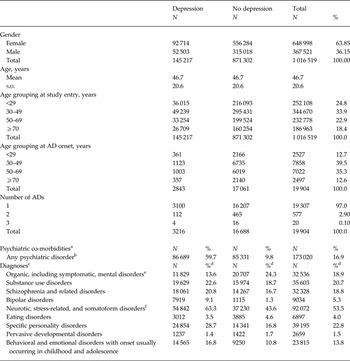
This study included 1 016 519 individuals followed up to a total of 7 337 598 million person-years from 1995 through 2012. The mean age upon study entry was 46.7 (s.d. = 20.6) years and a slight majority were female (63.9%) (see Table 1). In total, 86 689 (59.7%) individuals with a primary diagnosis of depression and 85 331 (9.8%) individuals without depression had a psychiatric disorder (other than depression). Table 1 provides additional information on the distribution of these psychiatric conditions in categories developed in previous studies (Pedersen et al. Reference Pedersen, Mors, Bertelsen, Waltoft, Agerbo, McGrath, Mortensen and Eaton2014).
Age, gender and psychiatric disorders among individuals with and without depression

a The category grouping of psychiatric disorders are adapted from Pedersen et al. (Reference Pedersen, Mors, Bertelsen, Waltoft, Agerbo, McGrath, Mortensen and Eaton2014).
b Individuals had at least one psychiatric disorder (other than depression).
c An individual could have more than one other psychiatric diagnosis.
d Percentages of the individuals with any other psychiatric disorders.
e These diagnoses include disorders such as dementia; delirium; mental disorders due to brain damage, dysfunction or physical disease and; personality and behavioral disorders due to brain disease, damage or dysfunction.
f These diagnoses include disorders such as anxiety disorders; obsessive-compulsive disorders; reaction to severe stress, and adjustment disorders; dissociative disorders and; somatoform disorders.
Of the 145 217 individuals with depression, 120 602 (83%), 18 760 (13%), 3752 (2.6%), and 2103 (1.4%) experienced 1, 2, 3, and ⩾4 depressive episodes, respectively. We identified 19 904 (2.0%) individuals with a diagnosis of AD during the study period; 70.5% were female and 3% (n = 597) had multiple AD diagnoses. The six most frequent ADs (which comprised 87.4% of all diagnosed ADs) were: type 1 diabetes mellitus, rheumatoid arthritis, ulcerative colitis, Graves’ disease, multiple sclerosis, and Crohn's disease. For the entire study population, the number of these cases was 4374 (22.0%), 4029 (20.2%), 2887 (14.5%), 2174 (10.9%), 2095 (10.5%), and 1834 (9.2%) respectively.
Association between depression and ADs
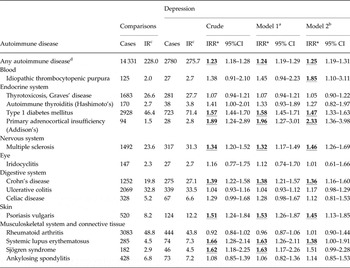
Overall, a history of depression was significantly associated with risk of ‘any AD’ (IRR 1.25, CI 1.19–1.31, see Table 2). Across the analyses, depression was significantly associated with eight out of the 15 examined ADs. In results from the fully adjusted model (model 2), depression remained significantly associated with an increased risk of idiopathic thrombocytopenic purpura (IRR 1.85, 95% CI 1.10–3.11), type 1 diabetes mellitus (IRR 1.47, 95% CI 1.33–1.63), Addison's disease (IRR 2.33, 95% CI 1.36–3.98), multiple sclerosis (IRR 1.46, 95% CI 1.26–1.69), Crohn's disease (IRR 1.36, 95% CI 1.16–1.60), psoriasis vulgaris (IRR 1.45, 95% CI 1.13–1.85), and systemic lupus erythematosus (IRR 1.38, 95% CI 1.00–1.91).
Incidence rate ratios (IRRs) for depression and risk of autoimmune disease

CI, Confidence interval.
a Adjusted for gender and age.
b Adjusted for gender, age, and psychiatric co-morbidities.
c Incidence rates (IR) per 100000 person-years.
d All of the autoimmune diseases below.
*Boldface is p < 0.05 and underlined is p < 0.01.
Time-related associations on the onset of depression and subsequent risk of ADs
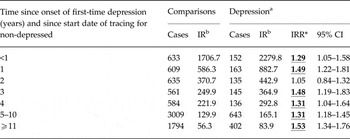
Our findings suggest that the susceptibility of developing an AD was relatively consistent over time following the onset of depression (See Table 3). Specifically, no notable difference in the risk of AD was found between the 1st and 11th years following the onset of depression (IRR 1.29, 95% CI 1.05–1.58 and IRR 1.53, 95% CI 1.34–1.76, respectively). The risk of AD remained increased throughout all years after the onset of depression, except during the 2nd year, in which the association was not significant (IRR 1.05, 95% CI 0.84–1.32).
Incidence rate ratios (IRRs) of any autoimmune disease since the time of onset of depression

CI, Confidence interval.
a Adjusted for gender, age and psychiatric co-morbidities.
b Incidence rates (IR) per 100000 person-years.
*Boldface is p < 0.05 and underlined is p < 0.01
Dose-response relationship between number of depressive episodes and risk of ADs
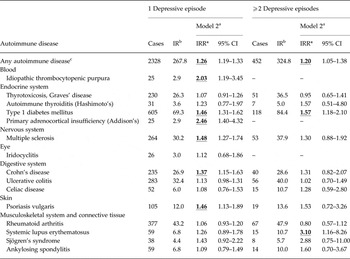
The risk of ‘any type of AD’ was not found to increase in a dose-response relationship with the number of depressive episodes (see Table 4). One depressive episode was significantly associated with a higher risk of developing any AD (IRR 1.26, 95% CI 1.19–1.33) but risk was not more elevated as a function of having ⩾2 depressive episodes (IRR 1.20, 95% CI 1.05–1.38).
Incidence rate ratios (IRRs) for depressive episodes and risk of autoimmune diseases

a Adjusted for gender, age and psychiatric co-morbidities.
b Incidence rates (IR) per 100000 person-years.
c All of the ADs below.
*Boldface is p < 0.05 and underlined is p < 0.01.
Age- and gender-stratified analyses
There was no significant gender difference in the relationship between depression and risk of ADs (see Supplementary Table S1). The relationship between depression and risk of ADs appeared to be more prominent among individuals aged <50 years, compared to those aged ⩾50 years (see Supplementary Table S1). All associations were significant for those aged <50 years while there was only one significant finding in the 50–69 years age group (IRR 1.20, 95% CI 1.10–1.31).
Depression and the risk of ADs when grouping by similar immunopathology
Depression was significantly associated with both T-helper 1 (Th1) and mixed Th1/T-helper 2 (Th2) in both the analyses of 1 and ⩾2 depressive episodes (see Supplementary Table S2). The IRR increased within both Th1 and mixed Th1/Th2 at one depressive episode from IRR 1.30 (95% CI 1.20–1.40) and IRR 1.33 (95% CI 1.19–1.49), respectively, to IRR 1.46 (95% CI 1.28–1.67) and IRR 1.45 (95% CI 1.21–1.73), respectively, when having experienced ⩾2 depressive episodes. Only one depressive episode was significantly associated with Th2 and Th2 rheumatic subgroups (the latter borderline significant) and results did not show any positive correlation between the number of depressive episodes and an increased risk of AD within these two immunopathology groupings.
Discussion
This study was representative of the Danish population and included all individuals with a diagnosis of depression from 1995 through 2012. Using this approach, we had a unique opportunity to conduct prospective analyses on the incidence of ADs among those with and without depression (Munk-Jorgensen & Ostergaard, Reference Munk-Jorgensen and Ostergaard2011). This study has four main findings. First, a history of at least one episode of depression was associated with a subsequently increased overall risk of the incidence of any AD. Second, depression was associated with increased risk of the onset of a wide range of specific ADs, though level of risk differed somewhat by type of AD. Third, the increased risk of ADs following the onset of depression was consistent over time. Fourth, there was not a clear dose-response relationship between depression and risk of all types of AD. These findings offer evidence of a possible link between depression and the subsequent risk of AD and suggest that the influence of depression tends to impact specific types of AD. Below, the aforementioned findings will be discussed in the context of existing literature and suggestions for future research and clinical implications will be provided.
It is not possible to determine the mechanism of the association between depression and ADs based on this study. However, a plausible biological mechanism explaining the association between depression and AD could be the bidirectional interplay of the central nervous and immune systems. Psychological distress (e.g. depressive symptoms) can have a prolonged impact on neuroendocrine pathways such as the sympathetic nervous system and the hypothalamic-pituitary-adrenal (HPA) axis. These pathways can both directly and indirectly regulate immune functioning (e.g. through changes in gene transcription activity in immunocytes). Following prolonged stimulation of these connections, the immune system may become dysregulated, contributing to the development and progression of autoimmune pathologies (Kiecolt-Glaser & Glaser, Reference Kiecolt-Glaser and Glaser2002; Glaser & Kiecolt-Glaser, Reference Glaser and Kiecolt-Glaser2005; Miller et al. Reference Miller, Maletic and Raison2009; Irwin & Cole, Reference Irwin and Cole2011; Voinov et al. Reference Voinov, Richie and Bailey2013).
Previous literature suggests a bidirectional association between depression and the immune system with studies documenting a link between prior AD and increased risk of the subsequent onset of depression (Kiecolt-Glaser & Glaser, Reference Kiecolt-Glaser and Glaser2002; Miller et al. Reference Miller, Maletic and Raison2009; Baysal et al. Reference Baysal, Durmus, Ersoy, Altay, Senel, Nas, Ugur, Kaya, Gur, Erdal, Ardicoglu, Tekeoglu, Cevik, Yildirim, Kamanli, Sarac, Karatay and Ozgocmen2011; Irwin & Cole, Reference Irwin and Cole2011; Benros et al. Reference Benros, Waltoft, Nordentoft, Ostergaard, Eaton, Krogh and Mortensen2013; Dowlatshahi et al. Reference Dowlatshahi, Wakkee, Arends and Nijsten2014). For example, depression has been linked with increased inflammatory markers and depression risk alleles have been found to be associated with regulating genes of the immune response. Likewise, a recent Danish register study has shown that autoimmune disease is associated with an increased risk of depression and a meta-analysis suggests that anti-inflammatory treatment decreases depressive symptoms (Miller et al. Reference Miller, Maletic and Raison2009; Raison & Miller, Reference Raison and Miller2012; Benros et al. Reference Benros, Waltoft, Nordentoft, Ostergaard, Eaton, Krogh and Mortensen2013; Köhler et al. Reference Köhler, Benros, Nordentoft, Farkouh, Iyengar, Mors and Krogh2014). In addition, recent studies have also found an increased risk of ADs among individuals with schizophrenia and eating disorders, which may provide further support for a bidirectional link between psychological disturbance (i.e. central nervous system) and the immune system (Benros et al. Reference Benros, Pedersen, Rasmussen, Eaton, Nordentoft and Mortensen2014; Raevuori et al. Reference Raevuori, Haukka, Vaarala, Suvisaari, Gissler, Grainger, Linna and Suokas2014).
Our subanalysis on grouping of ADs based on similar immunopathology suggested depression was more strongly associated with a higher risk of ADs characterized as immune Th1-type and/or mixed Th1/Th2-type responses. Of note, depression was not significantly associated with the rheumatic disorder subgroup. This may suggest that depression has a somewhat specific influence on the immune system, and thus these analyses could have the potential to generate new opportunities for future research.
We did not find a specific period of increased risk of AD following the onset of depression. Instead, our results suggest a general increased risk of AD any time after the onset of depression. The reason for this general increased risk over time is unclear. It is conceivable that the consistency in the increased risk over time could be explained either by differences in the time it takes for individuals in the population to build up an allostatic load of depression burden that reaches an AD onset ‘threshold’ or it could reflect differences in such thresholds of onset between the different ADs as well as differences in the course of development of ADs (McEwen, Reference McEwen2007). Further, it is possible that the actual onset of some cases of depression may have occurred many months/years prior to being diagnosed in a treatment setting. Alternatively, a diagnosis of AD may be delayed in some cases (e.g. because of sometimes long periods of undetected illness) further confounding an analysis of temporality. Another possibility is that an interaction of depression and stressful life events (e.g. divorce, death, job loss) could also account for the emergence of AD whereby the immune system – already enervated by the onset of depression – is further weakened by acute stress (Pace et al. Reference Pace, Mletzko, Alagbe, Musselman, Nemeroff, Miller and Heim2006; Irwin & Miller, Reference Irwin and Miller2007), triggering the onset of AD. We could not examine stressful life events in the current study. Future research that can clarify the time relation between these onsets, possibly by improved and strictly defined time measures of depression and AD and taking into account environmental and social factors and events, is needed. Moreover, these results also suggest that the actual clinical contact, following the onset of depressive symptoms, does not seem responsible for the association of a higher risk of AD, nor does it appear that ADs were simply cases that were identified late, as the association between depression and ADs did not substantially differ over time (i.e. Berkson's bias).
Our findings did not suggest a general dose-response relationship between the number of depressive episodes and the risk of ADs. When analyses were stratified by age, the risk of ADs increased somewhat with the number of depressive episodes among individuals aged <50 years. Although findings are mixed, previous research has shown that HPA axis responses to stress may be more sensitive in younger as compared with older adults (Kudielka et al. Reference Kudielka, Buske-Kirschbaum, Hellhammer and Kirschbaum2004). Thus, age may play an important role in the differential activation of the HPA axis following the onset of depressive symptoms. In turn, the immune functioning of younger adults may be more prone to dysregulation than that of older adults, increasing the subsequent risk of autoimmune disease. It is also possible that the impact of depression is not deterministic but rather influences the risk in a stochastic manner, which would not necessarily be reflected in dose-response analyses.
A possible explanation for the lack of a clear dose-response relationship could be attributable to methodological issues related to our definition of depression chronicity. In addition, small cell sizes in many cases compromised our ability to calculate reliable estimates for several specific ADs. Future studies that employ different methods may be able to better assess frequency, duration, and severity of depression, which could help shed light on whether and to what degree the severity and persistence of depression influences the risk of AD.
The herein reported findings could have a number of potential implications for the understanding and management of depression. For example, individuals with depressive symptoms may benefit from further evaluation for AD, where earlier detection and medical intervention can reduce the influence of AD on both short-term and long-term health (such as diabetes). Moreover, increased awareness of the potentially increased risk of developing AD associated with depression would be important in treatment for both medical and psychiatric institutions. Overall, the present findings underpin the need to diagnose and successfully treat depression in primary- and secondary-care contexts, as this would not only diminish the significant burden of suffering due to depression itself, but could also potentially reduce the risk of somatic diseases.
Several limitations should be noted when interpreting the results of this study. First, our assessment of the severity of depression was quite limited. This is a key limitation of registry data as there is limited information on clinical heterogeneity of a particular diagnosed condition. Depression can present in a wide variety of severity and persistence and we attempted to restrict the cases to those that met a minimum severity criteria by only including those with a primary diagnosis of depression (Byrne et al. Reference Byrne, Regan and Howard2005; Parker, Reference Parker2005; Munk-Jørgensen et al. Reference Munk-Jørgensen, Okkels, Golberg, Ruggeri and Thornicroft2014). No prior studies have systematically examined the validity or reliability of the range of depression diagnoses in the DPCRR, yet one study has validated single episode depression with good results (Bock et al. Reference Bock, Bukh, Vinberg, Gether and Kessing2009; Mors et al. Reference Mors, Perto and Mortensen2011). In the study by Bock et al. a total of 75.4% of 399 patients with a register diagnosis of a single depressive episode received the same diagnosis following a SCAN interview (82.8% for severe type of a single depression, 76.0% for moderate type of a single depression and 65.2% for mild type of a single depression). Second, estimates predict that only a minority of those with depression are ever seen in psychiatric treatment settings (Marcus & Olfson, Reference Marcus and Olfson2010) therefore it is likely that those who are seen have at least a more moderate-severe depression. As such, some individuals within the comparison group may have had unreported depressive symptoms or mild depression, suggesting that our results may be rather conservative estimates. Moreover, misclassification of some AD cases is also likely, though there are unlikely to be systematic differences in this between cases and controls (Eaton et al. Reference Eaton, Byrne, Ewald, Mors, Chen, Agerbo and Mortensen2006). Future studies that can examine the roles of medication for both depression and somatic disorders in the association between depression and AD would be useful. Last, we were unable to adjust for various potential confounding factors (e.g. cigarette smoking, obesity), which could confound these associations (Autoimmune Diseases Coordinating Committee, 2005; van Gool et al. Reference van Gool, Kempen, Bosma, van Boxtel, Jolles and van Eijk2007), as the registers do not sufficiently capture this information. For example, in some studies smoking has been shown to be protective against ulcerative colitis while it has been associated with increased risk for Crohn's disease (van der Heide et al. Reference van der Heide, Wassenaar, van der Linde, Spoelstra, Kleibeuker and Dijkstra2011). As depression is known to be associated with smoking (Fergusson et al. Reference Fergusson, Goodwin and Horwood2003; Boden et al. Reference Boden, Fergusson and Horwood2010; Bakhshaie et al. Reference Bakhshaie, Zvolensky and Goodwin2015), future studies that include such information are needed to begin to understand the potential pathways underlying these associations.
In sum, depression appears to be associated with increased risk of subsequent diagnosis of AD, compared to those without a history of depression. The risk of AD onset was elevated following depression and this increased risk did not appear to be confined to a limited period of time following depression onset nor was it dependent on a specific ‘dose’ or severity of depression. In conclusion, our results provide initial data suggesting that depression may play a role in the etiology of certain autoimmune conditions. As this is the first longitudinal study to examine the relationship between depression and the subsequent risk of ADs as a group, these findings need to be replicated and further explored. If replicated in clinical studies, this may suggest additional risk for individuals with depressive disorders.
Supplementary material
For supplementary material accompanying this paper visit http://dx.doi.org/10.1017/S0033291715001488.
Declaration of Interest
None.