Introduction
Myringoplasty performed as a single procedure, or as part of another ear operation such as a tympanoplasty or tympanomastoid surgery, is not always successful. The primary outcome measure for success is perforation closure. Secondary outcomes are hearing change and reduction in frequency of ear infections.
The limited available literature that reports the results of revision myringoplasty is sometimes used to support the contention that revision myringoplasty is less successful than primary surgery.Reference Berger, Ophir, Berco and Sade 1 , Reference Halik and Smyth 2 It is not hard to imagine why this may be believed, but is it true?
The International Otology Database has been prospectively used to record the details of otology operations performed in two Norfolk hospitals.Reference Yung, Gjuric, Haeusler, Van de Heyning, Martin and Swan 3 It incorporates all ear operations performed in a single-consultant practice over a nine-year period to 2016. Studies on hearing loss following myringoplasty and on deafness following mastoid surgery have recently been published using data from this audit.Reference Bewick and Prinsley 4 , Reference Prinsley 5
Data from the audit challenge the belief that revision myringoplasty is less successful than primary myringoplasty.
Materials and methods
Patients who underwent myringoplasty between 2007 and 2016, either as a single procedure or as part of another ear operation such as a tympanoplasty or a tympanomastoid operation, were identified retrospectively from the online records in the International Otology Database. This is a prospective, web-based audit tool for otology procedures performed.
The database is used to collect information about the nature and extent of disease, and the operations performed. It includes data about the post-operative course of the patient in the months and years after the operation. It also enables the comparison of individual results with ‘benchmark centres’ of excellence.
Adults and children were included in the study group. The primary outcome measure was the presence of a perforation at post-operative follow up. Audiological data for the revision cases were retrieved from the audit and are presented herein.
Results
A total of 914 cases are recorded in the audit. A myringoplasty was either the sole procedure or part of the procedure in 611 cases, representing 66.8 per cent of the cases. A follow-up visit was recorded at 3 months in 356 patients (in 58.3 per cent of the myringoplasty cases). Twenty-nine ear drums (8.1 per cent) were perforated.
The benchmark centres recorded data for 2319 myringoplasty operations; 1284 of the myringoplasty cases (55.4 per cent) had 3-month follow-up data. Eighty-two ear drums (6.4 per cent) were perforated at three months.
Overall, the results of all myringoplasty cases in the Norfolk series and in the benchmark centres are very similar, with a recorded success rate of more than 90 per cent. It is also interesting to observe that the overall follow-up rate with full audiogram data recorded at three months is similar in the two groups, 58.3 per cent and 55.4 per cent respectively.
Sixty-nine patients in the Norfolk series were recorded as having had a revision myringoplasty. The revision myringoplasty operations were performed in a single-consultant practice, either by the consultant or by a trainee under direct supervision. The method was underlay of temporalis fascia in 40 cases, and a composite of cartilage and perichondrium in 29 cases, performed either via a post-auricular or endaural approach in all cases.
Follow-up data at 3, 6 or 12 months were extracted for the revision cases; hence, there were follow-up data for all revision patients.
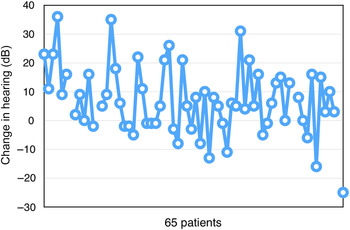
Six of the 69 patients (8.7 per cent) were recorded as having a perforation. Figure 1 shows the hearing change average at 0.5, 1, 2 and 3 kHz in the 65 patients for whom audiograms were performed. The overall average change was 7 dB. Two cases (5 per cent) repaired with fascia failed, and four (20 per cent) of the perichondrium and cartilage grafts failed. The number of failures is too small to enable meaningful comparison between the two graft types.
Hearing results in 65 revision myringoplasty cases.

Discussion
The comparative audit shows that the results of all myringoplasty operations in the Norfolk series were similar to those of the benchmark centres. The follow-up rate recorded formally at three months was also similar in the two groups. The follow-up rate of 58.3 per cent in the Norfolk series and 55.4 per cent in the benchmark centres reflects the fact that the web-based audit has a rigid dating system. Many of the patients have a follow up with an audiogram conducted nearer to six months after the operation and are therefore not represented in the comparative data fields at three months. In this paper, data points from follow-up visits at 6 months and 12 months were also scrutinised for the revision myringoplasty cases, which meant that 100 per cent of these 69 cases were included.
The results of the revision operations are very similar to the overall results, with a success rate just above 90 per cent. This is slightly better than the 82.2 per cent success rate reported in the Royal College of Surgeons of England prospective myringoplasty audit of 1999, which recorded data on 1070 operations performed by 73 of the 405 surgeons invited to participate.Reference Kotecha, Fowler and Topham 6 No distinction is made in that report between primary and revision surgery.
It is interesting to note that there were 611 cases in total, of which 69 (11.3 per cent) were revision cases. This proportion fits closely with the success rate finding of about 90 per cent.
The operations were performed by the consultant ear surgeon or by the trainee under supervision. A previous audit of specialist registrar training in the Norfolk region showed that the results of ear surgery performed by trainees were no different to that of the consultants.Reference Mahendran, Bennett, Jones, Young and Prinsley 7
Others have reported a large difference in the success rate of revision myringoplasty as compared to primary surgery. Berger et al., in 1997, reported an overall success rate of 54.7 per cent in 70 revision and 16 repeat revision cases.Reference Berger, Ophir, Berco and Sade 1 There was no difference in the success rate between the revision and the re-revision cases. Halick and Smyth, in 1988, found that 60 per cent of tympanic membranes were intact after revision surgery.Reference Halik and Smyth 2
-
• Results for revision myringoplasty are the same as those for primary myringoplasty
-
• Successful perforation closure is achieved in more than 90 per cent of cases
-
• There is a small average hearing gain of 7 dB
-
• These findings are important for informed consent
This report presents a more optimistic view of revision surgery. It is reasonable to inform the patient that the result of the operation is likely to be good, with perhaps a 9 out of 10 success rate, regardless of whether the surgery is primary or revision.
Conclusion
The success rate of revision myringoplasty is the same as that of primary myringoplasty in this series. The International Otology Database has been used to show this prospectively. Such a finding is important for the process of informed consent.