Transurethral resection of the prostate (TURP) is associated with postoperative upper urinary tract infection (UTI) and urosepsis with incidence rates of 6%–13% and 4%–12%, respectively. Reference Cafferkey, Falkiner, Gillespie and Murphy1–Reference Murphy, Stassen, Carr, Gillespie, Cafferkey and Falkiner4 Risks of these infectious complications are especially high in men with preoperative bacteriuria. Reference Nicolle, Gupta and Bradley5 Empiric antibiotic prophylaxis during the perioperative period of TURP, irrespective of preoperative bacteriuria status, was associated with significant reduction in postoperative bacteremia, septicemia, and upper UTI compared to placebo or no antibiotic prophylaxis, Reference Grabe, Forsgren and Hellsten2,Reference Grabe, Forsgren, Björk and Hellsten3,Reference Berry and Barratt6 and lower rates of postoperative fever and bacteremia among patients with preoperative sterile urine. Reference Qiang, Jianchen, MacDonald, Monga and Wilt7 Two previous studies have reported that urine culture-guided, targeted, antibiotic prophylaxis among bacteriuric patients undergoing TURP was associated with reduced postoperative fever and bacteremia when compared to no antibiotic prophylaxis. Reference Cafferkey, Falkiner, Gillespie and Murphy1,Reference Murphy, Stassen, Carr, Gillespie, Cafferkey and Falkiner4 To date, no studies have assessed the impact of urine culture-guided, targeted, antibiotic prophylaxis on the incidence of post-TURP lower and upper UTIs and perioperative changes in type and susceptibility profiles among the isolated uropathogens.
Although the most recent guidelines on antimicrobial prophylaxis in surgery, Reference Bratzler, Dellinger and Olsen8 urological procedures and antimicrobial prophylaxis, Reference Lightner, Wymer, Sanchez and Kavoussi9 and management of asymptomatic bacteriuria Reference Nicolle, Gupta and Bradley5 recommend obtaining preoperative urine culture and prescribing targeted antibiotic prophylaxis based on the susceptibility result of isolated pathogens for patients undergoing TURP, these recommendations are based on low-quality evidence and results from studies published more than a decade ago. In addition, the impact of inappropriate antibiotic prophylaxis (IAP) on post-TURP UTI, such as antibiotic prophylaxis that is too broad-spectrum and incorrect dosing, has not been well studied. The primary aim of this study was to compare the incidence of post-TURP UTIs between patients receiving appropriate antibiotic prophylaxis (AAP) and IAP. The secondary aims were to determine (1) the rate of and reasons for IAP, (2) antibiotic resistant profiles of uropathogens isolated from pre- and post-TURP urine cultures, and (3) risk factors associated with post-TURP UTIs.
Methods
Study design, setting, and population
We conducted a prospective cohort study among adult (age ≥18 years) patients who underwent TURP during the period from January 1, 2016, to December 31, 2019, at Thammasat University Hospital (TUH). The hospital is a 650-bed academic tertiary-care hospital in central Thailand. This study was approved by the Human Research Ethics Committee of Thammasat University (Medicine). Informed consent was obtained from the participating patients.
Study protocols, definitions, and outcome measurement
The study patients were prospectively identified via the patient lists of the TUH Division of Urology. All consecutive patients meeting inclusion criteria were followed daily by the research team during hospitalization and after discharge on days 7, 14, 21, and 30 after TURP for the development of UTI. The exclusion criteria were preoperative UTI, loss to follow-up within 30 days after TURP and the outcome of UTI could not be determined, no preoperative urine culture, and preoperative urine culture with mixed (>2) organisms. Preoperative antibiotic prophylaxis was prescribed at the discretion of the primary physician of each individual patient. The TUH Infection Control Department published the antibiotic treatment and prophylaxis guidelines with the updated hospital antibiogram annually and distributed them to all TUH physicians. Antibiotic susceptibility testing was performed and interpreted according to the Clinical Laboratory Standards Institute criteria. Asymptomatic bacteriuria was defined as the presence of ≥1 species of bacteria growing in the urine at specified quantitative counts (≥105 colony-forming units [CFU]/mL) in the absence of signs or symptoms attributable to UTI. Reference Nicolle, Gupta and Bradley5 Appropriate antibiotic prophylaxis was defined as shown in Supplementary Table 1 (online). Post-TURP UTI was defined as the development of the new onset of signs and/or symptoms of either lower or upper UTI after TURP (excluding irritative and/or discomfort symptoms while the urinary catheter was retained) and significant bacteriuria (≥105 CFU/mL). The primary outcome was the incidence of 30-day post-TURP UTI. The secondary outcomes were the rate of and reasons for IAP, antibiotic susceptibility rates of the isolated uropathogens, adverse events associated with antibiotic prophylaxis, and the onset, type, and risk factors associated with post-TURP UTI.
Statistical analysis
The sample size estimation was based on the difference in the rates of bacteremia between patients receiving targeted antibiotic prophylaxis (0%) versus no antibiotic (6.15%), Reference Cafferkey, Falkiner, Gillespie and Murphy1 since no studies have assessed the incidence of post-TURP UTIs in AAP versus IAP groups. To detect this difference with statistical power of 80% and a significance level of .05, the required sample size was 123 in each group. All analyses were performed using SPSS version 22.0 software (SPSS, Chicago, IL). Categorical variables were compared using the Pearson χ2 or the Fisher exact test as appropriate. Continuous variables were compared using the Mann-Whitney U test. P values < .05 were considered statistically significant. Probability of post-TURP UTI was compared between AAP and IAP groups using Kaplan-Meier survival analysis. A Cox proportional hazards regression model was used for determining factors associated with 30-day post-TURP UTI, with reported adjusted hazard ratios (aHRs) and 95% confidence intervals (CIs).
Results
Characteristics of the study patients
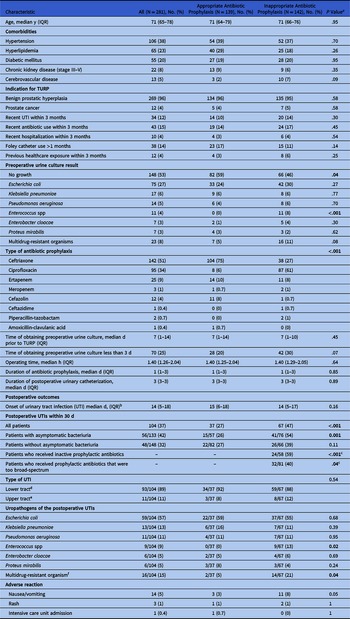
In total, 342 patients were screened, and 61 of these were excluded from the study (Supplementary Fig. 1 online). The procurement rate of preoperative urine culture was 94.4% (323 of 342). The characteristics of the included 281 patients are shown in Table 1. All prophylactic antibiotics were initiated within 1 hour of surgery. In total, 139 patients (49%) received AAP and 142 (51%) received IAP. The reasons for IAP were receipt of an antibiotic that was too broad-spectrum (81 of 142, 57%), receipt of inactive antibiotics against pathogens isolated from the preoperative urine culture (58 of 142, 41%), and incorrect prescribed dose of antibiotic (3 of 124, 2%). Prescribing ciprofloxacin as a prophylactic agent contributed to highest proportion of IAP overall (61%) and of IAP due to no activity against the uropathogens (95%) (Supplementary Table 2 online).
Characteristics and Postoperative Outcomes of the 281 Study Patients After Transurethral Resection of the Prostate (TURP) Partitioned by Appropriate Versus Inappropriate Prescribed Antibiotic Prophylaxis

Note. IQR, interquartile range; UTI, urinary tract infection. Data are in numbers (%) unless indicated otherwise.
a Comparing between patients who received appropriate and inappropriate antibiotic prophylaxis.
b Time from the surgery to the onset of UTI.
c Compared with the patients who received appropriate antibiotic prophylaxis.
d Defined as bacteriuria with new onset of dysuria, burning urination, increased frequency, increased urgency and/or suprapubic pain (excluding irritative/discomfort symptoms while the urinary catheter is retained).
e Defined as bacteriuria with new onset of fever, chill and/or pain and tenderness at flanks and/or dysuria (excluding irritative and/or discomfort symptoms while the urinary catheter is retained).
f Defined as an organism that was resistant to at least 1 agent of at least 3 classes of antibiotics that were normally used for treatment of infection caused by such organism.
Preoperative urine culture and susceptibility results
All 281 preoperative urine cultures were obtained within 14 days prior to TURP. Preoperative urine cultures revealed no growth in 148 patients (53%) and growth of 1 or 2 uropathogens in 133 patients (47%) (Table 1). Among 144 total uropathogens from 133 patients, Escherichia coli was the most common (75 of 144, 52%), followed by Klebsiella pneumoniae (17 of 144, 12%), Pseudomonas aeruginosa (14 of 144, 10%), Enterococcus spp (11 of 144, 8%), Enterobacter cloacae (7 of 144, 5%), Proteus mirabilis (7 of 144, 5%) and other bacteria (13 of 144, 7%), which included Acinetobacter baumannii (n = 3), Citrobacter freundii (n = 3), Morganella morganii (n = 2), Providencia stuartii (n = 2), Serratia marcescens (n = 2), and Streptococcus group D (n = 1). The susceptibility rates of the common uropathogens are shown in Supplementary Table 3 (online).
Study outcomes
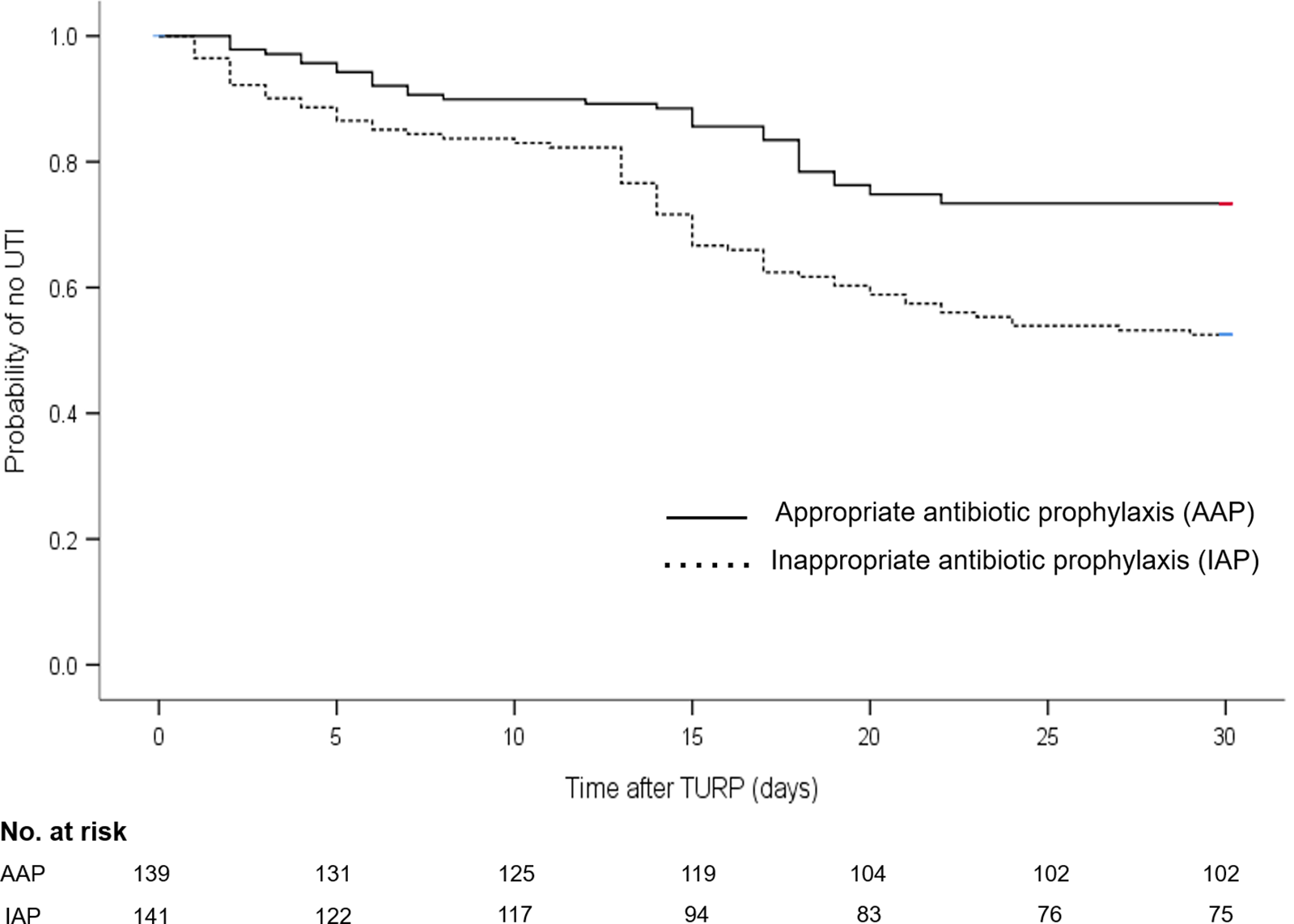
Overall, 25% of the cohort patients had urine culture obtained <3 days prior to TURP: 35 of 148 (24%) and 35 of 133 (26%) of the patients with negative and positive preoperative urine culture, respectively. The AAP group, compared to the IAP group, had significantly lower incidence of post-TURP UTI within 30 days among all cohort (27% vs 47%; P < .001) and among the patients with preoperative asymptomatic bacteriuria (26% vs 54%; P = .001). The incidences of post-TURP UTI were significantly higher in the patients who received inactive prophylactic antibiotics and in those receiving prophylactic antibiotics that were too broad-spectrum compared to those receiving AAP (59% vs 27%; P < .001 and 40% vs 27%; P = .04, respectively) (Table 1). The uropathogens that caused postoperative UTIs were similar in type and antibiotic resistance profile because those isolated from preoperative urine cultures in each individual patient, except for 6 E. coli isolates in the IAP group, which had susceptibility profiles that had changed from non–multidrug-resistant (MDR) to MDR patterns. These MDR E. coli isolates were recovered from 4 patients receiving ciprofloxacin and 2 patients receiving ceftriaxone (IAP because they were too broad-spectrum). Among the 48 patients without preoperative bacteriuria who later developed postoperative UTIs, the causative bacteria were E. coli (29 of 48, 60%), K. pneumoniae (10 of 48, 21%), P. aeruginosa (5 of 48, 11%), E. cloacae (3 of 48, 6%), and P. mirabilis (1 of 48, 2%). Renal and hepatic adverse reactions, Clostridioides difficile infection, other hospital-acquired infections, significant bleeding complications, and death were not observed in any patients in this study. The Kaplan-Meier survival analysis demonstrated the significantly lower incidence of UTI in the AAP group compared to the IAP group (P < .001) (Fig. 1). By Cox proportional hazards regression analysis, the independent factors associated with 30-day post-TURP UTI were receipt of inactive antibiotic prophylaxis against the preoperative uropathogens (aHR, 2.09; 95% CI, 1.40–3.13; P < .001), underlying cerebrovascular disease (aHR, 2.31; 95% CI, 1.17–4.59; P = .02), and prior UTI within 3 months of the TURP (aHR, 5.98; 95% CI, 1.09–32.91; P = .04) (Supplementary Table 4 online).
Kaplan-Meier survival analysis for probability of no urinary tract infections within 30 days after transurethral resection of the prostate. Comparison between the appropriate and inappropriate antibiotic prophylaxis groups by log-rank test, P < .0001.

Discussion
The most important finding of this study is that AAP among patients undergoing TURP was associated with a significant reduction in the incidence of 30-day post-TURP UTI. The benefit of preoperative urine culture procurement, together with targeted AAP, was associated with a 51% reduction in the incidence of UTI in patients with preoperative asymptomatic bacteriuria. The incidences of postoperative UTI were also significantly higher in the patients who received inactive prophylactic antibiotics and in those receiving prophylactic antibiotics that were too broad-spectrum compared to those receiving AAP. Notably, receiving inactive antibiotic prophylaxis was confirmed as an independent risk factor associated with post-TURP UTI in the multivariable regression analysis. Our findings are consistent with the prior studies that have reported benefit of urine culture-guided, targeted, antibiotic prophylaxis for reduction of post-TURP fever and bacteremia, Reference Cafferkey, Falkiner, Gillespie and Murphy1,Reference Murphy, Stassen, Carr, Gillespie, Cafferkey and Falkiner4 and these findings provide additional evidence in support of the current guideline recommendations. Reference Nicolle, Gupta and Bradley5,Reference Bratzler, Dellinger and Olsen8,Reference Lightner, Wymer, Sanchez and Kavoussi9
In our study, the high procurement rate (95%) of pre-TURP urine culture within 14 days of the scheduled surgery is consistent with a prior 90% reported rate. Reference Khaw, Oberle and Lund10 However, the prescribed IAP rate of 51% is higher than that reported in the same prior study (29%). Reference Khaw, Oberle and Lund10 As a comparative benchmark for future studies, this higher IAP rate in our study may be attributed to at least 3 reasons. First, expanded criteria for IAP by adding too broad spectrum of prescribed drug and incorrect drug dosing. Although these were not identified as the independent factors associated with post-TURP UTI, prescribing antibiotic prophylaxis that was too broad-spectrum was associated with the higher rate of subsequent UTIs due to MDR pathogens compared to prescribing AAP. Second, the antibiotic-resistant rates of the Enterobacteriaceae to the commonly prescribed prophylactic antibiotics, such as third-generation cephalosporins, fluoroquinolones, and TMP-SMX, are high in our regional setting. Although prescribing ciprofloxacin as a prophylactic agent is the second most common practice in the study, it contributed the most to IAP given no activity against most of the uropathogens. Lastly, one-quarter of the study patients had urine culture performed <3 days prior to TURP, and the culture results were not available at the time of TURP. Together, these factors inform on the clinically meaningful impact of timely procurement of preoperative urine culture and targeted AAP.
Post-TURP UTI within 30 days in this study was common (37%), and most cases had lower UTI. Notably, we assessed the lower UTI instead of bacteriuria as the post-TURP outcome. The rate of lower UTI in this study was lower than the rate of post-TURP bacteriuria (40%–74%) reported in previous studies. Reference Grabe, Forsgren and Hellsten2,Reference Grabe, Forsgren, Björk and Hellsten3 Our definition of lower UTI may be a more accurate clinically meaningful outcome than bacteriuria given that this definition considers the new onset of lower UTI symptoms but excludes irritative or discomfort symptoms that commonly occur right after TURP and during urinary catheter retention.
In this study, we identified cerebrovascular disease and prior UTI within 3 months of TURP as independent factors associated with post-TURP UTI. Underlying cerebrovascular disease may be attributed to limited post-TURP ambulation, bladder overflow, or urinary and fecal incontinence. In contrast, UTI within 3 months prior to TURP may represent risk for UTI recurrence. Patients with these risk factors should be carefully monitored for post-TURP UTI.
This study, to the best of our knowledge, is the first comparative assessment of the post-TURP UTI incidence for patients who received AAP versus IAP. In addition, it reports on the contribution of each prophylactic antibiotic to IAP, and changes in types and susceptibility profiles of the uropathogens isolated from the pre- and post-TURP urine cultures. Nonetheless, there were some recognizable limitations. First, the study design was a prospective observational cohort with some differences in baseline characteristics between the groups. Notably, a randomized controlled design to assign patients to receive AAP and IAP is not ethically feasible. However, most of the baseline characteristics associated with the study outcomes were not significantly different between the 2 groups. Second, the findings were from a single tertiary-care center with local uropathogen susceptibility patterns and might have limited generalizability. However, the principle of AAP for reduction in post-TURP UTI should be generalizable to other settings. Lastly, duration of antibiotic prophylaxis was not considered a criterion for AAP given there is no definitive consensus recommendation for the duration in current guidelines. Reference Nicolle, Gupta and Bradley5,Reference Bratzler, Dellinger and Olsen8,Reference Lightner, Wymer, Sanchez and Kavoussi9 However, the median durations of the antibiotic prophylaxis were not significantly different between the 2 groups.
In conclusion, AAP significantly reduced the incidence of 30-day post-TURP UTI compared to IAP. Timely preoperative urine culture procurement and AAP is a strategic, patient-centric approach to minimize risk for post-TURP UTI in the era of antibiotic resistance. Use of antibiotic prophylaxis that is too broad-spectrum may be associated with development of the MDR-associated UTIs. Patients undergoing TURP who have underlying cerebrovascular disease or preoperative UTI within 3 months should be closely evaluated for post-TURP UTI. Further studies are needed to assess interventions to improve the practice of prescribing AAP for patients undergoing TURP.
Supplementary material
To view supplementary material for this article, please visit https://doi.org/10.1017/ice.2021.299
Acknowledgments
We thank Dr Linda M. Mundy for her critical and thorough review of this manuscript.
Financial support
No financial support was provided relevant to this article.
Conflicts of interest
All authors report no conflicts of interest relevant to this article.