INTRODUCTION
Climate change predictions indicate an increase in the surface air temperature from 1.7 °C to 4.4 °C in the next few decades (Intergovernmental Panel on Climate Change (IPCC), 2007). Higher temperatures may diminish the likely benefits of increasing atmospheric concentrations of carbon dioxide (CO2) on productivity in some of the rice-growing environments (Krishnan et al., Reference Krishnan, Swain, Baskar, Nayak and Dash2007). Temperatures higher than 35 °C cause injuries with varying intensity in rice, depending on developmental stages. White leaf tips, chlorotic bands and blotches, white bands and specks on leaves, reduced tillering and reduced height may occur at vegetative stages (Krishnan et al., Reference Krishnan, Ramakrishnan, Reddy and Reddy2011, Yoshida et al., Reference Yoshida, Satake and Mackill1981). At reproductive stage, white spikelets, white panicles and reduced spikelet number can occur (Yoshida et al., Reference Yoshida, Satake and Mackill1981). Temperature coinciding with flowering determines fertility (Krishnan and Surya Rao, Reference Krishnan and Surya Rao2005) and spikelets with floral organs, such as lodicules (two), stamens (six) and pistil (one), are most sensitive to heat stress (Morita et al., Reference Morita, Shiratsuchi, Takahashi and Fujita2004). The magnitude of thermal burden on spikelets is largely a function of their size and shape and their immediate environment, particularly the relative humidity (Wassmann et al., Reference Wassmann, Jagadish, Sumfleth, Pathak, Howell, Ismail, Serraj, Redon˜a, Singh and Heuer2009), wind speed and radiation. The rice spikelets can poise the magnitude of thermal burden to some extent by transpirational cooling (Sheehy et al., Reference Sheehy, Mitchell, Beerling, Tsukaguchi and Woodward1998). Spikelet tissue temperature can be a better descriptor for high temperature stress damage than ambient air temperature (Jagadish et al., Reference Jagadish, Craufurd and Wheeler2007). Floral tissue damage due to high temperature stress could be due to certain combinations of temperature, relative humidity, radiation, relative humidity and wind speed resulting in inadequate transpirational cooling. Under controlled environments, micro thermocouples can be used to estimate the spikelet tissue temperature. Nevertheless, there exist many difficulties under field conditions in making accurate measurements of spikelet tissue temperature using short focal length infrared thermometer or a thermal infrared camera due to canopy/panicle architecture, colour and hairiness of spikelets, and time of the day.
Reactive oxygen species (ROS) are produced during plant photosynthesis, photorespiration, respiration, flowering and other reactions of cellular metabolism (Zhao et al., Reference Zhao, Nishimura, Fukumoto and Li2011). Hydroxyl radicals (OH−), superoxide anion (O2−), singlet oxygen (1O2) or less reactive hydrogen peroxide (H2O2−) can be harmful to the overall plant metabolic activity and damage membrane lipids, proteins, chlorophyll and nucleic acids. Under unfavourable environments, ROS production is increased and this increase is much higher due to high temperature stress (Djanaguiraman et al., Reference Djanaguiraman, Prasad and Al-Khatib2011). Activation of antioxidant enzymes, such as superoxide dismutase (SOD), catalase (CAT), ascorbate peroxidase (APX) and peroxidase (POD), can help to scavenge ROS. While SOD converts superoxide radicals (O2−) into hydrogen peroxide (H2O2), CAT dismutates H2O2 into water and oxygen, and APX by utilizing ascorbate as an electron donor to reduce H2O2 to water, POD reduces H2O2 to water using various substrates (e.g. phenolic compounds and/or antioxidants) as electron donors. Non-enzymatic constituents, such as lipid-soluble and membrane-associated tocophenols, water-soluble reductants, ascorbic acid and glutathione, are also involved in the antioxidant defence system of plants (Wahid et al., Reference Wahid, Gelani, Ashraf and Foolad2007). Generally, healthy plants maintain a balance between generating free radical oxygen species (ROS) and their scavenging mechanisms to maintain growth and metabolism. Multiple molecular forms of antioxidant enzymes can occur within tissues, cells or organelles and their changes can imply their potential roles in detoxification of ROS. There exists a relationship between enhanced or constitutive antioxidant enzyme activities and increased resistance to plant stress (Türkan et al., Reference Türkan, Zdemir and Koca2005).
Investigations on enzymatic scavenging mechanisms for ROS will help to define their involvement and provide new insights into high temperature tolerance in spikelets. We propose a hypothesis that higher activities of antioxidant enzymes, coupled with changes in their isozyme profiles in rice spikelets provide an important mechanism of tolerance to high temperature stress. In the present work, the effect of high temperature stress on the activities of antioxidant enzymes like SOD (EC 1.15.1.1), CAT (EC 1.11.1.6), APX (EC 1.11.1.11), POD (EC 1.11.1.7), guaicol peroxidase (GP) (EC 1.11.1.7) and catechol oxidase (CO) (EC 1.10.3.1), together with their isozyme profiles, were studied in spikelets of nine different rice genotypes, grouped as tolerant, moderate and susceptible from their responses to temperature after an agronomic evaluation from field experiments (Supplementary Table 1).
MATERIALS AND METHODS
Plant material and growth conditions
Rice genotypes
Seeds of rice genotypes (cv. N22, Annapurna and Khitish, considered to be tolerant to high temperature stress, and those of highly susceptible such as, cv. Ramakrishna, ADT 43 and Basmati 370, along with moderately tolerant cv. Sasyashree, Prasad and Divya), were obtained from the Division of Crop Improvement, Central Rice Research Institute (CRRI), Cuttack, India. The seeds were sown onto trays containing 2-mm sieved clay loam soil (2 kg per tray for each genotype), mixed thoroughly with (NH4)2SO4 (2.5 g), KCl (0.5 g) and single superphosphate (SSP) (0.5 g). Sterile water was used regularly to facilitate germination and growth of seedlings. After 15 d, three seedlings each for a particular genotype were transplanted into pots containing clay loam soil (7.4 kg), mixed thoroughly with (NH4)2SO4 (7.5 g), KCl (1.5 g) and SSP (1.5 g). An additional dose of (NH4)2SO4 (2.5 g) was provided on 25–30 d after transplanting. For each of the nine genotypes, 35 pots were maintained separately under flooded conditions throughout the crop cycle. Pots were maintained under natural sunlight conditions with the day/night temperature of 29 ± 0.9/21 ± 0.6 °C and RH of 75% (SD = 2.95) in the greenhouse of the experimental farm of CRRI, Cuttack.
Growth condition and high temperature treatment
On the first day of flowering (anthesis, i.e. the appearance of anthers), pots of each genotype were transferred at 08.00 h into controlled environment of the Plant Growth Chambers (Cassia Siamia Ltd., Hyderabad, India). The temperatures (SD in parentheses) of the growth chambers were maintained at 25 (SD = 1.6), 30 (1.4), 35 (1.2), 40 (1.5), 45 (1.7) and 50 (1.6) °C with an RH of 75% for six days separately in accordance with specific treatments for all the genotypes. Investigations were performed after exposure of plants at the flowering stage to high temperatures only up to 50 °C. Temperature of the ambient air cycled from outside the plant growth chambers was increased with the help of heaters inside the chambers. Photosynthetic photon flux density was maintained at 640 μmol m−2 s−1 inside, while the concentration of CO2 was not measured. After temperature treatments, all the plants were restored to the natural sunlit conditions (~25–32 °C). There were no pest or disease problems within the greenhouse.
Sampling
Spikelet fertility of the control and high temperature-treated plants was tested on those which opened between 09.00 h and 15.00 h on the first day of anthesis, and labelled using acrylic marker (Jagadish et al., Reference Jagadish, Muthurajan, Oane, Wheelerm, Heuer, Bennett and Craufurd2010). After observing for 12 d, fertility in percentage was scored by pressing the marked spikelets individually. In an effort to estimate the activities of antioxidant enzymes and their isozyme profiles, fertile spikelets of all the plants after different levels of high temperature exposure were collected between 08.00 h and 08.30 h on the following day. A minimum of three samples of spikelets (~1500 spikelets) were collected with each sample from a minimum of three plants of a particular genotype and pooled. All the sampled spikelets were frozen in liquid nitrogen, extracted immediately and the supernatant was collected for analysis.
Extraction and estimation of antioxidant enzyme activities
The antioxidant enzymes were extracted from the frozen spikelets by grinding the tissue using a pestle and mortar with liquid nitrogen and 25% (w/w) polyvinyl polypyrrolidone (PVPP). After grinding, the powdered tissue (0.5 g ~300 spikelets) was then extracted with 10 mL of ice cold potassium phosphate buffer (50 mM, pH 7.8) containing EDTA (1 mM), ascorbate (1 mM), sorbitol (10% w/v) and Triton X 100 (0.1). The extract was centrifuged twice for 10 min at 15,000 rpm at 4 °C. The supernatant as enzyme extract was then used for all the assays.
Superoxide dismutase (SOD) assay
The SOD assay was performed according to the photochemical method (Chowdhury and Chowdhury, Reference Chowdhury and Choudhury1985). The reaction mixture (3 mL) contained 2.4 mL of 50 mM sodium phosphate (Na2PO4) buffer (pH 7.8) containing 0.1 mM EDTA, 63 μM nitroblue tetrazolium chloride (NBT), 13 μM L-methionine and 0.2 mL of enzyme extract and 0.5 mL riboflavin (1.3 μM), which was added last. The reaction was monitored in the presence of 40 W fluorescent lamp for 20 min. One unit of SOD activity is defined as the amount of enzymes required to cause 50% inhibition of the rate of NBT reduction at 560 nm and was expressed as unit per gram of fresh weight.
Catalase (CAT) assay
The assay mixture contained 2.3 mL of 50 mM Na2PO4 buffer (pH 7.0), 0.5 mL of 10 mM H2O2 and 0.2 mL of enzyme extract. The decomposition of H2O2 was monitored at 240 nm for 3 min (Cakmak and Marschner, Reference Cakmak and Marschner1992). The activity is expressed as change in Optical Density (OD) per minute per gram fresh weight.
Ascorbate peroxidase (APX) assay
The reaction mixture contained 1.8 mL of 50 mM Na2PO4 buffer (pH 7.0), 0.5 mL of 100 mM H2O2, 0.5 mL of 0.5 mM ascorbic acid and 0.2 mL of enzyme aliquot. The assay was allowed to equilibrate at 25 °C for 1 min before the addition of H2O2, which initiated the reaction. The reaction was monitored as decrease in absorbance at 290 nm for 1.0 min at 25 °C after the determination of initial rate. A control reaction was prepared by replacing ascorbate with HEPES (4-(2-hydroxyethyl)-1-piperazineethanesulfonic acid) buffer. A unit of APX is defined as the amount necessary to oxidize 1.0 μmol of ascorbate per min at 25 °C (290 nm extinction coefficients of 2.8 mm−1 cm−1) (Nakano and Asada, Reference Nakano and Asada1981).
Guaiacol peroxidase (GP) assay
The activities were measured as oxidation of guaiacol (8.26 mM, ε = 26.6 mM− 1 cm−1) in the presence of H2O2 (8.8 mM) within 2 min (Rao et al., Reference Rao, Paliyath and Ormrod1996). The supernatant (0.2 mL) was reacted with 1.8 mL of 50 mM Na2PO4 buffer (pH 7.0) and 0.5 mL of 0.1 mM H2O2. The reaction was started with addition of 0.5 mL of 0.1 mM guaicol and followed in a spectrophotometer (Specord 200, Analytik Jena, Germany). The enzyme activity is measured by increase in absorbance at 470 nm caused by guaicol oxidation (E = 26.6 mM per cm), and the activity is expressed in millimolar guaicol oxidized per minute per gram fresh weight.
Catechol oxidase (CO) assay
Catechol (or polyphenol) oxidase (CO) was measured by monitoring the change in colour intensity by oxidation of catechol at 420 nm. The reaction mixture contained 1.8 mL of 50 mM Na2PO4 buffer (pH 7.0), 0.5 mL of 0.5% (w/v) catechol, 0.5 mL of 0.1 mM H2O2 and 0.2 mL of enzyme aliquot. The enzyme activity is measured by increase in absorbance at 420 nm caused by catechol oxidation and expressed as change in optical density per minute per gram fresh weight.
Isozyme profiling
Native polyacrylamide gel electrophoresis (PAGE) was performed on the crude extract using the stacking gel (with 4.5% acrylamide) and the separating gel (with 10% acrylamide) with running buffer composed of 4 mM Tris-HCl (pH 8.8) and glycine (38 mM). The crude extract with a protein content of 100 μg was loaded per well. The electrophoresis was performed at 4 °C with the application of 30 mA current.
Superoxide dismutase (SOD)
Isozyme profiling of SOD was done by incubating the gel in the solution containing 100 mL of 50 mM sodium phosphate buffer (pH 7.5) containing 200 mg of NBT in dark at 30 °C for 20 min. The solution was then drained off and incubated in another solution containing 50 mM Na-Phosphate buffer (pH 7.5), 0.4 mL TEMED and 1 mg riboflavin for about 15 min under 40 W fluorescent tubes (two in number) at room temperature for development of achromatic bands.
Catalase (CAT)
For the isozymes of CAT, the polyacrylamide gel was incubated in the solution containing H2O2 (0.1% v/v) for 5 min. Then the solution was drained off and the gel was placed in a solution containing potassium ferricyanide (0.5%) and ferric chloride (0.5%) solutions for 10 min. The zymogram was recorded as soon as the achromatic bands became evident.
Ascorbic acid peroxidase (APX)
Isozyme profiles of APX were obtained by incubating the gel in a solution of 50 mM potassium phosphate buffer containing 4 mM ascorbic acid and H2O2 (0.1 mM) for 15 min, then washing it with distilled water and incubating in a solution of 0.125 M HCl containing potassium ferricyanide (0.1%) and ferric chloride (0.1%) for 10 min. APX was located as achromatic bands on coloured background, as a result of the reaction between ferric chloride and potassium ferrocyanide, the latter having been produced by the reduction of potassium ferricyanide with un-reacted ascorbic acid.
Guaicol peroxidase (GP)
For determining the isozymes of GP, the polyacrylamide gel was prepared with 10% separating- and 4.5% stacking-gel. After electrophoresis the gel was stained with a solution containing 0.5 mM guaicol and 2 mL of 30% (w/v) H2O2 for about 5–10 min. The brownish colour bands appeared in the gel after washing with distilled water.
Catechol oxidase (CO)
Isozymes of CO were stained with a solution containing 0.1% catechol and 2 mL of 30% H2O2 for 5–10 min. The brownish colour bands appeared in the gel after washing with distilled water.
All the gels were scanned using Densitometer Florchem™ 5500 (Alpha Innotech, California, USA). The gels were analysed for densitometric values using UVI Tech software (St. John's Innovation Center, Cambridge, UK).
Yield and its components
For analyses of yield components and grain quality parameters, five replicate plants for each genotype during harvest stage were selected. After measuring the height, plants were harvested carefully along with the soil and washed to remove adhering soil. Plants were then divided into culms and leaf sheaths, leaf blades and panicles; the numbers of tillers and panicles were determined. To minimize wilting and respiration during separation of tillers and other plant parts, the samples were kept in ice-cold water. Immediately after processing, all samples were placed in an oven at 60 °C. The dry weight of each plant part was determined after a constant weight was attained. Panicles were hand-threshed, and the yield of filled grains was weighed after drying at 60 °C for 12 h. The 1000-grain weight for each rice genotype was estimated as a mean of three replicate samples, one from each replicate of five plants. Spikelet sterility was measured as the number of filled spikelets and expressed as a proportion of the total number of spikelets (Krishnan and Surya Rao, Reference Krishnan and Surya Rao2005). In the present experiment, the temperature treatments above 45 °C invariably led to drastic reduction in yield in all the genotypes. Although observations on different yield components were made for all the temperature treatments, data from two temperature treatments (25 °C and 45 °C for six days) were only presented.
Grain quality parameters
Another set of five plants in each replicate of a particular genotype was sampled and their panicles were sun-dried and hand-threshed. The grains from each replicate samples were dried in an oven at 30 °C to constant moisture content of 10%, and a sub-sample (50 g) of seeds from these was immediately stored in sealed and laminated aluminium foil packets at 1–2 °C until they were tested for grain quality parameters.
Membrane stability index (MSI)
The MSI was measured by an electrolytic leakage technique. Briefly, three weighed replicates of rice spikelets (2 g ~100 spikelets) from each treatment were soaked in 50 mL of distilled water at 25 °C for 16 h. The cell membrane thermal stability (CMTS) was estimated using the following equation:
CMTS = 1 – (1 – (T1/T2))/(1 – (C1/C2)),
where T and C refer to conductivity in the control and high temperature treated samples and subscripts 1 and 2 refer to conductance before and after autoclaving respectively. A control with distilled water (but without seeds) was also maintained. Membrane Thermal Stability (MSI) was expressed using the following equation:
MSI (%) = 100 – CMTS.
Protein concentration
For the estimation of protein concentration, grain sample (0.5 g) was macerated with 5 mL of 0.05 M Tris HCl buffer (pH 7.2) and transferred to a centrifuge tube. The extract was then centrifuged at 1200× g at 4 °C for 15 min. The supernatant was immediately used for the estimation of protein (Das et al., Reference Das, Nayak, Patra, Ramakrishnan and Krishnan2010).
Concentrations of sugar and starch
Dried grain sample (50 mg) was extracted in 10 mL of 80 percent ethanol for extraction of sugar and starch estimation. A glass ball was placed on top of the tube and kept in a water bath at 80 to 85 °C for 30 min. Cooled solution was centrifuged and decanted into a 50 mL beaker. This extraction was repeated three more times. The alcohol extract was evaporated on a water bath at 80–85 °C until most of the alcohol was removed (e.g. volume was reduced to about 3 mL) and made up to 25 mL with distilled water. While the concentration of sugar in the extract was analyzed, the residue left after sugar estimation was used for starch estimation (Das et al., Reference Das, Nayak, Patra, Ramakrishnan and Krishnan2010).
Statistical analyses
All the experiments were repeated three times (three technical replicate experiments with three biological replicates for each sample) for ensuring reproducibility of results. Significant differences between mean values of the observed parameters of control and temperature treatments of spikelets of individual genotype were evaluated by two-factor factorial analysis of variance. Analysis of variance was performed with the IRRISTAT Random Effect Model procedure (International Rice Research Institute, Los Banos, Philippines). Data on sterility (as percentage) and membrane stability index were transformed to arcsin values prior to analysis. Means differing significantly were compared using Duncan's Multiple Range Test (DMRT) at p ≤ 0.05. Pearson correlation matrices were calculated across all environments for each genotype pooled, and their homogeneity was determined. The significance of individual correlation coefficients was evaluated (Gomez and Gomez, Reference Gomez and Gomez1984).
RESULTS
Antioxidant enzyme activities
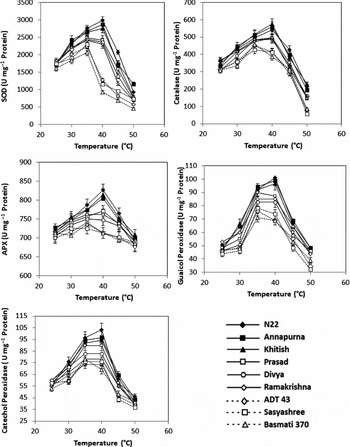
Antioxidant enzyme activities (SOD, CAT, APX, GP and CO) in spikelets among different genotypes did not significantly differ at the exposure to the lowest (25 °C) as well as the highest temperature (50 °C) (Figure 1). Increasing temperature from 25 °C to 40 °C at anthesis led to significant increase in the activities of antioxidant enzymes in all the genotypes. While maximum activities of different enzymes were observed between 35 °C and 40 °C, there was concomitant decrease with further increase in temperature. Among the genotypes examined, cv. N22, Annapurna and Khitish showed maximum activities at 40 °C, while cv. ADT 43, Ramakrishna and Basmati 370 had their maximum activities at 35 °C. Rapid decrease in enzyme activities at temperatures above 40 °C was also a characteristic of genotypes tested.
Effect of different temperature treatments on antioxidant enzyme activities in rice spikelets.

Expression of antioxidant isozymes in response to different temperatures
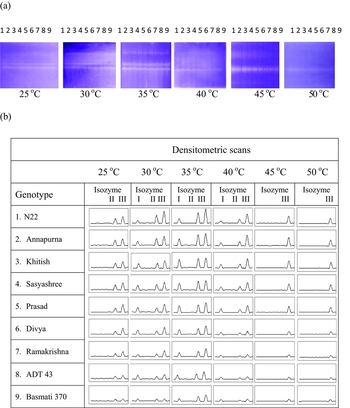
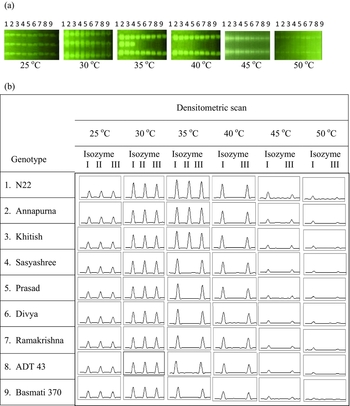
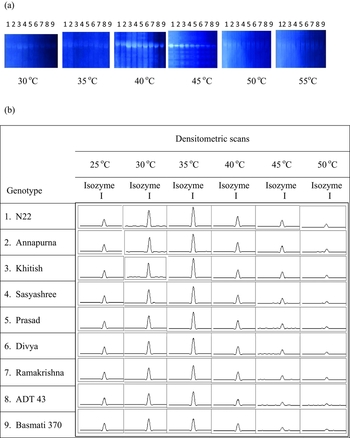
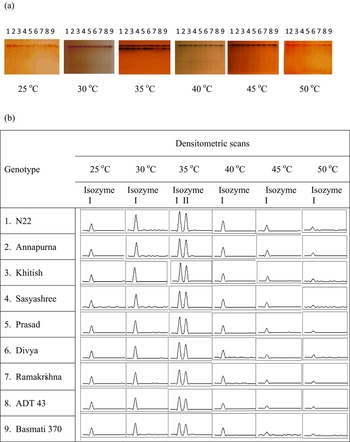
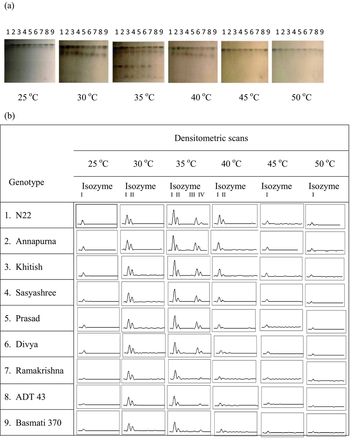
Antioxidant isozyme profiling revealed temperature-dependent changes in all the genotypes examined. In addition to the highly active isozymes, which were detected in the spikelets of the temperature-treated plants, there appeared to be high specificity patterns. The SOD isozymes II and III initially appeared under low temperatures (25 °C), while the isozyme-I was observed after the 40 °C treatment (Figure 2). After the treatment of 50 °C, the isozymes I and II disappeared in all the genotypes. Three CAT isozymes, with CAT I and III being major isozymes, were detected upon separation by the non-denaturing PAGE, followed by staining (Figure 3). There was only one isozyme of APX in all the nine rice genotypes after the exposure of 25, 30, 35, 40, 45, 50 and 55 °C for six days (Figure 4). The most significant enhancement of GP was observed at 40 °C, where two isoenzymes of GP preserved their activities (Figure 5). However, there was only one isozyme of GP at all other temperature treatments. There were about four isozymes of CO in these rice genotypes (Figure 6). The isozyme I of CO was present at all temperature treatments, the isozyme II was present after the 30 °C treatment, and isozymes III and IV were present only at 35 °C treatment. However, the CO isozymes III and IV disappeared after 35 °C treatment; isozyme II disappeared at 45 °C and only isozyme I was present after 50 °C treatment.
(a) Native PAGE analysis, and (b) densitometric scans of native PAGE electrophoretic pattern of SOD enzyme.

(a) Native PAGE electrophoretic pattern of catalase enzyme, and (b) densitometric scans of native PAGE electrophoretic pattern of catalase enzyme.

(a) Native PAGE electrophoretic pattern of APX enzyme, and (b) densitometric scans of native PAGE electrophoretic pattern of APX enzyme.

(a) Native PAGE electrophoretic pattern of guaicol peroxidase enzyme, and (b) densitometric scans of native PAGE electrophoretic pattern of guaicol peroxidase enzyme.

(a) Native PAGE electrophoretic pattern of catechol oxidase enzyme, and (b) densitometric scans of native PAGE electrophoretic pattern of catechol oxidase enzyme.

Relative quantification of isozymes and their changes
The relative quantification of isozymes was performed using densitometric values, which represented band intensities. Antioxidant enzymes, such as SOD (Supplementary Table 2) and CAT (Supplementary Table 3), showed three, APX (Supplementary Table 4), GP (Supplementary Table 5) and CO (Supplementary Table 6) showed one, two and four isozymes respectively. There were significant differences due to genotypes and temperature treatments of isozymes. In general, the quantities of isozymes increased with increase in temperature only up to 35–40 °C. Any further increase in temperature led to significant decrease in isozymes. Among the nine rice genotypes tested, cv. N22, Annapurna and Khitish showed higher amounts of isozymes at 35–40 °C, while the genotypes, such as Sasyashree, Prasad and Divya, had only moderate increase in their isozymes. In contrast, there were drastic decrease in the isozymes of cv. Ramakrishna, ADT 43 and Basmati 370 after the temperature treatment beyond 35 °C. There were no significant differences in the amounts of isozymes of all the genotypes both at 25 °C and 55 °C. Genotypes of cv. Ramakrishna, ADT 43 and Basmati 370 invariably had lower amounts of isozymes at all temperature treatments.
Analysis of variance
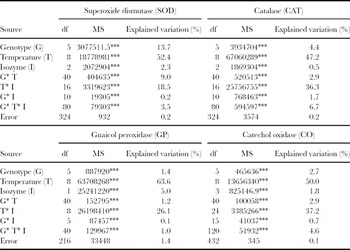
The interaction mean square (MS) value was less compared with that of main effects (Table 1). The value of the main effect MS for the proportion of antioxidant enzymes of SOD, CAT, APX, GP and CO was higher due to the temperature treatment or the genotypes tested. The changes in the relative quantities of isozymes of SOD, CAT, GP and CO were found to be influenced more by the temperature treatment than the genotype tested. Only in the case of APX, the influence due to genotype was found to be more than that of high temperature treatment. In general, the explained variation (%) due to the temperature treatment was found to be maximum, being 52.5, 47.2, 63.6 and 50.0% for the SOD, CAT, GP and CO respectively. Only the APX showed the maximum explained variation of 87.8% due to the genotypes.
Combined analysis of variance for antioxidant isozymes based on band intensities in spikelets of nine rice genotypes after six different temperature exposures at flowering.

Note: *, ** and ***: Significant at 0.05, 0.01 and 0.001 respectively; ns: not significant.
Yield attributes and grain quality
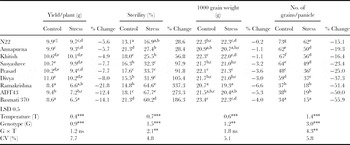
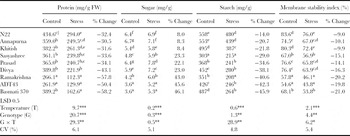
Exposure of rice plants to a high temperature of 45 °C at flowering for six days led to significant reduction in yield per plant, while there were only marginal reductions in the 1000 grain weight of all the genotypes tested (Table 2). In contrast, there were two- to three-fold increase in spikelet sterility (%), especially in the genotypes such as Sasyashree, Prasad, Divya, Ramakrishna, ADT 43 and Basmati 370. Only marginal increase was observed in the tolerant genotypes (N22, Annapurna and Khitish). In additional, the number of grains per panicle of high temperature (45 °C)-treated plants of tolerant genotypes was comparable to 25 °C. Interestingly, decrease in the membrane stability indices (MSI) was also indicative of agronomic grouping based on the levels of tolerance to high temperature stress (Table 3); MSI declined by 9–10% in the tolerant group (cv. N22, Annapurna and Khitish), about 15% in the moderate group (cv. Sasyashree, Prasad and Divya) and around 20% in the susceptible group (cv. Ramakrishna, ADT 43 and Basmati 370). The concentration of grain protein, an important quality parameter, decreased by 31, 37 and 55% respectively in the tolerant, moderate and susceptible genotypes (Table 3). There were similar trend of decrease in the concentrations of starch in these genotypes due to high temperature exposure. On the contrary, the concentration of sugar increased by 7, 18 and 31% in the tolerant, moderate and susceptible genotypes respectively.
Effect of temperature stress on yield attributes of different rice genotypes.

Note. ***Significant at p = 0.001; ** significant at p = 0.05; ns: not significant. ‡In a column, means followed by a common letter are not significantly different at the 0.05 level by Duncan's Multiple Range Test.
Effect of temperature stress on biochemical parameters of rice spikelet in different rice genotypes.

Note. ***Significant at p = 0.001; **significant at p = 0.05; ns: not significant. ‡In a column, means followed by a common letter are not significantly different at the 0.05 level by Duncan's Multiple Range Test.
DISCUSSION
Rice is predominantly a tropical crop and is often subjected to the vagaries of weather, which include changes in temperature during its growth period. The predicted increase in temperatures due to climate change processes can have varying influences on different tissues and genotypes of rice, depending on the intensity and duration of high temperature stress (Krishnan et al., Reference Krishnan, Swain, Baskar, Nayak and Dash2007, Yoshida et al., Reference Yoshida, Satake and Mackill1981). From the present study, decrease in yield, grain weight, membrane stability index, grain number per panicle and the concentration of grain protein and starch but increase in spikelet sterility (%) and the concentration of grain sugar due to high temperature (45 °C) exposure for six days at flowering clearly showed that rice is highly sensitive during the reproductive stage. In addition, the response of rice to high temperature exposure was found to be genotype-dependent. For achieving higher seed yield, it is essential to achieve an increased number of grains per panicle with less sterility (%). The changes in grain quality parameters, such as increase in sugar concentration, but decrease in starch concentration in the high temperature-treated plants can be attributed to the loss of membrane integrity (Krishnan and Surya Rao, Reference Krishnan and Surya Rao2005). Due to the cell membrane injury, the enzymes lose their catalytic activities, the cell reserves get depleted and the by-products of catabolic reactions become toxic (Wahid et al., Reference Wahid, Gelani, Ashraf and Foolad2007). High temperature exposure leading to decrease in the concentrations of protein and starch, and increase in soluble sugar concentration as observed in this present study, may lead to irreversible degradation of important cellular machinery during grain development. From an experiment using the phytotron facilities at the International Rice Research Institute, Philippines, it was observed that flowering was the most sensitive stage to high temperature in three indica (tropical) rice selections (N22, IR747B2-6 and BKN6624-46-2) (Satake and Yoshida, Reference Satake and Yoshida1978). The spikelet tissue temperature of 33.7 °C even for an hour at anthesis induced sterility (Jagadish et al., Reference Jagadish, Craufurd and Wheeler2007). Even the temperatures of 38 °C and 41 °C for an hour before or after anthesis affected spikelet fertility (Matsui and Omasa, Reference Matsui and Omasa2002). Similar observations are well documented but the underlying biochemical mechanisms and gene expression are to be investigated in detail (Hu et al., Reference Hu, Hu and Han2009).
Many antioxidant enzymes are activated to scavenge the ROS generated during metabolic reactions. Isozyme profiling of antioxidant enzymes can suggest whether induction of new isoforms or only the quantitative changes in the constitutive isoforms occur due to the high temperature stress. Agronomic characteristics, such as survival, plant height, yield and its components and grain quality parameters, offer the advantage of ease in their measurements. Because of the complex nature and range of plant responses, it is difficult to define tolerance to high temperature exposure by the agronomic traits alone. Our results suggested that the antioxidant defense system would be a more appropriate criteria for evaluating and selecting genotypes tolerant to high temperature. There was induction of new isozymes of SOD, GP and CO in spikelets after the high temperature treatment. No new isozymes were inducted for CAT and APX but there were alterations in the relative quantitation of constitutive isoforms. The high temperature treatments of up to 40 °C activated the isoenzymes compared with the control treatment at 30 °C. Similar results were reported for POD in rice (Srivalli et al., Reference Srivalli, Sharma and Khanna-Chopra2003).
In the present study of high temperature-stressed rice spikelets, both CO and GP increased significantly whereas APX did not show any variation due to different levels of high temperature exposure over 25 °C. In an earlier study on antioxidant defence mechanisms in rice seedlings exposed to low temperature stress, POD was found to show transient increase in its activity (Oidaira et al., Reference Oidaira, Sano, Koshiba and Ushimaru2000). Peroxidases are known to be involved in the biosynthesis of cell wall and lignification. Higher activities of peroxidase may contribute not only to the ROS scavenging but also to the maintenance of cellular membranes and cell wall function. In the present study, there were about 1–3 SOD isozymes in rice spikelets and one of them responded directly to the high temperature stress treatment.
Catalase activity of rice seed embryo and germination rate were closely correlated under low temperature conditions (Tanida, Reference Tanida1996). The tolerance in rice to chilling injury was attributed to the cold stability of CAT and APX. On the contrary, Oidaira et al. (Reference Oidaira, Sano, Koshiba and Ushimaru2000) did not observe significant changes in CAT activities in rice seedlings under low temperature. In the present study, three major bands representing isozymes of CAT were detected in rice spikelets. We observed that increase in sterility and decrease in CAT activities in spikelets were related under high temperature stress conditions. The activities of all three isozymes of CAT increased with high temperature treatment of 45 °C for six days (Figure 3). Likewise, severe water stress was found to induce a new CAT isoform in rice seedlings (Srivalli et al., Reference Srivalli, Sharma and Khanna-Chopra2003). In the present study of high temperature stress, higher intensities of all CAT isoenzymes were detected, suggesting the role of ROS scavenging mechanisms directly and the generation of ROS indirectly. No new isoform of APX was found to be induced in the spikelets after the high temperature treatment in the present study. Probably, the isozyme of APX, which was constitutive in nature, was either activated or inhibited. The activation of the existing isozyme suggests that the same isozyme may be produced under high temperature stress. In agreement with many previous observations (Scandalios et al., Reference Scandalios, Tsaftaris, Chandlee and Skadsen1984), our results indicate that only those isoforms which are needed to protect the high temperature stress condition are expressed. It is also well known that antioxidant isozymes respond differentially to biotic and abiotic stresses. Any limitation of one of the antioxidant systems may be compensated through the up-regulation of another. Although no such dependence was clearly observed in the present study, there existed a close similarity between the enzyme profiles of GP and CO in rice spikelets, when subjected to high temperature stress. Likewise, the profiles of CAT, GP and SOD suggest their interrelationships.
High or low temperature stress can have adverse effect on cellular homeostasis, and uncoupling of many physiological processes in plants (Wahid et al., Reference Wahid, Gelani, Ashraf and Foolad2007). Using microarray hybridization for 51,279 probe sets for japonica and indica transcripts, the genome-wide response patterns under heat stress for O. sativa subsp. japonica (cv. Zhonghua 11) was found to be different from those of cold, drought and salt, even though there were 240 genes, which responded to both heat and drought (Hu et al., Reference Hu, Hu and Han2009). The Os04g01740 (OsHsp90-1) gene of the Hsp70 family was found to be strongly induced under heat stress, but not induced by cold, drought or salt. High temperature can increase the accumulation of sucrose and pyruvate/oxaloacetate-derived amino acids and decrease levels of sugar phosphates and organic acids involved in glycolysis/gluconeogenesis and the tricarboxylic acid cycle respectively (Yamakawa and Hakata Reference Yamakawa and Hakata2010). The DNA microarray analysis revealed that genes for alternative oxidases (AOXs) were up-regulated to a Ratio of Cumulative Expression Level (RECL, that is the ratio of the sum of expression levels for all genes encoding aminoacyl-tRNA synthetase for a given amino acid in the high temperature condition to that in the control) of 1.40 under high temperature conditions. Alternative oxidases can prevent the over-production of respiratory components leading to the formation of ROS.
The antioxidant defense mechanism is a part of high temperature stress adaptation, and its strength is correlated with acquisition of thermotolerance. The ROS are primary damage causing agents, and at the same time they play protective role by acting as signalling molecules. In the cellular defence mechanisms against the effect of ROS on different biomolecules, antioxidant enzymes are expressed. Enhanced activities of antioxidant enzymes and their levels help to protect from the harmful effects of ROS. Our results clearly suggest that high temperature stress at the flowering stage of spikelets affects oxidative reactions. The activities of antioxidant enzymes (CAT, SOD, APX, GP and CO) responded to the high temperature stress, which is also genotype-dependent. The levels of tolerance to high temperature stress are primarily due to the differences in genotypic resistance by multiple molecular forms of antioxidant enzymes and their relative compositions. Increase in the activity of these antioxidant enzymes appears almost simultaneously, which can lead to the avoidance of ROS generation or can scavenge ROS or repair after the injury. The synthesis of new isozymes of antioxidant enzymes with altered kinetic properties is more beneficial than the existing antioxidant enzymes for scavenging of ROS. In conclusion, the results of this study confirmed our hypothesis that activities of antioxidant enzymes increased due to high temperature exposure but declined suddenly after 35 °C and beyond, depending on the varying levels of capabilities of genotypes to high temperature stress. Differential modulation of SOD, CAT, APX, GP and CO isozymes and their activities in rice spikelets suggest their potential use as biomarkers for identification and selection of genotypes that are tolerant to high temperature stress.
Acknowledgements
P. Krishnan and B. Ramakrishnan thank the Science and Engineering Research Council (SERC), Department of Science and Technology (DST), Government of India for the support with a research project on ‘High temperature stress response and associated changes in growth and yield of rice (Oryza sativa L)’. Smruti Das is grateful to DST for the Junior Research Fellowship. We acknowledge the facilities and support provided by the Director, CRRI, Cuttack and the Director, IARI, New Delhi.