It seems self-evident that a sharp decline in transport costs should contribute to an expansion in trade volumes, and this relationship should be strongest, ceteris paribus, if transport costs account for a large share of a good's final market price. Falling ocean freight rates and the late-nineteenth-century global trade boom represent a commonly cited example of this transport-trade relationship. Kevin O'Rourke and Jeffrey Williamson (Reference O'Rourke and Williamson1999, p. 35) argue that, “…the decline in transport costs after mid-[nineteenth] century was enormous, and it ushered in a new era [of globalization].” Echoing this conclusion, Antoni Estevadeordal, Brian Frantz, and Alan Taylor (Reference Estevadeordal, Frantz and Taylor2003, p. 362) report that, “[t]ransport costs on maritime routes played a big role in both [trade] boom and bust: they fell dramatically before 1914…[and] rose steeply up to 1939.” And, based on estimates of falling distance effects within a gravity model specification, David Jacks (Reference Jacks2009, p. 232) writes, “…[after 1870]…the spread of communication [and] transport networks lowered trade costs, and thus, stimulated trade flows.” Despite the prevalence of the belief that cheaper ocean shipping must have contributed to higher trade volumes between 1870–1913, there is surprisingly little direct evidence that can confirm this view.Footnote 1
In this article we argue that transportation did play an important role in the determination of late-nineteenth and early-twentieth trade volumes, but the nature of the relationship was complex. At least for some products, the impact of international transport costs can only be identified after controlling for intra-national transport costs. Our evidence ultimately supports the traditional narrative of late-nineteenth century globalization, but this support is conditional on an understanding that ocean freight rates alone are often inadequate to fully capture the effect of transport costs on trade. We base our conclusions on a detailed route and product-specific case study of one of the more important, and widely studied trade relationships in economic history: the late-nineteenth- and early-twentieth-century trans-Atlantic iron trade.Footnote 2
Using newly compiled information on west-bound trans-Atlantic ocean freight rates for pig iron, and British and North American railway charges, wharfage costs, brokerage fees, and insurance fees, we calculate the total cost to transport pig iron from British blast furnaces (through Liverpool) to Pittsburgh, Pennsylvania (through New York City), and to Hamilton, Ontario (through Montreal), for each year from 1870–1913. We also calculate the total cost to move iron ore from Michigan and coking coal from Pennsylvania to North American blast furnaces in Pittsburgh and Hamilton. We include these inter- and intra-continental transport cost measures in import demand functions, with additional controls for nation-specific pig iron, iron ore and coal tariffs, adherence to the gold standard, technological discontinuities, domestic demand determinants, British and North American pig iron prices, and lagged trade volumes. An instrumental variables (IV) approach controls for the endogenous nature of the relationship linking transport costs, tariffs and pig iron prices, to trade volumes.
Some of the estimated import demand elasticities are unexpected. If we estimate a naive import demand function that includes trans-Atlantic ocean freight rates as the only transport influence on British pig iron shipments, we find a weak and statistically insignificant connection between transportation and trade. When we broaden our measure of transport costs to include overland rail charges, wharfage, brokerage fees, and insurance, the impact of transportation on British exports becomes stronger and statistical significance improves. However, it is only when the costs associated with the intra-continental assembly of iron ore and coking coal by American and Canadian iron and steel producers are included in our import demand functions, that we can identify a considerably more elastic and statistically robust link between transportation and trans-Atlantic trade. Controlling for potential endogeneity in the transport-trade relationship strengthens this result.
Our case study clearly reveals the complex nature of the transport-trade relationship. As it becomes cheaper to assemble raw materials and intermediate inputs in import competing nations, trade may be suppressed even as ocean freight rates fall. This result is unlikely to be unique to the trans-Atlantic iron trade. We might reasonably expect falling transport costs to have simultaneously affected prices for imported final goods and raw material assembly costs in, for example, Russian, German, or Japanese iron markets, and for a wide range of other trans-Atlantic trade goods, including flour, cheese, meat, paper products, or refined minerals.Footnote 3
Does an appreciation of the intricate ways that transportation can affect trade really matter from an economic or historical perspective? In our case study, the elasticities derived from the import demand functions reveal the extent to which transport costs contributed to the collapse in Britain's iron trade after 1870.Footnote 4 Simple counterfactual experiments show that the decline in inter- and intra-continental transport costs were very nearly as important as falling relative prices in the determination of British exports into North American iron markets between 1870–1913. In contrast, the impact of falling ocean freight rates alone was inconsequential relative to these price movements.
PIG IRON PRODUCTION AND TRANS-ATLANTIC TRADE
A nation's ability to produce pig iron at competitive prices has often been taken as an indicator of an advanced stage of industrial development. Pig iron is an intermediate input produced by smelting iron ore with high carbon content fuels such as charcoal or coking coal. The molten metal that results from this process can be poured into moulds to form bars or slabs, which can then be further refined to oxidize a range of impurities, producing either wrought iron or steel. The production of pig iron relies on techniques that make intensive use of both human and physical capital. By 1913 efficient blast furnaces, foundries, and rolling mills were technologically advanced, organizationally complex, and they were characterized by significant scale economies.Footnote 5
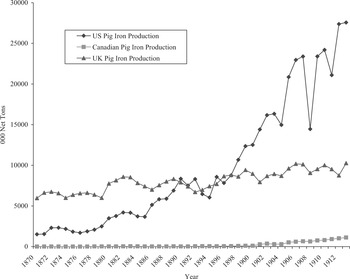
Figure 1 depicts the total quantity of pig iron produced by U.S., Canadian, and British blast furnaces annually from 1870–1913. By the early 1890s U.S. production matched British levels at approximately 9 million net tons.Footnote 6 By 1913 the United States produced more pig iron than any other nation, smelting just over 30 million net tons during that year.Footnote 7 Although production levels in Canada were low relative to the United States and Britain, the Canadian market was not inconsequential. Shipments to Canada were important to British blast furnaces, particularly during the second half of our period, and Canadian and U.S. markets were viewed as close substitutes by British exporters.Footnote 8 From a macroeconomic perspective, pig iron was an increasingly important industrial product. Canadian pig iron production was growing 12 percent faster than real gross domestic product (GDP) between 1870–1913 and U.S. production was growing 7 percent faster, while British production was shrinking by 0.5 percent relative to GDP. By 1913 Canadian blast furnaces were producing 293 lbs of pig iron per capita—an increase of nearly 290 lbs per person since 1870. U.S. pig iron production increased from 76 lbs per person to 567 lbs over the same interval, and the British industry produced 561 lbs per capita in 1913—an increase of just 31 lbs since 1870.Footnote 9 This growth in the trans-Atlantic industries occurred during a period of rapidly increasing North American demand for pig iron.
PIG IRON PRODUCTION

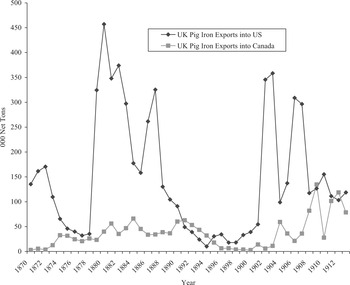
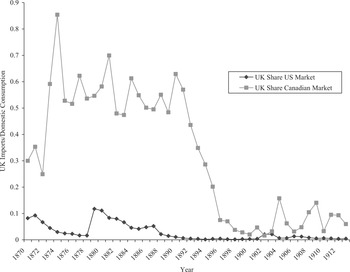
The total quantity of British pig iron exported to the United States and Canada in each year between 1870–1913 is shown in Figure 2a. Figure 2b shows the share of North American pig iron consumption supplied by these British shipments. Over the post-1870 period, British iron exports into Canada increased slightly, tonnage to the United States dropped, and Britain's share of the Canadian and American iron markets fell steeply. In 1913 Britain shipped just 118,700 tons of pig iron to the United States—a 16,000 ton decrease from the total tonnage shipped in 1870. These imports accounted for less than one-half of 1 percent of U.S. consumption. In Canada nearly 79,000 tons of British pig iron entered the market in 1913, but this represented only slightly more than 5 percent of domestic consumption, down from 30 percent in 1870 and nearly 90 percent in 1874.Footnote 10
BRITISH PIG IRON EXPORTS INTO NORTH AMERICA

Why did the trans-Atlantic trade in pig iron collapse as North American demand was expanding sharply? Plausible import demand elasticity estimates imply that any answer to this question must involve fairly dramatic movements in trade costs that include (but are not necessarily confined to) ocean freight rates, intra-continental raw material transport costs, and tariff protection.Footnote 11
BRITISH SHARE OF NORTH AMERICAN PIG IRON MARKETS

TRADE DETERMINANTS
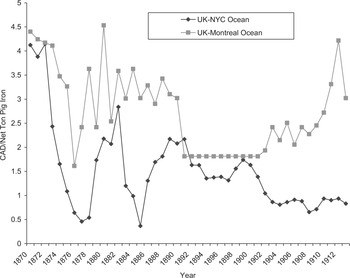
Pig iron is dirty, heavy, awkward to handle, and cheap to produce. As this implies, transport costs for pig iron, as a share of its final market price, are substantial. The ocean freight rate alone accounted for one-fifth of the price of British pig iron in Montreal in 1870. Figure 3a shows the cost to ship a 2,000 lbs net ton of pig iron from Liverpool to New York City and Montreal in each year between 1870–1913. These freight rates have been collected from a wide range of sources, and they are specific to the westbound trans-Atlantic shipment of pig iron.Footnote 12 Although there is considerable volatility from year-to-year, in general trans-Atlantic pig iron freight rates were trending sharply downwards. The Liverpool-Montreal rate peaked in 1880 at $4.53, then fell to a low of $1.81, settling at $3.02 in 1913—a 31 percent nominal decline since 1870. Liverpool to New York freight rates were lower than the Montreal rates in virtually every year. They fell from $4.13 per net ton in 1870 (16 percent of the Philadelphia price) to a minimum of $0.37 in 1895, ending our period of study at $0.83—an 80 percent decline since 1870.Footnote 13
WESTBOUND PIG IRON OCEAN FREIGHT RATES

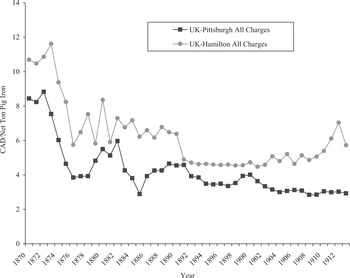
Of course, the total cost to ship pig iron from British blast furnaces to North American steel mills is not fully captured by ocean freight rates. A full accounting must include the cost to move the iron to and from port facilities, wharfage charges, brokerage fees, and insurance.Footnote 14 Accordingly, we include wharfage for the Montreal and New York ports, brokerage and insurance for the trans-Atlantic shipment of pig iron, and the cost to load and move pig iron by rail from British blast furnaces in Lancashire to British port facilities in Liverpool, and from the New York and Montreal port facilities to Pittsburgh and Hamilton.Footnote 15
WESTBOUND PIG IRON TOTAL TRANSPORT COSTS

A comparison of the ocean freight rate series depicted in Figure 3a and the total transport cost series depicted in Figure 3b illustrates the importance of overland and supplementary charges in the total cost to move pig iron. On average between 1870–1913 rail, wharfage, brokerage, and insurance costs exceeded the cost to ship pig iron port-to-port across the Atlantic by more than 27 percent on the Montreal route and by nearly 80 percent on the New York City route. In 1890, for example, it cost $4.55 per net ton to ship pig iron from British blast furnaces to Pittsburgh steel mills, of which the ocean freight accounts for only $2.08. In the same year it cost $6.39 to ship British iron to Hamilton's mills, but the trans-Atlantic part of the trip cost only $3.02. Total transport costs fell by 47 percent between 1870–1913 on the Canadian route and 65 percent on the U.S. route.
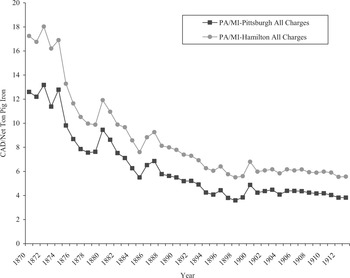
INTRA-CONTINENTAL RAW MATERIAL TOTAL TRANSPORT COSTS

Falling transport costs affected the cost of British iron in North American markets, but they also affected factory-gate raw material prices, and hence the cost to produce iron domestically. Both inter- and intra-continental transport costs influenced North American blast furnaces’ ability to compete with British imports. Throughout our period of study, North American blast furnaces used approximately 1.75 tons of iron ore and 1.25 tons of coking coal to produce one ton of pig iron.Footnote 16 These two inputs alone accounted for approximately two-thirds of the price of a ton of pig iron. With few exceptions, Canadian and U.S. blast furnaces acquired their raw materials from geographically proximate sources—iron ore came from the upper Great Lakes, including Marquette, Michigan, and coke came from Connellsville, Pennsylvania.Footnote 17 Iron ore transport costs include a fresh-water freight rate from ports on the upper Great Lakes to ports on the lower Great Lakes, insurance, brokerage fees, and rail charges for the shipment of ore from the mine head to the upper lake ports and from the lower lake ports to Hamilton and Pittsburgh. Coke transport costs include rail charges from the Connellsville kilns to Pittsburgh and, through Buffalo, to Hamilton.
Figure 3c depicts total transport costs for the assembly of 1.75 tons of ore and 1.25 tons of coking coal in Pittsburgh and Hamilton for each year between 1870–1913. Comparing Figure 3b and 3c, we can see that (per net ton of pig iron), raw material transport costs consistently exceeded trans-Atlantic transport costs, and intra-continental shipping costs were falling faster than inter-continental shipping costs.Footnote 18 In 1870 the cost to move the ore and coke required to produce one net ton of pig iron from their U.S. extraction points to Hamilton's blast furnaces, exceeded the cost to move one ton of iron from Britain to Hamilton by $6.55. This differential shrank over the next 44 years, such that by 1913 trans-Atlantic shipping costs were $0.16 higher than the intra-continental raw material transport costs faced by Canadian mills. The U.S. experience was similar, with intra-continental raw material assembly costs for the mills in Pittsburgh falling from $4.16 higher than inter-continental shipping costs in 1870, to just $0.89 higher in 1913.Footnote 19
Of course, transport costs are not the only determinant of aggregate trade costs. They may be offset (or augmented) by other costs associated with tariffs or currency exchange. In the nineteenth century it was not unusual, for example, for interested parties to petition governments for changes in tariff protection in response to perceived changes in transport costs.Footnote 20 Governments impose tariffs on output products and/or raw material inputs in an effort to alter aggregate trade costs in a politically or economically advantageous manner. In the United States, pig iron tariffs were the subject of a long and heated political battle during the years following the American Civil War.Footnote 21 This battle culminated in substantial reductions in the pig iron tariff in 1883, 1894, and 1912. In 1882 the U.S. pig iron tariff peaked at $6.25 per net ton—an ad valorem rate of nearly 25 percent—but by 1894 the tariff had dropped $3.57, and by 1913 the United States was admitting pig iron imports free of duty.Footnote 22 U.S. tariffs on raw materials were low throughout the period, with U.S. iron ore tariffs reaching a maximum of $1.17 per net ton of pig iron between 1883–1893 (approximately 9 percent ad valorem) and U.S. coal tariffs reaching a maximum of $1.40 in 1871.Footnote 23 By 1913 iron ore was entering the United States at a rate of just $0.23 per net ton of pig iron, and coal was entering at just $0.50 per net ton.
Tariff protection followed a very different trajectory in Canada. While American tariffs on pig iron moved steadily toward free trade from initially high levels, there were no Canadian tariffs on pig iron (or the raw materials used in its production) until the imposition of a $2.00 per net ton duty following Canada's adoption of a protection-based trade policy in 1879. An additional $0.50 increase in 1884 was followed by a doubling of the pig iron tariff to $5.00 in 1888, and a final increase to $6.00 in 1893, resulting in a peak ad valorem rate of just under 30 percent. By 1913 pig iron entering Canada faced a tariff rate that averaged $2.13 per ton, with a slight preference offered to British imports. Throughout the 1870–1913 period coal entered Canada duty free, and iron ore faced only a small $0.63 tariff per net ton of pig iron between 1879–1893.Footnote 24
Exchange rate fluctuations also influence trade costs.Footnote 25 For the trans-Atlantic iron trade we expect the impact of exchange rate volatility to have been small, at least relative to transport and tariff effects, because all three trade partners were strong proponents of the late nineteenth century fixed exchange rate regime. Canada and Britain maintained bilateral fixed exchange rates, tied to gold, throughout the 1870–1913 period. This resulted in very low exchange rate volatility between Canada and Britain. Although slightly more volatile than the Canada-U.K. exchange rate, aside from the immediate reconstruction period following the American Civil War when the United States was off gold, the value of the U.S. dollar was also remarkably stable.
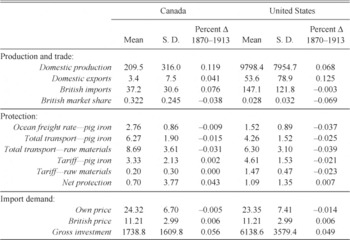
Trade costs associated with transportation, tariffs, and exchange rates are not the only factors that affect trade volumes. Because imported pig iron may have been an imperfect substitute for domestically produced pig iron, North American and British pig iron prices may have differentially affected the volume of British shipments.Footnote 26 Rising Canadian and U.S. prices provided an incentive to trade, while rising British prices suppressed trade. We also expect that price movements in the neighboring North American market may have diverted trade, with high U.S. prices suppressing shipments into Canada, and in turn, high Canadian prices suppressing shipments into the United States. From Table 1 we can see that average Summerlee No. 2 pig iron prices in Montreal were higher than No. 1 foundry pig iron prices in Philadelphia, which were considerably higher than Cleveland No. 3 pig iron prices in Britain. However, British domestic prices rose gradually after 1870, while prices in Canada slowly fell and U.S. prices declined sharply. The ratio of pig iron prices in Philadelphia relative to Britain fell from 2.5 in 1870 to just 1.2 in 1913, while the Montreal/U.K. price differential fell from 2.1 to 1.6 over the same period.
The size of North America's iron markets also influenced trans-Atlantic trade. Because most iron and steel products are purchased by firms and governments as investment goods, rather than by individuals as consumption goods, demand for pig iron is not well represented by typical measures of market size, such as population, GDP per capita, or real wages. Real gross fixed capital investment is a better measure of domestic demand for the machinery, equipment, and construction materials produced with pig iron. The summary statistics in Table 1 reveal that the United States accumulated gross fixed capital steadily through our period of study, increasing at an average annual rate of nearly 5 percent. In contrast, Canadian investment was discontinuous, growing by only 1.6 percent per year over the 1870–1895 period, before expanding in dramatic fashion (by more than 11 percent per year) during the post-1896 “wheat boom” era.
SUMMARY STATISTICS

Notes:
Quantities = 000s net tons; prices, rates, tariffs = Canadian dollars/net ton pig iron; aggregate values = 000s Canadian dollars; raw materials are measured per net ton pig iron = 1.75 net tons iron ore + 1.25 net tons coking coal; net protection = (pig iron total transport + tariff) – (raw material total transport + tariff) per net ton pig iron; percent Δ = average annual log difference.
Sources:
Detailed source and construction information provided in the online Data Appendix.
Finally, trade volumes may also have been affected by production technology. Pig iron has been the subject of much scholarly interest not only because of its importance in the process of industrial development, but also because of the discontinuous nature of the technological changes that were transforming late-nineteenth century iron and steel production. Two important technological discontinuities had the potential to influence trans-Atlantic trade volumes. First, the move away from charcoal and the adoption of coking coal dramatically altered the cost structure and optimal locations for North American blast furnaces, which in turn affected the incentive to trade iron across international borders. The proportion of coke burning furnaces in the United States began to grow well before 1870, and the transition away from charcoal was relatively smooth. In contrast, the adoption of coke as a primary fuel source in Canada was slightly delayed, but very abrupt.Footnote 27 Second, the rise to competitive dominance of fully integrated steel mills employing open hearth processes facilitated the use of molten pig iron in the production of steel. This switch to “hot-metal” affected trade incentives by introducing significant cost savings when firms integrated blast furnaces, steel furnaces and rolling mills into large, organizationally complex plants that used tightly coordinated physical and human capital.Footnote 28
If data were available from a broad panel of countries, we could assess the relative importance of these trade determinants for pig iron using a gravity model framework, including distance, GDP, and lagged trade volumes (to allow for delayed export responses) as additional explanatory variables. Unfortunately, detailed information about route and product-specific transport costs for final goods and raw materials is rare, and the standard gravity model approach is inappropriate for an analysis of a single product traded along two trans-Atlantic trade routes. The uni-directional trade of a specific product between two sets of bilateral partners can be modeled more usefully with import demand functions.Footnote 29
IMPORT DEMAND AND THE IMPACT OF TRANSPORT COSTS
Our empirical specifications borrow heavily from Clinton Shiells, Robert Stern, and Alan Deardorff's (Reference Shiells, Stern and Deardorff1986) approach, employed by Douglas Irwin (Reference Irwin2000) to estimate late nineteenth century elasticities of substitution for U.S. iron products. We focus narrowly on the relationship between British trans-Atlantic pig iron exports and transport costs, controlling for other trade costs, import demand determinants, and technological discontinuities. The models we estimate take the form:
![\[
\begin{array}
British Exports_{it}=f[Trade Costs_{it'} Import Demand Determinants_{it'}\\
Technology_{it'} Fixed Effects_i
\end{array}
\](https://static.cambridge.org/binary/version/id/urn:cambridge.org:id:binary:20160927090754657-0058:S0022050715000042:S0022050715000042_eqnU1.gif?pub-status=live)
where: British Exports = 000s net tons of pig iron
i = Canada and United States
t = 1870–1913
Trade Costs = gold standard dummyFootnote 30 ; pig iron and raw material tariffs; and pig iron and raw material transport costs
Import Demand Determinants = domestic final market price; British price; other North American price; real gross fixed investment; and lagged exportsFootnote 31
Technology = charcoal dummy; and hot-metal dummyFootnote 32
Fixed Effect = Canada dummy.
We estimate three specifications based on this general empirical framework. The first specification (Model 1) naively captures the unconditional correlation between ocean freight rates and trade volumes. The second specification includes controls for standard import demand determinants (changes in British, American, and Canadian pig iron prices; exchange rate effects; technological discontinuities; and pig iron and raw material tariffs), and we broaden our measure of transport costs by adding rail charges to-and-from port, brokerage, wharfage, and insurance to our trans-Atlantic ocean freight rates. In Model 2 we still ignore intra-continental raw material transport costs. The third specification includes all costs associated with the assembly of iron ore and coking coal in Pittsburgh and Hamilton as the final determinant of the impact of transportation on trade. The estimating equation for Model 3 takes the form:

All continuous variables are measured as natural logarithms, which imply that parameter estimates represent contemporaneous elasticities.Footnote 33 In each specification the α parameters include the constant and a fixed effect for time invariant, but nation-specific import demand determinants that are otherwise absent from the equations. The β parameters reflect the responsiveness of British trans-Atlantic pig iron exports to changes in trade costs, including transport costs, tariffs, and exchange rate effects. The γ parameters reflect the responsiveness of British exports to changes in import demand determinants, including domestic prices, British prices, prices in the neighboring North American market, gross investment, and lagged exports. The δ parameters reflect technological discontinuities associated with the switch from charcoal to coke, and the move from stand-alone blast furnaces to fully-integrated steel mills (that used molten pig iron, rather than re-heating cold iron).
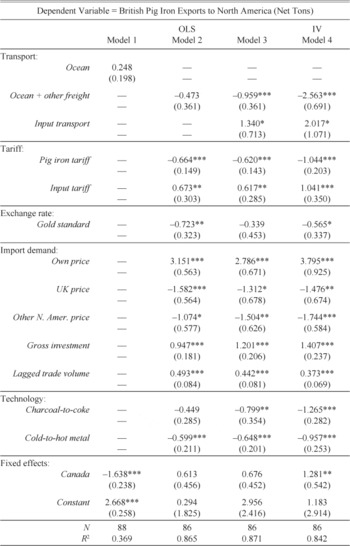
We begin by estimating all three models by ordinary least squares (OLS). Table 2 reports the results, including parameter estimates for each model, robust standard errors (corrected for serial correlation in the error terms and within and across panel heteroskedasticity), and an indicator of statistical significance. From Model 1 we can see that the unconditional correlation linking late-nineteenth and early-twentieth century trans-Atlantic freight rates to pig iron exports was small, statistically indistinguishable from zero, and positive.Footnote 34 This positive parameter estimate implies that if we choose to ignore all other influences on the transport-trade relationship, cheaper ocean freight rates after 1870 were not associated with globalization and expanding international markets, but instead they can be linked to falling trade volumes. Could this be correct, or is this most naive approach misspecified?
The estimates from Model 2 indicate that after controlling for standard import demand determinants and including all costs involved in the movement of pig iron from British blast furnaces to North American consumption points, the OLS estimate of the relationship linking transportation to trade volumes remains weak and statistically indistinguishable from zero, but the conditional correlation now has the expected negative sign. It no longer appears that lower transport costs can be linked to suppressed trade.
Model 2 also reveals that other influences on trade volumes were statistically and economically important. Both pig iron and raw material tariffs affected British iron shipments. A 1 percent increase in North American pig iron tariffs was associated with a strongly statistically significant 0.7 percent reduction in British export volumes, while a 1 percent increase in iron ore and coal tariffs triggered a 0.7 percent expansion in British shipments.Footnote 35 Productivity differences, technological choice, and input quality, insofar as these effects contributed to changes in relative output prices, were even more important determinants of trade.Footnote 36 The estimates reported in Table 2 indicate that a 1 percent increase in each destination country's own pig iron prices was associated with a 3.2 percent increase in British pig iron shipments, while a 1 percent increase in Britain's iron prices was associated with a 1.6 percent decrease in shipments, and a 1 percent increase in the neighboring country's pig iron prices lead to a 1.1 percent decrease in shipments to your own market.Footnote 37
NORTH AMERICAN IMPORT DEMAND FUNCTIONS


∗ = Significant at the 10% level.
∗ = Significant at the 5% level.
∗∗∗=Significant at the 1% level.
Notes:
Annual data for Canada and United States, 1870–1913. All continuous variables measured in natural logarithms. Robust standard errors reported in parentheses. IV estimation with GMM/fixed effects (Stata command xtivreg2). Durbin-Wu-Hausman specification test identifies the presence of endogeneity (F-stat=4.57; p-value=0.006). Weak instrument under-identification test identifies jointly insignificant excluded instruments (LM-stat=10.83; p-value=0.055). Stock-Yogo relative-bias test identifies maximum potential weak instrument bias relative to OLS bias in presence of endogeneity (F-stat=5.60; 20 percent relative bias critical value=5.56). Hansen over-identification test identifies instrument exogeneity (J-stat=1.96; p-value=0.743). Excluded instruments in Model 4: Transport = British ocean freight rate index from Harley (Reference Harley1989), domestic railroad TFP index, domestic fish price index; Tariff = electoral support for protectionist party in other North American nation, National Policy dummy (= 1 in Canada from 1879–1913); Own Price = domestic coal prices, domestic non-iron and steel manufacturing TFP. First stage estimation results and a full set diagnostic test results reported in the online Appendix Table A2.
Sources:
See discussion in text and online Data Appendix.
We can also see that increases in North American gross investment encouraged British trade,Footnote 38 trade volumes were persistent over time, and trade was suppressed by the shift from charcoal to coke and from cold-metal to hot-metal. One surprising result from Model 2 is the statistically significant negative impact that adherence to the gold standard appears to have had on trade volumes. Given that Canada was on gold throughout our period of study, and the United States was only off gold during the years immediately following the end of the American Civil War, this result may be capturing the reduction in British exports that followed from the winding down of America's reconstruction efforts. In general, based on the results from Model 2 it still appears that transport costs had an inconsequential effect on the volume of British trans-Atlantic iron shipments, at least relative to the impact of domestic and foreign prices and tariff levels.
In our third model we explicitly recognize that falling transport costs after 1870 affected prices for traded final goods and raw material assembly costs. All costs associated with the shipment pig iron, and the overland rail charges and Great Lakes shipping costs associated with moving ore from Marquette and coking coal from Connellsville are included in Model 3. Controlling for the effect of falling transport costs on final goods and raw materials reveals a considerably more robust relationship between trade and transportation. The elasticity estimates from Model 3 indicate that a 1 percent decline in the cost of shipping pig iron from Britain to North America was associated with a strongly statistically significant 0.96 percent increase in trade volumes, while a 1 percent decrease in the cost to assemble iron ore and coking coal in North American production facilities was associated with a marginally significant (p value = 0.064) 1.3 percent decrease in trade volumes. The OLS estimation of these transport cost elasticities reveals that trans-Atlantic iron shipments were almost as sensitive to transport charges as they were to domestic demand, neighboring pig iron prices, and British pig iron prices. Even the Own price elasticity estimate in Model 3 is just over twice the size of the transport cost elasticities. In this specification, British trade volumes do, in fact, appear to have been very sensitive to movements in both inter- and intra-continental transport costs. After 1870, cheaper trans-Atlantic shipping costs encouraged British iron exports, while cheaper North American raw material shipping costs suppressed British exports.
The OLS estimates reported in Table 2 for Models 2–3 indicate that final market prices, transport costs, and tariffs were strongly correlated with the quantity of British iron shipped to North America between 1870–1913. However, as described by Douglas Irwin (Reference Irwin2000), David Jacks and Krishna Pendakar (Reference Jacks and Pendakar2010), and Kris Inwood and Ian Keay (Reference Inwood and Keay2013), the OLS import demand elasticities for these determinants may be biased due to the presence of endogeneity.Footnote 39 For example, while increases in American and Canadian prices for pig iron may encourage trans-Atlantic trade, the resulting increase in British imports could shift domestic supply curves, subsequently driving down these same prices. This source of endogeneity implies a potential downward bias (closer to zero) in the OLS elasticity estimates associated with pig iron prices in the destination markets. Similarly, the OLS transport cost elasticities may be biased downward because an increase in the cost to ship pig iron may suppress trade volumes, but lower trade volumes also reduce the demand for shipping services, potentially driving down transport costs.Footnote 40 Another possibility is that rising North American tariffs could reduce British exports, but weakening British competition could induce either higher tariffs, because the policy has been so successful and therefore politically popular, or lower tariffs because the policy has succeeded in its initial protection objectives and/or failed in its revenue objectives.
To account for the potentially endogenous relationships linking trade volumes to destination market prices, transport costs, and tariffs, we re-estimate Model 3 using a fixed effects—two stage—generalized method of moments (GMM) instrumental variables approach. Excluded instruments for North American pig iron prices include domestic coal prices and domestic manufacturing productivity.Footnote 41 For trans-Atlantic transport costs, excluded instruments include Knick Harley's (Reference Harley1989) westbound coal freight rate index, a domestic railroad productivity index, and domestic fish prices.Footnote 42 The excluded instruments for North American tariff rates, including electoral support for protectionist parties in the neighboring North American nation, and a dummy variable that takes the value 1 during the period in which the Canadian Government was committed to broad nation-building policy objectives under the “National Policy,” reflect factors typically used in political economy models to explain late-nineteenth- and early-twentieth-century trade policies.Footnote 43
The IV results for Model 4 reported in Table 2 include an indication that the model has passed a Durbin-Wu-Hausman specification test confirming the presence of endogeneity among the Own price, Ocean + other freight, and Pig iron tariff variables, weak instrument F tests confirming the statistical strength of the excluded instruments,Footnote 44 and a Hansen over-identification test confirming that the excluded instruments are, in fact, exogenous. A comparison of the OLS estimates from Model 3 and the IV estimates from Model 4 reveals that, although the trade responses are slightly more elastic for raw material transport costs, raw material tariffs, domestic demand, prices in Britain, and prices in the neighboring North American market, the sign and significance of the elasticity estimates on all of the exogenous continuous variables are unaffected by the introduction of controls for endogeneity. There is, therefore, no qualitative impact on our conclusions with respect to these variables following the move to an IV approach.
The same is true for destination market prices—as expected, a small downward bias in the OLS estimates is revealed by a comparison with the IV estimates, but the sign and significance of the Own price elasticities are unaffected. Even after controlling for endogeneity, falling domestic prices in the Canadian and U.S. iron markets remain strongly and significantly correlated with falling British pig iron exports.
Because a reduction in British import competition could have encouraged either an increase or decrease in the political rewards associated with tariff protection, a priori we cannot predict the direction of any potential bias in the OLS estimates due to endogenously determined tariffs. A comparison of Model 3 and Model 4 reveals that any bias must be small, because although the IV estimates do appear more elastic (more negative) than the OLS estimates, the tariff elasticities derived from both approaches (and their standard errors) are qualitatively very similar. Falling North American tariffs on pig iron remain strongly and significantly correlated with rising British iron shipments.
In contrast to the Own price and Pig iron tariff elasticity estimates, the OLS estimates for trans-Atlantic transport costs appear to suffer from a more substantial downward bias. After using Harley's westbound coal freight rate index, a domestic railroad productivity index, and domestic fish prices as excluded instruments to control for the possibility that higher trans-Atlantic transport costs may suppress trade, while simultaneously, lower trade volumes may reduce the demand for transport services, we find that trade volumes become considerably more sensitive to changes in trans-Atlantic transport costs.Footnote 45 In Model 4 the IV pig iron and raw material transport cost elasticities are larger (more negative) and have more statistical influence than the OLS estimates, and it now appears that only destination market prices had a stronger connection to trade volumes than transport costs.Footnote 46 After controlling for endogeneity, a 1 percent decrease in the cost to move iron across the Atlantic was associated with a 2.6 percent increase in British pig iron shipments into North America, while a 1 percent decrease in the cost to assemble iron ore and coking coal in Pittsburgh and Hamilton was associated with a 2.0 percent drop in British shipments.Footnote 47
In general, both the OLS and IV elasticity estimates point to a strong connection linking the cost of moving products between distant markets to the volume of trade exchanged between these markets. However, the strength of this connection can only be fully uncovered after: measuring all contributions to transport costs (not just ocean freight rates); accounting for the potential endogeneity in the transport-trade relationship; and most importantly, recognizing that transport costs affect raw material assembly costs as well as the price of imported final goods. These results, therefore, confirm the importance of transport costs in the determination of late-nineteenth and early-twentieth century trade volumes, and they reveal the multi-dimensional nature of this relationship. This conclusion leaves us with one final question to consider: How important were these effects for the trans-Atlantic iron trade?
TRANSPORT COSTS AND THE COLLAPSE OF THE IRON TRADE
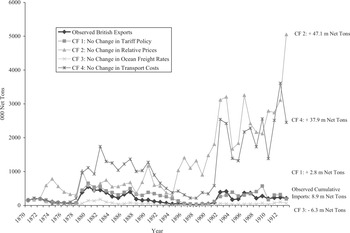
A series of simple counterfactual experiments provide some context for the econometric evidence reported in Table 2. In these experiments we use the IV elasticity estimates from Model 4 to execute iterative calculations that allow us to determine counterfactual levels of British trans-Atlantic pig iron exports in each year between 1870–1913. We consider four counterfactual scenarios: in Counterfactual 1 we ask what British export volumes would have been if there had been no changes in North American tariff policies after 1870; in Counterfactual 2 we do not allow any changes in North American prices relative to British prices after 1870; in Counterfactual 3 we do not allow westbound ocean freight rates to fall after 1870; and finally, in Counterfactual 4 we do not allow pig iron or raw material total transport costs to fall after 1870.
Britain exported 8.9 million net tons of pig iron to North America between 1870–1913. There was a 327 percent increase in shipments into Canada and a 13 percent decrease in shipments into the United States over this period, resulting in a 31 percent increase in aggregate trans-Atlantic trade. In our first counterfactual we derive British export volumes in each year holding U.S. and Canadian effective tariff rates fixed at their 1870 levels. We iterate the model forward through time using counterfactual rather than observed t–1 export quantities. The results from this experiment are depicted in Figure 4. We find that if Canadian tariff rates had not risen above their 1870 levels and U.S. tariff rates had not fallen, cumulative British exports would have totalled 11.7 million net tons, representing a 30 percent increase over observed cumulative exports. As this result suggests, the volume of trade generated by the maintenance of low pig iron tariffs in Canada would have just slightly exceeded the volume of trade suppressed by the maintenance of high pig iron tariffs in the United States.
In our second counterfactual we derive British export volumes while maintaining the log-difference between British pig iron prices and U.S. and Canadian pig iron prices at their 1870 levels.Footnote 48 British prices are allowed to evolve over our period of study as we actually observe them, but U.S. and Canadian prices are not allowed to fall relative to the British price. The results from Counterfactual 2 indicate that cumulative British pig iron exports into North America would have totalled 56.0 million net tons if British producers had not lost their relative price advantage in U.S. and Canadian markets—an increase over observed shipments of more than 47 million net tons. This estimate once again illustrates the importance of relative price movements in the determination of British exports.
COUNTERFACTUAL BRITISH PIG IRON EXPORTS INTO NORTH AMERICA

In our third and fourth counterfactual experiments we derive British export volumes holding ocean freight rates fixed at their 1870 levels (Counterfactual 3), and holding all pig iron and raw material transport costs fixed at their 1870 levels (Counterfactual 4). If westbound trans-Atlantic freight rates had not fallen during the 44 years after 1870, cumulative British pig iron exports would have dropped to just 2.6 million net tons, a decrease of more than 70 percent. Clearly, falling ocean freight rates stimulated trade. However, when we hold all transport costs, including intra-continental raw material shipping costs, constant after 1870, the counterfactual trade effects are even more dramatic, nearly matching those we derived in Counterfactual 2 when we maintained constant relative output prices. In Counterfactual 4 we do not allow inter- or intra-continental freight rates, railway charges, brokerage fees, wharfage, or insurance to vary from their 1870 levels. Under this scenario, British exports into the United States and Canada would have been more than five times higher than what we actually observe—a counterfactual increase in trans-Atlantic shipments of approximately 38 million net tons.
There is, of course, an important caveat we must keep in mind when assessing the results from these experiments. Each counterfactual varies only one determinant, while holding all else constant. For example, in Counterfactual 4 British and North American pig iron prices are not allowed to adjust to the dramatic restructuring of the trans-Atlantic iron markets implied by the results. If we were to take the predictions of this experiment at face value, we would be implicitly assuming perfectly elastic supply curves in the United States, Canada, and Britain, at each point in time throughout the 1870–1913 period. Clearly, this assumption does not reflect the economic realities of late-nineteenth- and early-twentieth-century markets. Despite this limitation, the experiment is still useful because it clearly illustrates the relative economic and historical importance of the trade effects implied by our transport cost, tariff, and output price elasticity estimates.
CONCLUSIONS
In this article we use newly compiled evidence on westbound trans-Atlantic transport costs for pig iron and intra-continental transport costs for iron ore and coking coal, to estimate elasticities derived from import demand functions. These estimates control for endogeneity in the transport, tariff and destination market price connections to trade. Our findings confirm that changes in relative output prices, tariff rates, and domestic demand were important determinants of the volume of British pig iron shipments to North America between 1870–1913. But we also find that both inter- and intra-continental transport costs had a large and strongly statistically significant effect on trade volumes. Counterfactual experiments illustrate the underappreciated impact of falling intra-continental raw material assembly costs on the late-nineteenth- and early-twentieth century collapse of British trans-Atlantic iron exports.
The significance of these findings goes beyond the trans-Atlantic iron trade. Two broadly applicable lessons are that: (i) ocean freight rates are only one of the many contributors to the total cost of transportation; and (ii) falling transport costs affect not only inter-continental final goods trade, but intra-continental raw material assembly costs, thereby potentially increasing the competitiveness of domestic producers. A broader definition of transport costs is appropriate for most, if not all traded goods, although clearly the significance of the different determinants of these costs will vary by product, partner, and time period. Similarly, transport costs for raw materials and intermediate inputs matter, but they will matter more when these inputs are costly to assemble and when transport costs are changing rapidly (or differentials are forming between markets). The late-nineteenth- and early-twentieth-century iron trade may seem to be an extreme example of these effects, but closer attention to the complexities in the transport-trade relationship may reveal other goods and periods similarly affected by coincident changes in the cost of over-land, fresh water, and salt water shipping.
If we adopt a broad perspective, our case study reveals that the significance of changing trade costs for final goods—for any reason—must be conditioned on the impact of the same phenomena on input assembly and internal trade in destination markets. Any analysis, for example, of the importance of changes in insurance markets, inventory financing, or market efficiencies will be incomplete unless it takes into account input and output markets for importing and exporting producers. Whether a less naive interpretive lens increases, as in our case study, or decreases our assessment of the importance of trade costs at a global or more aggregate level awaits further research. At a minimum, we can be sure that it is not a final good's inter-continental ocean freight rates alone that affect the incentive to trade between geographically distant markets.