Introduction
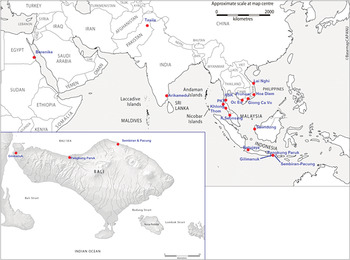
From the late first millennium BC onwards, Bali was linked via the Sunda Island-chain maritime route to South Asia, the Western Indian Ocean and, via Mainland Southeast Asia, to China. The late prehistoric/Iron Age open-air site of Pangkung Paruk is located 2km inland from the northern coast of central Bali, on a hilltop overlooking a bay in Buleleng Province (Calo et al. Reference Calo2015) (Figure 1). Excavation of the site has yielded a rich and diverse assemblage of imported burial goods, including artefacts previously undocumented at prehistoric sites in Island Southeast Asia, in association with four stone sarcophagus burials and other unenclosed, flexed inhumations. The imported artefacts include the largest known assemblage of Roman gold-glass beads from any site in early Southeast Asia. Also unique to this site are two pairs of elaborately decorated solid gold ear pendants and two Chinese bronze mirrors.
Maps of the Indian Ocean, showing sites mentioned in the text; the inset shows Bali in detail (templates by Base Map CAP, ANU, modified by A. Calo).

All of these artefacts—previously undocumented in Island Southeast Asia—find parallels in the second- to sixth-century AD moated city site of Oc Eo in the Mekong Delta of southern Vietnam, as individual finds at other sites in this region and on the Thai-Malay Peninsula. Oc Eo, a major site of the Early Khmer Funan polity (Malleret Reference Malleret1948, Reference Malleret1961, Reference Malleret1962), is situated in An Giang Province, at a strategic crossroads for early trade. Here, we examine the significance of these parallels using new data from our analyses of the Pangkung Paruk gold, glass and bronze artefacts.
Following excavations in 2009 and 2011 by the Bali Institute of Archaeology (BALAR), our team re-excavated Pangkung Paruk in 2013, as part of the lead author's Discovery Early Career Researcher Award (DECRA) project entitled ‘The Archaeology of the North Coast of Bali: a Strategic Crossroads for Early Trans-Asiatic Exchange’. This project also instigated new excavations at the sites of Sembiran and Pacung (Calo et al. Reference Calo2015), located 60km east of Pangkung Paruk, the results of which strengthen the evidence for extensive trans-Asiatic contacts with Bali from the second century BC onwards, based on a series of direct AMS dates.
Pangkung Paruk: context and dating
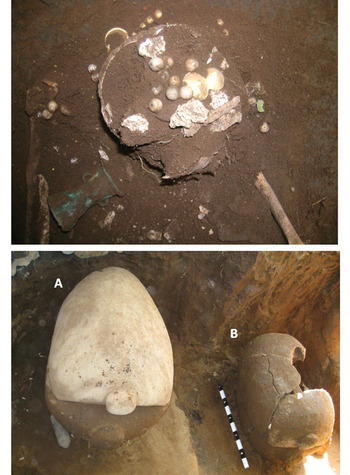
Following the discovery by the landowner in 2009 of an oval-shaped stone sarcophagus (A) with an assemblage of exotic burial goods—including a Chinese bronze mirror—BALAR undertook excavations at Pangkung Paruk. A second sarcophagus (B) containing a flexed inhumation was discovered adjacent to sarcophagus A, but 0.9m deeper. Sarcophagus B also contained a rich assemblage of burial goods, including gold, glass, gold-glass, carnelian, shell and bronze artefacts matching those in the first sarcophagus. A miniature Pejeng-type bronze drum was also found (Gede Reference Gede2009a & Reference Gedeb; Westerlaken Reference Westerlaken2011: 10). The majority of the goods in sarcophagus B were placed over and around the individual's skull (Figure 2). An unenclosed, flexed inhumation was also found next to sarcophagus B.
Top) Pangkung Paruk burial in sarcophagus B, showing detail of the skull with associated burial goods; bottom) excavation of sarcophagi A and B in 2009 (photographs courtesy of R. Westerlaken).

Later in 2009, the landowner uncovered two more sarcophagi (C and D) 5m to the east of the first two (Westerlaken Reference Westerlaken2011: 12), one containing a second Chinese bronze mirror. As the landowner removed the contents of these two sarcophagi upon discovery, sarcophagus B is the only one to have been excavated by archaeologists. The four volcanic tuff sarcophagi from Pangkung Paruk are of a type unique to Bali (in their shape and carving); to date, over 200 of these are known (Calo Reference Calo2014: 136). They are characterised by oval or rectangular containers and lids with protruding end knobs, the latter sometimes carved into animal or anthropomorphic heads. Subsequent BALAR excavations at the site (Tim Balai Arkeologi 2011, 2014) unearthed another unenclosed, flexed inhumation with associated carnelian beads. In 2013, our team excavated an occupation deposit at Pangkung Paruk at depths comparable to the levels at which all of the sarcophagi were found. The deposit yielded check-stamped earthenware pottery made using a carved wooden paddle. This pottery has close parallels with other late prehistoric/Iron Age sites in Bali, such as Sembiran, Pacung and Gilimanuk (Calo et al. Reference Calo2015: 385–86; Bellwood Reference Bellwood2017: 325, fig. 9.8a). Two AMS radiocarbon assays on charcoal associated with the pottery within the Pangkung Paruk deposit provide dates of cal AD 122–240 (S-ANU 37111) and cal AD 128–331 (S-ANU 37112), suggesting a second- to fourth-century AD occupation at the site. These dates are calibrated at 95.4% probability in OxCal v.4.2 (Bronk Ramsey Reference Bronk Ramsey2009), using the SHCal13 dataset (Hogg et al. Reference Hogg2013).
Roman gold-glass beads
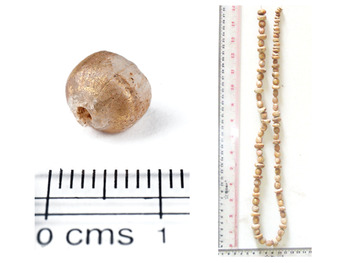
Collectively, the Pangkung Paruk burials have yielded 43 gold-glass beads, which we have documented compositionally to be of Roman-era Egyptian production (Figure 3) (Calo et al. Reference Calo2015: 389). This represents the largest collection of such gold-glass beads from any prehistoric context in Southeast Asia. Nineteen similar gold-glass beads were also excavated at Oc Eo, a major southern Vietnamese centre of trade, as well as gold and glass production (Malleret Reference Malleret1962: 267–68, pl. LV, nos 4107 & 4398; Bennett Reference Bennett2009). Gold-glass beads are characterised by a thin layer of gold foil inserted between two layers of transparent glass (Basa Reference Basa and Glover1992). They are typically found at Western Indian Ocean sites, such as Berenike on the Red Sea, in Nubia and the Persian Gulf (Obluska Reference Obluska2015: 751).
Pangkung Paruk Roman gold-glass beads: left) detail (photograph by A. Calo); right) cluster, inter-spaced with shell beads (photograph courtesy of R. Westerlaken).

In South Asia, soda-natron gold-glass beads occur in early first-millennium AD contexts at Mahasthan in Bangladesh, Arikamedu in Tamil Nadu and Junnar in Maharashtra (Dussubieux Reference Dussubieux2001; Gratuze et al. Reference Gratuze, Lankton, Alam, Boussac and Salles2015). In Southeast Asia (apart from at Pangkung Paruk and Oc Eo), natron beads are known from the coastal sites of Khlong Thom, Kuraburi, Phu Khao Thong and Tha Chana on the Thai Peninsula, and at Kuala Selinsing, located farther to the south on the Malay Peninsula (Francis Reference Francis1991; Basa Reference Basa and Glover1992; Lankton et al. Reference Lankton, Dussubieux and Gratuze2008). All of the analysed gold-glass beads from these sites are natron glass, as attested by the presence of the trace elements yttrium, cerium and zirconium. They date from the first to sixth centuries AD (Gratuze Reference Gratuze, Foy, Labaune-Jean, Leblond, Martin Pruvot, Marty, Massart, Munier, Robin and Roussel-Ode2018), based on their location in dated contexts and compositional analysis. The latter also demonstrates that half of the gold-glass beads were made in Egypt and half in the coastal Levant.
Gold-glass beads formed an important part of the Roman glass trade described in the mid first-century AD Periplus of the Erythraean Sea—a merchants’ guide to trading between the Red Sea, India and Africa (Casson Reference Casson1989). According to this source, Roman glass artefacts and other Roman goods were taken to south-east Indian ports and onwards to the Ganges Delta. From there, they were sent farther eastwards to trading zones located along the Thai-Malay Peninsula (Lankton et al. Reference Lankton, Dussubieux and Gratuze2008; Dussubieux & Bellina Reference Dussubieux, Bellina and Bellina2017; Lankton & Gratuze Reference Lankton, Gratuze and Pongpanich2019). Our excavation at Sembiran recovered one red, opaque Roman soda-natron bead from a first-century BC/first-century AD context (Calo et al. Reference Calo2015: 381 & 389). Identical beads have also been found at Oc Eo and the Hoa Diem jar burial site in southern Vietnam.
The flow of goods across Island and Mainland Southeast Asia also continued into East Asia. Gold-glass beads compositionally identical to those from Pangkung Paruk, for example, comprise a large percentage of the Roman glass found in first- to fourth-century AD contexts in Korea and Japan. The production of gold-glass beads has also been documented at the site of Bara in Pakistan (second century BC to second century AD), although these beads are made of soda glass with the addition of plant ash, rather than natron (Dussubieux & Gratuze Reference Dussubieux, Gratuze, Bopearachchi, Landes and Sachs2003). The composition of the Pangkung Paruk soda-natron gold-glass beads, therefore, matches most closely those from Egypt, Nubia, the Red Sea, the Persian Gulf, south-east India, Sri Lanka, the Thai-Malay Peninsula, the Mekong Delta, Korea and Japan.
Glass analysis: Roman, Indian and Southeast Asian origins
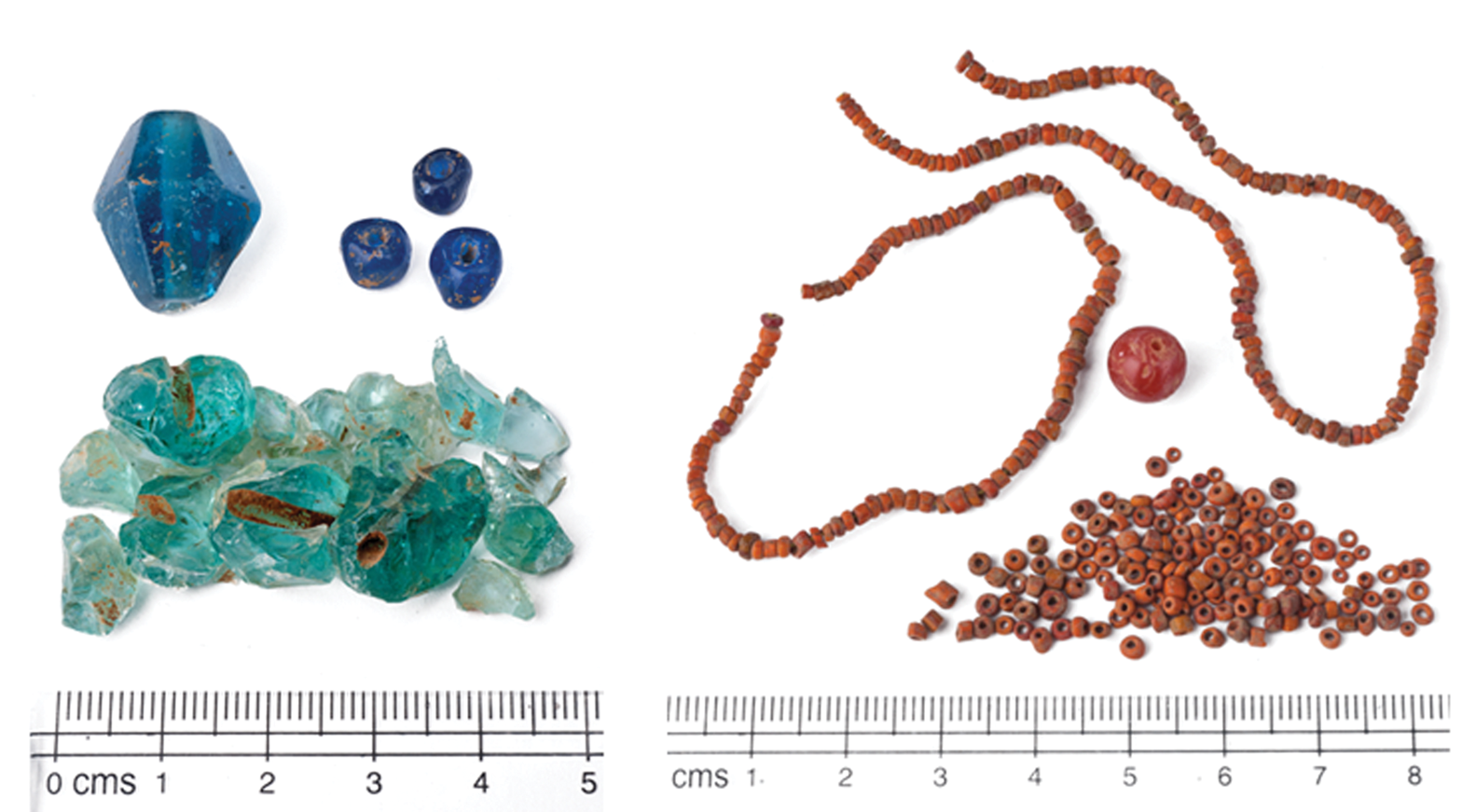
Two Pangkung Paruk gold-glass beads were analysed, along with seven other glass beads from the 2011 excavations. These latter include three opaque, orange, short-cylinder-shaped beads from a total of 350 similar beads, one cobalt-blue drawn bead and three aqua beads cut into sections (Figure 4). The nine beads in total were analysed by James Lankton and Bernard Gratuze using laser ablation inductively coupled plasma mass spectrometry (LA-ICP-MS). The results were compared against a large database of prehistoric glass found in Asia (Lankton & Dussubieux Reference Lankton and Dussubieux2006, Reference Lankton, Dussubieux and Janssens2012; Lankton et al. Reference Lankton, Dussubieux and Gratuze2008) to help identify possible provenance.
Pangkung Paruk glass beads (photographs by A. Calo).

The two Pangkung Paruk gold-glass beads have a typical Roman composition. They were made by melting sand together with natron—a mixture of efflorescent salts from Wadi Natrun in Egypt that was used as a fluxing agent to reduce the melting temperature of the glass. The precise composition of natron glass changed over time, depending on the sources of sand used; colourants and decolourising agents also changed (Freestone et al. Reference Freestone, Degryse, Lankton, Gratuze, Schneider, Rosenow, Phelps, Meek and Freestone2018). Comparing our samples to these known variations in the chemical composition of glass allows us to specify that the Pangkung Paruk beads were produced in Egypt between the first and the fourth centuries AD.
The three sectioned aqua lapidary beads are also made from soda glass, with a composition similar to Roman glass, but with a much higher uranium content. This suggests that they were produced in South or Southeast Asia. This particular composition was used in Sri Lanka from the first to second centuries AD onwards to make blown-glass models of miniature stupas. The cobalt-blue beads are made of potash glass with equal parts lime and aluminium oxide, and are probably of Indian origin, as are the similar beads from Hoa Diem in Vietnam. The three opaque orange beads are soda glass with a high lime and aluminium oxide content, along with magnesium oxide greater than 2 per cent, indicating the addition of plant ash. Such a composition appears to be relatively rare in India but common in Southeast Asia. These plant-ash-based orange beads are very similar in composition to short-cylinder, high-aluminium oxide soda glass beads from Oc Eo, analysed by Dussubieux (Reference Dussubieux2001). Remarkably, therefore, the Pangkung Paruk assemblage contains Roman Egyptian, South Asian and Southeast Asian glass beads.
Gold ornaments
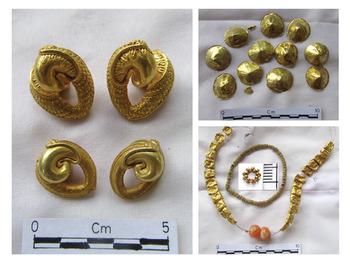
The gold ornaments recovered from Pangkung Paruk in 2009 comprise 20 conical eye covers, two pairs of elaborately decorated, solid gold ear pendants with filigree and fine wire decoration, 151 small discs with granulation and 26 hollow cuboid, gold-foil beads made of two halves soldered together—a technique also known from late first-millennium BC Saka sites in Central Asia (Figure 5; Popescu et al. Reference Popescu, Antonini and Baipakov1998: 143, fig. 147).
Pangkung Paruk gold ornaments (photographs by A. Calo).

Parallels with the Pangkung Paruk conical eye covers are known from Gilimanuk and Pangkungliplip in Bali (Soejono Reference Soejono1977: 63 & 319; Anggraeni 1999). Mask-like gold-foil burial covers are known from the sarcophagus site of Marga Tenggah in Bali, from Karang Agung in south-eastern Sumatra, and, in Java, from Plawangan, Lamongan, Pasir Angin and Batujaya (Bintarti Reference Bintarti1985; Prasetyo Reference Prasetyo1994–1995; Manguin Reference Manguin, Glover and Bellwood2004; Soejono Reference Soejono1977; Manguin & Indradjaya Reference Manguin, Indradjaya, Manguin, Mani and Wade2011). Batujaya, in north-western Java, also produced gold beads with granulation and gold-foil cuboid beads similar to those from Pangkung Paruk (Manguin & Indradjaya Reference Manguin, Indradjaya, Manguin, Mani and Wade2011).
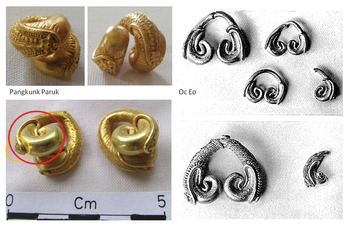
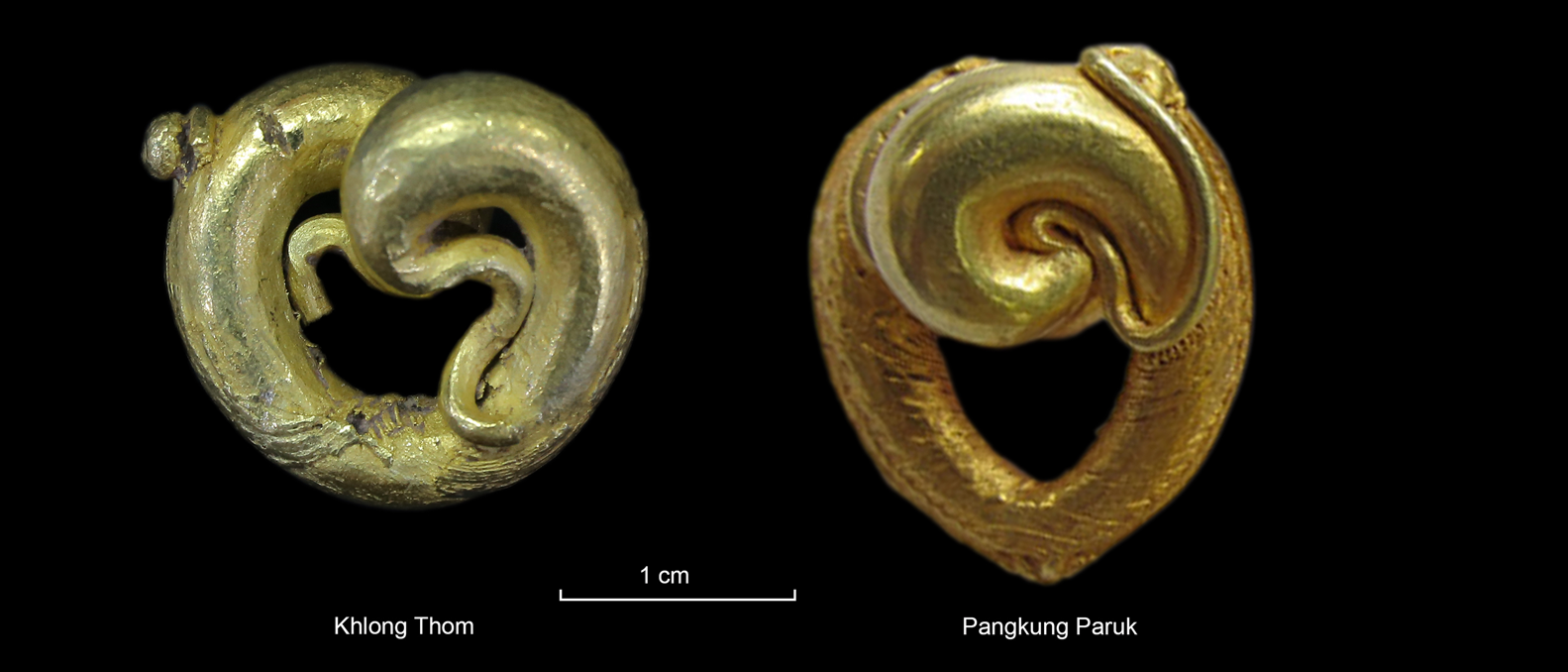
The sophisticated technology and decoration exhibited by the two pairs of gold ear pendants from Pangkung Paruk are unusual for late prehistoric Indonesian sites. Parallels are found in seven examples from an early Hindu context at Oc Eo (Figure 6; Malleret Reference Malleret1962: 73–74, nos 802–805; pl. XIV: 3162 & 3700), and from looted contexts at Khlong Thom in Peninsular Thailand, together with discs with granulation similar to the Pangkung Paruk examples (Figure 7; Reinecke Reference Reinecke, Barnes, Stein and Diebold2015: 132). At Oc Eo, gold working is documented by the presence of bivalve stone casting moulds for gold jewellery, workshop tools and unfinished plaques (Malleret Reference Malleret1948: 275, pl. I; Bennett Reference Bennett2009; Demandt Reference Demandt2016). Khlong Thom has also produced evidence of local gold working to manufacture Roman-style medallions (Borell et al. Reference Borell, Bellina, Chaisuwan, Revire and Murphy2014: 108–109, figs. 15, 11a & b, 12a & b). Four ear pendants similar to the Pangkung Paruk examples, and reportedly found in Java, are housed in Dutch museum collections (Malleret Reference Malleret1962: 27, fig. 5; Miksic Reference Miksic1991).
Pangkung Paruk and Oc Eo gold ear pendants (left: photograph by A. Calo; the circles highlight the similarity of the decorative schemes; right: from Malleret Reference Malleret1962: 73–74).

Gold ear pendants from Khlong Thom (left: photograph by A. Reinecke) and Pangkung Paruk (right: photograph by A. Calo).

The gold finds from Oc Eo also included polyhedral beads, which are notable for their shapes, including exact dodecahedra, the geometry of which was first studied by Greek Pythagoreans in the fifth century BC (Saint-Michel Reference Saint-Michel1951); dodecahedral bronze artefacts are also known from the Roman world (Malleret Reference Malleret1961: 345–46: figs 1–3; 1962: pl. XII). Polyhedral beads have also been found at Hoa Diem in Vietnam, at Khao Sam Kaeo, Phu Khao Thong and Tha Chana in Peninsular Thailand, at Srikestra and Beinnaka in Myanmar, at Air Sugihan in Sumatra and at Batujaya in Java (Pryce et al. Reference Pryce, Bellina-Pryce and Bennett2008, Reference Pryce, Murillo-Barroso, Biggs, Martinon-Torres, Bellina and Bellina2017: 507, fig. 5; Bennett Reference Bennett2009; Indradjaya Reference Indradjaya, Tjoa-Bonatz, Reinecke and Bonatz2011; Manguin & Indradjaya Reference Manguin, Indradjaya, Manguin, Mani and Wade2011; Nguyen Reference Nguyen, Piper, Matsumura and Bulbeck2017: 326–27). Han burials in southern China have also yielded such beads (Demandt Reference Demandt2016: 313). Many of these polyhedral beads show decorative similarities with specimens recovered from Bactria and Ghandara in Central Asia (Pryce et al. Reference Pryce, Bellina-Pryce and Bennett2008; Reinecke et al. Reference Reinecke, Leusch and Dung2014; Demandt Reference Demandt2016: 313).
Analysis of gold artefacts
Compositional analyses of three Pangkung Paruk gold artefacts from sarcophagus B, comprising one conical eye cover, one disc with granulation and one cuboid gold-foil bead, were undertaken using LA-ICP-MS in the Curt-Engelhorn-Centre for Archaeometry (CEZA) in Mannheim, Germany, as part of a large-scale comparative study of prehistoric Southeast Asian gold. The palladium/platinum (Pd/Pt) ratio vs silver (Ag) ratio of the Pangkung Paruk samples, and of our project's other gold samples from Sembiran and Pacung, were compared with those of over 200 samples from late prehistoric/Iron Age sites in Cambodia, Vietnam and Thailand (Schlosser et al. Reference Schlosser, Reinecke, Schwab, Pernicka, Seng and Vin2012; Calo et al. Reference Calo2015: 391–93).
The results from all 14 Bali gold samples (four Pangkung Paruk samples from three objects, seven samples from seven Sembiran objects and three samples from three Pacung objects) indicate the use of alluvial gold, as is the case for the aforementioned >200 tested samples from Mainland Southeast Asia. Most Bali samples form a distinct group that differs from the Mainland Southeast Asia ‘Prohear group’ of gold artefacts found at Prohear in south-eastern Cambodia, Giong Lon in southern Vietnam and Lai Nghi in central Vietnam, and dating from the first century BC to second century AD. The Pd/Pt ratios of eight Bali gold ornaments (four samples from three Pangkung Paruk objects, three samples from three Sembiran and two samples from two Pacung samples) show strong correlations with the ratios measured from Giong Ca Vo in the eastern Mekong Delta, and from Khlong Thom in western Peninsular Thailand. Together, they form a ‘Thai Peninsula/Mekong Delta/Bali’ group (Figure 8) of gold ornaments that clearly differs in composition from the Prohear group. We cannot yet identify the source of the gold in this group, but it is unlikely to be from Mainland Southeast Asia. Five of the analysed gold artefacts (one from Pacung and four from Sembiran) differ in Pd/Pt content from both the Thai Peninsula/Mekong Delta/Bali group and the Prohear group (Figure 8); the broad spread of their Pd/Pt values suggests gold sources outside of Southeast Asia—perhaps in South Asia.
Palladium/platinum (Pd/Pt) vs silver (Ag) ratios of gold samples forming regional groups (graph by A. Reinecke).

A possible route for gold artefacts from the northern Indian subcontinent to Southeast Asia across the Bay of Bengal can be suggested based on stylistic parallels from early first-millennium AD contexts at Sirkap (Taxila) in Pakistan, Oc Eo and Khao Sam Kaeo (Malleret Reference Malleret1962: 29; Pryce et al. Reference Pryce, Bellina-Pryce and Bennett2008). Furthermore, in Java, a Batujaya gold bracelet with a flat band and coiled wire knots from a second-century BC to second-century AD burial context closely resembles the Sirkap gold and copper bracelets (Marshall Reference Marshall1975: 23–25, pls 171e & 195b; Manguin & Indradjaya Reference Manguin, Indradjaya, Manguin, Mani and Wade2011: 122–23, fig. 5.9).
Chinese bronze mirrors and other bronzes
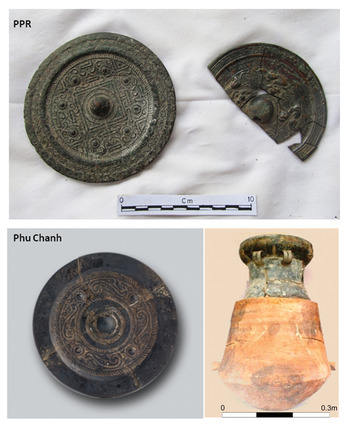
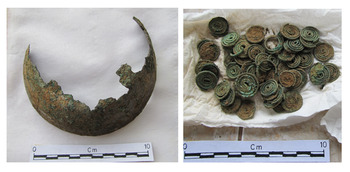
The two Pangkung Paruk Chinese bronze mirrors (Figure 9) can be dated stylistically from the Late Western Han to the Eastern Han dynasties (c. 10 BC–AD 220), and from the Late Eastern Han to the Wei and Jin dynasties (c. AD 150–400) (Yang Yong pers. comm.), respectively. These are the first Chinese bronze mirrors to be found at a prehistoric site in Island Southeast Asia. Lead isotope analysis of one mirror from either sarcophagus C or D was undertaken using Multi-Conductor-ICP-MS at the CEZA Laboratory in Mannheim. Pryce et al. (Reference Pryce, Calo, Prasetyo, Bellwood and O'Connor2018) also analysed a Pangkung Paruk bronze bowl from the same context as the mirror (sarcophagus C or D), and spiral bronze ornaments from sarcophagus B, as part of a group of 27 copper-alloy samples from our project. The bronze bowl (Figure 10) is unleaded, with a high-tin content, suggesting Indian or Southeast Asian production using South Asian techniques. Similar examples are known from Bengal and Peninsular Thailand (Pryce et al. Reference Pryce, Calo, Prasetyo, Bellwood and O'Connor2018: 1282).
Top) Pangkung Paruk Chinese bronze mirrors (photograph by A. Calo); bottom left) Phu Chanh bronze mirror (diameter approximately 0.1m. Photograph by Andreas Reinecke); bottom right) Phu Chan burial (bronze drum height: 0.4m, tympanum diameter: 0.48m; Bui Reference Bui2008: 70, fig. 10).

Left) Pangkung Paruk bronze bowl; right) Pangkung Paruk bronze spiral ornaments (photographs by A. Calo).

The Pangkung Paruk Han dynasty mirror is made of leaded, high-tin bronze and is compositionally consistent with Han mirrors found in China. Its lead isotope signature, however, indicates the use of highly radiogenic lead, which differs from other analysed mirrors from Khao Sam Kaeo and Vietnamese sites (Pryce et al. Reference Pryce, Bellina-Pryce and Bennett2008, Reference Pryce, Murillo-Barroso, Biggs, Martinon-Torres, Bellina and Bellina2017: 519–33, 2018: 13). In Vietnam, Han mirrors have been found at Oc Eo (Malleret Reference Malleret1962: pl. XCII, no. 461), and at Phu Chanh in Binh Duong Province, where the mirror was found inside a wooden burial jar covered by a Dong Son drum (Bui Reference Bui2008). Such mirrors have also been found at the Sa Huynh Culture jar-burial sites of Binh Yen, Go Dua, Lai Nghi and An Bang, all in Quang Nam Province of central Vietnam (Yamagata et al. Reference Yamagata, Manh and Bui2001; Yamagata Reference Yamagata, Bacus, Glover and Piggott2006; Lam Reference Lam2009; Reinecke Reference Reinecke and Tingley2009; Nguyen Reference Nguyen, Piper, Matsumura and Bulbeck2017). The Phu Chanh burial with associated Han mirror also contained a gold-silver eye mask with parallels in Indonesia and Bactria (Reinecke Reference Reinecke2016: 443–45, 447–48, 453–54).
The spiral bronze ornaments (Figure 10) from Pangkung Paruk are leaded and are stylistically typical of Balinese sites. As with most of the previously analysed examples from Sembiran and Pacung, their lead isotope signatures—including that of a Pejeng-type bronze drum from Manikliyu in central Bali—are similar to those of analysed Dong Son bronzes from central Vietnam. The copper for these latter bronzes was probably sourced from Sepon in Laos, “given the similar signatures for Mainland leaded artefacts and central Lao copper production at Sepon” (Pryce et al. Reference Pryce, Calo, Prasetyo, Bellwood and O'Connor2018: 1281 & 1286). This suggests the melting of imported ingots or artefact scrap in Bali for local recasting, particularly when considering the evidence for stone casting moulds from Sembiran and Manuaba (Ardika & Bellwood Reference Ardika and Bellwood1991; Calo Reference Calo2014: 128–33; Calo et al. Reference Calo2015: 390–91, fig. 11).
The role of the Sambas region for contact between south Vietnam and Indonesia
The Sambas region of north-west Borneo, located between southern Vietnam and Bali on a north–south axis, has yet to be subjected to systematic archaeological investigation. Given the location of the Sambas region and evidence for early contacts with Vietnam, hypothetically, this region may have allowed for a north–south route between the Mekong Delta in southern Vietnam and Bali/Java. Indeed, the Mekong Delta may have constituted a major port of call for contact with Indonesia, together with the Thai-Malay Peninsula.
The Sambas region has extensive alluvial gold deposits and is linked by the navigable Karimata island chain to the Musi River estuary of south-eastern Sumatra, another major source of alluvial gold. The ‘Sambas Hoard’ of Srivijayan gold and silver Buddhist statues found in Sambas, which date stylistically to around the ninth to eleventh centuries AD and are now housed in the British Museum, supports such links. Early contact with Vietnam is suggested by the discovery of two Dong Son bronze drums along with burial goods at Bukit Selindung (Edwards McKinnon Reference Edwards McKinnon1994). The top drum was placed as the lid of the lower upturned drum. The artefacts reported to be enclosed within include 164 carnelian, 19 agate and 423 glass beads; eight triangular-sectioned glass bracelets; nine circular-sectioned bronze bracelets and one bronze bowl; a gold ‘box-like’ bead, which may have been similar to the Pangkung Paruk cuboid beads; 43 spherical gold beads; and two coiled gold wire objects, which may have been similar to the gold spiral ornaments from Prohear (Reinecke et al. Reference Reinecke, Laychour and Sonetra2009). The Selindung drum burial resembles the Phu Chanh burial, comprising a wooden container covered by a Dong Son drum (Figure 9). Another double drum burial is known from Lamongan in east Java (Bintarti Reference Bintarti1985), which comprised a Dong Son and a Pejeng-type drum enclosing a child inhumation, accompanied by gold-foil face covers, gold and carnelian beads and bronze ornaments.
Conclusions
Pangkung Paruk has produced the largest collection of Roman soda-natron gold-glass beads in early Southeast Asia, thereby adding significant new information to our knowledge concerning the widespread early first-millennium AD distribution of such beads across Africa and Asia from Egypt to Japan. Our compositional analysis indicates that the Pangkung Paruk gold-glass beads were produced in Egypt during the first to fourth centuries AD. They match Roman glass excavated on the southern Indian subcontinent and along the Thai-Malay Peninsula, confirming a southern maritime route from the Western Indian Ocean to Southeast Asia. Analysis of the other Pangkung Paruk glass beads further documents contacts with southern Mainland Southeast Asia and the southern Indian subcontinent.
Geological sources for gold are difficult to identify due to possible multiple melting and recasting events and to gaps in our geological knowledge. Our comparative compositional study of gold excavated across Southeast Asia, however, is providing critical data to support or disprove stylistic and technological analyses concerning the origins of imported gold. The lead isotope signatures of the Balinese leaded bronzes, with the exception of the Pangkung Paruk Chinese mirror, are compatible with signatures from central Vietnam and Laos, and may be traced to the Sepon copper source in Laos.
The combined data from Pangkung Paruk, Sembiran and Pacung reinforce the continuity of the strategic role of northern Bali in trans-Asiatic exchange from the second century BC at Sembiran and Pacung, and extending onwards into the early and mid first millennium AD. These data enrich our understanding of the early maritime networks that linked Southeast Asia to South Asia, the Roman world and China. In particular, the parallels for the Pangkung Paruk imported artefacts at Oc Eo and other sites in the Mekong Delta and on the Thai-Malay Peninsula underline the significance of contacts between these major crossroad regions. We suggest that Bali and southern Vietnam may have also been connected along a north–south route passing through north-western Borneo, as well as via the better understood route from the Thai-Malay Peninsula to Indonesia.
Acknowledgements
This research was funded by the Australian Research Council through the Australian National University as A. Calo's DECRA excavations project (#DE120100069) entitled ‘The Archaeology of the North Coast of Bali: a Strategic Crossroads for Early Trans-Asiatic Exchange’ (2012–2015). For the laboratory analyses discussed here, we thank Bernard Gratuze for the glass analyses conducted at the Institut de Recherche sur les Archéomatériaux, Centre National de la Recherche Scientifique in Orleans, France, and the Curt Engelhorn Centre for Archaeometry in Mannheim for analysing the gold and bronze artefacts.