Introduction
The rapidly changing reality of older workers is a direct consequence of population ageing, political concern about the long-term viability of existing pension schemes and the widespread adoption of policies aimed at extending the duration of working lives (Blossfeld et al., Reference Blossfeld, Buchholz and Hofäcker2006; Hofäcker et al., Reference Hofäcker, Hess and König2016; Ní Léime and Ogg, Reference Ní Léime and Ogg2019; Wainwright et al., Reference Wainwright, Crawford, Loretto, Phillipson, Robinson, Shepherd, Vickerstaff and Weyman2019; Ní Léime et al., Reference Ní Léime, Ogg, Rasticova, Street, Krekula, Bédiová and Madero-Cabib2020). These changes have led scholars to question the standard (male-oriented) conception of retirement as a one-off transition, and to suggest that it may be more fruitful to consider the diverse pathways that unfold in the years leading up to – and potentially beyond – the age at which people qualify for a full basic pension (i.e. reach full pension age, ‘FPA’ hereafter) (Duberley and Carmichael, Reference Duberley and Carmichael2016; Worts et al., Reference Worts, Corna, Sacker, McMunn and McDonough2016; Stafford et al., Reference Stafford, Cooper, Cadar, Carr, Murray, Richards, Stansfeld, Zaninotto, Head and Kuh2017; Van Der Horst et al., Reference Van Der Horst, Lain, Vickerstaff, Clark and Baumberg Geiger2017; Wahrendorf et al., Reference Wahrendorf, Zaninotto, Hoven, Head and Carr2017; Axelrad and Mcnamara, Reference Axelrad and Mcnamara2018; Calvo et al., Reference Calvo, Madero-Cabib and Staudinger2018; Madero-Cabib et al., Reference Madero-Cabib, Corna and Baumann2020). By focusing on retirement pathways rather than simply studying the timing of the transition into retirement, we are able to identify the diverse routes to retirement that are available to people in later life. This allows a more dynamic analysis of this strategic phase of the lifecourse and opens up novel areas of scientific inquiry.
It is already widely recognised that the timing and patterns of transitions to retirement vary across national or welfare state contexts. As recent research has indicated, macro-institutional factors, such as the generosity and replacement ratio of pension schemes (Oesch, Reference Oesch2008; Hess et al., Reference Hess, König, Hofäcker, Hofäcker, Hess and König2016; Hofäcker et al., Reference Hofäcker, Hess and König2016), child-care and elder-care policies and provisions (Le Feuvre et al., Reference Le Feuvre, Kuehni, Rosende and Schoeni2014), life-long training policies (Wainwright et al., Reference Wainwright, Crawford, Loretto, Phillipson, Robinson, Shepherd, Vickerstaff and Weyman2019), and the adoption and effective implementation of anti-age discrimination measures (Burnay, Reference Burnay2004), shape the employment rates and retirement timing of older workers.
The influence of individual- (or micro-) level characteristics, such as health, education and partnership status, on retirement practices is also well-documented (Radl, Reference Radl2013; Steiber and Kohli, Reference Steiber and Kohli2017). Previous research has consistently found that poor health and lower educational levels are related to earlier transitions to retirement, often involving a period of disability or unemployment (Halleröd et al., Reference Halleröd, Örestig and Stattin2012; Radl, Reference Radl2013; Wahrendorf et al., Reference Wahrendorf, Dragano and Siegrist2013, Reference Wahrendorf, Zaninotto, Hoven, Head and Carr2017; Visser et al., Reference Visser, Gesthuizen, Kraaykamp and Wolbers2016). Likewise, several studies also found that the absence of a partner (i.e. being single, divorced or widowed) is associated with later retirement (Schils, Reference Schils2008; Radl, Reference Radl2013; Madero-Cabib et al., Reference Madero-Cabib, Gauthier and Le Goff2016).
Finally, gender has been identified as a major source of inequality in the retirement experience, although more so in some national contexts than in others (Oesch, Reference Oesch2008; Madero-Cabib and Fasang, Reference Madero-Cabib and Fasang2016; Ní Léime et al., Reference Ní Léime, Street, Vickerstaff, Krekula and Loretto2017). For example, retirement timing, pension income and pension replacement rates have been shown to vary considerably for men and women in England (Van der Horst et al., Reference Van Der Horst, Lain, Vickerstaff, Clark and Baumberg Geiger2017) and in the United Kingdom (UK) (Tosi and Grundy, Reference Tosi and Grundy2021), notably due to stark gender differences in employment trajectories before retirement. Nevertheless, ‘gender’ remains a complex notion to wield in cross-national comparisons, since it is often considered to be an individual-level characteristic (Hess et al., Reference Hess, König, Hofäcker, Hofäcker, Hess and König2016; Riekhoff and Järnefelt, Reference Riekhoff and Järnefelt2017), thus making it difficult to capture variations in the institutional gendering of retirement pathways across societal contexts or welfare regimes (Melesk, Reference Melesk2021).
So, while there is a consensus about the combined importance of institutional and individual factors for shaping labour force participation patterns in later life (Mandel, Reference Mandel2010; Hegewisch and Gornick, Reference Hegewisch and Gornick2011; Korpi et al., Reference Korpi, Ferrarini and Englund2013; Hofäcker, Reference Hofäcker2015; Ferragina, Reference Ferragina2017), cross-national studies of retirement rarely include both levels of analysis. To our knowledge, few studies to date have compared the influence of individual-level characteristics on retirement pathways across countries, welfare systems or lifecourse regimes. One exception to this rule is provided by Axelrad and Mcnamara (Reference Axelrad and Mcnamara2018), who compared the transitions of older men and women between different labour force statuses across two points in time, in a range of countries. This study emphasised the importance of adopting a gendered focus to explore the retirement process cross-nationally. In this study, we close these research gaps by mapping the long-term retirement pathways of men and women in 11 different countries, and by analysing their individual-level and macro-institutional determinants. The adoption of sequence analysis methods enables us to identify the full range of possible gendered retirement patterns across countries. Our main contribution lies in the ability to determine to what extent men and women follow similar or specific retirement pathways in different institutional contexts, and to measure the sensitivity of these pathways to individual-level determinants.
Concretely, our study addresses the following research questions:
(1) To what extent do retirement pathways vary by gender?
(2) To what extent does the gendered distribution of retirement pathways vary according to macro-institutional contexts, such as the predominant lifecourse regime?
(3) To what extent do individual characteristics (e.g. education levels, partnership status, health) influence the gender distribution of retirement pathways?
(4) To what extent does the influence of individual characteristics (e.g. education levels) on the gender distribution of retirement pathways vary across lifecourse regimes?
To address these questions, we examine the retirement pathways of 1,594 women and 1,105 men from 11 different countries, surveyed during the 12-year period surrounding the FPA, between 2004 and 2016. For this purpose, we use harmonised data from three surveys: the Health and Retirement Study (HRS), the English Longitudinal Study of Ageing (ELSA) and the Survey of Health, Ageing and Retirement in Europe (SHARE).
Analytical framework
Our study seeks to map the retirement pathways of the current generation of retirees in order to better understand the potentially diverse (gendered) implications of pension reforms and extending working life (EWL) policies in comparative perspective (Organisation for Economic Co-operation and Development (OECD), 2017, 2018; Silcock, Reference Silcock2012; Ní Léime et al., Reference Ní Léime, Ogg, Rasticova, Street, Krekula, Bédiová and Madero-Cabib2020). We are eager to explore the idea that those men and women who are currently leaving the labour market before reaching FPAFootnote 1 may represent a small or significant share of the older population, and may also have very different socio-demographic profiles and employment histories in different societal contexts. In short, we want to grasp the institutional and socio-demographic conditions under which some older people have effectively started to extend the duration of their working lives, but we also want to establish whether or not these are necessarily the same, for men and for women, across and within all societal contexts.
Retirement pathways in a context of extending working lives
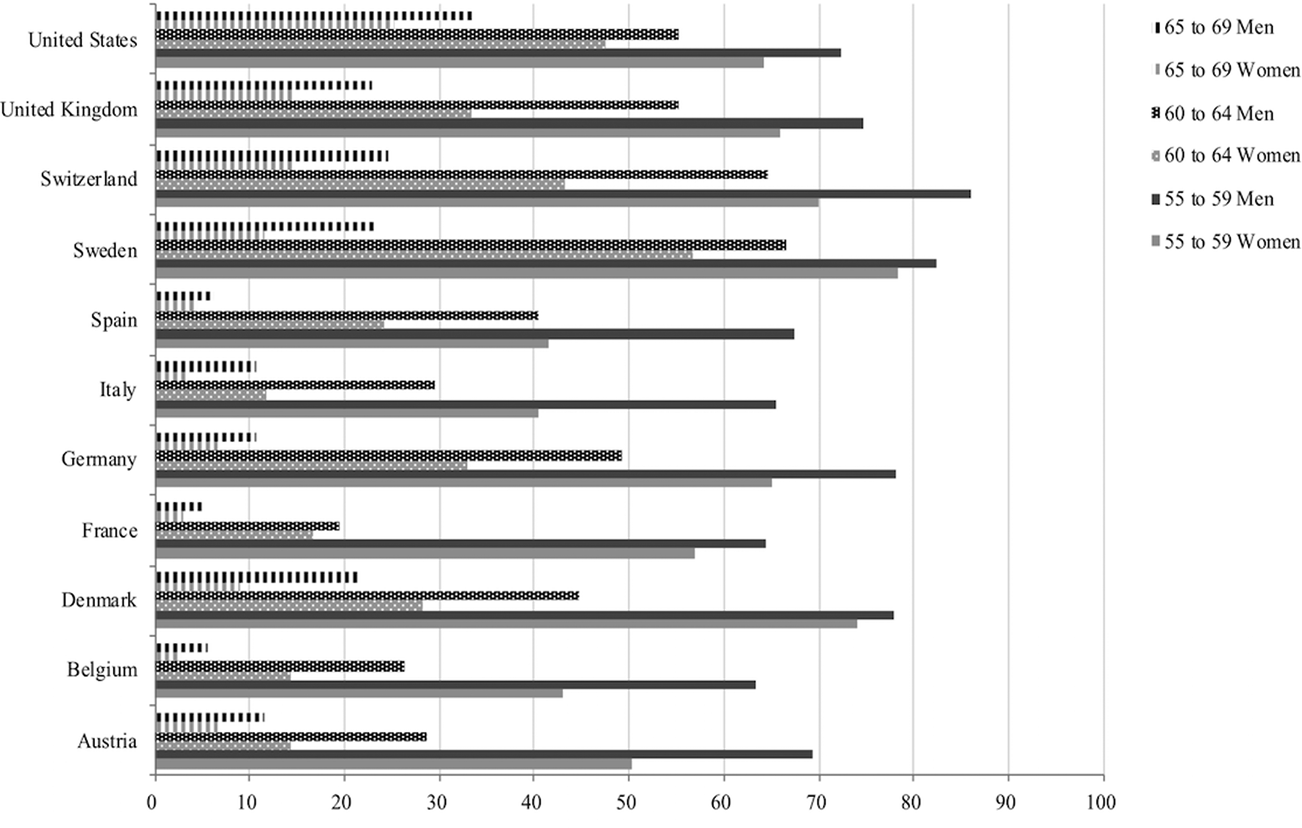
Figure 1 shows the employment rates for male and female workers aged 55–59, 60–64 and 65–69 across the countries studied here, in 2010, which is the reference year for this study.
Cross-sectional employment rates (percentages) of older workers by country, age category and gender in 2010.
Source: Organisation for Economic Co-operation and Development (2010).

These cross-sectional data enable us to visualise the diversity of employment rates across age groups in our chosen countries. Thus, over 80 per cent of men in the 55–59 years age group are (still) in employment in Denmark, Sweden and Switzerland, whereas this figure is below 70 per cent in Austria, Belgium, France and Italy. For the oldest age group (65–69 years), the male employment rates range from less than 12 per cent in countries like Austria, Belgium, France, Germany and Italy, to over 30 per cent in the United States of America (USA).
For women in the 55–59 years age group, employment rates range from over 60 per cent in the USA, Switzerland, Sweden, Denmark, Germany and the UK, to below 50 per cent in Spain, Italy, Belgium and Austria. At 65–69 years, over 25 per cent of women are still working in the USA, whereas under 5 per cent of them are in employment in France and Italy.
Interesting though they are, these cross-sectional figures provide little insight into the mechanisms behind the different retirement pathways, and they reveal little about the interplay of institutional and individual-level factors on the retirement pathways followed across and within these macro-institutional settings.
Gendered lifecourse regimes and employment policies
In this largely exploratory study we worked with data from 11 countries. We aimed to include all the countries that fulfilled our data availability criteria. Where possible (ELSA and HRS), we used single-country variables. Where this was not possible (due to limited sample size for some countries in SHARE), we addressed this challenge by creating country clusters that were relevant for our specific research questions. These clusters were inspired by the lifecourse regime typology (Möhring, Reference Möhring2016) and a preliminary categorisation of countries according to the nature of the EWL policies adopted in the mid-2000s (Buchholz et al., Reference Buchholz, Hofäcker, Blossfeld, Blossfeld, Buchholz and Hofäcker2006). Using data from the retrospective SHARELIFE survey, Möhring differentiates between a series of ideal-type ‘lifecourse regimes’ on the basis of three empirical measures:
(1) The degree to which individuals adopt a ‘normal work biography’, characterised by continuous employment in standard (i.e. permanent and full-time) jobs throughout the entire duration of their adult lives (‘career standardisation’).
(2) The ease and frequency with which individuals switch between different employment statuses (full-time, part-time, not-in-employment, unemployment) throughout their adult lifecourse (‘career volatility’).
(3) The similarity or diversity of employment histories across the whole population within a given national context (‘career heterogeneity’) (Möhring, Reference Möhring2016).
Since this typology adopts a longitudinal perspective on the interplay of social policy macro- (institutional) and life history micro- (individual) level influences, with a strong gender focus, it is particularly well-suited to the objectives of our study.
Besides the three empirical indicators used by Möhring, we included an additional criterion, based on broad EWL policy orientations adopted in the mid-2000s in different national contexts (Buchholz et al., Reference Buchholz, Hofäcker, Blossfeld, Blossfeld, Buchholz and Hofäcker2006; Ní Léime et al., Reference Ní Léime, Street, Vickerstaff, Krekula and Loretto2017, Reference Ní Léime, Ogg, Rasticova, Street, Krekula, Bédiová and Madero-Cabib2020). Previous research has identified two main policy responses to population ageing: ‘employment exit’ policies, which encourage the early retirement of older workers, and ‘employment maintenance’ policies, which provide opportunities for extending working lives (Buchholz et al., Reference Buchholz, Hofäcker, Blossfeld, Blossfeld, Buchholz and Hofäcker2006; König and Schilling, Reference König, Schilling, Hofäcker, Hess and König2016). Conditions fostering the adoption of an ‘employment exit’ logic are strong insider–outsider distinctions within highly regulated labour markets, whereas ‘employment maintenance’ policies are more likely to be adopted in weakly regulated labour markets, characterised by high job and occupational mobility. To date, little is known about the potentially differential effects of these EWL policy orientations on older men and women, and this is one of the issues we wanted to explore further.
For the countries covered by this study, England, the USA, Sweden and Denmark are associated with ‘employment maintenance’ policies, although the mechanisms behind this promotion of EWL are not identical in all cases. In England and the USA, these policies are largely market-induced, whereas they result from negotiations with social partners in Sweden and Denmark. Hence, in our analysis, we allocate these countries to three distinct analytical categories: Nordic (Denmark and Sweden), England and the USA. The decision not to conflate the USA and England into a single ‘liberal’ lifecourse regime category was based on previous research (Lain, Reference Lain2016; Van der Horst et al., Reference Van Der Horst, Lain, Vickerstaff, Clark and Baumberg Geiger2017) suggesting very different historical patterns of women's integration into the labour market in these two national settings. Specifically, while in both countries men are more likely than women to be in full-time employment across the lifecourse, in the USA the employment policies operate under a ‘gender sameness’ framework (Van der Horst et al., Reference Van Der Horst, Lain, Vickerstaff, Clark and Baumberg Geiger2017) in which both male and female workers are expected to work full-time in order to access social benefits (e.g. health insurance). By contrast, in England (as in the UK more generally), a ‘modified male breadwinner/female caregiver’ framework persists (Van der Horst et al., Reference Van Der Horst, Lain, Vickerstaff, Clark and Baumberg Geiger2017). According to this model, women are expected to serve as main carers of families and contribute marginally to the household income through part-time jobs. Consequently, about 40 per cent of English females work part-time, and this figure increases to 56 per cent among mothers of school-age children (Warren and Lyonette, Reference Warren and Lyonette2018).
In contrast, many Southern and Continental European countries have adopted ‘employment exit’ policies, encouraging the early transition of at least some categories of older (usually male) workers to retirement, either through subsidised pre-retirement schemes, or by limiting the pension penalties associated with anticipated labour market exit.
We were thus eager to discover the effects of these policy orientations on the distribution and determinants of current retirement pathways, particularly from a gender perspective. We worked with five country clusters: ‘Nordic’ (Sweden and Denmark), ‘Continental’ (Austria, Belgium, Germany and SwitzerlandFootnote 2), ‘Mediterranean’ (Italy, FranceFootnote 3 and Spain), ‘England’ and ‘USA’. As stated earlier, these lifecourse regime clusters differ somewhat from previous Welfare regime typologies (Esping-Andersen, Reference Esping-Andersen1999) because the central focus of this exploratory phase was to test for a potentially distinctive gendered distribution of retirement pathways and their determinants.
Data, variables and methods
Data
In this research, we aim to analyse gendered long-term retirement pathways in 11 different countries, and their individual-level and macro-institutional determinants. In order to analyse the distribution of retirement pathways under the contrasting macro-institutional contexts discussed above, we use a harmonised pooled-country dataset of 11 nations, including Austria, Belgium, Denmark, England, France, Germany, Italy, Spain, Sweden, Switzerland and the USA.Footnote 4 We draw on three bi-annual panel surveys: ELSA, HRS and SHARE.
ELSA provided data for England. Supported by the UK Economic and Social Research Council, ELSA started in 2002 by targeting individuals aged 50 years and above, who have been interviewed every two years. The response rate in Wave 1 was 65.0 per cent. Data from ELSA have been used by scholars to examine, for instance, employment patterns of older men and women (Van der Horst et al., Reference Van Der Horst, Lain, Vickerstaff, Clark and Baumberg Geiger2017), or the relationship between membership of community groups and quality of life after retirement (Steffens et al., Reference Steffens, Cruwys, Haslam, Jetten and Haslam2016).
HRS provided data for the USA. Supported by the National Institute on Aging, HRS began in 1992 by targeting individuals aged between 51 and 61, who were then interviewed every two years. The response rate in Wave 1 was 81.6 per cent. Wang et al. (Reference Wang, Zhan, Liu and Shultz2008) first used the HRS data to explore retirement transition and adjustment patterns. More recently, these data have been used to identify a range of diverse retirement pathways (Calvo et al., Reference Calvo, Madero-Cabib and Staudinger2018) and to examine the impact of different family care profiles (Stoiko and Strogh, Reference Stoiko and Strogh2019) on early and late retirement.
Supported by the European Commission, SHARE started in 2004 and includes individuals aged 50 years and above, who have been interviewed every two years. The average response rate in Wave 1 was 61.8 per cent (ranging from 73.6% in France to 37.6% in Switzerland, a country well known for low survey response rates). Amongst other topics, SHARE data have been used by scholars to examine the impact of the combination of employment and family trajectories on retirement timing (Madero-Cabib et al., Reference Madero-Cabib, Gauthier and Le Goff2016), and the impact of retirement on mental health (Kolodziej and García-Gómez, Reference Kolodziej and García-Gómez2019). SHARE provided data on Austria, Belgium, Denmark, France, Germany, Italy, Spain, Sweden and Switzerland. The reason for this selection of countries from the SHARE survey was based on the fact that they were observed across all waves and that they could be grouped into country clusters (based on a lifecourse regime typology (Möhring, Reference Möhring2016) and on the nature of the EWL policies (Buchholz et al., Reference Buchholz, Hofäcker, Blossfeld, Blossfeld, Buchholz and Hofäcker2006)) with a large enough sample size.Footnote 5
Many of the questions in ELSA and SHARE that relate to family life, work history, health issues, financial status in old age and social networks are inspired by questions used in the HRS survey, making it possible to perform cross-national comparisons. The selection of the specific waves for examining retirement pathways was influenced by the temporal structure of the surveys (see Table S1 in the online supplementary material). As the SHARE survey began in 2004, and because we wanted to study the same chronological period in all countries, the waves analysed in the ELSA and HRS surveys are those from 2004. Because the third wave of SHARE (called SHARELIFE) is not part of the panel, but is a retrospective wave, we did not consider it, and consequently did not consider the waves from ELSA or HRS that were fielded that same year. We thus used data from six waves from each of these three surveys. Furthermore, as data from Wave 7 of SHARE, Wave 8 of ELSA and Wave 13 of HRS were collected about 12 years after the first wave analysed here, we are able to examine the retirement pathways through six observations over a 12-year period, from 2004 to 2016.
To select our research sample, we used two criteria. The first was that people had to be six years younger than the gender- and country-specific FPA in the baseline observation year (2004), that is, in Wave 1 of SHARE, Wave 2 of ELSA and Wave 7 of HRS. We used the gender- and country-specific FPAs from 2010 (that is, six years after 2004) based on OECD data (2011).Footnote 6 In this way, individuals were observed six times from six years before their country- and/or gender-specific FPA (in 2004) until six years after FPA (in 2016). The second selection criterion was that people could have a maximum of one missing value in self-reported labour force status across the six observations in ELSA, HRS and SHARE. This represents just under a quarter (20.9%) of the study sample. Where required, we performed a highly conservative strategy to impute missing values on labour force status.Footnote 7 Our final research sample is composed of 1,594 women and 1,105 men (2,699 individuals).
Variables
The main variable used to construct retirement pathways is self-reported labour force status, which was captured in all the survey waves examined in this study. Self-reported labour force status comprises seven mutually exclusive items: (a) working full-time (i.e. working more than 35 hours a week), (b) working part-time (i.e. working less than 35 hours a week), (c) out of the labour force (i.e. individuals not in paid employment and not actively seeking a job), (d) retired (i.e. people fully retired from the labour market), (e) partly retired (individuals who receive some form of pension benefit, but nevertheless continue working, usually on a part-time basis), (f) disabled (i.e. people with a recognised disability, not in paid employment), and (g) unemployed (i.e. individuals not in employment, but actively seeking a job).
The main covariates of this study (all measured in the baseline year, i.e. 2004) are the societal contexts presented earlier: ‘Continental’ (Austria, Belgium, Germany and Switzerland), ‘Mediterranean’ (Italy, France and Spain), ‘Nordic’ (Denmark and Sweden), ‘USA’ and ‘England’.
Our choice of individual-level variables was determined by the exploratory nature of this study and the desire to focus this stage of our enquiries on the factors that could be applied to the entire population of older people in each institutional context, irrespective of their employment histories. Therefore, we chose not to focus on variables related to working conditions, such as having manual versus non-manual jobs, but rather on employment status (i.e. being inside or outside the labour force), since some working conditions indicators are not relevant for those women who have spent long periods of their adult lives out of the labour force, as is the case in our sample. We also eliminated variables related to the size and composition of the household, since the living arrangements of older people in some national contexts are known to have fluctuated considerably over time, including in the aftermath of the 2008 economic crisis (Mira Sanchez and O'Reilly, Reference Sánchez-Mira and O’Reilly2019).
We thus worked with the following individual-level variables: educational level (‘primary’, ‘secondary’, ‘tertiary’), marital status (‘married/partnered’, ‘divorced/separated’, ‘never married’, ‘widowed’) and three health indicators: poor self-rated health,Footnote 8 number of chronic conditions Footnote 9 and an activities of daily living (ADL) index.Footnote 10
Methods
Sequence analysis was employed to reconstruct the retirement pathways of women and men, by analysing individual sequences of labour force statuses chronologically in the period starting six years before the FPA and extending six years beyond the FPA. In sequence analysis, as in other trajectory modelling techniques, the scope and depth of the analysis are limited by the time period covered by the data as well as by the time intervals between observations (Wolf and Gill, Reference Wolf and Gill2009; Warren et al., Reference Warren, Luo, Halpern-Manners, Raymo and Palloni2015). Due to the characteristics of the three surveys described above, we observed the labour force status of respondents every two years. In order to capture the fact that actual retirement pathways may extend beyond this 12-year timespan, we included a retirement from no job status in our study. This enabled us to include those individuals (mostly women) who may already have been out of the labour market for many years when they finally reach FPA. We believe that this offers a more realistic vision of gendered retirement pathways in the current context.
Sequence analysis allowed us to measure the similarity or difference of every pair of individual sequences, considering the type of status, the ordering of statuses and their timing. For example, two retirement pathways would be regarded as similar if both are characterised by a period of full-time employment extending from six years before the FPA until the FPA, and then by a definitive switch to complete retirement until six years after FPA. In this example, we can see similar types of labour force statuses (full-time job and complete retirement), similar order of labour force statuses (first a full-time job and then complete retirement) and, finally, similar timing in which labour force statuses were confronted (full-time job from six years before the FPA and complete retirement from that time onwards). The analysis of similarities and differences between every pair of individual sequences was stored in a distance matrix that summarises the modifications (substitution and insertion/deletion) that would hypothetically be required for one sequence to become equal to the other one.Footnote 11
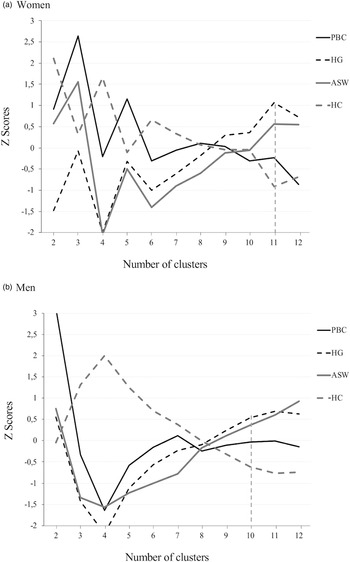
We then implemented a hierarchical cluster analysis on the distance matrix in order to group similar individual sequences (i.e. sequences composed of similar type, order and timing of statuses) into different categories. To do so, we used Ward's hierarchical cluster method (Ward, Reference Ward1963). A relevant decision when using this clustering method is to choose the most appropriate and informative number of types of sequences that summarise the diversity of retirement pathways adopted by people around the FPA. To decide on this, we used four selection criteria aimed at measuring the quality of different cluster solutions: Average Silhouette Width (ASW), Point Biserial Correlation (PBC), Hubert's Gamma (HG) and Hubert's C (HC).Footnote 12 We present normalised Z scores of these criteria given that some have an index that ranges from −1 to 1, while others range from 0 to 1. Further, while a higher measure in ASW, PBC and HG criteria means a better cluster solution, a lower measure in HC indicates a better solution.
After creating the types of retirement pathways, we could then measure the simultaneous influence of the covariates on the likelihood of belonging to one or another type. To this end, we performed multinomial logistic regressions.Footnote 13
Results
Gendered retirement pathways
Figure 2 shows the normalised outcomes (with Z scores) of the four selection criteria (ASW, PBC, HG and HC) for different cluster solutions for women (Figure 2A) and men (Figure 2B). As shown, whereas an 11-cluster solution is the most appropriate for women, ten clusters is the most appropriate solution for men.
Average silhouette width index on women's and men's samples.
Notes: To estimate retirement pathways, we tolerated at most one missing value per individual in self-reported labour force status across the six panel observations in the English Longitudinal Study of Ageing (ELSA), Health and Retirement Study (HRS) and Survey of Health, Ageing and Retirement in Europe (SHARE) (corresponding to 20.9% of the study sample), and we performed multiple imputations by chained equations to replace this missing observation. PBC: Point Biserial Correlation. HG: Hubert's Gamma. ASW: Average Silhouette Width. HC: Hubert's C.

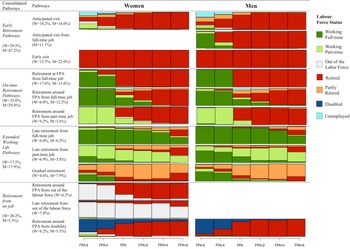
Figure 3 shows the 11 and ten trajectory types that best account for the retirement pathways of women and men, respectively. We show these types in chronogram plots, which illustrate the main pathway followed by individuals classified in each type. Age is displayed on the x-axis with six observation points: ‘FPA−6 years’ (2004), ‘FPA−4 years’ (2006), ‘FPA’ (2010), ‘FPA+2 years’ (2012), ‘FPA+4 years’ (2014) and ‘FPA+6 years’ (2016). The y-axis shows the proportion (0 to 1) of individuals classified in different statuses across time. At the right of Figure 3, the seven labour force statuses used to examine individuals’ retirement paths are defined to distinguish transitions between different statuses. In Figure S1 in the online supplementary material, we introduce the types in sequence index plots, showing the actual trajectory followed by each individual classified within a given type.
Types of women's and men's retirement pathways (chronogram plots).
Notes: To estimate retirement pathways, we tolerated at most one missing value per individual in self-reported labour force status across the six panel observations in the English Longitudinal Study of Ageing (ELSA), Health and Retirement Study (HRS) and Survey of Health, Ageing and Retirement in Europe (SHARE) (corresponding to 20.9% of the study sample), and we performed multiple imputations by chained equations to replace this missing observation. FPA: full pension age. W: women. M: men.

As mentioned previously, some of these pathways vary according to the precise employment status of the older workers six years before FPA (i.e. in full-time or part-time jobs, or not in employment), while others vary according to the timing of the transition to retirement (early, on-time, postponed). For analytical clarity and statistical robustness, we conflated the observed retirement pathways into broader categories, differentiated according to the timing of the transition to retirement (early retirement pathways, on-time retirement pathways and extended working life pathways), whilst also including the category retirement from no job. Finally, the left-hand column of Figure 3 indicates the proportion of women and men classified in each of the detailed retirement pathways identified, and also in each of the consolidated groups.
In response to our first research question, we can map the relative frequency and gender composition of each of the retirement pathways identified by the sequence analysis. The first consolidated category corresponds to early retirement pathways, which were followed by 29.5 per cent of the women and almost half (47.1%) of the men in our sample. It is composed of two trajectory types among women: ‘anticipated exit’ and ‘early exit’. For men, we find an additional ‘anticipated exit from full-time job’ pathway. This does not mean that no women retire from a full-time job before FPA, but simply that there were so few of them who did so that this does not represent a clear retirement pattern within the sample of older women. Whereas ‘anticipated exit’ refers to people who started the transition into retirement less than six years before FPA from various labour force statuses, the sub-type ‘anticipated exit from full-time job’ refers only to those people who were previously employed full-time. The type ‘early exit’ refers to individuals who were already fully retired six years before reaching FPA and who remained in that status until the end of the observation period (FPA + six years). Prior to the retirement transition (which occurred before the observation period of this study), these people may either have been employed or out of the labour market. About 15 per cent of the sample (16.2% of the women and 14.0% of the men) followed the ‘anticipated exit’ pathway. Men were almost twice as likely as women (22.0% of men compared to 13.3% of women) to follow the ‘early exit’ pathway, but only men (11%) followed the ‘anticipated exit from full-time job’ pathway (11.1%), probably reflecting the widespread use of pre-retirement schemes in male-dominated occupations in the years preceding our study period (Steiber and Kohli, Reference Steiber and Kohli2017).Footnote 14
The second consolidated group corresponds to on-time retirement pathways, which account for about a third of the samples (32.8% of the women, 29.4% of the men). The type ‘retirement at FPA from a full-time job’ refers to women (17.6%) and men (13.6%) who retire from the labour market as soon as they reach the FPA. Beyond this overall gender parity, the other two trajectory types that compose this second group are highly gendered; the type ‘retirement around FPA from a full-time job’ is followed by twice as many men (12.2%) as women (6.0%), while the type ‘retirement around FPA from a part-time job’ is followed by about three times more women (9.2%) than men (3.6%).Footnote 15
The third consolidated group, called extended working life pathways, represents a similar share of women (17.5%) and men (17.9%) in our sample, and corresponds to three retirement pathways involving some form of prolonged working life. First, it includes the pathway ‘late retirement from a full-time job’, which is composed of women (6.0%) and men (6.2%) working mainly in full-time jobs who postpone the transition to retirement beyond the FPA. Secondly, the type ‘late retirement from a part-time job’ corresponds to a pathway followed by 6.9 per cent of the women and 3.8 per cent of the men in our sample, who work beyond the FPA on a part-time basis. In third place, the ‘gradual retirement’ type involves combining some kind of retirement pension with a paid job (mostly part-time), and therefore postponing the moment of complete retirement beyond the FPA; it is followed by 4.6 per cent of the women and 7.9 per cent of the men in our sample.
Finally, the last consolidated group called retirement from no job accounts for those who have no job to retire from, and concerns 20.2 per cent of the women and 5.5 per cent of the men in our sample. The types ‘retirement around FPA from out of the labour force’ (6.2% of the women in our sample) and ‘late retirement from out of the labour force’ (7.8% of the women), describe the retirement pathway of women who are permanently out of the labour force (i.e. not employed and not looking for a job) for the whole of the observation period and who transition to retirement on reaching FPA or later. In contrast, the type ‘retirement around FPA from disability’ includes inactive and disabled individuals who retire around the FPA. It represents a similar share of the women (6.2%) and men (5.5%) in our sample.
It could be argued that these retirement pathways from out of the labour force are almost identical to the ‘early exit’ pathways described previously, since we observe individuals permanently inactive across the 12-year period analysed in this paper. However, those people who are not retired before reaching FPA and who were not employed before reaching that age are likely to be in very different material circumstances to those men or women who have early access to a retirement pension. Therefore, our typology allows us to capture these fine-grained distinctions in order to identify subtle variations in the institutional gendering of retirement pathways across country contexts.
The distribution of gendered retirement pathways across lifecourse regimes
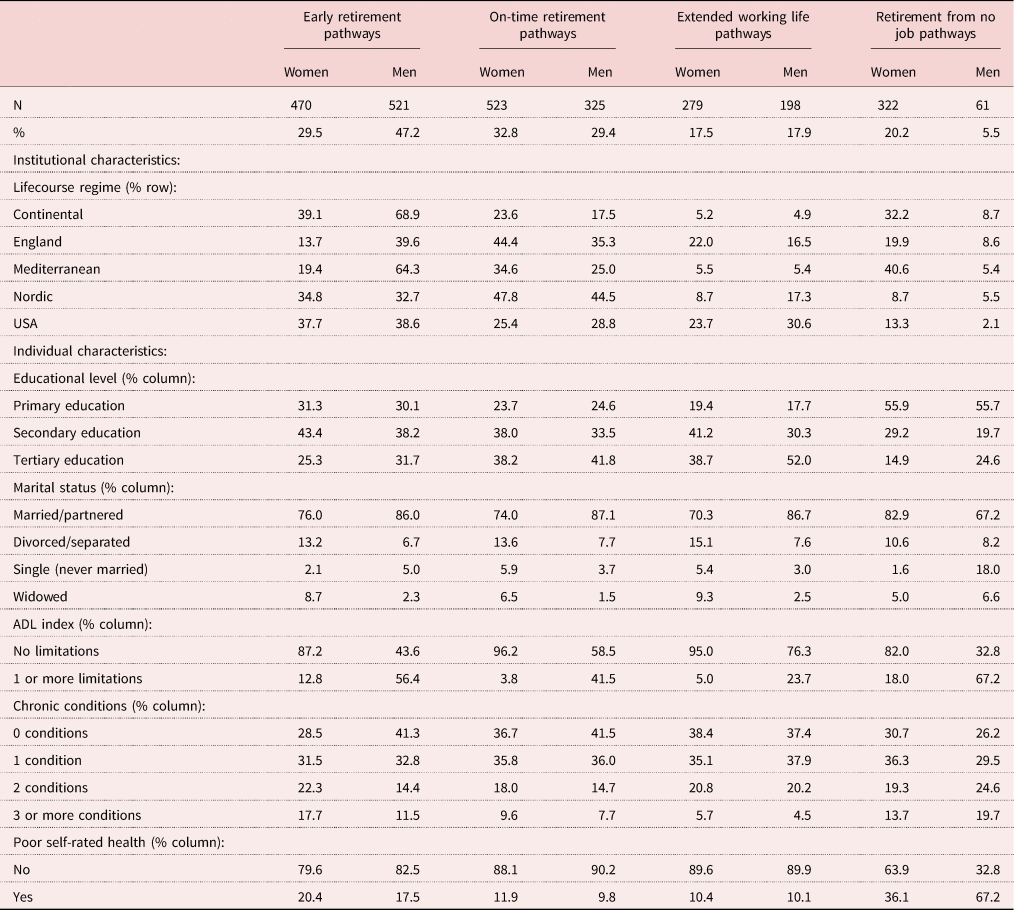
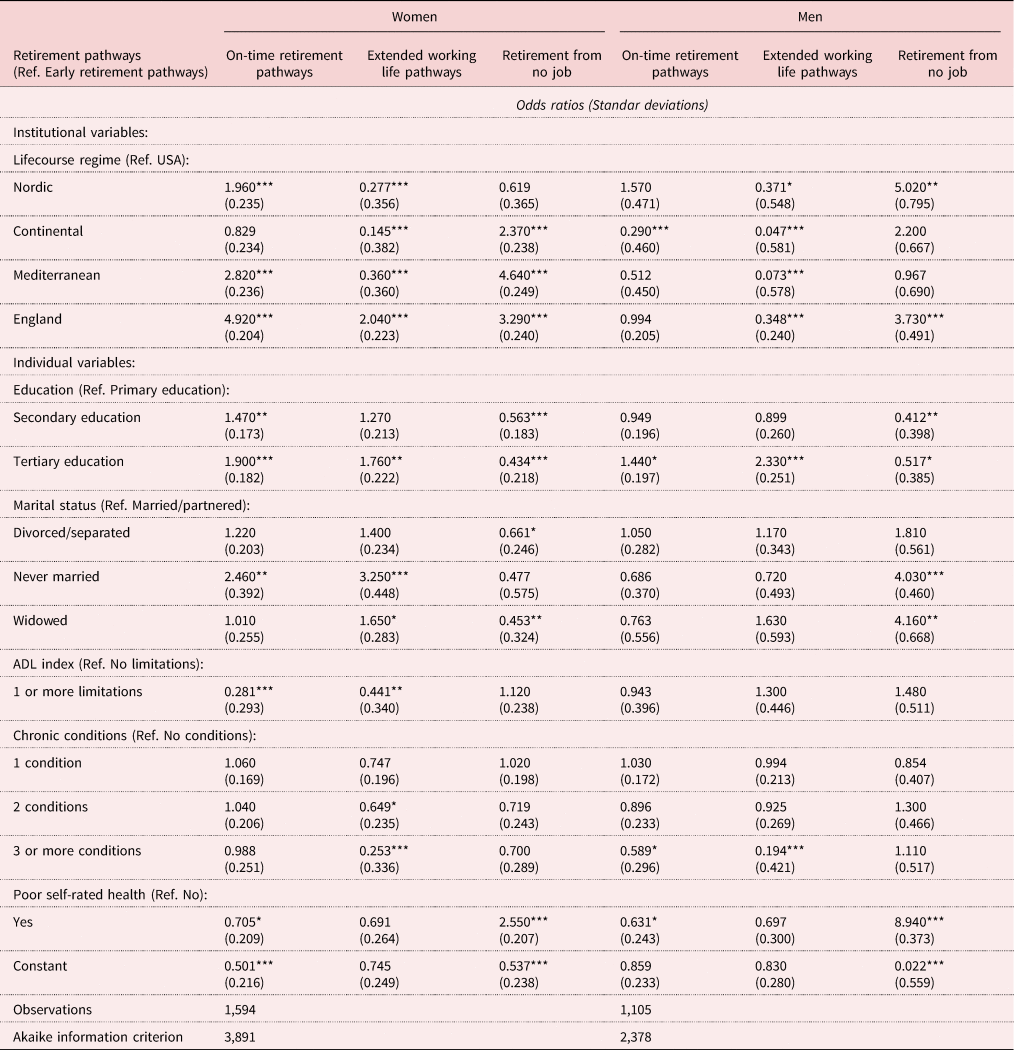
Table 1 shows the institutional and individual characteristics associated with each of our consolidated retirement pathways. Table S2 in the online supplementary material presents the same analysis on each detailed retirement pathway.
Distribution of consolidated gendered retirement pathways by institutional- and individual-level characteristics

Notes: All variables were measured in the baseline observation year (2004). To estimate retirement pathways, we tolerated at most one missing value per individual in self-reported labour force status across the six panel observations in the English Longitudinal Study of Ageing (ELSA), Health and Retirement Study (HRS) and the Survey of Health, Ageing and Retirement in Europe (SHARE) (corresponding to 20.9% of the study sample), and we performed multiple imputations by chained equations to replace this missing observation. USA: United States of America. ADL: activities of daily living.
Significance level: All associations are statistically significant at p ⩽ 0.001 (chi-squared).
In response to our second research question, we can now compare the relative importance and gender composition of these consolidated retirement pathways across different macro-institutional settings. Among men, the early retirement pathways are the most prevalent across all countries and lifecourse regimes. For women, this is the second most prevalent pattern, but only slightly more popular (+3%) than on-time retirement pathways. However, this pathway is not necessarily followed to the same extent by men and women in each societal context. Thus, early retirement pathways are highly prevalent among men in Continental (68.9%) and Mediterranean (64.3%) lifecourse regimes, but far less so in the Nordic countries (32.7%), in England (39.6%) or in the USA (38.6%). This is broadly in line with the ‘employment maintenance’ versus ‘employment exit’ distinction mentioned earlier (Buchholz et al., Reference Buchholz, Hofäcker, Blossfeld, Blossfeld, Buchholz and Hofäcker2006).
However, the picture becomes more complex once we consider the gendering of retirement pathways across macro-institutional contexts. As expected, the relative likelihood of men and women following a particular retirement pathway varies across lifecourse regimes. For example, women in England (13.7%) are much less likely to exit the labour market before reaching FPA than their counterparts in the Nordic countries (34.8%), whereas the share of early retirement pathways is similar for English and Nordic men (39.6 and 32.7%, respectively).
In a similar vein, we can see that men in the USA are marginally more likely to be working beyond FPA than their female counterparts (30.6% compared to 23.7% of women), whereas the gender distribution of extended working life is reversed in the English case, with 16.5 per cent of English men working beyond FPA, compared to almost 22.0 per cent of their female counterparts. This is quite a significant finding, showing that, even within so-called ‘liberal’ welfare regime contexts, the gendered distribution of retirement pathways may vary considerably. The fact that American men are twice as likely as their English counterparts to extend their working lives, whereas there is almost no cross-country difference for women's rate of post-FPA employment in the UK and the USA, signals the need to explore further the specific historical determinants of gendered EWL practices within and across societal contexts.
Secondly, the gender gap in early retirement pathways also varies considerably across lifecourse regimes. Women in the Mediterranean context are almost 30 per cent less likely than their male counterparts (13.2% versus 39.6%) to take early retirement and are more likely to extend the duration of their working lives (22.0% versus 16.5% of Mediterranean men), whereas there is almost no gender gap in the likelihood of working beyond FPA in the Continental countries (5.2% for women, 4.9% for men). Hence, despite similarly low rates of retirement from no job for men and women (ranging from 5.5 to 8.7%) in the Nordic context, the late careers observed in this context are primarily a male affair, since men are twice as likely as women (17.3% versus 8.7%) to follow extended working life pathways in the Nordic contexts.
Furthermore, although women have fairly similar rates of early labour market exit in Mediterranean countries (19.4%) and in England (13.7%), these figures are accompanied with very different proportions of women actually in the labour market around FPA. Thus, 40.6 per cent of women who reach FPA in the Mediterranean countries are already out of the labour market, as compared to just 19.9 per cent in England. This difference highlights the potentially divergent and gendered impact of labour market policies aimed at encouraging employers to retain their older workers (e.g. by training programmes, reduced working hours arrangements or health prevention schemes) in these contrasting institutional contexts (Wainwright et al., Reference Wainwright, Crawford, Loretto, Phillipson, Robinson, Shepherd, Vickerstaff and Weyman2019).
As expected, the retirement pathways in England and the USA are more heterogeneous than in the other lifecourse regimes. However, as we have already seen, the gender distribution of these retirement pathways is not identical from one liberal country to another. For example, women in England are almost twice as likely to retire ‘on time’ (44.4%) as their US counterparts (25.4%), whereas the share of on-time retirement pathways is quite similar for English (35.3%) and North American (28.8%) men.
To complete this first round of analysis, we can see that extended working life pathways are very unusual for women in the Nordic (8.7%), Continental (5.2%) and Mediterranean (5.5%) countries, whereas they are more common for the women in England (22.0%) and the USA (23.7%). For men, the distribution of extended working life pathways across lifecourse regimes is slightly different, with similarly low rates in Continental (4.9%) and Mediterranean countries (5.4%), but with almost a fifth of men working beyond the FPA in the Nordic countries (17.3%) and England (16.5%) and almost a third in the USA (30.6%).
Finally, one of the models of EWL currently being promoted by international organisations such as the OECD (Krekula, Reference Krekula2020), extending working life through gradual retirement (i.e. the combination of a pension and paid employment), is relatively prevalent in the USA (see Table S2 in the online supplementary material), accounting for 15.2 per cent of the late retirement pathways of men and 9.5 per cent of those of their female compatriots. This practice nevertheless remains marginal for the generation considered here, for both sexes, in all the other lifecourse regimes, with the partial exception of the Nordic countries, where 9.1 per cent of men had followed a gradual retirement pathway.
Combining institutional and individual determinants of gendered retirement pathways
In this section, in response to our third and fourth research questions, we aim to understand how institutional and individual characteristics combine to influence the likelihood of adopting one or other of these retirement pathways. To this end, we performed multinomial logistic regressions on women and men separately. Table 2 shows the results of these models on the consolidated retirement pathways (odds ratios (OR)). Table S3 in the online supplementary material presents the same analysis on each detailed retirement pathway.
Multinomial logistic regressions on consolidated gendered retirement pathways

Notes: All covariates were measured in the baseline observation year (2004). To estimate retirement pathways, we tolerated at most one missing value per individual in self-reported labour force status across the six panel observations in the English Longitudinal Study of Ageing (ELSA), Health and Retirement Study (HRS) and the Survey of Health, Ageing and Retirement in Europe (SHARE) (corresponding to 20.9% of the study sample), and we performed multiple imputations by chained equations to replace this missing observation. Ref.: reference category. USA: United States of America. ADL: activities of daily living.
Significance levels: * p < 0.1, ** p < 0.05, *** p < 0.01.
Table 2 indicates that, with the exception of England (OR = 2.040, p < 0.01), women from all other countries are less likely to follow an extended working life pathway than their US counterparts. However, as we saw previously, the similarity between England and the USA is less strong for men, since the chances of an English man following any type of extended working life pathways are lower (OR = 0.348, p < 0.01) than those of their US counterparts. This is also the case for men from Nordic (OR = 0.371, p < 0.1), Continental (OR = 0.047, p < 0.01) and Mediterranean (OR = 0.073, p < 0.01) countries.
With the exception of the Nordic countries, European women are more likely to follow retirement from no job pathways than their US counterparts, whether they are from Continental countries (OR = 2.370, p < 0.01), Mediterranean countries (OR = 4.640, p < 0.01) or from England (OR = 3.290, p < 0.01). Thus, even after controlling for individual-level determinants, women in the USA are more likely to follow the ‘late retirement from no job’ pathway than women in the Nordic countries, and they are less likely than women from the Continental and Mediterranean countries to retire from non-employment.
Looking firstly at individual characteristics, and in line with previous research (Halleröd et al., Reference Halleröd, Örestig and Stattin2012; Radl, Reference Radl2013; Wahrendorf et al., Reference Wahrendorf, Dragano and Siegrist2013, Reference Wahrendorf, Zaninotto, Hoven, Head and Carr2017; Visser et al., Reference Visser, Gesthuizen, Kraaykamp and Wolbers2016; Baumann and Madero-Cabib, Reference Baumann and Madero-Cabib2021), we see that, for men and women alike, higher education is positively associated with extended working life pathways. Being highly educated also lowers the chances of women following a retirement from no job pathway (OR = 0.434, p < 0.01), but, as we will see in the next section, not to the same extent in all macro-institutional contexts.
Due to the over-representation of married couples in our sample, the influence of marital status on retirement pathways appears to be relatively homogeneous across countries, with a clear and consistent influence of single status on the retirement pathways of men and women. Thus, in all institutional contexts, single, never-married women (OR = 3.250, p < 0.01) are more likely to follow extended working life pathways, while divorced, separated (OR = 0.661, p < 0.1) and widowed women (OR = 0.453, p < 0.5) are less likely to follow retirement from no job pathways than their married counterparts. In contrast, widowed (OR = 4.160, p < 0.5) and single, never-married men (OR = 4.030, p < 0.01) are more likely to follow retirement from no job pathways than their married counterparts.
Finally, we see that health issues (ADL limitations, chronic conditions and poor self-rated health) are not conducive to extending working lives. Particularly for chronic conditions, this association appears to hold for men and women alike, and to be independent of the lifecourse regime. Nevertheless, it is interesting to note (see Table S2 in the online supplementary material) that the minority of women who do continue working full-time beyond FPA are significantly more likely than their male counterparts to have poor self-related health (12.5% of women compared to just 2.9% of their male counterparts). This gender gap is partly inverted for those opting for gradual retirement. Here, 14.9 per cent of the men combining some form of employment with a pension declare poor self-related health, as compared to 6.9 per cent of their female counterparts. Somewhat surprisingly, about a third of those men (32.8%) and women (33.3%) who retired around FPA from disability declare good self-related health, which might suggest that they have experienced very specific functional limitations to performing their work tasks, but with no significant hindrance in their daily lives.
To sum up the main findings from the regression analysis, individual characteristics clearly influence retirement pathways, but not necessarily to the same extent, or even in the same direction, for all groups of older workers, under all lifecourse regimes.
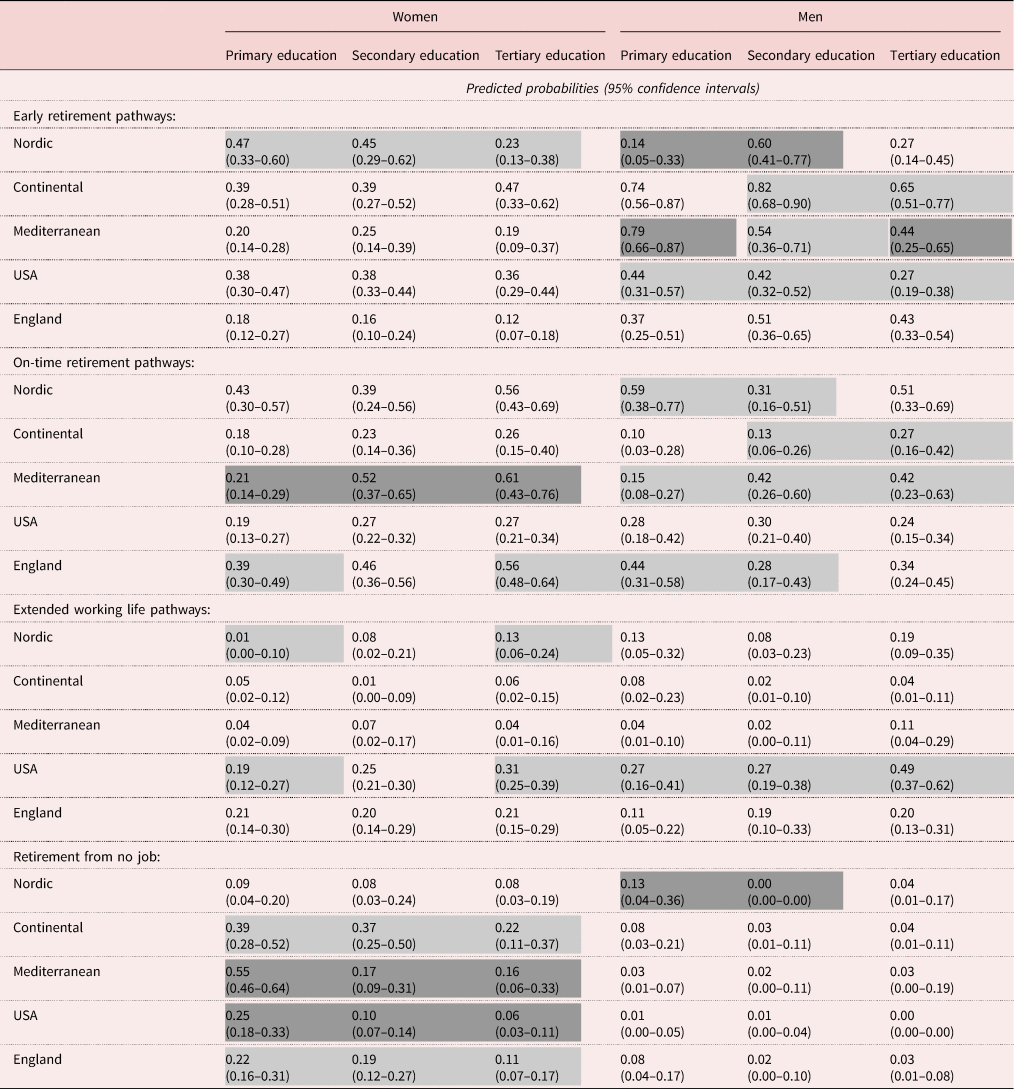
Finally, in response to our fourth and final research question and in order to better understand the interrelated influence of both institutional and individual-level characteristics, we added interaction effects between the macro-institutional contexts and educational levels to the two multinomial regression models (for men and for women). Table 3 shows the predicted probabilities (with 95% confidence intervals) of these interaction effects on the consolidated retirement pathways (see Table S4 in the online supplementary material for the same analysis on each detailed retirement pathway).Footnote 16
Predicted probabilities of interaction effects between lifecourse regimes and educational levels on consolidated gendered retirement pathways

Notes: Strong differences between groups are highlighted in dark grey. Weak differences between groups are highlighted in light grey. To estimate retirement pathways, we tolerated at most one missing value per individual in self-reported labour force status across the six panel observations in the English Longitudinal Study of Ageing (ELSA), Health and Retirement Study (HRS) and the Survey of Health, Ageing and Retirement in Europe (SHARE) (corresponding to 20.9% of the study sample), and we performed multiple imputations by chained equations to replace this missing observation. USA: United States of America.
Table 3 indicates that the probability of men following early retirement pathways does indeed vary by education. However, there are some interesting contextual variations to this rule. For example, in Continental and Mediterranean contexts and in the USA, early retirement patterns are less prevalent among the highly (tertiary) educated men and more prevalent among men with primary education levels; whereas this is not the case in the Nordic countries, where those men with secondary education are more likely than lower-educated men to exit the labour market early.
As far as women in early retirement pathways are concerned, we observe a negative linear effect of education in Nordic countries (i.e. the higher the education the lower the probability of retiring early). Interestingly, we observe statistically significant effects of education levels on the probability of early labour market exits for men and women in the Nordic contexts, but the direction of the interaction effects differs by gender: lower-educated Nordic women have relatively high chances of early labour market exit, while lower-educated Nordic men are relatively unlikely to retire before the FPA. No statistically significant educational determinants of female early retirement pathways can be observed in any of the other societal contexts.
Secondly, we observe that for women in the Mediterranean countries and in England, the higher the education the greater the likelihood of following an on-time retirement pathway. For men in Continental and Mediterranean countries, the higher the education, the greater the chance of on-time retirement; while higher education actually reduces the probability of men following this on-time retirement pathway in the Nordic contexts and in England.
Thirdly, higher education increases the chances of women following an extended working life pathway in the Nordic countries and in the USA, but not in the other societal contexts. For men, we observe positive linear effects of higher education on extending working lives only in the USA. Thus, the USA is the only context where higher education is associated with extended working life pathways for men and women alike.
Finally, we see clearly that lower-educated women are more likely than their higher-educated counterparts to follow the retirement from no job pathway, across all contexts, with the exception of the Nordic countries, where the number of women who are already out of the labour market when they approach FPA is quite low. As expected, men are very unlikely to follow this pathway wherever they live and whatever their education levels.
Discussion and conclusion
The main aim of this research was to analyse the individual-level and macro-institutional determinants of gendered long-term retirement pathways in 11 different countries. The study confirms the need for a gender-sensitive understanding of the contextual determinants of different retirement patterns, including postponed retirement practices, in the contemporary context.
Firstly, we have demonstrated the analytical advantages of thinking of this period in terms of diverse retirement pathways, instead of using the standard, male-centred, conception of retirement as a one-off transition. The focus on pathways allows us to explore the unfolding of retirement over a relatively prolonged period of time and to include (at least for the generation studied here) the large number of women who may be retiring after many years spent out of the labour market. This result also provides a useful reminder of the need to avoid an exclusive focus on labour market determinants (e.g. working conditions) when studying gendered retirement patterns across countries.
Secondly, we have shown that diverse retirement pathways coexist within a given national context at any given time, and that they are not randomly distributed between individuals and social groups. The relative importance of these pathways is sensitive to macro-level influences, although their distribution is also associated with individual-level characteristics, such as education or health.
Thirdly, we have demonstrated that particular societal contexts (i.e. lifecourse regimes) tend to be associated with a specific distribution of men and women between these diverse retirement pathways, which are not uniformly ‘gendered’ in all contexts. For example, women in the Mediterranean context are less likely than their male counterparts to take early retirement and are more likely to extend the duration of their working lives, whereas there is almost no gender gap in the likelihood of working beyond FPA in the Continental contexts. In the Nordic context, men are actually twice as likely as women to extend their working lives.
Fourthly, we have shown that the influence of individual-level characteristics (education, health and marital status) on retirement pathways is far from negligible, but that the strength and direction of this influence is variable, from one societal context to another and according to gender.
Finally, taking the analysis of education levels one step further, we have demonstrated that the influence of this individual-level variable is by no means homogenous across all macro-institutional contexts. Although being highly educated is generally associated with working beyond the FPA, the direction and strength of this correlation varies, according to the macro-institutional context and by gender. In some countries, education levels influence the distribution of men between different retirement pathways, whilst their effect is negligible in other contexts. Sometimes, the association between higher education and retirement timing that holds for men is completely different, or even inverted, for women living in the same institutional context.
These findings have direct implications for the elaboration, implementation and evaluation of retirement reforms and EWL policies, since they suggest that the characteristics of the older persons most likely to be affected by such measures will vary significantly from one institutional context to another. Our study confirms that the concrete and practical implications of policies to encourage current or future generations of older workers to extend their working lives (OECD, 2017) will vary according to the normative expectations (Radl, Reference Radl2013) and preferences (Hofäcker, Reference Hofäcker2015) associated with different lifecourse regimes, and according to the socio-demographic characteristics of the older men and women targeted by such policies. In other words, our findings suggest that public policies and market incentives aimed at discouraging early withdrawal from the labour market or promoting EWL will have different effects depending not only on individual factors such as educational levels and health status, but also according to the institutional contextual characteristics of the country in which people live and, more importantly, on the interaction between individual and contextual factors.
Therefore, the principal contribution of our study is to demonstrate the potentially divergent effects of a given individual-level characteristic on retirement decisions, depending both on the macro-institutional context within which older people live and on their gender. Thus, for example, we have shown that women in England are much less likely to exit the labour market before reaching FPA than their counterparts in the Nordic countries (13.7 and 34.8%, respectively), whereas the share of early retirement pathways is similar for English and Nordic men (39.6 and 32.7%, respectively). In other words, women in the Nordic countries are almost three times as likely to retire before reaching the FPA than their English counterparts, whereas there is no observable societal effect on the early retirement rates of men across these same institutional contexts. One possible explanation for this difference is that Nordic women are more likely than their English counterparts to have a history of continuous employment throughout their adult lives. As a result, a larger share of Nordic women may be able to sustain the penalties associated with early retirement, whereas English women with sporadic pension contributions (see Duberley and Carmichael, Reference Duberley and Carmichael2016) may be keen to avoid such penalties in order to maximise their financial resources in old age.
These results should alert us to the potentially diverse consequences of similar policy measures being adopted in contrasting societal contexts, and imposed on socially differentiated social groups (Krekula, Reference Krekula2020). In sum, this exploratory study highlights the need for further cross-national comparative studies on this topical subject. We see this preliminary analysis of the interaction between institutional and individual determinants of retirement patterns as the first stage of a more ambitious research programme, focused on the gender-differentiated impact and implications of EWL policies and practices, across and within national contexts (Le Feuvre et al., Reference Le Feuvre, Kuehni, Rosende and Schoeni2015).
Supplementary material
The supplementary material for this article can be found at https://doi.org/10.1017/S0144686X21001781
Financial support
This research was carried out under the project “Understanding vulnerabilities in extending working lives: A mixed-methods, interdisciplinary and cross-national comparative approach” financed by the the Swiss National Centre of Competence in Research LIVES – Overcoming Vulnerability: Life Course Perspectives (grant number 51NF40-185901), funded by the Swiss National Science Foundation (SNSF), and the project DAISIE (Dynamics of Accumulated Inequality for Seniors in Employment) of the NORFACE DIAL programme (grant number 462-16-110). This work was also financially supported by the Agencia Nacional de Investigación y Desarrollo (ANID), Chile (ANID/FONDECYT/INICIACION/N°11180360, ANID/FONDAP/N°15130009, ANID/Millennium Science Initiative/grant NCS17_062 ‘Millennium Nucleus for the Study of the Life Course and Vulnerability (MLIV)’).