High concentration of free fatty acids (FFA) in liquid milk is undesirable, as short chain FFA (in particular) can contribute to rancid off-flavor, characterized as goaty or soapy. There are other related issues that can compromise processing: besides off-flavor, FFA inhibits milk foaming by lowering the surface tension (Kamath et al., Reference Kamath, Wulandewi and Hilton2008).The concentration of FFA in milk is known to be affected by several factors during the milking and raw milk handling processes at the dairy farm, as well as general herd management factors, and possibly interactions between these.
Accumulation of FFA in raw milk originates from hydrolysis of the triglycerides catalysed mainly by lipoprotein lipase (LPL). LPL originates from the mammary gland where it is involved in the uptake of blood lipids for milk lipid synthesis. Although there is a high amount of LPL in milk, lipolysis is limited since triglycerides in the milk fat globules are protected by the surrounding membrane. However, when this membrane is disrupted by harsh mechanical treatments, LPL gets easier access to the triglycerides.
Pumping of the milk, especially in the presence of air as in automatic milking systems (AMS) (Rasmussen at al. 2006) or in the older high level milking pipe systems (Flemming, Reference Flemming1979; Evers and Palfreyman, Reference Evers and Palfreyman2001), increases the content of FFA in raw milk. Cooling the milk before pumping causes partial crystallization of the milk fat and a high proportion of crystallized fat obtained at 5 °C stabilizes the membrane for breakdown, whereas a medium proportion of crystallized fat at 15–20 °C create a critical fat structure regarding FFA formation (Bhavadasan et al., Reference Bhavadasan, Abraham and Ganguli1982; Wiking et al., Reference Wiking, Björck and Nielsen2003). Mixing cold and warm milk, for example when warm evening milking is pumped into the cold morning milk, increases FFA content, and the greater the temperature difference, the more the FFA content increases (Cartier and Chilliard, Reference Cartier and Chilliard1989).
Today, approximately 700 out of 2670 dairy farms in Denmark use AMS (http://www.landbrugsinfo.dk). The advantage of AMS is an increased milking frequency, which results in greater milk yield, e.g. milking from two to three or more times per day will increase the milk yield by up to 18% (Stelwagen, Reference Stelwagen2001). Unfortunately, the FFA concentrations also increase with increased milking frequency (Jellema, Reference Jellema1986; Wiking et al., Reference Wiking, Nielsen, Båvius, Edvardsson and Svennersten-Sjaunja2006). Since the milking frequency is higher than twice a day in AMS (approximately 2·7 for Holsteins cows: Hogeveen et al., Reference Hogeveen, Ouweltjes, de Koning and Stelwagen2001; Løvendahl and Chagunda, Reference Løvendahl and Chagunda2011), this is considered to be one of the main reasons for the elevated FFA concentration. The mechanisms behind the milking frequency effect are not fully elucidated, although it was found that the proportion of large milk fat globules also increases with increased milking frequency (Wiking et al., Reference Wiking, Nielsen, Båvius, Edvardsson and Svennersten-Sjaunja2006).
The composition of the cow's diet may also lead to milk being more susceptible to lipolysis. Wiking et al. (Reference Wiking, Björck and Nielsen2003) found that feeding concentrate with a large content of saturated lipids resulted in an elevated fat percentage and large-sized fat globules, which were very prone to lipolysis. They also found that milk originating from feeding unsaturated fat or from diets stimulating de novo synthesis caused a reduced fat percentage with this milk fat being more stable during pumping. Underfeeding of the cow can also lead to increased FFA concentration in the milk (Thomson et al., Reference Thomson, Van der Poel, Woolford and Auldist2005). During the summer, milk from grazing cows has an increased ratio of unsaturated:saturated fatty acid (Toledo et al., Reference Toledo, Andren and Bjorck2002; Heck et al., Reference Heck, van Valenberg, Dijkstra and van Hooijdonk2009; Larsen et al., Reference Larsen, Nielsen, Butler, Leifert, Slots, Kristiansen and Gustafsson2010) so that cows in herds fed more pasture (organic herds for instance), will produce milk with a lower concentration of FFA. For Denmark this is important, since more than 10% of milk production is organic.
A general sensory threshold for FFA in milk is a challenge to determine since the fatty acid composition varies a lot, and several analytical methods are used for quantifying FFA in milk. A recent study using Milkoscan-FT-IR demonstrated that the sensory threshold is around 1·2 mmol/100 g fat (Wiking et al., Reference Wiking, Løkke, Kidmose, Sundekilde, Dalsgaard, Larsen and Feilberg2017).
Our working hypothesis is that a number of management, feeding and technical factors can jointly impact on FFA concentrations in bulk tank milk. By taking repeated measures of FFA in a large number of herds representing the range of these factors, their effects can be estimated statistically. The aim of this study was to describe the effects of production system (organic vs. conventional farming), milking systems and feeding as well as the effects of milking interval and technical set-up in AMS herds on bulk tank milk FFA concentrations.
Material and methods
Design and data
Data from 5 sources (data A–E) were merged based on the common farm specific ID to make different types of statistical analysis to explain the variation in FFA at bulk milk tank level. FFA measurements in bulk milk samples (data A) taken at the farm at time of milk delivery from approximate 90% of dairy farms in Denmark makes the basis for this paper. Additionally, we obtained information about herd milking and production system (data B), technical details about AMS (data C), milking interval in AMS herds (data D) and feeding of the cows (data E).
Data A. FFA in bulk milk
Bulk milk tank samples from the routine sampling for raw milk composition and quality were analyzed for FFA by a MilkoScan FT6000 (FOSS, DK-3400 Hillerød, Denmark) at Eurofins central milk lab (DK-6600 Vejen, Denmark). At least two measurements per week for each farm in periods from weeks 1 to 52 in 2013 (used with data B, D and E) and weeks 9 to 40 in 2010 (used with data C) were conducted.
Data B. Production and milking system
Information about milking system and production system (conventional or organic) was acquired from the Danish Milk Recording organization (RYK, DK-8200 Aarhus N).
Data C: Technical data and parameter settings from AMS
Dairy herds using automatic milking systems (N = 277) were registered in detail for technical equipment. The registrations were conducted from October 2009 to October 2010. The milk quality advisors (SEGES, 8200 Aarhus N, Denmark) made 150 of the registrations by visits at the farm. The remaining system registrations were collected by the companies selling AMS in Denmark (Lely, DeLaval, S.A. Christensen and GEA) through their customer databases, and phone calls to the milk producer if data were missing. The registrations included AMS Model, pre-cooling system, bulk tank type and capacity, pumping length from milking unit to tank, settings for start of cooling and agitation in the bulk tank, bulk tank milk temperature, collection interval, type of milk centrifugal pump and software reported milking frequencies in the robots.
Data D. Milking interval
Recordings were obtained from 307 herds using AMS from either DeLaval or Lely, over a period from 1.1.2012 to 15.09.2013. The data were acquired from the back-up database in the management system. The average milking interval was first calculated for each individual cow per week. Interval data outside the range 10 min to 36 h was not used. Thereafter, the average milking intervals for herds per week was calculated.
Data E. Feed registrations
Feeding plans and evaluation of feeding in dairy herds made by the extension service in Denmark is uploaded into a central database (DLBR, 2014), allowing the compilation of a large amount of data representing dairy farming in Denmark. For the present work we have used feed evaluations recorded for the lactating cows during the year 2013 in herds with AMS, which resulted in 237 records, representing 103 herds. In all herds, cows were fed either a total mixed or partial mixed ration. Milk production as energy corrected milk (ECM) was calculated as described by Sjaunja et al. (Reference Sjaunja, Baevre, Junkarinen, Pedersen and Setälä1990) based on milk delivered to the dairy and expressed in kg ECM per cow per day.
Information on average cow feed intake was based on daily consumption of concentrates at the feeding stations or AMS, together with the daily amounts (kg) of feedstuffs offered to the lactating cows (measured by scale at the mixer wagon) and corrected for leftovers. Dry matter and nutrient contents, including fatty acids profile, of each feed item were primarily based on feed analysis and secondly on standard table values (http://www.norfor.info). The expected feeding value of the ration, taking into account the actual DMI, was calculated by the Nordic feed evaluation system (NorFor, Volden, Reference Volden2011) and expressed in MJ NEL (net energy for lactation). In addition, nutrient content and protein value of the ration were calculated using NorFor (Volden, Reference Volden2011). More detailed information can be found in Kristensen et al. (Reference Kristensen, Jensen, Østergaard, Weisbjerg, Aaes and Nielsen2015) where a similar dataset was used for analysis of feeding, production and efficiency.
Statistical analysis
The bulk tank FFA concentrations (y) were analyzed for systematic effects of production system (S, organic or conventional), milking system (MS, 6 levels) and season (as year-week, YW, 48 levels), and their interactions, together with random effects of herd (H, 3121 levels) in a linear mixed model [1] using the MIXED procedure in SAS (SAS Institute Inc., Cary, NC)
 $$\eqalign{ y = & \;\alpha + S + {\rm MS} + {\rm YW} + S \times {\rm MS} + S \times {\rm YW} + {\rm MS} \cr & \times {\rm YW} + H + \varepsilon } $$
Where α is the intercept and ε is the random error (N, 0, σε).
The bulk tank FFA concentrations (y) were also analyzed for systematic effects of production system (S, organic or conventional), and milking interval (MI, linear and squared as covariates), and their interactions, and season (as year-week, YW, 111 levels), together with random effects of herd (H, 307 levels) in a linear mixed model [2] using the MIXED procedure in SAS (SAS Institute Inc., Cary, NC)
 $$\eqalign{y = &\;\alpha + S + \beta _1MI + \beta _2{\rm MI} \times S + \beta _3{\rm M}{\rm I}^2 + \beta _4{\rm M}I^2 \times S \cr & + H + \varepsilon } $$
where α is the intercept, β's are regression coefficients and ε is the random error (N, 0, σε).
Furthermore, the bulk tank FFA concentrations (y) were analyzed for systematic effects of AMS manufacturer (MAKE, 3 levels) cooling system (CS, 3 levels: Yes, No, Unkn.), Buffer tank capacity (BTC, 4 levels), ‘Start cooling’ (SC, 3 levels), Stirring (ST, 3 levels), Milk pump type (2 levels, Freq./Regular,), pump tube length (PTL, 5 levels,), Test date (TD, 146 levels), together with random effects of herd (H, 41 levels) in a linear mixed model [3] using the MIXED procedure in SAS (SAS Institute Inc., Cary, NC)
 $$\eqalign{ y = &\;\alpha + {\rm MAKE} + {\rm CS} + {\rm BTC} + {\rm SC} + {\rm ST} + {\rm MPT} + {\rm PTL} \cr & + {\rm TD} + H + \varepsilon } $$
where α is the intercept, and ε is the random error (N, 0, σε).
Multivariate analysis was carried out as principal component analysis (PCA) and partial least squares regression using Simca P + version 14.0 (Umetrics AB, Umeaa, Sweden) using FFA from bulk milk tank samples (Data A) and feeding registrations (Data E). In order to balance the data and reduce noise from single high FFA values, values from the same herd were averaged. The feeding registrations were standardized by the dry matter content. All data were autoscaled and mean centered prior to the analysis. For partial least squares regression cross-validation was used the venetian blind method with seven data splits.
Results and discussion
Effect of production system, milking system and feeding on FFA in bulk tank milk
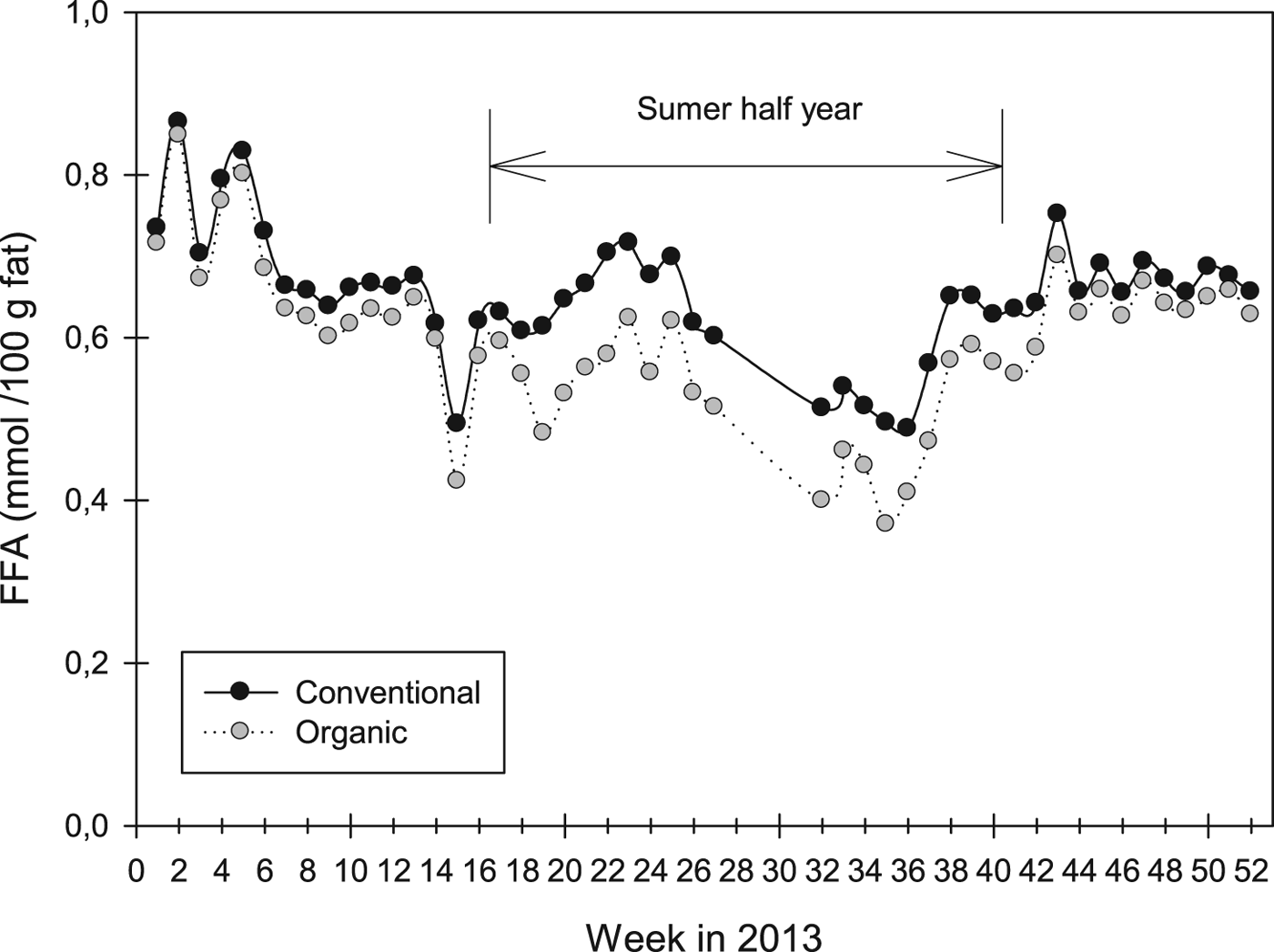
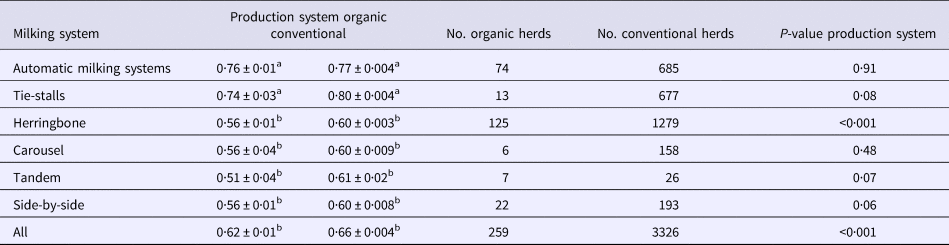
FFA concentrations in bulk milk from 259 organic and 3326 conventional herds were analyzed with FT-IR during one year. Bulk milk from organic herds contained significantly (P < 0·01) less FFA than milk from conventional farms (Table 1) and a significant (P < 0·001) interaction was found between production system and week of the year (Fig. 1). The FFA content in organic milk was markedly lower during the summer months, from about week 16 to week 43, but only a slight difference to conventional milk was found during the winter (Fig. 1). During the summer season cows in Danish organic herds are fed pasture and must by regulation be outdoors for at least 6 h daily. Indoors they are fed a total mixed ration. None of the conventional farms in the study had cows on pasture.
FFA concentration in conventional and organic bulk milk during year 2013

FFA in tank bulk milk from various milking systems and either organic or conventional production systems

LSmeans ± se in mmol/100 g fat.
a,bMeans in the same row with no common superscript differ (P < 0·001).
Table 1 shows that the milk coming from herds using either AMS or tie-stalls contained significantly (P < 0·001) more FFA compared with the other milking systems. For herringbone milking parlors, conventional production resulted in significantly larger FFA concentration (P < 0·001) than organic production but this interaction effect was not found in the other milking systems. In the present study, 21% of the conventional herds used AMS and 20% used tie-stalls, for organic herds it was 29 and 5%, respectively. Most herds (48% of the organic milk producers and 38% of the conventional) used a herringbone parlor. The levels of FFA in milk from herringbone, side-by-side, tandem and carousel systems were rather similar.
The FFA measurements within a herd vary from week to week, so instead of only focusing on average values, the monthly highest FFA measure in each herd was also seen as an indicator for the frequency of milk quality defects regarding FFA. Table 2 present the distribution of the monthly highest values of FFA for the studied milking systems. The majority of herds are in the interval 0·8–1·3 and no carousel, tandem or side-by-side systems were higher than this. For AMS-organic, 17·5% were in the class from 1·3–1·8, and 7·6% had higher FFA concentrations. The frequency of elevated FFA measure >1·3 in AMS-organic herds was higher than for AMS-conventional. A similar pattern was observed for tie-stall herds. Herringbone milking systems had the highest proportion of herds in the FFA intervals below 0·8. The results clearly show that AMS and tie-stalls more often have quality problems with FFA than the other milking systems. In a recent study, the sensory threshold for FFA analyzed by FT-IR was around 1·2 mmol/100 g fat (Wiking et al., Reference Wiking, Løkke, Kidmose, Sundekilde, Dalsgaard, Larsen and Feilberg2017), hence the result indicate that a rather large group of organic herds using AMS (25%) have severe problems with the FFA levels in the bulk tank milk.
Distribution (%) of monthly highest FFA measure in each herd with the various milking systems during a year.

The higher concentration of FFA in milk from AMS or tie-stall herds was expected (Rasmussen et al., Reference Rasmussen, Wiking, Bjerring and Larsen2006). In tie-stalls herds the milk pipelines are often placed high, requiring a large admix of air that hampers the stability of the milk fat globules. The reasons for the elevated FFA concentrations from AMS herds will be discussed in a following section focusing on interaction effects.
The effect of season on the difference between organic and conventional herds indicates that pasture has a beneficial effect by lowering the FFA content in milk. The fatty acid composition of milk changes with time of year in Northern Europe thus a higher content of C18, C18 : 1 and lower content of C14 and C16 are found in the summer period in general, and for organic milk C18 : 2 cis9, trans 11 and C18 : 1 trans 11 also increase (Butler et al., Reference Butler, Nielsen, Slots, Seal, Eyre, Sanderson and Leifert2008; Larsen et al., Reference Larsen, Andersen, Kaufmann and Wiking2014). Besides fatty acid composition, feeding pasture also affects the composition of the milk fat globule membrane by increasing the content of polar lipids that are more unsaturated during summer (Lopez et al., Reference Lopez, Briard-Bion and Ménard2014). This change in the milk fat globule membrane composition leads to smaller milk fat globules (Lopez et al., Reference Lopez, Briard-Bion and Ménard2014). These effects on the milk fat globules may explain the lower FFA content in organic milk compared to conventional during the summer period as small milk fat globules have larger surface tension than large globules and therefore might attract lipase to a lesser degree.
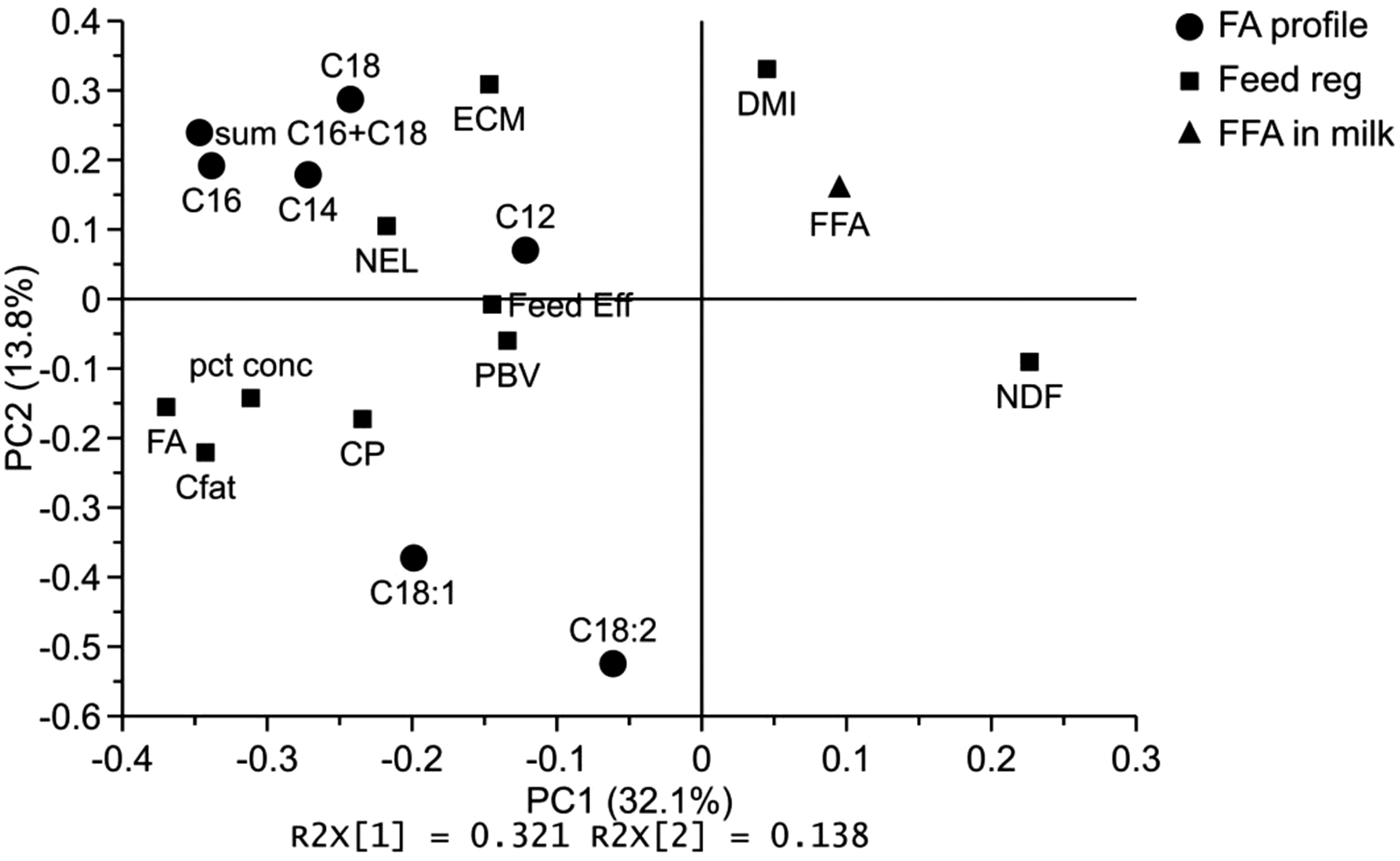
In order to get an overview of the multivariate pattern concerning FFA and feeding, exploratory data analysis was performed by PCA. The loading plot gives an overview of the variation patterns of the feeding parameters together with FFA in the bulk milk (Fig. 2). Principal component 1 (PC1) explained 32·3% of the variation in data and was driven by many of the feed variables; content of neutral detergent fibre (NDF)) on one side and oppositely, fatty acids (FA), crude fat (Cfat) and proportion of DMI from concentrate (Pct conc). Also the fatty acids C14, C16 and C18 were high on PC1. PC2 explained 14·4% of the variation and was dominated in the top of dry matter intake (DMI), milk yield (ECM) and the saturated fatty acids C14, C16 and C18 on one side and on the other side the unsaturated fatty acids c18 : 1 and c18 : 2. FFA was placed close to the center of PC1 and PC2 in the plot, indicating that the variation pattern of FFA in milk was not clearly related to the variation pattern in the feeding variables. Partial least squares regression was also used to analyze correlations between feeding regimes and FFA in milk, and was able to explain only 19% of the variation in FFA (Data not shown).
Principle component (PC) analysis showing loading plot of individual fatty acids (FA profile), free fatty acids content in milk (FFA in milk) and feed registration variables (Feed reg) except for dry matter, all variables are dry matter standardized; NEL: Daily intake in MJ net energy, DMI: Daily intake in kg dry matter, Cfat: Crude fat in g per kg DMI, FA: Fatty acids in g per kg DMI, CP: Crude protein in g per kg DMI, NDF: Neutral detergent fibre in g per kg DMI, PBV: Protein balance in the rumen in g per kg DMI, Pct conc: Proportion of DMI from concentrate.

Earlier studies have shown that saturated fat supplementation (C16 and C18 FA) can lead to increased FFA concentration in milk (Astrup et al., Reference Astrup, Vik-Mo, Skrøvseth and Ekern1980; Wiking et al., Reference Wiking, Björck and Nielsen2003). These experimental studies used a very high level of saturated fat which is typically not used in Danish herds today. The present results indicate that the long chain saturated fatty acids in feed rations to some degree contribute to more FFA in milk. Underfeeding of the dairy cows, by restricting pasture for example, can cause higher concentration of FFA in milk (Thomson et al., Reference Thomson, Van der Poel, Woolford and Auldist2005). The general feeding regime in Danish herds is intensive (even during the pasture season of organic cows, cows are supplemented with concentrate in order to sustain a high milk yield). By comparing the results from Figs 1 and 3, the present study indicates that grazing has a beneficial influence on the FFA level in milk; and long chain saturated fats in concentrate has a slightly negative effect.
FFA concentration in bulk milk as a function of milking interval in organic or conventional AMS herds.

Interaction effect between milking interval in AMS and type of feeding regimes on milk FFA concentration
In data set D, the average milking interval from each herd was calculated. Figure 3 shows that with shorter milking intervals the FFA concentrations in the bulk milk from both organic and conventional herds using AMS increased (P < 0·001). However, a strong interaction (P < 0·001) between milking interval and production system (organic vs. conventional) was present. The effect of decreased milking interval on milk FFA for organic cows was linear in the whole range, whereas for conventional cows there was no further decrease after 585 min (approximately 10 h. Fig. 1 and Table 1). Within AMS herds, no difference in concentration of FFA in bulk milk between organic and conventional herds was observed (Table 1) which is in accordance with little difference in FFA content at shorter milking interval (Fig. 3). The average milking interval was only 9 min shorter in conventional (553 min) than organic herds (562 min). In other milking systems such as herring bone, longer milking intervals are the norm and a smaller FFA content in organic herds was observed. The possible reasons and mechanisms for greater FFA at higher milking frequency are discussed further in the following section.
Effect of technical factors and milking frequency on FFA concentration in milk from AMS
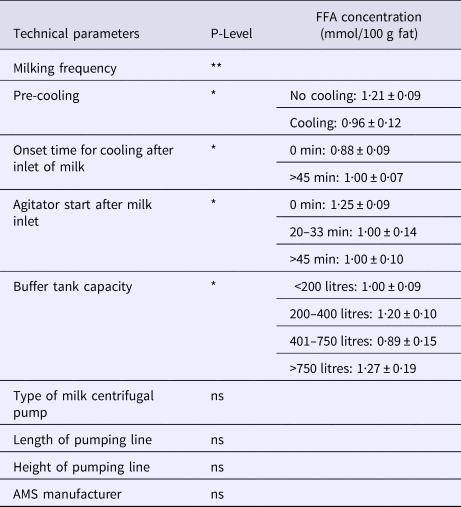
In 277 AMS herds information about all technical equipment was available. The factors having significant (P < 0·05) influence on FFA content in milk from AMS systems were milking frequency, pre-cooling, onset time for milk cooling after inlet to bulk tank, agitator start after milk inlet and buffer tank capacity (Table 3). As expected, we also found a significant relationship between increased milking frequency and increased FFA concentration. Milking frequency was the most significant factor and contributes more than the technological based factors.
Effects of herd average milking frequency and technical parameters in AMS milking systems on FFA in milk

LS means±se in mmol/100 g fat.
ns, Non-significant.
It has been reported that the increase in FFA content during more frequent milking is not caused by insufficient triacylglycerol synthesis but occurs during storage, which indicates that a weaker protective milk fat globule membrane is formed (Wiking et al., Reference Wiking, Nielsen, Båvius, Edvardsson and Svennersten-Sjaunja2006). In the same study it was also observed that the average diameter of MFG was significantly larger in milk obtained when milking four times than when milking twice a day. Milk yield per milking is lower when milking occurs more often. This means that the air to milk ratio in the pipe line increases and therefore the stability of the MFG is reduced by mixing milk with air during pumping or agitation. The clash between a MFG and an air bubble causes rupture of the MFG, since the membrane material and part of the core fat will spread over the air-milk-plasma interface and will be released into the milk plasma when air bubbles collapse or coalesce (Evers, 2004). Low quarter milk yields are also found associated with high FFA (Rasmussen et al., Reference Rasmussen, Wiking, Bjerring and Larsen2006). Therefore, the mechanisms behind greater FFA content at higher milking frequency in AMS is both biologically and mechanically derived, although the biological effect may contribute most, since the spontaneous lipolysis is high (Wiking et al., Reference Wiking, Nielsen, Båvius, Edvardsson and Svennersten-Sjaunja2006).
In AMS, it is possible to place a buffer tank before the bulk tank. In this layout smaller portions of milk are cooled before it is pumped further to the bulk tank. If milk is not pre-cooled before it is lead into the bulk tank there is a risk for temperature fluctuations in milk, which was reported to increase the FFA formation (Cartier and Chilliard, Reference Cartier and Chilliard1989). Depending on the volume of the cold milk, the temperature may increase in the whole tank or just locally where the cold and warm milk meet. Cooling itself provides crystallization of the triglycerides, which will result in some structural changes of the milk fat globule membrane due to lower volume of solid fat than liquid. This will presumably cause changes in the interfacial pressure around the milk fat globule membrane. Plasma proteins adsorb to the milk fat globule membrane upon cooling. In this way, the LPL comes into contact with the lipids, since it is bound to the caseins (Dickow et al., Reference Dickow, Larsen, Hammershøj and Wiking2011). Increasing the temperature with warm milk around the fat globule means that the activity of the LPL increases, and because it is now situated at the substrate, the FFA formation will be large. The present study demonstrates that pre-cooling of the milk reduces the FFA formation (Table 3), but unfortunately only a minority of the herds use pre-cooling. Starting the cooling of milk at the time it is pumped into bulk tank also has a beneficial effect on the FFA content (Table 3) because it reduces temperature fluctuations, and because the crystallized milk fat thus becomes resistant to the mechanical treatment from stirring.
Starting the agitator in the bulk tank before the blades are fully covered also lead to increased FFA concentration (Table 3). When the stirring unit only touches the milk surface, mixing of air into milk is inevitable, which contributes to the rupture of milk fat globules. Waiting 20 min or more secures a gentler stirring. The significant effect of buffer tank capacity is not straightforward, since the smallest FFA content is found at a tank size of 401–750 litres and both larger and smaller tanks cause higher FFA content (Table 3). An early start of cooling in the bulk tank also produces a significantly lower FFA content, on the other hand this has to be done correctly so that freezing of milk on tank walls is avoided. No significant effect of centrifugal pump type, length and height of pumping line and type of AMS manufacturer was found.
In conclusion, the present study demonstrates that in summer, organic herds have a lower FFA concentration in bulk tank milk, which is probably caused by their cows being on pasture during this period. Milk coming from AMS and tie-stalls have larger concentration of FFA than herds with other milking systems. Also, organic producers using AMS and tie-stalls deliver milk with elevated content of FFA. Cows managed organically produce milk of similar quality regarding FFA as cows in conventional herds when milked at short intervals but perform better at long milking intervals. In AMS, short milking interval is the most significant contributor to elevated FFA content in milk. Moreover, technical factors including pre-cooling, onset time for cooling after milk inlet, contact between milk and agitation also impact on the FFA in bulk tank milk. Feed ration differences accounted for up to 19% of the variation in FFA in milk.
Acknowledgement
This work was financial supported by the Danish Milk Levy Foundation and by the Danish Agency for Science and Technology via the Innovation consortium `FuturemilQ`.