In the provocatively titled Indoctrination U., David Horowitz argues that radical members of college faculties have “intruded a political agenda into the academic curriculum,” engaging in propaganda rather than scholarship and indoctrinating students rather than teaching them (Horowitz Reference Horowitz2007, xi). Although allegations of liberal bias in academia are nothing new, the issue has gained increased attention as the result of efforts by Horowitz and the Center for the Study of the Popular Culture (CSPC) to promote the Academic Bill of Rights for American colleges and universities.Footnote 1
According to Horowitz, the goal of the Academic Bill of Rights is to inspire college officials “to enforce the rules that were meant to ensure the fairness and objectivity of the college classroom” (Horowitz Reference Horowitz2007, 2).Footnote 2 Supporters argue that an Academic Bill of Rights is needed to “protect students from one-sided liberal propaganda … [and] to safeguard a student's right to get an education rather than an indoctrination.”Footnote 3 Opponents of the initiative, including the American Association of University Professors, have characterized the Academic Bill of Rights as an assault on academic freedom (Jacoby Reference Jacoby2005; Schrecker Reference Schrecker2006) that is based on exaggerated claims of anti-conservative bias (Ehrlich and Colby Reference Ehrlich and Colby2004; Wiener Reference Wiener2005; Jacobson Reference Jacobson2006a; Reference Jacobson2006e; Jaschik Reference Jaschik2006c).Footnote 4
Although a growing body of social science research indicates that college faculties are disproportionately liberal and Democratic, at least when compared with the population in general (Brookings 2001; HERI 2002; Klein and Western Reference Klein and Western2005; Jaschik Reference Jaschik2005b; Klein and Stern Reference Klein and Stern2005a; Reference Klein and Stern2005b; Reference Klein and Stern2006; Rothman, Lichter, and Nevitte Reference Rothman, Lichter and Nevitte2005) there has been very little systematic research on whether faculty members' political leanings actually affect the ideological views of the students they teach. If students' political views are being changed by a left-leaning professoriate, we should be able to see evidence of that influence; indeed, we would expect that changes in political orientation would be most dramatic among students at more ideologically liberal institutions.
This study utilizes empirical evidence from the CIRP Freshman Survey, the College Student Survey, and the Higher Education Research Institute (HERI) Faculty Survey to assess the effect of faculty ideology on the political attitudes of undergraduate students over the course of a four-year college career (2001–2005). Our analysis of 38 private colleges and 6,807 student respondents indicates that, consistent with a number of previous studies, faculty members are predominately liberal and Democratic. We find little evidence, however, that faculty ideology is associated with changes in students' ideological orientation. The students at colleges with more liberal faculties were not statistically more likely to move to the left than students at other institutions.
Is the Academy Liberal?
The argument that liberal faculty members are indoctrinating students goes back to the very beginnings of the modern conservative movement and publication of William F. Buckley's God and Man at Yale: The Superstitions of “Academic Freedom” (Buckley Reference Buckley1951). Indeed, the subject has been periodically revisited by a number of right-leaning authors who have criticized the academy for “moral relativism,” “political correctness,” and “liberal orthodoxy” (see for example Bloom Reference Bloom1987; Kimball Reference Kimball1990; D'Souza Reference D'Souza1991; Bennett Reference Bennett1992; Bork Reference Bork1996).
Faculty ideology has become a subject of considerable debate in recent years as the result of publication of a number of studies (some of which were sponsored by the CSPC), which suggest that college faculties are ideologically and politically out-of-step with the general public. In 2002, American Enterprise magazine highlighted the results of 18 studies of faculty party registration patterns on American college campuses (American Enterprise 2002). The data from these studies indicated that faculty members affiliated with “parties of the right” (i.e., Republican, Conservative, or Libertarian) were vastly outnumbered by those affiliated with “parties of the left” (i.e., Democrat, Green, or Working Families). According to two of the studies cited in the report, for example, professors on the right were outnumbered 166 to 6 at Cornell, and 72 to 1 at University of California, Santa Barbara (American Enterprise 2002, 19–23). The editor-in-chief of American Enterprise, Karl Zinsmeister, argued that the study results indicate that colleges and universities are “virtual one-party states, ideological monopolies, badly unbalanced ecosystems. They are utterly flightless birds with only one wing to flap. They do not, when it comes to political and cultural ideas, look like America” (Reference Zinsmeister2005, 18).
The American Enterprise report also included results from a 2001 survey of 151 Ivy League faculty members. The survey, which was sponsored by the CSPC and administered by Republican pollster Frank Luntz, found that 64% of survey respondents described themselves as “liberal” or “somewhat liberal,” while only 6% of respondents described themselves as “conservative” or “somewhat conservative” (Luntz Reference Luntz2001). In addition, only 3% of Ivy League faculty members surveyed identified themselves as Republicans compared with 57% that identified themselves as Democrats.Footnote 5 Likewise, another CSPC study examined party registration data for faculty at 32 elite colleges and found that Democrats outnumbered Republicans by a ratio of more than 10 to 1 (Horowitz and Lehrer Reference Horowitz and Lehrer2003).Footnote 6
In October 2006, the Institute for Jewish and Community Research (IJCR) announced the results of a broad national survey of 1,259 college professors. The IJCR survey, which was administered online, found that respondents were three times more likely to describe themselves as liberal than conservative and 72% reported voting for John Kerry in the 2004 presidential election (Wilson Reference Wilson2006). Likewise, a review of political donations by the Center for Responsive Politics indicated that faculty members and educational employees were far more likely to contribute to Democratic candidates and PACs than Republican ones during the 2004 and 2006 election cycles (Smith Reference Smith2006). Similar studies have also found that law school professors donate disproportionately to Democratic candidates (McGinnis and Schwartz Reference McGinnis and Schwartz2003; McGinnis, Schwartz, and Tisdell Reference McGinnis, Schwartz and Tisdell2005; Liptak Reference Liptak2005).
In addition to the many studies sponsored by ideologically oriented groups, a growing body of social science research lends additional support to the argument that American college faculties are disproportionately liberal and Democratic.Footnote 7 Several large-scale faculty surveys, for instance, have identified a leftward tilt within specific academic disciplines, including the social sciences (Klein and Stern Reference Klein and Stern2005a; Reference Klein and Stern2005b; Klein and Western Reference Klein and Western2005)Footnote 8 and sociology (Klein and Stern Reference Klein and Stern2006).Footnote 9
Similarly, in a survey of 550 professors in economics, history, political science, and sociology sponsored by the Brookings Institution—a center-left think tank—only 8% of respondents described themselves as conservative or very conservative, compared with 31% who described themselves as liberal or very liberal. In that same survey, 77% of respondents identified themselves as Democrat or lean Democrat compared with 13% who were Republican or lean Republican (Brookings 2001).
Other studies have reached across multiple disciplines to examine the ideological and political orientations of a broad cross section of faculty members. A 2001–2002 survey of more than 55,000 faculty and administrators at 416 colleges by the nonpartisan Higher Education Research Institute found that 47.6% of faculty members were on the left, compared with just 18% on the right (Jaschik Reference Jaschik2005b; HERI 2002).Footnote 10 Similar results were also reported by Rothman, Lichter, and Nevitte (Reference Rothman, Lichter and Nevitte2005) in their analysis of a national survey of more than 1,600 randomly selected faculty members from 183 four-year colleges and universities. In their study, Rothman, Lichter, and Nevitte found that 72% of faculty self-identified as liberal and just 15% as conservative. In addition, 50% of faculty members self-identified as Democrats, compared with just 11% who were Republicans. Though liberal and Democratic majorities were most pronounced among the humanities and social sciences, a liberal orientation was also found in business and economic departments, albeit to a somewhat lesser extent.Footnote 11 Rothman, Lichter, and Nevitte compared their results with those from a 1985 Carnegie study and concluded that faculty ideology has veered sharply to the left:
Over the course of 15 years, self-described liberals grew from a slight plurality to a 5 to 1 majority on college faculties. By comparison, among the general population in 1999, 18% viewed themselves as liberal and 37% conservative. In 2004 the figures were almost unchanged—18% liberal and 33% conservative. Thus, according to these self-descriptions, college faculty are about four times as liberal as the general public. (Rothman, Lichter, and Nevitte Reference Rothman, Lichter and Nevitte2005, 4–5)
In addition to survey-based research, several methodologically sophisticated studies of voter registration patterns suggest that faculty members' liberal ideological preferences are likely to translate into partisan preferences that favor the Democrats. A study by Klein and Western (Reference Klein and Western2005) looked at the party identification of faculty members across 23 academic departments at University of California, Berkeley, and Stanford found ratios of Democrats to Republicans of 9.9 to 1 and 7.6 to 1, respectively. Cardiff and Klein (Reference Cardiff and Klein2005) expanded on this study by examining the partisan affiliations of tenured and tenure-track faculty at 11 California colleges and universities. The authors found that Democrats outnumbered Republicans by a 5 to 1 ratio and, though there was variation across disciplines, Democrats outnumbered Republicans in all fields. The ratio of Democrats to Republicans was highest within the liberal arts (8 to 1 Democrat to Republican) and lowest in the field of business (1.3 to 1).
To be certain, many in the academy and elsewhere have taken issue with the methodology employed and conclusions drawn by the (mostly) conservative groups and right-leaning scholars who have addressed the issue of faculty ideology and politics (Jacoby Reference Jacoby2005; Berube Reference Berube2006). Zipp and Fenwick (Reference Zipp and Fenwick2006), for example, argue that many of the studies that purport to show liberal dominance are unrepresentative, focusing on a small number of elite colleges and a small range of academic disciplines. They also criticize the decision to focus on party identification, arguing that the most useful measure of political diversity on campus is political ideology rather than party membership or voting history. Zipp and Fenwick also point out that larger and more representative studies of faculty ideology indicate that faculty divisions are more narrow than conservative critics suggest, citing Ladd and Lipset's (Reference Ladd and Lipset1975) finding of a 2 to 1 liberal to conservative ratio in their analysis of 1969 data, HERI's finding of 2.6 to 1 (2002) and Hamilton and Hargens (Reference Hamilton and Hargens1993) finding of 1.2 to 1.
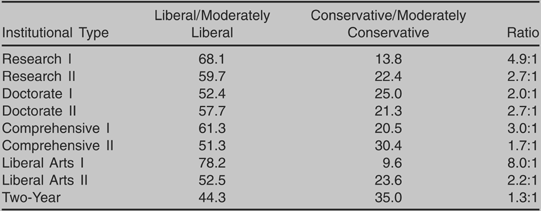
Although Zipp and Fenwick conclude that “it is misleading to claim that faculty at American colleges and universities are overwhelmingly and increasingly liberal” they also note that “there are relatively few conservatives in the academy” (Reference Zipp and Fenwick2006, 316).Footnote 12 Indeed, the Carnegie Foundation data the authors rely on indicates that left-of-center faculty members far outnumber those on the right. Nearly 56% of faculty members are liberal or moderately liberal, compared with just 24% that are conservative or moderately conservative. The difference is particularly stark at the farthest points of the ideological spectrum, with more than three times as many faculty members describing themselves as “liberal” as “conservative” (23% versus 7%). In addition, though Zipp and Fenwick do find evidence of ideological variation across institutions and disciplines, their figures (collapsed and re-presented here in Table 1) actually show a decidedly left-wing orientation for all types of four-year colleges, with the ratio of liberals to conservatives particularly high in top-tier liberal arts colleges (8 to 1 liberal to conservative) and elite research universities (a 5 to 1 ratio). Though conservatives fare better at two-year colleges, comprehensive colleges, and lower-tiered liberal arts and research institutions, the Carnegie data presented by Zipp and Fenwick indicate that college faculties do lean to the left, though perhaps not as far out as conservative critics allege.
Percent of Faculty Identifying as Liberal versus Conservative, by Institutional Type

Source: 1989 Carnegie survey data presented by Zipp and Fenwick (Reference Zipp and Fenwick2006) Table 3, 312. Categories were collapsed to provide comparable categories of liberal/moderately liberal and conservative/moderately conservative.
Causes and Consequences
The debate over faculty ideology has shifted away from whether college faculties are liberal (the evidence from most studies suggests that they are) towards an examination of the causes and consequences of a left-leaning professoriate. Arguments about the causes of the ideological imbalance often center on whether the liberal makeup of the academy is due to ideological bias and discrimination against conservatives, or merely the result of the self-selection of conservatives into other professions (see Jacoby Reference Jacoby2005, or the exchange between Rothman, Lichter, and Nevitte Reference Rothman, Lichter and Nevitte2005 and Ames et al. Reference Ames, Barker, Bonneau and Carman2005).Footnote 13
The debate over consequences revolves around the allegations made by conservative groups like the CSPC that ideological imbalance in the academy has led to discrimination against conservative students and faculty (Wilson Reference Wilson2005; Jacobson Reference Jacobson2004a; Reference Jacobson2004b; Braunlich Reference Braunlich2004), a one-sided approach to scholarship and political debate (Pilger Reference Pilger2004; Bauerlein Reference Bauerlein2004; Reference Bauerlein2005), and the indoctrination of college students to liberal viewpoints (Salerno Reference Salerno2003, 12; Horowitz Reference Horowitz2005; Reference Horowitz2007; Neal, French, and Siegel Reference Neal, French and Siegel2005).Footnote 14 Allegations of discrimination in hiring and promotion, for instance, are the subject of a vigorous but as yet inconclusive debate. A 2005 study by Rothman, Lichter, and Nevitte concluded that conservative scholars are discriminated against in hiring and promotion. The Rothman study has been criticized by some members of the academy, however, who argue that the sample is unrepresentative; these critics point to self-selection, not discrimination, as the key factor that accounts for varying levels of professional success for liberals and conservatives in academia (Ames et al. Reference Ames, Barker, Bonneau and Carman2005; Berube Reference Berube2006, 68–70).Footnote 15
Both liberals and conservatives have presented examples and counterexamples of student-faculty interactions that support their opposing positions on the intellectual climate of the academy (see Horowitz Reference Horowitz2007; Berube Reference Berube2006). Thus far there is no definitive empirical evidence of widespread or systematic ideology-based bias on the part of faculty. Indeed, Kemmelmeier, Danielson, and Basten's recent study (Reference Kemmelmeier, Danielson and Basten2005) of the relationship between ideology and grading patterns at a single large public university casts doubt on previous studies that found that liberal faculty members in some disciplines grade conservative students more harshly than liberals. The study, which included 3,890 students, found that conservative students received grades equal to or higher than more liberal students; in fact, conservatives actually scored higher grades than liberals in the fields of business and economics and there was no difference between the grades received by liberals and conservatives in sociology, African American studies, and other more liberal fields of study (Kemmelmeier, Danielson, and Basten Reference Kemmelmeier, Danielson and Basten2005).Footnote 16
Only a handful of studies have attempted to assess whether faculty liberalism actually affects the political beliefs of college students. Zipp and Fenwick (Reference Zipp and Fenwick2006) used faculty responses to questions about the goals of undergraduate education, intellectual freedom, and standards of scholarship as a means to assess the willingness of faculty members to impose their views on students and their commitment to intellectual and academic freedom. Zipp and Fenwick concluded that, compared to conservatives, more liberal faculty members were more supportive of tenure and other protections of academic freedom and less likely to agree that “shaping students' values” is as an important goal of undergraduate education. Unfortunately, for our purposes the Zipp and Fenwick study is more useful as an indicator of how ideology shapes faculty perceptions about professional norms and their place in the profession than as a measure of indoctrination. Conservatives have long alleged that the academy has embraced liberal ideals and rejected Western values in favor of postmodern relativism; thus, it is not surprising that conservative faculty members are less supportive of tenure and more supportive of “value-based” education than their more liberal colleagues. Likewise, if liberal indoctrination is as commonplace in the academy as has been alleged, liberal professors may be less likely to recognize it and conservatives more likely to push back.
Kelly-Woessner and Woessner (Reference Kelly-Woessner and Woessner2006) examined faculty ideology more directly by assessing the impact of faculty members' political dispositions on nearly 1,400 students taking introductory political science courses at 29 colleges and universities. Although this study found that students perceive most faculty members to be liberal, it also concluded that students give less credence to the statements of faculty members who did not share the students' own political views (Kelly-Woessner and Woessner Reference Kelly-Woessner and Woessner2006; Jaschik Reference Jaschik2006b).Footnote 17 Thus, even if faculty members are disproportionately liberal, this study suggests that faculty ideology is unlikely to have much of an impact on student views.Footnote 18 The main benefit of this approach is that it provides insight into the way ideology shapes student and faculty assessments of one another. The study is limited, however, in that it examines the impact of faculty ideology on students taking a single course. Additional research is needed to take into account the effect of faculty ideology on student ideology across multiple classes or over the duration of a college career.
The indoctrination argument is fundamentally an argument about change, the main point being that liberal professors indoctrinate students to become more liberal over the course of their college careers. Thus, in order to assess whether there is evidence of indoctrination, additional empirical research is needed that takes into account both faculty ideology and changes in student political orientation that occurs between the time that students start and finish college.
Research Question
Our primary research question is whether there is a significant relationship between the liberalism of faculty at an institution and changes in the political orientation of students over the course of their college careers. Simply put: is there evidence that students shift their political orientations to correspond more closely to the political dispositions of the faculty at their college or university? In addition to faculty ideology, we are also interested in assessing the effect of other potentially relevant factors that may contribute to student ideological change, including institutional type (religious or nonsectarian), institutional selectivity, and peer orientation. It should be emphasized, however, that we are not attempting to study the behavior of college professors or to argue that the ideological makeup of the professoriate is a good or bad thing. Our focus is limited to one of impact: is there evidence that faculty ideology affects student ideology over the course of students' four years in college?
Sample and Variables
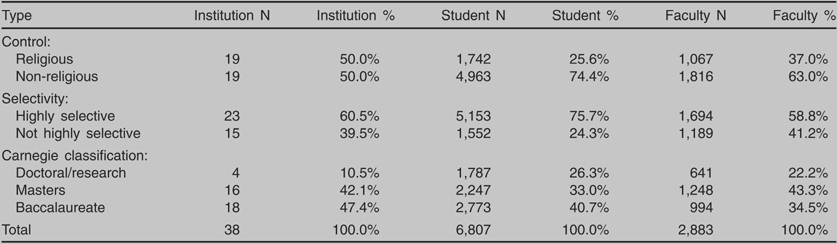
Data for this study came from the Cooperative Institutional Research Program's (CIRP) 1999 Freshman Survey, the 2003 College Student Survey (CSS), and the 2003–2004 Faculty Survey, all sponsored by the HERI at the University of California, Los Angeles. The overall student sample consisted of 7,999 students attending 47 different private institutions, both nonsectarian and religiously affiliated. Students completed the freshman survey upon entering college in the fall of 1999 and the CSS in their fourth year of college, in 2003. The CSS results included only students who were still at the same institution in 2003 that they entered in 1999. After taking out CSS non-completers, nine institutions had an unacceptably low number of respondents remaining, and those schools were taken out of the sample. The final sample consisted of 38 institutions with 6,807 student respondents (see Table 2).
Institutional Profile

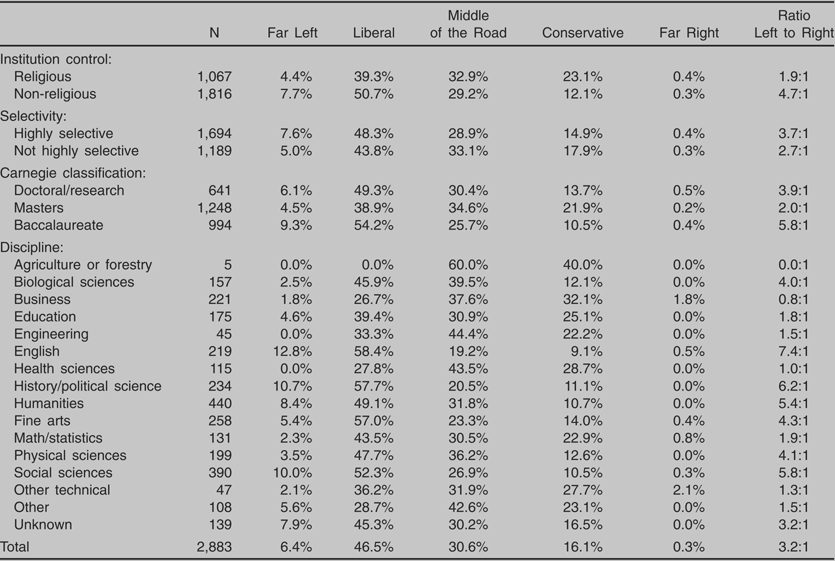
The faculty sample consisted of 2,883 useable responses from faculty members participating in the 2003–2004 HERI faculty survey. Faculty members came from the same set of institutions as those examined in the CSS/CIRP studies and respondents represented a broad array of discipline areas (see Table 3). The institutions included in this study represent the four-year institutions that administered all three of the surveys in the same years. In order to maintain the anonymity of institutions, a masked dummy variable was created by HERI that allowed for the matching of students and faculty by institution. For each institution, HERI also provided a unique identifier and a stratification code indicating control and selectivity for each institution.
Faculty Political Orientation by Institutional Types and Disciplines

Freshman Survey
This study utilized data from the (fall) 1999 CIRP freshman survey. The CIRP freshman survey consists of a variety of items aimed at measuring the characteristics, attitudes, values, and aspirations of students (HERI 2007). To preserve anonymity, masked unique identifiers were assigned by HERI so that student and faculty data could be matched. A CIRP stratification code indicating institution type (religious/non-religious) and Carnegie classification were also provided for each respondent. Political orientation is a standard item on the freshman survey instrument every year, as students are asked to identify their political orientation on a five-point scale from far right to far left.
College Student Survey (CSS)
The College Student Survey (CSS) was developed to measure students' cognitive and affective growth during college as well as their post-college plans (HERI 2007). It is administered to students in their final (senior) year of college and many of the items on the CSS are similar to, or the same as, items on the CIRP freshman survey. This study utilized data from the (spring) 2003 CSS. When considered together, CSS and CIRP datasets enable researchers to measure changes in student responses over time for a number of key attitudinal measures, including political orientation
HERI Faculty Survey
The HERI faculty survey was designed to provide information about the attitudes, experiences, concerns, job satisfaction, workload, teaching practices, and professional activities of college and university faculty (HERI 2007). As in the freshman survey and the CSS, faculty members were asked to identify their political orientation on the same five-point scale. As shown in Table 3, the orientation of the faculty is predominately liberal. Of all faculty respondents, 53% identified themselves as “liberal” or “far left” compared with 16% of respondents who identified themselves as “conservative” or “far right.” For comparative purposes, a 2004 American National Election Study (ANES) survey found that approximately 25% of the general population identified themselves as left-of-center and 41% to the right (ANES 2004).
Variables
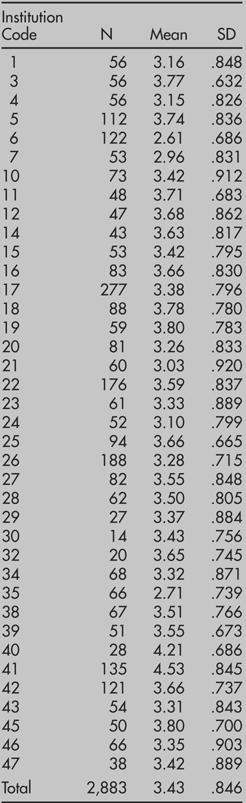
Our first step was to develop an institutional faculty political orientation variable using responses to the political orientation item on the faculty survey. The average responses for each institution were calculated and used to populate this variable. The averages for institutions range from 2.61 to 4.53, with the lower averages representing more conservative faculty and the higher averages representing more liberal faculty (a list of faculty political orientation by institution is provided in Appendix 1).Footnote 19 Second, we measured the degree of change in students' political orientation from their first year to their fourth year by subtracting the CSS political orientation scale response from the freshman political orientation scale response. Students who completed the freshman survey but did not complete the CSS were dropped from the analysis. Third, we developed an institutional peer-orientation variable by averaging the student responses on political orientation from the freshman survey. This will tell us, in relative terms, the political orientation of the students as they arrived at college.
We then ran a multiple regression analysis to assess the relationship between the independent institution-wide variables of faculty political orientation, peer (student) political orientation, control type, and selectivity level, and the dependent variable, change in student orientation. We also ran a regression analysis with those same institution-wide characteristics combined with the personal student characteristics of gender, race/ethnicity, and family income.
Results and Analysis
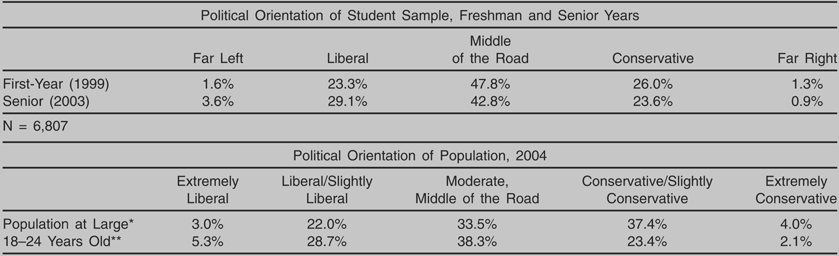
We first took a descriptive look at the students' political orientation as identified in their freshman and senior years. As shown in Table 4, there were slightly more students who identify as conservative or Far Right than liberal or Far Left when entering college, with almost one-half identifying as middle of the road. By the time these students graduated, their orientation had moved to the left and liberal/Far Left students outnumbered conservative/Far Right students by more than 8%. While the net change of more than 10% toward the left seems like a significant swing, this can be put in the context of the more left-of-center political orientation of 18–24-year-olds in the general population. Indeed, an examination of the self-identified political ideology of 18–24-year-olds who participated in the ANES (also presented in Table 4) indicates that the senior-year students in our sample identify as being left or right of center at the same general rates as members of this age group in the voting population. Thus, even though there as a net shift of 10% toward the left in our sample, the students were actually moving towards the population norm, not away from it.
Self-Identified Political Orientation

* N = 907
** N = 94
Source: 2004 American National Election Study
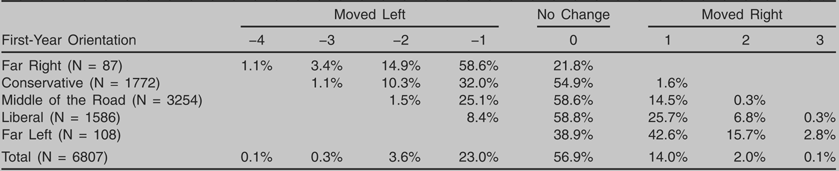
Table 5 shows the degree to which student political orientation changed from freshman to senior year. Almost 57% of the students identified the same orientation as seniors as they did as freshmen. Another 23% reported a change of one scale placement to the left, and another 4% reported a change of two or more to the left. To the right, 14% reported a change of one scale placement and a little more than 2% reported movement of two or three placements. In all, 27% moved to the left and 16% moved to the right.
Change in Political Orientation by Degree of Movement on Orientation Scale, All Students

Regression
Our analysis focused on the change in political orientation at the institutional level and, using change in student political orientation as the dependent variable, we ran a regression model with the following institutional characteristics:
• average faculty political orientation,
• average freshman political orientation,
• institutional control (religious/non-religious), and
• selectivity (highly selective/not highly selective).
Understanding and controlling for the interaction between faculty orientation and other characteristics is important because these characteristics allow us to take into account other factors related to institutional culture. The political orientation of a freshman is important because it tells us the orientation of the student prior to attending college and if students of a certain orientation self-select into specific schools. Institutional control based on religion can certainly affect the political culture of a college or university as well as the type of students who self-select into those institutions. Institutional selectivity is particularly relevant because the literature and rhetoric on faculty bias specifically identifies elite institutions as being some of the worst offenders (Horowitz and Light Reference Horowitz and Light2006).
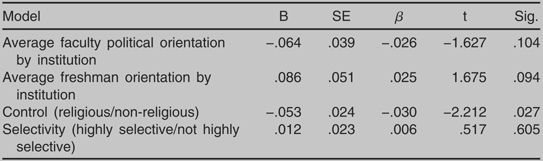
Table 6 shows the results of the regression model using the institutional characteristics noted above. Institutional control was the only variable to reach a level of significance (p < .05), where students at non-religious schools moved farther to the left than their counterparts at religiously affiliated schools.
Regression Analysis of Institution-Wide Variables on Student Change in Political Orientation

F(4,6,802) = 3.343, R = .044, R2 = .002
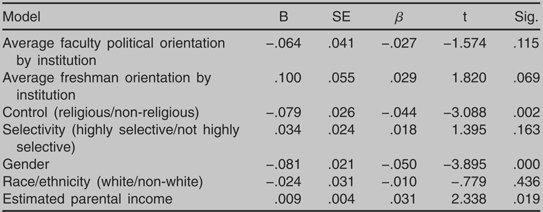
We also ran a second regression model to assess the impact of individual student characteristics as well as institutional characteristics. In addition to the institutional factors included in the original model, the second model also considered gender, race (white/non-white), and estimated family income. As shown in Table 7, both gender and family income reach levels of significance. Based on these findings we can tell that women move more to the left while in college than men, and that as a student's family income becomes higher, change in political orientation moves to the right. In neither of these regression models did faculty orientation have a significant relationship with the independent variable.
Regression Analysis of Institution-Wide and Student Demographic Variables on Student Change in Political Orientation

F(7, 6185) = 5.295, R = .077, R2 = .006.
Finally, we categorized the 38 institutions into relative faculty orientation groups; the third with the lowest average faculty orientation scores were labeled more conservative, the middle third were labeled moderate, and the top third were labeled more liberal. Students in the more conservative third of the institutions (in terms of faculty orientation) had a mean orientation of 2.81, compared with 2.93 for students in the moderate group and 3.12 for students in the more liberal third (see Table 8). An analysis of variance (ANOVA) finds that the difference in freshman political orientation between these groups is statistically significant. Students entering the institutions with more conservative faculty tended to be more conservative, students entering the liberal institutions were more liberal, and the students entering the moderate institutions fell between the two other groups.
Mean Freshman and Senior Political Orientation by Relative Faculty Institutional Orientation

Differences across faculty orientation groups were statistically significant at both the freshman and senior levels, F(2, 6807) = 72.93, 77.14, p < .000. The differences in mean change were not significant, F(2, 6807) = 1.09, p = .333. Institutions were ranked from liberal to conservative and divided into thirds for the purpose of this analysis. Political orientation scale is as follows: 1 = Far Right, 2 = conservative, 3 = middle of the road, 4 = liberal, 5 = Far Left.
We also examined the differences in the mean change in political orientation from freshman to senior year for the students in each of the three groups. As Table 8 also shows, all three groups moved slightly to the left. Though the conservative group shifted to the left to a lesser degree than the other two groups, the differences in mean change between the groups is very small and not statistically significant.
Discussion
The goal of this study is to assess whether faculty political orientation is associated with changes in student political orientation. The findings presented here suggest that faculty political orientation at the institutional level does not significantly influence student political orientation. The descriptive data also indicate that while faculty orientation is overwhelmingly liberal, student orientation when leaving college is not significantly different than the population at large. Our analysis did find that other institutional and personal characteristics, including institutional control, gender, and socio-economic status, have an effect on changes in student political ideology. It should be noted that neither of the regression models had a high level of predictive value (R2 = .002, R2 = .006), but they did show which key variables were significantly correlated with change in student political orientation.
The finding that institutional control is correlated with change in political orientation is not surprising. Students at religiously controlled institutions were less likely to move to the left during their college career and we believe that this is most likely due to self-selection. Students with strong religious beliefs are probably more likely to attend religiously controlled institutions. Institutional culture may also play a part, as both the freshman and faculty surveys indicate higher levels of conservatism among peers and faculty members at religious institutions.
Our results show that female college students are more likely than men to move to the left during the course of their college careers. It is well established that in the general population women are more liberal than men and according to Dey (Reference Dey1997) and data from the ANES that is also the case for college-aged women.Footnote 20 Our results also indicate that higher socioeconomic status (as measured by estimated parental income) is associated with changes in political orientation toward the right. The finding that more wealthy students are more likely to move to the right during the course of their college careers (and vice versa) may reflect increasing student awareness about political parties and ideologies and where they stand on issues related to wealth, taxes, and government assistance for lower-income Americans (see for instance Stonecash, Brewer, and Mariani Reference Stonecash, Brewer and Mariani2002).
Though we are hopeful that this study contributes to ongoing debates about faculty ideology and indoctrination, there are some limitations to this study that should be taken into account by other researchers. We are mindful, for instance, that our finding that students move leftward during college is not, by itself, evidence of indoctrination. Students may move to the left as a result of other factors, such as shared cultural influences, a common stage in personal development, or as a reaction to peer pressure, current events, or political developments. We have tried to deal with this problem by controlling for faculty ideology; if faculty ideology has an impact on student ideology then changes in student ideology should be more pronounced at institutions with more liberal faculty members and vice versa. We find little evidence that this is the case. Of course, this finding does not necessarily mean that professors act fairly or without ideological bias in their teaching, subject matter, or selection of reading materials. Professors could, after all, be failing to indoctrinate students despite their concerted efforts to do so! Regardless of any biases (intentional or unintentional) that professors bring to their teaching, the findings presented here may help alleviate the concern that students, on a widespread basis, are adopting the political positions of their liberal professors.
Another limitation of this paper is that it focuses on institutions and, in doing so, it does not tell us much of anything about a student's individual experiences or the ideological views of the particular professors a student interacted with during their college career. While it would be preferable to take into account the ideology of the faculty members who actually taught each particular student, privacy laws make it very difficult to gather the data without running into considerable problems with regard to sample size and representativeness. In addition there are some advantages to our approach of looking at overall faculty ideology. Part of the argument is that students are being indoctrinated not just in class, but from the general climate created by faculty members that pervades their teaching, scholarship, and outside of the classroom activities. The indoctrination argument is, in large part, about what goes on in the classroom. But what goes on in the classroom is affected by the broader campus culture and vice versa. Thus, the overall faculty ideology of the institution is likely to influence all students in some way.
Though the number of students examined here is considerable (6,807), the number of institutions remains relatively small (38). We were limited by the fact that relatively few institutions participate in all three of the surveys needed to account for faculty ideology and changes in student ideology over time. There are no public universities in the sample, and large percentages are selective liberal arts colleges. Though this is a limitation, many of the conservative critiques focus in particular on elite and private colleges, so it is not entirely without merit to use this sample as a test of the indoctrination argument. It should also be noted that students at these institutions who take longer than four years to complete their programs are unlikely to be included in the senior year surveys used in this study (and were therefore likely to be dropped from the dataset).
A final limitation of this study relates to the potential impact of an exogenous shock—the September 11 terrorist attacks. The college students in our sample began college in the fall of 1999 and finished in the spring of 2003. For the students in this sample, the terrorist attacks of September 11, 2001, took place at the start of their junior year in college, roughly midway through their college careers. Clearly, the September 11 attacks have the potential to impact this cohort of students' political viewpoints. For this reason, further research is needed to assess whether similar changes occur for other groups of students whose college careers occurred under different historical circumstances.
To summarize, there are four important findings here related to questions about faculty ideology and fears that liberal faculty members are indoctrinating students to adopt a liberal ideology. First, it is very clear that faculty members tend to be liberal and are much more liberal than the general population. Second, there is evidence that there is a degree of self-selection going on among students when they choose a college. Students tend to enroll at institutions that have a faculty orientation make up more similar to their own. This area is ripe for further research, for there may be other institutional factors at play, such as campus culture or history. Third, students whose ideology changes while in college tend to change to the left, but that movement is within the normal orientation range of 18–24-year-olds in the general population. Fourth, and most important, there is no evidence that faculty ideology at an institutional level has an impact on student political ideology. Student political orientation does not change for a majority of students while in college, and for those that do change there is evidence that other factors have an effect on that change, such as gender and socioeconomic status. Based on the data presented in this study, college students appear to be more firm in their political beliefs than conventional wisdom suggests. Though students' political ideology is not set in stone, it does not appear to change as a result of faculty ideology, at least at an institutional level.
Mean Faculty Political Orientation by Institution

Scale: 1 = Far Right, 2 = conservative, 3 = middle of the road, 4 = liberal, 5 = Far Left