Introduction
The sweet potato whitefly, Bemisia tabaci (Gennadius), is an exceedingly polyphagous pest capable of developing on hundreds of plant species, including many agricultural crops (Oliveira et al., Reference Oliveira, Henneberry and Anderson2001). Its broad host range has been the subject of many studies aimed at understanding the whitefly's host selection preferences, as well as the influence of host plants on whitefly fitness (Van Lenteren & Noldus, Reference Van Lenteren, Noldus and Gerling1990; Gerling & Mayer, Reference Gerling and Mayer1996).
The taxonomic status of B. tabaci is a complex issue; different populations, while morphologically indistinguishable, display a high degree of genetic and biological variability, and this has led to the definition of B. tabaci as a species complex. To date, more than 20 biotypes, differing genetically and in host range, insecticide resistance, and ability to transmit plant viruses and cause plant disorders, have been designated (Brown et al., Reference Brown, Frohlich and Rosell1995; Perring, Reference Perring2001). While some of the biotypes have a limited host range and local distribution, others, particularly biotype B, are widely distributed and polyphagous. Because biotypes can not be distinguished by morphological characters, their identification is dependent on molecular techniques.
De Barro et al. (Reference De Barro, Trueman and Frohlich2005) recently proposed grouping B. tabaci populations into six geographical races based on COI and ITS1 gene sequences, but the common nomenclature used is still that of biotypes. In Israel, two biotypes have been reported: B (also referred to as the silverleaf whitefly, B. argentifolii Bellows & Perring); and Q. According to the classification of De Barro et al. (Reference De Barro, Trueman and Frohlich2005), these two biotypes belong to two closely related sister groups: the Q biotype, which originated in the Mediterranean Basin; and the B biotype, which arose in the Middle East and Asia Minor. Despite their close geographical origins, these two biotypes rarely interbreed. Females have been reported to reject the mating attempts made by males, and the rare inter-biotype crosses observed resulted in either sterile F1 or a hybrid breakdown at the F2 (Ma et al., Reference Ma, Hadjistylli, Gorman, Denholm and Devine2004; Shai Morin, personal communication). Both pre- and post-zygotic reproductive barriers, thus, seem to exist between the Q and B biotypes tested. The most prominent phenotypic differences between the two biotypes are the higher fecundity and competitive abilities of the B biotype and the greater degree of pesticide resistance of the Q biotype (Pascual & Callejas, Reference Pascual and Callejas2004; Horowitz et al., Reference Horowitz, Kontsedalov, Khasdan and Ishaaya2005).
Like other phloem-feeders, B. tabaci harbors primary symbionts, obligatory bacteria which are essential for its survival and development. The symbiont, Portiera aleyrodidarum, is confined to specialized cells (bactriocytes) and is vertically transmitted (reviewed in Baumann, Reference Baumann2005). In addition to this primary symbiont, B. tabaci is host to a diverse array of secondary symbionts (SS). Although SS are facultatively associated with their hosts, i.e. they are not essential for host survival, they may play important roles in their host's ecology and evolution. SS currently described from B. tabaci are Arsenophonus, Hamiltonella, Wolbachia, Cardinium, Fritschea and Rickettsia (reviewed in Baumann, Reference Baumann2005; Gottlieb et al., Reference Gottlieb, Ghanim, Chiel, Gerling, Portnoy, Steinberg, Tzuri, Horowitz, Belausov, Mozes-Daube, Kontsedalov, Gershon, Gal, Katzir and Zchori-Fein2006), but only Hamiltonella and Rickettsia have been detected in Israeli B. tabaci populations (Gottlieb et al., Reference Gottlieb, Ghanim, Chiel, Gerling, Portnoy, Steinberg, Tzuri, Horowitz, Belausov, Mozes-Daube, Kontsedalov, Gershon, Gal, Katzir and Zchori-Fein2006). The function of these SS in the whitefly is unknown, but other insect-SS systems reveal assorted and intriguing phenomena. In the pea aphid, Acyrthosiphon pisum, for example, five different SS have been identified and studied. Two of them, Hamiltonella defensa and Serratia symbiotica, increase resistance to parasitoids of the genus Aphidius (Oliver et al., Reference Oliver, Russell, Moran and Hunter2003; Ferrari et al., Reference Ferrari, Darby, Daniell, Godfray and Douglas2004). S. symbiotica also improves the aphid's heat tolerance (Montllor et al., Reference Montllor, Maxmen and Purcell2002) and compensates for the absence of the primary symbiont (Koga et al., Reference Koga, Tsuchida and Fukatsu2003). Another SS, Regiella insecticola, is strongly correlated with host plant range, susceptibility to environmental factors, resistance to entomophthogenic fungi and the alteration of dispersal and mating (Tsuchida et al., Reference Tsuchida, Koga and Fukatsu2002, Reference Tsuchida, Koga, Shibao, Matsumoto and Fukatsu2004; Scarborough et al., Reference Scarborough, Ferrari and Godfray2005; Leonardo & Mondor, Reference Leonardo and Mondor2006).
Bacteria of the genus, Rickettsia (α-Proteobacteria), are mostly known as obligate intracellular symbionts of blood-feeding arthropods and as causative agents of many vertebrate diseases such as typhus. They are evidently associated with various phenomena in non-blood feeding arthropods as well, including sex ratio disorders (reviewed in Perlman et al., Reference Perlman, Hunter and Zchori-Fein2006). Wolbachia (α-Proteobacteria) is a well-known ‘reproductive manipulator’, owing to its ability to alter many arthropods' reproduction processes (Stouthamer et al., Reference Stouthamer, Breeuwer and Hurst1999). Wolbachia was traced in previous surveys of B. tabaci (Zchori-Fein & Brown, Reference Zchori-Fein and Brown2002; Nirgianaki et al., Reference Nirgianaki, Banks, Frohlich, Veneti, Braig, Miller, Bedford, Markham, Savakis and Bourtzis2003; De Barro, Reference De Barro2005), and it has been cited as the possible cause of cytoplasmic incompatibility among some B. tabaci biotypes (De-Barro & Hart, Reference De Barro and Hart2000). Arsenophonus spp. (γ-Proteobacteria) also are distributed among a variety of insects including whiteflies, aphids, psyllids and a louse fly (Baumann, Reference Baumann2005; Dale et al., Reference Dale, Beeton, Harbison, Jones and Pontes2006). A. nasoniae causes male embryo mortality in the parasitoid wasp Nasonia vitripennis (Gherna et al., Reference Gherna, Werren, Weisburg, Cote, Woese, Mandelco and Brenner1991), but its effect on other hosts is unknown. Cardinium (Bacteroidetes) is also known as a reproductive manipulator (Weeks et al., Reference Weeks, Velten and Stouthamer2003). Bacteria of the order, Chlamydiales, are often pathogenic to humans and vertebrates, and some are vectored by arthropods (http://www.chlamydiae.com). However, nothing is known about the phenotype of Fritschea (Chlamydiales) in B. tabaci (Everett et al., Reference Everett, Thao, Horn, Dyszynski and Baumann2005).
This study was initiated in order to determine if SS associations and infection frequencies are correlated with the biotype and host plant of B. tabaci, in both field and laboratory populations. We see this as a first step towards understanding the phenotypical characteristics of these symbionts in this insect species complex.
Methods and materials
Whitefly origin and rearing
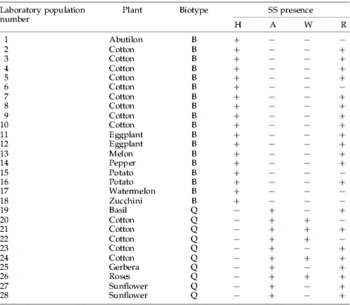
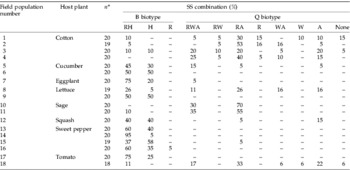
Samples of B. tabaci were obtained from the laboratory collection of Dr R. Horowitz (Beit Dagan, Israel). These whiteflies were originally collected in various agricultural crops, during various years and seasons, at different locations in Israel (table 1) and were maintained in the laboratory as separate populations on cotton seedlings (‘Acala’) (26±2°C, 60% RH, 14L:10D). In order to screen field populations, live B. tabaci adults were collected from various crops at 18 different locations throughout Israel (table 2) during September and October 2005 and were immediately preserved in 96% ethanol.
Presence (+) or absence (−) of secondary symbionts in Bemisia tabaci laboratory populations.

R, Rickettsia; H, Hamiltonella; W, Wolbachia; A, Arsenophonus.
Infection frequencies of different secondary symbiont combinations in Bemisia tabaci field populations.

n=total number of individuals tested from each population (including both biotypes).
R, Rickettsia; H, Hamiltonella; W, Wolbachia; A, Arsenophonus; –, zero.
Screening for the presence of secondary symbionts
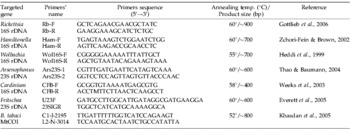
Laboratory populations were first screened in bulk to determine the presence of the various SS. Twenty to fifty adult whiteflies from each lab population were ground together in a lysis buffer as described by Frohlich et al. (Reference Frohlich, Torres-Jerez, Bedford, Markham and Brown1999). This was followed by incubation at 65°C for 15 min, and then at 95°C for 10 min. The presence of Rickettsia, Hamiltonella, Wolbachia, Cardinium, Arsenophonus and Fritschea in the samples was determined using genus-specific primers for amplifying 16S or 23S rDNA gene fragments (table 3). Reactions were carried out in 25 μl volumes each containing 2 μl of the template DNA lysate, 10 pm of each primer, 0.2 mm dNTP's, 1× RedTaq buffer and one unit of RedTaq DNA polymerase (Sigma). PCR products were visualized on 1.2% agarose gel containing ethidium-bromide.
PCR primers and conditions used in the study.

In order to verify the products' identity, bands were eluted, cloned into the pGEM T-Easy plasmid vector (Promega) and transformed into E. coli. For each bacterium, two colonies were randomly picked and sequenced (ABI 3700 DNA analyzer, Macrogen Inc., Korea). The resulting sequences were compared to known sequences in the databases using the BLAST algorithm in NCBI.
In order to assess within- and between-population infection rates of the bacteria found in the laboratory screening, 20 adults were taken from each field population and ground individually according to the method described above. They were screened with the relevant primers for the presence of the SS identified by the bulk screening of laboratory populations (table 3).
Identification of B. tabaci biotypes
Biotypes were identified using a method described by Khasdan et al. (Reference Khasdan, Levin, Rosner, Morin, Kontsedalov, Maslenin and Horowitz2005). Briefly, in this method a fragment of the mtCOI gene is amplified by PCR (Frohlich et al., Reference Frohlich, Torres-Jerez, Bedford, Markham and Brown1999), followed by restriction endonuclease digestion with VspI, which generates a clear polymorphism between biotypes B and Q. PCR reactions were carried out as described above with the addition of 0.2 mm MgCl2. The PCR products were incubated with 0.1 units of VspI (Fermentas) at 37°C for 16 h before loading onto agarose gel.
Statistical analysis
SS frequencies among biotypes and/or plants were compared by a Pearson non-parametric test using the χ2 distribution. JMP 5.0.1 software (SAS Institute) was used for all statistical analyses.
Results
Screening for the presence of secondary symbionts
Laboratory populations
Hamiltonella was detected in all 18 B biotype populations, but was not found in any of the ten Q biotype populations. Wolbachia and Arsenophonus were found only in Q biotype populations (5/10 and 10/10, respectively). Rickettsia was found in both Q biotype (80%) and B biotype (72%) populations (χ12=0.21, P=0.65). Two Q populations were double-infected with Arsenophonus and Wolbachia, five were infected with both Arsenophonus and Rickettsia, and three harbored all three SS (table 1). None of the populations screened tested positive for the presence of either Cardinium or Fritschea.
Field populations
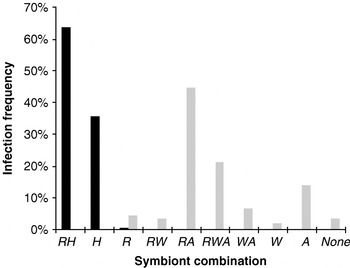
Since neither Cardinium nor Fritschea were detected in the mass laboratory screening, field populations were not screened for these two SS. As in the lab populations, Hamiltonella was detected in virtually all B biotype individuals, whereas none of the Q biotype whiteflies were infected with this bacterium (fig. 1). Wolbachia and Arsenophonus were detected only in Q biotype individuals (33% and 87% infection, respectively). Both biotypes harbored Rickettsia, with a somewhat higher infection percentage in the Q biotype (74% and 64%, respectively, χ12=3.7, P=0.054). All possible combinations of Rickettsia, Wolbachia and Arsenophonus were found among the Q biotype individuals (fig. 1); five of these individuals (3.3%) did not carry any of the SS, while none of the B individuals was SS-free (χ12=6.93, P<0.01). The infection categories distribution was significantly different across the two biotypes (χ92=351.4, P<0.0001).
Frequency of secondary symbiont combinations within field-collected individuals of B and Q biotypes of Bemisia tabaci. R, Rickettsia; H, Hamiltonella; W, Wolbachia; A, Arsenophonus; , B (n=205);, Q (n=150).

The B biotype was dominant in field populations sampled from sweet pepper, cucumber, squash and eggplant (75–100%), while the Q biotype dominated in cotton and sage plots (80–100%) (χ72=208.6, P<0.0001). In tomato and lettuce, the results were not uniform (table 2).
Infection status of SS did not differ among host plants within the B biotype (χ122=8.6, P=0.73) but did vary within the Q biotype (χ212=42, P<0.01). The differences among host plants within the Q biotype were mostly associated with individuals collected from sage plots (n=38), all of which carried both Rickettsia and Arsenophonus. About one-third of these individuals also carried Wolbachia. Among individuals from other host plants, only ∼38% carried both Rickettsia and Arsenophonus and 14–19% were triple infected (table 2). Infection with Rickettsia alone and with the combination of Rickettsia plus Wolbachia was found only in individuals sampled from cotton plots (seven and five individuals, respectively). Wolbachia infection rates were similar, 31–38% across samples from all host plants (χ32=0.26, P=0.96).
Discussion
Biotype and SS
Our study demonstrates a clear association between certain SS and B. tabaci biotypes. All Israeli populations of the B biotype harbor Hamiltonella, whereas Wolbachia and Arsenophonus are found exclusively in the Q biotype (fig. 1). Variability of symbiont combinations has been reported in the past for the A and B biotypes (Costa et al., Reference Costa, Westcot, Ullman, Rosell, Brown and Johnson1995), although at that time the identity of the bacteria was not established. It thus appears that biotype-dependent differences of SS composition can be of use in differentiating between B. tabaci biotypes.
Secondary symbionts are usually considered non-essential to their hosts, hence their presence between and within populations can be variable. Hamiltonella, for example, was previously reported from 40% of B. tabaci populations (Zchori-Fein & Brown, Reference Zchori-Fein and Brown2002) and from 0–46% of screened pea aphid populations. The incidence of Rickettsia in A. pisum also ranged from 1–48% in various reports (Chen et al., Reference Chen, Montllor and Purcell2000; Darby et al., Reference Darby, Birkle, Turner and Douglas2001; Tsuchida et al., Reference Tsuchida, Koga and Fukatsu2002; Darby et al., Reference Darby, Tosh, Walters and Douglas2003; Haynes et al., Reference Haynes, Darby, Daniell, Webster, Van Veen, Godfray, Prosser and Douglas2003; Ferrari et al., Reference Ferrari, Darby, Daniell, Godfray and Douglas2004). Exceptionally, all 40 clones of the aphid Uroleucon ambrosiae collected throughout the USA were found to carry Hamiltonella (Sandstrom et al., Reference Sandstrom, Russell, White and Moran2001), a result similar to the virtually 100% occurrence of Hamiltonella in the B biotype of B. tabaci reported here. Such a high incidence may indicate an obligatory or even mutualistic interaction between Hamiltonella and its host. There are many ways in which Hamiltonella may contribute to the whitefly. Two possibilities include complementing the primary symbiont, Portiera, as reported recently from a sharpshooter (Wu et al., Reference Wu, Daugherty, Van Aken, Pai, Watkins, Khouri, Tallon, Zaborsky, Dunbar, Tran, Moran and Eisen2006) and facilitating the higher fecundity of the B biotype, as compared to the Q and other biotypes (Brown et al., Reference Brown, Frohlich and Rosell1995; Nombela et al., Reference Nombela, Beitia and Muniz2001; Pascual & Callejas, Reference Pascual and Callejas2004), thereby enhancing its own transmission. Hamiltonella might also be involved in plant physiological disorders that are exclusively caused by B biotype (e.g. squash silver-leafing). These hypotheses can be tested if Hamiltonella-free B biotype populations can be successfully established.
Wolbachia and Arsenophonus were harbored only by the Q biotype of B. tabaci. Wolbachia can be found in all major insect orders in varying frequencies (Stouthamer et al., Reference Stouthamer, Breeuwer and Hurst1999; Werren & Windsor, Reference Werren and Windsor2000). The ∼30% infection proportion of Wolbachia found in our study is in agreement with previous reports (Zchori-Fein & Brown, Reference Zchori-Fein and Brown2002; Nirgianaki et al., Reference Nirgianaki, Banks, Frohlich, Veneti, Braig, Miller, Bedford, Markham, Savakis and Bourtzis2003). Nirgianaki et al. (Reference Nirgianaki, Banks, Frohlich, Veneti, Braig, Miller, Bedford, Markham, Savakis and Bourtzis2003) reported that 11 out of 39 B. tabaci populations collected worldwide were infected with Wolbachia; of those, ten were ‘non-silverleafing’ biotypes, i.e. non-B biotype, as in our study. Rickettsia is the only SS that was found in both biotypes, a fact that might hint at a horizontal transmission pathway of this bacterium, possibly via the host plant.
The biotype-based divergence of SS resembles the strong association found between host races of A. pisum and their SS by Simon et al. (Reference Simon, Carre, Boutin, Prunier-Leterme, Sabater-Munoz, Latorre and Bournoville2003). In that study, Hamiltonella was found only in the alfalfa race of the aphid, while Rickettsia and Serratia were abundant in the pea race and rare on alfalfa and clover races. Double infections were also quite common in that study, as in ours. Other studies have revealed that Rickettsia and Serratia can suppress Buchnera, the primary symbiont of A. pisum, but Serratia can compensate for the essential role of Buchnera when the latter is absent (Koga et al., Reference Koga, Tsuchida and Fukatsu2003; Sakurai et al., Reference Sakurai, Koga, Tsuchida, Meng and Fukatsu2005). A quantitative PCR study can clarify if similar interactions exist in the B. tabaci-SS system.
There are several ways in which the biotype-dependence of SS communities can be explained:
1. Allopatric divergence. It has been suggested that historic geographic isolation has led to separation of races (De Barro et al., Reference De Barro, Trueman and Frohlich2005); accordingly, the B and Q biotypes acquired different sets of SS when they were isolated in the past, and only later became sympatric.
2. Sympatric divergence. (i) B and Q biotypes may have acquired different SS while in sympatry due to the genetic differences between them; or (ii) a SS (e.g. Hamiltonella or Arsenophonus) may have invaded one population, thus erecting a reproductive barrier between this population and others, resulting in the development of a new biotype.
Wolbachia, Rickettsia and Arsenophonus are known to cause reproductive manipulations in arthropods, but their role in B. tabaci is unknown. The possibility that these symbionts and others may cause reproductive isolation among biotypes via cytoplasmic incompatibility or other mechanisms should be carefully explored. Understanding the role of SS in the reproductive isolation of biotypes may help resolve the long-standing debate surrounding the taxonomic status of members of the B. tabaci complex; if the B and Q biotypes are reproductively isolated merely because of transient SS infections, they can be regarded as biotypes of the same species, while the lack of such influence will support their division into two distinct species. However, it should be noted that the ability of biotypes to interbreed may have been lost due to molecular distance, as proposed by De Barro et al. (Reference De Barro, Trueman and Frohlich2005).
Biotype and host plant
In field populations, B. tabaci biotypes were distributed differently among different host plants: the Q biotype was dominant on cotton and sage in this study; and the B biotype was dominant on sweet pepper, cucumber, squash and eggplant (table 2). While such biotype-plant affinities may suggest specific adaptations, they can also reflect the insecticidal history of the crops. For instance, Israeli cotton fields are frequently treated with pesticides against B. tabaci during September, and this may favour the establishment of the insecticide-resistant Q biotype on that crop (Horowitz et al., Reference Horowitz, Kontsedalov, Khasdan and Ishaaya2005). Firm conclusions regarding the nature of possible biotype-plant associations await further investigation. Interestingly, all whiteflies sampled in the sage plots proved to be of the Q biotype and carried Rickettsia and Arsenophonus, a significantly higher infection rate than was found on other host plants. Although these SS may be advantageous for B. tabaci on this plant, a bias resulting from insecticide exposure cannot be ruled out. Controlled experiments with both biotypes on sage will be necessary to gain insight into the sage-Q biotype-Rickettsia and Arsenophonus tri-trophic interactions.
The importance of SS in the biology, ecology and evolution of B. tabaci biotypes will be clarified by further information regarding the phenotype of each SS.
Acknowledgements
The authors would like to thank Svetlana Kontsedalov for maintaining laboratory populations and Rami Horowitz for supplying whiteflies. Fabrice Vavré, Molly Hunter and two anonymous reviewers gave very constructive comments on early drafts of the manuscript. Thanks to Ruti Yonah for editing the manuscript. This research was supported by Grant No. 2004416 from the US-Israel Binational Science Foundation (BSF), Jerusalem, Israel to EZ-F and by the High Council for Scientific and Technological Cooperation between France and Israel to MG.