Introduction
Why do communities with larger shares of ethnic or racial minorities have worse public outcomes, such as lower public service provision?Footnote 1 To explain this empirical regularity, political scientists and economists have hypothesized the existence of a “diversity debit” or a “coethnicity advantage.”Footnote 2 Despite scant evidence for a causal link between ethnic demographic patterns and socially inefficient outcomes, the sheer number of studies showing that diversity harms public goods provision, trust, and social cohesion has sufficed to convince the most skeptical reader. More recently, however, some of these findings have been challenged on empirical and theoretical grounds. On the empirical side, scholars have demonstrated how the negative effects of diversity can result from a statistical artifact that when accounted for, shows that homogeneous communities have worse public outcomes than diverse ones.Footnote 3 On the theoretical side, studies have noted the potential endogeneity of the relationship between diversity and public outcomes by highlighting how both ethnic diversity and poor service provision can result from historically weak nation-states.Footnote 4
We contribute to this literature by shifting attention to the subnational level and examining the causal underpinnings of the recently uncovered homogeneity debit. To do so, we investigate one important common determinant of local ethnic demography and public goods provision: historical levels of local state capacity. We argue that both the contemporary ethnic composition of communities and their ability to provide public services trace their origins at least in part to the distribution of local state capacity across the national territory in the past. Accordingly, the association between ethnic demography and public outcomes observed in the present does not necessarily reflect a causal relationship between these variables; rather, it may indicate that the spatial distribution of both variables has been influenced by the historical reach and the strength of the state.
In our analysis, we focus on the case of Brazil and rely on a new geocoded, historical data set of 5,505 municipalities, including a variety of racial demography, public goods, state capacity, and economic geography variables. First, we show that localities that had lower state capacity more than a century ago have worse public goods provision and larger shares of Afro-descendants today.Footnote 5 To illustrate one important channel through which historical state capacity influenced the initial geographic distribution of racial groups, we focus on the location of quilombos (settlements of runaway slaves). Reflecting the fact that fugitive enslaved persons had powerful incentives to select away from areas of strong state capacity, our results show that homogeneous communities of Afro-descendants were more likely to form in remote, inaccessible areas of the country. Because these hard-to-reach communities inherited weaker state apparatuses, they are less capable of providing public services than their counterparts, despite displaying comparable levels of public spending today.
Next, we examine whether the logic of race-based geographic exclusion applies broadly. We propose a more general version of our argument that incorporates a set of additional mechanisms operating beyond quilombo territories. We also investigate the more general relationships among the distribution of state capacity, public goods provision, and changes in racial demographic patterns across municipalities throughout the twentieth century. Overall, our results suggest that the contemporary disadvantage of homogeneous Afro-descendant municipalities in public goods provision is a function of both the initial selection of Afro-descendants into lower state capacity areas and of the remarkable persistence of these geographic inequalities over time. In other words, how municipal governments perform today depends critically on how these communities emerged in the first place.
These findings have implications for our understanding of the relationship between ethnic demography and public outcomes more broadly. Previous research has associated ethnic homogeneity with a host of positive outcomes, arguing that it facilitates the aggregation of public preferences, collective action, and norm enforcement.Footnote 6 More recently, scholars have also demonstrated that under certain circumstances, ethnic homogeneity can instead facilitate elite capture and thus lead to reduced public goods provision.Footnote 7 This article complements these recent findings on the homogeneity debit and proposes an alternative theoretical explanation for such patterns. We argue that the ability of different groups to tap into the potential benefits of coethnicity are strongly conditioned by whether these groups have historically benefited from or been harmed by their interactions with the state.
In summary, the direct effects of ethnic demography on public outcomes may be weaker than scholars have thought. The failure to account for past levels of state capacity and other relevant, context-specific, historical factors calls into question the strength and validity of previous findings regarding the social costs and benefits of a diverse or homogeneous ethnoracial demographic composition. In the best-case scenario, the observational analyses that have neglected historical forces and focused exclusively on present-day covariates may have overestimated the effects of ethnic demography; in the worst-case scenario, these studies may have characterized a spurious relationship as causal.
Ethnoracial Demography and Public Outcomes
Three Streams of Research on Ethnic Demography
The first, descriptive, question with which much of the political economy research on ethnic demography has been concerned is whether the relationship between diversity and various public outcomes is positive or negative. Accordingly, a standard approach in this literature has been to examine local- or national-level outcomes, such as social spending, as a function of ethnic fractionalization or similar measures that are treated as though they are exogenous, after accounting for a number of confounding variables. Following this strategy, scholars have found support for the diversity debit hypothesis across a wide variety of regions and outcomes.Footnote 8 Although this literature is understandably hesitant to make policy prescriptions, one implication of these findings is that having a homogeneous demographic structure benefits societies and their governance. The absence of potentially politically salient societal cleavages, whether based on religion, race, or language, makes cooperation among individuals easier to sustain and social cohesion more likely to emerge.Footnote 9 The ease of intergroup coordination, in turn, makes communities more inclined to make investments with long-term returns.Footnote 10
More recently, however, the limitations of this approach have been brought to the fore. Scholars have emphasized the failure of previous work to account for the heterogeneous effects of diversity across different types of public goods,Footnote 11 units of analysis,Footnote 12 and institutional contexts.Footnote 13 Further, recent studies have questioned the adoption of the fractionalization index as the standard measure of diversity. In particular, by treating ethnic groups as equivalent, this variable fails to indicate which ones are represented in what proportions in the population and thus obscures important differences in the ways that distinct groups relate to public outcomes.Footnote 14 Altogether, what these studies have demonstrated is that even the deceptively simple exercise of determining the sign of the association between local demographic composition and public goods provision may produce contradictory findings, depending on the outcomes studied,Footnote 15 the samples considered, and the measures used.
The second, theoretical, question that scholars have grappled with revolves around the mechanisms behind the diversity debit. Why does it lead to socially inefficient outcomes? Innovative research has examined the reasons for these negative effects from theoretical and empirical perspectives.Footnote 16 But some of the empirical patterns that we observe remain unexplained. According to the in-group bias or parochial altruism mechanisms, for instance, individuals derive utility from the well-being of a fellow group member and attach lower or even negative value to the welfare of out-groups.Footnote 17 Although these mechanisms help to clarify why more diverse communities may contribute less to the public welfare, they fail to explain why a group of ethnically homogeneous localities would systematically experience worse outcomes than diverse localities. Likewise, mechanisms, such as shared tastes and preferences or increased efficacy and findability among coethnics, elucidate why more homogeneous communities find it easier to work collectively.Footnote 18 But these same mechanisms fail to account for the systematic divergence in the outcomes of equally homogeneous communities that differ only in the identity of the majority group, further emphasizing the idea that groups are not interchangeable.
The third stream of research has focused on addressing endogeneity concerns directly.Footnote 19Although scholars have long acknowledged the endogenous relationship of ethnic demography and public outcomes,Footnote 20 few studies have taken into account the historical processes that have influenced the distribution of ethnic groups across space, and even fewer studies have been able to identify plausibly exogenous sources of variation in ethnic demography.Footnote 21 Because groups are rarely, if ever, randomly assigned to different territories, it is thus still unclear whether the relationships uncovered in previous observational research are in fact causal. One alternative interpretation is that public outcomes themselves cause particular demographic distributions to emerge. Another possibility is that a third, omitted variable, such as the strength of the state at the national level, has influenced both contemporary ethnic diversity and public goods provision.Footnote 22 For instance, as previously demonstrated, historically capable states have been able to provide public services more effectively while simultaneously being more successful at homogenizing their populations.Footnote 23
This article contributes to this growing literature by further investigating the extent to which the contemporary relationship between ethnic demography and public outcomes can be attributed to common antecedent factors at the subnational level. Theoretically, the unit of analysis matters because the mechanisms at play differ from those that operate across countries.Footnote 24 Empirically, the study of subnational variation requires novel data, given that national-level measures, such as Andreas Wimmer's precolonial state centralization, provide no information about the distribution of state capacity across the territory.Footnote 25 Additionally, investigating subnational patterns allows us to identify more precisely the ways in which the state has influenced the initial distribution of groups across space, while keeping constant other important confounders, such as culture and institutional environment.
The Endogeneity of Ethnic Demography
Among the various historical forces that may have simultaneously influenced subnational demographic structures and public outcomes, we focus on the territorial expansion of the state and its capacity across different areas. We argue that the willingness and ability of different ethnic groups to settle in more prosperous or better serviced areas within a given territory can be constrained by their socioeconomic status and by the type of relationship they have with the state. Although these constraints might be temporary, their effects can unfold over time in a cumulative manner. Thus, accounting for the contemporary compositional characteristics of communities or for other important proximate factors, such as average levels of social spending, might not be sufficient to address endogeneity concerns. To examine whether the association we observe between current ethnic demography and public outcomes can be attributed to more basic structural factors (see Figure 1), we explore some of the historical forces that are known to have influenced spatial settlement patterns across Brazil.
The Endogenous Relationship of Ethnic Demography and Public Outcomesa
a X, Y, and Z represent the multiplicity of possible historical economic and political confounding variables that affect both ethnic demography and public outcomes.

Although it is beyond the scope of this article to propose a theoretical framework that exhaustively elucidates the codeterminants of subnational ethnic demography and public outcomes, we highlight a number of factors that may play a salient confounding role. First, and among the most consequential drivers of group-specific settlement patterns, are geographic and climatic factors, which can favor certain types of economic activity and labor organization and encourage greater state penetration and population growth in some areas as opposed to others.Footnote 26 Weather and crop characteristics, for example, are significantly associated with taxation and education spending across US counties.Footnote 27 Moreover, the suitability of certain North American regions for the cultivation of cotton has been shown to explain some of the spatial variation in the historical prevalence of slavery.Footnote 28 In other words, geographic characteristics have the potential to affect both subnational distribution of ethnic groups and levels of public goods provision.
Second, beyond the effects of geography and climate, state policies can differentially affect ethnic groups, engendering heterogeneous birth, death, intermarriage, and migration rates in ways that systematically relate to the strength and penetration of the state across the territory. Most prominently, the state can deliberately relocate some ethnic groups to less developed regions through explicit “demographic engineering” measures.Footnote 29 Alternatively, the adoption of less explicit directives may produce similar outcomes. Governments have been shown to rely on land-use regulation, for instance, to help property owners at the expense of the poor in ways that simultaneously intensify racial segregation and differentially affect public goods provision.Footnote 30
More generally, even ostensibly color-blind state interventions, such as road construction, land reform, regional development programs, or tax subsidies, may disproportionately affect some groups and, as a result, exacerbate preexisting ethnic and spatial disparities.Footnote 31Whether deliberate or unintended, the overall effects of state policies are all the more consequential if we consider that even small initial compositional differences across groups (for example, in their average income) give rise to heterogeneous behavioral responses that in the long run can magnify intergroup disparities across multiple dimensions.Footnote 32 In other words, the ethnically biased effects of state policies may persist long after the policies themselves have disappeared.
This article focuses on the heterogeneous effects that the spatial reach of the state can have on different groups’ settlement choices.Footnote 33 We argue that the willingness and ability of ethnic groups to settle across space is influenced by the presence and strength of the state in different regions. To the extent that, ceteris paribus, individuals of different ethnic groups have similar preferences with respect to living in well-governed areas while avoiding excessive taxationFootnote 34 and exploitation,Footnote 35 we should expect no association between local state capacity and ethnic demography. But when forced-labor institutions or official ethnic discrimination policies are in place, the choices of the disadvantaged group are severely constrained and as a result, an unbalanced territorial distribution of groups may emerge. Even in the absence of discriminatory policies and institutions, local state capacity can still correlate with ethnic demography if individuals’ group membership coincides with their economic status, thus limiting their ability to move to specific areas.
In making this argument, we build on the growing literature conceiving of ethnic demography as a product of the same historical factors that make public goods provision more or less efficient in the present,Footnote 36 and we elucidate one of the channels through which this process may occur at the subnational level. Although the mechanisms underlying the association between state capacity and increased public goods provision, shown with arrow X in Figure 2 (a) and (b), have been explored in the literature,Footnote 37 the relationship between state capacity and ethnic demography outcomes, shown with arrow Y of Figure 2 (a), is less clear, as it depends on the context and level of analysis. This is what we examine next, focusing on the case of Brazil.
Endogenous Racial Demography and Public Goods Provision in Brazila
a The diagrams illustrate how as a result of past state capacity (for example, via quilombos), present racial demography and public goods provision can be strongly related, even in the absence of a causal link.

Endogenous Racial Demography in Brazil
Brazil constitutes a paradigmatic example of a modern democratic state that despite not having adopted explicitly exclusionary policies in the past, has nevertheless maintained a society where the circumstances experienced by Afro-descendants are categorically worse than those experienced by whites. Unlike in the South African or US cases, Brazil's approach to racial cleavages, articulated in the 1891 constitution following the abolition of slavery in 1888, was an “integrationist whitening strategy.”Footnote 38 Thus, much like indigenous groups in other parts of Latin America, Afro-descendants in Brazil were “formally equal members of society but were effectively denied equal experiences—limited access to the state … resources, land, and dignity.”Footnote 39 The fact that the Brazilian state privileged specific identities and interests over others—together with its uneven spatial reach—not only approximates it to a number of other cases in Latin America, but also underlines its ability to generate theoretical insights about what causes restricted forms of citizenship to emerge in settings where individuals’ rights are not explicitly molded around ethnoracial lines.
Beyond Brazil's theoretical significance, its large racial, spatial, and economic disparities also make it particularly well-suited for the study of the relationship between ethnoracial demography and public outcomes. Specifically, Brazil provides sufficient variation in the local predominance of racial groups to allow for a clear empirical differentiation between distinct types of homogeneous communities—in other words, it allows us to disentangle coethnicity from group identity. According to its last census, the country has near-equal proportions of African and European descendants (50.74 percent negros Footnote 40 and 47.73 percent brancos) and almost as many majority-white as majority-black municipalities.
Importantly, the country's decentralized structure makes the municipality an ideal unit of analysis for our purposes. The municipality constitutes the smallest politically relevant administrative unit in the country and is where decisions about local capacity investments and service provision are made. As such, municipalities offer a large number of comparable cases that share the same electoral rules, broad institutional environment, and mandates, while reflecting distinct histories of local state building. Since Brazil's independence, municipal governments have held the primary responsibility for investments in social overhead capital and public services, including the outcome variables used in our study. That these localities had to finance public goods with their own resources meant that without the ability to generate revenue effectively, they could not fulfill their mandated responsibilities.
As our previous research in Brazil shows, homogeneous Afro-descendant municipalities have worse public goods provision than either diverse municipalities or homogeneous white ones, even after controlling for levels of public spending and poverty.Footnote 41 These results suggest that coethnicity or intragroup behavioral strategies alone may not be sufficient to account for the systematic disparities we observe between equally homogeneous communities. Further, they emphasize the need to examine the determinants of spatial variation in racial demography and the extent to which the latter is causally related to public outcomes. To address these questions and test whether the racial composition of municipalities and their public outcomes have common antecedent factors, we focus on the historical variation in local state capacity across Brazil.
Race-Based Selection into Low State Capacity Areas and Quilombos
Some of the numerous Afro-descendant communities across Brazil's territory today were born from the donations of provision grounds to enslaved persons and others arose from migratory movements following the abolition of slavery, when ex-slaves fled from plantations to take up squatting claims on frontier lands.Footnote 42 A number of these more recently formed communities emerged as a result of voluntary migration and involuntary displacement, themselves driven by a variety of forces that range from local economic growth to speculation and land grabs. In addition, many of today's majority Afro-descendant communities originated in permanent settlements for escaped slaves that were established from the seventeenth through nineteenth centuries.Footnote 43
In this article, we focus on runaway slave settlements, quilombos (or maroon communities), and use their location as a reflection of one of the ways in which subnational variation in the capacity or even the very presence of the state may have shaped local demographic structures as well as subsequent public goods provision, as shown in Figure 2 (b). In particular, we build on the fact that these autonomous settlements were established and have persisted in hard-to-reach areas of low state presence and capacity, as shown in arrow Y1 in Figure 2 (b), to avoid being “discovered and destroyed by punitive expeditions,”Footnote 44 much like the Southeast Asian communities analyzed by James Scott.Footnote 45 At the same time, the fact that these communities were predominantly composed of escaped slaves resulted in relatively higher shares of Afro-descendant populations in the surrounding areas (Y2). Historically low levels of state capacityFootnote 46 have made it harder for these localities to develop their municipal apparatuses and effectively produce public goods over time (X). We thus argue that this and other types of race-based selection into territories of low state capacity can give rise to a strong association between contemporary racial demography and public goods outcomes (Z)—one that can emerge even in the absence of a causal relationship between these variables.
Importantly, one of the reasons why quilombola communities were much more prevalent in Brazil than in other countries was the nature of its frontiers:
Although all slave societies had runaway communities, Brazil probably had the most numerous, longest lasting, and most widespread distribution of such quilombos (sometimes also called mocambos) communities in the Americas. Such settlements were in existence for well over a century, and others would be continually founded until the end of slavery in the late nineteenth century. The reasons for the intensity of quilombo activity in Brazil have a great deal to do with both the size of the slave labor force introduced into the country and the open nature of the frontier in all regions of plantation or slave activity. … Unlike the nineteenth-century United States, the slave zones of Brazil were neither blocked by a hostile Indian frontier nor surrounded by white agricultural settlements, but rather were accessible to open frontiers everywhere just a few miles from the coast.Footnote 47
Predictably, slave escapes sparked a fierce reaction from slave owners, who would frequently resort to local militia groups and paid mercenaries to capture runaway slaves and destroy their communities. There is little question that the assistance of the state was indispensable in safeguarding slaveowners’ interests. Municipal police forces and local courts played a crucial role in guaranteeing the enforcement of contracts, while local authorities conducted investigations and organized expeditions to recover runaways.Footnote 48 As a result, to increase their chances of survival, quilombola communities sought to withdraw from the state as much as possible, settling in remote regions with dense forests and limited access.Footnote 49
The significance of the quilombo mechanism notwithstanding, one may still wonder whether the logic of race-based geographic exclusion studied here applies more broadly. Although we primarily focus on former slave settlements, a more general version of our argument incorporates a set of additional mechanisms that operate beyond quilombo territories. In particular, we highlight the role of immigration, law enforcement, and access to land. These three alternative pathways suggest distinct ways in which local state capacity continued to play a central role in the spatial distribution of ethnic groups in the decades after emancipation. In the supplementary material, we elaborate on these channels of influence and provide suggestive evidence in support of their empirical relevance.
In summary, because of race-based selection into more remote regions, of which quilombos constitute but one example, we expect areas with lower state capacity in the past to display both greater shares of Afro-descendants and lower levels of public goods provision today.
Data
We use an original data set of 5,505 Brazilian municipalities as defined by the 2000 census,Footnote 50 including contemporary and historical racial demography, public goods, state capacity, and geography variables. Given our primary goal of highlighting the historical roots of present variation in racial demography and public goods provision, these factors constitute our two main dependent variables.
To measure our first dependent variable, variation in racial demography across the country, we use individual-level census data and construct the Afro-descendant group share for each municipality.Footnote 51 For our second dependent variable, we use a composite measure of public goods provision that reflects the basic set of services that contemporary states are expected to provide: essential infrastructure (for example, piped water, electricity, and sewage), public health services, and educational opportunities.Footnote 52 Specifically, we use the percentage of the local population with access to each of these services, along with two indices reflecting the quality of locally provided healthcare and education, each comprising five subcomponents.Footnote 53
Our first independent variable measures historical levels of local state capacity as reflected by tax revenues per capita across municipalities in the early 1920s (logged).Footnote 54 To test our argument regarding the self-selection of Afro-descendants into remote, low state capacity areas, we use the density of quilombosFootnote 55 within the boundaries of each municipality as our second independent variable. Our data set includes all the communities officially recognized as quilombola descendants.Footnote 56
Our covariates include a set of geographic characteristics that can influence the ability of local governments to effectively provide public services. These include the size of the locality, altitude, rainfall, sunshine, distance from the coast, and distance from the capital (for summary statistics, see Table A1 of the supplementary material).Footnote 57 Because empirical specifications with historical variables are prone to spatial autocorrelation,Footnote 58 in addition to conditioning on the set of pretreatment covariates described above, we control for latitude and longitude, include state fixed effects, and report robust standard errors clustered at the level of the 1872 (or 1920) municipality as reflected by the corresponding “Minimum Comparable Areas.”Footnote 59 We also adopt Conley standard errors with a conservative two hundred kilometer threshold and run alternative models that account for spatial interdependence, and we see no change in the underlying results.
Last, to strengthen confidence in our results, we replicate our analyses adopting a number of alternative measures of local state capacity. Specifically, we use the number of public officials in municipalities in 1920 to capture the administrative dimension of state strength. Additionally, we use the density of railroadsFootnote 60 in 1920 and a direct measure of geographic remoteness, defined as the average travel time required to reach the nearest city from a particular municipality.Footnote 61 For better presentation of our results, all variables used in the analysis were standardized between zero and one.
Analysis and Results
As a starting point for our analysis, we replicate the results from previous research showing the disadvantage of more homogeneous Afro-descendant municipalities in providing and accessing public services. As shown in Figure 3 (and in Table A3 of the supplementary material), the share of Afro-descendants is strongly and negatively correlated with public goods provision (see in arrow Z in Figure 2 (a) and (b)), explaining a staggering 23 to 56 percent of the variation in these outcome measures across Brazilian municipalities. As previously documented, a significant part of this gap across communities remains even after accounting for all standard political economy and public finance covariates, including government spending and average income levels.Footnote 62
The Homogeneity Debit of Afro-Descendant Municipalities in Brazila
a Each dot represents a municipality in 2000. For variable descriptions, see the supplementary material.

Our primary empirical strategy is to model present racial demography and public outcomes as a function of past state capacity while accounting for stable geographic characteristics. Our main results, presented in Table 1, show that tax revenues per capita in 1923 (our measure of fiscal capacity) are strongly associated with increased public goods provisionFootnote 63 and lower Afro-descendant shares across Brazilian municipalities today. In particular, local taxes per capita one hundred years ago alone explain approximately 19 to 22 percent of the variation in these contemporary outcomes.Footnote 64 Furthermore, these relationships persist even after we account for state fixed effects and a range of geographic factors. Overall, this analysis supports the idea of past state capacity as a common antecedent factor predicting present-day demographic structures and public outcomes, as illustrated in arrows X and Y in Figure 2 (a), and points to the endogeneity of the relationship between these variables.Footnote 65
Present Public Goods Outcomes and Racial Demography as a Function of Past State Capacitya

∗∗p < 0.01, ∗∗∗p < 0.001; clustered standard errors in parentheses
a All models are OLS regressions based on original data. All models are tested for spatial-autocorrelation, and the adoption of Conley standard errors does not alter the obtained results. For variable descriptions, see the supplementary material.
We next use a number of alternative measures of local capacity reflecting nonfiscal aspects of state strength, including its administrative and infrastructural dimensions, as well as a measure of its geographic penetration across the territory. The first specification uses the size of the state's bureaucratic apparatus across municipalities in 1920 as a dependent variable. The second and the third models adopt the number of railroads within each municipality and geographic remoteness (reverse coded), respectively, as alternative proxies for local state capacity. As Table A5 of the supplementary material indicates, although some of the estimates are slightly weaker, overall our results remain substantively unchanged. Municipalities that had fewer public officials and less accessible territories one hundred years ago have greater shares of Afro-descendants in the population and worse public outcomes today.
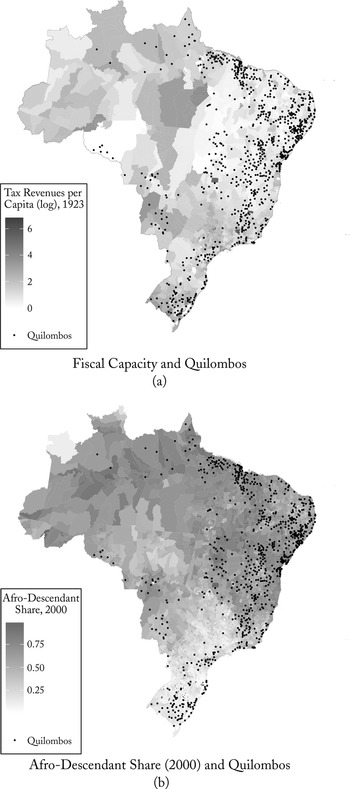
Although spatial variation in state capacity may have differentially influenced the demographic trajectories of ethnic groups through a host of mechanisms (see below), we focus on one in particular: the formation of quilombola settlements across the country. Specifically, as stated above, we hypothesize that some part of the association we observe between public goods provision and Afro-descendant shares today stems from maroon communities self-selecting into hard-to-reach areas where the state's capacity was minimal, as shown in Figure 4 (a) and (b).
Past State Capacity, Location of Quilombos, and Racial Demography

We first test whether the location of quilombola settlements is associated with lower levels of local capacity in the past, as shown with arrow Y1 in Figure 2 (b). Past levels of local capacity are measured by tax revenues in the early 1920s, the earliest point in time for which we have spatially disaggregated data and full national coverage. The simple bivariate correlation between these variables is −0.22. As indicated in Table 2, a negative and statistically significant relationship continues to hold after we include state fixed effects and account for a variety of geographic factors.
Quilombos and Past State Capacitya

∗∗p < 0.01; ∗∗∗p < 0.001; clustered standard errors in parentheses
a All models are OLS regressions based on original data. All models are tested for spatial-autocorrelation, and the adoption of Conley standard errors does not alter the obtained results. For variable descriptions, see the supplementary material.
We next examine whether municipalities with a higher density of quilombos have greater shares of Afro-descendants in the population today, as shown with arrow Y2 in Figure 2 (b). The bivariate correlation between these variables is positive (0.23) and remains strong even after we account for the full set of covariates (see Table 3). These results suggest that Brazilian municipalities with more quilombos were less likely to have strong state apparatuses in the past and have a systematically different demographic composition today than their counterparts. To further corroborate these findings, we also examine the association between the location of quilombo settlements and both the proportion of Afro-descendants and a binary measure indicating the presence of state officials across the territory in 1872, sixteen years before the abolition of slavery (see Table A6 of the supplementary material). Although the data used in these specifications are somewhat coarser and more prone to measurement error, they show the same patterns observed in previous models.
Quilombos and Present Shares of Afro-Descendantsa

∗∗∗p < 0.001; clustered standard errors in parentheses
a All models are OLS regressions based on original data. All models are tested for spatial-autocorrelation, and the adoption of Conley standard errors does not alter the obtained results. For variable descriptions, see the supplementary material.
Race-Based Selection beyond Quilombos
One important question concerns the extent to which the quilombos mechanism explains the correlation we observe between demography and public outcomes in the full sample of municipalities. On the one hand, it is possible that our data only capture quilombos that had sufficiently high levels of social cohesion or organizational capacity to seek official certification. In this case, our results may underestimate the role of past settlement choices in the broader sample of Afro-descendant communities. On the other hand, it is also possible that only those quilombos that encountered particularly critical challenges to their survival sought recognition from the state in an attempt to ameliorate their situation. If this is the case, our results may instead overestimate the detrimental effects of self-selection into remote areas. Similarly, if we consider that receiving official recognition as a quilombo allows communities to reach better economic outcomes,Footnote 66 our results may underestimate the strength of the association between racial demography and public outcomes in the broader sample. Alternatively, if quilombola communities have taken measures to resist urbanization and incorporation by the state, certification may be associated with particularly low levels of public goods provision, making our findings biased in the opposite direction.
In practice, our data likely include cases of all these different trajectories, the relative prevalence of which cannot be easily ascertained. But because we argue that maroon settlements constitute only one of the channels through which past state capacity has influenced local demographic structures, extending our analysis beyond quilombola communities should yield similar results. We therefore replicate Table 1 in Table A7 of the supplementary material by excluding municipalities with quilombos altogether. As the latter table shows, although the estimates in these models are somewhat smaller, our substantive findings remain unchanged.
To sustain and illustrate the broader spatial and temporal applicability of our argument beyond the quilombos channel, in Appendix C of the supplementary material, we explore three additional mechanisms through which local state capacity may have influenced demographic patterns in Brazil: (1) promotion of European immigration, (2) selective use of law enforcement, and (3) restriction of access to land. We next investigate whether these channels are empirically relevant. Table C1 shows that local state capacity in the early 1920s is in fact associated with the concentration of immigrants in the population, size of the coercive state apparatus, and average land price (per acre) across municipalities at that time. Table C2, in turn, shows that each of these variables has a strong negative association with the contemporary share of Afro-descendants in the population. Together, these results provide suggestive evidence that municipalities that were more capable in the past attracted more immigrant workers, displayed higher land prices, and sustained larger repressive apparatuses, which in turn seem to also have hampered the settlement of Afro-Brazilians in these localities over time.Footnote 67
Finally, one could still argue that other, more fundamental, historical factors have affected both state capacity and racial demography. In particular, the local prevalence of slavery may have influenced the strength of the state across localities.Footnote 68 Although this line of reasoning would still be consistent with our argument regarding the endogenous association between ethnic demography and public outcomes, it might lead to a different interpretation of the causal pathways at work. We consider this possibility in detail in Appendix D of the supplementary material, using 1872 census data on the share of free and enslaved Afro-descendants across municipalities.Footnote 69 These results suggest that the local prevalence of slavery fails to be consistently associated with subsequent demographic and public goods outcomes.
Persistence of State Capacity
A growing empirical literature has demonstrated that historical institutions play an important role in determining the quality of contemporary public administration.Footnote 70 Specifically, scholars have shown that differences in the stock of fiscal capacity acquired by states in the past has a strong lingering effect on contemporary tax outcomes.Footnote 71 In Table A8 of the supplementary material, we confirm empirically the implied association between past and present levels of local capacity (R = 0.52) across Brazilian municipalities, using as outcomes taxes per capita and an indicator of whether municipalities have a cadastral map of real estate properties. Tables A9 and A10 of the supplementary material replicate these results using fiscal data from 1985 and census data from 1991 and 2010. This observed temporal persistence, especially in light of Brazil's changing political and economic conditions over the last century, raises the question of which mechanisms may have been at work in this particular case.
Most path-dependent arguments call attention to the factors that establish certain directions of change and foreclose others in a way that shapes long-term trajectories. The role of timing and sequencing, in particular, has often been evoked to explain the existence of different institutional paths.Footnote 72 Most important for our purposes, Michelle D'Arcy and Marina Nistotskaya argue that the key to understanding contemporary variation in state performance is the timing of democratic transitions.Footnote 73 If democratization happens after a certain level of institutional capacity has been attained, democracy enables states to further extend bureaucratization, taxation, and public goods provision. By contrast, if it takes place before a strong administrative apparatus is established, democracy impedes rather than promotes additional state development. To develop the ability to monitor and punish free-riding, states must be able to override the welfare-undermining preferences of individuals, which can only happen before states become responsive to citizens’ preferences. Thus, if democracy precedes sufficient bureaucratization, the state remains trapped in an equilibrium of low effectiveness. In the case of Brazil, the effect of timing and sequencing may thus have been reflected in the differential influence of democracy on the ability of high- and low-capacity municipal governments to strengthen their apparatuses over time.
Besides considering the role of timing and sequence, demonstrating path dependence also requires spelling out its self-reinforcing dynamics.Footnote 74 In particular, electoral mechanisms have often been highlighted as important channels through which state capacity equilibria may persist over time. Key to these arguments is the idea that citizens’ expectations about the state shape the strategic choices of politicians, which in turn perpetuate specific outcomes. Jessica Gottlieb and Florian Hollenbach,Footnote 75 for instance, argue that in settings where fiscal capacity is low, citizens have little reason to believe that they can benefit from a tax increase and, as a result, are less likely to support greater spending and the expansion of fiscal capacity.Footnote 76 To avoid being punished at the ballot box, incumbents in low-capacity settings thus prefer to target benefits at narrow constituencies and refrain from investing in developing state capabilities. Conversely, when capacity levels are high, voters who benefit from public goods favor increased taxation and spending, creating an electoral incentive that encourages further capacity expansion. These incentives lead to two distinct equilibria: a low-capacity one in which incumbents do not strengthen state capabilities and continue to favor personalistic exchanges, and a high-capacity one in which incumbents expand revenue-raising capabilities and spend more on broad-based public services.Footnote 77 Importantly for our argument, this research shows that this strategic behavior helps to explain the stickiness of weak fiscal capacity across Brazilian municipalities.
Table A11 of the supplementary material provides suggestive evidence that is line with these mechanisms. Using data from the nationally representative Reference Latinobarómetro2005 Latinobarómetro survey, we investigate whether residents of historically capable municipalities report higher levels of confidence in their local government and express more positive attitudes about taxation today. If living in localities with historically higher capacity is indeed reflected in improved experiences with the state, we expect residents of these municipalities to be more likely than those in less capable municipalities to trust the local government to employ public resources effectively. Consequently, citizens should also be more willing to support tax increases, enhancing the incentives of politicians to invest in fiscal capacity. In line with these expectations, the results show that past capacity levels (measured circa eighty years before the survey) have a significant positive association with individuals’ tax attitudesFootnote 78 and reported confidence in the local government today.
Although this analysis does not rule out other potential explanations for the path-dependent nature of local capacity, it offers suggestive evidence in support of a plausible mechanism of persistence and highlights an important implication of our findings regarding the self-selection of groups into remote areas; if left to their own devices, low-capacity localities may find it difficult to depart from a trajectory of noninvestment.Footnote 79 As the concrete experiences of individuals condition their expectations of state effectiveness, they make specific institutional configurations self-enforcing. In this sense, contemporary variation in the strength of local state institutions and the level of public goods provision is at least partially rooted in the cumulative effects of long-term interactions between citizens and the state.
Persistence of Race-Based Selection
Whereas scholars have long explored and empirically demonstrated the path-dependent nature of state capacity, the question of whether racial demographic structures persist over time remains less clear. In this section we provide some preliminary evidence regarding changes in the racial distribution of municipalities across Brazil from 1940 to 2000 and the extent to which they relate to prior levels of state capacity.
Table 4 replicates the demographic part of the analyses in Table 1 for the period 1940–2000. As the results illustrate, the share of Afro-descendants is consistently negatively correlated with prior levels of local state capacity, as captured by tax revenues per capita in 1920, across all available time periods.Footnote 80 These associations suggest that despite potential changes in self-identificationFootnote 81 and population mobility, the spatial coincidence between Afro-descendant majorities and weaker municipal capacity has persisted over time.
Racial Demography as a Function of Past State Capacity (1940–2000)a

∗∗p < 0.01; ∗∗∗p < 0.001; clustered standard errors in parentheses
a All models are OLS regressions based on original data. For variable descriptions, see the supplementary material.
Along with the general population growth over the last century, the share of Afro-descendants in the median municipality has increased from 34 percent in 1940 to 49 percent in 2000. Nonetheless, during the same period, 25 percent of municipalities did not experience much change in their racial demographic composition and 23 percent saw a relative decrease in their Afro-descendant shares. If our argument is correct, we should expect municipalities with higher levels of state capacity in the past to experience lower growth or even an outright decline in the share of Afro-descendants over time. To measure demographic change, we follow the existing literatureFootnote 82 and construct two separate variables indicating the absolute and the relative change in the share of the Afro-descendant population from 1940 to 2000 across municipalities. Whereas the former variable simply denotes the difference in Afro-descendant shares between 1940 and 2000 in a given municipality, the latter captures the relative growth rate of Afro-descendants as a fraction of the group's baseline share.Footnote 83 To account for different baseline Afro-descendant shares in 1940, we also include those as a control variable in some specifications, along with all the geographic controls used in our main specifications.
As Table 5 shows, both the absolute and the relative change in the proportion of Afro-descendant populations from 1940 to 2000 are negatively associated with state capacity levels in 1920. As a robustness check, we also examine the relationship between past state capacity and more proximate demographic changes (1940–1980), and obtain similar results (see Table A12 of the supplementary material).
Racial Demographic Change as a Function of Past State Capacity (1940–2000)a

+p < 0.1; ∗p < 0.05; ∗∗p < 0.01; ∗∗∗p < 0.001; clustered standard errors in parentheses
a All models are OLS regressions based on original data. For variable descriptions, see the supplementary material.
Overall, these analyses suggest that besides influencing the initial settlement choices of different groups, local state capacity has also been associated with subsequent changes in the demographic composition of municipalities over time. This path-dependent nature of local demographic structures together with the stickiness of local state capacity may help to elucidate the persistent negative association between shares of Afro-descendants and public outcomes in Brazilian municipalities over time.
Discussion: Generalizability of the Argument
It is clear from the preceding analysis of Brazilian municipalities that the spatial distribution of racial groups and past state capacity are intimately related, with the latter accounting for a substantial part of the effect of demographic patterns on contemporary public outcomes. Although we do not claim that the mechanisms we focus on here are widespread, we believe that the idea of differential group-based incentives to select away from or toward the grip of the state is generalizable. Therefore, we now consider how our argument regarding the endogeneity of ethnic demography to state capacity may apply to other types of outcomes, different contexts, and levels of analysis beyond subnational units.
First, although this article focuses on the association between state capacity and public goods provision in particular, our argument regarding the endogeneity of ethnic demography may be extended to other public outcomes. One thesis that has attracted considerable attention concerns the detrimental effects of ethnic diversity on social capital, trust, and cohesion.Footnote 84 But recent evidence has shown that prior investments in state capacity can promote persistently higher levels of social capital.Footnote 85 Therefore, to the extent that ethnic diversity is itself influenced by state capacity, as demonstrated here, its previously uncovered effects on social capital may be spurious.
Second, if the logic of our argument is correct, it should be applicable to any country with significant local variation in state capacity where (1) the population is differentiated along ethnic or other visible and sticky descent-based categories,Footnote 86 (2) strong status differences between groups coincide with durable socioeconomic and political inequalities,Footnote 87 and (3) groups have differential incentives to avoid areas of strong state capacity—that would otherwise have been preferable—even if only temporarily. Given the historical legacies of colonialism, slavery, feudalism, and caste that have prompted the emergence of hierarchical distinctions among ethnic groups around the world, we believe that the overlap of geographic and racial inequalities we observe in Brazil is far from unique.Footnote 88
Third, our argument relies on mechanisms that are directly tied to subnational contexts, where boundaries tend to be more permeable than those at the national level. Nonetheless, future studies can examine whether, for example, stronger states tend to exhibit more restrictive immigration policies, which in turn systematically reduce the willingness and ability of certain groups to migrate to these regions,Footnote 89 confounding any association we might observe between diversity and public outcomes across countries.
Conclusion
In this article, we present evidence that the observed negative association between the contemporary share of Afro-descendants in the population and public outcomes across Brazilian municipalities is in part due to a common antecedent factor: the uneven distribution of state capacity more than one hundred years ago. As a consequence of slavery, Afro-descendant populations were constrained in their movements across the territory and had to seek and settle in isolated areas with low state presence and capacity where they had a chance of forming viable frontier communities. As a result, the performance of these more remote majority-black localities today does not match that of their neighbors, which benefited from a stronger state infrastructure early on, despite displaying similar levels of government spending in the present.
Our findings speak to the literature that emphasizes the endogeneity of linguistic diversity and state capacity across countries.Footnote 90 In particular, our argument aligns with the idea that ethnic demographic patterns are deeply intertwined with and even a consequence of state strength. But it also complements this literature by elucidating the mechanisms that operate across subnational rather than national entities and in relation to racial (rather than linguistic) cleavages, which are arguably less susceptible to change.
Our results also speak to the literature on the legacies of slavery.Footnote 91 As indicated by our additional analyses, the long-term effects of slavery's presence and intensity across space may be obscured by subsequent countervailing forces and by its broader indirect effects in nominally unaffected areas. In fact, some of the municipalities that had higher shares of slaves in the 1870s were also those that experienced larger inflows of immigration in the post-abolition period; and places where slave labor was almost nonexistent throughout the nineteenth century are those with some of the weakest public outcomes today. As a result, the historical shares of enslaved persons do not provide much analytical leverage to understand long-term outcomes in this case.
Our article is not without limitations. First, although we do not make any strong causal claims with regard to the role of state capacity in shaping demography, our measure of past state capacity may itself be endogenous. Although we corroborate our findings with additional indicators and measures, it is possible that local state capacity in 1920 (or even 1872) was itself affected by prior racial-demographic factors or by other local dynamics.Footnote 92 Second, and related, our data do not allow us to fully elucidate how past levels of state capacity persisted over time or to identify all the ways in which it affected racial demography patterns; a number of simultaneous mechanisms are likely at play.Footnote 93 Nonetheless, these limitations do not challenge our main argument regarding the systematically biased distribution of ethnic groups across space and the resulting pervasive endogeneity of ethnic demography and public outcomes.
Overall, this article shows that the current observed effects of demographic composition can be, at least in part, a byproduct of that composition's history. To that end, our findings call for a greater focus on the role of the state in creating and reinforcing historical disparities between ethnic and racial groups. Investigating the ways in which present outcomes depend upon past choices is therefore a critical task for future observational studies positing ethnic demography as a consequential determinant of public outcomes. Although our study does not rule out the possibility that ethnic demography has an independent effect on public goods provision, social capital, or other important outcomes, it highlights that group identity can itself be tied to distinct histories and experiences with the state.
Supplementary Material
Supplementary material for this article can be found at https://doi.org/10.1017/S0043887121000241.
Data
Replication files for this article can be found at https://doi.org/10.7910/DVN/LBJOAN.
Acknowledgments
This article is one of several joint articles by the authors. Author names appear in reverse alphabetical order and reflect a principle of rotation. An earlier version of the article was presented at the annual meetings of the American Political Science Association, European Political Science Association, Midwest Political Science Association, and Southern Political Science Association, as well as at the Yale University political economy seminar. We would like to thank our colleagues who have read and commented on previous drafts of this article. We are especially grateful to René Flores, Egor Lazarev, and Michael Touchton.
Funding
The authors are grateful to the Mamdouha S. Bobst Center for Peace and Justice at Princeton University for the financial support that made the data collection possible.