Introduction
Because of the continuing increase of herbicide-resistant weeds, advances have been made in technology that have led to the development of dicamba-resistant soybean (Seifert-Higgins and Arnevik Reference Seifert-Higgins and Arnevik2012). This new technology, referred to as the Roundup Ready® Xtend system (Monsanto Co., St. Louis, MO), was recently approved and offers growers an additional weed control option. The technology allows for the postemergence use of both dicamba and glyphosate in soybean and dicamba, glyphosate, and glufosinate in cotton (Gossypium hirsutum L.). However, as with the release of the glyphosate-resistant cultivars (Dill et al. Reference Dill, CaJacob and Padgette2008), an increase in dicamba use will result in a greater potential for off-target movement. Dicamba has been used historically for control of broadleaf weeds in corn (Zea mays L.) and is known for causing injury to soybean in nearby fields (Behrens and Lueschen Reference Behrens and Lueschen1979).
Injury to sensitive crops can occur via particle drift, volatility, or tank contamination, as well as other means. Anticipating potential problems, Monsanto Co. and BASF (Florham Park, NJ) have been working with growers, agricultural service providers, land grant universities, and university extensions to develop stewardship practices for these technologies. These practices include the development of low-volatility formulations of dicamba, adjuvant and herbicide premixes that reduce drift, as well as advanced spray nozzle designs that limit fine spray droplets. In dicamba-resistant soybean, dicamba applications can be made pre-planting, at planting (PRE), and after the crop emerges (POST) (Seifert-Higgins and Arnevik Reference Seifert-Higgins and Arnevik2012). With a wide range of applications during the growing season and a wide range of planting dates in the midsouthern United States, the opportunity for off-target movement is expected to increase (Barber et al. Reference Barber, Norsworthy, Bond, Steckel and Reynolds2015; Norsworthy et al. Reference Norsworthy, Barber, Scott, Bond, Steckel and Reynolds2015). Although symptomology resulting from synthetic auxin herbicides is easily recognized, subsequent yield loss would be dependent on the herbicide rate, specific crop, timing of application, and weather conditions prior to and following application (Griffin et al. Reference Griffin, Bauerle, Stephenson, Miller and Boudreaux2013; Scholtes Reference Scholtes2014).
Crop injury and yield loss of soybean in response to dicamba have been extensively researched. Common symptoms in soybean of off-target movement of synthetic auxin herbicides such as dicamba include parallel venation, cupping of the leaf, stem and leaf epinasty, cracked and swollen stems, and eventually chlorosis, inhibition of growth, and necrosis (Al-Khatib and Peterson Reference Al-Khatib and Peterson1999; Andersen et al. Reference Andersen, Clay, Wrage and Matthees2004, Auch and Arnold Reference Auch and Arnold1978; Kelley et al. Reference Kelley, Wax, Hager and Riechers2005, Sciumbato et al. Reference Sciumbato, Chandler, Senseman, Senseman and Smith2004; Wax et al. Reference Wax, Knuth and Slife1969). Al-Khatib and Peterson (Reference Al-Khatib and Peterson1999) reported that initial symptoms of severe petiole epinasty and leaf curling on soybean were observed within 3 h after dicamba treatment at the highest evaluated rate (186.6 g ae ha–1) and 1 d after treatment (DAT) for the lowest rate (5.6 g ha–1) (1/100 to 1/3 of the use rate of 560 g ha–1).
The timing of synthetic auxin herbicide exposure may have a significant impact on the severity of soybean height and yield reductions (Al-Khatib and Peterson Reference Al-Khatib and Peterson1999; Solomon and Bradley Reference Solomon and Bradley2014). Al-Khatib and Peterson (Reference Al-Khatib and Peterson1999) found that soybean plants treated at third trifoliate stage (V3) with dicamba at 187 g ha–1 expressed 66% visual estimations of injury 7 DAT and 92% injury 14 DAT, resulting in a height reduction of 75% and grain yield reduction of 80% when compared to the untreated check. When dicamba at 56 g ha–1 was applied at V3, a 45% yield reduction was observed (Al-Khatib and Peterson Reference Al-Khatib and Peterson1999). Andersen et al. (Reference Andersen, Clay, Wrage and Matthees2004) applied dicamba at 5.6 g ha–1 at V3 and reported 30% to 40% soybean injury at 7 DAT and yield reductions of 14% to 34% when compared to the nontreated control. In a similar study, only 6% yield reduction was observed when dicamba at 5.6 g ha–1 was applied at V3 (Kelley et al. Reference Kelley, Wax, Hager and Riechers2005). Andersen et al. (Reference Andersen, Clay, Wrage and Matthees2004) reported 80% injury following an application of 187 g ha–1 at V3, resulting in yield loss of 72% to 83%. Johnson et al. (Reference Johnson, Fisher, Jordan, Edmisten, Stewart and York2012) reported soybean injury of 8% to 21% at 7 DAT from dicamba applied at 3 g ha–1 pre-bloom and a yield loss of 1% to 20%. At 41 g ha–1, injury to soybean from dicamba was 37% to 80% with a yield loss of 13% to 85%. Variability among the results leads to the conclusion that visual estimates of dicamba injury during vegetative growth are at best a moderate indicator of yield response (Griffin et al. Reference Griffin, Bauerle, Stephenson, Miller and Boudreaux2013).
Dicamba applications during soybean reproductive growth stages have also been examined. Greater injury and yield reductions occurred when dicamba was applied at later soybean growth stages (Auch and Arnold Reference Auch and Arnold1978; Wax et al. Reference Wax, Knuth and Slife1969). Dicamba applied to an indeterminate soybean at 17.5 g ha–1 at bloom reduced soybean plant height 46% and resulted in a yield loss of 52% when compared to the nontreated control (Wax et al. Reference Wax, Knuth and Slife1969). Scholtes (Reference Scholtes2014) also applied dicamba at 17.5 g ha–1 at bloom and reported height reduction of 28% and yield reduction of 36%. At 11 g ha–1, dicamba applied at early bloom (R1) reduced soybean yield 34% to 42%, and 56 g ha–1 reduced yield 36% to 67% (Auch and Arnold Reference Auch and Arnold1978). Wax et al. (Reference Wax, Knuth and Slife1969) applied dicamba to soybean at mid-bloom and reported a yield reduction of 23% when applied at 4.4 g ha–1 and 75% at 35 g ha–1. Low rates of dicamba applied to soybean later in the growing season cause minimal effects on observable injury and yield. For instance, dicamba applied after R5 resulted in no significant observable injury, height reductions, or yield reductions in research conducted in the midsouthern United States (Scholtes Reference Scholtes2014). Although Griffin et al. (Reference Griffin, Bauerle, Stephenson, Miller and Boudreaux2013) reported that soybean at flowering is 2.5 times more sensitive to dicamba compared with vegetative exposure with respect to yield loss, conclusive findings for a relationship between estimates of injury and yield loss were difficult to assess.
Soybean yield is a function of plant population, the number of seeds produced per plant, and seed weight. Dicamba deleteriously affects each of these yield components (Weidenhamer et al. Reference Weidenhamer, Triplett and Sobotka1989). Soybean plants exposed to dicamba become malformed and have altered morphology and reduced growth. Soybean plants exposed to low rates of dicamba during vegetative growth had stimulated lateral development and increased branching, especially when the apical meristem died (Andersen et al. Reference Andersen, Clay, Wrage and Matthees2004; Wax et al. Reference Wax, Knuth and Slife1969); however, dicamba did not affect pod and seed production, because the herbicide was probably detoxified before reproduction began (Auch and Arnold Reference Auch and Arnold1978; Solomon and Bradley Reference Solomon and Bradley2014). The severity of leaf injury was influenced by application rate but not growth stage. In contrast, it was determined that following a V3 application of dicamba at sublethal rates, the number of pods per plant was similar to that of the nontreated control, whereas following an R2 application the number of pods per plant was highly influenced by herbicide rate (Solomon and Bradley Reference Solomon and Bradley2014).
A subsequent consequence of soybean exposure to dicamba during flowering or early pod production was abnormal pod formation (Auch and Arnold Reference Auch and Arnold1978; Kelley et al. Reference Kelley, Wax, Hager and Riechers2005). A reduction in yield was observed as a result of limited pod production, which in turn reduced pod number, seed number, and seed weight (Kelley et al. Reference Kelley, Wax, Hager and Riechers2005; Wax et al. Reference Wax, Knuth and Slife1969). Soybean yield reductions are probably correlated more with seeds per pod than pods per plant or seed weight (Solomon and Bradley Reference Solomon and Bradley2014).
Conclusions can be made that soybean injury and yield loss following dicamba exposure is influenced by herbicide rate and growth stage during exposure; however, some research indicates that cultivar selection affects soybean recovery from herbicide injury (Weidenhamer et al. Reference Weidenhamer, Triplett and Sobotka1989). A soybean cultivar is identified by its maturity group and growth habit. Early-maturing soybean cultivars tend to be classified as indeterminate, whereas determinate soybean cultivars normally mature later. Wax et al. (Reference Wax, Knuth and Slife1969) suggested that soybean yield response to dicamba at different growth stages may depend on whether the soybean cultivar is determinate or indeterminate. Weidenhamer et al. (Reference Weidenhamer, Triplett and Sobotka1989) reported a greater negative effect on yield of indeterminate soybeans exposed to dicamba at flowering than for determinate soybeans that cease vegetative growth at the onset of flowering. Furthermore, the decreased amount of time between planting and flowering in early-maturing soybean reduces leaf area and may limit the opportunity to recover from early-season herbicide injury (Holshouser Reference Holshouser2001). Determining the recovery of soybean based on growth habit and maturity may help to alleviate this seemingly unpredictable yield loss.
The objective of this research was to determine the response of soybean to low rates of dicamba over a range of growth stages using cultivars common to the midsouthern United States.
Materials and Methods
Field experiments were conducted in 2014 and 2015 at the Lon Mann Cotton Research Station (34°43’43.9” N, 90°44”0.3” W) in Marianna, AR, on a Calhoun silt loam soil, and at the Rohwer Research Station (33°48’28.0” N, 91°16”28.1” W) in Rohwer, AR, on Sharkey clay soil. These experiments were conducted to determine the effect of dicamba application rate and timing on soybean growth and yield. The diglycolamine salt formulation of dicamba (Clarity® herbicide; BASF Corp., Research Triangle Park, NC) was used for this research. For all experiments, dicamba treatments were applied using an air-pressurized tractor-mounted sprayer calibrated to deliver 143 L ha–1 at 270 kPa. Sprayers were fitted with four AIXR110015 flat-fan nozzles (TeeJet Technologies, Springfield, IL) spaced 41 cm apart. Applications were applied in wind speeds of no more than 4.8 km h–1. Soybean was planted at 288,000 seeds ha–1 on raised beds spaced 97 cm apart using a four-row planter. Each plot consisted of four rows, and treatments were applied to the center two rows of each plot to avoid cross-contamination between plots. Nontreated border areas between plots were 1.94 m wide. Cross-contamination between adjacent treated plots was not observed during weekly visual inspections. Fertility, weed control, irrigation, and overall management practices implemented were research-based University of Arkansas Extension recommendations.
Dicamba Application Timing and Rate Effect on Soybean Growth and Yield
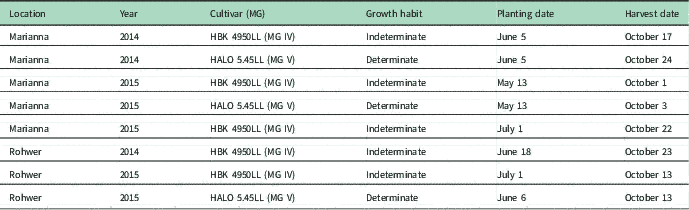
Experiments were conducted on Credenz HBK 4950LL (Bayer CropScience, Research Triangle Park, NC), an indeterminate soybean, at both locations in 2014 and 2015. HALO 5.45LL (Cache River Valley Seeds, Cash, AR), a determinate soybean, was planted at Rohwer, AR, in 2014 and Marianna, AR, in both 2014 and 2015. Soybean varieties were evaluated in separate trials. An additional site was evaluated in Marianna, AR, on the HBK 4950 LL soybean in 2015 at a later planting date. For experiments conducted at each location, soybean cultivar, maturity group, planting date, and harvest date information are provided in Table 1. Experiments were organized as a two-factor factorial, randomized complete block design, with four replications. Factor A was soybean growth stage and factor B was dicamba rate. The two rates of dicamba evaluated were 1/64× (8.75 g ha–1) and 1/256× (2.18 g ha1) of a label rate (560 g ha–1) for POST use in dicamba-resistant soybean. Applications were made at the V4 and V6 stages and at each reproductive stage starting with R1 and ending with R6. Experiments also included a nontreated control at all locations for comparison purposes. Applications were made within 5 d (±) of the intended growth stage depending on weather conditions.
Information for each trial conducted, giving location, year, soybean cultivar and maturity group (MG), growth habit, planting date, and harvest date information for dicamba experiments.

Visual estimates of percentage crop injury were recorded 1, 2, and 4 wk after treatment (WAT) on a scale of 0% to 100%, where 0% equals no injury and 100% was complete crop death. Soybean heights were evaluated at harvest by measuring five random soybean plants per plot from the soil surface to the top of the central stem or terminal bud. Immediately prior to harvest, 1 m of row was collected from the center of each plot and used for additional measurements. Using the plant samples from the 1-m row, 10 random plants were selected and pods were hand harvested from each plant to determine if pod malformation existed. Pods were considered malformed if epinasty (twisting) was present or if pod tips were curled or rolled. Data were collected on total pod number and percentage of pod malformation on each plant. Soybean was harvested from the center two treated rows of each plot with a small-plot combine, and seed yields were adjusted to 13% moisture content.
All data were tested for normality and met this assumption; hence no transformations were necessary. Data for visual estimates of injury, plant height, pod malformation, and soybean yield were subjected to ANOVA using JMP 11.0.0 (SAS® Institute Inc., Cary, NC) to test for the significant effects of dicamba rate, treatment timing, and their interaction. Location and year combinations were considered an environment sampled at random, as suggested by Blouin et al. (Reference Blouin, Webster and Bond2011). Considering year and location as random effects permits inferences about treatments to be made over a wide range of environments (Carmer et al. Reference Carmer, Nyquist and Walker1989). Dicamba rate and application timing were fixed effects in the model, whereas replications were random effects. For plant height, pod counts, and pod malformation, averages from the subsamples were used in the analysis. Differences between treatments were based on Fisher’s protected LSD at α = 0.05. Tukey’s HSD (Honest Significant Difference) test was used to determine which specific means were different from the nontreated control, and significant differences are denoted in the accompanying tables with an asterisk.
Results and Discussion
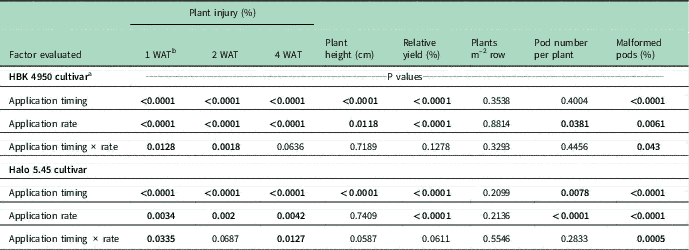
Symptomology observed for dicamba consisted of chlorosis of terminals, cupping and crinkling of uppermost leaves, swollen petiole bases, and stem and leaf epinasty. Severity of leaf injury in this study was influenced by dicamba rate and application timing. ANOVA revealed significant interactions between application timing and rate for soybean injury at 1 and 2 WAT for cultivar HBK 4950 and at 1 and 4 WAT for Halo 5.45 (Table 2). In addition, this interaction was also significant for percentage of malformed pods for both cultivars. All other variables will be reported as main effects across rates and timings.
ANOVA (α = 0.05) of soybean injury, plant height, relative yield, plants per meter row, pod number, and percentage of malformed pods of two soybean cultivars. Data were combined from studies conducted in 2014 and 2015 at Marianna and Rohwer, AR. Dicamba at 2.18 g ae ha–1 and 8.75 g ae ha–1 was applied at V4, V6, R1, R2, R3, R4, R5, and R6 growth stages to each soybean cultivar.

a Bold type indicates P values are significant at P < 0.05.
b Abbreviation: WAT, weeks after treatment.
HBK 4950LL Soybean
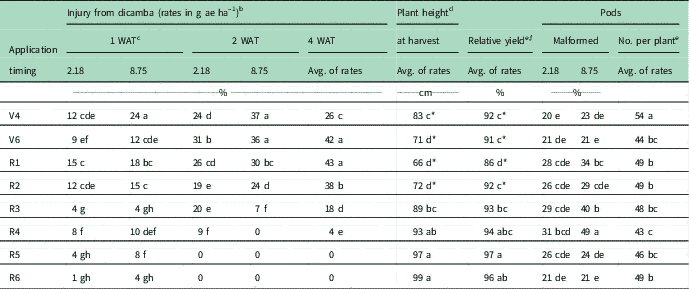
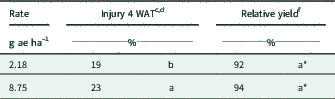
A significant interaction of application timing and dicamba rate resulted for visual injury of the HBK 4950LL soybean at 1 and 2 WAT, and both main effects were significant at 4 WAT (Table 2). From general observations (dependent upon dicamba rate), injury resulting from dicamba applied early in the growing season (prior to beginning pod stage, R3) became visible within a week of application and tended to become more severe within 2 WAT. Once soybean plants began to set pods, injury was less severe. Plants treated with dicamba at 8.75 g ha–1 at V4 were injured 24% at 1 WAT and increased to 37% at 2 WAT (Table 3). Averaged over both dicamba rates, the most severe injury was observed as late as 4 WAT from applications made at V6 and R1 stages, resulting in 42% and 43% injury, respectively (Table 3). Visual injury observed at each application timing interacted with herbicide rate at 1 and 2 WAT. By 4 WAT an interaction was no longer present, and across application timings the higher rate (8.75 g ha–1) resulted in more overall injury (Table 4).
The interaction effect of application timing and dicamba rate on observable injury to soybean and pod malformation. The main effect of application timing on observable injury, relative yield, and the average number of pods per plant for a HBK 4950LL soybean.Footnote a Data combined over years of studies conducted at Rohwer and Marianna, AR, in 2014 and 2015.

a Means separated within assessments using Fisher’s protected LSD at α = 0.05.
b Injury rated on a scale from 0% to 100%, with 100% being plant death. Injury ratings of 0 were removed from mean comparison.
c Abbreviation: WAT, weeks after treatment.
d Plant heights measured from the soil surface to the top of the central stem.
e An asterisk denotes measurements significantly different from the nontreated control. The nontreated control measured 101 cm at harvest, yielded 3,760 kg ha–1 and averaged 55 pods per plant.
The main effect of dicamba rate on observable injury to soybean and relative grain yield for HBK 4950LL soybean.Footnote a, Footnote b Data combined over years of studies conducted at Rohwer and Marianna, AR, in 2014 and 2015.

a Means separated within columns using Fisher’s protected LSD at α = 0.05.
b Data averaged over eight application timings (V4, V6, R1–R6).
c Abbreviation: WAT, weeks after treatment.
d Injury rated on a scale from 0% to 100%, with 100% being plant death.
e Plant heights measured from the soil surface to the top of the central stem.
f An asterisk denotes measurements significantly different from the nontreated control. The nontreated control had a grain yield of 3,750 kg ha–1.
Soybean plant height at harvest following dicamba was dependent upon the main effects of application timing and dicamba rate (Table 2). As with visual injury, the amount of height reduction at harvest increased as dicamba was applied at earlier growth stages (Table 3). Averaged across the two rates, the most severe stunting was observed following an R1 application, resulting in an average plant height reduction of 35% when compared to the nontreated control (101 cm). Similar results were seen in plant height following applications made at V4, V6, and R2 growth stages (Table 3). Furthermore, dicamba applications resulting in height reduction compared to nontreated soybean also resulted in yield loss.
Dicamba rate and application timing each had a significant effect on grain yield of the HBK 4950LL soybean; however, no interaction was observed (Table 2). As seen in other research, when dicamba is applied during flowering (R1), soybean is highly susceptible to yield loss (Auch and Arnold Reference Auch and Arnold1978; Wax et al. Reference Wax, Knuth and Slife1969). Averaged across dicamba rate, an R1 application resulted in a 14% yield loss, whereas dicamba applied at R5 or R6 yielded within 3% to 4% of the nontreated control (Table 3). It was also found that dicamba applied at R3 and R4 reduced soybean yield 7% and 6%, respectively, when compared to the nontreated control (Table 3). When averaged across application timings, relative yield differed two percentage points between the two rates (92% at 2.18 g ae ha–1 and 94% at 8.75 g ae ha–1) (Table 4). Differences in percentage pod malformation were difficult to discern across dicamba application timing and rate. However, the higher rate (8.75 g ha–1) applied at R3 and R4 resulted in significant increases in pod malformation. Dicamba applied during flowering or early pod production caused fewer pods per plant and reduced relative seed yield (Table 3), but seed yield was not reduced for the R4, R5, and R6 application timings. Yield loss following dicamba injury may also be associated with other yield components, such as seeds per pod and/or weight of that seed (Kelley et al. Reference Kelley, Wax, Hager and Riechers2005; Solomon and Bradley Reference Solomon and Bradley2014).
HALO 5.45LL Soybean
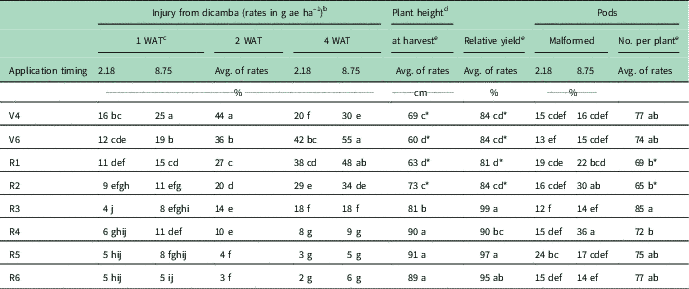
An interaction of application timing and dicamba rate was observed on visual injury of the determinate HALO 5.45LL soybean at 1 and 4 WAT, and the main effects of application timing and dicamba rate were significant at 2 WAT (Table 2). At each application timing, injury observed 1 WAT between the two rates differed following dicamba applications at V4, V6, R3, and R4. Differences in injury between dicamba rates at 3 WAT were distinguishable following V4, V6, and R1 applications. Similar to results seen in the HBK 4950LL soybean cultivar, injury symptoms resulting from dicamba applications made during late vegetative and early reproductive growth appeared at 1 WAT and tended to increase over the next 2 to 4 wk. Observable leaf injury to soybean at 4 WAT was reduced when dicamba was applied after the R3 growth stage for both dicamba rates. At 2 WAT, when averaged across rates, soybean injury was 44% and 36% following the V4 and V6 application timings, respectively. By 4 WAT, soybean injury was 55% following dicamba at 8.75 g ha–1 applied at V6, similar to the 48% injury from 8.75 g ha–1 applied at R1 (Table 5).
The interaction effect of application timing and dicamba rate on observable injury to soybean and pod malformation. The main effect of application timing on observable injury to soybean, plant height, relative grain yield, and average number of pods per plant for HALO 5.45LL soybean.Footnote a Data combined over years of studies conducted at Rohwer and Marianna, AR, in 2014 and 2015.

a Means separated within assessments using Fisher’s protected LSD at α = 0.05.
b Injury rated on a scale from 0% to 100%, with 100% being plant death.
c Abbreviation: WAT, weeks after treatment.
d Plant heights measured from the ground to the top of the central stem.
e An asterisk denotes measurements significantly different than the nontreated check. The nontreated control measured 89 cm at harvest, yielded 3,700 kg ha–1, and averaged 86 pods per plant.
Only the main effect of application timing was significant for plant height at harvest (Table 2). Plant height at harvest was reduced more from dicamba applied at V6 and R1 than at other application timings (Table 5). Compared to the nontreated control, a 33% height reduction occurred following a V6 application. Following an R1 application, a 29% height reduction was observed at harvest. Plant heights at harvest were similar following V4 and R2 dicamba applications, ranging from 22% to 29% reduction when compared to the nontreated control (89 cm). Similar to the HBK 4950LL soybean, a significant height reduction observed at harvest resulted in a significant seed yield loss. When applied after R2, the effect dicamba had on plant height became less apparent (less than 10% reduction in height).
A significant seed yield reduction in HALO 5.45LL, a determinate soybean, depended on application timing and dicamba rate (Table 2). On average, 19% yield loss occurred following an R1 application; however, grain yields recorded from V4, V6, and R2 treatments were similar when averaged across dicamba rates (Table 5). When compared to the nontreated check, no significant yield loss was recorded from applications at R3 and later. Averaged across application timings, yield loss in the determinate soybean was almost twice as great by dicamba at 8.75 g ha–1 as at 2.18 g ha–1 (Table 6).
The main effect of dicamba rate on observable injury to soybean, plant height, relative grain yield, and number of pods per plant for HALO 5.45LL soybean.Footnote a, ,Footnote b Data combined over years of studies conducted at Rohwer and Marianna, AR, in 2014 and 2015.

a Means separated within columns using Fisher’s protected LSD at α = 0.05.
b Data averaged over eight application timings (V4, V6, R1–R6).
c Injury rated on a scale from 0% to 100%, with 100% being plant death.
d Abbreviation: WAT, weeks after treatment.
e Plant height measured from the ground to the top of the central stem.
f An asterisk denotes measurements significantly different than the nontreated check. The nontreated control measured 88 cm at harvest, yielded 2,950 kg ha–1, and averaged 86 pods per plant.
Similar to the results with the HBK 4950LL soybean cultivar, dicamba applied from R1 to R6 caused abnormal pod formation and restricted pod fill; however, neither parameter was related to seed yield (data not shown). Following dicamba exposure, soybean has the ability to produce new axillary buds, eventually resulting in new flowers and seed pods; however, determinate or indeterminate, it has been shown in previous research that the effect of dicamba on soybean yield is influenced by seed number or seed weight more so than by pod number (Kelley et al. Reference Kelley, Wax, Hager and Riechers2005).
Practical Applications
Seed yield of both HBK 4950LL and HALO 5.45LL soybean cultivars is highly sensitive to dicamba rate during the late vegetative/early reproductive growth stages, and observable injury is at best a moderate indicator of yield loss for both cultivars, as noted previously (Wax et al. Reference Wax, Knuth and Slife1969; Auch and Arnold Reference Auch and Arnold1978; Weidenhamer et al. Reference Weidenhamer, Triplett and Sobotka1989; Al-Khatib and Peterson Reference Al-Khatib and Peterson1999; Andersen et al. Reference Andersen, Clay, Wrage and Matthees2004; Kelley et al. Reference Kelley, Wax, Hager and Riechers2005; Johnson et al. Reference Johnson, Fisher, Jordan, Edmisten, Stewart and York2012; Griffin et al. Reference Griffin, Bauerle, Stephenson, Miller and Boudreaux2013; Solomon and Bradley Reference Solomon and Bradley2014). During these sensitive growth stages, depending upon the amount of dicamba exposure, injury is expressed at 1 WAT and tends to increase until 3 to 4 WAT. Furthermore, damage to the soybean terminal, resulting in reduced plant height, appears to be a good indicator of yield reduction; however, other factors influence height reductions, such as application timing and cultivar selection (Weidenhamer et al. Reference Weidenhamer, Triplett and Sobotka1989).
The plasticity of soybean makes it difficult to generalize the effects of dicamba (Auch and Arnold Reference Auch and Arnold1978). The plasticity of soybean can be expressed by examining these different cultivars. Greater recovery is expected in the midsouthern United States from late-maturing cultivars (maturity group V) as a result of vegetative growth remaining for a longer period before flowering, allowing for more production of leaf area and nodes for pod formation. This longer period of vegetative growth allows for greater recovery of yield potential following herbicide-induced injury during early vegetative growth stages (Ritchie et al. Reference Ritchie, Hanway, Thompson and Benson1994; Westgate Reference Westgate1999; Holshouser Reference Holshouser2001).
Acknowledgments
This research was supported by funding from the Arkansas Soybean Promotion Board.
No conflicts of interest have been declared.