Introduction
The United Kingdom (UK) has an ageing population, with the proportion of those aged 65+ forecast to be 26 per cent by 2041, with the greatest number residing in rural and coastal areas (Office for National Statistics, 2018b). A 2019 study by Age UK found that 2.6 million people aged over 65 speak to three or fewer people they know in a week, with 225,000 of these people often not speaking to anyone (Age UK, Reference Age2019). Loneliness can increase the risks of frailty (Gale et al., Reference Gale, Westbury and Cooper2018), and of developing coronary heart disease and stroke vulnerability (Valtorta et al., Reference Valtorta, Kanaan, Gilbody and Hanratty2018); whilst social networks can help long-term condition management (Hinder and Greenhalgh, Reference Hinder and Greenhalgh2012). The work of Burholt et al. (Reference Burholt, Winter, Aartsen, Constantinou, Dahlberg, Feliciano, Gierveld, Regenmortel and Waldegrave2020) has identified the distal outcomes that can emerge from social isolation, including negative impacts on health and wellbeing and social cohesion. Rural activities like driven-game shooting (DGS) could provide a means to increase social contact for those in rural areas, particularly for those no longer working, by reducing loneliness and improving individuals’ mental health levels. However, a contextual literature review undertaken by the authors revealed that to date there has been a lack of independent, unbiased research into the social impact of participation in DGS.
Prior research has explored the importance of social capital and social contact for good mental health and wellbeing (Carpiano, Reference Carpiano2006, Reference Carpiano2007; Sarracino, Reference Sarracino2010; Bartolini and Sarracino, Reference Bartolini and Sarracino2014; Jetten et al., Reference Jetten, Haslam, Cruwys, Greenaway, Haslam and Steffens2017; Bian et al., Reference Bian, Hao and Li2018; O'Connor et al., Reference O'Connor, Alfrey, Hall and Burke2019), with social networks being identified as one of the key determinants of health (Dahlgren and Whitehead, Reference Dahlgren and Whitehead1991). Whilst it is not the purpose of this paper to enter into an in-depth exploration of one's depth of social networks versus feelings of loneliness, it is also important to recognise that smaller social networks do not always equate to loneliness, especially in later life. Indeed, Carstensen et al. (Reference Carstensen, Isaacowitz and Charles1999) suggest that as individuals age, their perceived time horizons become shorter, and hence they begin to more specifically engage in those activities that are most meaningful to them. This indicates that for some older people, fewer but more meaningful social relationships are preferable to broader social networks. Potential cost savings to society of maintaining good mental and physical health have also been highlighted. It is estimated that poor mental health costs the UK £105 billion per annum, when the various social and economic factors are considered (Department of Health Independent Mental Health Taskforce, 2016) and the overall costs of loneliness for each individual person can be £6,000 over 10 years (McDaid et al., Reference McDaid, Bauer and Park2017). The World Health Organization (2020) identifies health as ‘a state of complete physical, mental and social wellbeing and not merely the absence of disease or infirmity’, whilst Public Health England (2018) acknowledges the wider determinants of health as being related to a broad range of social, economic and environmental factors.
Whilst it is therefore clearly not only obesity and smoking that determine health outcomes, Dobbs et al. (Reference Dobbs, Manyika, Chui and Lund2014) indicated that obesity has a burden of around £47 billion a year on society (approximately 3% of Gross Domestic Product), making it the greatest impact after smoking. This has been identified as more than the annual cost of armed violence, war and terrorism (Press Association, 2014). Social impact measurement provides a methodology to understand better the impacts on individuals and more broadly for society, both financial and otherwise, of given programmes, activities or interventions. Social impact remains poorly understood, with a lack of definition of the concept first identified over 10 years ago (Sairinen and Kumpulainen, Reference Sairinen and Kumpulainen2006) remaining unresolved to date. Research has sought to define what constitutes social value creation as a process (Jain et al., Reference Jain, Hazenberg, Seddon and Denny2020), whilst prior research has also identified best practice methodologies to approaching impact measurement (Clifford et al., Reference Clifford, Hehenberger and Fantini2014). The approach adopted in this study to measuring impact is discussed further later in the paper, but it is important to acknowledge the social, constructed nature of social impact and the ‘beneficiaries’ that it pertains to (Burdge and Vanclay, Reference Burdge and Vanclay1996).
This study considers the extent to which social networks created via DGS participation impact on the health and wellbeing of those participating. In doing so, the paper makes an original contribution to theoretical approaches to understanding the social impact of rural activities and land use within the UK (and also potentially globally). Given the focus globally on health and wellbeing, codified in the United Nations’ Sustainable Development Goal 3 (Good Health and Wellbeing) (United Nations, 2020), as well as prior research linking negative health and wellbeing outcomes for those excluded from social relations (Burholt et al., Reference Burholt, Winter, Aartsen, Constantinou, Dahlberg, Feliciano, Gierveld, Regenmortel and Waldegrave2020), studies such as this that demonstrate the impacts that rural areas and activities can have on society (both positive and negative) are of paramount importance.
Driven-game shooting
There has been limited research into the social impacts of taking part in DGS, with existing studies predominantly based on economic or environmental impacts rather than the social impacts on people (Hillyard and Marvin, Reference Hillyard and Marvin2017). Research to date has either been sponsored by the shooting industry or the anti-shooting lobby (see Public and Corporate Economic Consultants, 2012, 2014; Cormack and Rotherham, Reference Cormack and Rotherham2014; British Association for Shooting & Conservation, 2016) and, therefore, has been accused of bias on both sides of the DGS debate. Given the tensions that exist on both sides of this debate and the need to demonstrate impartiality, we feel that it is important to explain here the context in which the research was conducted (Silverman, Reference Silverman2004).
The research that is reported here is based in a PhD research study that was funded by the host university, with no funding or prior engagement from either side of the DGS debate. Two of the three researchers in this study (including the lead researcher) have never been involved in game shooting or rural field sports of any kind prior to the research, nor have they been involved with any organisations against field sports. Further, the third researcher, whilst having been involved in game shooting and field sports previously, was not involved in the data analysis or thematic conclusions developed in the research, instead utilising their experience to advise on the game-shooting sector and social impact measurement. During the study, the research team was approached by organisations representing both sides of this debate offering support or challenging the research, and whilst we were always keen to engage in dialogue with both sides, we never received financial support from either side. This, we believe, marks this research as one of the first truly independent studies of its kind in this area. The researchers nevertheless acknowledge that researcher bias is prevalent in all research as no research takes place in a social vacuum (O'Connor, Reference O'Connor2011), and we have through a process of reflexivity attempted to minimise this at all stages of the research process (design, fieldwork, analysis and reporting) so as to maximise the reliability and validity of the data gathered and thus the conclusions reached in this paper.
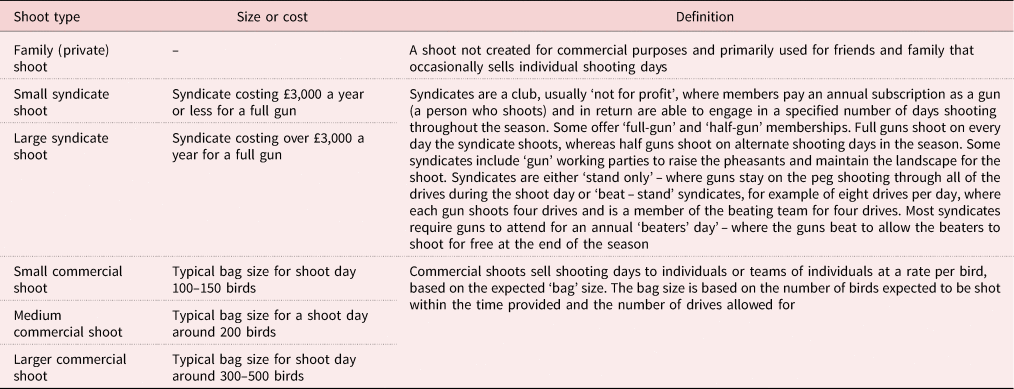
There are no precise overall figures for participation in DGS in the UK, but a reasonable estimate using available research data suggests around 1.5 million people take part in the activity nationwide, coming from a wide range of educational and professional backgrounds and in a number of different roles.Footnote 1 DGS is a form of shooting where the birds are ‘flushed’ out of cover towards and over people armed with shotguns (the guns), rather than the guns ‘walking up’ to where the birds are located. It requires the participation of not just guns, but also beaters, people that walk through fields and specific types of vegetation to ‘flush’ the birds over the guns; and then pickers-up, people who have dogs with them, typically labradors or spaniels, to retrieve the shot birds. Driven-game shoots (the organisations that run DGS) range in size from large to small commercial shoots, as well as clubs or syndicates of all sizes. Syndicate members split the costs of either attending several commercial shoot days throughout the season together as part of a ‘roving’ syndicate or are ‘location-based’, where they manage an area of land to raise quarry (game birds) and then shoot a certain number of days as part of the syndicate, often sharing beating and shooting duties on the shoot day or on alternate shoot days. Syndicates are a way that participation in DGS can be widened, as costs are considerably reduced, often with members and volunteers providing the labour to both raise the birds and take on the beating and picking-up roles on the shoot day. Table 1 gives an outline of different shoot types and sizes as defined in this study.
Definition of shoot types and sizes in this study

Note: The term ‘drives’ is the name for the process where birds are flushed, or driven, over the guns.
Social capital, identity, social networks, and health and wellbeing
The study focused on the social impacts of DGS as a rural activity, based on a theoretical underpinning of social capital and the social networks it creates. Social capital has been defined as ‘Connections among individuals – social networks and the norms of reciprocity and trustworthiness that arise from them’ (Putnam, Reference Putnam2000: 19). Bonding social capital and identity are inextricably linked, with identity and its associated shared values, attitudes, beliefs and understandings (Claridge, Reference Claridge2018b, Reference Claridge2018c). If friends share a well-defined group identity then the bond between them is stronger, enabling the creation and maintenance of social structures (Burke and Cantwell, Reference Burke, Cantwell, Levine and Hogg2010). Shared understanding and sense of belonging are key to the development of strong bonding social capital (Burke, Reference Burke and Ritzer2007; Burke and Cantwell, Reference Burke, Cantwell, Levine and Hogg2010; Claridge, Reference Claridge2018b, Reference Claridge2018c) and therefore social networks. This study used this theoretical underpinning of social capital and its links to identity as a basis for measuring the social impact of engagement in DGS for participants in relation to their health and wellbeing. This provides a stronger form of ‘theoretically based’ social impact assessment (SIA) evidence than many other SIAs (Dietz, Reference Dietz1987; Becker, Reference Becker, Becker Henk and Vanclay2003; Rattle and Kwiatkowski, Reference Rattle, Kwiatkowski, Becker and Vanclay2003; Aledo-Tur and Domínguez-Gómez, Reference Aledo-Tur and Domínguez-Gómez2017), whilst following the process for SIAs recommended by GECES (Groupe d'experts de la Commission sur l'entrepreneuriat social), the European Commission expert group for SIA (Hehenberger et al., Reference Hehenberger, Harling and Scholten2014).
Social networks have been identified as one of the key social determinants of health (Dahlgren and Whitehead, Reference Dahlgren and Whitehead1991). The National Health Service (NHS) has recognised the importance of prevention and maintaining good mental and physical health and wellbeing in both the Five Year Forward View, in terms of tackling the ‘health and wellbeing gap’ (NHS, 2014) and as part of the Long Term Plan, with prevention and self-care being one of its key elements (Alderwick and Dixon, Reference Alderwick and Dixon2019; NHS, 2019). Loneliness and low social network levels have been found to impact mental and physical wellbeing negatively (Aiden, Reference Aiden2016).
Whilst social capital has been criticised as being ill-defined and ambiguous, it allows researchers to recognise the positive and productive aspects of social contact (Claridge, Reference Claridge2018a). Measurement of social capital by governments is often simplistic, considering numbers of social contacts, along with level of trust, civic participation and views of the local area; but not the benefits or ‘returns’ of those contacts, such as in the UK government social capital surveys. In this study, the connections between individuals are first assessed, in line with Putnam's (Reference Putnam2000) social capital definition as noted above, along with the presence of bonding and bridging social capital, to explore integration and wider participation within DGS, an activity that has been accused of elitism in the past. Bonding social capital, sometimes referred to as horizontal social capital, refers to the ties within the same group, often local communities or groups, where members have the same interests, where lots of people know each other, and where there are strong norms and trusts (Claridge, Reference Claridge2018a). This type of capital or informal network has been noted as important for personal identity, support and belonging.
The use of social capital as a basis for quantifying the value of impacts allows them to be expressed in an understandable way within a capitalist society, in line with the framework of social capital ‘returns’ identified by Lin (Reference Lin2008). Whilst instrumental social capital returns benefit individuals, expressive social capital returns of physical health, mental health and life satisfaction can have wider societal financial return in terms of cost-savings to the NHS, for example, as well as improving health outcomes and reducing mortality. This paper proposes that the social networks created through the social capital found within DGS are available to be used when necessary, such as a need for peer support in times of ill-health or bereavement. Whilst the causality of these mechanisms is not the focus of this paper, this is an area for further research beyond this work. The perception of these social structures varies between individuals and is affected by human agency (Collier, Reference Collier1994; Archer, Reference Archer2016). Therefore, the use of a standard measure for mental wellbeing in the form of the Short Warwick Edinburgh Mental Well-being Scale (SWEMWBS) gave a relevant ‘outcome’ measure and consequently a way to assess social impact objectively and compare it with national data. The study also discusses possible reasons for the outcomes measured through triangulation between the literature review, and qualitative and quantitative results datasets.
Methodology
Design
This research adopted a two-stage, sequential mixed-methods approach, taking place during the August 2018 to February 2019 shoot season, consisting of seven field visits to shoots in rural settings across England to gain observational case study data, and identify 45 participants to be interviewed. The research utilised an observational reflective diary, semi-structured interviews and a questionnaire to produce a rich, mixed-methods dataset. The study adopts a critical realist approach as it recognises that structures exist separate from individuals, which can be influenced by different personal perceptions and can be created by human agency (Collier, Reference Collier1994). The study recognises that the activity of DGS and its direct impacts are real, but that the perception of these impacts and their benefit will differ between participants (shared values, identity, personal wellbeing), which is a key aspect of research approached from a critical realist perspective. The study explored why people engage in the activity and what impact this has both on them and wider society, including those outputs, outcomes and impacts that may have appeared initially unobservable.
The study was sequential in design, combining qualitative research at stage one with quantitative research at stage two, to allow the data from stage one to inform the design of stage two and to allow for validation of the data through triangulation. The approach to triangulation was focused on ensuring that the results of the statistical analysis aligned with the emergent themes from the qualitative analysis and vice versa, through this process of triangulation (McLeod, Reference McLeod1994). A pilot study of seven semi-structured interviews was combined with a review of the extant literature, reflective notes from two preliminary shoot visits (small commercial and small syndicate) and informal conversations with key stakeholders. This pilot revealed theme areas around social capital, identity, as well as the ‘social determinants of health’ and health and wellbeing, which were used to confirm the semi-structured questionnaire design and the methodological appropriateness of stage one.
Sample
The sampling frame for the first qualitative stage was theory-driven and purposive (Miles and Huberman, Reference Miles and Huberman1994). The researcher visited seven shoots, sampled across the range of shoot types and sizes, and interviewed a selection of 45 beaters, pickers-up (whose roles are described in the Introduction), guns, gamekeepers and others from different shoot sizes and types and from across the country. The second-stage data collection questionnaire was developed using the key themes identified during the qualitative data analysis. The sampling frame for the second-stage questionnaire distribution was purposive and snowball, to ensure maximum dissemination of the questionnaire within the DGS community (Cohen et al., Reference Cohen, Manion and Morrison2018). The 2,424 questionnaire responses suitable for analysis received were spread UK-wide, making the sample size far in excess of the minimum level of 783 needed to detect small effects at the medium level (Cohen, Reference Cohen1992).
The qualitative dataset was drawn from a range of participants (age range = 17–79 years, mean = 56, median = 57), with 73 per cent men and 27 per cent women (N = 45).
At the quantitative stage, the mean age of participants was 55 (median = 57), with an overall gender split of 87 per cent male and 13 per cent female (N = 2,236) and amongst those 55 and over, 90 per cent were male and 10 per cent were female (N = 1,339). In the overall quantitative dataset, 33 per cent were retired or semi-retired (N = 2,424) and of those aged 55 and over, 57 per cent were retired or semi-retired (N = 1,340).
Data collection
At the first, qualitative, data collection stage, the researcher visited two large commercial shoots in the south-west of the UK, one medium and one smaller commercial shoot in Yorkshire, and three different-sized syndicate shoots in Oxfordshire, Hampshire and the East Midlands. Reflective records of shoot visits, including participant observation, were recorded at each shoot, with the researcher spending a full day at each shoot to gain participant trust and understanding of the research parameters, meaning participants were at ease with the researcher presence, enabling a socially embedded and more realistic picture of their participation to be observed. Subsequently, 45 semi-structured interviews were completed via telephone after the shoot visits with a range of participants selected from the shoots visited which included beaters, pickers-up and guns. Interviews were recorded and transcribed verbatim.
The second quantitative stage questionnaire was piloted with ten respondents from 12 March 2019 to 6 April 2019. This resulted in development of the questionnaire, which was open from 9 May 2019 until 31 July 2019, distributed online via 24 field sport-related closed social media groups, joined by the researcher for the purposes of the study, email contacts and in hard copies at country fayres and in a few relevant retail outlets, yielding 2,424 responses suitable for analysis. To minimise the data disruption risk of those against shooting accessing the questionnaire, it was not shared in large, open social media pages. Instead, the survey was shared through a number of associations and community groups associated with DGS for dissemination to their members and via closed, relevant Facebook groups of a non-political nature. This high response rate likely reflected the fact that individuals in the DGS community were keen to engage in the research, sharing the questionnaire link with their contacts directly via email and on social media in closed groups, and asking others to do the same.
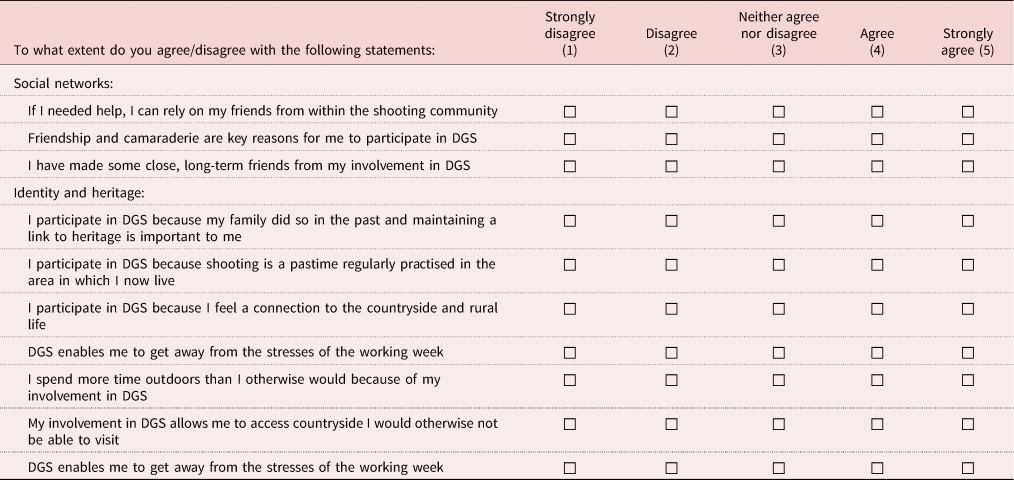
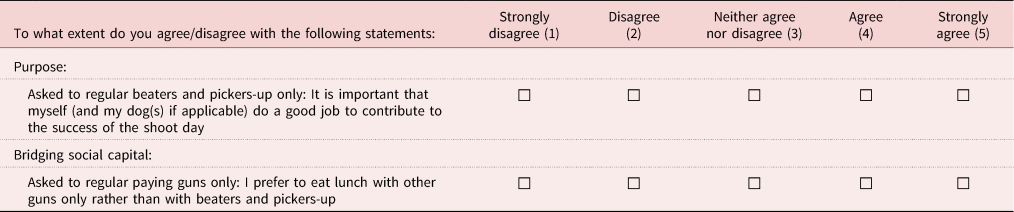
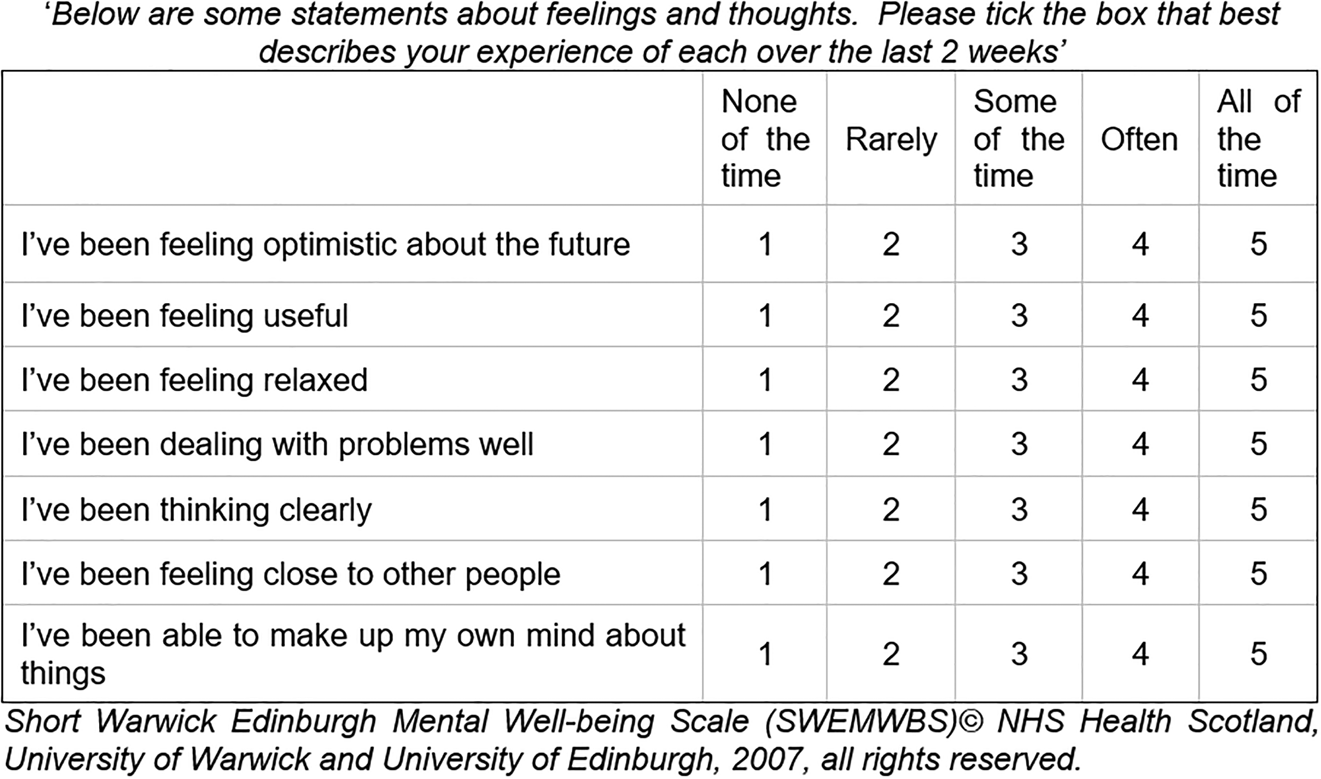
The questionnaire included demographic, descriptive and opinion questions, including distances walked at shoots, how individuals participate in DGS and how often, along with the size and types of shoot attended, to allow comparison between groups within DGS. The questionnaire was designed to assess the types of social capital within DGS and the potential social impact or returns on that social capital, and included a number of five-point Likert scale questions. Questions were asked to all participants to assess friendships built, social networks and identity, along with demographic information and a question to assess loneliness. In addition, a Likert scale question to evaluate bridging social capital was asked to regular paying guns, relating to mixing of guns and beaters/pickers-up during the shoot day, alongside a question for regular beaters and pickers-up about the importance of doing a good job during the shoot day, to give an indication of the need for a purposeful role. The SWEMWBS questions were included to assess mental wellbeing. This scale was chosen as it is a widely used, verified scale, utilised by the UK government to assess mental wellbeing of the national population (Office for National Statistics, 2018a). The key questions are shown in Tables 2 and 3 and Figures 1 and 2.
Key Likert scale questions asked to all respondents

Note: DGS: driven-game shooting.
Key Likert scale questions asked to specific respondents

The Short Warwick Edinburgh Mental Well-being Scale question.

The loneliness question.

Comparative datasets
There are groups and individuals who are opposed to shooting for sport. This opposition created a difficulty in finding a non-shooting control group, as any open survey would likely have attracted input from those vehemently against shooting, which could have skewed any results. Therefore, the comparison dataset used for mental wellbeing was survey number 6614 Understanding Society: Waves 1–8, 2009–2017 (UK Data Service, 2017). For loneliness, the comparison dataset used was survey number 8478 Community Life Survey, 2017–18 (UK Data Service, 2018).
Analysis
Qualitative data, from the interviews and the shoot visit ‘reflective records’ recorded by the researcher, were analysed by the authors using the Straussian grounded theory-based Constant Comparative Method, starting with open coding and then following a process of phenomenological reduction to identify key themes (Strauss and Corbin, Reference Strauss and Corbin1990). During the immersion stage, 247 units of analysis were identified. Further analysis after the immersion stage led to the formation of 24 concepts during the categorisation stage. The final stage of phenomenological reduction led to the emergence of four key themes: ‘social capital’, ‘identity’, ‘positive impacts’ and ‘negative impacts returns’. The qualitative analysis informed the design of the second-stage quantitative questionnaire.
The accuracy, validity and reliability of the quantitative data from the questionnaire responses and the comparative datasets detailed above were checked and data analysed using the Statistical Package for the Social Sciences (SPSS version 22.0) and Microsoft Excel (2016). Independent sample t-tests were undertaken in order to explore the experimental and comparison datasets. The validity of the responses to the questionnaire's Likert questions were tested for normality and outliers. Responses were normally distributed. The SWEMWBS responses were assessed as having Cronbach's alpha scores exceeding 0.8, complying with best practice (Henson, Reference Henson2001). No individual question removal made the value greater than the Cronbach's alpha of the whole scale.
Results and discussion
This section brings together the qualitative and quantitative results. First, there is consideration of the motivations of participants to be involved in DGS followed by an exploration of the social capital that exists within DGS, its links to feelings of identity and belonging amongst participants, and how this creates strong social networks within DGS that positively impact the wellbeing of those involved. The positive impact on mental health and wellbeing is then explored via the quantitative results analysis, which measured mental wellbeing using a recognised scale. Potential additional reasons for the wellbeing scores, related to and facilitated by individuals’ participation in DGS, other than the strong social capital networks found in the study, are then explored through the interview data. We believe that this synthesis of the datasets to explore these thematic areas helps to strengthen the arguments made and conclusions drawn in the paper.
Motivations and identity
Those involved demonstrated a strong sense of shared understandings, friendships and identity, in line with identified key pillars of social capital (Bourdieu, Reference Bourdieu and Richardson1986; Portes, Reference Portes1998; Putnam, Reference Putnam2000; Claridge, Reference Claridge2018b). As additional shoots were attended (although the weather was sometimes better the work involved remained hard), this feeling of camaraderie, friendship and self-defined rural identity was reinforced:
The other thing that obviously is a big attraction for myself and just about everyone I know is the social aspect because the very fact that you are doing something that isn't run of the mill means that you are actually working with a group of people all of whom have similar interests and ability so it's a sort of natural selection process really … and why I do it when it's wet and horrible. (P18, beater, commercial, large, age 56)Footnote 2
There was an expression of rural identity from all participants, indicating that participation was part of a rural way of life which many involved had been participating in since childhood and through the generations, a clear example of strong bonding social capital:
I have always been a country person brought up on a farm, never lived in a village or anything rather live out in the sticks sort of thing … I was brought up to it actually, father and brother. My father and my brother were always into their shooting, rough shooting really on the farm and I sort of always tagged along behind, a little kid, sort of happy to carry the game. (P16, picker-up, commercial, large, age 63)
Social capital and social networks
There was strong bonding and bridging social capital in all forms of DGS, although there were some social divisions at commercial shoots between guns and beaters/pickers-up, whilst social networks were stronger at syndicate shoots. A strong sense of long-term friendship was expressed by many and is well illustrated by a beater's comments:
Being with a group of friends that you've developed over the years … I suppose we've all got a common interest in the countryside, accept country sport … and it's just nice to meet people with a common interest in an environment you enjoy … I enjoy [spending time with] most of the people I beat with. (P23, beater, commercial, large, age 73)
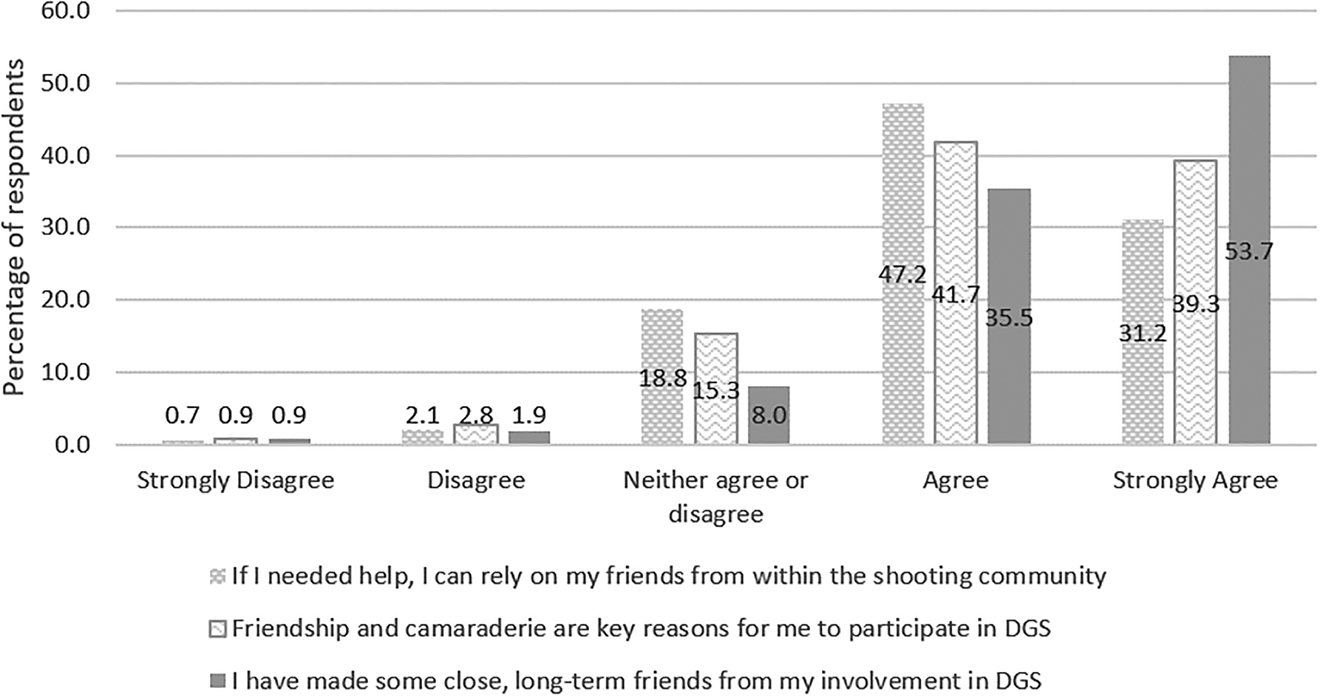
Figure 3 also shows the responses to the social network survey questions, indicating that there were strong social networks across all forms of DGS.
Responses to social network questions.
Note: DGS: driven-game shooting.

It was hypothesised that syndicate membership resulted in stronger social networks. An independent t-test for all three social network questions looking at the difference in the mean values between syndicate and non-syndicate members was found to be significant (p < 0.001), being higher for syndicate members with a Cohen's d effect score of small to moderate (0.21–0.32) practical significance. There was a strong, statistically significant, positive correlation between respondent levels of agreement with ‘if I needed help, I can rely on my friends from within the shooting community’ and ‘I have made some close, long-term friends from my involvement in DGS’ (mean = 4, r = 0.601, N = 14, p < 0.001), confirming that the longer the friendships made through DGS, the more likely people are to be able to rely on said friends if they need help.
Building on this, independent t-test analysis showed that those in DGS syndicates have statistically stronger social networks than those not in syndicates, measured via the comparison of the three social network question responses shown in Figure 3 (question 1: p < 0.001, d = 0.26; question 2: p < 0.001, d = 0.21; question 3: p < 0.001, d = 0.32). This indicates stronger bonding social capital and therefore stronger social networks within syndicates. Strong friendships were also apparent between beaters and pickers-up at the commercial shoots visited by the researcher, between those who had long-term involvement at that particular shoot. The use of regular, long-term teams of beaters and pickers-up may strengthen these friendships, as this builds high levels of trust and reciprocity, which are key elements of the traditional understanding of social capital (Portes, Reference Portes1998; Putnam, Reference Putnam2000). Trust was particularly important to this group of individuals, who were wary of outsiders being ‘anti-shooting’ and therefore cautious about initial engagement.
Bridging social capital can help individuals to cross social divides and potentially access resources that would otherwise not be accessible to them (Claridge, Reference Claridge2018b), either enabling them to access individual benefits as a result of their investment in social capital (Bourdieu, Reference Bourdieu and Richardson1986), or benefits for themselves and others both inside and outside a group (Coleman, Reference Coleman, Dasgupta and Serageldin2000; Putnam, Reference Putnam2000). Participation can help build relationships within personal and business lives, which has been recognised in prior research exploring newcomers to the countryside (Heley, Reference Heley2010), in line with the potential for individual returns on social capital highlighted by Lin (Reference Lin2008), Bourdieu (Reference Bourdieu and Richardson1986) and Coleman (Reference Coleman, Dasgupta and Serageldin2000):
We've got people who are retired, we've got people who still run their own businesses that go beating … But also like we've got firemen, firewomen, retired firemen, retired police officers, people that have their own businesses, people who worked in steel works, so there's a very wide aspect. With the shoot I used to be in there was a doctor that used to go beating. (P36, beater, commercial, small, age 57)
The strongest bridging social capital and the least division was found at syndicate shoots at the qualitative stage and among members of shooting syndicates. Regular paying guns who were members of syndicates were significantly less likely to agree with separation of beaters and pickers-up from guns for meal breaks (p < 0.001, d = 0.22) and 81.5 per cent of the 1,265 syndicate members who responded confirmed all shoot participants at syndicate shoots have breaks, drinks and lunch together and socialise at the end of the day, further supporting stronger bridging social capital at syndicate shoots. Whilst commercial shoots had very little bridging social capital between guns and other participants, the data revealed that there was bridging social capital between the beaters and pickers-up themselves at these shoots, confirming a wide range of educational and occupational background between guns, beaters and pickers-up and a plethora of opportunities for participation at all levels of cost.Footnote 3 This shows the potential for bridging social capital and wider participation within DGS, rejecting the previously held assertion that all game shooting is an elitist pastime with little cross-cultural social capital (Hillyard and Burridge, Reference Hillyard and Burridge2012).
Bourdieu argued that social capital is very much related to class and that accumulated cultural capital and other factors influence individuals’ ability to maximise social capital benefits (Bourdieu, Reference Bourdieu and Richardson1986; Bourdieu and Wacquant, Reference Bourdieu and Wacquant1992). The lack of division seen in syndicates would seem to reject Bourdieu's assertion, as there is clearly mixing and bridging of groups. Coleman (Reference Coleman, Dasgupta and Serageldin2000) would refer to this as a ‘closed network’, as opposed to an ‘open network’, as one person knows more people and therefore holds more ‘power’ within the network (Coleman, Reference Coleman, Dasgupta and Serageldin2000). This type of capital or informal network has been noted as important for personal identity, support and belonging (Woolcock and Narayan, Reference Woolcock and Narayan2000). It can also enable participants to access services, advice and other benefits as their network of contacts is wider than it otherwise would be if they did not participate. The social stratification within DGS is between those that participate and feel a sense of rural identity, which could be defined as ‘status’ of being a ‘country person’. This resonates with the three forms of social stratification outlined by Weber (class, status and party) in his three-component theory of stratification, with each impacting on the distribution of power within a community (Weber, Reference Weber1978). This suggests that the bridging capital present in DGS can help to overcome social stratification through shared identity and heritage, which are explored next.
Identity and heritage
The creation of social capital networks within DGS was strongly linked to identity. Within DGS there are unspoken cultural understandings and shared meanings, not readily accessible and understood by those outside DGS, which create strong bonds. This has a positive impact on how individuals interact with the world (Cohen, Reference Cohen and Cohen1982) and reinforces their psychological wellbeing through shared identity (Haslam et al., Reference Haslam, Jetten, Postmes and Haslam2009):
It's a thing if you look at your friends, the vehicle you drive, the clothes you wear is all around the shooting aspect. I've got a 4×4 vehicle, I need a 4×4 vehicle. I wear moleskins, I've got a checked tattersall shirt on as we speak, so your clothing, you know also sometimes what you eat I mean we have pheasant sometimes on a Sunday so the whole, all these areas all come down to, it makes you in a sense. (P36, beater, commercial, small, age 57)
Rural identity was a key reason for DGS participation, in line with the ‘country identity’ recognised in previous research into shooting (Cox et al., Reference Cox, Watkins, Winter, Hallett, Nixon and Short1996). This identity provides a context for people to establish personal identities, with 91.3 per cent of the survey respondents indicating that they participated in DGS because they feel a connection to the countryside. Statistical testing using an independent t-test found that there was no significant difference between the scores for rural (N = 1,797, mean = 4.48, standard deviation (SD) = 0.73) and urban (N = 627, mean = 4.42, SD = 0.77) dwellers (t(2,422) = 1.93, p > 0.05), confirming that participation in DGS that is influenced by a feeling of a connection to the countryside and rural life is not dependent on residence in a rural area. The rural or countryside identity is therefore not grounded in the place where they currently reside, but may be linked to the pastimes they pursue, providing an indicator of strong bonding social capital in DGS. Prior literature has argued that in-group or category-based identity verification allows people to create and maintain the social structures in which their identities are embedded (Burke, 2007; Burke and Cantwell, Reference Burke, Cantwell, Levine and Hogg2010). This further supports the assertion that bonding and bridging social capital and the creation of social networks are strongly linked to identity, as the quote below identifies:
I just love the fact I'm being accepted and doing, and living … I moved to the country, I was born in London, I've moved to the country and absolutely immersed myself in country life. And absolutely, you know, if you're not going to join them don't come … and it's really, really lovely. Really lovely. (P19, beater, commercial, large, age 54)
The return of DGS participants who now live in urban areas to take part in the seasonal, rural pastime of DGS would seem to be a form of ‘intangible cultural heritage’ and the quantitative stage of analysis found that participants in DGS who grew up in a rural area (village or rural) were significantly more likely to participate for heritage reasons than those who grew up in an urban area (p < 0.001, d = 0.57). Syndicate shoots were shown to have stronger friendship ties and therefore stronger social network ‘ties’. It has been argued that the stronger the ties within a social structure, the greater the identity concerned (Stets and Burke, Reference Stets and Burke2000). The data also revealed syndicate members had a stronger link to heritage as a reason for participation than non-syndicate members (p < 0.001, d = 0.20). This further supports the important role of identity and intangible cultural heritage (United Nations Educational, Scientific and Cultural Organization, 2003) in DGS, particularly in certain forms of participation, and is illustrated by the following quote related to friendship:
Meeting up with like-minded people and a feeling I suppose of belonging to a group, all be it loosely, because you cannot see somebody for 12 months, obviously I don't see some of the beaters for seven months of the year and you just pick up where you left off because you have got such a lot in common. (P9, picker-up, commercial, large, age 72)
The creation of ‘social networks’ through bonding and bridging social capital, in line with Putnam's definition of social capital: ‘Connections among individuals – social networks and the norms of reciprocity and trustworthiness that arise from them’ (Putnam, Reference Putnam2000: 19), which although ‘virtual’, were shown to be available for ‘activation’ by participants in DGS when needed, in a way that could have a positive impact on participants’ mental health and wellbeing. The following section looks at these positive impacts or returns on the social capital-based networks within DGS in the form of ‘social impacts’ to both individuals and wider society in relation to mental health and wellbeing.
Mental health and wellbeing
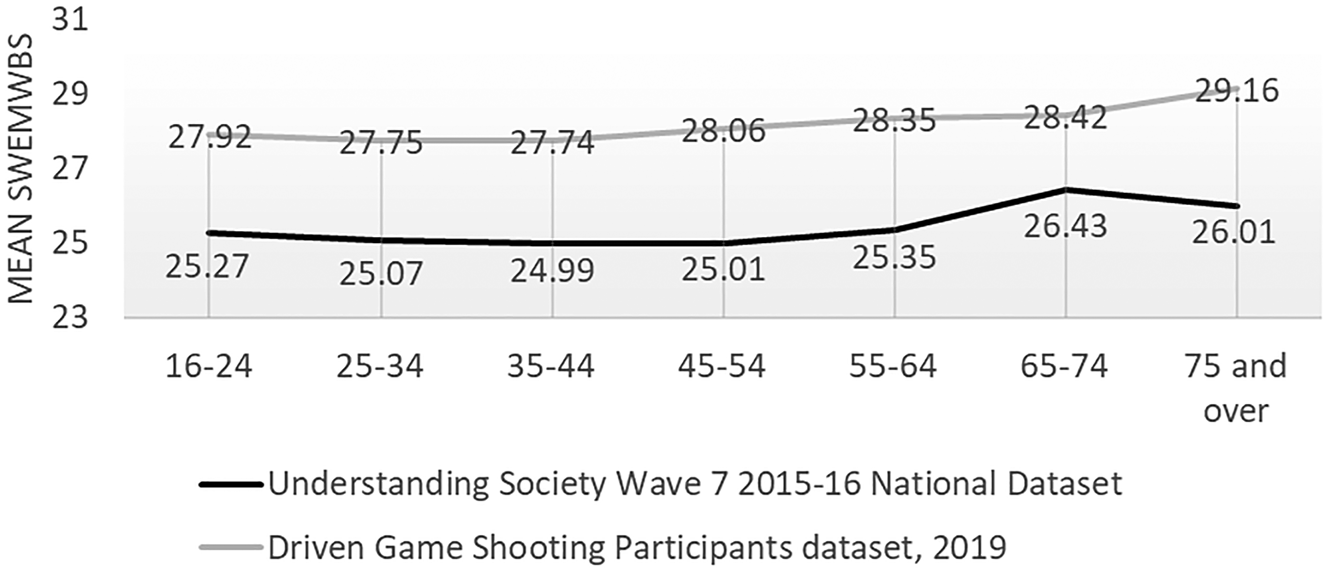
For mental wellbeing, measured using the SWEMWBS, the comparison dataset used was survey number 6614 Understanding Society: Waves 1–8, 2009–2017Footnote 4 (UK Data Service, 2017), as illustrated in Figure 4. The SWEMWBS gives a score out of 35 for mental wellbeing, representing the combined values of seven question responses from 1 to 5. Participants in DGS were found to have statistically higher levels of mental wellbeing than the national dataset comparison group, with a moderate to large effect size (p < 0.001, d = 0.64). Although those in syndicates (with stronger bonding social capital) were found to have significantly higher wellbeing than those not in syndicates (28.37 versus 28.03), the very low effect size indicated that within the overall dataset there was very little difference between the wellbeing of syndicate and non-syndicate members (p < 0.001, d = 0.09). Membership of social groups with strong identity links, as identified in this study, have been found to protect and enhance health and wellbeing, they make people feel good, capable and in control of their lives (Greenaway et al., Reference Greenaway, Haslam, Cruwys, Branscombe, Ysseldyk and Heldreth2015, Reference Greenaway, Cruwys, Haslam and Jetten2016), with a positive sense of identity, meaning and purpose (Haslam et al., Reference Haslam, Jetten, Postmes and Haslam2009). Figure 4 shows comparison of the full DGS dataset with the national average dataset using the age banding published in the national wellbeing survey.
Comparison of the driven-game shooting participant dataset and the national dataset using the Short Warwick Edinburgh Mental Well-being Scale (SWEMWBS).

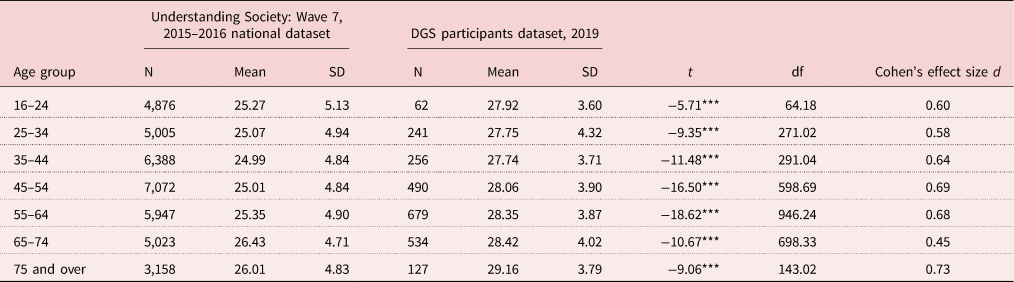
The national dataset is published in age bands and the comparison between these age bands illustrated in Figure 4 led to further analysis, which revealed that there was a statistically significant difference in the SWEMWBS between syndicate members and non-syndicate members for those aged 55 and over (p < 0.001, syndicate members N = 737, SD = 3.61, non-syndicate members N = 603, SD = 4.23; d = 0.22). The comparison with national dataset bandings in Figure 4 also revealed the highest impact was in those aged 75 and over. The average national dataset SWEMWBS reduces between the 65–74 age group and the 75 and over age group, whereas in the DGS sample, the average SWEMWBS is much higher, supporting the assertion that being part of the strong social network activity of DGS can have a strong positive impact for those in retirement. The majority of DGS participants were aged over 55, with the median age being 57 (mean = 54.57). The full results of the t-test in Table 4 show that the difference was found to be significant (p < 0.001) across all of the age bands. However, the effect size was largest (d = 0.73) in those 75 and over, at the higher end of the moderate effect size, indicating that the greatest impact on wellbeing scores through DGS participation, measured using the SWEMWBS and compared to the national dataset, can be seen in those aged 75 and over. All other age bands showed a moderate to large effect size of between d = 0.58 and d = 0.69, with the exception of those aged between 65 and 74, where only a small to moderate effect size was apparent (d = 0.45).
Independent t-test results for age bands comparing SWEMWBS national survey data with DGS participant responses

Notes: DGS: driven-game shooting. SD: standard deviation. df: degrees of freedom.
Significance level: *** p < 0.001.
The highlighting of the older adult impacts within the study came about for a combination of reasons. The median age of participants was 57 at the quantitative stage (mean = 54.57) and at the qualitative stage the mean age was 56. As shown in Figure 4, the SWEMWBS increased from age 55 up to a very high level at 75 and over. When combined with qualitative-stage findings that 62 per cent of interviewees were aged 55 or over and the researcher's experience on site at shoots, finding many participants were older and referred to purpose in retirement, this led to the impact on older adults and those who were retired or semi-retired, in rural areas in particular, becoming a key area of focus.
This change of wellbeing and mental health perceptions as people aged was also captured by one of the participants in the interviews:
I do think if you live to some extent on your own as you get older and become very introspective there can be degree of how do I feel today and that's bad for anyone. You know, when you have a couple of kids you don't have time to invest in yourself and how you're feeling and I think that is a possible pitfall if you don't have enough to do as you get older. (P9, picker-up, commercial, large, age 72)
As noted earlier, identity plays a key role in the social structures created within DGS. Strong relationship ties within a social network can make identities more noticeable and salient (Stets and Burke, Reference Stets and Burke2000). Burke (2007) argues that the process of verifying identity, through participation in DGS in the case of this study, enables people to create and maintain social structures in which the identities are embedded. The existence of these social networks was shown to have a positive impact on participants’ mental health and wellbeing measured using SWEMWBS, reducing loneliness and giving those participating a sense of purpose, particularly in retirement, as detailed in the next section.
Additional potential reasons for higher mental wellbeing scores
In addition to building strong social networks, involvement in DGS facilitates regular exercise in all weathers and access to green spaces, factors which may contribute to this higher mental wellbeing level. DGS is a rural pursuit with 80.0 per cent of those interviewed at the qualitative stage living in rural areas (village or rural) and 70.3 per cent of participants in the wider survey living in rural areas (village and rural). The wider survey included 32.9 per cent of participants who were retired or semi-retired and 40.0 per cent of participants interviewed at the qualitative stage were retired or semi-retired. Loneliness can be a greater issue when individuals retire and no longer have the day-to-day social contact that a working life facilitates. A 2019 study found that 2.6 million people aged over 65 speak to three or fewer people a week, with 225,000 people aged over 65 often speaking to no one in a week (Age UK, Reference Age2019).
An examination of the percentage of respondents who reported feeling lonely ‘often/always’ compared to the national dataset and within the DGS dataset split by various participation groups found that overall 1.2 per cent of those participating in DGS report feeling lonely ‘often/always’ much less than the national average at 5.9 per cent, whereas only 0.5 per cent of those over 65 in syndicates reported feeling lonely often/always. Having a lack of social contact has also been shown to negatively impact physical health and wellbeing, impacting life expectancy (Holt-Lunstad et al., Reference Holt-Lunstad, Smith, Baker, Harris and Stephenson2015; Aiden, Reference Aiden2016; Nyqvist et al., Reference Nyqvist, Victor, Forsman and Cattan2016; McDaid et al., Reference McDaid, Bauer and Park2017), with associate costs to the taxpayer (McDaid et al., Reference McDaid, Bauer and Park2017). Involvement in DGS as a syndicate member, particularly over the age of 65, appeared to be a factor in higher mental wellbeing measured using SWEMWBS, with 0.9 per cent of syndicate member participants in the DGS sample reporting feeling lonely ‘often/always’ compared to 5.9 per cent in the national comparative dataset Community Life Survey 2017–18. Those participants aged over 65 who were members of a syndicate with their stronger bonding social capital, as outlined earlier in this paper, reported feeling lonely often/always in just 0.5 per cent of cases, indicating the positive impact of participation in DGS in reducing loneliness, particularly for those aged over 65 years. At the qualitative stage, interviewees drew attention to the risks of loneliness for rural populations:
I could easily go a day here where I wouldn't see anybody and you sort of think, that's not a good thing really … I wouldn't want it to become like the norm that you don't do very much, and you don't see very many people. I think that's when you become a little bit introverted and you don't sort of get yourself out there and that's when I think you're just, (sighs) you know waiting for the inevitable. (P18, beater, commercial, large, age 56)
DGS participation can provide a reason to go out and participate in a social network-based activity with a clearly defined purpose. Those involved felt they play an integral role in the shoot day and this ‘sense of belonging’ and purpose encouraged individuals to spend more time outdoors and complete physical exercise throughout the entire year, in the natural environment, which has also been shown to have a positive impact on their physical and mental wellbeing (Ryan et al., Reference Ryan, Weinstein, Bernstein, Brown, Mistretta and Gagné2010; Thompson Coon et al., Reference Thompson Coon, Boddy, Stein, Whear, Barton and Depledge2011; Kerr et al., Reference Kerr, Marshall, Godbole, Neukam, Crist, Wasilenko, Golshan and Buchner2012; Loureiro and Veloso, Reference Loureiro and Veloso2014; Frühauf et al., Reference Frühauf, Niedermeier, Elliott, Ledochowski, Marksteiner and Kopp2016; Zhang, Reference Zhang2017). A total of 79.5 per cent of respondents agreed or strongly agreed their involvement in DGS enabled them to get away from the stresses of the working week, which could have been an influencing factor in higher mental wellbeing scores. In addition, 79.2 per cent of respondents agreed or strongly agreed that they spend more time outdoors than they otherwise would because of their involvement in DGS. Exercise taken outside has been shown to be more beneficial than exercise completed indoors (Thompson Coon et al., Reference Thompson Coon, Boddy, Stein, Whear, Barton and Depledge2011). Regular exercise, facilitated by access to open spaces via DGS in the case of this study, is associated with reductions in the number of long-term conditions such as heart disease, cancer and musculoskeletal conditions (Department of Health, 2012). Spending time outdoors can have positive mental wellbeing benefits (Ryan et al., Reference Ryan, Weinstein, Bernstein, Brown, Mistretta and Gagné2010; Kerr et al., Reference Kerr, Marshall, Godbole, Neukam, Crist, Wasilenko, Golshan and Buchner2012; Frühauf et al., Reference Frühauf, Niedermeier, Elliott, Ledochowski, Marksteiner and Kopp2016). Additionally, the role of land in human spirituality, perceived connection with a god and as a place of ‘therapeutic stillness’ has been considered in relation to overall human wellbeing (Winter, Reference Winter, Smith and Hopkinson2012). These phenomena could be factors in the higher mental wellbeing scores seen in this study.
In terms of physical health and wellbeing, the qualitative stage of data collection demonstrated to the researcher that a good level of fitness was required to be a beater and/or picker-up, as she accompanied the beaters and pickers-up whilst they completed their roles walking many kilometres (km), measuring distances using a pedometer, throughout the shoot day. Beaters and pickers-up said that although they liked walking, involvement in DGS encouraged them to go out and complete exercise over the winter months when they otherwise may not have done, indicating that DGS facilitates regular physical activity over the entire year, in all weathers. The wider dataset showed that the median distance walked by participants was 8.0 km (mean = 8.1, SD = 3.97), rising to a median of 9.0 km (mean = 9.4, SD = 3.83) for beaters and pickers-up. Regular physical activity has been shown to impact both physical and mental wellbeing positively (Miles, Reference Miles2007; Grant et al., Reference Grant, Machaczek, Pollard and Allmark2017). Walking is particularly beneficial for those in older age groups, as indicated in higher societal savings when benefits are calculated for those aged 45 years and over (World Health Organization, 2019), and has been suggested as a good way for men reluctant to take part in physical activity to improve fitness (Pollard, Reference Pollard2010), which is relevant as DGS is a predominantly male sport (86.7% male respondents).
Conclusion
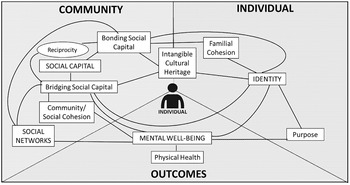
In conclusion, participation in DGS results in statistically significantly higher mental wellbeing measured using SWEMWBS than the national average. The reasons for this higher mental wellbeing level facilitated by DGS participation have been explored and include reduced loneliness, strong identity, a sense of purpose, social support networks available for activation in times of need, physical exercise, spending time in nature, and a strong rural and/or cultural heritage identity. Figure 5 summarises the positive social impact outcome findings, showing links between social capital, identity and social networks and the outcomes for individuals and communities.
Social capital, identity and social networks: community and individual outcomes.

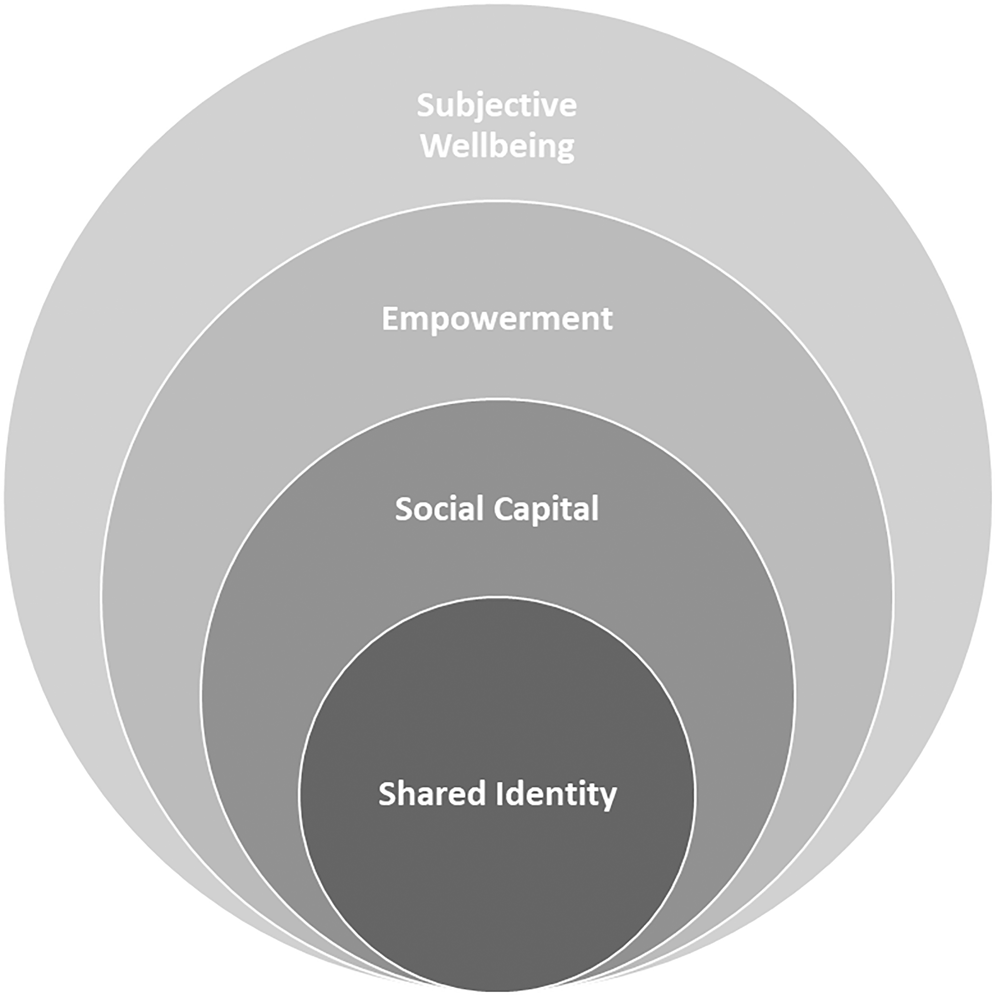
Those engaging in DGS have a well-developed sense of belonging, which leads to strong identities creating social structures through strong bonding and bridging social capital, providing community, reciprocity and social support networks (Putnam, Reference Putnam2000). This means that relationships cross traditional conceptions of habitusFootnote 5 (Bourdieu, Reference Bourdieu and Richardson1986) and align more closely to the empowerment theories of Weber (Reference Weber1978). Participants share a social status as members of the DGS community in a manner that subsumes traditional boundaries of class or economic status. This social capital and identity within DGS help individuals to build resilient social networks and engage in positive social interactions that drive positive wellbeing and feelings of empowerment, in line with Weber's arguments around individual social action (Weber, Reference Weber1978). For Weberian scholars, DGS can be argued to overcome the traditional class boundaries that disempower those from the ‘lower’ classes, restricting their access to resources and limiting their social action. Within DGS these boundaries are blurred and so individuals are able, irrespective of class, to access social networks and resources that would otherwise not be accessible to them. This in turn empowers the individual, raising their wellbeing through shared identity that is not based upon socio-economic status; thus, enabling social action and delivering tangible cumulative benefits (social impact) to society. Figure 6 outlines this process in a simplified manner.
Driven-game shooting, empowerment and wellbeing.

These positive social impacts have benefit both to the individual and wider society. The cost savings to society in maintaining good health and wellbeing can be substantial. As was noted earlier, it is estimated that poor mental health costs the UK £105 billion per annum, when various social and economic factors are considered (Department of Health Independent Mental Health Taskforce, 2016). The overall social cost of loneliness for each individual can be £6,000 over a 10-year period (McDaid et al., Reference McDaid, Bauer and Park2017). Whilst the valuing of subjective wellbeing is in its infancy, it has been suggested that maintaining subjective wellbeing can be valued at £10,560 per person, per year (Maccagnan et al., Reference Maccagnan, Wren-Lewis, Brown and Taylor2019). Therefore, the benefits of DGS to society (and probably other pastimes that encourage a shared identity that crosses class boundaries) may be significant in the long term. This paper therefore seeks to argue that such ‘class-neutral’ activities could provide a key element in building individual wellbeing and social cohesion, reducing the negative implications of removal from social relations (Burholt et al., Reference Burholt, Winter, Aartsen, Constantinou, Dahlberg, Feliciano, Gierveld, Regenmortel and Waldegrave2020) by offering older people in rural areas the opportunity to engage in social activities.
This research was restricted by the controversial nature of the topic, meaning no control group could be used, and this was overcome through use of a national dataset for comparison; this provides bias into the sample, however, as were not able to generate a true comparison across all of the data-points reported in the survey. This is an area for further research. This study confirms that the financial value of positive social impact on mental and physical health and wellbeing for individuals taking part in social network-based activities like DGS is potentially significant, especially for older individuals, as the cost savings to the taxpayer in avoiding poor mental health and maintaining physical health can be very high. This will have implications for policy makers when considering amendments to the rules surrounding DGS in the UK and could influence policy decisions around supporting other social network-based, rural activities nationwide.
Author contributions
All persons who meet authorship criteria are listed as authors, and all authors certify that they have participated sufficiently in the work to take public responsibility for the content, including participation in the concept, design, analysis, writing or revision of the manuscript.
Financial support
This research received no specific grant from any funding agency in the public, commercial or not-for-profit sectors.
Conflict of interest
The authors declare no conflicts of interest.
Ethical standards
The research was subject to a rigorous, full ethical approval process via the University of Northampton. Anonymity of participants was fully assured. All responses to the second-stage questionnaire were anonymous. Postcodes were anonymised prior to data storage. Online Surveys (formerly Bristol Online Surveys) software was used to comply with confidentiality and digital security requirements. Gaining consent was handled differently for fieldwork observation than interviews, with a verbal consent script used for fieldwork and signed consent form for interviews (LeCompte and Schensul, Reference LeCompte and Schensul2010).