The debate over the bereavement exclusion (BE) criteria for major depression (MD) – that MD should not be diagnosed if the symptoms can be ‘better accounted for by bereavement’ [(American Psychiatric Association, 1994) 327] – was one of the most heated and publicized in the DSM-5 revision process (Zachar et al. Reference Zachar, First and Kendler2017). One part of this debate was about historical precedents, about whether the BE criteria was a novel idea when first proposed in DSM-III (American Psychiatric Association, 1980) or had prior historical precedents in the psychiatric literature on the diagnosis of MD (Horwitz et al. Reference Horwitz, Wakefield and Spitzer2007; Kendler, Reference Kendler2008; Wakefield, Reference Wakefield2013). A central issue in these discussions is whether MD should be diagnosed solely on the basis of the presenting history, symptoms, and signs (the context-independent position) or whether the diagnostician should take into account psychosocial adversities recently experienced by the patient (the context-dependent position). If the depressive symptoms were considered commensurate with the level of adversity, the context-dependent position would suggest that a diagnosis of MD should not be given.
In this paper, I address these questions through a review of 49 descriptions of MD or melancholia (hereafter for simplicity ‘MD’) in psychiatric textbooks or articles published from 1880 to 1960. Rather than focusing narrowly on the BE criteria, I sought to provide an historical context to this debate by addressing, in these historical documents, three inter-related questions:
(1) Does the author consider psychosocial adversities to predispose to mental illness generally and MD more specifically? If yes, is bereavement noted as one such possible adversity?
(2) Does the author advocate for a context-dependent approach to the diagnosis of MD?
(3) Does the author endorse the key features of the BE criteria – that is, an acceptance of the context-dependent approach to the diagnosis of MD but its restriction only to cases of bereavement and not to other kinds of adversity?
Methods
I sought to assemble a substantial and representative number of psychiatric texts that described in reasonable detail the diagnostic approach to MD. I began with texts I had assembled for two prior projects: psychiatric textbooks written in 1900–1960 (Kendler, Reference Kendler2016) and textbooks and review articles on MD published from 1880 to 1900 (Kendler, Reference Kendler2017). Because large amounts of text – including sections on the etiology of mental illness – had to be reviewed, I limited these texts to either those published in or translated into English. In total, adding a few new texts that I located in the interim, I examined 49 texts from authors in the following countries: USA – 26, UK – 15, German – 2, France – 2, and one each from Austria, Canada, and Switzerland. Of these, 45 were textbooks and four were review articles.
My review went through three stages. First, I determined whether the text contained a general discussion on the etiology of mental illness. Most of the longer textbooks contained such a section, but these were missing from some of the shorter ‘handbooks’ and from all of the review articles. If this section was present, I read it carefully to see if it contained a discussion of the impact of recent psychosocial adversities. In the earlier texts, these were labeled ‘moral’ causes of illness. If adversities were noted, I then determined if bereavement was considered one such cause. Several texts described ‘emotional reactions’ as possible causes such as fright, fear or grief. I did not count these instead requiring that the author listed specific ‘events’ such as romantic loss, business difficulties or death of loved ones.
Second, I examined carefully the section on MD including the introduction, which often contained a ‘definition’ of the syndrome by the author, the description of symptoms and signs, and in particular the section on differential diagnosis. It was here that I sought a description of the potential role that recent psychosocial adversities should play in the diagnosis of MD. When present, this was, interestingly, most frequently noted in the initial ‘definition’ section of MD and less frequently in the discussion of differential diagnosis. Many of these texts contained descriptions about the differential diagnosis of MD with ‘milder’ psychiatric disorders such as neurasthenia or later neurotic or ‘reactive’ depression. These were not of interest to this inquiry that focused on the distinction between MD and a ‘normative’ reaction which was not considered to represent a mental illness.
Third, in those texts which raised the issue of the discrimination between MD and a normative response to recent adversities, I carefully examined which adversities were listed to see if bereavement was among them. I required that death (or an equivalent phrase) be specifically noted. I did not count a mention of ‘grief’ alone as from context, this term was often used broadly in these texts to refer to an emotional reaction to a range of losses. I also recorded, as an internal control, the presence of financial or business losses in the list of adversities that often precede MD. Finally, I never utilized any material in these texts that were only presented as part of a case history.
A limitation of this study is that I cannot prove that these texts – which often ran to hundreds of pages – did not contain an important statement addressing one of these three issues that I missed. One cannot definitively prove a negative. However, with one exception – the recent English translation of Kraepelin's sixth edition (Kraepelin, Reference Kraepelin1990) – I located searchable PDFs of all documents which were originally published before 1910. For these, I did relevant word searches to reduce the chances of missed key phrases. For the more recent texts, I utilized their indices. Nonetheless, it is not unlikely that I missed some important phrases in a few of these texts. The p values were reported two-tailed.
Results
General findings
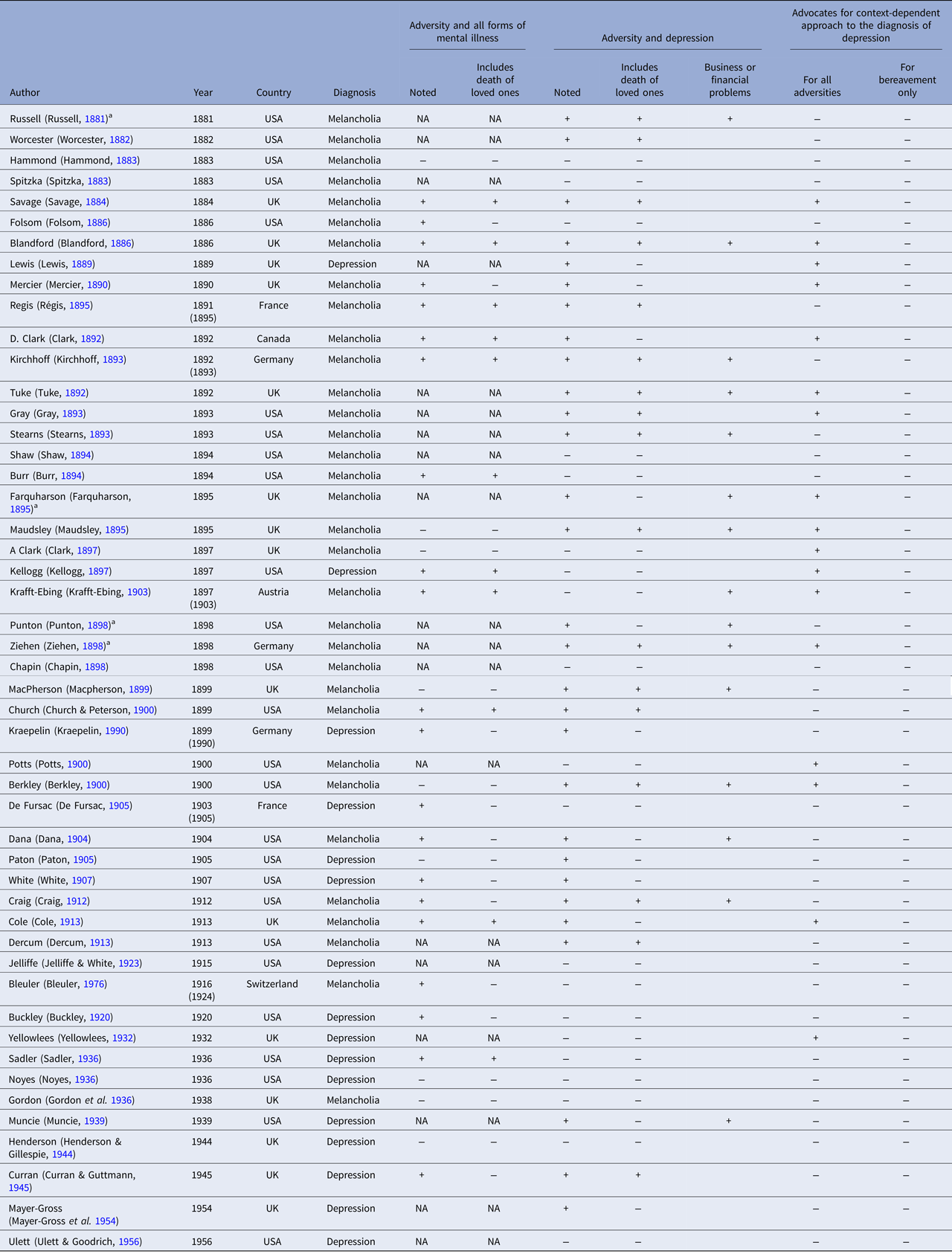
Of the 49 texts reviewed, 19 had no general section on the etiology of mental illness (Table 1). Among the 30 that did, 19 (63%) noted that specific recent adversities predisposed to illness risk. Of those 19, 11 (58%) mentioned bereavement as one such adversity. Examples include the following:
Severe mental and physical strains, reverses in business, loss of property and friends, masturbation, sexual excesses, religious excitement, anxiety in any and all its forms (may induce onset of melancholia) (Punton, Reference Punton1898). About twenty-four per cent of all cases of insanity are ascribed to moral causes, among which are classed domestic troubles, grief over death of friends, business worries, anger, religious excitement, love affairs, fright, and nervous shock (Church & Peterson, Reference Church and Peterson1900). A sudden calamity, loss of a dearly loved relative or friend, reverse of fortune, political catastrophe, or a shock or fright preceding from some awful spectacle or violent quarrel, or near approach to death – these are the things which unhinge the mind (Blandford, Reference Blandford1886).
Summary of key results from 49 textbooks and articles published on depression or melancholia from 1880 to 1960

a Journal article. All other documents are textbooks. When a second date is provided, i.e. the date of the publication of the translation. Ziehen's article was originally published in English. NA – not applicable because relevant section was not present in the text. + means present; − means absent.
In the sections on MD, 29 of the authors (59%) stated that adversities in adult life were a relevant etiologic factor in depression. Of those 29, 17 (58%) mentioned bereavement as a specific risk factor. The next most frequently noted adversities were financial problems (15% or 52%) and romantic difficulties (7% or 24%). Examples of these descriptions included:
Disappointments, excessive mental application and strain, reverses in business, masturbation, loss of property, loss of children …, may act as direct causes in the development of the disease (of MD) [(Stearns, Reference Stearns1893) 128]. In nearly one half of all cases of melancholia, emotional disturbances from the death of wife, husband, or child are mentioned in the clinical histories of patients. Vivid emotions of any kind, the shock of business reverses, the loss of property, actual want (are also common antecedents) (Berkley, Reference Berkley1900). (Melancholia) … is often excited by severe domestic or financial losses, by severe illnesses and overwork [(Dana, Reference Dana1904) 642]. The psychological precipitants (of MD) may be of the most diverse types; but broken love affairs and bereavements are particularly prominent (as well as) professional disappointments and ‘disgrace with fortune or men's eyes’ [(Curran & Guttmann, Reference Curran and Guttmann1945) 164].
Seventeen of the 49 texts (35%) advocated for the context-dependent position – that MD should be diagnosed only when the symptoms and signs displayed were out of keeping with the recent experiences of the patient (Table 1). These 17 texts were not distributed evenly across countries or time periods. Of the 15 UK authors, 10 (67%) advocated for the context-dependent position, while this view was adopted by only seven of the 34 other authors (21%) (χ2 = 9.75, df = 1, p = 0.002). Taking Kraepelin's publication in 1899 of this sixth edition – with its introduction of his mature concept of manic-depressive illness – as an historical watershed, the context dependence of MD was advocated by 13 of 27 (48%) of the authors publishing before 1899 but only four of 21 (19%) publishing after (χ2 = 4.37, df = 1, p = 0.04).
Rationales for the context-dependent position
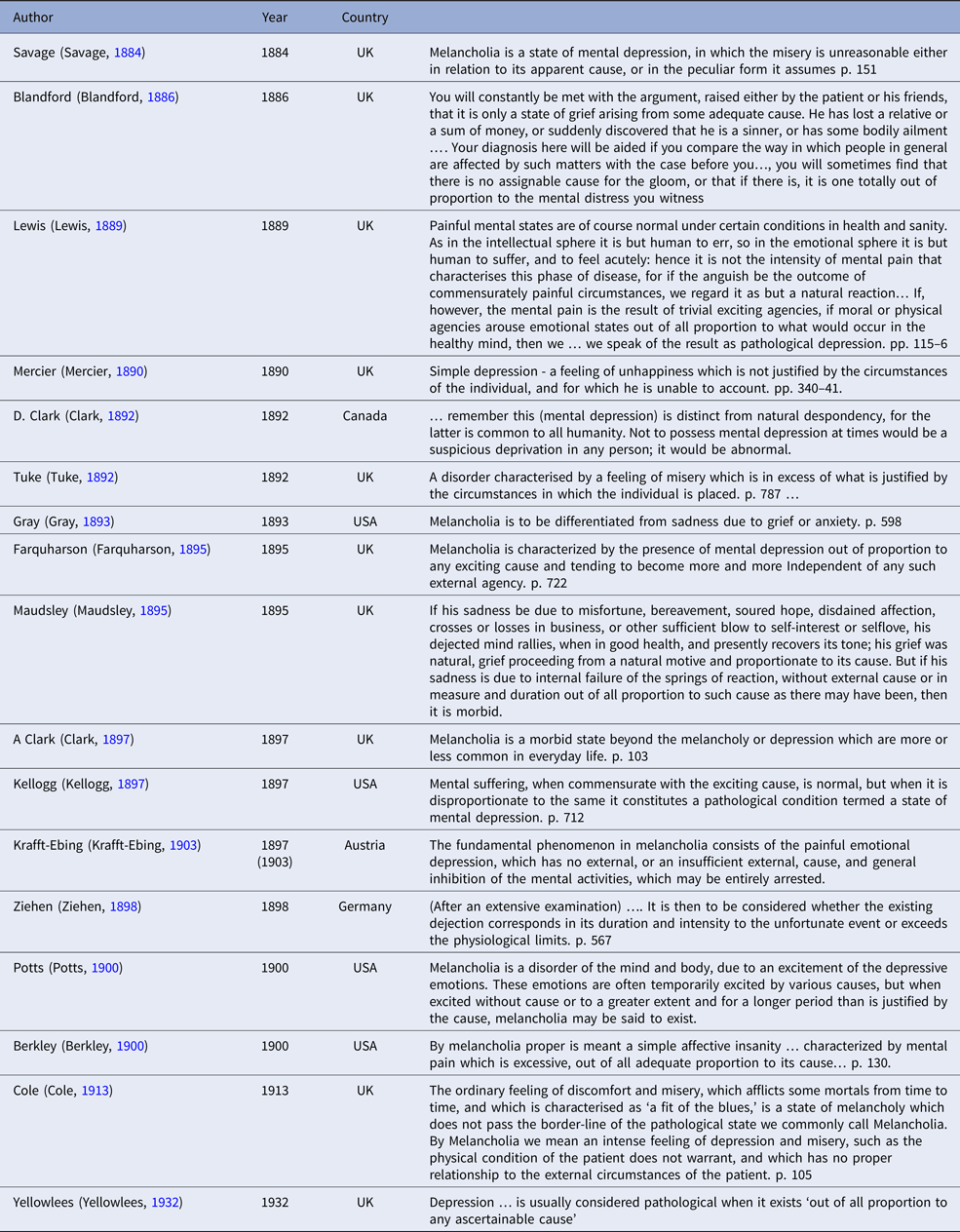
Table 2 provides relevant quotes from all authors advocating for the context-dependent position on the diagnosis of MD. Most authors described their rationale only briefly but others commented more extensively. The phrases most frequently used to discriminate MD as a mental illness from normative depressive symptoms were that, in the context of experienced adversities, the symptoms and signs were ‘unreasonable’, ‘not justified’, ‘disproportionate’, and, most commonly, ‘out of proportion’. Alternatively, some authors noted that the stressors were ‘insufficient’, or did not ‘correspond’ or ‘warrant’ the resulting depressive symptomatology. Several authors use the phrase ‘natural’ to describe a normative context-dependent depressive syndrome.
Quotations from authors who advocate for the context-dependent approach to the diagnosis of depression or melancholia

Implementing the context-dependent position
Several authors comment, in a more practical vein, on how the context-dependent position might work in clinical practice (Table 2). Blandford tells readers that ‘Your diagnosis here will be aided if you compare the way in which people in general are affected by such matters with the case before you… (Blandford, Reference Blandford1886)’. Farquharson (Farquharson, Reference Farquharson1895) suggests that following patients over time will help as true melancholia becomes ‘more and more independent’ of any precipitating stressors. Maudsley (Maudsley, Reference Maudsley1895) notes that in the patient with a non-pathological depression, the ‘dejected mind rallies … and presently recovers its tone’. Krafft-Ebing (Krafft-Ebing, Reference Krafft-Ebing1903) states that the symptom of a ‘general inhibition of the mental activities’ is indicative of true melancholia.
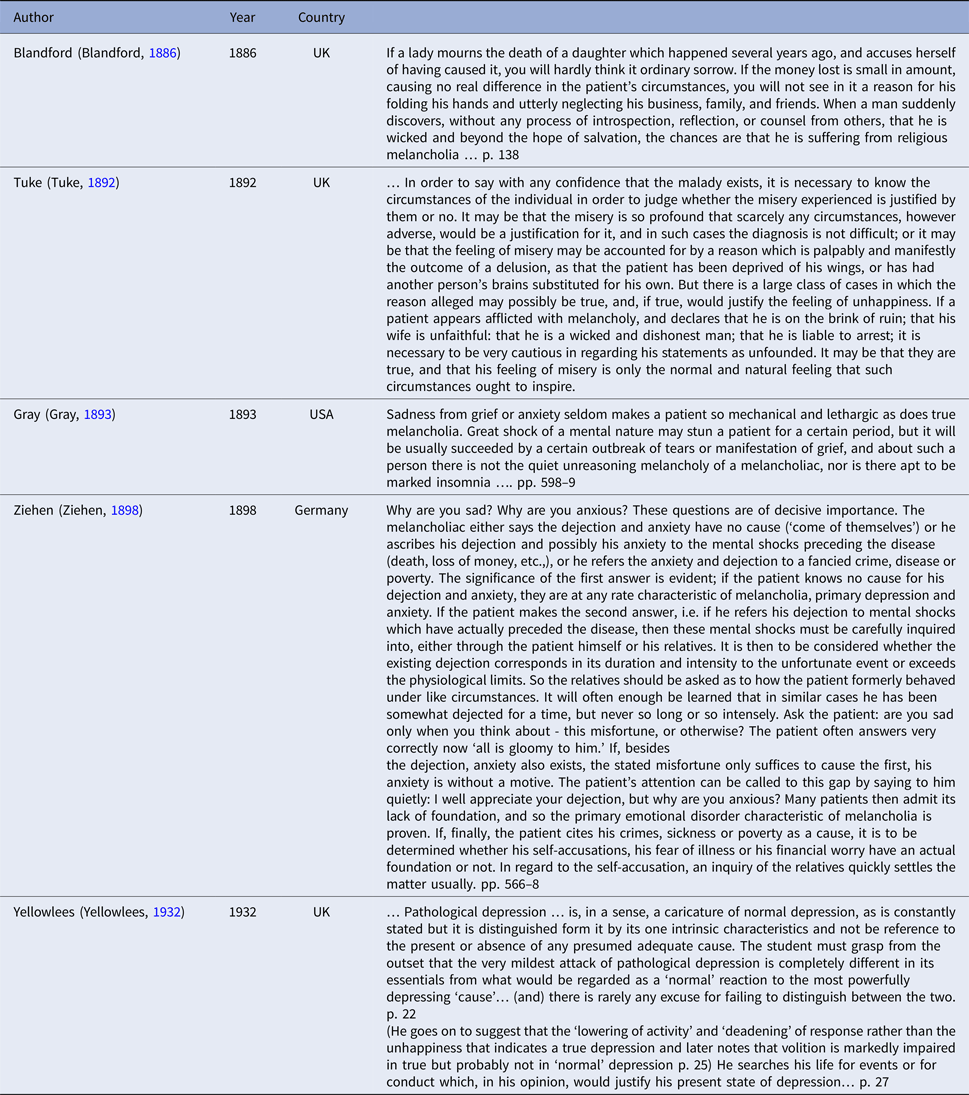
Table 3 contains more extended comments by five of our authors on the challenges of distinguishing between MD and a normative depressive syndrome. Blandford (Blandford, Reference Blandford1886) gives three poignant examples of cases where, in his own words, the depressive symptoms were clearly ‘out of proportion’ to the experienced stressors. Tuke (Tuke, Reference Tuke1892) raises the concerns of how to interpret claims by the depressed patient that his symptoms are in reaction to stressors. You can rule this out, he argues, when the depressive symptoms derive from delusional beliefs. But he then notes the ‘large class’ of patients where their explanation for their melancholy ‘may possibly be true’. He urges caution in concluding that such beliefs are necessarily false.
More extended quotes regarding the operationalization of a context-dependent position of distinguishing major depression from normative depressive symptoms

Gray takes a different tack, suggesting, as did Krafft-Ebing, that symptoms can be helpful in the differential diagnosis. True cases of melancholia, he suggests, are ‘mechanical and lethargic’ and suffer from ‘marked insomnia’. While the normative depressive reaction typically has a more demonstrative ‘outbreak of tears or manifestation of grief’, the true depressive has a ‘quiet unreasoning melancholy’.
In one of the more fascinating of our texts, Ziehen (Ziehen, Reference Ziehen1898) describes a mental status examination for the diagnosis of a depressive syndrome. He cautions against always taking the patient's explanation for their depression literally (‘he refers the anxiety and dejection to a fancied crime, disease or poverty’) and suggests that any supposed cause ‘must be carefully inquired into, either through the patient himself or his relatives’. In determining whether the depressive symptoms are commensurate with the stressors, ‘the relatives should be asked as to how the patient formerly behaved under like circumstances’.
Finally, Yellowlees (Yellowlees, Reference Yellowlees1932) also gives an extensive description of the problems of the diagnosis of MD. He argues that the clinical presentation of true depression ‘is completely different’ from the normative depressive syndrome. He later gives a few details on how such a distinction might be made (e.g. a ‘deadening of responses’ and markedly impaired volition) and ends with suggesting substantial skepticism about the patient's own explanation for his depression.
Discussion
The questions
In DSM-5, the diagnostic criteria for panic disorder and specific phobia require that the diagnoses take account of the psychosocial context in which symptoms arise. Panic attacks are required to be ‘unexpected’ and the symptoms of specific phobia must be ‘out of proportion’ to the actual danger to which the subject is exposed. By contrast, for schizophrenia, the diagnosis is made independent of the psychosocial context in which the symptoms arise.
The BE debate in DSM-5 centered around two issues, the historical backgrounds of which are reviewed in this paper. The first and larger question is whether MD should be diagnosed in a context-dependent manner – like panic disorder and specific phobia – or a context-independent manner like schizophrenia. If diagnoses of MD need to be made accounting for psychosocial context, the second and more focused question in the BE debate is whether the relevant context should be restricted to bereavement or to apply more generally to any severe recent adversity.
The goal of this paper was to provide an historical background to this debate. Given evidence that our current concept of MD can, with considerable fidelity, be traced back to 1880 (Kendler, Reference Kendler2016, Reference Kendler2017), that was a logical starting point on my inquiry. The year 1960 was chosen as a concluding date so as to end our inquiry substantially before the DSM-III revolution in psychiatric nosology.
Main results
Out of the wide diversity of findings, I emphasize four points, moving from less to greater specificity with respect to the BE debate. First, the recognition that recent psychosocial adversity is causally related to psychopathology in general and MD more specifically goes back a long way, far before the empirical studies of stressful life events that began rigorously in the 1960s (Paykel et al. Reference Paykel, Myers, Dienelt, Klerman, Lindenthal and Pepper1969; Brown et al. Reference Brown, Sklair, Harris and Birley1973; Frank et al. Reference Frank, Anderson, Reynolds, Ritenour and Kupfer1994). However, the pathogenic nature of such events was noted by only about 60% of authors and when a set of illustrative events were provided, the list, while diverse, was typically short. While death of relatives was relatively often mentioned, it was never treated as a special or distinct kind of adversity.
Second, our historical review provides mixed support for the context-dependent approach to the diagnosis of MD. It was a minority opinion expressed in about a third of the texts. However, the 17 authors who argued that depression requires a judgement that it is ‘unexpected’, or ‘out of proportion’ to experienced adversities represented a vocal minority, some of whom defended their position forcefully and at length. Of note, the context-dependent position was not found in the texts we examined from the two most prominent of our authors (Kraepelin and Bleuler) nor was this position supported by a number of the leading lights of early and mid-twentieth century US and British psychiatry (e.g. White, Jelliffe, Henderson, and Mayer-Gross). However, some well-known late nineteenth century figures, especially Maudsley and Krafft-Ebing, were advocates.
Third, a range of views were expressed on how a context-dependent approach to the diagnosis of MD would be implemented. Most frequently, the authors appeared to rely on their clinical experience and empathic understanding to judge whether the patient's clinical history, symptoms, and signs were ‘out of proportion’ to the reported adversities. As a reader, my sense was that these clinicians were going through the mental exercise of ‘imagining’ whether the particular set of symptoms seen in their patient would arise in a ‘normal’ person, given this context of these particular stressors. But several authors realized that this approach had a major problem. Depressed individuals had what we would today call ‘cognitive distortions’ and ‘a search after meaning’. So, their reports of causative adverse events could not always be trusted. Relatives should be interviewed to confirm such reports and even to inquire how the patient coped with similar difficulties in the past. A few authors took a different approach, suggesting that clinical symptoms or course of illness could successfully distinguish MD from a normative depressive response. Only a few symptoms were listed and these were not highly consistent across authors.
Finally, the historical context of the second central issue in the BE debate can be easily addressed. Bereavement was often mentioned as an example of adversities that predisposed both to mental illness generally and to MD specifically. However, no author proposed that the context-specific diagnostic approach to MD should be confined to bereavement. So, in the narrow sense, given the authors we have reviewed here, the BE criterion as operationalized in DSM-III was without historical precedent
Other issues
Why was the context specificity of MD most frequently advocated by British authors? In his masterly history of nineteenth century British psychiatry (Scull et al. Reference Scull, MacKensie and Hervey1996), Scull argues that Bucknill and Maudsley were amongst the most dominant psychiatric figures in the British Isles in the latter nineteenth century. Maudsley strongly advocated for the context-specific position on MD diagnosis (Maudsley, Reference Maudsley1895). Bucknill co-authored the most influential psychiatric text in the mid-nineteenth century England (Bucknill & Tuke, Reference Bucknill and Tuke1858) [published too early (1858) to include in our survey]. This text also takes a context-specific position on melancholia. In a portion of the book written by Bucknill, he poses a question about the impact of adversity in a person with and without a prior predisposition to mental illness. In considering the diagnosis of melancholia in such cases, Bucknill writes ‘…it may only be possible to found a distinction upon the relative intensity of the natural and of the pathological emotion’ [(Bucknill & Tuke, Reference Bucknill and Tuke1858) 310]. In a rather profound insight into the problem of context specificity for psychiatric disorder as a whole, Bucknill later writes
Grief, fear, and anxiety are all natural to the mind; delusion and hallucination are unnatural. Disease has to be ascertained from the degree and origin of the former (i.e. melancholia), while the mere existence of delusion (in what we would now call psychotic illness) is often enough to guide the judgment [(Bucknill & Tuke, Reference Bucknill and Tuke1858) 310].
Finally, Bucknill's co-author, Daniel Tuke, of the famous Tuke family of Quaker reformers who played a key role in the development of moral therapy, edited the influential Dictionary of Psychologic Medicine (Tuke, Reference Tuke1892). The section on melancholia in this book took a clear context-dependent position. So, it appears that the leadership of British psychiatry in the late nineteenth century was in favor of the context-dependent diagnostic approach to MD, a situation without parallel in the other countries we examined.
Authors writing after publication of Kraepelin's influential sixth edition – with its articulation of his mature concept of manic-depressive illness (Trede et al. Reference Trede, Salvatore, Baethge, Gerhard, Maggini and Baldessarini2005) – were significantly less likely than earlier authors to argue for the context specificity of MD. The reason for this was evident in reviewing these texts. When authors accepted Kraepelin's diagnostic concept of manic-depressive illness, the points of emphasis in their treatment of MD shifted toward the genetic, constitutional, and biological with less attention or interest in environmental or psychological influences. This is consistent with Kraepelin's views as articulated in his sixth edition:
Manic-depressive insanity … is a very common disorder (the causes of which) have to be looked for essentially in a pathological predisposition. I was able to find a hereditary tendency in about 80% of my cases…. The development of the disorder is generally independent of all other external causes, even though the patient and those around him usually refer to some incident or other by way of explanation [(Kraepelin, Reference Kraepelin1990) 302–303].
Conclusions
About two-thirds of psychiatric texts published from 1880 to 1960 that described general etiologic factors in mental illness recognized recent adversities as important influences. In their discussions of MD, 60% of authors noted the etiologic importance of recent adversities and of these about half mentioned bereavement. Bereavement was frequently mentioned as a recent adversity that predisposed to mental illness in general and MD more specifically. However, no author suggested that it was qualitatively different from other stressors.
The context-dependent approach to the diagnosis of MD receives mixed support in this historical review. It was a minority position over the time period of this review and its advocates did not include the most influential of continental psychiatrists nor the twentieth century leaders American or British psychiatry. But, it received relatively consistent and articulate support from nineteenth century British authors.
These advocates most commonly suggested an empathic ‘understandability’ criterion for the judgment about the context specificity of MD. However, a number of authors noted both the problem of biased patient reporting and the difficulty of discriminating when the MD was truly ‘out of proportion’ to the precipitants. Some authors suggested that certain signs and symptoms could discriminate ‘true’ from ‘normative’ MD but no broad consensus about the most informative features was evident. It is, in this context, worthwhile quoting the view on this problem from what is widely regarded as the outstanding twentieth century monograph on MD by A. Lewis. He discusses his attempt to apply previously proposed criteria to separate his very carefully studied 61 melancholic patients into those whose illness could easily be understood as contextual (or ‘psychogenic’) v. endogenous:
The criteria were applied…But the more one knew about the patient, the harder this became. A very small group of nine case emerged (in which) … it could be said that the situation in these cases have been an indispensable efficient cause for this attack… There was a small group of 10 in whom one could not in the least discover anything in their environment which could have been held responsible for the outbreak of the attacks. But all the others were understandable examples of the interaction of organism and environment, i.e., personality and situation; it was impossible to say which of the factors was decidedly preponderant (Lewis, Reference Lewis1934).
Of note, this review found no historical precedent for the BE criteria as first proposed for DSM-III – i.e. that ruling out a diagnosis of MD because it was ‘out of proportion’ to stressful events should apply only to those who have experienced bereavement.
My goal for this review was a scholarly one – to clarify the historical antecedents of the BE debate. I make no claim that historical positions taken by earlier expert clinicians are necessarily the correct ones. Indeed, many of the issues raised by the BE debate can be and have been subject to empirical inquiry. Nonetheless, historical opinions are relevant in that they permit us to contextualize these issues and allow us to see how they were viewed and understood by the major figures in our field in past generations.
Acknowledgements
Peter Zachar Ph.D. provided helpful comments on an earlier version of this essay.
Conflict of interest
The author reports no conflicts of interest.