Introduction
Modernity poses a deep challenge to the regulatory project. The post-modernist ethos seems to have robbed us of any faith in a supreme moral or epistemological authority, which could guide us as we struggle to find solutions to our multiple environmental problems. This spirit of deep scepticism was cultivated by several streams of thought, ranging from critical legal studies to feminist critique, deconstruction and sociology of science.Footnote 1 Against this background of normative and epistemological perplexity the regulatory vision of neoclassical economics – environmental economics in our context – emerged as a beacon of objective reason offering a comprehensive programme of rational governance.
Environmental economics argues that economic thinking should guide the entire regulatory process, from rule making (e.g. instrument choice), to enforcement, monitoring and retrospective adaptation.Footnote 2 The application of economic principles across the entire regulatory spectrum should bring, it is argued, the maximisation of total social welfare. The economic position thus rests on a teleological interpretation of the regulatory project.Footnote 3 In its grand claim for fixing society’s ecological malfunctions, the regulatory vision of environmental economics constitutes the most prominent representative of the social engineering ethos. The policy prescriptions of environmental economics had a substantial impact on the environmental policy agenda of governments across the world – reflected in more extensive use of market-based instruments and in an increasing reliance on economic methodology in regulatory decision-making.Footnote 4
This article develops a general critique of the economic approach to environmental regulation, drawing on the insights of systems theory. Systems theory provides a systematic framework within which the discursive plurality and deep scepticism that characterises the modern society can be observed and expressed. The theoretical framework of systems theory allows us to unfold the blind spots of the economic approach to regulation and expose the limitations of its policy prescriptions. System theory highlights, first, the problematic of subjugating the regulatory system to a single purpose, which in the context of environmental economics is interpreted as the utilitarian maximisation of collective welfare. Second, it questions the teleological pretence of the regulatory project as it is configured in the economic literature. It highlights in this context the problem of trans-systemic incompatibilities, which lead to the reconstruction of economic ideas, as they are incorporated in the systems of law and politics. The approach of environmental economics to this dilemma has been either a complete disregard, conceptualising the legal and political systems as neutral conduits for transferring the economic signals prescribed by economic theory; or an attempt to reconceptualise the legal and political systems according to the analytical framework of neoclassical economics. Neither of these approaches offers a convincing response to this regulatory dilemma. This twofold critique of the economic approach can be extended, I will argue, to every regulatory project with far-reaching teleological ambitions. Further, it also questions the coherence and efficacy of alternative regulatory visions such as self-regulation, reflexive law and responsive regulation, which offer a more modest teleological vision. Finally, this critical contemplation on regulatory theory also exposes the limits of systems theory itself as a practical social science, leading to an enquiry into the role of intuition in regulatory decision-making.
The article proceeds as follows. The first section outlines the basic principles of the economic approach to environmental regulation, distinguishing between two strands of economic thought: normative and sociopolitical.Footnote 5 The second section develops a general critique of the economic theory of regulation, drawing on the insights of systems theory. The third section considers the problem of trans-systemic disruptions. It discusses two examples of the reconstruction of economic ideas within the legal and political domains, drawing on the EU and US regulatory experience. This section traces the ways in which the legal and political systems reconstruct the conceptual models of environmental economics and explores the impact of these discursive processes on the efficacy of the regulatory project. Section four develops a critique of the sociopolitical strand of environmental economics, focusing on the ideas of ‘political economy’. The final section considers the coherence of alternative regulatory models (self-regulation, reflexive law and responsive regulation) and explores the limits of systems theory. It concludes with a discussion of the role of intuition in regulatory judgment.
1 The economic approach to environmental regulation
Environmental economics offers a unitary vision of the regulation of environmental problems, based on the claim that economic guided intervention is preferable to alternative regulatory visions from the point of view of total social welfare.Footnote 6 The economic vision is based on two pillars. First, a shift from regulatory intervention based on uniform standards (command and control regulation) to intervention relying on market-based instruments (MBIs). Second, the claim that the entire universe of regulatory decision-making – rule making, enforcement practices and judicial decision-making – should be based on the analytic framework of economic reasoning. It is important to distinguish in this context, as noted above, between two strands of economic analysis: normative and sociopolitical. The normative approach sees as its mission the development of optimal regulatory solutions. This theoretical exploration is undertaken in a first-best world. In particular, it considers the legal and political systems as neutral fields that can perfectly employ the economic ideas and generate the optimal signals that economic theory recommends. As I will argue below, the sociological naïveté of the normative approach significantly limits its ability to serve as a guide to policy-makers. The sociopolitical strand, which includes the fields of political economy (or public choice), institutional economics and law and economics, accepts the claim that the legal and political systems do not form a neutral medium and their structure and operation should be analysed independently. Yet this sociologically more complex approach suffers from several flaws that limit its usefulness in the resolution of actual regulatory problems. These flaws are discussed in section four.
Consider, first, the call for a more intensive use of MBIs.Footnote 7 This intervention model is based on the idea that excessive pollution and the overexploitation of natural resources are caused by a lack of a proper market for environmental goods and services. The response to this problem lies in the creation of artificial markets for environmental goods and services, which will force market playersFootnote 8 to consider the environmental aspects of their decisions, by providing them with proper economic signals. The economic literature focuses on two central types of economic instruments: environmental taxes and tradable permits.Footnote 9 Despite their laissez-faire appearance both instruments require intensive and non-trivial governmental intervention. Governments are required to determine the tax rate or the quantity of allocated permits in a manner that would produce the desired results in terms of the total pollutants emitted into the environment. This imposes a difficult informational burden on environmental agencies (environmental agencies do not have information concerning the firms’ pollution control cost and are also facing formidable difficulties in estimating the environmental/health damage caused by pollution). The implementation of MBIs raise further challenges involving the administrative costs associated with their operation (especially monitoring), the impact of fiscal interactions (due to the revenue-raising nature of MBIs) and their distributional implications. Despite these non-trivial challenges, economists seem confident in their belief in the superiority of MBIs over direct regulatory instruments.Footnote 10
The second pillar of the economic approach seeks to base environmental decision-making on the methodological framework of economic analysis. It is possible to distinguish in this context between two main methods. Cost-benefit analysis (CBA) addresses the different costs and benefits associated with a particular regulatory choice (from rule-setting to enforcement decisions), setting its projected environmental/health benefits against its estimated costs.Footnote 11 The output of this analysis is a ranking of various environmental policy options according to their contribution to aggregate social welfare (measured in monetary terms).Footnote 12 The second method takes the environmental goal as a given and examines the relative costs of the various regulatory options, exploring how the designated goal can be achieved at the lowest cost (‘cost-effectiveness’ method) (EPA, 2000, p. 178). Economic reasoning should also guide, it is argued, the judicial decision-making process. Two leading examples of the use of cost-benefit analysis in legal reasoning are Becker’s model of punishment (Becker, Reference Becker1968) and the Learned Hand’s negligence formula (Simons, Reference Simons2001). I will examine Becker’s model and the way in which it was utilised by US courts in more detail in section 3.2.
2 The regulatory approach of environmental economics: a systems theory critique
2.1 Systems theory: exposition
Systems theory offers a sceptical view of the teleological ambitions underlying the regulatory vision of environmental economics. Before I elaborate this critique, I want to outline the main tenets of the sociological framework of systems theory.Footnote 13 The portrait of modern society outlined by systems theory is based on three pillars: functional differentiation, radical autonomy of society’s subsystem and multifaceted epistemology. These pillars draw on a critical theoretical shift, which takes communications – rather than people, organisations or rules – as the basic building blocks of society.Footnote 14 Social systems are conceived under this view as networks of communications. The thesis of functional differentiation describes the modern society as a polycentric system: an assemblage of autonomous subsystems. The systems include the law, the political system, science, morality, religion, education, art and the mass media. Footnote 15 The boundaries of the various social systems are a product of a unique binary code that establishes each system as a separate entity within the social universe (Luhmann, Reference Luhmann1992, p. 1428). The political system is characterised by the code power/no-power, or government/opposition (Luhmann, Reference Luhmann and Ziegert2004, p. 39), the legal system with legal/illegal (or lawful/unlawful) and the economic system with the code payment/non-payment (Luhmann, Reference Luhmann and Bednarz1989, p. 52). A legal operation (the basic communicative element of law) is thus every communication that invokes the binary distinction legal/illegal. Similarly, the communicative units that make up the economic system refer to the payment/non-payment code.Footnote 16
The polycentric structure of modern society is the result of an evolutionary process of functional differentiation that culminated in the creation of autonomous systems responding to different social needs.Footnote 17 Law, for example, responds to the need to protect certain types of expectations from the uncertainty of the future. The concept of normativity creates expectation structures (normative expectations) that are immune to change even in the face of disappointment.Footnote 18 The political system reflects the need for making binding collective decisions and enforcing them (Luhmann, Reference Luhmann and Bednarz1989, pp. 85–86; Reference Luhmann and Ziegert2004, p. 369). The modern economic system, built on money as a universal medium, represents an evolutionary reaction to the problem of scarcity (Luhmann, Reference Luhmann and Bednarz1989, pp. 51–52).
The various social subsystems are conceived as autopoietic: they are constituted through the recursive reproduction of communications.Footnote 19 Thus, law as an autopoietic system is made up neither of rules nor of legal decision-makers, ‘but of legal communications. . .interrelated to each other in a network of communications that produces nothing but communications’ (Teubner, Reference Teubner1990, pp. 739–40).Footnote 20
The conception of social systems as autopoietic has two radical implications: the first involves the relation between the system and its environment. As autopoietic systems, social systems cannot be regulated from outside – their dynamic is determined by their internal, immanent structure. The environment (other social systems, conscious systems) can create perturbations that trigger internal changes – but it cannot control the system’s internal dynamic (Letelier, Marin and Mpodozis, Reference Letelier, Marin and Mpodozis2003). The interaction between the different (social) subsystems and between social and conscious systems is not based therefore on hierarchical relations or linear causality. Despite this condition of operational closure, distinct systems can establish a certain level of co-ordination and mutual sensitivity through processes of structural coupling. Structural coupling represents a process in which distinct systems engaged in recursive interactions undergo congruent structural changes without losing their unique identities.Footnote 21 Thus, for example, the interaction between law and the economic system is based on two mechanisms of structural coupling: contracts and property rights.Footnote 22 However, structural coupling is an evolutionary achievement, which cannot be easily reproduced through planned intervention.
The second implication of the conception of society’s subsystems as autopoietic is epistemological. Each of the social systems – law, politics, the economic system – generates its own world view, contingent upon its binary code. The binary schema enables the social system to create a meaningful picture from the chaotic mixture of stimuli to which it is exposed (Christodoulidis, Reference Christodoulidis1991, p. 383). Human society must cope, according to this view, with a multifaceted epistemology – the result of competing points of view.Footnote 23 There is no meta-discourse or supreme authority that has a privileged cognitive or moral voice.
2.2 Teleological illusions: on the limits of social engineering
Systems theory highlights several problems in the regulatory vision of environmental economics. First, it points to the problematic of subjugating the regulatory system to a single purpose – which in the context of economic theory is interpreted as the maximisation of collective welfare. This attempt is incompatible with the pluralistic worldview of systems theory. The lack of meta-discourse which can determine the purpose of the regulatory project casts doubts on the (economic) presupposition that the regulatory project should serve a single goal.Footnote 24
The second aspect of the critique of systems theory focuses on the teleological pretence of the regulatory project as it is presented in the economic literature. It questions the claim that it is possible (optimally) to solve society’s multiple environmental dilemmas through planned social intervention. This scepticism is based on two key features of contemporary society: the co-existence of multiple epistemological viewpoints and the complex and non-linear nature of the interaction between distinct subsystems.
Consider in this context the social dynamic underlying a typical regulatory intervention. Regulatory intervention impinges on several social systems, and therefore requires the development of a causal model that would perfectly describe the interaction between them. In particular, a theory of regulatory intervention requires an understanding not only of the internal dynamic of the object of intervention, but of the systems through which the intervention is executed: the legal system, the political system and the organisational system of the state bureaucracy (including regulatory agencies).
Systems theory points to two key difficulties that are facing the social planner as he tries to devise and execute a regulatory programme. First, systems theory emphasises that we do not have at our disposal a meta-epistemology that would enable us to select between competing representations of reality (and this argument holds also for the epistemological conception of systems theory itself) (Maturana, Reference Maturana1988, p. 33). Although science plays a central role in developing theories about the world, other social systems develop competing portraits of reality – whether as interpretations of scientific claims or independently of any scientific mediation. Thus, for example, law creates an idiosyncratic image of reality, which mirrors its self-generated normative grid (covering both substantive and procedural norms) (Teubner, Reference Teubner1993, pp. 77–78). Thus, pollution can be described in the legal realm only within the context of a particular normative structure (e.g. the provisions of the US Clean Air Act), and in view of evidence given in court. This evidence does not have to be necessarily ‘scientific’; law can form a picture of reality by direct judgmental impression derived from testimonies given in court (independently of the testimony of experts).Footnote 25 Even when the court hears the testimony of experts it retains the power to determine which one to accept and to set standards for distinguishing between ‘good’ and ‘bad’ science.Footnote 26 Similarly, pollution can be perceived within the economic system only if it can be expressed in the language of cost-benefit calculus (Teubner, Reference Teubner1993, p. 79). This epistemological multiplicity is not limited to nature – it also reflects the way each subsystem develops a portrait of other social subsystems and conscious systems. But without a coherent picture of reality it is unclear how one can design a regulatory scheme that would change reality according to a certain goal.
But the problem for the social planner goes further than establishing a coherent picture of the intervention target. Even if we assume that the regulator has adopted a concrete regulatory telos together with a particular image of reality (e.g. a science inspired portrait of environmental risks) he will still have to face the challenge of decoding the exact contours of the interaction between different subsystems. This dilemma is manifested in the complex process of reconstruction and reinterpretation that economic concepts undergo as they are incorporated in the legal, political or bureaucratic domains. The interpretation of economic ideas within the political domain is determined by the power semantics that constitutes the political system. Regulatory proposals will be reconstructed according to the political dialect of protecting, constructing and challenging power structures. Re-election, protection of the coalition, keeping promises to voters (or to influential and powerful supporters) in order to maintain the electoral power base are the algorithms that govern political communication. The political dynamic is also determined by the reflexive mechanisms of political life: public opinion, surveys, media reports and public protests (Christodoulidis, Reference Christodoulidis1991, p. 386).
The state bureaucracy is closely tied to the political system and in that sense the decision programmes of regulatory agencies may invoke the political code as a decision criterion. But administrative agencies also employ additional criteria, such as self-preservation and the enhancement of bureaucratic power (e.g. in terms of the size of the bureaucratic organisation) (Brans and Rossbach, Reference Brans and Rossbach1997, pp. 428–31). The combination of the power code with bureaucratic self-preservation can yield additional biases in the implementation of economic ideas. In the legal domain, as in politics, the interpretation and application of economic ideas is shaped by the internal legal logic: the legal/illegal distinction and the ethos of normativity. The evolution of legal ideas is not motivated by a standard of efficiency but by a criterion of temporal coherence.
These trans-systemic transpositions – by transforming the meaning of the original economic ideas and distorting the economic signals they ultimately produce – can critically erode the environmental effectiveness of the regulatory scheme. The effectiveness of the regulatory intervention depends, therefore, on the existence of a model correctly describing the interaction between different social systems, and the influence of this interaction on human beings and nature. Without a complete model of the multiple trans-systemic interactions involved in the regulatory process, the ability optimally to plan and execute a social engineering plan is doubtful. It thus makes little sense, for example, to design an optimal ecological tax, without reacting, simultaneously, to the potential ‘distortions’ associated with the legal, political and administrative domains.
Dealing with these trans-systemic distortions constitutes a major challenge for the social planner. Systems theory argues in this context that the causal dynamic of the interaction between the systems that are involved in environmental regulation – human beings, social systems and the natural environment – is not linear or hierarchical. The complexity of this multifaceted interaction makes it very difficult to model it using formal means.Footnote 27 The complexity of these trans-systemic disruptions forms, therefore, an intricate challenge to effective regulation.
3 Trans-systemic transpositions: economic concepts in law and politics
Systems theory highlights the deep challenges facing the regulatory enterprise in the face of unbridgeable systemic gaps and multiple autonomies.Footnote 28 A key expression of this challenge is the semantic process of reconstruction and reinterpretation that accompanies the introduction of economic concepts into the domains of law and politics. These processes of trans-systemic transposition generate a deep cleavage between the original configuration of the regulatory models of environmental economics and the ultimate interpretation and application of these models in the realms of law and politics. This process can considerably erode the efficacy of the ultimate regulatory scheme. As I argued above, it is very difficult to predict the exact outcome of these trans-systemic processes; further, given the constancy of the social structures underlying these processes, it is also not possible to prevent them by subjugating law and politics to some form of economic control.
Below I give two examples of these processes of trans-systemic transposition, drawing on the EU and US regulatory contexts. The goal of this empirical examination is not to provide a complete empirical demonstration of the arguments of systems theory. Such empirical analysis is beyond the scope of this article.Footnote 29 Rather I want to use the following two case-studies to demonstrate three points. First, I want to give an example of the way in which the systemic differences pointed to by systems theory are translated into incongruities in the application and interpretation of concrete economic models and ideas. Second, drawing on the EU Emission Trading Scheme example, I want to demonstrate the difficulty of predicting the exact contours of the transposition process, highlighting the failure of economic models – despite their ‘scientific’ pretence – to provide concrete predictions. Finally, I want to highlight the extent to which these trans-systemic transposition processes reflect deep-seated social configurations.
3.1 Political transpositions: the EU Emission Trading Scheme
The EU Emission Trading Scheme (ETS)Footnote 30 provides an interesting example of the way in which politics reconstructs economic ideas. The EU ETS is considered the cornerstone of the EU fight against climate change. Its aim is to help EU Member States to achieve compliance with their Kyoto Protocol commitments and to create a framework that will allow – as economic theory predicts – the Protocol’s targets to be achieved at least cost.Footnote 31 To implement the ETS, Member States were required to set National Allocation Plans (NAPs), which will determine the total quantity of CO2 emissions that Member States grant to local firms, and can consequently be sold or bought by these firms in a European-wide market. The trading is supposed to take place in three trading periods: the first ran from 2005–2007, the second is running from 2008–2012 and the third will start in 2013. Member States had to submit new NAPs for each trading period (to be approved by the EU Commission).
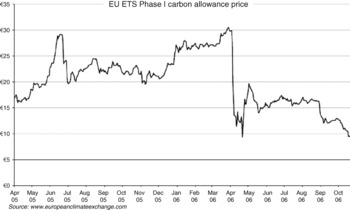
An examination of the results of the first trading period provides interesting insights about the impact of political interference on the ETS’s economic model. The first phase of the EU ETS had very little environmental impact. This was due mainly to the ‘generous’ caps imposed by Member States’ NAPs. Most Member States have allocated allowances to industry above the business as usual scenario (that is, more than firms actually needed).Footnote 33 The economic result was a volatile market for carbon allowances, with prices of allowances collapsing in mid 2006, reaching the mark of less than 10 euros per tonne of CO2 in October 2006 (House of Commons Environmental Audit Select Committee, 2007, p. 18). This landslide in the prices of carbon allowances was not predicted by the preliminary economic evaluations regarding the operation of the ETS.Footnote 34
The price of Phase I carbon allowances collapsed in April–May 2006Footnote 32

This outcome reflects a deep dissonance between the regulatory reality and the economic projections. The design of the NAPs was driven by a two-level political calculus, which reflected domestic and cross-European political powerplays. In contrast to the prescriptions of economic theory, the design of the national cap was not driven by concerns over the external effects of CO2 emissions or the possibility of achieving a more efficient allocation of emission reduction burdens. What was at stake were political questions such as the impact of the ETS on unemployment rates and on the political support of certain (energy intensive) industrial sectors.Footnote 35 The NAPs and corporate allowances were reinterpreted as bargaining chips in a political powerplay.Footnote 36
The European Commission has taken into account the political difficulties associated with the implementation of the ETS across the EU multiple jurisdictions. By forcing the Member States to submit new NAPs at each trading phase, the Commission has given itself the opportunity to reflect on the results of the previous phase and to introduce necessary changes. Indeed, in reaction to the failure of the first phase, the Commission has taken a stricter approach in reviewing the NAPs for the second trading period.Footnote 37 Further, on 23 January 2008 the Commission put forward a package of proposals for a new climate change policy. Central to the strategy is a strengthening and expansion of the EU ETS.Footnote 38 Whether this ambitious plan will be implemented (and survive the political game) is still to be seen.
Systems theory points out that the process of political reconstruction that has characterised the ETS first phase is inevitable and that its exact contours cannot be predicted. This does not mean that the effort to implement the project is futile. It means only that one has to acknowledge (and react to) the institutional constraints in which it takes place.
3.2 Legal transpositions: optimal and absolute deterrence in the sentencing of environmental offenders
Similar processes of reinterpretation also take place in the legal domain. The use of economic concepts in US environmental case-law provides an insightful example. This section focuses on US jurisprudence regarding the sentencing of environmental offenders. US environmental laws provide the courts with a broad discretion in determining civil penalties for environmental violations.Footnote 39 In assessing a civil penalty the court must consider ‘the seriousness of the violation or violations, the economic benefit (if any) resulting from the violation, any history of such violations, any good-faith efforts to comply with the applicable requirements, the economic impact of the penalty on the violator, and such other matters as justice may require’.Footnote 40
In interpreting this provision the courts referred extensively to economic ideas and methodologies. However, as I will demonstrate below, there is a wide gap between the legal use of economic conceptions, and their meaning within the economic domain, as reflected, especially, in Becker’s model of optimal punishment.Footnote 41 In determining the penalty imposed on environmental offenders US courts relied prominently on an evaluation of the economic benefit gained by the environmental wrongdoer through his non-compliance.Footnote 42 It is important to note that while the law allows the courts also to consider the seriousness of the violation, the courts did not make serious attempt to use economic methodology in order to assess the ecological harm (and hence the seriousness of the violation).
Two arguments have been invoked by courts in support of the economic benefit analysis. The first refers to the issue of general and specific deterrence. A penalty must encompass the economic benefit of non-compliance; otherwise ‘the violator and potential violators would perceive that it pays to violate the law, creating an obvious disincentive for compliance’.Footnote 43 Second, the economic benefit analysis was seen as an instrument allowing courts ‘to level the economic playing field and prevent violators from gaining an unfair competitive advantage’.Footnote 44 The US Environmental Protection Agency developed a detailed calculative technique – encapsulated in software entitled the BEN model – to calculate a violator’s economic benefit from delaying or avoiding compliance.Footnote 45 The BEN model received the support of numerous court rulings in the US.Footnote 46
While the jurisprudence of US courts refers widely to economic terminology and methodology, the courts’ reasoning deviates in several respects from the principles of environmental economics. In particular, the economic-benefit analysis is driven by the logic of absolute deterrence, which is inconsistent with the economic vision of optimal deterrence. To make this difference clear consider the structure of Becker’s model of optimal deterrence. Becker argues that in order to create optimal deterrence punishment should be calculated as a function of the social harm associated with the offensive behaviour.Footnote 47 The expected fine, i.e. the probability of detecting the offence times the fine rate, is set to be equal to the ecological/health damage. Given f the expected fine, p the probability of discovering the offender and h the damage, Becker’s model states that:

Creating a linkage between the fine and the damage ensures that the enforcement system produces efficient deterrence, by deterring only those environmental offences whose damage to society is greater than the benefit they produce for the offender.Footnote 48
In contrast, the economic-benefit model takes deterrence as an absolute value. Under this framework the punishment should create an incentive assuring that the offence will not be committed in any case. To achieve this goal punishment is conceptualised as a function of the benefit (with an added ‘deterrence’ constant, β).Footnote 49 Thus, if the rate of the fine is f, the probability of discovering the offender p, and the offender’s benefit from committing the offence b,Footnote 50 the absolute deterrence model can be presented as:

Note that this model is inconsistent with the efficiency ethos because it can prevent ‘efficient’ pollution (e.g. in cases where the ecological harm is lower than the projected savings from not installing the best available clean technology).Footnote 51
The second justification which is used by the courts to support the economic-benefit model of punishment is that it will create a level playing field, ensuring that violators do not gain an unfair competitive advantage. The terminology used by the courts seems to reflect a concern for the function of the market. It could be interpreted as an attempt to facilitate an ideal competitive market. However, this interpretation is at odds with economic theory. A competitive market will be created not by capturing the counter-factual savings of environmental offenders, but by attributing proper prices to the use of environmental resources. Such attribution could be achieved by requiring environmental offenders – as postulated by Becker’s model – to internalise the externalities they create through the imposition of fines reflecting the harm they cause. In other words, the idea of a competitive market requires the law to attach (proper) prices to environmental assets – not to prohibit their usage.Footnote 52 It requires the law to recognise the legitimacy of ‘efficient pollution’. A similar critique of the idea of ‘level playing field’ can be found in the field of international trade law.Footnote 53
The forgoing gap between the legal and economic interpretations is a product of the legal ethos of normativity. Becker’s model empties the environmental standards prescribed by the Clean Water Act and the Clean Air Act of their normative meaning.Footnote 54 It seeks to use the legal system as a mechanism for setting prices for the use of environmental resources (be it water or air). In this model the criminal rule is not conceived as a platform for the construction of stable normative expectations with respect to anti-environmental behaviour. The law is conceived, rather, as a platform for the creation of artificial market in environmental goods (air, water) in which the prices are set ex post by the courts (reflecting the cost of the associated externality). Becker’s model thus transforms the prescriptions of the CWA and CAA from crisp rules to contingent rules – their behavioural effect depends on the relation between the benefit from the polluting activity and the ecological or health damage. This contingent normative reality is incompatible with the legal drive to create a stable system of expectations concerning appropriate environmental behaviour. Despite their seeming reliance on economic terms, the doctrines of ‘economic-benefit’ analysis and ‘economic level playing field’ are incompatible therefore with the logic of environmental economics. The idiosyncratic logic of the law produces, then, substantial discrepancies between the use and interpretation of economic concepts in the economic and legal domains.
4 The dissonance between efficiency and pragmatics: the unfulfilled promise of political economy
4.1 The myth of the homo politicus
I distinguished above between two strands of economic thought: normative and sociopolitical. The normative approach, I argued, is deeply problematic because of its sociological naïveté. I argued further that while the sociopolitical strand represents a significant theoretical advancement, it also suffers from several flaws that limit its usefulness as a guide to policy-making. This section explores these flaws, focusing on the field of political economy.Footnote 55 The most important achievement of political economy was the integration of the analysis of political behaviour (and later, legal) into the larger body of economic analysis. This was achieved by modelling politicians and bureaucrats – similarly to any other economic agent – as self-interested maximisers, who are assumed to maximise a ‘political’ or ‘bureaucratic’ welfare function. These welfare functions differ in their underlying components, reflecting the different institutional contexts in which the two actors operate. The political welfare function provides, in effect, an economic definition of the concept of political power. The politician is assumed to be driven by a desire to maximise the prospects of capturing political power.Footnote 56 The regulator welfare function represents a complex combination of materialistic and power motivations. He is assumed to be driven by a desire to increase his power within the administrative hierarchy (which may also imply maximising the powers of the administrative unit he heads) or to use his discretionary power to get bribes (or job offers) from the industry.Footnote 57 The result of this modelling configuration was the abandonment of the idea that politicians or public officials necessarily work for the common good, and allowing for the possibility that the outcomes of the regulatory process may be influenced by various interest groups through the provision of financial or other support (Peltzman, Levine and Noll, Reference Peltzman, Levine and Noll1989, p. 1). The political economy model assumes that the process of policy formation (and implementation) may be strongly influenced by different interest groups, which will support their claims through the provision of political or financial incentives. This model allows, therefore, for the possibility that the policies recommended by environmental economics may be subverted in the political and administrative processes that underlie any regulatory intervention.Footnote 58
There is therefore some similarity between the worldview of systems theory and that of political economy: both models take seriously the investigation of the autonomous dynamic of law and politics. However, systems theory differs from the model of political economy in two critical aspects. First, the two models draw on a different conception of society. The gap between the two models is best illustrated by considering their varied interpretations to the model of homo politicus (a similar argument can be made with respect to the concept of homo bureaucraticus). The political economy literature assumes that this model, which describes the politician as a self-interested maximiser seeking to maximise political power, fully captures (or at least closely enough) the way in which real political agents behave. The homo politicus model reflects, in this sense, an ontological claim. This interpretation reflects the commitment of economics to the philosophy of methodological individualism – to the claim that social phenomena can be fully explained through a reduction to individuals. Systems theory argues, in contrast, that it is a categorical mistake to conceive the homo politicus model as a true description of the internal world of political figures (whether leaders or parties). Rather, the homo politicus (and similarly the homo juridicus or the homo bureaucraticus) represents a fictitious persona giving expression to the discursive logic of the political (or legal/administrative) system. It is a discursive fiction that represents in the world of discourse the characters acting in its environment.Footnote 59 The claim that the homo politicus model properly describes the political players confuses between the political system (and its unique logic) and the human agents that operate in its environment.
Research conducted in the field of political psychology provides further support to the forgoing argument, demonstrating that political decisions are not simply a product of power calculus, but may also be influenced by differences in personality. These psychological processes characterise decisions taken by both leaders and citizens. In a recent study, Mondak and Halperin provide a detailed account of how personality factorsFootnote 60 can influence citizens’ political choices.Footnote 61 Other studies have explored how such factors influence the decisions of political leaders.Footnote 62 Factors such as openness to experience, conscientiousness, belief in the ability to control events and the need for power may influence the attitude of politicians toward using economic instruments in environmental schemes.
Analysing actual political processes requires therefore a model that will explore the coupling processes between the political system and the human agents that act in its environment. The discursive distinctions that characterise the political domain operate under this view as structural constraints, which limit the way in problems can be thematised politically. The account of political life given by political economy is incomplete because it does not give due regard to the psychological study of political behaviour and to the institutional constraints within which political action takes place. These shortcomings undermine the capacity of political economy models to provide valuable predictions with respect to actual regulatory dilemmas.Footnote 63
4.2 The unbridgeable gap between the normative and political strands of environmental economics
The second problem highlighted by systems theory refers to the dissonance between the normative and political strands of environmental economics. One of the key problems of the field of political economy concerns its failure to develop an integrated theory which could bring together its unique pragmatic insights and the normative prescriptions of (conventional) environmental economics.Footnote 64 Such a model should have offered a method to solve the fundamental dilemmas posed by environmental economics, subject to the institutional constraints highlighted by political economy. Without such an integrated model one is left with optimal regulatory solutions, which – as political economists tell us – have no chance of being accepted.Footnote 65
The failure of the political economy research programme to produce an integrated model is manifested most clearly in the idea of ‘government failure’. This idea considers the disruptive processes accompanying the invocation of economic ideas in the political and legal fields as a reflection of deep institutional failure, which calls for corrective intervention.Footnote 66 The crude message underlying the idea of government failure seems to be that the ‘cure’ to the trans-systemic distortions depicted by political economy lies in the subjugation of the political, administrative and legal systems to economic logic. This message conflicts with one of the basic insights of systems theory: the recognition that the failure – political or legal – referred to by the economic literature is an expression of the systemic attributes that establish the legal and political systems as autonomous systems. The transformation of the economic ideas in the legal and political systems reflects the fundamental attributes of these domains; it is, in other words, a reflection of the deep-seated structure of modern society. Removing the political and legal failures by subjecting them to economic calculations would undermine the autonomy of the legal and political systems, possibly damaging their ability to serve the social functions associated with them.Footnote 67 Further, this idea also underestimates the possibility that politics and law will permeate and undermine the new institutional structures which will be erected to implement the new economic order.
But the idea that the problem of government failure could be resolved by subjugating the political and legal systems to some form of economic control is also problematic because it underestimates the cognitive and computational challenges associated with unitary economic governance. The following thought experiment can demonstrate these challenges. Imagine the establishment of a new institution: the Economic Commissioner for Environmental Regulation.Footnote 68 The office of the Commissioner would employ a team of economists who will regulate every legal or administrative act concerning the environment (legislation, judicial rulings, licensing decisions).Footnote 69 The Commissioner will have the authority to change any such act according to economic principles (prominently cost-benefit analysis), using advanced computers and software, and without any budget limits.
The claim that such a model can cure the illnesses of the existing system and generate an efficient and consistent regulatory system is not convincing for two reasons. First, the cognitive and computational burden imposed by this model would be insurmountable.Footnote 70 As our omniscient economic Commissioner tries to cope with the cognitive and computational challenges involved in conducting a cost-benefit analysis of each and every regulatory act, she will soon find herself entangled with the following dilemma: how many resources (time and money) should she invest in deliberation and information gathering before making a decision (noting not only the cost of deliberation and exploration but also the cost of not acting in time). Instead of producing environmental decisions our Economic Commissioner will be engaged in a desperate attempt to find an optimal way of making decisions – what economists (self-reflectively) term the paradox of deciding how to decide.Footnote 71 To cope with this challenge the new institution would have to adopt decision rules (heuristics) reflecting meta-economic considerations.Footnote 72 The need for meta-economic considerations will damage the consistency and economic purity of the decisions. The chaos accompanying the decision-making processes in a differentiated society would be replaced by a different chaos generated by a quest for economic purity. The functional differentiation characterising modern society is, in this respect, a response to the difficulty of dealing with the complexity of modern life.Footnote 73
5 Regulation as the art of intuitive judgment
Systems theory points to three central challenges that the regulatory project must address: (1) designing regulatory policy in a social environment of multiple causes (recognising the lack of a normative meta-authority which could resolve possible conflicts); (2) facing the radical uncertainty involved in planned intervention in a differential society, where the interaction between different systems is complex and non-linear; and (3) intervening in the inner dynamic of autonomous systems without endangering their autopoietic cycle. As I argued above, the regulatory model of environmental economics does not provide a convincing response to these challenges. It suffers from several fundamental problems. In its normative form environmental economics is characterised by a sociological naïveté, which makes it blind to the adverse impact of trans-systemic transpositions. And to the extent that it does seek to develop sociological sensitivities it fails to devise a convincing model that could integrate between the prescriptions of the normative model with the institutional insights of political economy. Further, none of these approaches shows sensitivity to the ideological plurality that characterises contemporary society. These three blind spots cast doubts on the capacity of environmental economics to lead processes of policy reform at the environmental domain.
The difficulties underlying the social engineering effort were of course the subject of intense research. In recent years various models seeking to respond to this problematic were offered, ranging from self-regulationFootnote 74 and reflexive lawFootnote 75 to responsive regulation.Footnote 76 From a system-theoretic perspective these models seem appealing. They are based on a common recognition of the limits of regulatory intervention, and on a mutual exploration of circumlocutory forms of regulatory intervention.
Closer inspection reveals, however, that despite their apparent stance of teleological modesty, these alternative models remain bounded by the same epistemological barriers that characterise the economic approach to regulation. This becomes clear as we evaluate the various efforts to implement these ideas in the last twenty years. Consider first the model of self-regulation. This model is based on the creation of legal infrastructure that will encourage internal process of learning and self-improvement within regulated bodies. Legal intervention, in this context, is based on influencing organisational routines, changing decision-making structures in the organisation and the restructuring of the organisational hierarchy (Teubner, Reference Teubner1993, p. 96; Black, Reference Black1996, p. 47). However, despite two decades of experimentation with various models of self-regulation, there are still doubts regarding the institutional elements that distinguish between effective and non-effective self-regulatory schemes.Footnote 77 These doubts refer both to the internal organisational elements necessary to facilitate credible processes of self-improvement and to the external institutional components required to support them. The scepticism regarding the efficacy of self-regulatory programmes is also reflected in the divergence of approaches among environmental regulators. Thus, while environmental regulators in both the US and Canada have tended to adopt a cautious approach towards self-regulatory schemes,Footnote 78 the European Commission has shown greater belief in this approach through its action regarding the EMAS programme.Footnote 79 The Commission has encouraged EU Member States to offer comprehensive regulatory benefits to EMAS-certified firms (Dahlstrom, Howes, Leinster and Skea, Reference Dahlstrom, Howes, Leinster and Skea2003) and its recent proposal to revise the EMAS Regulation seeks to give a further boost to this programme across the EU.Footnote 80 It seems that the difficulty of establishing effective self-regulatory schemes did not receive sufficient attention by the early writings on this issue.
The concepts of reflexive law or responsive regulation raise similar questions. The idea of reflexive/responsive regulation is driven by the recognition that social autonomy constitutes a cognitive problem for the law; it thus attempts to create mechanisms that can cope with this cognitive challenge.Footnote 81 However, looking closely at the details of these models reveals that despite their proclaimed sensitivity to the cognitive challenges associated with regulatory intervention, their pragmatic solutions exhibit an epistemological pretension that is not very different from the one exhibited by environmental economics.
It is not possible to consider in this article all the various proposals which were promulgated under the heading of reflexive or responsive law. I will therefore focus on three key contributions: Robert Baldwin and Julia Black’s recent model of ‘really responsive regulation’ (Baldwin and Black, Reference Baldwin and Black2008), Teubner’s ‘reflexive law’ model and Ayres and Braithwaite’s model of ‘responsive regulation’. What ‘really responsive regulation’ sets out to do, Baldwin and Black argue, ‘is to offer a framework for regulation which responds to firms’ attitudinal settings, recognises the significance of the institutional environment (or “regulatory character”), which develops an awareness of the differential nature of the logics of different regulatory tools and strategies, which is performance sensitive, and which responds to change’ (Baldwin and Black, Reference Baldwin and Black2008, pp. 75–76). The responsive regulator imagined by Baldwin and Black is much more sophisticated than the omniscient economic ruler of environmental economics. He can not only perfectly grasp all the multiple logics that populate the regulatory domain (both within the regulated bodies and within its own institutional sphere), but can also create a regulatory programme that will be sensitive to these idiosyncratic logics, while simultaneously maintaining a more or less coherent structure (p. 72). The responsive regulator is also equipped with remarkable powers of retrospection; he is capable of reassessing and redesigning his overall regulatory strategy in view of unfolding contingencies (p. 94). Baldwin and Black admit that these are ‘fairly formidable tasks’ (p. 76), but they quickly move on.
It seems that Baldwin and Black’s model of ‘really responsive regulation’ is inherently paradoxical: while it claims to take seriously the cognitive and computational difficulties facing the social planner, the different requirements it imposes on the regulator, de facto disregard them. Teubner’s model of reflexive law seems to suffer from a similar irresolvable tension. Teubner suggests that the cognitive dilemmas facing the regulatory endeavour may be resolved by what he terms ‘reciprocal observation’. Reciprocal observation requires the external observer (the regulatory agency presumably), to develop knowledge of the ‘“blind” process of co-evolution. . .regulated by the twofold selectivity of the autopoiesis of the law and that of the social system concerned’. And if there are doubts about the social adequacy of law in relation to the regulated field then ‘the “mechanism” must be made “more intelligent”. The law must improve its knowledge of the processes, functions, and structures within the field of regulation’ (Teubner, Reference Teubner1993, p. 80). The epistemological burden underlying this proposal is substantial; further, this proposal seems inconsistent with Teubner’s earlier remarks about the cognitive challenge generated by social autonomy (p. 68). Ayres and Braithwaite’s model of ‘responsive regulation’ involves similar (suppressed) epistemological challenges. The essence of ‘responsive regulation’ is a ‘tit for tat’ approach of escalatory regulatory responses. But implementing this approach, as Baldwin and Black note, requires the regulator to be able to make various, cognitively demanding, choices. Thus, to give one example, the regulator must be able to correctly evaluate the environmental risks involved. Where regulation is directed at potentially catastrophic risks the appropriate reaction may be immediate resort to the higher-level regulatory reactions, rather than applying the conventional escalatory approach (Baldwin and Black, Reference Baldwin and Black2008, pp. 62–63).
Further, neither Baldwin and Black’s model of ‘really responsive regulation’, nor any of its theoretical predecessors, seem to take seriously the fact that we live in a society of multiple causes. This deep pluralism questions not only the capacity of a regulating agency to determine its regulatory objectives, but also cast doubts on its ability to reassess its actions – because according to which criteria will such self-monitoring and re-evaluation take place?
But if we reject both the model of environmental economics and the alternative models of self-regulation and reflexive law, what are we left with? While systems theory provides a convincing warning against the pretence of perfect empirical and moral knowledge, underlying the ethos of social engineering, it does not offer a solution to this dilemma.Footnote 82 Systems theory offers a theoretical framework from which society’s multiple epistemological points of view can be observed. However, it does not provide a precise algorithm which could unfold the unique dynamic of each social subsystem or the exact trajectories of trans-systemic interactions. In that sense it is wrong to interpret systems theory as an actual manifestation of Asimov’s fictional science of psychohistory (Asimov, Reference Asimov1951). Neither does systems theory provide us with a universal meta-discourse which could resolve modern society’s numerous normative quarrels.
Systems theory highlights the deep paradox of the study of regulation. Developing a scientific portrait of regulatory decision-making presents us with a deep paradox. On the one hand, we are driven by a desire – both theoretical and pragmatic – accurately to describe the essence of regulatory judgment and to develop a science of regulation; on the other hand, we are also confronted by the intractable feeling that regulation is ‘essentially (a contradiction in terms) only contingency, singularity, risk. . .’ (Barthes, Reference Barthes and Howard1980/1993, p. 20).Footnote 83 An inevitable consequence of this paradoxical description is that regulatory decisions and regulatory judgments, in both their instrumental and normative facets, are to a large extent intuitive. They involve the invocation of insight or common sense, which cannot be reduced to rational or algorithmic calculus.Footnote 84
This revised conceptualisation of regulatory judgment sets the ground for a different understanding of reflexive law. Let me offer two tentative theses in this context. The first calls for a shift from a prospective to a retrospective state of mind. This thesis suggests that we should abandon the idea that reflexive law offers a decision-making framework that can produce regulatory decisions, which are a priori superior to those generated (for instance) by economic calculation. Rather, the main goal of reflexive law is to instil institutionally wide sensitivity to mistakes. It is based on a retrospective rather than a prospective approach.
The second thesis invites us to explore the concept of intuitive judgment. The concept of reflexive law should be interpreted as an attempt to cultivate those faculties of intuition and insight, which, as we saw, are integral components of regulatory judgment. Intuition is necessary both to devise regulatory objectives in a world of conflicting causes and to determine the best way to achieve these objectives given the radical uncertainty associated with regulatory intervention. Because the nature of the faculty of intuitive judgment is to some extent inexpressible, one can question, of course, whether this faculty can be cultivated at all. A precondition of such an attempt is an understanding of what intuitive judgment means. Intuitive judgment refers, I would argue, to the ability to transcend the boundaries of a particular point of view; to challenge established categories and recast them in new light. It refers, further, to the ability of an observer to perceive a problem simultaneously through multiple perspectives. Only by breaking our usual manner of looking at the world can we liberate an internal space for intuition to spring forth.Footnote 85 But how can we facilitate the development of such faculties within the context of a bureaucratic environment? The key element is the development of an institutional environment that encourages critical debate (both internal and external) and is sensitive to different discourses. Succumbing to a single voice – be it economic logic or any other – is clearly inconsistent with this vision.
These concluding observations may seem disappointing – certainly from the perspective of a culture driven by a yearning for control; but they provide, I think, a more credible portrait of our collective capabilities.Footnote 86