Introduction
Infection with Trichinella species is common in wild carnivores throughout the world (Pozio & Murrell, Reference Pozio and Murrell2006). Wild and domestic animals become infected with Trichinella spp. when they ingest raw muscle containing first-stage larvae from infected prey or through scavenging. There are currently four species and one genotype of the Trichinella genus known in the USA. Trichinella spiralis, T. murrelli, Trichinella genotype T6 and T. nativa modify host muscle cells to nurse cells with thick collagen capsules. Trichinella pseudospiralis modifies host muscle cells to nurse cells without collagen capsules (Pozio & Zarlenga, Reference Pozio and Zarlenga2013). Trichinella spiralis is found primarily in domestic and wild pigs throughout the world and occasionally infects other animals, including carnivores (Pozio & Murrell, Reference Pozio and Murrell2006; Pozio & Zarlenga, Reference Pozio and Zarlenga2013). Trichinella murrelli predominately infects wild carnivores in temperate regions of the USA, southern Canada and possibly Mexico (Pozio & Zarlenga, Reference Pozio and Zarlenga2013). Trichinella nativa and Trichinella genotype T6 are freeze-resistant taxa whose natural hosts are carnivores in northern latitudes. Trichinella pseudospiralis has a cosmopolitan distribution, can infect meat-eating mammals and is the only Trichinella sp. that has been found to infect birds. All of these species of Trichinella are zoonotic (Pozio & Zarlenga, Reference Pozio and Zarlenga2013).
Puma concolor, commonly called cougar, puma, mountain lion or catamount, ranges through North, Central and South America. Culver et al. (Reference Culver, Johnson, Pecon-Slattery and O'Brien2000), using phylogenetic analyses, suggested six subspecies of this wild felid: P. c. couguar in North America, P. c. costaricensis in Central America, P. c. capricornensis in eastern South American, P. c. concolor in northern South America, P. c. cabrerae in central South America and P. c. puma in southern South America. In North America, cougars are found predominately in western American states and Canadian provinces, with occasional reports elsewhere in the eastern US and Canada. An additional subspecies of P. concolor, the Florida panther (P. c. coryi), continues to be recognized by the US Fish and Wildlife Service as a distinct subspecies separate from other cougars. Florida panthers are protected by the Endangered Species Act (ESA, 1973) since they exist in a small, isolated population in the swamps and forests of southern Florida (Johnson et al., Reference Johnson, Onorato, Roelke, Land, Cunningham, Belden, McBride, Jansen, Lotz, Shindle, Howard, Wildt, Penfold, Hostetler, Oli and O'Brien2010). Cougars are highly adaptable and can occupy a variety of habitats, including swamps, grassland, forests and mountains among others. They are obligate carnivores and the nutritional requirement of consuming meat predisposes them to infection with Trichinella spp.
In Colorado, cougar populations are managed for conservation purposes and to provide sport-hunting opportunity. In addition, individual cougars are sometimes removed to prevent depredation on livestock and pets, and for public safety. Sport-hunting-caused mortality in the cougars is regulated by hunting seasons, a bag limit and quotas on the number of cougars that are allowed to be killed within specified management areas, called Game Management Units. All cougars killed by hunters must be checked visually by an official with Colorado Parks and Wildlife within 5 days of harvest.
According to Colorado Parks and Wildlife regulations, successful hunters are required to preserve all edible parts (excluding internal organs) of cougar meat. Ingestion of raw or undercooked cougar meat with Trichinella species increases the risk of trichinellosis. In 1995, an outbreak of trichinellosis in ten people from Idaho County, Idaho was linked to the consumption of improperly cooked cougar jerky infected with Trichinella genotype T6 (Dworkin et al., Reference Dworkin, Gamble, Zarlenga and Tennican1996; Vollbrecht et al., Reference Vollbrecht, Sokolowski, Hollipeter, Sigler, Greenblatt, Andersen, Tennican, Gamble and Zarlenga1996). The objectives of the current study were to examine the prevalence of Trichinella spp. infection in cougars from Colorado and to determine which species of Trichinella infect the wild felids.
Materials and methods
Collection and examination of cougar tongues
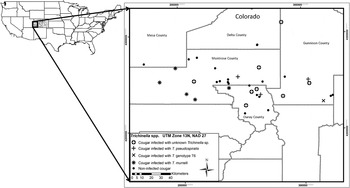
Tongues were collected opportunistically from legally hunted cougars (n = 36), killed for depredation control (n = 2) and shot illegally (n = 1) between November 2010 and December 2012 from the Uncompahgre Plateau (35.5500°N, 108.4667°W) in Delta, Gunnison, Mesa, Montrose and Ouray Counties, Colorado, USA (fig. 1). Vegetation cover in the Uncompahgre Plateau varies from the pinon–juniper-covered foothills, starting from about 1700 m elevation, to the spruce–fir and aspen forests, growing to the highest elevations of about 3000 m. Sex, age group (subadult: 12–23 months; adult: ≥24 months) and collection locations in Universal Transverse Mercator (UTM) coordinates (NAD27) were recorded for each cougar. Tongues in varying degrees of decomposition (cougars were dead from a few hours to 1–2 days, with one dead for about 21 days) were frozen (−20°C) until they were shipped on ice packs to the Center for Veterinary Health Sciences at Oklahoma State University (OSU) in December 2012 for processing to determine Trichinella spp. infection. Once the tongues arrived at OSU, they were still frozen and, consequently, were placed at −20°C until they were processed to determine infection with Trichinella.
Locations in Colorado where cougars (Puma concolor couguar) were collected and where species of Trichinella were found from November 2010 until February 2012. Counties sampled included: Delta, Gunnison, Mesa, Montrose and Ouray. Cougars infected with Trichinella spp. were found in the five counties sampled.

Cougar tongues were tested for infection with Trichinella spp. by artificial digestion (Webster et al., Reference Webster, Maddox-Hyttel, Nockler, Malakauskas, van der Giessen, Pozio, Boireau and Kapel2006). Approximately 5.0 g of tissue were weighed (to the nearest 0.1 g) and homogenized using a Polytron (Kinematica GmbH, Kriens-Luzern, Switzerland). Homogenized samples were mixed with 10 ml of artificial digestive fluid (1% pepsin, 1:10,000 IU, and 1% hydrochloric acid) per 1.0 g of tissue. Digests were mixed vigorously on magnetic stir plates at 37°C for 30 min. After 30 min, digests were immediately cooled on ice and allowed to settle for 20 min (Pozio & La Rosa, Reference Pozio and La Rosa2003). Sediment was washed 3–5 times with tap water, depending on the amount of cellular debris, and larvae were searched for using a stereomicroscope at 40× magnification. Results were recorded as the number of Trichinella sp. larvae per g (LPG) of tissue digested.
Molecular analysis
Trichinella spp. larvae recovered by artificial tissue digestion from cougars were washed in saline, preserved in absolute ethyl alcohol, and submitted to the International Trichinella Reference Center (ITRC, www.iss.it/site/Trichinella/) in Rome, Italy for genotyping. Individual Trichinella spp. larvae were identified by multiplex polymerase chain reaction (PCR) analysis following the protocol described by Zarlenga et al. (Reference Zarlenga, Chute, Martin and Kapel1999) and modified by Pozio & La Rosa (Reference Pozio and La Rosa2003). Briefly, DNA was extracted from a maximum of ten individual worms of each isolate. PCR was performed using ExTaq DNA polymerase (Takara, Saint-Germain-en-Laye, France) in 50 μl containing 1.5 mm MgCl2, 200 mm deoxynucleoside triphosphates (dNTPs), 50 pmol of each primer and 0.5 units of ExTaq DNA polymerase. The PCR-amplified fragments from purified DNA were visualized by agarose gel electrophoresis (2.0% standard agarose). Single Trichinella sp. larvae from one reference strain (ITRC code) for each taxa circulating in North America were used for comparison: T. spiralis (ISS003), T. nativa (ISS010), T. pseudospiralis (ISS470), T. murrelli (ISS035) and Trichinella T6 (ISS040).
Data analysis
The prevalence of Trichinella spp. infection was calculated according to Bush et al. (Reference Bush, Lafferty, Lotz and Shostak1997). Ninety-five per cent confidence intervals were calculated according to Sterne's exact method (Reiczigel, Reference Reiczigel2003) using Quantitative Parasitology 3.0 (Rozsa et al., Reference Rozsa, Reiczigel and Majoros2000). Comparisons of the prevalence of Trichinella spp. between sex and age group were done using chi-square (Sokal & Rohlf, Reference Sokal and Rohlf1997). Mann–Whitney Rank Sum tests (Sokal & Rohlf, Reference Sokal and Rohlf1997) were used to compare Trichinella sp. LPG between sex and age groups of infected cougars. Chi-square and Mann–Whitney Rank Sum tests were performed using SigmaPlot 12.5 statistical software (Systat Software Inc., San Jose, California, USA).
Results
Tongues from 39 cougars (fig. 1) were tested for infection with Trichinella species (table 1). The prevalence of Trichinella spp. infection (95% confidence interval) was 43.6% (28.7–59.5%). A discernable difference in the prevalence of Trichinella spp. infection between male 39.3% (22.9–59.1%) and female 54.5% (26.5–80.0%) cougars was not detected (χ2 = 0.256, df = 1, P = 0.613). A statistically distinguishable difference in the prevalence of Trichinella spp. infection between adults 56.0% (35.8–74.4%) and subadults 21.4% (6.1–50.0%) was not detected (χ2 = 3.069, df = 1, P = 0.080). Table 1 shows the median LPG (SE; range) of Trichinella spp. recovered from cougars. Statistically more (U = 12.0, P = 0.039) Trichinella spp. LPG were detected in male than female cougars. However, a statistical difference was not detected (U = 115.5, P = 0.057) in Trichinella spp. LPG detected between adult and subadult cougars.
The prevalence (%) and median number of larvae/g (LPG ± SE) of Trichinella species in the tongues of cougars from Colorado; N, number of hosts examined, CI = 95% confidence intervals, ranges in brackets, and * one sub-adult female was not infected.

Amplifiable DNA from Trichinella spp. first-stage larvae was obtained from 9 of the 17 infected cougars. No PCR amplification was obtained from larvae of 8 isolates, probably due to DNA degradation. Banding patterns from multiplex PCR amplifications showed 5 cougars infected with T. murrelli (ITRC codes: ISS5121, ISS5122, ISS5124, ISS5126 and ISS5127), 3 with T. pseudospiralis (ISS5125, ISS5128 and ISS5204) and 1 with Trichinella genotype T6 (ISS5123).
Discussion
Multiple species of Trichinella have been documented in Puma spp. (table 2) across the entire range of the wild felids. In Canada, cougars have been found to be infected with T. nativa, T. murrelli, Trichinella genotype T6 and T. pseudospiralis (Gajadhar & Forbes, Reference Gajadhar and Forbes2010). In the USA, cougars and Florida panthers have been found to be infected with T. pseudospiralis, T. murrelli, Trichinella genotype T6 and T. spiralis. Information on the occurrence of Trichinella in cougars in Central and South America is scant. The authors are not aware of any published reports of Trichinella spp. in cougars from Central America (table 2).
The prevalence (%) of Trichinella taxa in Puma concolor in Argentina, Chile, Canada and the USA; N, number of hosts examined.

* Larvae were identified as T. spiralis before the advent of current molecular methodologies that can differentiate Trichinella species.
Early publications indicated that cougars from both Canada (Schmitt et al., Reference Schmitt, Saville, Friis and Stovell1976) and the USA (Kluge, Reference Kluge1967; Winters, Reference Winters1969; Worley et al., Reference Worley, Fox, Winters, Greer and Kim1974; Rausch et al., Reference Rausch, Maser and Hoberg1983) were infected with T. spiralis. However, identification of T. spiralis at that time must be interpreted with caution, as it was performed before the advent of current taxonomy that identifies 12 taxa in this genus (Pozio & Zarlenga, Reference Pozio and Zarlenga2013). Florida panthers were found to be infected with T. spiralis (Reichard et al., Reference Reichard, Criffield, Thomas, Paritte, Cunningham, Onorato, Logan, Interisano, Marucci and Pozio2015). Infection with T. spiralis in wild animals is considered rare and, in the case of Florida panthers, likely reflects the fact that wild pigs (Sus scrofa) comprise a significant proportion of the wild felid's diet (Maehr et al., Reference Maehr, Belden, Land and Wilkins1990; Dalrymple & Bass, Reference Dalrymple and Bass1996). Previous examination of tongues from six cougars in Colorado found no evidence (detection method(s) not given) of Trichinella spp. infection (Olsen, Reference Olsen1960). Nonetheless, the routine occurrence and the diversity of Trichinella spp. that infect cougars and Florida panthers from across North and South America suggest that it is common for these wild felids to be infected.
The occurrence and transmission of Trichinella spp. follow zoogeographical regions, with T. nativa in Holarctic frigid areas, Trichinella genotype T6 in Nearctic frigid areas, T. murrelli in Nearctic temperate regions, and both T. pseudospiralis and T. spiralis being cosmopolitan (Pozio, Reference Pozio2000). The occurrence and distribution of Trichinella species in cougars and Florida panthers appear to follow this same pattern throughout North and South America (Gajadhar & Forbes, Reference Gajadhar and Forbes2010; Krivokapich et al., Reference Krivokapich, Pozio, Gatti, Prous, Ribicich, Marucci, La Rosa and Confalonieri2012; Reichard et al., Reference Reichard, Criffield, Thomas, Paritte, Cunningham, Onorato, Logan, Interisano, Marucci and Pozio2015; current study). Trichinella pseudospiralis was found in Florida panthers and cougars from British Columbia and Colorado, reflecting the plasticity of this parasite throughout various geographical regions in North America.
In the current study, Trichinella genotype T6 was found in one cougar. This infected cougar was killed at an elevation of 2804 m (9199 ft), which was the fourth highest of any wild felid collected in our study (data not shown). In Europe, T. britovi is found at higher altitudes than T. spiralis (Pozio et al., Reference Pozio, Rinaldi, Marucci, Musella, Galati, Cringoli, Boireau and La Rosa2009). It is possible that a similar phenomenon is occurring in North America, since Trichinella genotype T6 is freeze resistant and would be expected to persist in colder environments at higher altitudes. However, this hypothesis has not been tested rigorously in North America and requires further investigation. We noticed (fig. 1) that cougars infected with T. murrelli were detected in the western portion of the study area, whereas T. pseudospiralis was in the eastern half. While our sample size was too small to draw conclusions or test hypotheses, future sampling efforts should be directed to determine if there are two separate foci: one for T. murrelli and one for T. pseudospiralis. If separate foci can be established with certainty, it would be interesting to determine the environmental conditions (e.g. temperature, precipitation, humidity, elevation, vegetation, etc.) that support separate foci of the two Trichinella species in the same geographical region.
The detection of six different Trichinella taxa in P. concolor according to the geographical areas where this large carnivore resides, suggests that the genetic differentiation of the genus Trichinella is more influenced by the environmental conditions where the host lives rather than by the entozoic habitat of the hosts. This stresses the importance of the environmental conditions on the survival of larvae in decaying host carcasses. The ecological niche of the host carrion can be considered as the environment of the ‘free-living’ stage, equivalent to the egg stage of most nematode species. The time larvae survive in decaying muscles is influenced by the environmental temperature and humidity. Low temperature and high humidity favour their survival (Pozio & Murrell, Reference Pozio and Murrell2006).
Trichinella spp. has been observed in other wild animals sampled from Colorado. Examination of tissues showed that 4 of 394 (1%) bobcats (Lynx rufus), 1 of 193 (0.5%) coyotes (Canis latrans) and 1 of 33 (3.0%) foxes (Vulpes (fulva) vulpes) were infected with Trichinella spp. (Olsen, Reference Olsen1960). The diet of cougars in the Uncompahgre Plateau is predominately ungulates (Alldredge et al., Reference Alldredge, Bergman, Bishop, Logan and Freddy2008), chiefly mule deer (Odocoileus hemionus) and elk (Cervus canadensis). However, cougars are generalists and will opportunistically eat any animal they can catch. Other known prey of cougars in the Uncompahgre Plateau includes porcupines (Erethizon dorsatum), beavers (Castor canadensis) and domestic sheep (Ovis aries) among others (Anderson et al., Reference Anderson, Bowden and Kattner1992; Logan, Reference Logan2007). Cougars inhabiting the Uncompaghre Plateau have been known infrequently to consume other carnivores, including bobcats and other cougars (K. Logan, unpublished data). In addition to their normal ungulate prey, cougars in New Mexico preyed on other cougars, coyote, striped skunks (Mephitis mephitis), badgers (Taxidea taxus) and ringtails (Bassariscus astutus) (Logan & Sweanor, Reference Logan and Sweanor2001). Similarly, a small portion of the diet of cougars in Arizona comprised mesocarnivores, including coyote, bobcats, grey foxes (Urocyon cinereoargenteus) and raccoons (Procyon lotor) (Mattson, Reference Mattson2007). While these carnivores and omnivores are likely sources of Trichinella infection, the prey that cougars consume in the Uncompahgre Plateau to acquire the nematode is not known.
The consumption of improperly cooked wild game is currently implicated in a higher proportion of trichinellosis cases in humans in the USA than is commercially produced pork (Wilson et al., Reference Wilson, Hall, Montgomery and Jones2015). Of all the wild game animals consumed in the USA, infected bears and wild hogs are most often implicated as sources of Trichinella spp. to humans. Ingestion of improperly cooked cougar meat (i.e. jerky) was confirmed as the source of Trichinella genotype T6 infection in people in Idaho (Dworkin et al., Reference Dworkin, Gamble, Zarlenga and Tennican1996). Of 15 people who consumed the contaminated cougar jerky, 7 became ill and 10 were confirmed to be infected. In the present study, cougars were infected with T. murrelli, T. pseudospiralis and Trichinella genotype T6, all of which are capable of infecting humans and causing trichinellosis. Trichinella murrelli and T. pseudospiralis are freeze-susceptible and can be inactivated by freezing. However, Trichinella genotype T6 is freeze-tolerant and cannot be reliably destroyed by freezing. People eating meat and products from wild game are advised to follow federal regulations for cooking meat (US Department of Agriculture, 2012) to avoid zoonotic transmission of Trichinella spp.
Cougars from Colorado were infected with T. murrelli, T. pseudospiralis and Trichinella genotype T6. The high prevalence of Trichinella spp. in cougars in Colorado, as well as those published from other locations in North America, suggests that these nematode parasites are common across the range of cougars in North America. Cougars feed predominately on wild ungulates, but are opportunistic carnivores and will prey on almost any animal they can capture. However, the source of Trichinella spp. infection to cougars is unknown. All species of Trichinella isolated from cougars to date are zoonotic and any person consuming cougar is advised to cook the meat thoroughly.
Financial support
The study was funded in part by the Center for Veterinary Health Sciences – Oklahoma State University, Colorado Parks and Wildlife, and the World Organization for Animal Health Reference Laboratory for Trichinellosis (Rome, Italy).
Conflict of interest
None.