


%20--%3e%3c!DOCTYPE%20svg%20PUBLIC%20'-//W3C//DTD%20SVG%201.0//EN'%20'http://www.w3.org/TR/2001/REC-SVG-20010904/DTD/svg10.dtd'%3e%3csvg%20version='1.0'%20id='Layer_1'%20xmlns='http://www.w3.org/2000/svg'%20xmlns:xlink='http://www.w3.org/1999/xlink'%20x='0px'%20y='0px'%20width='64px'%20height='64px'%20viewBox='5.5%20-3.5%2064%2064'%20enable-background='new%205.5%20-3.5%2064%2064'%20xml:space='preserve'%3e%3cg%3e%3ccircle%20fill='%23FFFFFF'%20fill-opacity='0'%20cx='37.785'%20cy='28.501'%20r='28.836'/%3e%3cpath%20fill='%23595959'%20d='M37.441-3.5c8.951,0,16.572,3.125,22.857,9.372c3.008,3.009,5.295,6.448,6.857,10.314%20c1.561,3.867,2.344,7.971,2.344,12.314c0,4.381-0.773,8.486-2.314,12.313c-1.543,3.828-3.82,7.21-6.828,10.143%20c-3.123,3.085-6.666,5.448-10.629,7.086c-3.961,1.638-8.057,2.457-12.285,2.457s-8.276-0.808-12.143-2.429%20c-3.866-1.618-7.333-3.961-10.4-7.027c-3.067-3.066-5.4-6.524-7-10.372S5.5,32.767,5.5,28.5c0-4.229,0.809-8.295,2.428-12.2%20c1.619-3.905,3.972-7.4,7.057-10.486C21.08-0.394,28.565-3.5,37.441-3.5z%20M37.557,2.272c-7.314,0-13.467,2.553-18.458,7.657%20c-2.515,2.553-4.448,5.419-5.8,8.6c-1.354,3.181-2.029,6.505-2.029,9.972c0,3.429,0.675,6.734,2.029,9.913%20c1.353,3.183,3.285,6.021,5.8,8.516c2.514,2.496,5.351,4.399,8.515,5.715c3.161,1.314,6.476,1.971,9.943,1.971%20c3.428,0,6.75-0.665,9.973-1.999c3.219-1.335,6.121-3.257,8.713-5.771c4.99-4.876,7.484-10.99,7.484-18.344%20c0-3.543-0.648-6.895-1.943-10.057c-1.293-3.162-3.18-5.98-5.654-8.458C50.984,4.844,44.795,2.272,37.557,2.272z%20M37.156,23.187%20l-4.287,2.229c-0.458-0.951-1.019-1.619-1.685-2c-0.667-0.38-1.286-0.571-1.858-0.571c-2.856,0-4.286,1.885-4.286,5.657%20c0,1.714,0.362,3.084,1.085,4.113c0.724,1.029,1.791,1.544,3.201,1.544c1.867,0,3.181-0.915,3.944-2.743l3.942,2%20c-0.838,1.563-2,2.791-3.486,3.686c-1.484,0.896-3.123,1.343-4.914,1.343c-2.857,0-5.163-0.875-6.915-2.629%20c-1.752-1.752-2.628-4.19-2.628-7.313c0-3.048,0.886-5.466,2.657-7.257c1.771-1.79,4.009-2.686,6.715-2.686%20C32.604,18.558,35.441,20.101,37.156,23.187z%20M55.613,23.187l-4.229,2.229c-0.457-0.951-1.02-1.619-1.686-2%20c-0.668-0.38-1.307-0.571-1.914-0.571c-2.857,0-4.287,1.885-4.287,5.657c0,1.714,0.363,3.084,1.086,4.113%20c0.723,1.029,1.789,1.544,3.201,1.544c1.865,0,3.18-0.915,3.941-2.743l4,2c-0.875,1.563-2.057,2.791-3.541,3.686%20c-1.486,0.896-3.105,1.343-4.857,1.343c-2.896,0-5.209-0.875-6.941-2.629c-1.736-1.752-2.602-4.19-2.602-7.313%20c0-3.048,0.885-5.466,2.658-7.257c1.77-1.79,4.008-2.686,6.713-2.686C51.117,18.558,53.938,20.101,55.613,23.187z'/%3e%3c/g%3e%3c/svg%3e)
%20--%3e%3c!DOCTYPE%20svg%20PUBLIC%20'-//W3C//DTD%20SVG%201.0//EN'%20'http://www.w3.org/TR/2001/REC-SVG-20010904/DTD/svg10.dtd'%3e%3csvg%20version='1.0'%20id='Layer_1'%20xmlns='http://www.w3.org/2000/svg'%20xmlns:xlink='http://www.w3.org/1999/xlink'%20x='0px'%20y='0px'%20width='64px'%20height='64px'%20viewBox='5.5%20-3.5%2064%2064'%20enable-background='new%205.5%20-3.5%2064%2064'%20xml:space='preserve'%3e%3cg%3e%3ccircle%20fill='%23FFFFFF'%20fill-opacity='0'%20cx='37.637'%20cy='28.806'%20r='28.276'/%3e%3cg%3e%3cpath%20fill='%23595959'%20d='M37.443-3.5c8.988,0,16.57,3.085,22.742,9.257C66.393,11.967,69.5,19.548,69.5,28.5c0,8.991-3.049,16.476-9.145,22.456%20C53.879,57.319,46.242,60.5,37.443,60.5c-8.649,0-16.153-3.144-22.514-9.43C8.644,44.784,5.5,37.262,5.5,28.5%20c0-8.761,3.144-16.342,9.429-22.742C21.101-0.415,28.604-3.5,37.443-3.5z%20M37.557,2.272c-7.276,0-13.428,2.553-18.457,7.657%20c-5.22,5.334-7.829,11.525-7.829,18.572c0,7.086,2.59,13.22,7.77,18.398c5.181,5.182,11.352,7.771,18.514,7.771%20c7.123,0,13.334-2.607,18.629-7.828c5.029-4.838,7.543-10.952,7.543-18.343c0-7.276-2.553-13.465-7.656-18.571%20C50.967,4.824,44.795,2.272,37.557,2.272z%20M46.129,20.557v13.085h-3.656v15.542h-9.944V33.643h-3.656V20.557%20c0-0.572,0.2-1.057,0.599-1.457c0.401-0.399,0.887-0.6,1.457-0.6h13.144c0.533,0,1.01,0.2,1.428,0.6%20C45.918,19.5,46.129,19.986,46.129,20.557z%20M33.042,12.329c0-3.008,1.485-4.514,4.458-4.514s4.457,1.504,4.457,4.514%20c0,2.971-1.486,4.457-4.457,4.457S33.042,15.3,33.042,12.329z'/%3e%3c/g%3e%3c/g%3e%3c/svg%3e)
There is an urgent need to promote adoption of healthier diets and sustainable food systems in order to reduce the burden of lifestyle-related morbidity and mortality and preserve the world’s ecosystems for future generations(Reference Willett, Rockström and Loken1). Chefs have emerged as key stakeholders in efforts to positively shape consumer eating habits and food systems transformation(2,Reference Bakker, Brown and Clark3) . Food away from home now makes up close to 1/3 of total calories consumed and more than 1/2 of household food expenditures(Reference Todd4), making chefs uniquely positioned to influence dietary intake of Americans via the nutritional quality of food away from home (Reference Yoon, Chung and Jun5–Reference Palmer and Leontos7). In addition, chefs can promote sustainable food systems and mitigate food systems-related climate change by adapting their menus and business practices(Reference Yoon, Chung and Jun5,Reference Curtis and Cowee8–Reference Schubert, Kandampully and Solnet10) . The potential for impact extends beyond more traditional full service restaurants to encompass other settings and sectors that reach large numbers of people including institutional food service (e.g. K-12 education, universities and hospitals), chain restaurants and food and beverage companies(11).
The rise of the ‘celebrity chef’ has popularised chefs as food experts and sources of nutrition information, expanding the chef’s influence outside of the kitchen to help shape public attitudes, corporate interests and government policy on nutrition and sustainability issues(Reference Caraher, Lang and Dixon12–Reference Inwood, Sharp and Moore15). Previous work has demonstrated that chefs tend to have positive attitudes towards nutrition and their role in influencing food choices however, this does not necessarily translate into increased nutritional knowledge or more healthful food preparation(Reference Friesen, Altman and Kain16–Reference Lessa, Cortes and Frigola19). While chefs are increasingly implementing sustainable menu and business practices, they consistently rank sustainability factors such as local sourcing, environmental/humane animal treatment and organic foods below other priorities such as taste, convenience, nutrition and cost(Reference Curtis and Cowee8,Reference Inwood, Sharp and Moore15) .
Despite recognising the opportunity, they have to enhance population and environmental health, chefs have not yet broadly embraced their roles as agents of change in the food system. Many culinary schools are now incorporating nutrition and sustainability into their curriculums in acknowledgement of the need to prepare chefs for expanded roles and responsibilities in these areas(Reference Mitchell, Ayoun and Lee20–23). For instance, the American Culinary Federation Education Foundation, Inc. Accrediting Commission requires a minimum of 30 h of theoretical and applied learning in nutrition for over 200 of its accredited postsecondary culinary programs(24). In 2016, The Ministry of Training, Colleges and Universities mandated that culinary schools in Ontario incorporate sustainability into their curriculum requirements(Reference Godoy25), and several US culinary schools now offer certificates in sustainable food systems or integrate sustainability concepts into their degree programs(26–29).
A small number of studies have explored attitudes of culinary students about nutrition(Reference Reichler and Dalton17,Reference Gillis, Whibbs and Li21,Reference Abdulsalam, Condrasky and Bridges30) , but the role of sustainability in culinary education and attitudes towards sustainability for chefs in training has not been studied. As calls strengthen to incorporate sustainability into dietary guidance and practice(Reference Rose, Heller and Roberto31,32) , more must be done to understand how the next generation of chefs view healthy eating and sustainable practices as part of their future roles, and how nutrition and sustainability are balanced against other prominent factors affecting food choices such as taste, price and convenience. The purpose of this study was to examine food choice priorities of undergraduate students enrolled in a degree program at a US culinary school (‘culinary students’) and to assess how they perceive nutrition and sustainability as part of their roles, responsibilities and future work as chefs.
Methods
We designed a web-based survey using the Survey Gizmo platform to assess factors influencing personal food choices, attitudes and beliefs about chefs’ roles in the food system, and intention to incorporate nutrition and sustainability into a career as a chef among students attending The Culinary Institute of America (CIA). Survey questions were informed by previous literature on food choice priorities(Reference Glanz, Basil and Maibach33) and attitudes and beliefs of chefs(Reference Curtis and Cowee8,Reference Friesen, Altman and Kain16–Reference Reichler and Dalton18,Reference Gillis, Whibbs and Li21) , and were reviewed by experts for face validity prior to initiating the survey. The CIA is a private, not-for-profit college with campuses in New York, California, Texas and Singapore, offering associate degrees, bachelor’s degrees, master’s degrees and certificates in a range of culinary and food business specialties. The total undergraduate enrolment at the CIA in 2019 was 3668 students.
The survey was distributed via email to all CIA students >18 years old currently enrolled in any associate or bachelor’s degree program across their three US campuses. Singapore students, graduate students and any student <18 years old at the time the email list was pulled were excluded. A total of 2609 students were sent an email inviting them to participate in the survey, and data were collected between 19 September 2019 and 5 October 2019 with three email reminders sent throughout the data collection period. Participation in the survey was voluntary, and participants were required to provide consent before answering the survey questions. A total of 551 participants completed the survey, representing a 21 % completion rate. Participants were incentivised with the option of being entered into a raffle for one of sixteen $25 gift cards after completing the survey. Respondents who completed the survey but who did not consent to participate in the study (n 5) were excluded from the analysis, creating a final analytic sample of 546 CIA students. All data received by the researchers was de-identified, and this study was determined to be exempt (category #2) by the University of Michigan Institutional Review Board.
Measures
Factors influencing food choices (at home or when eating out at a restaurant)
Respondents were asked to rank the following seven factors in order of importance (1 = most important, 7 = least important) when deciding what to eat for a meal, either at home or in a restaurant: taste, price, convenience, sustainability, healthfulness, seasonality and locally grown. Taste, price and convenience were chosen based on primary drivers of food choices previously documented in the general US population(Reference Glanz, Basil and Maibach33).
Attitudes and beliefs about nutrition and sustainability
Attitudes and beliefs were assessed by asking respondents to reflect on a series of statements relating to nutrition and sustainability, indicating the level to which they agreed with each statement. All items were measured on a five-point Likert scale from strongly disagree (1), disagree (2), neutral (3), agree (4) and strongly agree (5). Prompts related to general attitudes included the statements ‘Poor diet quality is a big problem in the US,’ and ‘Food system contributions to climate change are a big problem.’ Respondents also reflected on their beliefs about the importance of chefs having nutrition and sustainability knowledge (e.g. ‘It is important for chefs to learn about nutrition,’ and ‘It is important for chefs to understand the environmental impact of their ingredients’), and whether chefs have a responsibility to help address obesity and other diet-related health problems or climate change through their menu decisions.
Personal goals about incorporating nutrition and sustainability into career
As the survey participants are students training to become chefs, we also evaluated intentions for incorporating nutrition and sustainability into their future careers. Using a five-point Likert scale from strongly disagree (1), disagree (2), neutral (3), agree (4) and strongly agree (5), respondents were asked to rank their level of agreement with statements such as ‘I hope to promote healthy eating habits through my work as a chef’ and ‘I hope to promote environmentally sustainable local food systems through my work as a chef.’
Open-ended survey questions
Survey respondents were asked open-ended questions inviting them to share their opinions on whether chefs are appropriate role models for healthy eating and reducing food system contributions to climate change (why or why not?), and to provide suggestions for how chefs might promote healthy and environmentally sustainable foods and behaviours through their work.
Demographic measures
Covariates included gender, age (18–19 years, 20–22 years, ≥23 years), race/ethnicity (Non-Hispanic White, Non-Hispanic Black, Hispanic, other), year in program (1st, 2nd, 3rd, 4th) and Pell Grant status. Pell Grants are awarded by the federal government to low-income students who demonstrate exceptional financial need and receipt of a Pell Grant is used as a proxy for socioeconomic status in this sample.
Analysis
Analyses were conducted using Stata, Version 16.1 (StataCorp., LP), with significance set at P < 0·05. Descriptive statistics for each measure (frequencies, percentages, means and confidence intervals) were generated for the full survey sample and across the demographic covariates (gender, age category, race/ethnicity, year in program and Pell grant status). Stacked graphs were created to illustrate the proportions of respondents ranking each of the seven factors influencing food choices in order of importance and to describe the unadjusted Likert-scale distributions showing levels of agreeance across the different nutrition- and sustainability-themed statements.
We ran two sample t-tests to explore significant differences in attitudes and beliefs for gender and Pell grant status, and ANOVA with Tukey post-hoc tests for race/ethnicity, age category and year in program. Likert scale responses were re-coded into dichotomous variables, with 1 indicating agreement with the statement (agree (4) or strongly agree (5)) and 0 indicating either a neutral response (3) or disagreement (disagree (2), strongly disagree (1)). Due to the fact that affirming the attitudes and beliefs about nutrition and sustainability was a relatively common outcome, we chose to use generalised linear models with a Poisson family, log link and robust standard errors to calculate the relative risk (RR) of agreeing with each statement of attitudes and beliefs across gender, race/ethnicity, age, class year and Pell grant status. These methods are described in more detail elsewhere(Reference Zou34). Separate, fully adjusted models were estimated for each measure of attitudes and beliefs about nutrition and sustainability.
Qualitative analyses used a thematic analysis approach(Reference Saldana35). Open-ended survey answers were given initial codes by two members of the research team using an inductive and iterative process. Initial codes were defined using a line by line reading of the data and were then grouped into broader themes. Coding was done ‘by hand’ in Microsoft Excel and Word; a qualitative data analysis software was not used to facilitate coding.
Results
Table 1 describes the demographic characteristics of the sample and total student population. Students who responded to the survey were more likely to be female (60·3 %) compared to 47·6 % female among the overall student population. Race/ethnicity distribution of the sample more closely mirrored that of all students with 52·8 % identifying as non-Hispanic white (43·6 % in the total student population), 6·2 % as non-Hispanic Black (7·2 % in the total student population) and 13·4 % as Hispanic (15·7 % in the total student population). The majority (51·3 %) of the respondents were 18–19 years old and were in the first year of their associate or bachelor’s program (56·6 %). The CIA has a large proportion of students (54 %) pursuing a 2-year associate’s degree which may explain why such a high percentage of survey respondents were in their first or second year. Thirty-three percent of the respondents were Pell Grant recipients which is slightly higher than the proportion of Pell Grant recipients among all students (28·8 %).
Demographic characteristics of the study sample and total student population

* Data not available.
Factors influencing food choices (at home or when eating out at a restaurant)
Overall, taste was ranked as the most important factor influencing culinary students’ food choices with 43·8 % of respondents ranking it as their top priority (mean rank score = 2·90 (95 % CI 2·70, 3·10)). Taste was followed by price (3·32 (95 % CI 3·15, 3·50)), healthfulness (3·87 (95 % CI 3·72, 4·01)), convenience (3·95 (95 % CI 3·79, 4·11)), seasonality (4·51 (95 % CI 4·35, 4·68)), sustainability (4·58 (95 % CI 4·42, 4·73)) and locally grown (4·71 (95 % CI 4·53, 4·89)) (Fig. 1). The rank order of taste, price, healthfulness and convenience differed by race/ethnicity, with non-Hispanic Black respondents ranking price as the top priority (2·73 (95 % CI 2·03, 3·44)) followed by taste (3·13 (95 % CI 2·27, 3·98)), convenience (3·69 (95 % CI 3·07, 4·31)) and healthfulness (3·77 (95 % CI 3·22, 4·31)), and Hispanic participants ranking convenience (3·90 (95 % CI 3·45, 4·34)) as the third most important factor after taste (2·84 (95 % CI 2·31, 3·38)) and price (3·09 (95 % CI 2·59, 3·59)), and ahead of healthfulness (3·96 (95 % CI 3·56, 4·35)) (see online Supplemental Fig. 1). Respondents in the youngest age category (18–19 years old) also ranked convenience (3·83 (95 % CI 3·61, 4·04)) behind taste (2·88 (95 % CI 2·60, 3·16)) and price (3·26 (95 % CI 3·02, 3·51)) but ahead of healthfulness (3·95 (95 % CI 3·74, 4·15)) while the oldest age category (≥23 years) ranked healthfulness (3·66 (95 % CI 3·35, 3·98)) as the second most important factor after taste (2·64 (95 % CI 2·25, 3·04)), followed by price (3·72 (95 % CI 3·34, 4·10)) then convenience (4·10 (95 % CI 3·76, 4·43)). The three environmental factors (seasonality, locally grown, sustainability) always ranked below the other factors, a trend that was consistent across gender, age, class year, race/ethnicity and Pell grant status.
Rank order of influences on food choices (at home or when eating out in a restaurant)

Attitudes and beliefs among culinary students about nutrition and sustainability
Most culinary students surveyed agreed or strongly agreed that it is important for chefs to learn about nutrition (96·0 %) and the environmental impact of their ingredients (90·8 %) (Fig. 2). More respondents agreed that poor diet quality is a big problem in the USA (93·5 %) compared to food system contributions to climate change (73·1 %), yet slightly more respondents believe it is part of the chef’s role to help address climate change through menu and purchasing decisions (67·1 % agree or strongly agree) than believe chefs have a responsibility to help address obesity and other related health problems through their menu decisions (63·5 % agree or strongly agree).
Unadjusted distribution of culinary student attitudes and beliefs about nutrition and sustainability

Fully adjusted models revealed that females were more likely to agree that diet quality is a big problem in the USA (RR 1·06 (95 % CI 1·00, 1·12), P = 0·04) but this did not translate into any significant gender differences in beliefs about nutrition and sustainability as part of a chef’s roles and responsibilities.
Non-Hispanic Black students were significantly less likely to agree that chefs have a responsibility to address climate change through their purchasing and menu decisions (RR 0·57 (95 % CI 0·37, 0·88), P = 0·01) compared to other racial/ethnic groups (Table 2). Students in their 4th academic year were significantly more likely to agree that food systems contributions to climate change are a big problem (RR 1·29 (95 % CI 1·07, 1·55), P = 0·006), that it is important for chefs to understand the environmental impact of their ingredients (RR 1·12 (95 % CI 1·05, 1·20), P < 0·001) and that chefs have a responsibility to address climate change through their purchasing and menu decisions (RR 0·57 (95 % CI 0·37, 0·88, P = 0·02).
Adjusted model of culinary student attitudes and beliefs about nutrition and sustainability

Generalised linear models with a Poisson family, log link and robust error variance comparing the outcome of agree or strongly agree (1) to neutral, disagree, strongly disagree (0).
All models were adjusted for sex, race/ethnicity, age, year in program and Pell grant status.
* P < 0 05.
** P < 0 01.
*** P < 0 001.
Culinary student goals about incorporating nutrition and sustainability into career as chef
Most culinary students surveyed said that they plan to promote healthy eating habits and environmentally sustainable food systems through their work as chefs (75·7 % and 80·6 % agree/strongly agree, respectively). However, fewer students consider the health and environmental impact of the food they will create to be a primary consideration in their future careers (57·8 % and 60·2 % agree/strongly agree, respectively) (Fig. 3).
Culinary student goals about incorporating nutrition and sustainability into a career as chef

Open responses on whether the public should look up to chefs as role models for healthy eating and reducing food system contributions to climate change
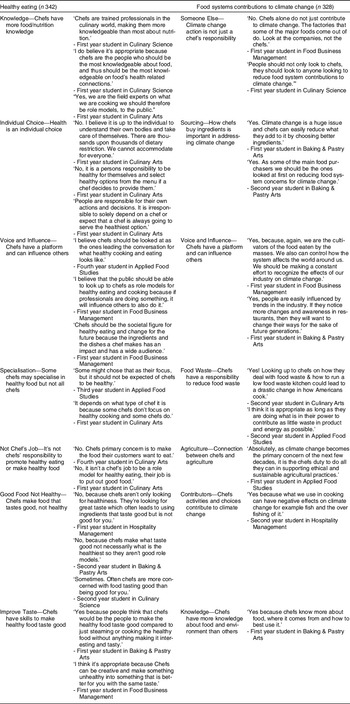
Table 3 describes key themes and excerpts from the open response questions. Seven primary themes under healthy eating were identified from the data: (1) Knowledge; (2) Individual Choice; (3) Voice and Influence; (4) Specialisation; (5) Not Chef’s Job; (6) Good Food Not Healthy and (7) Improve Taste. Themes related to food systems contributions to climate change included: (1) Someone Else; (2) Sourcing; (3) Voice and Influence; (4) Food Waste; (5) Agriculture; (6) Contributors and (7) Knowledge.
Open response themes and key quotations on whether the public should look up to chefs as role models for healthy eating and reducing food system contributions to climate change

Most participants reflected positively on the public looking to chefs as role models for healthy eating and reducing food system contributions to climate change. Many culinary students described chefs as food experts with unique knowledge that can be used to promote healthy eating. For example, one first year student in the Culinary Science program noted, ‘Chefs are trained professionals in the culinary world, making them more knowledgeable than most about nutrition.’ Perspectives on the chef’s role in reducing food system contributions to climate change were more closely tied to implementing sustainable practices, such as choosing what to purchase and where to purchase it from. A second-year student studying Baking and Pastry Arts explained, ‘As some of the main food purchasers we should be the ones looked at first on reducing food system concerns for climate change.’
A theme that emerged across both nutrition and environmental perspectives is the belief that chefs have a platform that should be utilised to positively influence others to adopt more healthful and sustainable eating behaviours. ‘I believe chefs should be looked at as the ones leading the conversation for what healthy cooking and eating looks like,’ stated a fourth-year student in Applied Food Studies. A first-year student in the Baking and Pastry Arts added, ‘Yes, people are easily influenced by trends in the industry. If they notice more changes and awareness in restaurants, then they will want to change their ways for the sake of future generations.’
The open-ended responses also revealed why some participants do not see chefs as role models for healthy eating and sustainability, primarily the belief that this should not be the chef’s responsibility. According to a first-year student in the Culinary Arts program, ‘People are responsible for their own actions and decisions. It is irresponsible to solely depend on a chef or expect that a chef is always going to serve the healthiest option.’ Another first-year student in the Food Business Management program expressed, ‘No. Chefs alone do not just contribute to climate change. The factories that some of the major foods come out of do. Look at the companies, not the chefs.’
Some respondents described how factors guiding food choices can be at odds with one another, for instance, that healthfulness and sustainability of a food can negatively impact taste and price. ‘No, because chefs need to make money and what sells is delicious food. Healthier cooking is more challenging to make it taste good and through all the work we have to do as cooks, it is low on my priority list,’ remarked a second-year student studying Culinary Arts. A second-year student in the Food Business Management program explained, ‘Some chefs may be proud of their sustainable menus, but many chefs tend to prioritize cost and flavor over sustainability in ingredients.’
Open responses on what chefs can do to help promote healthy eating and environmentally sustainable eating habits among the public.
The students surveyed offered many suggestions for how chefs can promote healthy eating and environmental sustainability through their work. The responses can be categorised into three primary opportunity areas for chefs to make a positive impact:
-
(1) Through menu and purchasing decisions
‘The most important thing chefs can do is, if they are able to and willing, to revamp their menus to include more plant-based protein items while reducing the amount of meat selection or size of said selections. Or adding to the menu, more healthful items that are intriguing to the public and not just salad.’ – Fourth-year student in Culinary Science program
‘Buying local, chefs should always support local farms and reduce their food miles. They should also practice seasonality and plan their menus around what is in season.’ – Second-year student in Food Business Management program
-
(2) Through acting as educators and influencers
‘Lifelong learning and educating oneself. Our changing world relates to our food and its availability. Chefs can provide quality, healthy food. Provide demos and food education in our schools and colleges. Provide healthy options as opposed to fast food or microwavable. Educate the public.’ – Second-year student in Culinary Arts program
‘Speak to each guest and write on your menu and social media about your sustainability practices and their impact.’ – Second-year student in Culinary Science program
-
(3) Through using culinary skills to make healthy and sustainable options more appealing and accessible to the public
‘The most important thing that chefs can do to promote healthy eating habits is providing solutions to the cliché problem of unappetising healthy food. Show that it tastes good and people will want to eat more of it.’ – Third-year student in Applied Food Studies program
‘Chefs should become educated on how to produce healthy food that tastes delicious on the lowest possible budget. They should use nutritional ingredients and cooking methods that turn cheap ingredients into healthy meals and somehow disseminate that knowledge to the public. Unhealthy food is often popular because of how fast, cheap and convenient it is to obtain. It is vital to create healthy food that can compete with those advantages.’ – First-year student in Culinary Science program.
Discussion
This study explored the food priorities and attitudes of students at a US culinary school, assessing how they view nutrition and sustainability as part of their future role as stakeholders in the food system. To our knowledge, this is the first study to explore attitudes about both nutrition and sustainability among culinary students. Findings indicate that these future culinary professionals generally believe nutrition and sustainability are important and support these issues as part of chefs’ roles and responsibilities. However, there was variability in how and to what extent these students believe they should apply nutrition and sustainability in their careers. Similar to research in other populations(Reference Curtis and Cowee8,Reference Aggarwal, Rehm and Monsivais36) , taste was the primary driver of personal food decisions amongst this group of culinary students. Other important factors were price, healthfulness and convenience, however the order of these priorities differed by race/ethnicity and between the youngest and oldest age groups.
While there was agreement that it’s important for chefs to be knowledgeable about nutrition, only slightly more than half of students agreed that healthfulness of food would be a primary consideration in their career. These results are similar to findings from Gillis et al. (2020)(Reference Gillis, Whibbs and Li21) where 99 % of students at a Canadian chef school agreed that chefs need to know how to prepare nutritious food while 60 % ranked nutrition as ‘very important’ for their future work. Unlike Gillis et al., we did not find gender differences in how culinary students value nutrition as part of a chef’s education or work, even though female students in our study were more likely to agree that dietary quality is a big problem in the USA. Differences in culinary student food priorities had not previously been explored across race/ethnicity. In this sample of culinary students, taste, price and convenience were consistently ranked the highest priorities when it comes to personal food choices, a trend that mirrors the preferences of the general population(Reference Glanz, Basil and Maibach33). Healthfulness was a lower priority among non-Hispanic Black and Hispanic students when making personal food decisions, with non-Hispanic Black students ranking price above all other factors and both non-Hispanic Black and Hispanic students ranking convenience ahead of healthfulness. It’s unclear how the different food priorities among these groups might translate into the students’ professional choices as chefs, but future studies should explore the implications of these differences and their potential to contribute to nutrition and health disparities. This reinforces the need to leverage the unique knowledge and growing influence of chefs to source, prepare and promote healthy and sustainable foods that are also tasty, affordable and convenient in order to enhance their appeal across all demographic groups. A small but growing number of chefs and restaurants have embraced this approach, such as a former head chef of the top rated restaurant in the world who now produces school meals in London and the Bronx that cost less than $1·25 each(37), a San Francisco Bay Area startup that provides nourishing and culturally relevant reimbursable meals to school districts across the USA(38), or a fast-casual restaurant chain in Los Angeles that serves healthy and convenient meals at reduced prices in low-income neighborhoods(Reference Strom39).
This is the first study we are aware of that explores attitudes towards food systems sustainability among culinary students. Results revealed that many culinary students believe it is important for chefs to understand the environmental impact of their ingredients and to help address sustainability through their work. Despite participants ranking all environmental factors below healthfulness when making food decisions, more students said they hope to promote sustainable food systems and to make the environmental impact of their food a primary consideration when they become chefs than to encourage healthy eating habits or to consider healthfulness of food prominently in their career. There were differences in attitudes towards environmental concerns across race/ethnicity, with non-Hispanic Black participants being significantly less likely to perceive climate change as part of a chef’s responsibilities to address through their work. Attitudes towards climate change are often more closely associated with political affiliation than race/ethnicity, but previous research has suggested that minorities may be less likely to believe there is scientific consensus on climate change or identify as environmentalists(Reference Schuldt and Pearson40). While this association is not well understood, it is notable in this context as culinary students who do not see it as their responsibility to address climate change may be less likely to adopt environmental friendly behaviours when they become chefs. Students in their fourth academic year were more likely to believe that chefs should learn about sustainability and take action to address climate change in their work. This may reflect that students in bachelor degree programs at the CIA have more opportunities to incorporate coursework on sustainable food systems compared to those completing associate’s degrees, or perhaps that students who are interested in sustainability are pursuing more advanced culinary degrees.
Our results suggest that the majority of culinary students surveyed could be willing allies in public health efforts to improve diets and reduce food systems contributions to climate change. This is an encouraging insight and demonstrates the potential to engage chefs at all levels in promoting healthy and sustainable diets. There are several current ‘celebrity chefs’ who have taken on prominent roles in efforts to improve dietary quality and nutrition(41–43). Others have focussed on sustainability and climate change by supporting local food systems(44) and eliminating meat to reduce the climate impact of their menus(Reference Anderson and Gross45). Aside from ‘celebrity chefs’ and the fine-dining sector, sustainable and healthy menu options are both growing trends in the restaurant industry as a whole, including full service, fast casual and fast food restaurants(46–Reference Pittman48). In other areas of the food service sector, schools, hospitals and workplace cafeterias are implementing sustainable practices and responding to demand from customers for healthy options(11,49–52) . Sustainable procurement policies are growing in prominence in food service, and chefs who value sustainability are well positioned to make progress in these areas(Reference Day Farnsworth, Delwiche, McKinney, Thottathil and Goger53). Additionally, a number of strategic initiatives and collaboratives have emerged from culinary schools, such as the CIA, to help accelerate progress towards healthier and more sustainable business practices across the food industry(54). With the shift towards more home cooking in response to restaurant closures in the COVID-19 pandemic(Reference Murphy, Benson and McCloat55), chefs have extended their influence beyond the restaurant into people’s homes through live virtual cooking demos, social media and meal kits. These growing platforms represent additional opportunities for chefs to educate the public and promote healthier and more sustainable eating behaviours.
The results from this study indicate that engagement with culinary students to advance public health goals may prove fruitful. An important area for further research is how to translate strong support for nutrition and environmental sustainability among culinary students into adoption of practices that advance healthy diets and sustainable food systems in their careers as chefs. Given the urgency of addressing diet-related health and environmental concerns, bold action is needed to close the gap between attitudes and action as a new generation of culinary professionals enters the workforce and become leaders in the food industry. Culinary schools can help address this gap by more seamlessly integrating nutrition and food systems training into their degree requirements and offering more courses, job shadowing and internship opportunities focussed on promoting healthy and sustainable foods. The food service industry is changing rapidly in response to growing consumer demand for plant-forward, health-centred and sustainably sourced foods, and culinary schools must adapt their programming accordingly. This shift will require more than one-off electives or a small number of required credits in nutrition and sustainability topics. The opportunity areas suggested by participants in this study form a preliminary framework for developing enhanced curricular and co-curricular strategies that teach and motivate culinary students to improve nutrition and sustainability when they become chefs, through their menu and purchasing decisions, their role as educators and influencers in the food system and their ability to make healthy and sustainable options more appealing and accessible to the public. These strategies must emphasise the substantial overlap between healthier and more sustainable diets, prioritising culinary and business practices that optimise benefits to human and environmental health. Culinary schools should seize the opportunity to empower their students with the necessary knowledge and skills to promote healthier and more environmentally conscious food choices in their careers as chefs.
Limitations
A limitation of this study is its generalisability to other populations of culinary students since participants were recruited from a single culinary school and participation was voluntary, contributing to potential selection bias. While we did not have access to admissions data from other culinary schools for comparison, it should be noted that the CIA is considered as one of the more prestigious and expensive culinary schools in the USA(56), with almost half of its students pursuing 4-year bachelors degrees in a number of specialised programs(57). This may cater to a different demographic of students than other culinary schools and if so, our results would not necessarily reflect the attitudes, beliefs or career aspirations of all culinary students.
Additionally, our sample may not have been representative of the total student population at the CIA, with a higher proportion of female students completing the survey. The study sample had a greater proportion of Non-Hispanic White respondents and a smaller proportion of those identifying as Non-Hispanic Black, Hispanic and other race/ethnicity compared to the total student population. More than half of the participating students were in the first year of their program, which may have under-represented attitudes and beliefs of more experienced students as they approach graduation and prepare to enter the workforce. Also, survey questions were not taken from validated instruments or otherwise validated before use in this survey. Future research should focus on exploring nutrition and sustainability attitudes and beliefs among students at a broader sample of culinary schools and with working chefs and culinary professionals in various sectors of the food industry.
Conclusion
This study supports the inclusion of chefs as valuable stakeholders in developing solutions to confront pressing diet and climate challenges. Culinary students represent the next generation of food industry leaders, and the majority of those participating in this study believe nutrition and sustainability are important considerations that chefs have a responsibility to address. There are differences in culinary students’ personal food choice priorities, attitudes and beliefs, especially across race/ethnicity, so efforts to engage culinary students should consider these disparities and aim to reconcile leading food choice priorities (e.g. taste, price, convenience) with health and sustainability values. Opportunities exist for public health practitioners and culinary educators to leverage culinary students’ support for nutrition and sustainable food systems into strategies that educate and inspire them to improve diet quality and environmental impact of the food system in their careers as chefs.
Acknowledgements
Acknowledgements: Betsy Carroll, Director of Institutional Research and Effectiveness at The Culinary Institute of America for supporting the survey design and dissemination to students within the Survey Gizmo platform. Financial support: J.A.W. was supported by the National Institutes of Diabetes and Digestive and Kidney Diseases of the National Institutes of Health (Award #K01DK119166). This publication is supported by the Kruse Family Publications Award. Conflict of interest: There are no conflicts of interest. Authorship: J.A.W. conceived of the study. J.A.W., T.R. and A.R. designed and implemented the survey and J.B., T.R. and A.R. analysed the survey data. The first draft of the manuscript was written by J.B. and J.A.W. and all authors provided feedback on the manuscript and approved the final version to be published. Ethics of human subject participation: This study was determined to be Exempt by the University of Michigan Institutional Review Board. Dr. Wolfson was on the faculty at the University of Michigan at the time the study was conducted.
Supplementary material
For supplementary material accompanying this paper visit https://doi.org/10.1017/S1368980021003578




 Open access

