Impulsivity has been defined as “a predisposition toward rapid, unplanned reactions to internal or external stimuli without regard to the negative consequences of these reactions to the impulsive individual or to others” (Moeller, Barratt, Dougherty, Schmitz, & Swann, Reference Moeller, Barratt, Dougherty, Schmitz and Swann2001, p. 1784).
Many theoretical approaches to the construct of impulsivity have explicitly called for a multidimensional definition. For instance, Patton, Stanford, and Barratt (Reference Patton, Stanford and Barratt1995) proposed that it has the following three components: (1) attentional impulsiveness (not focusing on the task at hand); (2) motor impulsiveness (acting on the spur of the moment or without thinking); and (3) non-planning impulsiveness (not planning and thinking carefully about the future). Buss and Plomin (Reference Buss and Plomin1975) concluded that impulsivity is a multidimensional trait defined mainly by lack of inhibitory control, or lack of ability to delay a behavior. Their model posits three other components of impulsivity: tendency not to consider alternatives and consequences before making a decision, lack of persistence, and tendency toward boredom/sensation seeking. Eysenck and Eysenck (Reference Eysenck and Eysenck1977), on the other hand, subdivided impulsivity into these four dimensions: narrow impulsiveness (acting hastily and without reflection), risk-taking, non-planning, and liveliness. Cross, Copping, and Campbell (Reference Cross, Copping and Campbell2011) reviewed the construct of impulsivity, and concluded that it could be defined in terms of three different facets: reward hypersensitivity (strongly tied to motivation), punishment hyposensitivity (low punishment avoidance), and inadequate effortful control. They all suggest impulsivity is not a homogeneous construct.
Of the facets of the construct of impulsivity that have been studied, motor impulsiveness ought to be the dimension most closely associated with impulsive driving, because the motor component of this type of activity is essential. In fact, motor impulsiveness is related to lower performance on psychomotor tasks. Barrat (Reference Barratt1959) already demonstrated the negative effects of anxiety and impulsivity on learning psychomotor tasks. In this research, our interest lies not just in examining how motor impulsiveness relates to driving, but in looking for a more global style that is characteristic of people who direct their impulsivity toward the vehicle itself as well as the road, who drive or get around through a series of abrupt, impatient, and sometimes even dangerous maneuvers.
Impulsivity as a personality trait, and hostility and anger behind the wheel, are psychological attributes that have been studied extensively in the context of traffic and road safety, because they are considered the foundation for risky driving behaviors that may have negative consequences, including traffic accidents. For instance, Deffenbacher, Deffenbacher, Lynch, and Richards (Reference Deffenbacher, Deffenbacher, Lynch and Richards2003), in a simulated driving experiment, determined that driving anger is a predictor in risky, unsafe, and aggressive behavior. Likewise, Owsley, McGwin, and McNeal (Reference Owsley, McGwin and McNeal2003) studied the relationship between impulsivity and safe driving through self-report in a sample of elderly adults, finding that more impulsive individuals were more likely to make mistakes and illegal traffic maneuvers while driving. Dahlen and White (Reference Dahlen and White2006) studied how the combination of different facets of personality and driving anger could predict aggressive driving and risky behavior behind the wheel. In a similar study, Dahlen, Martin, Ragan, and Kuhlman (Reference Dahlen, Martin, Ragan and Kuhlman2005) found that including variables like aggressiveness and impulsivity improved predictions about risky behavior behind the wheel. Specifically, those authors found that impulsivity is mainly tied to using the vehicle to express anger.
Many of the studies cited have produced instruments that specifically measure those aspects in hypothetical driving situations. For instance, the Driving Anger Scale (DAS), developed by Deffenbacher, Oetting, and Lynch (Reference Deffenbacher, Oetting and Lynch1994), evaluates the anger drivers experience in different situations that arise in daily life while driving a vehicle. Examples include getting stuck in a big traffic jam, or another driver maneuvering (e.g. changing lanes) without signaling. A related instrument is the Driving Anger Expression Inventory (DAX), which was developed by Deffenbacher, Lynch, Oetting, and Swaim (Reference Deffenbacher, Lynch, Oetting and Swaim2002) to measure different ways drivers express driving anger. The authors emphasize the need for a specific scale to measure aggressiveness behind the wheel, considering that driving puts people in unique situations, and given the strong association between the frequency and intensity of driving anger and the risk of getting in an accident or experiencing other adverse consequences. While instruments have been made to measure driving anger, there is no scale to specifically measure impulsivity behind the wheel. However, multidimensional measures have been developed that include factors like driving stress, risky driving, hostility or anger at other drivers (sometimes termed aggressiveness), and a driving style characterized by speeding, unsafe driving, or traffic violations, for instance the Dula Dangerous Driving Index (DDDI; Dula & Ballard, Reference Dula and Ballard2003), Driver Behavior Questionnaire (DBQ; Reason, Manstead, Stradling, Baxter, & Campbell, Reference Reason, Manstead, Stradling, Baxter and Campbell1990), Driving Behavior Inventory (DBI; Gulian, Matthews, Glendon, Davies, & Debney, Reference Gulian, Matthews, Glendon, Davies and Debney1989), Multidimensional Driving Style Inventory (MDSI; Taubman-Ben-Ari, Mikulincer, & Gillath, Reference Taubman-Ben-Ari, Mikulincer and Gillath2004), and Prosocial and Aggressive Driving Inventory (PADI; Harris et al., Reference Harris, Houston, Vazquez, Smither, Harms, Dahlke and Sachau2014).
Many traffic studies have considered the human factor the strongest predictor of negative consequences (Evans, Reference Evans1991), rather than the state of the road or vehicle. For that reason, we believe it is crucial to define, measure, and study this construct in the driving context.
Given the hypothesized multidimensionality of impulsivity as a construct, it would stand to reason that its various facets or dimensions could have a differential effect on driving a car. Furthermore, we believe this construct is distinct from but related to other constructs, like driving anger and aggressiveness. With all that in mind, this study aims to measure impulsivity and test its relationship to other variables it has historically been associated with, all within the driving context.
In terms of hypotheses, we propose that impulsivity is associated with greater use of the vehicle to express anger, and a higher level of driving anger in different situations. We also expect it will be related only to the motor dimension of impulsivity as a personality trait.
Additionally, we expect to find an inverse linear relation between age and impulsive driving, as earlier studies have suggested (Steinberg et al., Reference Steinberg, Albert, Cauffman, Banich, Graham and Woolard2008), and differences as a function of gender such that men are more impulsive than women (Cross et al., Reference Cross, Copping and Campbell2011; Deffenbacher, White, & Lynch, Reference Deffenbacher, White and Lynch2004; Eşiyok, Yasak, & Korkusuz, Reference Eşiyok, Yasak and Korkusuz2007).
To evaluate the properties of driving, we believe it is important to record objective variables related to it, like the loss of driver’s license points and traffic accidents. With that in mind, we expect to find a positive relation between impulsive driving, loss of driver’s license points, and accidents involving the driver.
Therefore, the present research objective is to create a questionnaire that enables the study of impulsive driving – specifically in the traffic context: the I-Driving Scale (IDS). We will analyze some of its psychometric properties, among them reliability, validity evidence in terms of internal structure, and the construct’s relationship with other variables and behaviors to which it may relate.
Toward that end, two studies were conducted. In the first, we created the new scale’s items, analyzed their reliability as far as internal consistency, and analyzed the internal structure of impulsive driving through exploratory factor analysis. We also examined this measure’s relation with certain demographic variables, driving aggressiveness and anger, and finally, with different dimensions of general impulsivity. The second study’s aim was to replicate that structure and analyze impulsivity’s relationship with objective traffic variables, like accidents and loss of driver’s license points.
In summary, while the variables impulsivity, anger, hostility, and aggressiveness have been widely studied, to date there is no instrument to specifically measure impulsivity in traffic settings. Thus, we believe it is very important to create a new scale designed to evaluate one’s level of impulsivity behind the wheel to deepen our understanding of this variable (which to date has been explored using instruments lacking in specificity) and allow us to predict risk behaviors.
STUDY 1
Method
Participants
The sample was comprised of 162 participants. There were initially 219, but 57 were eliminated because they failed to complete the series of questions all the way through to the end. One hundred of the participants were women, and 62 men. They ranged in age from 18 to 69 years old (M = 27.40 and SD = 8.98), and had an average driving experience of 7.04 years (SD = 8.24) and 6.54 hours per week (SD = 8.39). They were all Spanish citizens, except two participants from Romania, one from Italy, and one from China.
Procedure
The scales and items tapping demographic variables were combined into an online questionnaire that was created for the study and distributed via different social networks. Participants were selected through a snowball sampling procedure. According to this non-probability sampling technique, each participant identifies other potential study participants. In this case, each time someone filled out the questionnaire, they shared it with their network of potential participants. The data were recorded anonymously for later analysis. The only requirement for participation was having a driver’s license.
The instructions for completing the questionnaire appear in Figure 1.
IDS Instructions and Items.

Instruments
The IDS was administered together with the short-form version of the DAS, the Barrat Impulsivity Scale (BIS11), which was developed by Patton et al. (Reference Patton, Stanford and Barratt1995), and the Use the Vehicle to Express Anger subscale of the DAX. Only that DAX subscale was used because of the relationship Dahlen et al. (Reference Dahlen, Martin, Ragan and Kuhlman2005) found between it and impulsivity as a personality trait, as discussed in the introduction.
In the original study, the DAS (Deffenbacher et al., Reference Deffenbacher, Oetting and Lynch1994) displayed a 6-factor structure, defined as: discourtesy, illegal driving, hostile gestures, slow driving, traffic obstructions, and police presence. The factors represent six situations that may provoke feelings of anger in drivers. Beginning with 33 original items, the authors developed a short-form version with 14 items (α = .80). Answers are given on a five-point Likert-type scale ranging from 1 (no anger) to 5 (very angry). A high correlation (r = .95) was found between the original and short-form versions. We studied the original scale’s psychometric properties in different countries, including Spain (Lajunen, Parker, & Stradling, Reference Lajunen, Parker and Stradling1998; Sullman, Reference Sullman2006; Sullman, Gras, Cunill, Planes, & Font-Mayolas, Reference Sullman, Gras, Cunill, Planes and Font-Mayolas2007). The short-form version of the DAS was adapted for the Spanish context by Herrero-Fernández (Reference Herrero-Fernández2011a). That study confirmed some of the Spanish version’s psychometric properties through reliability analysis (α = .84) and confirmatory factor analysis, using maximum likelihood estimation. According to the goodness of fit statistics we observed (χ2/df = 3.70, RMSEA = .07, CFI = .95, and GFI = .93), the scale shows goodness of fit to a three-factor structure, factors which can be defined as: anger at traffic obstructions, anger at reckless driving, and anger at direct hostility. Anger at traffic obstructions refers to situations that impede the natural progression of vehicle transit, slowing the trip. The second factor, anger at reckless driving, refers to situations that generate risk for the driver as a result of risky, imprudent behaviors of other drivers on the road. The third and final factor, anger at direct hostility, covers situations in which the driver is the object of another driver’s direct hostility without impeding the vehicle’s natural progression.
The original version of the DAX inventory (Deffenbacher et al., Reference Deffenbacher, Lynch, Oetting and Swaim2002) has 53 items that reflect the ways in which people express their driving anger; it is distributed into five factors. Herrero-Fernández (Reference Herrero-Fernández2011b) adapted it in a Spanish sample of 432 people, and then examined the Spanish adaptation’s psychometric properties. According to his results, the scale showed a five-factor structure and high indices of internal consistency: verbal aggressive expression (α = .91), physical aggressive expression (α = .79), use the vehicle to express anger (α = .82), displaced anger (α = .78), and adaptive/constructive expression (α = .81). In our study, as indicated above, the Use the Vehicle to Express Anger subscale was utilized because of its relation to overall impulsivity, and its possible association with impulsive driving.
The BIS (Barrat, Reference Barratt1959) consists of 30 items designed to evaluate impulsivity as a trait as well as a facet of behavior. This scale is perhaps the most widely used to measure this construct, both in clinical and research contexts (Stanford et al., Reference Stanford, Mathias, Dougherty, Lake, Anderson and Patton2009). The present study employed the 11-item version of the BIS (Patton et al., Reference Patton, Stanford and Barratt1995). Items on the BIS11 fall into three subscales: attentional impulsiveness, motor impulsiveness, and non-planning impulsiveness. Total scores on the scale are obtained by adding up scores on each subscale. This version was adapted for the Spanish context by Oquendo et al. (Reference Oquendo, Baca-García, Graver, Morales, Montalvan and Mann2001).
Like the IDS, items on the DAX and BIS11 are answered on a 4-point Likert-type scale.
Scale Construction
Initially, 16 items comprised the IDS scale, representing different facets according to which impulsivity has been defined specifically in the driving context. Two experts on driving psychology created them based on experimental observations of driving behavior in real-life situations behind the wheel, recording their ocular movements and presenting distractor tasks (Recarte & Nunes, Reference Recarte and Nunes2003). Subsequently, various traffic experts and drivers read the items and made suggestions about how to interpret them. Answers are given on a 4-point Likert-type scale (1 = nunca o casi nunca [never or almost never], 2 = ocasionalmente [occasionally], 3 = a menudo [often], 4 = siempre o casi siempre [always or almost always]). The scale was ultimately reduced to 11 items after analyzing items’ psychometric properties and eliminating those that did not meet minimum requirements in terms of reliability and convergence with the total scale.
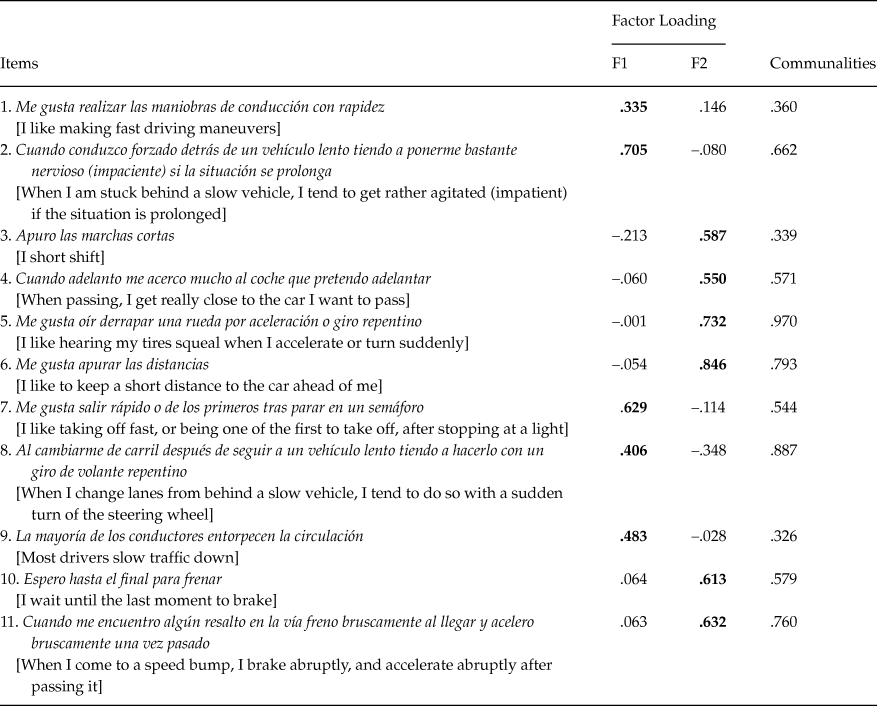
Total scores on the scale are obtained by adding up all the item scores. The final scale appears in Figure 1, along with the instructions participants received.
Results
Factorial Structure of the IDS
The IDS’s factorial structure was analyzed through Exploratory Factor Analysis (EFA) using the program Factor, version 9.3 (Lorenzo-Seva & Ferrando, Reference Lorenzo-Seva and Ferrando2006).
The Unweighted Least Squares (ULS) method of factor extraction was used, which has the advantage of not assuming items will be normally distributed (Schermelleh-Engel, Moosbrugger, & Müller, Reference Schermelleh-Engel, Moosbrugger and Müller2003). Since values of skewness and kurtosis were greater than one, we included polychoric correlations between items in our analysis (Muthén & Kaplan, Reference Muthen and Kaplan1992), as the descriptive results show. Factor rotation was done using the Promin method of oblique factor rotation (Lorenzo-Seva, Reference Lorenzo-Seva1999). This method utilizes the potentially simplest items to guide rotation, creating a semi-specified target matrix with values considered close to zero, and carrying out oblique procrustean rotation (Ferrando & Lorenzo-Seva, Reference Ferrando and Lorenzo-Seva2014).
The KMO coefficient had a value of .76, which is considered adequate goodness of fit for a factorial model. Furthermore, Bartlett’s test of sphericity yielded adequate results, χ2 (66) = 292.60, p < .001.
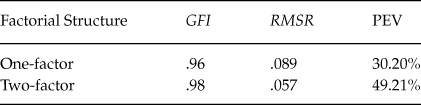
Two methods were used to determine how many factors to extract: Optimal Parallel Analysis (Timmerman & Lorenzo-Seva, Reference Timmerman and Lorenzo-Seva2011) and the Hull method (Lorenzo-Seva, Timmerman, & Kiers, Reference Lorenzo-Seva, Timmerman and Kiers2011). Both methods indicated that two factors should be extracted. The goodness of fit indices used to test the model were: the Goodness of Fit Index (GFI) and Root Mean Square of Residuals (RMSR). For an item to be considered part of a factor, its factor loading had to meet the cut-off of .30.
We tested the scale’s goodness of fit to one- and two-dimensional factorial structures.
Table 1 presents results for both factorial structures, goodness of fit statistics, and percentage of variance explained by each factor.
Estimations of the IDS’s Goodness of Fit to 1- and 2-factor Structures Using the Factor 9.3 Program

Note: GFI: Goodness of Fit Index; RMSR: Root Mean Square of Residuals; PEV = Portion of variance explained by the factor/s.
The statistical values obtained show that the IDS fits a two-dimensional model best (Hu & Bentler, Reference Hu, Bentler and Hoyle1995).
Based on items’ factor loadings, the first factor was called impatience (I) and the second aggressiveness or abruptness (A). The correlation between those two factors was .59. Table 2 presents the configuration of the matrix of factor loadings, as well as communalities, after rotation, associated with each item, according to analyses done using the program Factor.
Factor Loadings and Communalities Associated with each Item in the Configuration Matrix

Note: Each item’s highest factor loading appears in bold.
Descriptive Analysis of the IDS, Reliability of IDS Items, Subscales, and Total Scale; and Reliability of DAX, DAS, and BIS11 Subscales and Final Scales
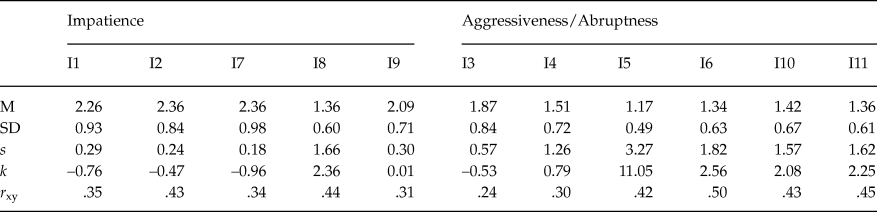
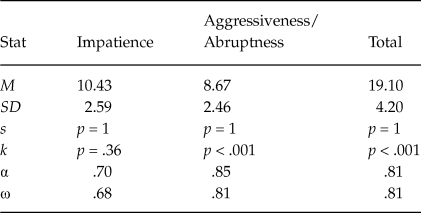
Statistics and discrimination indexes (corrected item-total correlations) pertaining to items in each factor appear in Table 3, and statistics and discrimination indexes pertaining to the factors themselves appear in Table 4.
Descriptive Analysis and Reliability of Items

Note: s = skewness index; k = kurtosis index; r xy = discrimination index.
Descriptive Analysis and Reliability of the Total Scale and Its Factors

Note: s = Mardia’s index of multivariate skewness; k = Mardia’s index of multivariate kurtosis; α = Cronbach’s alpha coefficient; ω = McDonald’s omega coefficient.
Correlations between the IDS and Other Measures
To gather evidence for the IDS’s validity, we calculated correlations between it (total scale and subscales), and other measures of impulsivity and driving anger (Table 5). Cronbach’s α coefficient, a measure of internal consistency, was computed for each of the various subscales and scales used to measure anger and general impulsivity in our sample, and can be found in Table 6.
Correlations between Subscales and Other Related Measures, Estimated Using Pearson’s r Statistic

Note: DAX-UV = Use the Vehicle to Express Anger subscale of the DAX; DAS-O = Traffic Obstructions subscale of the DAS; DAS-R = Anger at Reckless Driving subscale of the DAS; DAS-H = Anger at Hostile Gestures subscale of the DAS; BIS-A = Attentional Impulsiveness subscale of the BIS; BIS-M = Motor Impulsiveness subscale of the BIS; BIS-NP = Non-planning Impulsiveness subscale of the BIS.
** p < .01; ***p < .001.
Cronbach’s α Coefficient for each General Anger and Impulsivity Subscale Administered to Our Sample

As you can see, the two factors show the same pattern of correlation with all variables. Impatience showed statistically significant correlation with all the scales. However, aggressiveness/abruptness only showed statistically significant correlation with the DAS subscales Use the Vehicle to Express Anger, and Anger at Traffic Obstructions, and with impulsiveness as a personality trait. This evidence supports a two-factor structure of the IDS.
Relationship between Gender, Driving Experience, Age, and Driving Frequency, and Impulsive Driving
Several one-way analyses of variance were applied to test for statistically significant differences as a function of gender on the IDS subscales (impatience and aggressiveness/abruptness) and total scale (impulsive driving), and on the DAX-UV, DAS-O, DAS-R, and DAS-H subscales, and the Total DAS. Analyses were done in the program IBM SPSS, version 19.
No statistically significant differences as a function of gender were observed in impatience, F(1, 160) = 0.58, p = .45, nor on the total impulsive driving scale, F(1, 160) = 3.02, p = .08. Nonetheless, on the aggressiveness/abruptness variable, we found that men (M = 9.19) were more aggressive or abrupt in their driving than women (M = 8.34), F(1, 160) = 4.70, p = .03, ηp 2 = .03, although the effect size was apparently quite small.
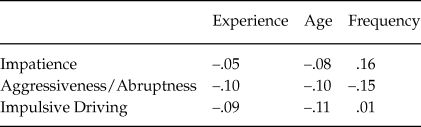
We also calculated linear correlations between scores on the total scale and subscales of impulsive driving, and the variables driving experience, age, and weekly driving frequency. The results appear in Table 7. We determined that impatience, aggressiveness/abruptness, and impulsive driving were not significantly correlated with any of the variables analyzed.
Pearson Correlation between the Impatience and Aggressiveness/Abruptness Subscales, and Total Impulsive Driving, and the Variables Driving Experience (in Years), Age, and Weekly Driving Frequency (in Hours)

Regarding the DAX-UV, we found significant differences as a function of gender, F(1, 160) = 9.07, p = .003, ηp 2 = .05, such that men (M = 16.56) used the vehicle to express anger more than women (M = 14.85). Nevertheless, as on the IDS aggressiveness/abruptness subscale, the effect size was very small. No differences were observed according to gender on any other total scale or subscale: DAS-O: F(1, 160) = 2.32, p = .13; DAS-R: F(1, 160) = 9.16, p = .16; DAS-H: F(1, 160) = 3.25, p = .07; Total DAS: F(1, 160) = 3.58, p = .06.
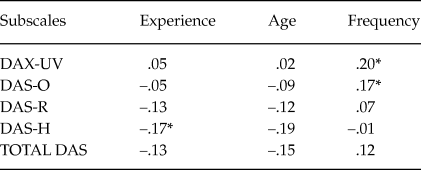
Table 8 presents the correlations between the DAX-UV, DAS-O, DAS-R, DAS-H, and Total DAS, and the variables driving experience, age, and weekly driving frequency.
Correlations (Pearson’s r Statistic) between Subscale and Total Scores on the DAX and DAS, and the Variables Driving Experience (in Years), Age, and Weekly Driving Frequency (in Hours)

Note: *p < .05, **p < .01.
As you can see, like the IDS, most of the other sub- and total scales did not relate to those variables either.
STUDY 2
This study’s objective was to confirm the structure of the IDS that was arrived at through exploratory factor analysis in Study 1, and its possible relation to other variables of practical concern, specifically the loss of driver’s license points and involvement in different types of traffic accidents.
Method
Participants
The second study had 107 participants. Although 136 were initially involved, 29 respondents’ data had to be eliminated because they did not answer the entire series of questionnaire items. Of the 107 participants, 55 were women and 52 men. They ranged in age from 18 to 73 years old (M = 40.57 and SD = 11.84) and had 18.64 years of driving experience on average (SD = 11.69). They were all Spanish citizens except for one British participant.
Procedure
As in Study 1, participants answered anonymously and were selected through different social networks using the same procedure. After providing some sociodemographic information, participants were asked how many driver’s license points they had lost, if they had been involved in a minor or serious accident, and if so, if they had been at fault or not, and in how many accidents from each category. They also filled out the IDS.
Results
Confirming the Factorial Structure of the Construct Impulsive Driving
Confirmatory Factor Analysis was conducted using the lavaan R statistical package (Rosseel, Reference Rosseel2012), applied to the covariance matrix. We tested the factorial structure found in Study 1.
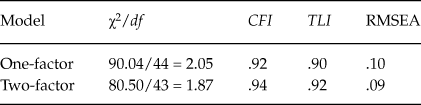
We also analyzed one- and two-dimensional factorial structures using the ULS method of factor extraction. Goodness of fit indices are displayed in Table 9.
Goodness of Fit: χ2/df, Comparative Fit Index (CFI), Tucker-Lewis Index (TLI), and Root Mean Square Error of Approximation (RMSEA) for One- and Two-factor Models

Note: Diff χ2 = 9.53, df = 1, p = .002.
Since three of the four indices showed acceptable goodness of fit, we conclude that the two-factor structure proposed in Study 1 has been confirmed.
Reliability in the form of internal consistency was found to be adequate in this second study, with slightly higher values than in the first, and Cronbach’s alpha indexes of .83 for the total scale, .80 for the impatience subscale, and .88 for the aggressiveness/abruptness subscale.
Relationship between Gender, Driving Experience, Age, Loss of Driver’s License Points, and Number of Accidents, and Impulsive Driving
A one-way analysis of variance was done to detect any gender differences on the subscales (impatience and aggressiveness/abruptness) and total scale (impulsive driving). We also calculated the two subscales’ linear correlations with total impulsive driving scores, and the variables driving experience, age, loss of driver’s license points, and number of minor/serious traffic accidents where the individual was/was not at fault. These analyses were carried out in the program IBM SPSS, version 19.
Results revealed no significant differences as a function of gender in the impatience variable, F(1, 103) = 0.25, p = .62, aggressiveness/abruptness, F(1, 103) = 1.70, p = .195, or impulsive driving, F(1, 103) = 1.07, p = .30. Correlational results appear in Table 10. Again the two subscales displayed different patterns of correlation. Impatience correlated positively with loss of driver’s license points, while aggressiveness/abruptness correlated negatively with driving experience and age. Neither of those variables correlated with the number of accidents involving the driver. Nor was a correlation found between number of accidents and loss of driver’s license points.
Correlations between Gender, Driving Experience, Age, Loss of Driver’s License Points, and Number of Accidents, and Impulsive Driving (Pearson’s r)

Note: Number of driver’s license points lost (points), number of minor accidents where the participant was at fault (MAF), number of serious accidents where the participant was at fault (SAF), number of minor accidents where the participant was not at fault (MANF), and number of serious accidents where the participant was not at fault (SANF).
Discussion and Conclusions
This study’s objective was to create an instrument (the IDS) to measure impulsive driving. Impulsivity and other personality traits, like anger and aggression, have been studied previously in the context of driving a car, mainly because those constructs have historically been linked to dangerous behaviors that may be associated with traffic accidents. Nevertheless, studies have historically evaluated impulsivity using generic personality measures, not measures specifically developed for traffic situations. For example, refer to Owsley et al. (Reference Owsley, McGwin and McNeal2003); Smith, Waterman, and Ward (Reference Smith, Waterman and Ward2006); and Bachoo, Bhagwanjee, and Govender (Reference Bachoo, Bhagwanjee and Govender2013). To determine the internal structure of the impulsive driving construct, exploratory factor analysis was applied in one sample, followed by confirmatory factor analysis in a second sample. In both cases, a two-factor structure fit the data best. Having analyzed the two factors’ constituent items theoretically, we can say that the first was related to impatience behind the wheel, comprised of items like “I like making fast driving maneuvers” and “I like taking off fast, or being one of the first to take off, after stopping at a light.” The second factor, meanwhile, related to aggressiveness/abruptness, both in driving (possessing the knowledge and motor ability to operate a car) and navigation (possessing the knowledge and ability to travel along public roads), and was comprised of items like “I like hearing my tires squeal when I accelerate or turn suddenly” and “I wait until the last moment to brake.” This impulsive driving style, articulated in impatient maneuvers prompted by situations in the environment or other drivers, and/or abrupt maneuvers, may be an inefficient way to drive, and worse yet, a risky activity.
With respect to the scale’s reliability as far as internal consistency, indicators were good for the total scale and its two constituent factors – impatience and aggressiveness/abruptness – in Study 1 (total scale α = .81, 11 items; impatience α = .70, 5 items; aggressiveness/abruptness α = .85, 6 items) as well as Study 2 (total scale α = .83; impatience factor α = .80; aggressiveness/abruptness factor α = .88). The items’ discriminant indexes ranged from .24 to .50 (Mdn = .42).
Considering the correlational results, we conclude that aggressiveness behind the wheel is positively associated with impulsiveness as a personality trait independently of aspects of driving a car, use of the vehicle to express anger, and anger in the event of traffic obstructions; this was not the case for anger at the reckless driving or hostile gestures of other drivers. Impatience, on the other hand, was associated with every subscale that measures driving anger, and it was associated, too, with the construct of impulsivity as a personality trait. This differential pattern of correlation with each of the scales is further evidence of a two-factor structure.
Regarding our analyses as a function of gender, no differences were observed in impatience scores or overall impulsive driving scores. We did find an association, though, between gender and driving aggressiveness and use of the vehicle to express anger, with men driving more aggressively and tending to use the vehicle to express anger more than women. Similar results were reported in Deffenbacher et al. (Reference Deffenbacher, White and Lynch2004), and in Eşiyok et al. (Reference Eşiyok, Yasak and Korkusuz2007).
In Study 2, we found an inverse relationship between age and aggressiveness/abruptness, as earlier studies have likewise reported (Dahlen & White, Reference Dahlen and White2006; Deffenbacher et al., Reference Deffenbacher, Deffenbacher, Lynch and Richards2003; Herrero-Fernández, Reference Herrero-Fernández2011a, 2001b).
We also found a positive correlation between loss of driver’s license points and impatience, but no relationship with aggressiveness/abruptness.
Contrary to expectations, we found no relationship between impulsive behavior and traffic accidents (minor nor serious), regardless of whether participants were at fault or not. This finding should be taken with a grain of salt because the sample was small and voluntary, but we found no relationship between loss of driver’s license points and accidents either. Given the relationship between losing driver’s license points and impatience, it seems what gets penalized in the point system is more closely aligned with that facet than with risk of having an accident. We will examine that aspect in more depth in future studies, but it is still an interesting piece of data to consider.
Furthermore, we saw a tendency in Study 1 where as driving experience increased, anger at other drivers’ hostile gestures decreased; and as weekly driving frequency increased, use of the vehicle to express anger increased, too, along with drivers’ anger at traffic obstructions.
Creating this new scale opens up a new direction for research that can be applied in various fields apart from traffic psychology, for instance teaching new road safety methods, and also to develop new technologies that minimize the impact of potentially adverse effects of impulsive driving.
Few studies have related self-report measures and objective measures behind the wheel. One example is a study by Herrero-Fernández (Reference Herrero-Fernández2011c) that investigated the relationship between purely objective variables, like pulse volume, heart rate, skin conductance level and response, and electromyography of the forearm flexor muscle (to measure pressure on the wheel), and different self-report measures of anger and anxiety during accidents in simulated driving experiments. Another example is Recarte and Nunes (Reference Recarte and Nunes2000). This type of study helps expand our understanding of driving behavior, while bolstering the validity of research findings and conclusions. Therefore, we believe it is especially important to conduct future research relating IDS data to data collected in real driving sessions.
A possible limitation of this research is the size of the samples we employed. They were not small, but they were not especially large either. Even so, the ranges in age and years of driving experience make the samples more representative.
In summary, we developed a scale to measure impulsive driving. Previously no such measure had been designed. This variable has been defined as characteristic of a driving style where people drive impatiently, and aggressively or abruptly, both at the vehicle level, and in relation to external circumstances. The scale is made up of 11 items whose psychometric properties were evaluated and found to be acceptable. The results show a connection between impulsive driving and impulsivity as a general trait. Furthermore, we observed a convergence between impatience and different facets of driving anger, but found that aggressiveness/abruptness converged only with use of the vehicle to express anger, and anger at traffic obstructions. This demonstrates how important it is to define and measure this construct to explore the effects of its possible involvement in efficient, low-risk driving.